

The NZ Govt’s solution for those who won’t follow the narrative:

Hear Australia’s Sen Malcolm Roberts speak on covid
Time for a reblog of this one … 18 months on. Sen Malcolm Roberts frequently calls out corruption. EWR

Senator Malcolm Roberts speaks. Remember him speaking out about the climate change gravy train. (Video at the link, brilliant speech).
Hear him here also:
Hear plenty more speeches from Sen Roberts at this link, he majors on exposing corruption:
https://rumble.com/search/video?q=senator%20malcolm%20roberts

James Corbett separates climate fact from fiction
via The Activation Podcast: On this episode of The Activation podcast Derrick Broze interviews returning guest James Corbett regarding his work on climate change. James has been researching the claims about climate change since 2007 and has produced dozens of reports and podcast dissecting the various claims about anthropogenic climate change. Derrick and James discuss what the climate change propagandists have right and what they have dangerously wrong. They also discuss the agenda behind the climate change movement. You are not going to want to miss this informative and empowering episode!
EWR Comment: our info on this topic can be found here. It includes a petition signed by thousands of scientists and a speech by Australia’s Sen Malcolm Roberts who nails it completely. He has also spoken out similarly about the new ‘safe & effective’ medical treatment.

Dealing with pests in your lawn (Wally Richards)
There are three insect pests that are the main problem ones in lawns; grass grubs, porina and black beetle grubs.
The affect they have on your lawns depends on the number of the pests in a given area.
A few, will hardly be noticed, where a good number per square foot will damage the grasses and be easy to see. Damage can be seen by bare spots, brown, dead areas or discolored grasses.
Birds are a very good indicator that there are grubs in the lawn when they spend their time scratching and pecking in certain areas.
I have gardeners ringing me up about this time of the year to say they have grass grubs in their lawns or that they have dead spots.
My first question is, how do you know you have grass grubs?
They usually reply that there is dead areas or that birds are ripping certain areas apart.
Nether of these are a good indication that there are currently grass grubs actively eating roots near the surface.
If there are dead areas which have appeared in the spring or early summer then it is likely that grass grubs did cause the problem by eating the roots of the grasses in the autumn and into the winter.
The grasses would have appeared ok in the winter, even though they had little root system left, because they were not actively growing.
In the spring when they started to grow on the root system left, which was insufficient to support the grass, thus it browns off and dies.
In the meantime the grubs have burrowed deep into the soil to pupate and then emerge about October to December as beetles.
There may well be a few grass grubs in the lawn at this time and by lifting some turf you can soon find out and how many there are per square foot.
If there are a few like 1 to 5 then its hardly worth while bothering with a treatment, a greater number would be worth while to treat.
Most likely the reason the birds are working the lawn is for porina caterpillars which live in the soil. Porina come up in the early part of the evening to feed at the base of the grasses.
These are easy to control by firstly mowing the lawn to allow the spray you are going to use, to reach the base of the grasses where they feed.
Then in late afternoon mix Neem Tree Oil at the rate of 5mils per litre of warm water and apply that to your lawn area. Using a lawn boy will do the best job to get a good coverage.
(Note EPA has just about completed our application under the new requirements for all Neem Oils and we should be back selling later this month.)
That night when the grubs come up to feed they will get a dose of Neem and that turns off their ability to ever eat again.
If the birds eat them they will not be affected and worms in the soil will be ok too.
The time to treat for grass grubs in the lawns is in the autumn when the soil is moist and they are feeding near the surface. The other time is when they are beetles which is about now.
With porina they can be treated all year round whenever they are present.
Treatment for grass grubs and black beetle grubs can either be a strong chemical one or a safe natural one such as Wallys 3 in 1 for lawns which is a mix of Eucalyptus and Tea Tree oils.
This will not harm wild life, pets or worms, where the chemical ones will.
To treat the grass grub beetles you can use the method described in my first book, Wally’s Down to Earth Gardening Guide, extract;
Grass grub adults emerge in October, (as beetles) and are active until about mid-December, depending on weather conditions and exactly where they are in New Zealand.
The cooler the temperature, the later they emerge. The adults will start to emerge in mild conditions, when the soil temperature reaches about 10 degrees, they then mate, fly, eat and lay eggs in the short space of time between dusk and early evening.
As they tend to fly towards light, you are most likely to know they’re there when the flying beetles hit your lighted window panes.
This very attraction for the light has become one of our best weapons in controlling the pest in its adult stage.
You can set up a grass grub beetle trap by placing a trough, such as the one used when wall-papering, directly underneath a window near a grassed area.
Fill the trough with water to about two-thirds of its capacity, then place a film of kerosene on top of the water.
Put a bright light in the window, the beetles fly towards the lit window, hit the glass and fall into the trough. The kerosene acts as a trap, preventing the fallen beetles from climbing out.
You can extend this method to areas away from the house by using a glass tank, such as might be used for an aquarium.
Place the empty tank into a tray containing several inches of water (and the kerosene), and position a light inside the glass tank.
By adding a sheet of ply or something similar over the top of the tank, you will ensure that the light shines only through the sides of the tank above the waiting water and kerosene.
It is better to use a dome-shaped battery-powered light rather than an ordinary torch for this job as the bigger light makes the trap more effective.
If the tray and tank are raised off the ground and placed on something like a table, you will get an even better result.
However you set up your beetle trap, this is a very good method to dispose of the pests.
Simply get rid of all the beetles caught the next morning by flushing down the toilet or feeding to chooks.. Run this system (call it Wally’s Grass Grub Beetle Catcher, if you like) from just before dusk to about 2 or 3 hours after sunset.
We know now how to make the grubs’ preference for light work against them, but light can also work in their favour.
If you have un-curtained windows in rooms which are lit at night, you will find grass grub beetles from yours and neighboring lawns will be attracted to the area during the early hours of the evening.
Street lighting is probably the worst offender, and people with areas of lawn near street lights often find those are the parts worst-affected by grass grubs.
The beetles will eat the foliage of various plants such as roses, beans and citrus while on the wing.
Those plants that are being eaten can be sprayed with Neem Tree Oil.
If the populations of beetles are very high then in the early part of the evening take a torch and check the plants that are being eaten.
If you see lots of the brown beetles then mix up a spray of Wallys Super Pyrethrum added and go out and spray the pests.
The pyrethrum is a quick knock down and should wipe out good numbers of them.
The more beetles you can kill means less damage to your lawns next year.
Phone 0800 466464
Garden Pages and News at www.gardenews.co.nz
Shar Pei pages at www.sharpei.co.nz
Mail Order products at www.0800466464.co.nz
New Zealand Bill of Rights Act 1990. Part II of the Act covers a broad range of Civil and Political Rights. As part of the right to life and the security of the person, the Act guarantees everyone:
The right not to be deprived of life except in accordance with fundamental justice (Section 8)
2The right not to be subjected to torture or to cruel, degrading, or disproportionately severe treatment or punishment (Section 9)
3The right not to be subjected to medical or scientific experimentation without consent (Section 10)
4The right to refuse to undergo any medical treatment (Section 11)
Furthermore, the New Zealand Bill of Rights Act 1990 guarantees everyone: Freedom of Thought, Conscience, and Religion.
This includes the right to freedom of thought, conscience, religion, and belief,
INCLUDING THE RIGHT TO ADOPT AND HOLD OPINIONS WITHOUT INTERFERENCE (Section 1)
“We’re watching NZ!” (Former Fox News anchor)

Clayton Morris is a former Fox News anchor. In Redacted, Clayton and his wife Natali take an in-depth look at the legal, social, financial, and personal issues that matter to you. They want to set the record straight and bring you the stories nobody else is telling. Along with the facts and the full picture, Redacted offers real-world analysis without an agency driven by corporate overloads. With Clayton’s extensive journalism experience, he isn’t afraid to demand the truth from authorities. Redacted is an independent platform, unencumbered by external factors or restrictive policies on which Clayton and Natali Morris bring you quality information, balanced reporting, constructive debate, and thoughtful narratives.
Kiwis were warned away back in the ’80s about the coming destruction of the farming sector. See the writings and videos of late NZ evangelist and investigative author Barry Smith who worked out their plan long before it was ever in the news. He was called a nutter back then. The same as we following in the past two decades have been. Not a conspiracy theory any more. It’s cold hard fact. EWR

US OBGYN challenges NZ Doctor’s recommending of the CV VX during pregnancy
Two important interviews with Dr James Thorpe … EWR
READ / LISTEN AT THE LINK
RELATED:
What is happening with babies and mothers?
Photo: pixabay.com
US Physician Societies are completely CORRUPTED: Why I refuse to join any of them


Silenced NZ Medical Professionals speak out

Overseas rates of cancer, cardiac events & respiratory conditions are up, yet NZ figures are not being made available… Why?
From hatchardreport.com
In 1923 three of America’s largest corporations formed a company to add tetraethyl lead to petrol. They omitted to mention it included lead and simply called their additive ‘ethyl’.
Almost immediately, production workers began to exhibit the discoordination and confusion that mark those severely poisoned by lead. Bill Bryson records that almost immediately, the Ethyl Corporation embarked on a global policy of calm but unyielding denial that would serve it well for decades.
In 2020 the world’s largest pharmaceutical corporations introduced biotech experimental injections derived from risky gene therapy research, they called them ‘vaccines’ because vaccines are universally recognised as safe and effective. Their products were neither. Even early recipients had high rates of injury, death, and pregnancy complications. Simultaneously, the manufacturing corporations obfuscated and hid this data and launched a global campaign of public relations and political lobbying on a scale never before seen in the field of public health.
If you think this is a conspiracy theory, think again. Time you looked at our Ministry of Health statistics with an open mind.
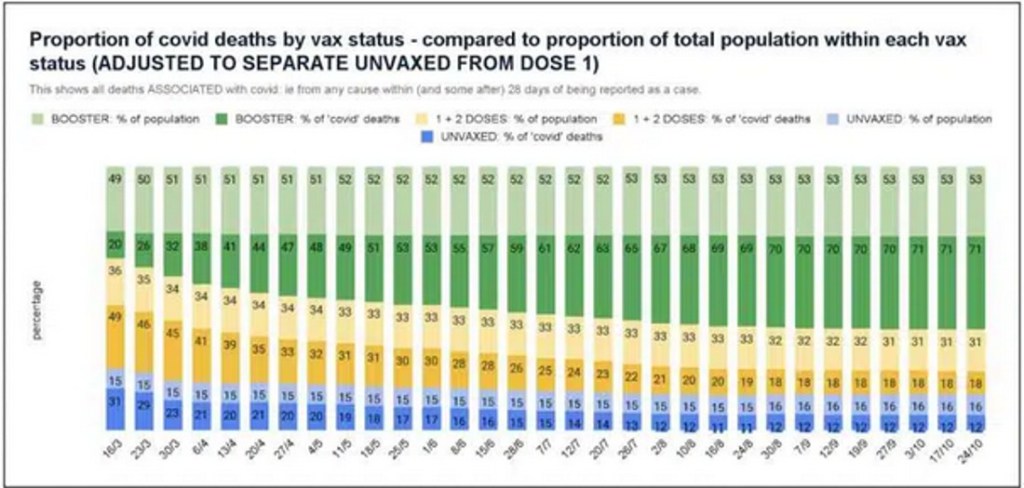
The latest MoH data on Covid deaths shows that 53% of the New Zealand population are boosted but account for 71% of Covid deaths, whereas 16% are unvaccinated and account for just 12% of deaths.
Still births per 1,000 in 2021 are up 10% compared to pre-pandemic rates and our birth rate per 1,000 population is down 10%.
Our hospitals and emergency services are still overwhelmed and no one knows quite why. Overseas rates of cancer, cardiac events, and respiratory conditions are up where data is published, but the New Zealand figures are not being made available. Why?
All cause mortality has reached record levels in 2022, at one point 26% above historical levels. The number of excess all-cause deaths greatly exceeds the number attributed to Covid.
Dr Helen Petousis-Harris, New Zealand’s leading vaccinologist, in an interview on 11th October with Radio New Zealand said:
“I wouldn’t be running out to get myself boosted. I don’t think it would be particularly useful. I don’t see any evidence to suggest it is going to benefit me.”
And yet MPs are sitting and considering a Bill to allow coroners to avoid recording a cause of death, while MoH is gearing up to regularise mRNA vaccination. In other words, parliament feels that less investigation is called for, not more. Why?
You are possibly also unaware that the origins of the Covid virus are increasingly well understood. A published scientific study has uncovered multiple microbiological signatures of synthetic genetic splicing in the Covid viral DNA, while even heavily pro-vaccine publications like Propublica have located a smoking gun in Chinese documents. Covid-19 came from a lab accident in Wuhan.
I needn’t remind you that the lab leak origin of Covid was labelled a conspiracy theory last year by Te Punaha Matatini. Nor that government with cross party support has poured millions into saturation advertising and MSM coverage telling the public that mRNA technology is safe and effective. It isn’t.
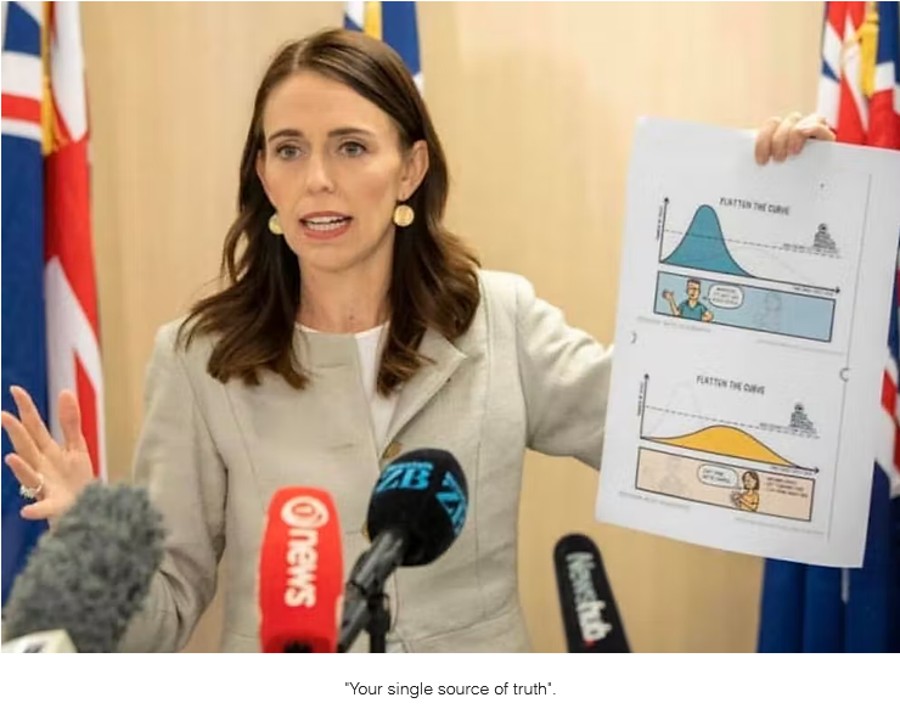
Little has been said recently about the Ardern doctrine that the government should be ‘our one source of truth’. The folly and naivete of this pronouncement from the lectern is now obvious. Science is a process that cannot be rushed to conclusions, it can only be based on evidence. We should not have insisted that the whole population be coerced to participate in experimental biotech interventions.
The purchase agreement we signed with Pfizer included the rider that the government acknowledges that the long term outcome of mRNA vaccination is unknown. The implications of this never filtered down into our pandemic policy. The government chose to endorse safety without evidence. The long term health outcomes of mRNA vaccination and pandemic policy remain unknown.
Repeated representations to government to include vaccination status on death certificates have been ignored. Without this, meaningful research into the effect of pandemic policies is impossible. The implication of a cover up is hard to avoid.
The absence of meaningful public debate, the suppression of a free press, the cancellation of dissenting expert opinion, and the politicisation of science are all hallmarks of a repressive state overreaching itself. It does no credit to New Zealand and endangers the future of our civil society. Time to wake up.
Guy Hatchard
29 October 2022
SOURCE
https://hatchardreport.com/open-letter-to-new-zealand-mps-october-29-2022/

Some useful gardening tips (Wally Richards)
For most of the country it has been a poor spring and slow start of the growing season.
We have the daylight hours, in fact we are now only about 7 weeks away to the longest day of the year.
It is the temperatures that are the problem, we are not getting the constant warm temperatures during the day and night.
That does not matter to hardy plants and vegetables that can be grown outdoors all year around such as cabbages. (On line shopping today New World whole cabbage $9.99 at Countdown $7.69)
Lettuce between $3.00 to $4.00 each?
Wow, I currently have so many lettuces that I give then to my chickens.
Not only that as a result of letting one lettuce (Drunken Woman my favorite) go to seed, it self seed giving hundreds of seedlings.
Some of which I have transplanted and currently have lettuce from small seedlings to mature plants going to seed.
I don’t bother growing much cabbage, broccoli or cauliflower as they take longer to mature and we seldom use them anyway in preference to Bok Choy which is much quicker to mature and takes less room.
Silverbeet is an excellent vegetable to grow as it has high nutritional value and you harvest only the outer leaves for use as it will keep producing till it goes to seed.
Whether you grow in open ground, raised gardens or in containers you can produce hardy vegetables that will not only be inexpensive compared to current cost of purchased vegetables but will also have great flavour be free of chemical poisons.
The stuff you buy from Supermarket is not only bloody expensive but are chemically grown and sprayed with chemicals thus having little goodness and a bland flavour.
If it tastes good without having to use condiments then it is good for your health.
Basically no matter how you grow you apply natural products to the soil/growing medium such as any animal or chicken manures, blood & bone, sheep manure pellets at the base.
Garden Lime such as Wallys Calcium & Health, minerals from Ocean Solids and Wallys Unlocking your soil.
Then over this a layer of Daltons Compost. (Most others I do not trust because they can contain recycled green waste which maybe full of herbicides).
Then into this you plant seeds or seedlings and spray them every week with Magic Botanic Liquid (MBL) they will grow twice as fast and twice as big and be very advantageous for your health and budget.
I expect that vegetables in the supermarket are only going to get dearer because of high cost of imported fertilisers, cost of chemical sprays to keep the plants looking perfect on the shelves and the cost of diesel.
Because of the milder temperatures heat loving plants are not fairing very well.
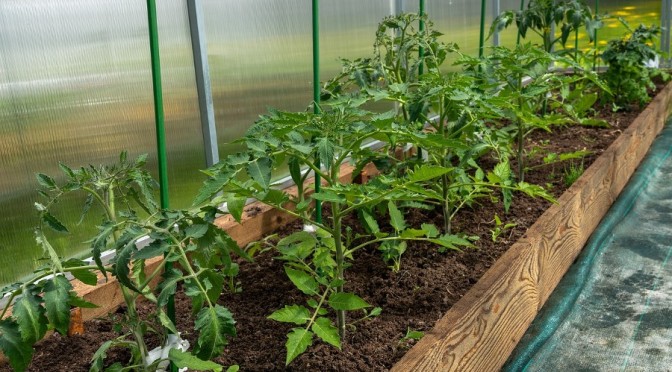
My tomato plants grown in a plastic house in the Auto-pot system are doing ok but plants that like much more heat such as cucumbers, capsicum and chili are sitting and sulking even with the high quality nutrient they have to grow with.
I hate to think how poorly these plants wound do in open gardens along with pumpkin and other cubits.
They would really sulk until the temperatures became better which is most unusual for weather after Labour Weekend in NZ.
If, as some predict, we are heading into a solar minimum which reduces the global temperatures to the extent of a mini-ice age or worse then that would be far worse for food growing than a global warming.
Most of you will have planted or are planting tomato plants currently, if in a glasshouse you will have better results than out doors. Outdoors you need a very sunny, sheltered spot for best results.
Treat the soil with the products mention but don’t use Calcium & Health instead buy some Dolomite.
Tomatoes and Potatoes like a slightly acidic soil pH.
Now this is important to get the best results out of a tomato plant; you make a deep hole and plant it deep, up to the bottom leaves or even deeper.
The reason is that a tomato plant will produce roots all the way up the trunk and often on a more mature plant you will see knobs near the base of the trunk which are beginnings of roots.
If that is seen then mould up growing medium so the root system is increased.
The bigger the roots to feed, the better the plant.
You can place a little of Wallys Neem Tree Powder in the planting hole and sprinkle some of Wallys Secret Tomato Food with Neem Granules on the soil.
That will assist in deterring whitefly especially in a glasshouse as well as feed the plants.
The Secret tomato food contains a good amount of potash which I have noticed lacking in other brands, likely because potash is expensive.
If your tomato, capsicum, chili do not have ample potash then your fruit will lack flavour.
Wallys Secret Tomato Food with Neem Granules was created on the request of a specialist tomato grower who wanted the very best tomatoes.
He told me many years ago that he had tried all the brands but none of them produced really great flavored fruit.
So along with fertiliser experts we created the product, Wallys Secret Tomato Food which over the last 15 plus years has been well sort after by people that love to grow the best tomatoes possible.
There are two types of tomato plants; Indeterminate and Determinate the first is tall growing and is actually a climber the later is a bush type which is short with a wide spread such as dwarf types.
In the Indeterminate type there are very large fruiting ones such as Boy o Boy which can produce fruit weighing 500 grams. Some you need only one slice to cover sliced bread!
To do that you need to not only remove the laterals but also reduce down the amount fruit per truss to get a monster tomato.
Laterals form between the trunk and the leaf branch and in Indeterminate tomato plants it is best to remove them otherwise you get a plant that requires lots of staking and support.
On a determinate plant the laterals are often left on to make the plant bushier and produce a lot more trusses and thus a lot of smaller fruit.
If you allow a lateral to grow about 8cm long you can strike it as a cutting and get free extra tomato plants.
If last season your tomatoes were affected by the tomato psyllid that we wrote about recently then you need to use Wallys Cell Strengthening Kit to protect your plants and be able to harvest tomatoes like you did in the past.
Phone 0800 466464
Garden Pages and News at http://www.gardenews.co.nz
Shar Pei pages at http://www.sharpei.co.nz
Mail Order products at http://www.0800466464.co.nz
New Zealand Bill of Rights Act 1990. Part II of the Act covers a broad range of Civil and Political Rights. As part of the right to life and the security of the person, the Act guarantees everyone:
1The right not to be deprived of life except in accordance with fundamental justice (Section 8)
2The right not to be subjected to torture or to cruel, degrading, or disproportionately severe treatment or punishment (Section 9)
3The right not to be subjected to medical or scientific experimentation without consent (Section 10)
4The right to refuse to undergo any medical treatment (Section 11)
Furthermore, the New Zealand Bill of Rights Act 1990 guarantees everyone: Freedom of Thought, Conscience, and Religion.
This includes the right to freedom of thought, conscience, religion, and belief,
INCLUDING THE RIGHT TO ADOPT AND HOLD OPINIONS WITHOUT INTERFERENCE (Section 1)

The real Anthony Fauci (Pt 2)
View Part 2 at this link (Part 1 included)

CV truths for busy people
From garymoller.com
Updated: Oct 19
We all have friends and family who still believe their Government is benevolent, who think their response to the pandemic has been marvellous, and the mRNA jab is safe and effective. But, of course, the opposite is the reality: Our Government has declared war on its people. They are working for insane foreigner technocrats, who intend to turn us into a totalitarian state, the vaccine is neither safe nor effective, and they are doing everything they can to hide the extent and gravity of their crimes.
Despite the obvious, in-your-face lying about these crimes, for most people, including myself, comprehending the reality and gravity of the situation is far from easy. But unfortunately, continuing to believe monumental lies is the easier path to follow for many people. They may argue that they are too busy, that they already have too much on their plates to deal with. We are told by the Government and their advisers, like the Pink Lady, who is our expert about everything, that they know better than you or anyone else about what is going on, and to such as extent that they’ll fire and publicly ridicule anyone who questions their truths.
https://www.garymoller.com/post/why-are-doctors-and-other-health-professionals-so-silent
One response is to ask them to do just one thing for you and set aside a little time to plug in their headphones and listen to two podcast-style presentations. After that, you can then have a civil discussion about the issues and agree or disagree but continue to be good friends no matter the outcome.
There are many possible presentations to recommend for the busy person, but here are two which should do the job:
(Unlike other broadcasters like Michael Laws and Sean Plunket, Leighton Smith is renowned for meticulously researching his podcast topics and not talking over his guests.)
Leighton Smith Podcast: Statistician and author Guy Hatchard discusses the distortion of public information, and the age of social engineeringLeighton Smith Podcast: Statistician and author Guy Hatchard discuss the distortion of public information and the age of social engineering
I’ll add here that Guy Hatchard and I go back a long time: We were part of a small group of health professionals who have, on two occasions, prevented the passing of the Natural Health Products Bill, which essentially hijacks natural health products, including ones like also vera, vitamin C and zinc to further the aims of Big Pharma and Medical-Industrial Complex. It just happens that the Minister of Health is about to railroad this legislation through the House this year without adequate consultation. If this legislation passes, practitioners like men may become a thing of the past.
”Dr Nikki Turner, you are murdering people! … Now debate me.” – Dr James Thorp MD: This interview, hosted by a couple of Kiwi broadcasters, Kelvyn Alp and Hannah Spierer, now streaming from a USA-based platform, is a beauty. In this interview, an international medical heavyweight calls out New Zealand’s lightweight medical expert for a head-to-head debate.

WATCH AT THIS LINK
As an aside, Alp and Spierers’ broadcasting platform was shut down in New Zealand a few months ago, hence the USA presence now. They are currently on bail defending themselves from prosecution by the NZ Government for holding or sharing objectionable information and face what could be years behind bars. if they lose!
SOURCE:
https://www.garymoller.com/post/covid-truths-for-busy-people

DIED SUDDENLY | OFFICIAL TRAILER
https://rumble.com/v1q6ecx-died-suddenly-official-trailer.html
DIED SUDDENLY | OFFICIAL TRAILER
Streaming November 21st –
Why do we never believe them? For centuries, the global elite have broadcast their intentions to depopulate the world – even to the point of carving them into stone. And yet…we never seem to believe them. In this Stew Peters Network EXCLUSIVE, the award winning filmmakers behind WATCH THE WATER and THESE LITTLE ONES present the truth about the greatest ongoing mass genocide in human history.
Watch this NEW segment now at https://StewPeters.com
Photo: pixabay.com

The DAYS are getting DARKER RAPIDLY!!!

Large European vaccine orders questioned in Eur Parliament – 10 doses per EU citizen (Dr John Campbell)
10 vaccine doses for every EU citizen MEP Mr. Cristian Terhes https://www.youtube.com/watch?v=beEfo…
Ursula von der Leyen (President of the European commission) Her actions are currently criminally investigated
MORE INFO AT THE SOURCE
Scotland’s excess baby deaths – Dr John Campbell
See notes below the video at Youtube.
The excess in infant deaths is not confined to Scotland.
RELATED ARTICLE HERE
“The … release of Pfizer adverse effects document which occurred on May 2nd, 2022 reveals that between 82-97% of pregnant women in the Pfizer vaccine trials lost their babies.” SOURCE

More sudden deaths – is anybody investigating?
Sincere sympathy to the loved ones of these two men.
Sadly it seems, these sudden deaths are becoming the accepted new norm. How can these numbers be ignored like this? As they are being in other similar incidences… treated as being somewhat routine. ‘Cause unknown’ but no follow up as to why. They are of course being called ‘tragic’ and tragic they are … but it behooves the authorities put in charge of public health, by the public, to figure out just why they are happening. Is there a common denominator? In better times that denominator would be hunted down with great zeal.
Not now.
It has become the very large elephant in the room …. EWR
LINKS BELOW
UK radio presenter dies while presenting live on air
Rugby player collapses, dies during East Coast centennial celebration match
Image by keesluising from Pixabay
Psyllids in your garden and how to deal with them (Wally Richards)
Psyllidae, called the jumping plant lice or psyllids. (Note much of the following is from Internet research)
They are a family of small plant-feeding insects that tend to be very host-specific, each plant-louse species only feeds on one plant species or feeds on a few closely related plants.
Of current concern to tomato, potato, tamarillo, capsicum and chili gardeners is the new psyllid commonly known as the tomato/potato psyllid.
This psyllid comes from Central and North America where it breeds primarily on potatoes, tomatoes and other plants in the potato family, Solanaceace.
It also breeds on kumara, which is in the bindweed family, Convolvulaceae.
It was first found in New Zealand in 2006 and has spread throughout New Zealand.
This psyllid may transmit a bacterium, Candidatus Liberibacter solanacearum that causes a disease in its host plants.
The tomato potato psyllid occurs on its host plants in gardens, and crops in greenhouses and on farms.
The tomato potato psyllid breeds all year, though the time from egg to adult (generation time) is longer in the winter when it is cold, than in the summer or in a heated greenhouse.
Adult tomato potato psyllids are small insects similar in size to aphids. They have wings and look like small cicadas with a distinctive white band on the abdomen. The two pairs of transparent wings are held over their abdomen.
Tomato potato psyllid eggs are yellow and attached to leaves by a thin short stalk. The eggs may be laid on all parts of the leaf and plant stem, but are often found on the leaf edge where they are most easily seen.
Nymphs hatch from the eggs. They are flat and scale like, and have three pairs of legs and sucking mouthparts.
They settle on young leaves, mainly on the underside. Although they can walk, they spend much of their time motionless with their stylets inserted into the plant feeding on the plant sap.
There are five nymphal stages, each is called an instar. buds. Adults emerge from fifth instar nymphs.
The length of time needed for nymphal development depends on the temperature and is shorter when it is hotter.
The tomato potato psyllid inserts its maxillary stylets into the phloem, (the plant vessels for transmitting sap from the leaves to other parts of the plant.)
The sap has a high volume of water and sugars, more than the insect needs.
It excretes the excess water and sugar, which is called honeydew. The tomato potato psyllid coats the droplet of honeydew with white wax before ejecting it.
Leaves can become covered with these white wax coated droplets that are called psyllid sugars.
Like some other Hemiptera (sucking bugs), the tomato potato psyllid can transmit plant pathogens to plants.
Tomato potato psyllid is the primary vector (transmitter) of a bacterium, Candidatus Liberibacter solanacearum, which causes a disease that may weaken plants and reduce yields and quality of crops.
Plants infested with the psyllid may exhibit symptoms of a disease, psyllid yellows.
The disease symptoms initially appear in response to psyllid feeding and is presumably a physiological reaction to feeding and saliva secretions by the tomato potato psyllid.
On tomatoes, the disease symptoms are the yellowing and stunting of the growing tip and a cupping or curling of the leaves.
Many flowers may fall off the trusses of infected plants and fruit that develop may be small and misshapen.
On potatoes, the foliar symptoms are a stunting and yellowing of the growing tip and the edges of the curled leaves often have a pink blush or purple colour.
After a while infected potatoes develop a scorched appearance and plants may collapse prematurely.
Potato plants that are infected at an early stage, develop numerous small tubers. Tuber quality is also affected when the plants are infected at a later stage.
The disease is referred to as zebra chip because when the affected potatoes are fried they exhibit dark stripes where the areas high in sugar burn.
In New Zealand, the bacterial disease is usually less of a problem on outdoor capsicums, chilli and egg-plant.
Tomato potato psyllid breeds all year, especially in the warmer parts of the country and in greenhouses. In these situations, all life stages may be found all year round. In other areas, non-breeding adults may be found on plants.
Adults feed on leaves and can mate more than once. A female can lay up to 500 eggs over a 21-day period, but in the field it is more likely to be around 200 eggs.
The number of eggs laid also depends upon the host plant. The rate of development of nymphs is dependent on temperature.
The psyllid develops between 15°C and 32°C with optimum development at 27°C.
In a greenhouse with an average temperature of 18°C psyllids takes 33 days to complete their life cycle.
In New Zealand there are to 7-8 generations per year in the Auckland region.
In New Zealand’s winter, the numbers of psyllids are low and development is very slow.
Adults and nymphs can survive short periods of sub-zero temperatures. In New Zealand’s spring numbers on infested plants will begin to build up and reach a peak in late summer/early autumn.
Adult psyllids have wings and in North America can spread long distance by air. In New Zealand, dispersal tends to be more limited, 100 m or more in three days. They will invade new areas and plants, especially in summer.
From my experience its a temperature to numbers game, when given the ideal temperatures.
One adult laying 500 eggs can mean in about a month you have a population of 250,000 adults
Initially sprays will help control but as numbers rapidly increase you would need to spray every day and still lose the battle.
That was the point I reached about 3 years ago and watched my tomato plants and tamarillos die in front of my eyes.
The following season I treated my tomatoes and other host plants with silicon drench and sprays and in one season completely wiped out the psyllids from my glasshouse and gardens.
The silicon treatment which I call the ‘Cell Strengthening Kit’ makes the plant’s cells too tough for the psyllid nymphs to piece and feed and they soon starve to death after hatching.
This breaks the life cycle and there are no new adults to replace the old ones when they die.
Information on the kit is available on our mail order web site at www.0800466464.co.nz
More info on the pest at http://www.gardenews.co.nz/product.html#The%20Potato%20and%20Tomato%20Psyllid%20control%20with%20Cell%20Strengthen%20sprays%20and%20drench
With our Silcon products you can once again grow tomatoes, potatoes and other affected plants.
or phone me for more information.
Phone 0800 466464
Garden Pages and News at www.gardenews.co.nz
Shar Pei pages at www.sharpei.co.nz
Mail Order products at www.0800466464.co.nz
New Zealand Bill of Rights Act 1990. Part II of the Act covers a broad range of Civil and Political Rights. As part of the right to life and the security of the person, the Act guarantees everyone:
1The right not to be deprived of life except in accordance with fundamental justice (Section 8)
2The right not to be subjected to torture or to cruel, degrading, or disproportionately severe treatment or punishment (Section 9)
3The right not to be subjected to medical or scientific experimentation without consent (Section 10)
4The right to refuse to undergo any medical treatment (Section 11)
Furthermore, the New Zealand Bill of Rights Act 1990 guarantees everyone: Freedom of Thought, Conscience, and Religion.
This includes the right to freedom of thought, conscience, religion, and belief,
INCLUDING THE RIGHT TO ADOPT AND HOLD OPINIONS WITHOUT INTERFERENCE (Section 1)
Photo: pixabay.com

In just the last three months, 53 performers have dropped dead, or keeled over, on stage
From Mark Crispin Miller
And how many performers can you remember ever doing anything like that before? … Me neither.
VIDEO AT THE LINK
https://www.bitchute.com/embed/XgPtJyqwWwpW/
RELATED:
114 medical professionals who “died suddenly”—in Russia
Photo: pixabay.com
Why Are Dutch Farmers Protesting?
WATCH THE LONGER VERSION AT DR SHIVA’S WEBSITE, AND READ HIS ARTICLE … LINK BELOW:
“In this discussion, Dr. SHIVA Ayyadurai, MIT PhD, through a LIVE interview with leadership of the Farmers Defense Force – leading the protests on the ground in the Netherland – educates us on the history and current events of WHY the Dutch Farmers are protesting.”
READ MORE
Take a stand against that ridiculous fart tax! (petition)
It does have a fancier name but why give them the ‘honour’ of using it? It’s just another step towards reducing the food supply (watch this video on that topic if you think that’s ‘conspiracy’). It’s part of Agenda 21 /30’s so called ‘great reset’ where we’ll own nothing and be happy. Well so they wish anyway. Klaus, Bill and their little band of so called ‘elites’ (not).
It is worth a try anyway to sign the petition… bearing in mind that the NZ corporation parading as a government tends to ignore the wishes of thousands of its tax payers because we are not a democracy after all. EWR
(Note my sentiments here expressed are not necessarily those of the Groundswell movement. However, destroying farming will definitely affect us all).
SIGN THE PETITION HERE
Photo: pixabay.com
https://www.groundswellnz.co.nz/stop-the-farming-tax
RELATED:

Phosphorous for your garden (Wally Richards)
When we buy plant foods or fertilisers for our gardens we see on them the letters N:P:K followed by numbers which indicate the amounts of each of these elements. The NPK stands for Nitrogen, Phosphorus and Potassium.
Nitrogen provides growing power and helps make plant leaves and stems green.
Nitrogen is used to form basic proteins, chlorophyll, and enzymes for the plant cells. In short, a plant can’t grow without it.
Phosphorus stimulates budding and blooming. Plants need phosphorus to produce fruits, flowers, and seeds.
It also helps make your plants more resistant to disease. Phosphorus doesn’t dissolve like nitrogen. The soil will hang onto phosphorus, not releasing it into water.
Potassium promotes strong vigorous roots and resistance to disease.
Potassium is a nutrient your plants need for good internal chemistry.
Plants use potassium to produce the sugars, starches, proteins and enzymes they need to grow and thrive. Potassium also helps your plants regulate their water usage, and better withstand the cold.
I believe of the three elements its the phosphorus that is least understood by some gardeners.
In the distant past phosphorus was obtain from manures especially bird or bat droppings called guano. Phosphorus was also obtained from Reactive Rock Phosphate which is a hard phosphatic rock.
In most soils it dissolves very slowly.
To make the rock phosphate more readily available to plants it was discovered that a process using sulfuric acid, early in the 1900’s,
would breakdown the reactive rock phosphate so a new agricultural fertiliser was created called Super or Super Phosphate.
It became a boon to agriculture and farming with tons of Super been spread to cause fast growth in fields and crops.
Unfortunately like a number of discoveries such as DDT and Asbestos, there was a hidden price to pay.
Super phosphate kills soil life and with their demise leads to unhealthy plants/grasses.
Not only that, it is now known that Super laden plants and grasses can cause health problems in stock including cancers.
(Chlorine and acidic products also destroy soil life including earth worms. Overt time through continued use soil becomes inert or lifeless)
I read a very interesting book some years ago called ‘Cancer, Cause and Cure’ written by an Australian farmer, Percy Weston.
Percy observed the results of the introduction of Super on his farm and the changes that occurred.
If you are interested the book can be obtained by mail order. The book made me reconsider the use of Super phosphate in garden fertilisers.
Interestingly I have never been an advocate of Super phoshate and to the best of my knowledge have never purchased it as a stand alone fertiliser for my gardens.
Though I have on odd occasions in the past used General Garden Fertilisers.
Fortunately I have always preferred sheep manure pellets, animal manures and natural products as my general plant food.
Now days I avoid using chemical fertilisers or chemical sprays including any herbicides anywhere on my property.
But I have noticed in the past, that even though I have obtained good healthy crops and plants, there is some factor that appears to be missing and the crops are not as lush as I feel they could be.
I have often thought that I am not getting sufficient phosphorus in my composts and mulches.
This caused me to do a bit of research on the Internet and found to my delight a company in New Zealand who make a product called BioPhos.
They take the rock phosphate and break it down naturally with micro organisms making it as readily available to plants as Super phosphate is.
The company sent me a email booklet and it showed trials that proved that not only did BioPhos work as well as Super, but actually better as it did not have a ‘peak’ growth on application and gave a much longer sustained release of phosphorus to plants.
Instead of killing soil life it actually supplies new micro organisms to the soil which carry on breaking the natural phosphorus down, meaning that only one application is needed per year unless you are cropping during the winter as well.
Some rose growers and rose societies recommend using BioPhos for better, healthier roses. BioPhos contains phosphate, potassium, sulphur and calcium at the rates of P10:K8:S7:Ca28.
It is pH neutral and used at the following rates; New beds work in 100 grams per square metre, the same with lawns but water in to settle.
Side dressing plants; seedlings 8 grams (a teaspoon full) around base of the plant or in the planting hole.
Same for potatoes (which do well with phosphorus) Sowing beans peas etc sprinkle down row with seeds.
Roses and similar sized plants 18 grams or a tablespoon full around plant or in planting hole.
Established fruit trees etc, spread at the rate of 100 grams per square metre around drip line or where feeder roots are.
Apply to vegetable gardens in spring and a further application in autumn if growing winter crops. Can be applied to container plants also.
Gardeners that use Biophos for the first time around their gardens often contact me tell how much their gardens have improved within a few weeks of using the product.
Maybe because the gardens are missing phosphate and a sprinkling gives the plants what they have been wanting.
Phone 0800 466464
Garden Pages and News at www.gardenews.co.nz
Shar Pei pages at www.sharpei.co.nz
Mail Order products at www.0800466464.co.nz
New Zealand Bill of Rights Act 1990. Part II of the Act covers a broad range of Civil and Political Rights. As part of the right to life and the security of the person, the Act guarantees everyone:
1The right not to be deprived of life except in accordance with fundamental justice (Section 8)
2The right not to be subjected to torture or to cruel, degrading, or disproportionately severe treatment or punishment (Section 9)
3The right not to be subjected to medical or scientific experimentation without consent (Section 10)
4The right to refuse to undergo any medical treatment (Section 11)
Furthermore, the New Zealand Bill of Rights Act 1990 guarantees everyone: Freedom of Thought, Conscience, and Religion.
This includes the right to freedom of thought, conscience, religion, and belief,
INCLUDING THE RIGHT TO ADOPT AND HOLD OPINIONS WITHOUT INTERFERENCE (Section 1)
Photo: Image by Ville Mononen from Pixabay
The Real Anthony Fauci (Movie: 10 days free screening)
This movie is available to view free for what looks like 8 more days now. You will need to sign up with an email but access is immediate. Worth taking the time to watch in an era of so much deception going down.
VIEW AT THE LINK
https://www.therealanthonyfaucimovie.com
Here is another link, just arrived in my mailbox from londonreal.tv (Brian Rose)… I’m unsure if this has a time limit, I don’t think it does. EWR

Those Claiming that we Need to Fix Global Warming are the Very Ones Causing it
URGENT: New Documentary Proves Climate Engineering by Controlling the Weather (NOT “Global Warming”) is Destroying Life and the Planet: Immediate Danger FAR Greater than COVID-19
by Brian Shilhavy
Editor, Health Impact News
As the world has been dominated for the past year by the fake threat that the Globalists want us to believe COVID-19 presents, a much greater risk to human health and the very life that exists on this planet has been covered up, until now.
In a very well documented and brilliantly produced explosive new film just released, The Dimming, by Dane Wigington of GeoengineeringWatch.org, conclusive evidence is presented to show that the planet earth is not being destroyed by global warming as defined by the Globalists, but it is being destroyed by the Globalists themselves through their weather modification efforts to dim the sun by spraying nanoparticles into the atmosphere and then using microwave transmissions such as 5G to weaponize the weather.
The horrendous forest fires on the west coast late last year, the nuclearized winter storm that recently hit Texas, and one that is currently hitting Denver as this is being written, are all related to the Globalists militarized weather modification programs.
These climate engineering programs that are spraying dangerous nanoparticles into our atmosphere every day, and then activated by EMF radiation like 5G, are causing far more sickness and disease than any virus can, including producing “flu-like” symptoms.
Dane Wigington has interviewed some the world’s top scientists and authorities on climate engineering and its effects on life and health in this film …
READ AT THE LINK
Photo: Sth Island NZ, Marian Sutherland

The global and local economy has slipped into a predatory frame of mind
hatchardreport.com
A Fatal Fascination With Pharmaceutical Interventions
Earlier this week Leighton Smith asked me if I thought the structure of society was breaking down. Before the week is through, the UK Chancellor Kwasi Kwarteng is out after just 38 days in office (exit right). He suggested that the uber wealthy needed more money to manage and the common man a lot less in difficult times. The UK papers, both left, and right, have had a field day suggesting PM Liz Truss has lost her balance of mind.
Do I think the condition of society is terminal? No. It is wildly out of balance, completely polarised, and financially strapped, but these are still things that hopefully can be fixed. So why have they happened?
Consumers Can Switch to Bidets if They Are Unhappy
Yesterday I wandered glumly around my local supermarket, morosely looking at price tags. Toilet paper which pre-pandemic sold for $8.50 for 18 rolls, was now selling for $18.50 for 24 rolls. Despite the bigger package, you can’t disguise the fact that this is a wicked price increase of 63%. Callously a supermarket spokesperson joked New Zealand consumers can switch to bidets if they are unhappy.
This price increase, and many others like it (too many), is more a reflection of how corporations have come to regard customers than it is related to any underlying economic conditions. The global and local economy has slipped into a predatory frame of mind.
Economic decisions are taken by individuals. The current economic downturn implies that individual decision-makers have become more isolated from the needs of their fellows. Society is not a reality TV show where the winner takes all, the individual and social interest need to remain balanced. So how have we lost this perspective?
Mind-body Balance is Fundamental to Health
Balance of mind is supported by balance of body—balance of physiological processes. Loss of a balanced perspective involves a loss of physiological balance. Traditional systems of healthcare like Indian ayurveda, Chinese medicine, and many others regard balance as a fundamental of health. Ayurveda seeks to maintain physiological balance through herbal and other interventions. It identifies three fundamental components of physiological (and incidentally mental) balance: Transport, Transformation, and Structure.
RNA, in one form or another, touches nearly everything in a cell. RNA carries out a broad range of functions, from translating genetic information into the molecular machines and structures of the cell to regulating the activity of genes during development, cellular differentiation, and changing environments.
Note these RNA responsibilities: Translating, Regulating Activity, and Maintaining Structure. Which run exactly parallel to the ayurvedic components of balance.
You can see where this is going. Change the way the RNA works in our trillions of cells, and how much have you interfered with balance? Not just physiological balance, but crucially balance of mind. Body and mind are intimately connected; they are not separate but are two sides of one coin.
It is widely accepted that drugs affect mental processes, so why is it not routine to test the possible mental effects of novel medical interventions?
Consumption of Psychotropic Drugs Has Been Normalised Despite Questions About Safety
When a close friend was studying at Auckland University, they were asked to write an essay on the morality of drug use with reference to the philosophy of John Stuart Mill. Mill combined philosophy with economics. He believed that the individual is free to choose what makes them happy unless it interferes with social well-being. According to Mill’s philosophy, the question was asked whether individual drug taking was right or wrong.
My friend argued that individual drug taking should be considered a social ill because of the conditions under which drugs are supplied lead to a lot of undesirable effects on families and healthcare systems. The paper was awarded a low mark. Faculty expected that students would decide that drug taking was an acceptable individual choice.
This story had a happy ending, my friend appealed their mark which was raised on independent review. The bad taste in the mouth remained for me—we live in a society where the consumption of psychotropic drugs, both legal and illegal, has been normalised despite questions about safety.
In other words, mental and physiological balance has been put aside in favour of the superman philosophy. Any sign of trouble, dodge into a phone booth, pop a pill, and emerge ready to save the world. Naturally, our response to the pandemic had to be a pill or an injection. The fundamentals of health—diet, lifestyle, rest, exercise, and happiness had already been relegated to a distant second place by our fascination with all things pharmaceutical and even labelled conspiracy theories.
The Rush to Vaccinate Turned Out to Be a Fatal Mistake
According to medical orthodoxy, vaccination should have been an individual and social good, one of which Mill would have approved. However, mRNA injections involve a novel technology which resets fundamental physiological processes. Novel mRNA vaccines upset balance throughout the body, including our circulatory, reproductive, and respiratory systems. The blood-brain barrier and the placenta are breached, and the heart and mind are affected.
The solely pharmaceutical paradigm of health could be out of place in the adverse effect post-pandemic landscape. Those damaged by mRNA adverse reactions are facing an uphill struggle to source effective treatments and meaningful compensation. Reportedly some adverse effect sufferers are being offered additional risky experimental ‘remedies’.
In the USA, the drug Humira, an immune system suppressant sometimes used in the treatment of Crohn’s disease, has been offered to some. Humira’s label highlights the risk of serious infections leading to hospitalization or death, including TB, bacterial sepsis, invasive fungal infections and infections due to opportunistic pathogens. It also features cancers, notably lymphoma and hepatosplenic T-cell lymphoma. Other warnings listed on Humira’s label include severe allergic reactions, hepatitis b reactivation, neurological reactions, blood reactions, worsening congestive heart failure and lupus-like syndrome—out of the frying pan into the fire.
Some of these adverse reactions sound depressingly similar to those which can follow mRNA vaccination. There is a reason for this. Humira belongs to a class of medicines called biologic drugs. It is made from a synthetic (bioengineered) antibody. It belongs to a group of medicines called ‘anti-TNF’ drugs or therapies. This is because it works by suppressing a protein in the body called TNF-alpha (tumour necrosis factor-alpha). Your body naturally produces TNF-alpha as part of its immune response, in order to help fight infections by temporarily causing inflammation in affected areas.
In other words, Humira takes over control of our natural immune response by blocking a key pathway in the chain of events which originates with the DNA to RNA transfer of information. Sound familiar? We need to exit from a biotechnology paradigm which seeks to re-engineer the relationship between our DNA and the immune system it orchestrates—a relationship we depend on every second of the day.
The ultimate sources of mental balance, of philanthropy, kindness, security, understanding, and happiness are no doubt tied to our bodily processes. If these are irreversibly altered, recovering from social polarisation might be difficult, but history records remarkable regeneration following great ups and downs. It is perhaps right to assume that such will eventually be the case.
However, if we are to secure our individual and collective future, we will need to wake up from our fatal fascination with an exclusively pharmaceutical dream of health—it is becoming a nightmare. We need Global Legislation Outlawing Biotechnology Experimentation—GLOBE. We have no desire to be lab rats or drug addicts.
SOURCE
https://hatchardreport.com/a-fatal-fascination-with-pharmaceutical-interventions/

Climate ‘expert’ with clear UN, Gates, WEF links advises Kiwis to consider lab-grown meat and milk
From 1News … one of NZ’s leading government mouthpieces…
That climate ruse again.
“Global sustainability consultant Aimee Christensen told Q+A that industrial countries – like Aotearoa – are struggling to let go of their industries and acknowledge their contributions to historic emissions…”
Some of us know why the climate’s changed but they won’t be owning up to that any time soon. One of our former MPs Amy Adams did admit back in 2014 that geoengineering was a practice being considered to ‘combat climate change’. So we can safely assume it’s not conspiracy then as Nick Smith claims? Australia’s Sen Malcolm Roberts has put paid to the climate lies however, have a listen to his speech on topic in 2019.
So Aimee wants us to consider lab grown food? Show us the safety studies please Aimee. I’m remembering the failed Golden Rice fiasco. That pitched a second try on the public in 2018.
This latest attack on NZ farmers is all on cue. PM Ardern recently announced she wants to introduce a fart tax on farmers for their methane emissions! It will reduce our carbon footprint she says. Meanwhile these globalists (Ardern included) think nothing of swanning off to their elite annual meetings in Davos in private jets. They are not even smart enough to dupe us with the appearance of a smaller ‘carbon footprint’. And as to the climate ‘expert’ she has Clinton, Rockefeller and WEF links in her (not) impressive resume. You will even see Coca Cola, World Bank and Google in there.
This proposal for a fart tax was put out there a year or two back. It is how globalists typically work. Introduce the idea. Make like it’s dismissed when everybody gets up in arms. Then at a more opportune time, bring in an ‘expert’ like Ms Christenson to float the idea again.
In order to press farmers into their way of thinking ‘the Government needs to wield some heft’ she says.
“I’ve always had to have hope, and I’ve seen it – I’ve seen fearless leadership by government leaders…”
Fearless leadership? Heft? From our one source of truth?
Ardern is pretty good at that, as we’ve observed here in NZ for the past two years.
Here is a link to the lamestream article.

Those Fluoridation Lies
Fluoridation: the End Game begins!
This post from garymoller.com is from 2019 … interesting what has transpired since then. Fourteen councils ordered by those ‘protecting’ us to fluoridate their town supplies. Better to allow those who want it to purchase it. EWR
Please take a few minutes to watch this video that appeared on TVNZ last night.
(Author disclosure: I have damaged teeth – dental fluorosis – due to excess fluoride during childhood. I guess that means I’m biased).
This news item is an appalling piece of journalism. Shame on Hillary, Jeremy and their team. Let me explain why.
First of of all, here is the JAMA-published study. Please take a few minutes to read it and take note of the references and perhaps read some of them.
This is a robust study that has been published in one of the most prestigious medical journals in the world. It can not be dismissed as lightly as TVNZ’s experts have done. There are at least 50 earlier studies that support the findings of this latest study. The Bashash Study is one of these. Please read it then continue to read what I’m writing here.
READ AT THE LINK
https://www.garymoller.com/post/fluoridation-the-end-game
Photo: pixabay.com

What the Media Won’t Tell You About KING CHARLES III (Pt 3)
SOURCE LIST:
The lord of darkness? Disturbing details on Charles’ favorite uncle https://www.heraldscotland.com/politics/19731909.lord-darkness-disturbing-life-charless-favourite-uncle/
Prince Charles and Lord Mountbatten’s Treasured Relationship https://www.biography.com/news/prince-charles-lord-mountbatten-relationship
Prince Philip’s turbulent childhood with Lord Mountbatten https://www.bbc.com/news/uk-56690270
Who Was Lord Louis Mountbatten, Prince Charles’ Mentor? https://www.marieclaire.com/culture/a29771564/lord-louis-mountbatten-the-crown/
The FBI doc on Mountbatten https://warwick.ac.uk/fac/cross_fac/capital/teaching_and_learning/projects/robeson/fbi/robes14.pdf
Lord Louis Mountbatten’s assassination by the IRA https://britishheritage.com/history/lord-mountbatten-death
Charles doesn’t have to pay inheritance tax https://www.businessinsider.com/charles-doesnt-have-to-pay-inheritance-tax-750-million-estate-2022-9
Ghislaine Maxwell, Jeffrey Epstein and the prince: ‘How on earth was this allowed to happen?’ https://archive.ph/vlm0M#selection-641.0-641.93
Kevin Spacey kill them with kindness vid https://www.youtube.com/watch?v=cxAVjU5DtkE
Kevin Spacey accuser commits suicide after his vid https://movieweb.com/kevin-spacey-accuser-suicide-christmas-video/ Kevin Spacey list of accusers https://www.usatoday.com/story/life/2017/11/07/kevin-spacey-scandal-complete-list-13-accusers/835739001/ Mountbatten’s paedophile abuse: letter from definitive biographer Andrew Lownie not published by Sunday Independent. https://villagemagazine.ie/mountbatten-child-abuse-scandal-no-right-of-reply-afforded-by-the-sunday-independent/
Jimmy Savile caused concern on visits with prince charles https://www.theguardian.com/media/2012/oct/29/jimmy-savile-behaviour-prince-charles
Jimmy Savile wrote PR handbook for royal family https://www.thenational.scot/news/20048564.jimmy-savile-wrote-pr-handbook-prince-charles-netflix-show-reveals/
Jimmy savile introduced to royal family by Lord Mountbatten 1966 https://www.express.co.uk/expressyourself/43798/How-Jim-really-did-fix-it

Spring in the garden: things we might miss or forget (Wally Richards)
It is an very interesting spring and start to the new season.
Most of us are saying where is spring? It is already into October and not much springy in the air.
Mind you before the Polar Blast that had us adding another layer of clothes and lighting the fire we did have some not too bad days.
Hopefully those mild days were sufficient to bring some of the pests out of their winter hiding places to be stuck dead by the cold blast.
If in spring we have an early start with sunny days and warm temperatures, then it turns to custard with a few days of bitter cold then all the pests that came out will shiver to death and our pest problem will be significantly reduced.
It then will be into the new year before their numbers multiply and cause problems.
It is now not long before Labour Weekend arrives and that is the New Zealand Traditional time for planting out the tender plants such a tomatoes and Impatiens.
More tender plants such as cucumbers should not be planted till the weather really settles otherwise they just sit there and sulk.
If you do early plantings of non-hardy plants then only do a couple or so and then two to three weeks later another little planting.
Follow that pattern and you cant go wrong.
It is a timely reminder to check grafted fruit trees, ornamentals and roses.
Grafted means they are growing on a similar family plant’s root stock.
This is done for several reasons such as preventing suckering, giving what is supposed to be a better plant such as High Health in Roses and also to determine the end result size of the tree.
The root stock can and often does start producing foliage and if that is allowed to grow then the energy from the roots is grabbed by the root stock’s development and likely at some time the tree that is grafted onto the root stock will fail and die.
Normally it is fairly easy to see the union where the tree is
connected to the root stock.
So any foliage that appears there on the root stock should be rubbed off or cut off to prevent it growing bigger.
Sometime the foliage may appear from under the soil near the trunk. Once again remove.
I have come to understand that grafted stone fruit trees are very likely to have curly leaf disease as the graft is a weakening aspect of the tree’s health and vigor.
I learnt this week an interesting thing; apparently if a person receives a transplant organ then over time that person may start to develop characteristics and even memories of the donor.
Which make s me wonder if a grafted tree starts to show aspects of the tree it is grafted too?
Dwarf stone fruit are the worst to have curly leaf problems.
If you grow a peach, nectarine or plum from a stone then apparently because it is on its own root system it will be far less likely to have curly leaf disease and maybe also less or none of other problems.
With roses we some times see what is often called a water shoot which is a strong upward shoot from near the base.
I think the recommendation is to cut them off but on one occasion I let it grow and with some cosmetic pruning over a couple of seasons turn a bush rose into a standard.
A reader today asked about her compost bins which are made out of tanalised timber.
She asked ‘Would the tanalised timber be harmful to the compost and would it be ok to use the compost on the vegetable garden’?
Tantalized timber has some nasty chemicals in them (Ask any older builder that has worked with tantalized timber for years about how they are faring)
I also learnt from a building inspector that tantalized fence palings that I screwed to my steel warehouse
(To attach steel cages onto for gas bottles and instant gas hot water unit) would overtime eat into the steel and cause corrosion.
So if the chemical can do that to colour steel what are they going to do to your food crops that will take up the chemicals that leach into the soil/compost?
Not a healthy outlook for sure.
The answer is to give the tantalized wood that has been cut to the right size a couple of coats of acrylic paint before assembling to seal the chemicals in.
This is also applied to raised gardens when using tantalized timber.
Container plants indoors and outdoors over winter required much less water but now as the day light hours increase and temperatures rise they will require more moisture.
A problem arises though in that the growing medium, when it became dry causes tension that does not allow the water to penetrate.
So when you water not all the mix/root system gets any moisture and you have a dry spot.
Water rather than staying in the mix a lot of it will run out into the saucer.
There are two ways to solve this problem.
Container that are not too large should be taken and plunged into a tub of water submerging the whole pot. It will start to bubble away which is the air being forced out of the medium as the water replaces the dry air pockets.
When the pot stops bubbling lift up and let the surplus water drain out before returning to its saucer.
That means next time you water the plant will get all the benefit.
If you have a large container that you cannot plunge into a tank of water then what you do is this.
Fill your watering can with warm water and then give a good squirt of dish washing liquid into it.
Lather up with your hand to make the water nice and soapy.
Water the soapy water into the container mix and this will break the tension and allow water to wet the whole mix till the same happens again.
Hanging baskets are prone to having tension and not getting a proper drink. This is especially so with hanging baskets outdoors.
Plunge into a tub of water and watch them bubble. During the summer outdoor baskets should be plunged once a month.
Another big problem with container plants is root mealy bugs and the easy way to fix is to sprinkle a little of Wallys Neem Tree powder over the mix then cover with a little more potting mix.
The powder with become mouldy as it breaks down and look unsightly.
Under a layer of fresh mix you will not see it.
Something extra which I received this week that you may find interesting/shocking?
https://www.debtclock.nz/?utm_campaign=20221007_newsletter_jordan&utm_medium=email&utm_source=taxpayers
Someone has to pay for this and its not the ones that have caused this debt.
Phone 0800 466464
Garden Pages and News at www.gardenews.co.nz
Shar Pei pages at www.sharpei.co.nz
Mail Order products at www.0800466464.co.nz
New Zealand Bill of Rights Act 1990. Part II of the Act covers a broad range of Civil and Political Rights. As part of the right to life and the security of the person, the Act guarantees everyone:
1The right not to be deprived of life except in accordance with fundamental justice (Section 8)
2The right not to be subjected to torture or to cruel, degrading, or disproportionately severe treatment or punishment (Section 9)
3The right not to be subjected to medical or scientific experimentation without consent (Section 10)
4The right to refuse to undergo any medical treatment (Section 11)
Furthermore, the New Zealand Bill of Rights Act 1990 guarantees everyone: Freedom of Thought, Conscience, and Religion.
This includes the right to freedom of thought, conscience, religion, and belief,
INCLUDING THE RIGHT TO ADOPT AND HOLD OPINIONS WITHOUT INTERFERENCE (Section 1)
Image by Eszter Miller from Pixabay

What the Media Won’t Tell You About KING CHARLES III (Pt 2)
This is Part 2 of a series of 3 from reallygraceful’s bitchute channel. Also on Youtube. There is a part one you will find at her channels, which basically covers what we have covered here on previous Royal videos, and particularly the one titled Behind the Royal Facade. However in this second video reallygraceful goes into the CV subject matter and the WEF and their agenda of the reset (links below), also previously covered here in part at least in various posts. (See in ‘categories’). The third I will post shortly if you haven’t already found and watched it. EWR
Below are links supplied by reallygraceful in this video:
THE GREAT RESET has been launched tweet https://twitter.com/ClarenceHouse/status/1268187326703898627?s=20&t=Vsd-fzMf_pOtnpZxrKYMvg
‘A golden opportunity’ – HRH the Prince of Wales and other leaders on the Forum’s Great Reset https://www.weforum.org/agenda/2020/06/great-reset-launch-prince-charles-guterres-georgieva-burrow/
8 predictions for the world in 2030 https://www.facebook.com/watch/?v=10153920524981479
A brave new world sustainable development digital rev pdf https://www.bitc.org.uk/wp-content/uploads/2020/03/bitc-digital-report-abravenewworld-march2020.pdf
population control runs in the fam https://www.express.co.uk/news/royal/1091825/prince-philip-plague-comment-prince-william-prince-charles-human-population-fears-spt
prince philip on population control https://people.com/archive/vanishing-breeds-worry-prince-philip-but-not-as-much-as-overpopulation-vol-16-no-25/
The prince who wanted to become a deadly virus interesting article https://newdailycompass.com/en/the-prince-who-wanted-to-become-a-deadly-virus
excellent excellent analysis https://winteroak.org.uk/2022/04/15/charles-empire-the-royal-reset-riddle/#1
Welcome to 2030. I own nothing, have no privacy, and life has never been better http://wef.ch/2h653Mq
Photo: screenshot Bloomberg Markets & Finance

You must be logged in to post a comment.