
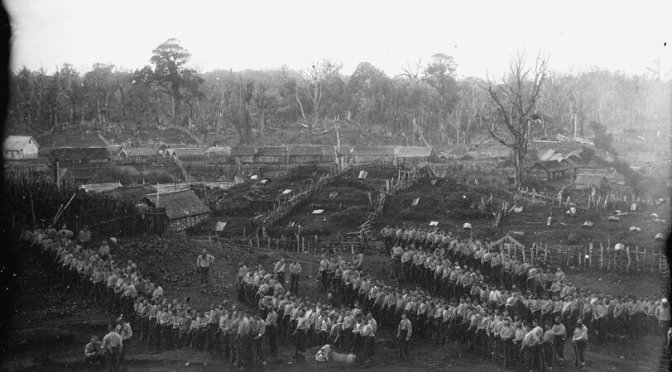
Like clockwork, every year on November 5th it’s fireworks (Guy Fawkes) time in the British colony of NZ.
Two events few of us know about today … 46 years apart … their anniversaries nine days apart…
Parihaka
On November 5th 1881, 1500 armed constabulary and volunteers invaded the peaceful village of Parihaka whose people had simply declined to sell their ancestral lands which in due course got confiscated anyway (confiscated being a polite word for stolen). Their crops were destroyed and houses burned, followed by occupation, severe deprivation and abuse (see timeline). This is reminiscent of Naboth’s vineyard, an incident recorded in the scriptures. Parihaka’s chief, Te Whiti, incidentally, was an adherent to Christianity who lived by and taught the scriptures.
Understandably your government would prefer that you forget this episode. And most of us have, or like many, didn’t even know about it. There has been an apology delivered, albeit fairly recently. It always seems surreal to me, that more than a hundred years after a crime of that magnitude, government reps can show up and simply say ‘sorry’. They do pay back a tiny percentage of what they stole but that’s it.
Read the story of Parihaka and follow the time line at the Parihaka Website.…
“The people resisted the confiscation of lands using non-violence. Still, the village, with a population of several thousand people, was invaded by an army of colonial troops in November 1881 and occupied for several years. Hundreds were imprisoned in the South Island for acts of civil disobedience but given criminal sentences.”
“In New Zealand and Australia, it’s a mark of honour to have ancestors who fought on the Dardanelles or at the Somme or Passchendaele. A national origin myth has been constructed around the Anzacs, replete with a day of remembrance, outsized monuments, and a rich tradition of rituals that are rehearsed annually “lest we forget”.
Nothing like the same emotional (or financial) investment is made in remembering the wars that took place at home. Our own colonial violence, in Taranaki and at Ōrākau, Pukehinahina/Gate Pā and elsewhere, has been relegated to the margins of the national consciousness. It’s an ongoing process of selective historical amnesia that we’re only slowly beginning to address — not so much lest we forget, as best we forget.”
Richard Shaw
From Uncovering the stories my family forgot, about a past still haunting Aotearoa, article published at E-Tangata.
Shaw authored The Forgotten Coast, also on topic.
He Whakaputanga
The other event that’s been forgotten took place on 28th October 1835. Thirty four rangatira signed He Whakaputanga o te Rangatiratanga o Nu Tireni (known in English as the Declaration of Independence of the United Tribes of New Zealand). It was signed firstly by Northern Māori, and later by other iwi including the Māori King Te Wherowhero, Ngāti Mahuta (Waikato).
“He Whakaputanga o Te Rangatiratanga o Nu Tireni (known in English as the Declaration of Independence of the United Tribes of New Zealand) is far more than a foundational document; it is a powerful testament to Māori sovereignty and intellectual foresight. …”
Read more about He Whakaputanga and what it means today, here in an article by Craig Rikihana.
RELATED
How Capture Became Governance
The Architecture of Indebtedness
The Architecture of Narrative
Books to read about Parihaka:
Days of Darkness by Hazel Riseborough
Ask That Mountain by Dick Scott
Te Whiti o Rongomai and the Resistance of Parihaka, by Danny Keenan
The Parihaka Woman by Witi Ihimaera
The Parihaka Album: Lest We Forget by Rachel Buchanan
Parihaka: The Art of Passive Resistance by Te Miringa Hohaia,
Articles from E-Tangata about Parihaka
https://e-tangata.co.nz/tag/parihaka
Discover more from Environmental Health Watch NZ
Subscribe to get the latest posts sent to your email.
