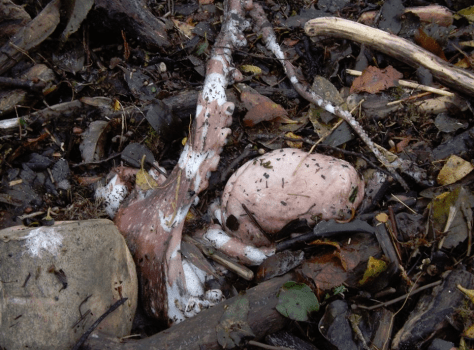
“Manaaki Whenua Landcare Research tested eight dead rats and one weka. None of these animals had any residue of 1080 toxin. Two other rats were too decomposed to test.
Massey University School of Veterinary Science undertook post-mortem examinations of five of the dead rats but could not determine their cause of death. The weka was also examined with cause of death unknown.”
The reports produced are for 4 dead rats and one weka and one rat too decomposed to test.
Well my arithmetic says that 8 dead rats (plus 2 decomposed ones) comes to 10.
Some questions need to be answered:
1) Where are the reports on the other 4 rats that were NOT too decomposed to test?
2) Why was only fluoroacetate (1080) tested for? As the carcasses were already at least 16 days old at time of testing, they needed to test for a range of chemical markers – metabolic products of 1080 poisoning, such as fluorocitrate. Biosynthesis had taken place. (See the attached paragraph from Spurr and Powlesland -“Dead Birds”)
3) Why did the testing take so long? Were they waiting for more degradation to take place? (Remember the poisoned Indian family… no urine tests for 1080 poison were done for 18 days, despite that being recommended by a doctor at the time!!!)
4) Why did the scientists use gas chromatography? Another scientist has said : ‘Gas chromatography won’t find 1080. They should have used 19F NMR and looked for metabolic products. They have deliberately used the wrong tests.’
4) Where did the Weka’s head disappear to?
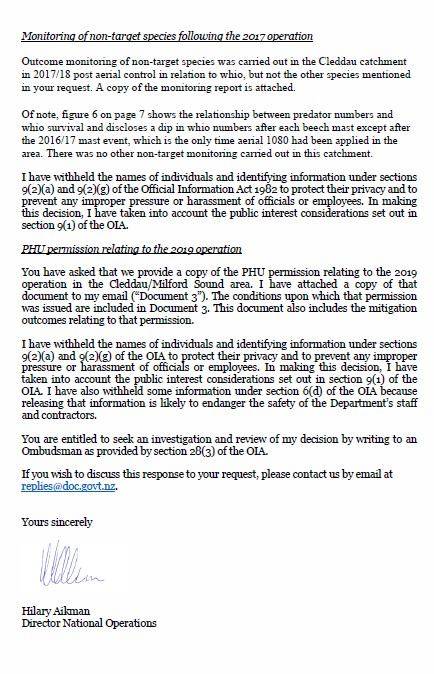
5) Why didn’t the labs test any bone marrow? Spinal is the best source apparently. (Even if the Weka’s head fell off and got lost en route, they could have tested its spine.)
6) What happened to the crayfish DoC took away for testing?!!!!
These are just a few of the questions that need to be asked. There will be more!
THE MISSING CRAYFISH AND THE HEADLESS CHOOK (WEKA)
I have just been speaking to Trevor Reid again. He was one of the small group of Westport people who cleared all the dead creatures off North Beach, Westport, on 9 November 2019, and then asked the local DoC office for assistance…… two DoC rangers brought a digger to the beach and buried everything these conscientious people had piled on their trailer, except for the samples DoC took for testing.
One of these samples was the crayfish, seen clearly here on the back of the trailer. It was the only sea creature DoC took for testing. So.. why has it disappeared? DoC’s test results, out today, make no mention of it. (It pays to remember that 1080-poisoned sea life would have been a nightmare for the Dept of Conservation to deal with. The South Island’s West Coast is renowned for its sea fishing industry.)
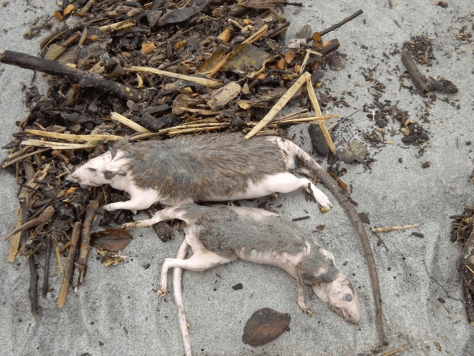
In the top photo the Weka is hard to make out. It is the grey creature just above the centre of the photo, between two rats. It’s leg is white after the time spent in water. It’s beak is partially hidden under a bit of driftwood. However it HAS a head. It was the only Weka on the beach. The Weka that DoC tested was supposedly headless! Did they lose the head? DoC are good at losing heads and hearts… in more ways than one !
I do think we should all keep in mind that the Dept of Conservation simply can not afford to admit to killing any of the animals on North Beach, Westport, with 1080 poison. Their poisoning method does not now avoid any waterways, and if it could be shown that animals can travel as much as 140 kms in a flood to the river mouths, the hue and cry would be enormous.
Sadly we know this to be the case. Even more sadly we are not dealing it appears with honest people, nor are we dealing with a news media keen to get to the truth.
Remember folk, this is from the same establishment that in 2006 lost a young deceased woman’s heart on its way for 1080 testing. The same establishment that failed to test the poisoned Waikato family for 1080 in the required time frame as an initially responding MD recommended. The same establishment that is still getting around to providing answers to the two South Island picnicking women who fell ill after being showered with 1080 pellets in 2014. The same establishment that is okay with there having been no studies done regarding the health risks of 1080 on the human foetus. The same establishment that retired MD Charles Baycroft says does not allow MDs to look for evidence of poisoning.
Note also: they did not test the marine life. Octopus, squid, crabs, crayfish? The actual food people who fish will be eating.
Do you really believe the authenticity of their test results folks?
The thing is as the aforementioned MD has warned us, there is never any evidence of 1080 poisoning because the MOH does not allow the evidence to be looked for. Period. No one will ever know he says, if you die of 1080 poisoning.
So, do bear in mind the following when going about your daily lives or enjoying a holiday in NZ:
The NZ authorities do not practice the precautionary principle with the spreading of 1080 poison. In fact they are now legally allowed to drop it into your waterways without the previously required consents, even though the manufacturer’s warning says take care not to drop it into the waterways. Whilst they continue to claim it is harmless, there is much independent research that says otherwise. (See 1080science for further independent info). In light of that, in my opinion it is safer to follow the precautionary principle, that is, proceed as if there were a possible risk to your health rather than assume there is none. Since 1080 is a known teratogen I believe it is particularly important for pregnant mothers or even those who think they may be or who could be pregnant, to distance themselves from an area where 1080 is being distributed, particularly aerially because of the drift of the dust over long distances. Stay safe people by taking your own precautions. EWR
You can read about DoC’s testing in the article below by Radio NZ. And do search for other 1080 articles in ‘categories’ (left of page) … you’ll be surprised at what you’ll read that mainstream media isn’t talking about.
Mt Hutt Helicopters Ltd, Methven (CEO Josh Kershaw) one of the six main 1080-poisoning helicopter companies in the South Island for many years, is reportedly out of action, flight wise. I’m told they no longer have an Air Operator’s Certificate (AOC) or Ag rating apparently, and are doing maintenance only. It is rumoured in the helicopter world that they were “struggling to get pilots”.
The last 1080 they dropped, as far as I know, was the Inangahua, Buller district, aerial 1080 drop in mid-2019.
I’m told they own an AS350 and a Notar. (Presumably they leased in other choppers for 1080 poison operations.)
I have also been told the Notar is in the process of being ‘parted out’ (dismantled and sold off in parts). Not sure about the AS350. Many of the parts will be embedded with 1080. Helicopter pilots tell me 1080 dust will be inside fins and the tail boom, and fine dust will be all through the working parts.
As well as this, Way to Go Heliservices Ltd, Rangiora, (CEO Rob Kittow), another major poisoner, particularly this Spring, has been for sale for at least a year I’m told… on Trademe and in aviation mags. Maybe people don’t want to buy 1080-riddled helicopters?
The other four main South Island 1080-poisoning helicopter companies are Marlborough Helicopters Ltd, Blenheim ( CEO Owen Dodson), Anderson Helicopters Ltd, Hokitika ( CEO Kevin Anderson), Central South Island Helicopters, Oamaru (CEO Gary Oakes), and Helicopters Otago Ltd ( CEO Graeme Gale).
Beck Helicopters Ltd, Eltham Taranaki, ( CEO Alan Beck) often come to the South Island to drop 1080 poison too.
‘Way to Go Heliservices’ at Makarora, Mt Aspiring National Park, 1080 poison operation, October, 2019 – Photo Carol Sawyer
Note: I report what I am told in good faith, when it is from people inside the industry whom I consider reliable, (in this case from two separate sources) and I endeavour to get my facts correct, but please bear in mind that some of this information is anecdotal.
TIMELINE : DoC’s ‘RATGATE’ AT NORTH BEACH, WESTPORT – INDEPENDENT LAB TEST RESULTS TODAY CONFIRM DEATHS “ALMOST CERTAINLY” 1080 POISON
by Carol Sawyer
1 – 3 November, 2019 – The Dept of Conservation aerially drops 104 tonnes of 1080 poison baits into the Maruia River catchment, to kill rats. This catchment feeds into the Buller River and out to sea at Westport.
********************************
8 November — A Westport local spots numerous dead creatures (rats, birds, marine life) on North Beach, Westport, at the mouth of the Buller River, after heavy rain.
A dead octopus, just one of many varieties of wild and marine life found recently on North Beach, Westport
********************************
9 November – Locals collect a trailer-load of 680 dead rats, a goat, octopods, skates, sole, starfish, crabs, barracuda, monkfish, crayfish ( all bottom feeders which could have eaten 1080 baits washed to sea) and seabirds from North Beach and ask DoC for assistance.
DoC dig a hole on the beach and bury the by dead wild and marine life washed up at North Beach, Westport
Doc dig hole in the sand and bury potentially toxic load on the beach. Freedom campers move elsewhere.
Freedom Campers at North Beach move on after discovery of the source of the dead wildlife washed up at North Beach Westport
Buller District Council announces, on behalf of DoC, that the aerial 1080 drop at Springs Junction the previous week (Maruia catchment) “may have contributed to the problem”, and advises caution.
*******************************
11 November – DoC, now moving into damage control, changes its story. On Prime TV News, West Coast Operations Director Mark Davies says ‘Doc thinks it’s unlikely the rats were poisoned by 1080 in a recent drop, then washed out of the hills by heavy rain. “I just can’t imagine that the two are connected”, he said.’
To Newshub, Davies said “… reports of dead fish and birds – along with the rats – are not consistent with the way 1080 is understood to work.”
However ‘One News’ hadn’t quite caught up with the new fairy story and said “”The Department of Conservation (DOC) said they may be victims of a recent 1080 drop 140 kilometres away in the Lewis Pass National Reserve.”
Also on 11 November, more dead rats and dead muttonbirds are discovered on a beach 8 kms north of Westport, seagulls are seen picking dead rats out of the sea at Waimangaroa Beach 17 kms north of Westport, and further reports come in of dead creatures found at Punakaiki and elsewhere..
*******************************
12 November – “DOC’s West Coast regional director of operations Mark Davies said the 1080 theory was however just that – a theory – and highly unlikely.” TVNZ News
*******************************
13 November – DoC’s Buller Operations Manager, Bob Dickson, clutching at straws now, announces a brand new DoC theory – The rats were committing suicide. They had run out of food and were all jumping into the rivers and rafting, dead, down to the beaches.
*******************************
15 November – First independent laboratory test results returned. Laboratory scientists’ professional conclusion is that the deaths of the beach animals tested were almost certainly caused by 1080 poison.
Tell me again, is DoC really saving our birds? EWR
From Carol Sawyer
This is on the Dunedin Ecosanctuary’s Facebook page today :
“LOCAL RESIDENTS: PLEASE REPORT SIGHTINGS OF SICK KĀKĀ
We are sad to report that two of our Ōrokonui kākā have died over the last week. Initial indications from autopsies suggest that ingestion of an anticoagulant toxin was the cause.
It is possible that the kākā may have accessed bait from stations used for eradicating possums outside the sanctuary. Ōrokonui staff have contacted Ospri, which is managing a large TB control programme in the Dunedin area. This has resulted in a rapid response with contractors removing bait from stations across the entire operation area of the programme as a cautionary measure.
We are asking local residents in the communities surrounding the ecosanctuary to keep an eye out for our kākā and to immediately report any sightings of unwell (or dead) birds. Both of our kākā showed similar symptoms before they died: unusual swaying behavior, looking lethargic and ill. Please contact the DoC Hotline 03 477 0677 from 8:30 to 5pm weekdays, or after hours on 0800 362 468 if you see a kākā behaving in this way. Dunedin’s Wildlife Hospital is on standby to treat any sick birds.
We take this opportunity to remind our wider communities to please not feed kākā as we do not want to encourage them to interact with human-made structures, particularly those that contain food, outside of the safety of the ecosanctuary.”
If you read the mainstream news you will no doubt be aware of the recent news from the South that’s gaining more momentum by the day … the 600 (possibly 1080-poisoned) rats washed up on South Island Westport beach. I’ve not reported on any of it yet so am featuring more than one of the initial articles. (The header image features a trailer load of dead rats shoveled up off the beach). Not too much mention has been made of the myriad of other marine species washed up at the same time as the rats, and the birds of course. We know those are disappearing fast thanks to 1080 given LandCare Research has admitted to 10K in one Sth Island drop. (See this post). Mainstream news however is focusing on the rats rather than the many other species. EWR
Below, Carol Sawyer has reproduced the Greymouth Star’s article on it:
RATS DUMP POINTS TO 1080 POISON – 680 CARCASES ON WESTPORT BEACH
Greymouth Star, 11 November 2019, By Laura Mills
Department of Conservation staff were today patrolling Buller beaches after at least 680 rat carcases were washed up on Saturday at Westport. There were also unconfirmed reports this morning of more washing up on Waimangaroa beach, and even some further south at Punakaiki. It comes after a DOC 1080 drop inland at Maruia, where the amount of 1080 used had been increased. It is thought the poisoned rats were flushed into the river by torrential rain in the area, and eventually washed 140km down the Maruia and Buller rivers to the sea. Last week, the Greymouth Star reported a plague of rats in the Maruia Valley, with reports they were chewing wiring in tractors and people who camped at Lake Daniells were disturbed by rats running over their tent all night. The population explosion was caused by a beech mast fruiting. The discovery of stinking, rotting piles of rats on Westport North beach even made British tabloid The Mirror yesterday, complete with graphic pictures.
Photos on social media showed dead birds, a starfish, skate and octopus. Seagulls could be seen eating the carcases.
Westport rocketed up the list of the satirical website ‘Sh.t Towns of NZ ’ as the news broke, to reach No 1, with the heading ‘tides of dead rats washes up on beach in sign of impending apocalypse’. DOC Buller district operations manager Robert Dickson said this morning 680 rats had been collected so far.
Some dead fish were also found and would be autopsied, but as fish were not susceptible to 1080 poison, DOC did not expect this to be the cause of their deaths, he said. “ We have asked for urgent tests, results should be back by the end of the week. ” “ Beaches were checked yesterday and no sign of any rats, there will be a further check after high tide today.” He warned that 1080 was very toxic for dogs, so until the all-clear was given, a great deal of care should be taken to keep dogs away from carcases found on the beaches. Mr Dickson said the 1080 sowing rate at Maruia was 0.15% baits 2kg per hectare. That was increased from 1.5kg earlier this year after more rats than expected sur vived earlier drops. Westport local Daniel Case said he heard about the dead rats on Friday and on Saturday morning he went for a look at North Beach, near the Buller River mouth.
“Off the top there’s just hundreds of fish, rats, octopus, starfish … everything. ” He said the carcases spanned as far as the eye could see. “ I only went for probably a kilometre walk but when they were cleaning it up, the locals cleaning it up, they said it went the whole way down — 3-4km. The people that picked them all up and were doing the clean up, they said a couple of DOC officers helped out and disposed of them for them.” He expected more carcases to wash up for the next couple of high tides. “ We all know the 1080 is getting dropped but when you see it come on to your back doorstep it’s pretty out of control and you got to think about what ’s up in the bush and up the riverbanks and everything that ’s still to come out,” Mr Case said.“ We couldn’t have got all of it in one hit, there’s got to be a lot more coming . . . it ’s got to be disastrous up there, that ’s for sure. ” DOC Western South Island operations director Mark Davies, of Hokitika, said in a statement it was “not inconceivable” the rats could have been washed out of the hills by heavy rain that followed an aerial 1080 operation at Maruia. “ Until we know other wise, we have to presume the rats have been poisoned by 1080 and take a cautionary approach,” Mr Davies said. In the meantime, signs had been posted at Westport and the carcases buried.
Watch this space for further updates.
Photos by Trevor Reid & an anonymous photographer. Supplied by Carol Sawyer.
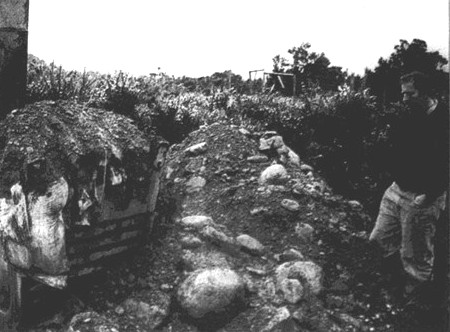
There is much more in terms of outcome to this item posted at the Save Raukumara from 1080 FB page which you can read if you are a member of FB. I will endeavor to post the remainder later but for now, what struck me most about this news item from 2000, was that DoC handed this land over knowing full well they had buried a Class 1A Ecotoxin in the form of 1080 pellets only 6 feet down and refrained from informing the new owner.
Let that sink in for a bit & perhaps ponder on the dishonesty of this corporation that has the mandate for CONSERVING your environment. This is an oxmoron.
This of course is the way of corporations. Profits first & people & environments not even second if you watch ‘The Corporation’ doco (on YT) that is well illustrated … and let’s not forget our former govt depts are corporations now. Many have missed that important feature of our recent history.
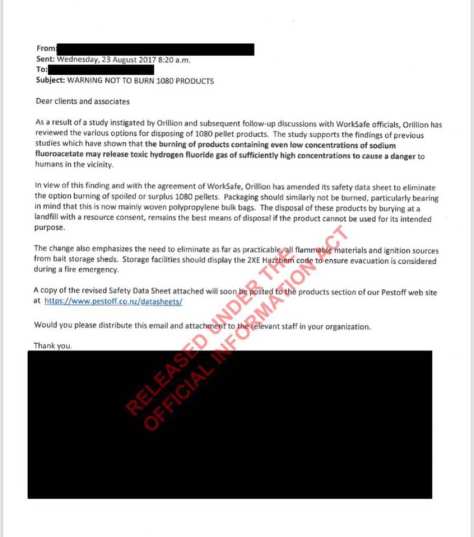
And you have to wonder how many more lots of 1080 are buried all over NZ including landfills, considering it is the world’s largest consumer of this deadly product that was once added to water to kill ship rats and is extremely difficult to detect if you are poisoned by it. In fact your government doesn’t want you to detect it according to recent information by a retired MD.
EWR.
Greymouth Evening Star 28 July 2000 (posted at the Save Raukumara from 1080 FB page).
This is truly disturbing, especially on the heels of a recent post on topic and the revelations from the Taupo area where a hunter reports the same after SIXTY PLUS YEARS of 1080 treatment. The poison simply is not working, and worse it is decimating our native birds. Kea are nearing extinction (here also) and remember this post also about the 10K birds killed in one drop? When is this madness going to be looked at with independent eyes, independent research and an eye for alternatives. They are aerially treating areas that could be easily trapped while saying they only aerially treat inaccessible places.
Note: this post since published has had 40K shares on FB (14K initially in one week … at which point the pro poisoners were responding with comments it is not true. The person who provided the info is 100% bonafide & reliable I can assure you). The truth is coming out. I encourage you, if you have similar ‘silent’ stories do contact me using the contact form…. the accumulation of other sightings provides more evidence that 1080 is not conserving our natives & is also killing our non natives. This is by design of course although DoC is not outright telling us that. The plan is to totally eliminate all non natives, part of the UN biodiversity goals.
The Makarora area of Mt Aspiring National Park was aerially 1080-poisoned on 15 October, 2019 – the Wilkin, Fish, Blue, Cameron, Makarora and Young Valleys.
Yesterday I was told that the old six-bunk forestry hut at Top Forks, Wilkin River Valley, is being restored, and the workers restoring it are living there while it is restored. They say there is absolutely nothing left alive up there. It is as silent as the grave…. no birds, no insects, NOTHING !
Extraordinarily, even though the area was poisoned only two weeks ago there are NO warning signs on any of the DoC online track information on the Young Valley Track, Cameron Valley Track, Blue-Young Valley Track, etc! There will be dead carcasses and baits in the streams and rivers. Innocent tourist trampers from overseas will drink from the streams.
Do exercise the precautionary principle folks, even if your authorities are not. And warn any tourists personally that you know. Generally they follow what the glossy clean and green brochures say, or omit to say would be more to the point. See further info on the precautionary principle below. EWR
MILFORD SOUND – A REPORT
by Carol Sawyer
Note: for recent related articles on Milford Sound go to this link.
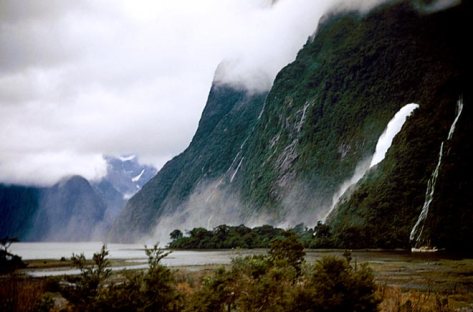
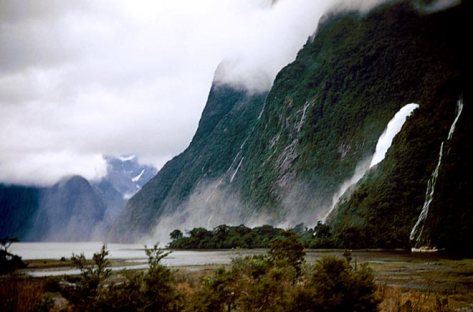
Milford Sound was aerially 1080 poisoned on 15 October, 2019. A tourist operator tells me that the helicopters were even pouring 1080 poison on the vertical faces of Sheardown Peak (top photo) These are vertical faces, with the odd patch of bush hanging off them, where nothing will be living.
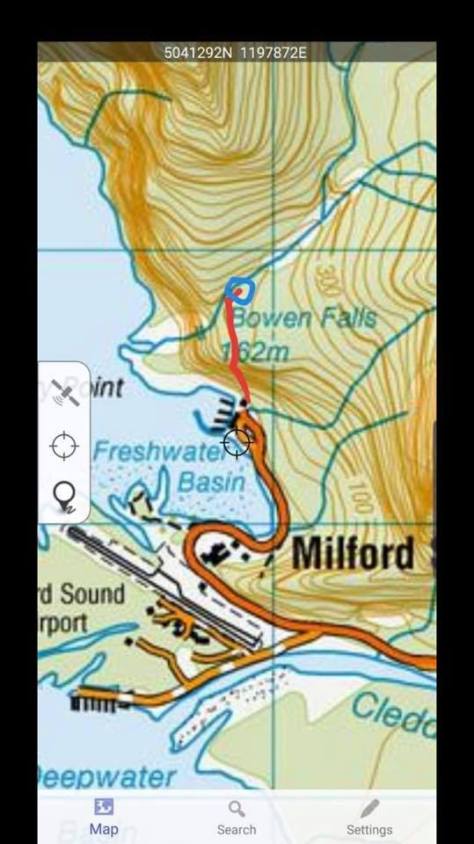
The water source for all Milford Sound drinking water, the Bowen River, was also aerially poisoned right up to 100 metres above the water intake, and just 200 metres from the Bowen Falls. Dead carcasses will also be in that waterway.
Last time part of this area was poisoned Shane Wilson drove all the way from Otautau, Perrin Brown came from Te Anau, and Margaret Dynes travelled all the way from Winton…. to record the event. Shane filmed tourists filling their water bottles at Monkey Creek while the choppers dropped poison overhead.
Header image: Sheardown Peak, Milford Sound
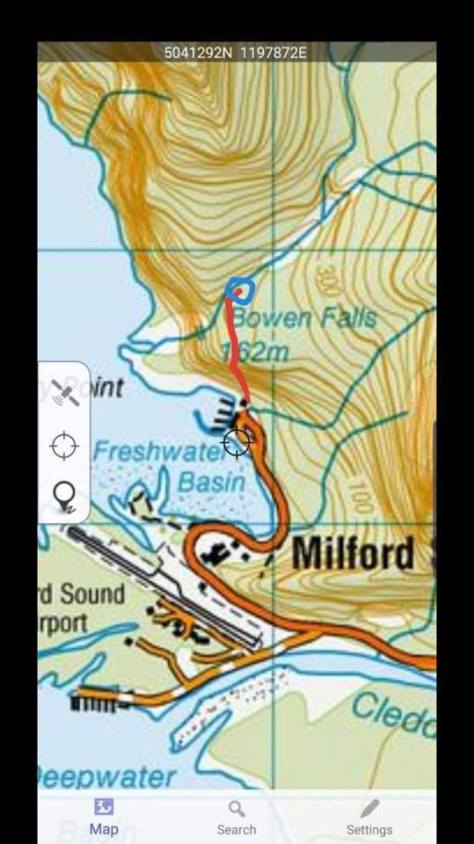
Bowen Falls, Milford SoundMap showing water intake for all Milford Sound drinking water (blue circle). The red line is the pipe line to a hydro scheme
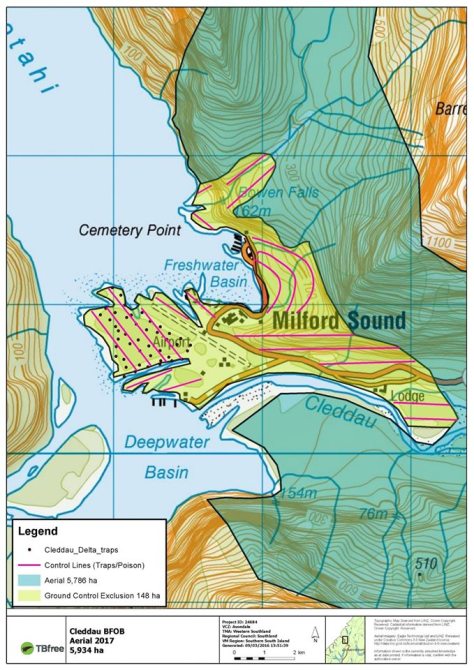
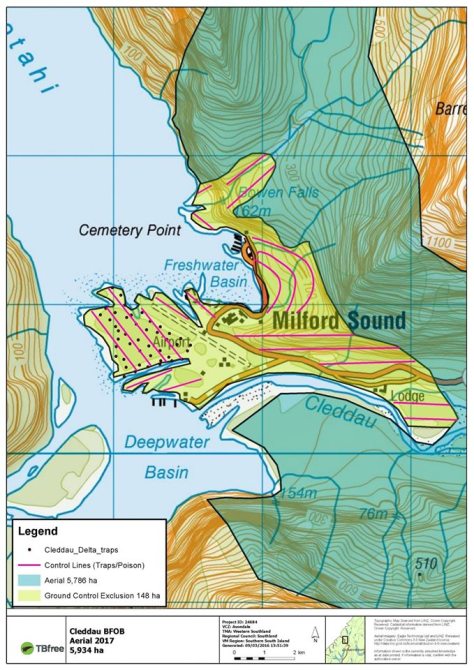
DoC map of Milford edge of aerial 1080 drop… the green area was poisoned.
The NZ authorities do not practice the precautionary principle with the spreading of 1080 poison. In fact they are now legally allowed to drop it into your waterways without the previously required consents, even though the manufacturer’s warning says take care not to drop it into the waterways. Whilst they continue to claim it is harmless, there is much independent research that says otherwise. (See 1080science for further independent info). In light of that, in my opinion it is safer to follow the precautionary principle, that is, proceed as if there were a possible risk to your health rather than assume there is none. Since 1080 is a known teratogen I believe it is particularly important for pregnant mothers or even those who think they may be or who could be pregnant, to distance themselves from an area where 1080 is being distributed, particularly aerially because of the drift of the dust over long distances. I believe these are the concerns being raised here, and particularly also with regard to warning tourists of the risks of drinking the water, who may not be able to read the signs (if there indeed are any). Finally, of particular concern is the topography of Milford Sound. When it rains as per the above image, “all of the steep landscape can be considered a streambed”. EWR.
VIDEO: “Once the rats have gone down to negligible numbers” says Maggie Barrie, (former Min of Conservation) “then we’ll use traps” … ? Um…. 60 years on and still we have rats? It isn’t working Maggie. A blind person could see that. We still have rats and our native Kea are nearly extinct. Perhaps the Dept of Conservation would be better named the Dept of Destruction.
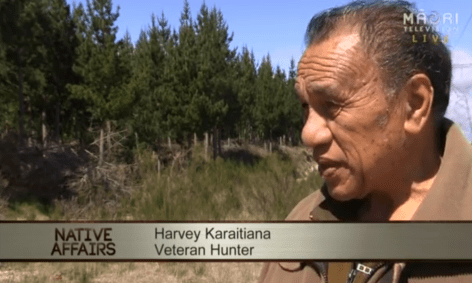
Hunter, Harvey Karaitiana, interviewed in the video says he came across 1080 by accident in the 1950s when he saw small fixed wing aircraft spreading something in the Wainui bush near Taupō. Upon investigation he saw green stuff all over the ground. Days afterwards he found dead birds and animals in the bush. Remember this is a Class 1A Ecotoxin that kills all oxygen breathing life including humans, and it appears the public had no warning on the drop! Mr Karaitiana wrote to the local newspaper at the time expressing his concerns.
Note: Mr Karaitiana says they are still treating the same land with 1080, and reports that whereas once he would hear Morepork and other birds in the area, he no longer does. They are all gone he says. Department of Conservation? Really?
The poison 1080, to our Māori people he said, is one of the most deadly poisons out that we know of.
And DoC by the way declined to be interviewed.
To watch the video click on the link below the image:
A must watch also is Poisoning Paradise, the doco made by the GrafBoys (banned from screening on NZ TV, yet a 4x international award winner). Their website is tv-wild.com. Their doco is a very comprehensive overview with the independent science to illustrate the question marks that remain over the use of this poison. There are links also on our 1080 resources page to most of the groups, pages, sites etc that will provide you with further information.
NOTE: The NZ authorities do not practice the precautionary principle with the spreading of 1080 poison. In fact they are now legally allowed to drop it into your waterways without the previously required consents, even though the manufacturer’s warning says take care not to drop it into the waterways. Whilst they continue to claim it is harmless, there is much independent research that says otherwise. (See 1080science for further independent info). In light of that, in my opinion it is safer to follow the precautionary principle, that is, proceed as if there were a possible risk to your health rather than assume there is none. Since 1080 is a known teratogen I believe it is particularly important for pregnant mothers or even those who think they may be or who could be pregnant, to distance themselves from an area where 1080 is being distributed, particularly aerially because of the drift of the dust over long distances. I believe these are the concerns being raised here, and particularly also with regard to warning tourists of the risks of drinking the water, who may not be able to read the signs (if there indeed are any). Finally, of particular concern is the topography of Milford Sound. When it rains at Milford Sound, “all of the steep landscape can be considered a streambed”. EWR.
By Carol Sawyer
Bowen Falls, Milford Sound….. the water intake for supplying Milford Sound township, and all tourist boats and accommodation, is approx. 200m upstream of the Bowen Falls and approx. 100m below the 1080 poison bait drop zone, where 1080 poison baits were aerially dropped on 15 October, 2019.
See smallest map attached. The person who provided that map says:
“Blue (circle) is rough location of intake. Red is a big pipe running from intake into the hydro electric station. It creates the power. Also here is where the only filter for our drinking water is…it’s a UV filter. Then it is distributed to vessels and accommodations. Our drinking water is straight from the Bowen River valley. I have walked up the pipeline before… quite steep in places.”
The significance of all of this is that the aerial 1080 drop could possibly have contaminated the water supply. As well as that, poisoned carcasses will, as we know from experience in all aerial 1080 drops, end up in that waterway as well, also then being a source of contamination.
1)Bowen Falls – Photo Te Ara, Encyclopaedia of NZ
2)Water intake – approximate position provided.
3)Area around Milford Sound excluded from aerial 1080 poison… map provided by Dept of Conservation.
DEPT OF CONSERVATION TELLS TOURISM COMPANY OFF – Skippers are not to warn tourists about the dangers of drinking the water after aerial 1080 drop in Milford Sound area yesterday.
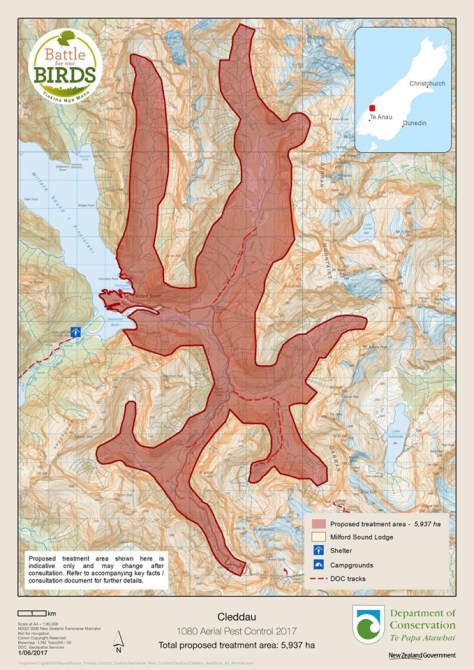
Milford Sound (Arthur, Sinbad and Cleddau Valleys) was aerially poisoned on 15 October, 2019.
Pam Vernon reports (15 October, 2019) “A reader at the Envirowatch Rangitikei site today commented about warning the tourists on the dangers of drinking the water: “Hi there my brother works as a skipper for one of the biggest tourism companys in Milford and one of the skippers warned the customers on the mic and a doc member was on the boat and got seriously offended called her boss then doc warned the company gave them a chewing. The company forced all skippers to say nothing at all or risk consequences. The company is afraid of the bad side of doc because that’s who gives them there consent to cruise in Milford. Blackmail against freedom of speech. This is real as of the other day.”
Another person said, (14 October, 2019, 1080 Eyewitness):
“DOC poisoning operation in Milford tomorrow
Who the hell gives DOC the right to poison our only water supply, the Bowen Falls?
650,000 tourists come here every year to view this pristine environment, if only they knew….. “
I’m told the Bowen Falls are in the drop zone, and the whole township at Milford Sound and all the tourist boats are supplied by water from that source.
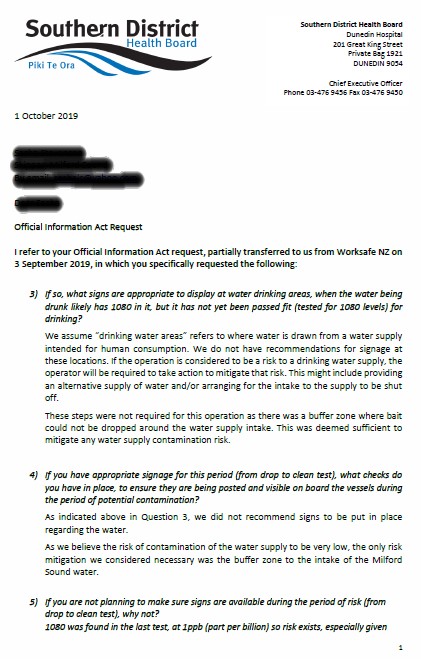
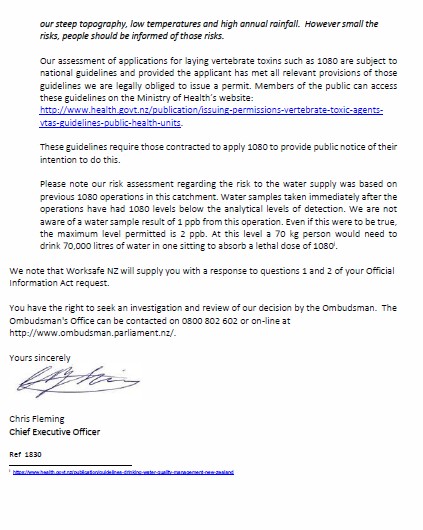
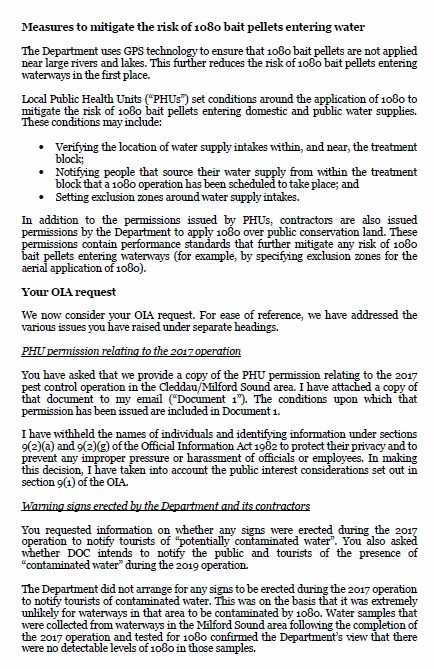
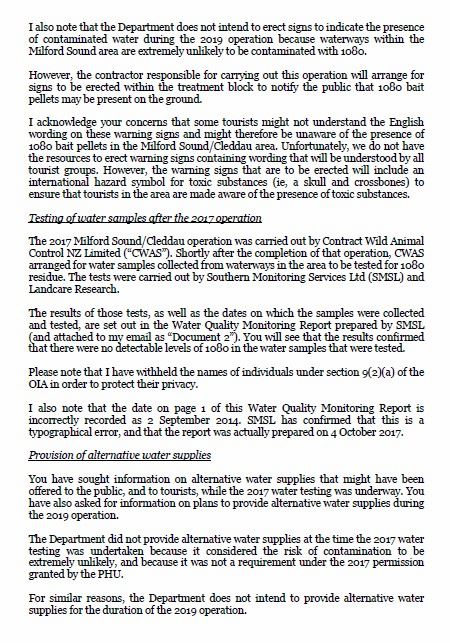
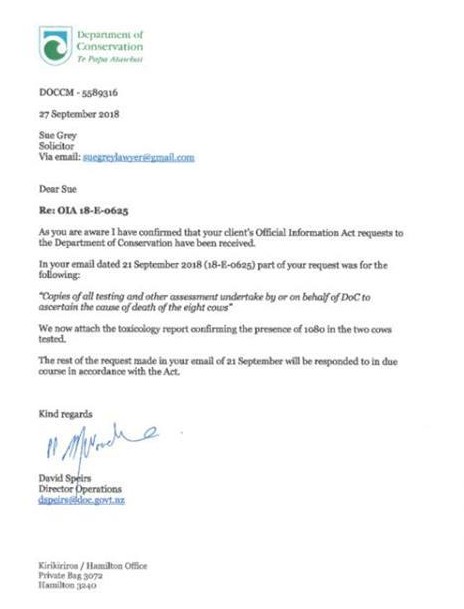
OIA responses from Southern DHB and DoC state there is a buffer zone round the Milford water intake which they regard as sufficient. See attached, (plus maps from original notification of the drop).
The Milford Sound water intake is approximately 200m above the Bowen Falls, and I’m told the intake is only about 100m inside the top end of the buffer zone (yellow area on map). Helicopters were seen working along that face. Helicopter pilots tell me 250m is a minimum buffer zone for safety, and more if on a slope, as baits tumble into valleys. Poisoned carcasses will inevitably end up in that waterway, as well, providing further contamination.
“The Bowen River catchment valley is rather like a giant granite bath, with very little top soil, and average rainfall of 7000mm per annum. Together with winter temperatures, ice and snow melt, this will likely increase the risk of 1080 arriving at the intake at the same time and breaking down much more slowly.”
and of the 2017 drop at Milford Sound he says:
“The water quality testing (pg 6 of DOC’s operational report 5.2.2) revealed the presence of 1080 at 1ppb.”
Put it this way… I wouldn’t be drinking that water !
According to Leslie McGrath, the Dept of Conservation will not take water tankers in to supply safe water because it is “too expensive” ! However the Department’s response to a request for alternative water supply is at the bottom of page 3 in their OIA response attached.
BUFFER ZONES ROUND LAKES, RIVERS AND STREAMS NO LONGER A REQUIREMENT AT 1080 POISON DROPS
By Carol Sawyer
Someone has just asked me if having GPS in a helicopter means 1080 poison baits do not need to be dropped into waterways – i.e.that streams and waterways could be avoided.
Well, yes, but ag pilots tell me, and Murray Dench also explains this quite well in the post below) that, even with GPS, bait-dropping can only be accurate with some certainty to within a minimum of 200 metres, and even then, so-called ” overflies” happen (i.e. baits land outside the drop zone).
A good example of an “overfly” was the Kepler Mountains drop at Lake Manapouri in Spring 2016 when a 200 ha area outside the drop zone was covered in 1080 baits by HeliOtago.
(Even though protestors were initially blamed for this, HeliOtago later admitted the cause was that their pilots were under pressure to finish the job).
However the new government rules are that NO stream or waterway needs to be avoided by helicopters dropping 1080 poison, so the question of GPS accuracy and bait-dropping is somewhat academic!
Even when buffer zones are set around waterways, they tend to be woefully inadequate. In Febuary 2017, at the 1080 poison drop at Makarora, a 20 metre buffer zone was applied to the Makarora and Wilkin Rivers, yet baits were found in these rivers after the poison drop.
Below is Murray Dench’s report:
DROPPING 1080 POISON FROM THE SKY IS NOT AN ACCURATE PROCESS
In 2007, following the ERMA Review, Murray Dench wrote to Andrea Eng, General Manager Hazardous Substances, ERMA on Differential Global Positioning Systems with regard to dropping 1080 baits. What he wrote is very interesting. Here it is :
“The distribution of the baits from a helicopter is far from certain. While DGPS has allowed more accurate placement of the aircraft there are other factors involved :-
1. The groundspeed of the machine during the delivery run.
Over level terrain this is quite easily controlled but over steep terrain (where the helicopter is most ‘useful’) every act of climbing and descending to match the contour changes the ground speed.
This is difficult to control because the pilot (if he’s smart) will be concentrating on terrain avoidance and personal welfare to the detriment of accurate groundspeed monitoring.
Another negative factor is wind speed and its degree of crosswind (or even tail wind) component. Again, in level terrain the crosswind component is relatively constant and can be allowed for but in broken country wind changes are legendary including lift, lee turbulence, rotor action, and a raft of others which sensible pilots do their best to avoid.
The changing wind speeds and directions rapidly change the aircrafts airspeed indication for which the pilot must compensate to maintain the target groundspeed. It also rapidly changes the aircraft direction of travel and rate of climb which has to be constantly corrected. When you combine terrain avoidance with constant altitude changes and violently changing wind speed and direction it is not hard to see that accurate distribution of baits is not likely.
2. The height of the machine above the ground during the delivery run.
It is assumed that the hopper delivery system is designed to produce a certain pattern on the ground when delivered from a certain height. If the delivery is from a lesser height then the pattern will not have reached its full dimension and a narrow strip of high bait concentration will be laid. If the delivery is from a greater height than the target then the delivery pattern may be wider with reduced bait density. If delivery from the ideal height results in the baits falling vertically downwards then distribution from a greater height is okay except that the baits are longer in the air and are therefore more susceptible to wind currents moving them out of the intended delivery zone. Trying to maintain an accurate height above ground in steep and broken country while trying to maintain groundspeed and avoid terrain creates a scenario ripe for failure.
3. Accurate delivery relies on the baits exiting the hopper and dropping onto the spinning distribution disc at a constant rate.
This is highly unlikely. The greater the head (weight) of baits in the hopper the greater is the pressure available to push the bottom baits out. As the hopper level reduces the pressure reduces and so the flow of baits also reduces. It is possible that there is some compensation for this negative affect provided by the reducing friction losses against the hopper walls as the hopper level falls but given slippery carrots and free flowing cereal baits it is hard to imagine this mitigation being enough. It is a pretty safe bet that the distribution density of baits at the start of a run is greater than at the end.
4. Overlap.
If a circle of material is continuously dropped while in motion then the path along the centre line of the circle will receive twice as much material as the edges. This is because the material which is thrown forward is added to by the material which is thrown backwards over exactly the same path whereas the material thrown to the extreme edges cannot be duplicated. This provides a distribution pattern with the highest concentration along the centreline of the direction of travel gradually reducing to the minimum distribution density along both edges. It is not possible to produce an even distribution density from a moving 360° rotating disc. It is assumed the applicators mitigate against this effect by overlapping each delivery run so the low distribution density strips along the edges are ‘double dosed’ to achieve the target density.
Again it is assumed this need to overlap is programmed into the tracks to be flown under GPS guidance but is another error inherent in the entire delivery system.
Unintended by-kill is closely correlated with bait distribution.
Having a DGPS in the cockpit of the delivery aircraft is certainly a help but many other factors need assessment and controls added to improve the chance of accurate delivery. ERMA failed to investigate and understand the variables associated with bait delivery and how poor distribution might easily result and instead nominated DGPS as a ‘cure all’ which it cannot be.”
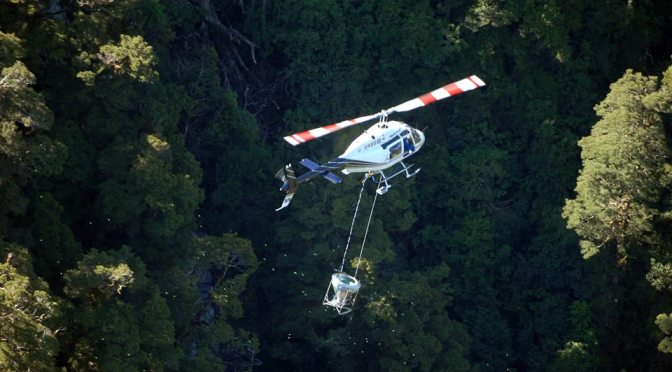
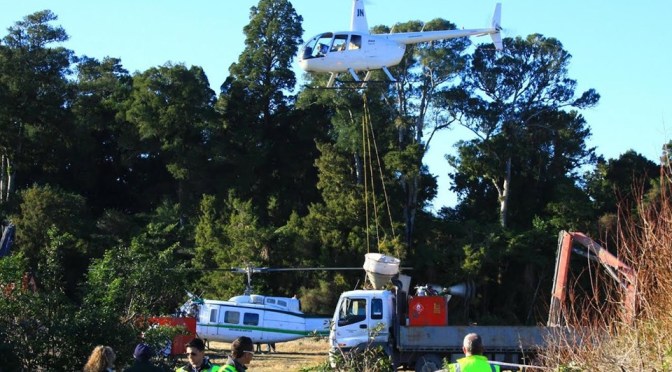
Look closely at the photo above in the header image and you will see baits flying in all directions. This helicopter is low to the bush. Imagine that same helicopter at height and you can start to realize the inaccuracy of a bait drop.
PLEASE NOTE: If you are calling this fake news, it is DoC info acquired by OIA, in which case you are calling DoC’s own info fake.
Commiserations also to the bee keepers. I know this is not good news for you & your income. I have already been told by one bee keeper (a reliable source) who wishes to remain anonymous, that DoC dropped 1080 near their hives & cost them thousands of dollars. They could find no successful avenue of redress against DoC, none at all. By all accounts it sounded very deliberate & were it accidental there should have been some kind of compensation or insurance one would think? All I can say is folk need to be aware and protect themselves by using the precautionary principle.
EWR
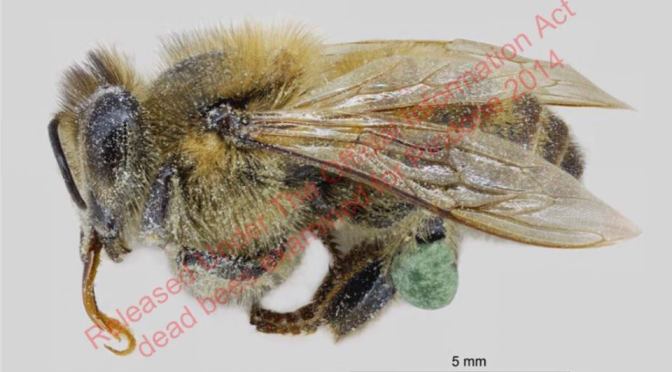
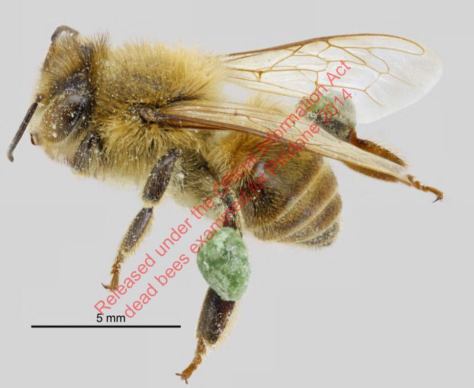
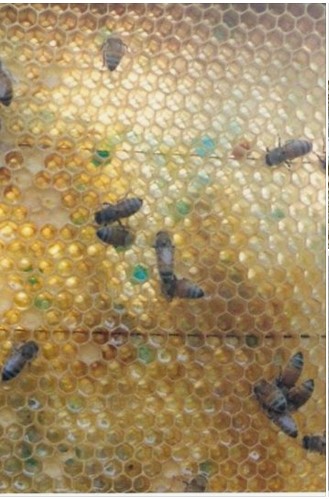
Evidence: POISONING bees and the Manuka honey industry. NZ’s Dept of Conservation try to wriggle around the fact that 1080 is an insecticide – but DOC even registered it as such in NZ as wasp bait. And here we have evidence of honeybees gathering poison. NZ has NO accredited test for 1080 in honey. Do you feel safe eating honey now? Tell DOC by email enquiries@doc.govt.nz
Is 1080 an insecticide? Here is the registration data for 1080 insect bait:
Name:Fish paste containing 10 g sodium fluoroacetate/kgCAS Number:Synonyms:1.0% 1080 Wasp Paste, 1080Approval number:HSR002425. 1080 also sold in peanut butter paste as well as pellets. Check out the factory website www.pestoff.co.nz
1080 takes 1.5 to 2 hours to kill bees, enough to complete about 4 foraging trips.
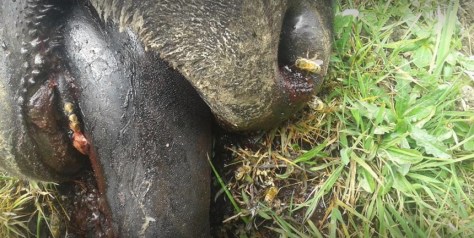
(Above) 6 bees photographed feeding on poisoned blood pouring out cows nose = 1080 poison. Mapara South Road, NZ. Bees fed for 6 days from 14th September 2018.
(Above) 1 honeycomb tested Landcare Research Tongariro National Park 0.0046 ppm 1080 poison 2002 – 7 years after 1080 jam banned.
2 honeycomb samples tested LR Lab Tongariro National Park 0.009 ppm 1080 poison 2003 – 8 years after 1080 jam banned. No further 1080 tests despite this obvious threat to consumers.
Other toxins found in bees from DOC “pest control” operations.
32 dead bees, washed prior to analysis 7.86 ug/g pindone
37 dead bees, washed prior to analysis 4.03 ug/g pindone
52 dead bees, washed prior to analysis 3.64 ug/g pindone
25 live bees, washed prior to analysis 0.74 ug/g pindone
1 of 2 bees found dead 90.3 ug/g pindone
The highest concentration of 1080 detected in the honey was 15 ppb and subsequent tests showed a gradual decay down to 3 ppb after 59 days. The honey source that the samples were taken from would have eventually gone on sale after 16 weeks, hence there would not have been any detectable level of 1080 in the sale product, although under different circumstances, this time could be considerably shorter. Zero studies were done to see if the 1080 samples “lost” 1080 due to the toxin binding to the plastic sample pots – 1080 is well known for binding. What this could mean is the samples tested lower over time while the drums of honey remained high and were then sold.
1080 IN HONEY FROM POSSUM BAITS RAHOTU – TARANAKI Murray Lowe HEALTH PROTECTION OFFICER TARANAKI HEALTHCARE
No we are not terrorists we are ENVIRONMENTALISTS who don’t want to be poisoned. Love this video … says it all. Thanks Benny Rebel. EWR
We live together and everybody lives downstream
We live together and everybody lives downstream
One people One Planet One Circumstance
One home One love One second chance
And they call you an activist
Call you a radical
And they call you a terrorist
because you want your drinking water clean
A must watch also is Poisoning Paradise, the doco made by the GrafBoys (banned from screening on NZ TV, yet a 4x international award winner). Their website is tv-wild.com. Their doco is a very comprehensive overview with the independent science to illustrate the question marks that remain over the use of this poison. There are links also on our 1080 resources page to most of the groups, pages, sites etc that will provide you with further information.
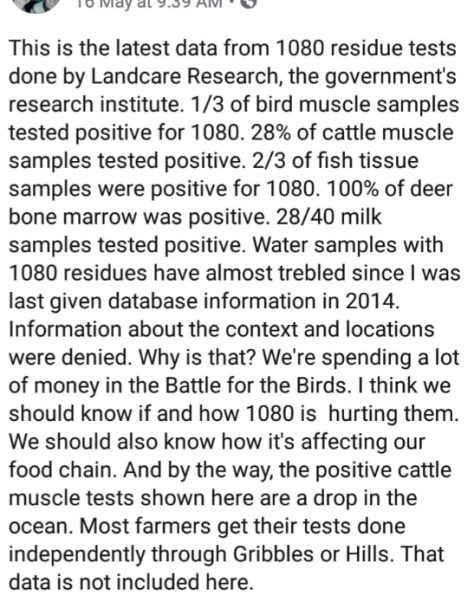
“Landcare Research maintains a national database of vertebrate pesticide residue test results, from samples of plants, soil and animal tissue and corresponding background information submitted to its Toxicology Laboratory at Lincoln.”
Lawyer Sue Grey and Regional Councillor Kathy White have obtained information via an OIA request from Landcare Research that confirms after 50 years of extensive application of 1080 poison (a Class 1A Ecotoxin) to NZ’s environment that 1080 is well established in our food chain. Water content has trebled in the past five years. Were it not for this info request we would all of course be none the wiser which is why it is advisable that you exercise the precautionary principle with regards to the food that you eat.
This is what Landcare’s website says regarding testing information. https://www.landcareresearch.co.nz/…/s…/advice-and-protocols
There is no effective antidote for 1080 poisoning in humans. A retired NZ MD Charles Baycroft has kindly & bravely told us that 1080 poisoning won’t be found because MDs are not allowed to look for it. Neither are you allowed to do an epidemiological study into its effects on humans. So if you die of it the good Doctor said, nobody will know. EWR
Midstream of an article further down here about a Labrador pet poisoned in the Hunua Ranges are the related links to the topic of 1080. ‘Council approves’ … ‘Kiwi repopulate’ and ‘bid to stop’ 1080 drop. The Kiwi repopulate one is pretty strategic or yes, could be random. Putting the positive shine on a sad topic however it ‘justifies’ the drops in the mind of you the reader. Since your government does not exercise the precautionary principle with 1080, you may like to familiarize yourself with the many things you aren’t being told by your ‘protection’ authorities or mainstream media, contained in the following six articles:
Hunua Ranges is the catchment area for Auckland city’s water supply
With the Hunua Ranges 1080 drop about to happen following a brief foray in court to stop it, where the judge deemed it should go ahead anyway in spite of 19 Doctors writing to the government cautioning about health risks. Not to mention DoC’s lawyers asking that their scientist not be cross examined… how dodgy is that? They just plow on regardless & ignore the voice of the people. Getting very fascist isn’t it?
Remember this post on social media? September just gone? QUOTE:
“I was there last week Doc wouldn’t let our lawyer cross examine their scientists and court allowed that. Lawyer won hands down against doc They couldn’t prove 1080 safety…..TOTAL CORRUPTION
Our lawyer proved by DoC’s own files they were lying …but we LOST”
NOTE: SINCE THIS POSTED, I’VE HEARD THE DROP IS NOT GOING AHEAD AT THIS STAGE. STILL IN COURT…. (PS 19/1/2019 … it DID of course go ahead).
Why do they not want their scientist cross examined? Couldn’t stand the heat? Don’t have the back up science for their data? Could be anybody’s guess but certainly not rocket science. Whatever side of the fence you sit on the 1080 issue, this is about justice of which there appears to be very little these days, remembering Graeme Sturgeon for instance & his ‘win’ that left him with $23K court costs. Looking from afar here we are being sent a very clear message which I’m sure you can figure out for yourselves.
THE INCREDIBLE LETTER BELOW HAS BEEN PREPARED BY DOCTORS WHO ARE CONCERNED ABOUT 1080 POISON BEING DEPOSITED IN DRINKING WATER
Open letter to the Government, Friday, 21st September 2018.
As doctors, we are extremely concerned about the health risk of depositing poisoned bait over 22,500 hectares of the Hunua water catchment area. Specifically, we are concerned about Sodium Fluoroacetate (SMFA / 1080), a known deadly poison which is known to cause sub-lethal effects on reproduction and is classified as a teratogen, having potential to contaminate the Auckland water supply.
This statement is made within correspondence in 1994 by an Eltham resident (NZ) to a US manufacturer of 1080 (details supplied in the document at the end of the article). The person was trying to ascertain the level of risk to environment and health regarding an imminent drop of 1080 poison into a Taranaki National Park.
It is interesting to note that the replies to all the risks the person raises in their questions are risks that are now deemed quite safe & have become normalized (to the authorities at least that is – many people are now very concerned, witness the recent hikoi & continual NZ wide protests going on).
Here are the questions and answers enlarged for reading:
The Auckland Council stated in its pacifying document that it used “highly accurate GPS application technology to apply bait”.
The truth is that GPS technology was used to ensure every stream and watercourse within the drop boundaries were spread with 1080 poison.
The Auckland Regional Public Health Service set conditions “to protect human health”, and also helped with the “drinking water monitoring plan”, stated Auckland Council in a project document. However, it’s sobering to note that in 2008 the Ministry of Health stated “To date there are no known epidemiological studies that have been carried out in relation to 1080 and potential adverse health effects on humans.” It’s now 2016, and still no studies on chronic impacts have been done, but the areas the poison is being dropped into our environment continues to increase ….
The 23,000 hectare parklands had just reopened that day after being closed for an aerial drop of 1080, or sodium fluoroacetate, in bait form as part an extensive pest eradication scheme.
Auckland Council’s operation lead Rachel Kelleher said although a rigorous track clearance programme was completed, and warning signs erected, “it is possible that dogs could come into contact with baits and carcasses if not closely supervised”.
Cara’s father said he did not note any warning signs driving in to the suspension bridge track parking lot, and didn’t keep her on a lead.
“She was in my sight all the time, but she was deviating one to two metres from the path.
“When we got home we saw that she had been vomiting a very bright-green substance with small dark blue granules.”
On the way to the Manukau After Hours Veterinary Clinic, she had a convulsion. She was given sedative, but it wasn’t enough to stop the fits.
The veterinary clinic’s practice manager, Jedda Ford said it appeared she had ingested a very large dose of poison, but couldn’t be sure if it was slug bait or 1080 – a sample had been collected for testing.
“The vet said there was a 5-10 per cent chance she would live and almost a 100 per cent chance she would have brain damage,” he said.
Essi was put to sleep on humane grounds.
Cara Popping said the family was beyond devastated.
“Everyone was her best friend; She was the most beautiful dog in the world,” her father said.
But the family weren’t interested in placing blame, or joining sides in the 1080 debate – they simply wanted to warn other dog owners to exercise caution around the Hunua Ranges.
“We’d hate for another family to got through the same heartbreak as we have,” Popping said.
The official Auckland Council advice is to keep dogs on a leash around in drop areas – and keep dogs well fed and hydrated.
In ‘clean green’ NZ (not) of course our authorities can kill off 10,000 birds in one drop with 1080 poison (link below article), and believe it or not, they are ‘saving our birds’. EWR
From achnews.org
In Brussels and Florence, people began to express concern over the rising finds of dead newborn birds (tits) in their nests.
When these concerned people notified the bird conservation association Vogelbescherming Vlaanderen and the ecological gardening association Velt, they began a crowd-funded investigation. Over 1000 people sent in dead tits and nests, which were analyzed and a report was published with shocking results.
“We found a total of 36 different pesticides in 95 mesh nests,” Geert Gommers, a pesticide expert said in a statement.
The birds’ nests revealed traces of 36 different fungicides, herbicides, insecticides and biocides. The alarm came when they found traces of DDT, an insecticide banned since 1974, in 89 of the 95 nests examined.
“That DDT is still present in our environment after all this time is worrying,” the statement read.
READ MORE
(NOTE there is a link to the report in the article however the report is not in English, you may have to use google translate):
Remember what NZ’s retired MD Charlie Baycroft said recently …‘if you die from 1080 poisoning, nobody will know because the Ministry of Health is bullying NZ Doctors into not testing for 1080′. There is no evidence of 1080 poisoning he says, because it is not allowed to be looked for. EWR
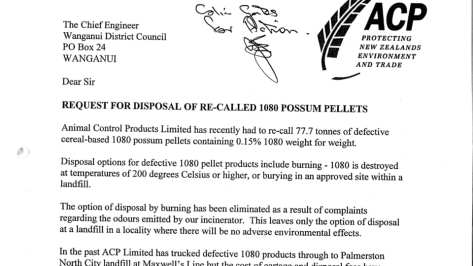
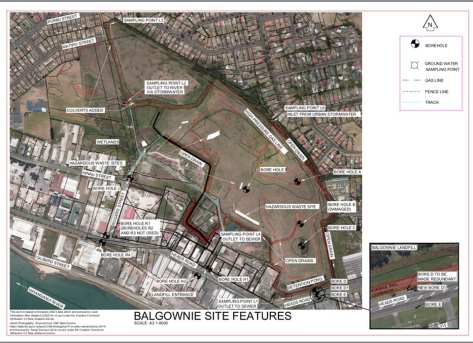
Heart disease and Cancer dominate mortality in Whanganui where the Government owned 1080 poison factory used to burn 1080 to dispose before residents complained about the smell of toxic fumes. Eighty tonnes gets buried there and they signed off by digging up some baits that are well known to leach and then called that environmental testing. USA EPA have proved 1080 binds specifically and doesn’t flush off with water meanwhile Landcare have never tested for adsorption of 1080 to sand.. they don’t have an accredited test for gravel either. Take a look at where they buried 80 tonnes of baits that were defective due to moisture in the grains.. not because of defective 1080.. the place is coastal so has sandy soils. What monitoring of the local people’s health has been done to see if there is a link.. none. That’s the quality of the science here in New Zealand.
RELATED:Transforming a Whanganui wasteland to a wetland
Lawyer, Sue Grey testifies to a number of unlawful acts of the crown and its contractors who have been aerially spreading deadly poison, called 1080, on DOC land, Maori Land and private land. Sue and her team has identified over 10 possible legal challenges involving apparent criminal or civil breaches of statutory obligations by DoC, OSPRI and/or poison contractors. Sue Grey testified on June 23, 2019 before the ITNJ Commission of Inquiry into Weaponisation of the Biosphere. Watch all the Indonesia Seatings at https://commission.itnj.org Help continue this work and expose the next phase of expert witness testimonies. http://www.itnj.org
“Sue Grey Testimony on New Zealand’s Ecocide with the use of 1080 Poison
The ITNJ opens its Commission of Inquiry into the Weaponisation of the Biosphere with stunning testimony from New Zealand expert witness Sue Grey, in what she describes as ‘ecocide’ and ‘a war on nature’.
A lawyer and activist with multiple science degrees and over 30 years’ experience in environmental health policy, Sue testifies to the devastation being caused to New Zealand’s native wildlife and ecosystems through the systematic and widespread aerial poisoning with the chemical Sodium Fluoroacetate, commonly known as “1080” Poison.
Four hundred million 1080 pellets (enough to kill over a hundred million people) will be spread by helicopter this year over much of the country’s land and waterways, in a longstanding Crown sponsored program, its stated purpose: to preserve native wildlife by eradicating non-native stoats and rats. However, the cereal baits attract many other species of insects, birds, and mammals, contaminating the food chain and cruelly killing thousands of “non-target” species including deer, farmed stock and dogs. There has been a drastic impact on Kea (native parrots) and cereal baits are known to poison many other species of native bird including iconic Kiwi and Weka.
Birds and animals can be poisoned by eating the bait directly, drinking from poisoned waterways, or by feeding on the carcasses of poisoned animals. Evidence also exists that 1080 has made it its way up the food chain into wild pork, farmed cows and honey, and is also suspected to have poisoned humans, many of whom Grey has represented.
Despite many years of campaigning, lawsuits, public outcry, and official statistics that prove its catastrophic failure, the New Zealand government refuses to take responsibility and bring an end to the serious threats posed by this program to New Zealand’s ecosystem and its inhabitants.
ABOUT THE ITNJ: The ITNJ is the world’s first people-powered tribunal that operates independently of governments and corporations, and is therefore willing to issue rulings against those organizations based on Natural Law, where agents of governments and/or corporations have caused harm or loss to living men and women, and in this case, matters that relate to the weaponization of our biosphere and the existential ecocide and genocidal threat against humanity.
FOR MORE INFORMATION PLEASE VISIT: commission.itnj.org CONTACT:press@itnj.org
TO LEARN MORE ABOUT THE ITNJ, PLEASE SEE: www.itnj.org / itnjcommittee.org
FOR PRINT QUALITY PHOTOGRAPHS PLEASE CONTACT: media@itnj.org
Marcus James talks to Jim Hilton about Health effects of 1080 on the unborn fetus and how pregnant women are not warned by the health boards in areas where there are drops or by DoC not to drink the water or be in the area because of dust residue/particulate matter.
A must watch also is Poisoning Paradise, the doco made by the GrafBoys (banned from screening on NZ TV, yet a 4x international award winner). Their website is tv-wild.com. Their doco is a very comprehensive overview with the independent science to illustrate the question marks that remain over the use of this poison. There are links also on our 1080 resources page to most of the groups, pages, sites etc that will provide you with further information.
Recent information from Animal Control Products Ltd is that DoC buy between 30% and 50% of their 1080 product every year, that OSPRI and regional councils account for another 40%, and (presumably) ZIP and Predator Free NZ account for the rest…. between 10% and 30%.
As DoC have produced maps showing they intend to be covering 1.124 million ha with aerial 1080 this year, at a rate of 1.5 to 2 kgs per ha, and even if they account for a 50% buy-up of the poison, we can safely assume a total of about 4,000 tonnes of 1080 poison baits will be spread on our land this year.
That is 6,000kgs of pure 1080 poison (at the standard 0.15% pure poison per bait rate).. So at an LD50 of 0.5mg per kg bodyweight that means 35mg can kill a 70kg human being. That works out to be theoretically enough 1080 dropped on NZ this year to poison 171,428,571 x 70kg people, with half of them, 85,714,285, having a lethal dose!
LD50 : [ Based on fatal or near-fatal cases of human poisonings, the dangerous dose for humans is 0.5-2.0 mg/kg BW (Negherbon 1959)]
(LD50 stands for Lethal Dose 50 – killing with poison is not an exact science so an LD50 is used, which means that one can assume 50% of the people poisoned will die. It doesn’t mean the other 50% get off scot-free!)
Photo credit: supplied by Carol Sawyer
If you are new to NZ’s 1080 poisoning program here is a good article to start with …
A must watch also is Poisoning Paradise, the doco made by the GrafBoys (banned from screening on NZ TV, yet a 4x international award winner). Their website is tv-wild.com. Their doco is a very comprehensive overview with the independent science to illustrate the question marks that remain over the use of this poison. Check out also 1080science.co.nz for the independent science.
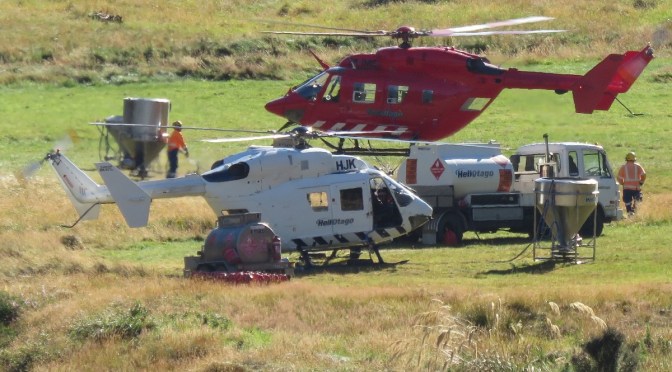
There has been much discussion about the helicopters used in HeliOtago’s 1080 drops being also used as rescue helicopters for the Otago Rescue Helicopter Trust.
Some people have said that toxic 1080 dust can not get into the helicopters because the blades push the dust down and away from the machines. I have been sent this film by a heli pilot who says this is not so and comments : “From about 2.50 in on this clip, has speed up so vortex is left behind, but at lower speeds it comes back through disc.”
Go to about 2.00 in this film and have a look and imagine it is lethal 1080 dust and not fertiliser. You will be horrified !
Other pilots have told me it is impossible to completely decontaminate a helicopter of 1080 dust – bad for helicopter pilots, helicopter maintenance staff, and PATIENTS – and any passengers actually. Don’t get into a 1080 poison helicopter if you can avoid it !
Remember, this is what Milford local Sacha Stevenson recently wrote to DoC about. No warning signs for tourists. Turns out they won’t be putting any up about the water, just the usual signs with the skull on to warn them since they haven’t resources to put signs up in every tourist’s language. Signs will only indicate pellets, not the risk of water contamination. And the other rationale cited, that it’s ‘extremely unlikely’ the water will be poisoned. Whatever happened to the precautionary principle? Not good enough. EWR
By Carol Sawyer Video by Shane Wilson
“Oh well”, says the NZ government, “They’re Chinese. They don’t know any different. What do we care?!”
It’s appalling actually. No self-respecting Kiwi (on second thoughts there might be a few) would drink out of those creeks in the middle of a 1080 poison drop – or afterwards. Shane Wilson watched as four busloads of tourists stopped there on “Aerial 1080 Poison Day” and filled up their water bottles. They probably thought the helicopters were taking tourists for a joyride! Shane tried to warn some of them but they didn’t understand him.
Department of Conservation reports of a rat explosion in the Northern Ruahine Ranges defy credibility and show the department was “out of its depth” in wilderness management according to a sporting hunters’ organisation.
Laurie Collins spokesman for the Sporting Hunters Conservation Outdoor Trust (SCHOT) said research had shown that following aerial drops of 1080 poison, the 20 percent surviving rats with much reduced food competition exploded in numbers. He cited Ruscoe’s research in 2008 “Interaction of Mammalian Pest Populations following Control” that showed rats recover quickly and increase quickly so within 18 months rat numbers would be two to three times greater than before poisoning operations.
And ‘long’ it has been. What the Herald failed to mention is that her Doctor suspected 1080 poisoning which is why he asked for her heart to be tested. Please read our earlier article on this … the Doctor was in effect stone walled which confirms Dr Baycroft’s information (see below).
Have you ever heard of a lab losing a human heart before?
This is horrible beyond imagination for this family. And it sounds extremely suspicious doesn’t it? This family was paid absolutely no respect in this. Not by the authorities anyway. Remember what retired Doctor Charles Baycroft has told us recently… ‘if you die from 1080 poisoning nobody will know’ because Doctors he said are not allowed to look for it, and they are bullied into not testing. Word has it that the leaves in the area where Whitney walked that day were smeared with 1080 gel, a highly concentrated application.
The NZ authorities do not practice the precautionary principle with the spreading of 1080 poison people. In fact they are now legally allowed to drop it into your waterways without the previously required consents, even though the manufacturer’s warning says take care not to drop it into the waterways. Whilst they continue to claim it is harmless, there is much independent research that says otherwise. (See 1080science for further independent info). In light of that, in my opinion it is safer to follow the precautionary principle, that is, proceed as if there were a possible risk to your health rather than assume there is none. EWR
The family of an American backpacker whose heart went missing after she died suddenly in Queenstown last month face a long wait.
The Auckland District Health Board is investigating the disappearance of 23-year-old Whitney Robie’s heart from LabPlus, the hospital’s pathology laboratory.
Miss Robie collapsed while watching TV at Deco Backpackers in Queenstown on May 15 and died shortly afterwards despite efforts to revive her.
“I USED TO HAVE A HUGE FLOCK OF KEA AROUND MY FARM DOWN THE WEST COAST…
..and when they did a big 1080 drop, maybe 12 or 15 years ago, they completely wiped this flock of several hundred, possibly as many as a thousand, Kea out in one fell swoop. They were all dead within days. The tops around the farm were from that point on, until I sold it and left, were silent.
Also all the bush falcons get wiped out in the bush, harrier hawks, etc…
the destruction that it causes is incredible.
Whenever you do a survey in the bush after a big 1080 drop you will find all sorts of dead birds, including the insect-eating birds.”
A must watch also is Poisoning Paradise, the doco made by the GrafBoys (banned from screening on NZ TV, yet a 4x international award winner). Their website is tv-wild.com. Their doco is a very comprehensive overview with the independent science to illustrate the question marks that remain over the use of this poison. There are links also on our 1080 resources page to most of the groups, pages, sites etc that will provide you with further information.
Check out the 1080 pages at the main menu, particularly the sub tab, ‘suspected 1080 poisoning cases’. Finally, remember what the retired MD Charlie Baycroft said recently …‘if you die from 1080 poisoning, nobody will know because the Ministry of Health is bullying NZ Doctors into not testing for 1080′.
Finally a note re commenting:
Whilst your comments are welcome, this is a venue for independent info. Please discuss/debate your pro poison thoughts in mainstream where they’re welcomed & independent info is not. You will find the independent science at 1080science.co.nz Or search other articles in categories at the top, left hand side of the page.
The following article appeared in the Christchurch Press in January 2002. What’s intriguing is how the British team quickly identified indicators of an industry built on poison, and how their story echoes the voice of 1000’s of New Zealanders across the country – even after the ERMA reassessment of 1080 poison in 2007…Poison use ‘a sinister tale’.
Article from:
The Press Article date: January 29, 2002NELSON — A British filmmaker’s criticism of 1080 poison use in New Zealand has alarmed government departments.
Terry Brownbill, making a documentary to be screened in Europe, says the real story behind our use of 1080 is “a sinister tale of corruption and bureaucratic indifference”.
The Department of Conservation (DOC) says his allegations of public lies and alleged corruption are unfounded.
The Ministry of Agriculture and Forestry, worried about the documentary’s impact on meat- export markets, says concerns expressed by Brownbill about the possibility of 1080 residue entering food are invalid.
Last May Brownbill led a two- man film crew on a three-week tour of New Zealand, talking to opponents and supporters of aerial 1080 use. The resulting documentary is still being edited.
Brownbill says DOC and the Animal Health Board (AHB) were “empires built on poison” and British viewers of his documentary would be horrified by the poisoning of New Zealand “in the name of the Queen”.
Brownbill’s documentary was commissioned by Britain’s Sky TV.
Brownbill said the programme made it very clear New Zealand’s pure image was a sham.
“When the world gets to know the full horror of how New Zealand is carpet bombing millions of acres of farmland and native forest, there will be a backlash which could seriously affect agricultural exports and tourism,” he said.
“Both DOC and the AHB are empires built on poison.
“New Zealand seems far more concerned about losing its clean-green image than it does about protecting its people.”
Animal Health Board communications manager Nick Hancox said the board was more interested in achieving its aim of reducing TB in New Zealand than “empire building”. —NZPA
0800 Free-call Number for Victims of 1080 Poison Operations
“Brownbill claimed to have found a “hot spot” of 9 people suffering with brain tumours, living around the small town of Kumara, on the West Coast. He went on to say that he believed the tumours were a result of an incident in which he said five tonnes of 1080 bait was buried near a stream in the area, and that no Medical Officer of Health went on to investigate this “hot-spot.” “
The Graf Boys
Clyde Graf
After finding it difficult to get help, from what they believe is 1080 poisoning, the owners of an iconic tourist business based on the west coast of the South Island have established a free-call number – 0800 BAN 1080 (0800 226 1080) – for people to share their experiences after aerial 1080 operations.
The concern about 1080 poisoning is not a new phenomenon. While filming on the West Coast in 2002, a British film crew led by Terry Brownbill, stated New Zealand’s use of 1080 poison “was a sinister tale of corruption and bureaucratic indifference.”
Brownbill claimed to have found a “hot spot” of 9 people suffering with brain tumours, living around the small town of Kumara, on the West Coast. He went on to say that he believed the tumours were a result of an incident in which he said five tonnes of 1080 bait was buried near a stream in the area, and that no Medical Officer of Health went on to investigate this “hot-spot.”
However, the Agriculture Minister at the time, Jim Sutton, said the “1080 documentary maker should put up or shut up,” and disputed the British journalist’s claims, inferring that “the risk of 1080 residues entering the food supply is very low.”
History shows that Mr Brownbill’s claims do have credibility. Hundreds of farm animals – including sheep, dry stock, cows, horses, and deer – have been poisoned in aerial operations across the country, since the British film crew left New Zealand. It would seem improbable that all of these animals had received a lethal dose, without any of their surviving paddock companions, not receiving sub-lethal doses. (Only about one animal is tested for 1080 residues in every 2 months, and is randomly chosen from anywhere in New Zealand. So the chances of actually striking an animal from where a drop has taken place within a few days of testing, is consequently, very low.)
There are plenty of cases of farm animal deaths following aerial poisoning operations, from Northland to Southland.
In one case, it was reported in the Wairarapa Times Age that 9 dairy cows were poisoned by 1080.
The processing plant spokesperson stated that “at the end of the day if contamination is suspected we’d like to hear about it”. The milk from the cows was subsequently processed into milk powder before the farmer had warned the processing plant that his cows had been poisoned.
In the documentary Poisoning Paradise, Taupo (Western Bays) farmer Lance Aldridge states that his neighbor had over 150 sheep poisoned in one operation, and that in other drops he has had deer and cattle poisoned, with test results showing 1080 residues in carcasses as much as 12 months after the poisoning operation took place. He states that he believes the animals were either poisoned by the 1080 remaining in the fields where the animals were grazing, or from streams feeding the farm, following another drop over 5 kilometres away.
The creators of the free-call number believe there is mis-trust and fear among communities, of not being taken seriously when contacting the authorities, especially when those they are encouraged to engage with are the very departments dropping the poisons.
In 2008 midwives from Karamea, also on the West Coast, warned several pregnant ladies to leave the district while an aerial 1080 drop was being conducted. The response to their warnings from authorities was astonishing and swift. The mid-wives were humiliated publicly. Not surprisingly, another drop is planned for the Karamea region this year.
In December 2008, the Ministry of Health published a statement including the following paragraphs:
“Studies show that 1080 can cause foetal skeletal malformation, cardiomyopathy/damage to heart muscle, and testicular effects/reduction in sperm count in animals.”
“To date, there are no known epidemiological studies that have been carried out in relation to 1080 and potential adverse health effects on humans.”
It’s not just health concerns that the 0800 number is setup for.
Many people, all across New Zealand have had their pets and live stock poisoned. “We’d like to hear from them too,” stated the 0800 free-call trust’s spokesperson.
The inconvenience and investigations that follow placing a complaint, discourage victims.To make a claim, and have that claim registered, and officially recorded, is a long and complex process. Hence the recent claim by the PCE that only 8 dogs have died from 1080 poison in the last 4 years. This is inaccurate.
One Taupo farmer alone has had 8 of his working dogs die after poisoning operations around the farm he manages. The killings are endless, right across our country.
Do the people of New Zealand have reason to be concerned? Yes they do.
Should the people of New Zealand rely on government departments, government organisations and industry supporters to provide them with robust research, and consumer confidence – when the pest control company that imports 1080 poison and produces the 1080 bait, is owned by our government, and when the Minister of Finance and the Minister of Agriculture represent 50% shareholdings in the company that imports the poison? No, they shouldn’t!
“If you have been a victim of 1080 poisoning, or you know of someone that has, please phone 0800 BAN 1080, and talk about it. If you believe you’ve been poisoned, you’ve had stock poisoned, your water-supply poisoned, or your pet poisoned – even if it’s historical – please call and let us know. It’s free, it’s independent, and it’s confidential. It’s time to start a credible record of the impact of poisoning operations.” Said Clyde Graf.
And one last thing – take advantage of the opportunity to watch Poisoning Paradise free, at the Green Unplugged Film Festival, and please spread this 0800 free-call phone number to your friends and family. The destructive use of 1080 poison can only be stopped, with your help.
Sadly this is what has happened on more than one occasion in (not) clean green New Zealand. A warning about 1080 poison a Class 1A Ecotoxin that unbelievably NZ authorities claim is not very dangerous: our authorities do not practice the precautionary principle with the spreading of 1080 poison. In fact they are now legally allowed to drop it into your waterways without the previously required consents, even though the manufacturer’s warning says take care not to drop it into the waterways. Whilst they continue to claim it is harmless, there is much independent research that says otherwise. (See 1080science for further independent info). In light of that, in my opinion it is safer to follow the precautionary principle, that is, proceed as if there were a possible risk to your health rather than assume there is none. Since 1080 is a known teratogen I believe it is particularly important for pregnant mothers or even those who think they may be or who could be pregnant, to distance themselves from an area where 1080 is being distributed, particularly aerially because of the drift of the dust over long distances.
So if you are out tramping, visiting from overseas or just an unaware local, you’d be wise to take your own drinking water (don’t use the streams, taps etc) and check very carefully with DoC when making plans to be sure there will be no drop in your vicinity. The signage it appears, is not always there to warn you. (See further notes & info below the Stuff article). EWR
From Stuff
A couple are angry and upset that a holiday weekend tramp through a Pelorus Sound track ended with them being “dusted” with 1080 bait.
Kaiuma Bay couple Simon and Carol Caley have written an open letter of complaint to the minister of conservation, and are also seeking an apology for his department’s “complete and utter failure to protect the public” after pellets were dropped near them from a helicopter on Saturday.
Health and conservation authorities are investigating how toxic 1080 bait was spilled on to the track.
The Nelson Marlborough Public Health Service (PHS) is investigating a breach of a condition under which a Department of Conservation (DOC) 1080 drop was permitted in Pelorus Sound over the weekend.
A must watch also is Poisoning Paradise, the doco made by the GrafBoys (banned from screening on NZ TV, yet a 4x international award winner). Their website is tv-wild.com. Their doco is a very comprehensive overview with the independent science to illustrate the question marks that remain over the use of this poison. There are links also on our 1080 resources page to most of the groups, pages, sites etc that will provide you with further information.
Check out the 1080 pages at the main menu, particularly the sub tab, ‘suspected 1080 poisoning cases’. Finally, remember what the retired MD Charlie Baycroft said recently …‘if you die from 1080 poisoning, nobody will know because the Ministry of Health is bullying NZ Doctors into not testing for 1080′.


















 Remember this post on social media? September just gone? QUOTE:








You must be logged in to post a comment.