Category Archives: 1080

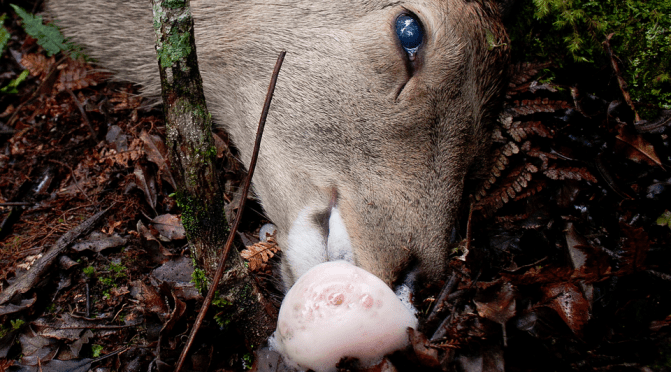
DEER POISONED WITH 1080 can experience exploded internal organs, they tear open their own stomachs with their antlers, blood oozes from eyes & nose & their eyes pop out

A repost from 2019

These images were captured in the Taupo Region in 2016, images of contorted deer that have died a slow agonizing death from 1080 poisoning. For over 50 years the New Zealand Government has been systematically dropping massive amounts of food, laced with this cruel and universally toxic poison into its forest ecosystems. Enough poison every year to kill the entire population of NZ four times over. No other country is doing, or ever has done, anything remotely similar on such a scale.

READ AT THE LINK

If you’re new to the independent information about NZ’s favourite poison for ‘saving’ birds (one aerial 1080 drop in 2002 killed an estimated 10,000 birds … Landcare’s own data) a must see is the GrafBoys’award winning doco, Poisoning Paradise.

Explore our 1080 pages (main menu) or use the drop down box, left hand side of the page. Animals die a very cruel death with 1080. A Veterinarian has explained death by 1080 as slow electrocution. The NZ authorities tweaked the Animal Welfare act to exempt the spreaders of aerially dropped 1080 poison from prosecution for cruelty!

Finally, they want rid of all non-natives. They are not telling us that directly of course. Jenese James describes NZ’s Pest Free agenda in her article, Who is driving PFNZ?:

RELATED POSTS HERE

AND HERE:

Why are people so concerned about 1080?

A farmer who lost 570 ewes following an accidental 1080 drop on his farm said that 6 months later sheep were still dying


Back in 1994 Dr Meriel Watts wrote in her book The Poisoning of New Zealand*, of constant phone calls to the Soil & Health Assn by  folk asking … “Is 1080 safe & do I have to let them drop it on my property?” The Association’s view at the time she said was ‘no’ and ‘no’. Soil & Health’s submission to the Parliamentary Commissioner for the Environment’s Possum Management review stated that “the current practice of distributing by air large amounts of 1080-laced carrot and pollard baits over large areas has lead to unacceptable risks to the environment, human health, dogs, farm stock, birds and other members of the ecosystem.” (p 186, 187).

That submission cited various incidents experienced by farmers.

“In one case a South Island farm lost 570 ewes when 1080 was dropped in his pastures as a result of the helicopter swinging too wide when dropping over bush patches. His sheep were still dying up to six months later; there were also a large number of abortions.” (Dr M Watts, p 187)

“In another case … a central North Island farmer came home to find 1080 spread all over her farm and around her house. There was a nice sign stating this fact, but no prior notification and no prior permission given. Fortunately her dogs were locked up.” (Dr M Watts, p 187)

We seldom of course hear of these incidents as they are not normally featured by mainstream media.  It has been highlighted via the GrafBoys’ information that these stats are actually hidden in the paper work.

Farmers, when claiming compensation, are required to list that compensation as for purposes other than poisoned stock losses.

Please read the comments at this link (previous post) where a farmer shares about the loss of his dogs to likely 1080 poisoning. “MAF and DOC hushed it up pretty quick” he said.

See tv-wild.co.nz also for further info from the GrafBoys. Watch the video on topic at their Youtube channel here.


*The Poisoning of New Zealand by Dr Meriel Watts, Ak Institute of Technology Press, 1994

Image by Roman Solar from Pixabay (note, not the actual farm or farmer in the article).

A mother & 3 children poisoned in 2016 by 1080 poison dust said the NZ hospital had no idea what to do!

So the NZ authorities have been bombarding our forests & farms with this Class 1A Ecotoxin for well nigh 60 years, and the hospitals still don’t know what to do?!!! Don’t have a plan in place at all? Doesn’t that sound well … not too intelligent?

A repost on 1080: READ AT THE LINK

Image by Usman Yousaf from Pixabay

If you still think 1080 is saving our birds you must watch the award winning Poisoning Paradise doco

“This New Zealand film has won 4 international environmental awards – but here in NZ, TV channels refuse to play it. Why? Because if they did, there would be outrage and riots over New Zealand’s use of aerially applied 1080 poison. See for yourself … ”  From TheGrafBoys‘ Youtube Channel

Learn more here

And explore our 1080 pages at the main menu. Particularly info on the disappearing bird populations and the suspected poisoning of humans.

Remember this,

“IF YOU DIE FROM 1080 POISONING NOBODY WILL KNOW” … BULLIED DOCTORS ARE NOT DOING THE TESTS … Dr Charles Baycroft

and this,

Two scientists who reviewed more than 100 of DoC’s scientific papers say: “There’s no credible scientific evidence showing any species of native bird benefits from 1080 drops”

See here also. And select 1080 from the drop down categories box, top left of page.

SOURCE

“No dead body will ever be tested for 1080 in NZ because any pathologist who did so would not have a job for long”… NZ MD speaks out

This is an older post from Carol Sawyer, a New Zealander researcher and writer who spent many years intensively examining the information on 1080 poison. Information that DoC is not interested in. Here Carol interviews retired GP Kevin Shannon on the 2006 story concerning the loss by a NZ laboratory of the heart of a young woman who was a suspected victim of 1080 poisoning while tramping in the South Island Dr Shannon’s statement explains the reticence of any laboratory that does test for 1080 in disclosing their identity. EWNZ.


Police tested for about six poisons, none of them 1080, and then “had the effrontery” to tell him this was not a death by 1080 poison.

hiking-358555_1280.jpg

By Carol Sawyer

Last year I met with retired Dunedin GP, Kevin Shannon, still fit and tall and travelling the world at the age of 87. Kevin (who gave a submission at the ERMA Review 2007, on the case of the death of a female tramper in the link below), is of the opinion that:

…some New Zealanders, no-one knows how many, will have died of heart attacks due to undetected Compound 1080 (sodium monofluoroacetate).

Kevin added that in this instance the Police tested for about six poisons, none of them 1080, and then “had the effrontery” to tell him this was not a death by 1080 poison.

He told me that no dead body will ever be tested for 1080 in NZ because any pathologist who did so would not have a job for long.

See article here :

https://envirowatchrangitikei.wordpress.com/…/could-this-h…/

(see here also)


RELATED:
 THE CATCH 22 OF 1080 POISONING IN NZ – AN MD SAYS THERE IS ‘NO EVIDENCE’ OF IT BECAUSE IT IS NOT ALLOWED TO BE LOOKED FOR

NO ONE IS ALLOWED TO DO AN EPIDEMIOLOGICAL STUDY IN NZ TO SEE HOW 1080 POISON MAY BEHAVE IN OUR POPULATIONS LIVING WITHIN THE POISON AND DUST ZONES

“IF YOU DIE FROM 1080 POISONING NOBODY WILL KNOW” … BULLIED DOCTORS ARE NOT DOING THE TESTS … Dr Charles Baycroft

“In case you have any doubt, the MOH and their clerical employees have a great deal of control over our medical professions and they do not take kindly to anyone expressing an opinion that they disagree with. Working Doctors with current practicing certificates have to tread lightly where the MOH and their agendas are concerned.” Dr Charles Baycroft

NB: Exercise the precautionary principle and take extreme care whilst tramping in NZ’s wild places. The Class 1A Ecotoxin 1080 is spread liberally and aerially around NZ’s environment and we are told it is not very harmful to humans. See our page on suspected 1080 poisoning cases.

SOURCE

Photo Credit: Carol Sawyer

1080 – where are the cancer causing or carcinogenicity studies?

Some of our readers will have seen this post. I’m re-sharing it, and others on topic going forward, as many will not be up to speed on this toxin that our conservation ‘experts’ (DoC) swear is harmless once dissolved in water (hence why they can now dump it in our waterways). They spread it all over NZ like veritable lolly scrambles :

For over 50 years the New Zealand Government has been systematically dropping massive amounts of food, laced with a cruel and universally toxic poison into its forest ecosystems. Enough poison every year to kill the entire population of NZ four times over. No other country is doing, or ever has done, anything remotely similar on such a scale.

1080 is an alias for Monofluoroacetate, a chemical. Monofluoroacetate was originally developed and marketed as an insecticide. It functions primarily by interfering with the citrate step in the Krebs cycle [5]. The Krebs cycle is the major and an essential mechanism by which all air breathing creatures utilize food to produce energy. It is therefore universally toxic to all animals, essentially every living thing except plants and some micro-organisms. The degree of toxicity of 1080 is extreme, but varies somewhat among species. It is categorised by the World Health Organization (WHO) as 1A, their highest rating, “extremely toxic” [1,2]. The PAN pesticide database classifies 1080 as one of the few “PAN Bad Actor Chemicals”, by which it means “highly acutely toxic” [2]. It can kill every air-breathing animal. One hundred milligrams is sufficient to kill an adult human [1]. In theory, one could kill at least 20 million people with the amount being dropped into New Zealand Forests every year.
Dr Q Whiting-OKeefe (BA Chemistry, Math), MD, FACMI

RELATED:

Poisoning Paradise (must see award winning doco banned from NZ screens)

Why are people so concerned about 1080?

For further info on the carcinogenicity of 1080 and to hear the late Dr Scanlon discussing the issues highlighted below go to this article: IN 2009 TWO MIDWIVES URGED THEIR PREGNANT PATIENTS TO LEAVE TOWN BEFORE A 1080 DROP – HEAR THE LATE DR SCANLON SPEAK ON THE LACK OF RESEARCH ON THE POTENTIAL RISKS TO THE UNBORN

dr scanlon 1080 .png

SOURCE

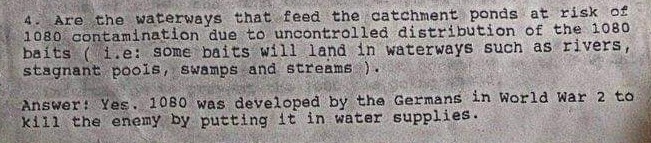
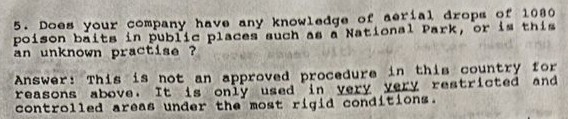
1080 was added to water supplies by Germany in WW2 as a chemical weapon says a US manufacturer – & the NZ authorities are dropping it aerially into NZ’s waterways

A repost from 2018 EWNZ

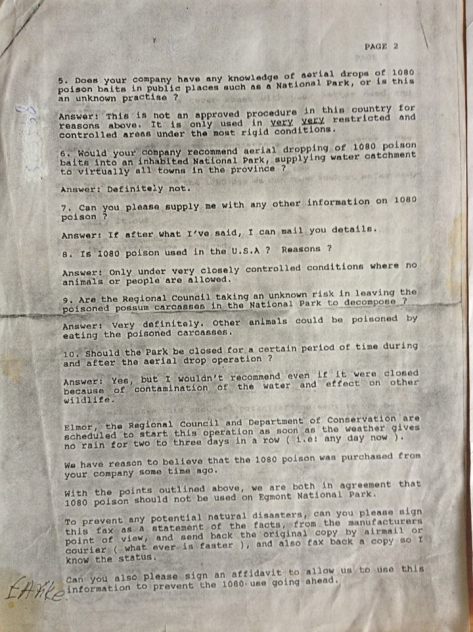
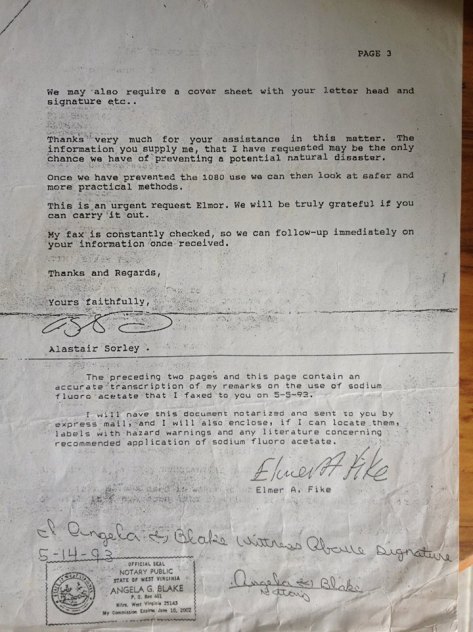
This statement is made within correspondence in 1994 by an Eltham resident (NZ) to a US manufacturer of 1080 (details supplied in the document at the end of the article). The person was trying to ascertain the level of risk to environment and health regarding an imminent drop of 1080 poison into a Taranaki National Park.

It is interesting to note that the replies to all the risks the person raises in their questions are risks that are now deemed quite safe & have become normalized (to the authorities at least that is – many people are now very concerned, witness the recent hikoi & continual NZ wide protests going on).

Here are the questions and answers enlarged for reading:

1. sec poisoning

Nowadays we are told that 1080 targets pests and we are given the impression that little if any other form of wildlife is affected. In fact nothing could be further from the truth.  A person told me recently in the Manawatu that she was told no birds would die in the bush nearby when it was 1080ed however to her surprise she found a dead bird after the area was treated.  Of course we now know that this is a common occurrence by the testimony of many people who find multiple dead birds after drops, photograph them & post them online. And of course we have the various documentations that we’ve published here of multiple finds, with latterly the estimate by a Landcare scientist of 10,000 birds in a South Island drop. Just search ‘birds, 1080’ in our search box to find more.

2. Risks

Again we have multiple examples of people finding themselves in drop zones without realizing it, some bombarded with pellets. We also have examples of families with children finding baits on the walking tracks. According to the above they are at substantial risk but DoC doesn’t seem to think so. They tell us “1080 presents little risk to humans or the environment”. 

3 in water

We are regularly told that 1080 breaks down to harmlessness in water. A scientist told me the other day it is so diluted it isn’t a problem, repeating the cup of tea mantra we hear so regularly.  We also learned recently it was added to water to poison ships rats and we heard from the former Greens co-leader that there are question marks over the official testing on 1080 concentrations in water.

4 Germans

This is very enlightening. No wonder the data sheets tell us not to allow it into waterways. However NZ it seems makes up their own rules on that one. No research to prove their point, they just tweaked the rules.  Here is a link to the information regarding the development of 1080 by Germany for use as a chemical weapon in water supplies.

5 aerial drops

Not approved in the US! “Very very restricted & controlled areas” only. And here it is chucked around like a veritable lolly scramble. The baits aren’t picked up off public walkways & neither are the poisoned animals collected & disposed off,  frequently left to rot in the water where eels and other meat eaters can feed off them (Watch Poisoning Paradise on that one).

6 national park

Remember the Hunua Ranges drop recently? A Court injunction to stop that one failed & during the proceedings DoC lawyers asked (and were granted) that the opposing lawyers not be allowed to question the DoC scientist. Now doesn’t that say something? Let’s not forget Bill Benfield’s revelation either that a drop in the Hunuas in the ’90s left the water filters packed with 1080 pellets. Good one DoC. And none of the public ever got to hear about it.

8 USA

Previously I’ve noted the frequent discovery of pellets on tracks, drops going on around tourists, pellets dumped near people fishing, on it goes. The veritable lolly scramble again.

10 quarantine

Water & wildlife contamination. Something we are repeatedly told does not happen. The manufacturer’s data sheet warns users not to drop into waterways. NZ has tweaked the rules of course so they can.

You may need to make your own decisions on all of that & make your own plans for non-contamination if necessary. It does not look like anybody else is going to.

Here are the whole pages of the documents with addresses & contact details:

1. Letter to Fike Ent.
2. Letter to Fike Ent.
3. Letter to Fike Ent.

Discover more from Environmental Health

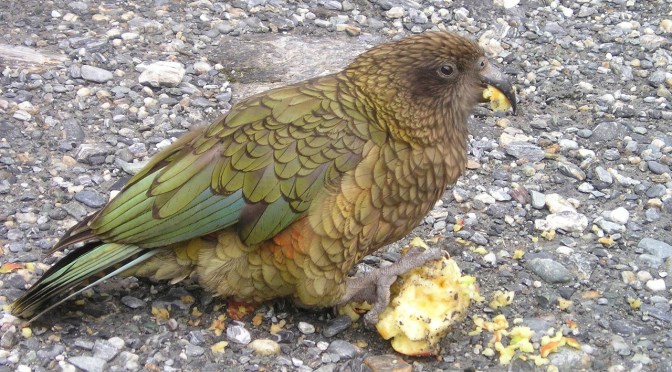
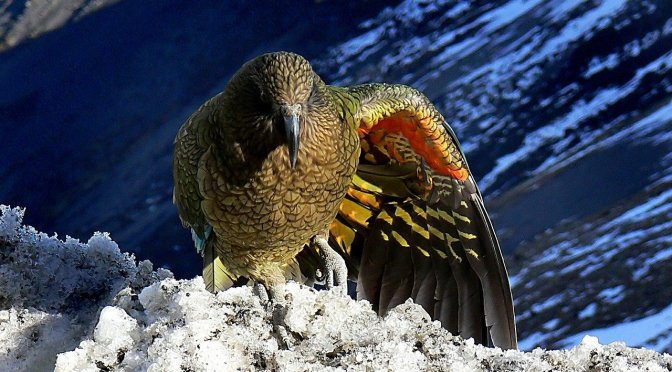
DoC’s own data reveals each 1080 poisoning operation kills on average 12% of NZ’s native kea – “a tragedy easily avoided” – Dr Jo Pollard (2020)

NZ’s Dept of Conservation would have us believe 1080 targets pests only. One aerial drop in Otago in the South Island in 2002 revealed an officially estimated 10,000 native bird deaths! Search Kea in the search box (right of page) for further info on Kea deaths due to aerial 1080 poisoning … EWNZ


Dr Jo Pollard, BSc (Hons), PhD

Posted by Carol Sawyer

(Published in the Greymouth Star, 10 March, 2020)

In 1979 scientist Eric Spurr warned that wide scale poisoning of New Zealand with compound 1080, intended to kill introduced mammals, was actually killing kea and many other animals. It took decades before NZ’s Department of Conservation (DoC) finally began to monitor kea deaths from 1080 poisoning.

Now, using DoC’s own data, we can estimate that each poisoning operation will kill an average 12% of kea.

During the most horrific example DoC managed to kill 78% of the tracked kea population (7 of 9 kea monitored at North Okarito). Last month, in the Matukituki Valley, 50% of DoC’s monitored kea died after a 1080 drop.

Disturbingly, two myths have again been rolled out in an attempt to soothe public anger over the destruction of these now rare, iconic birds.

Myth 1. Kea are only likely to eat baits if people have conditioned them through providing food previously. DoC’s own research shows that this is not true. 9% of monitored kea (2/22) died at Kahurangi, a site chosen by DoC precisely because of its remoteness.

The fallacy of this claim is clear to anyone with experience of kea. They are curious to examine and pull anything new apart – as motorists will often attest after even the briefest of encounters with these inquisitive creatures. Scientists consider that this trait is likely an adaptation to living in a harsh environment, where food can be very hard to find, especially in winter (when 50% or more of kea juveniles are likely to die of starvation). Before the advent of DoC, helicopters and a toxin designed to kill everything from microbes to mammals, a willingness to try a new food source undoubtedly played a key role in the birds’ survival.

Myth 2. Kea nests need protection from stoats and 1080 poison provides that protection. Two studies have shown that the presence of stoats does not bother kea (in 1969, then again in 1999). Even if stoats were a problem for kea, 1080 would not fix the situation, quite the reverse. Scientists found that stoats became more likely to eat birds after 1080 drops. Why? Because rats, a primary source of food for the stoats, have been almost wiped out.

Mice do not usually eat 1080 baits so, in the absence of hungry rats, their numbers boom in the aftermath of a 1080 drop – a fact easily established by a review of the literature. Rat numbers, usually low immediately after 1080 operations, rebound strongly within months – often peaking at figures far higher than were present pre-drop. The population booms of mice and rats that are caused by 1080 drops are never highlighted by DoC, although they are easily seen in many studies. Those booms are likely to fuel stoat plagues as a new generation of mustelids arrives to find a larder overflowing with rodents.

Journalist Dave Hansford last year made the dubious claim that because of the “benefit” of 1080 to kea breeding, up to 22% of kea could die before there would be a net loss (Spinoff, August 2019). A 50% death rate would surely be tragic then, even to a journalist with an extreme pro-1080 bias!

Nature lovers should be very concerned because the monitoring of kea throughout 1080 drops is unique. No other native species: microbe, plant, insect or bird has been given even a tiny fraction of the attention or resources that have been used to monitor kea. 1080 is broad spectrum, highly toxic, spreads rapidly, travels up food chains, binds to cellulose and has extreme, unexpected effects. What is happening to everything else that lives in our forests, wetlands, grasslands and mountain tarns?

1080 poison may have a dual function for DoC. Not only does it attract an enormous amount of government funding, its use may help divert concern away from other ways in which vital habitat is being lost through poor management and financial interests. Examples are DoC’s approving high quotas for tourist helicopter flights (80 per day were planned for the remote Darran mountains) and the continued mining of conservation land (despite government promises to curb it).

The public needs to wake up to the fact there is no “science” behind DoC’s aerial poisoning. Mast-driven rodent plagues, often used to justify aerial poisoning, have been around since the time of the kiore. They are part of a general, short term increase in productivity including bird breeding. Effects are not something DoC needs to try to control with aerial poison, it should follow the evidence and stop blindly interfering in a process that it is simply not equipped to control.

Healthy populations of native birds, such as mohua and kakariki, lived in many places around the South Island until DoC started “helping” them by interfering with nests and trapping out the main rat predator (stoats). Rat numbers escalated, bird numbers plummeted, then broad spectrum 1080 poison was applied.

DoC’s science-less management shows a complete lack of respect for NZ’s ecological heritage and the legal mandate it holds to conserve it. Kea, much loved and admired, seem destined for the same fate as other species that have suffered from DoC’s “helping hand”. DoC needs to leave them and everything else alone, now.

For references and more information visit www.1080science.co.nz

RELATED

DoC’s own census on Kea numbers reveals a decline from 60,000 in the 1970s, to an estimated 1 to 4,000 now … an open letter to Amanda Gillies

Image by Simon from Pixabay

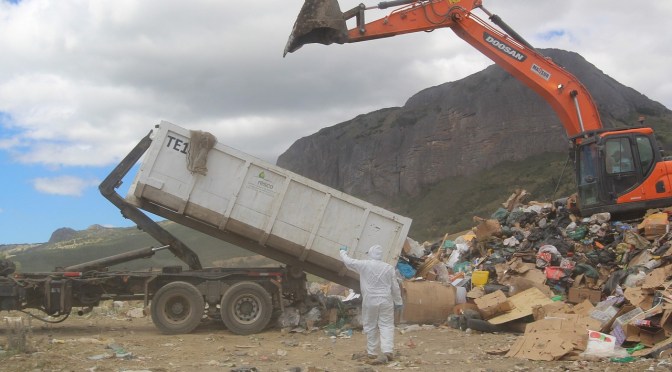
Is there 1080 in your landfill? According to a 2019 OIA request DoC alone has buried 100 tonnes in NZ’s landfills

“It is common practice to dump excess 1080 pellets after 1080 drops have finished (Re Stewart Island dump, see article).When 1080 toxin was first discovered in ground water the source of the toxin was traced to a landfill site above. Un-spread 1080 baits had been buried in the landfill and the toxin had leached out of the baits and seeped down into the ground water where it remained as toxic as the day it was dumped. No breakdown of the poison had taken place over all that time” … these are only DoC’s figures … “OSPRI has traditionally dropped more 1080 poison than DoC. Regional Councils account for around 12% of 1080 use too.”

READ AT THE LINK

Image by Heamna Manzur from Pixabay

What DOC doesn’t want you to know about 1080 Poison (leaked report from 2014)

Another repost from 2016… EWNZ

Forest & Bird Say 1080’s as Safe to Eat as a Packet of Crisps … and DOC says it’s Deadly to Dogs?

Here is a repost from 2016 … on the topic of poisons and the general ignorance of folk concerning their hidden effects … remember the ‘safe and effective’ mantra that wasn’t? EWNZ

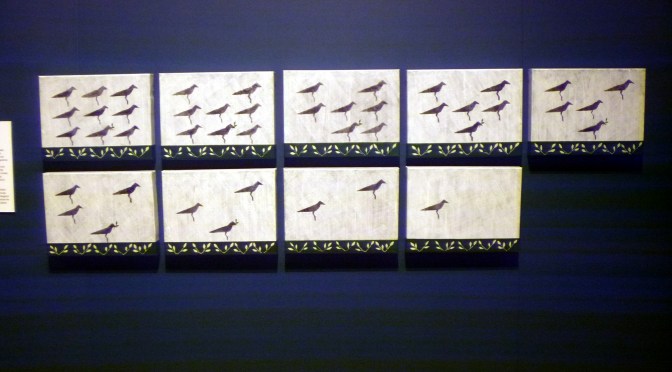
NZ’s Silent Forests – Where have all the Birds Gone? (Send us your stories)

I’m posting out our page on the disappearing bird populations. If you have noticed the same in your area do send us details via the contact page. We can raise awareness by adding them. You can retain anonymity on request. EWNZ

Here is a link to the page:

Image credit: envirowatchnz ‘Poisoning the Birds’

In 2002 in NZ a Landcare scientist estimated the likely death toll from an Otago 1080 drop to be around 10,000 birds

And DoC claims 1080 targets non native species?

Read a quote from DoC’s own website:

1080 targets predators

New Zealand is unusual, because apart from bats, there are no native land mammals. This means we can control introduced mammalian predators without negatively impacting populations of native species.

1080 targets introduced predators such as rats and possums. Stoats are also controlled through scavenging of poisoned rat carcasses. SOURCE

Doc Bird deaths

Would they have us believe that of these 10K deaths, none were natives? Other drops indicate otherwise (read at the link below).

1080 – “There was a deathly silence … no birds … I went into the bush with 3 dogs that day & came out with none”

A New Zealander whose name I have on record, relates a story of his lucky escape from 1080 poisoning during the 1980s. He reflects on how he could have gone the same way as his three dogs all tragically poisoned by 1080 pellets …. one he had to shoot to put out of its misery.

“During the 1980s I was living on a ten acre block bordering native forest and Lake Taupo above the cliffs adjacent to the Waihi waterfall. They put a sign up saying 1080 had been dropped but at that time there were no media explanations about how 1080 worked and they said it was for rats and possums only. I’d never really heard about 1080. I came across a deer that looked like it had just died. It was in prime condition and I was wondering if 1080 worked like cyanide in which case I was going to take some meat home for the table. While I was making up my mind my dog started running around in circles and the blood vessels in his eyes started exploding. There was a deathly silence. No birds nothing. I looked at the deer and it’s eyes were the same as my dog. My dog saved my whole family. That day is emblazoned in my mind and I will never forget it as long as I live. I thought that I had stumbled into hell. I went into the bush with three dogs that day and came out with none. I just didn’t see what happened to the other two.
The emotional anguish I felt that day is right up there with the worst experiences of my unsheltered life. It was decades later that I educated myself totally about 1080 and realized how lucky I was that I never chopped some meat off that deer. We were on rainwater from our roof and our house was meters from the bush edge but they only dropped on the other side of the state highway where there were no buildings.

DOC can say what it likes.

I don’t believe them because I have seen the truth.”


Note: Peter if you see this please get in touch


Visit our page titled ‘NZ’s Silent Forests – Where Have All the Birds Gone?’ for further observations on topic. If you have noticed similar in your neck of the woods, do let us know. We can highlight that on the page. Use the contact page. EWNZ


RELATED:

In 1957 a 1080-poisoned horse was fed to local dogs leaving 250 of them dead

Banned in most countries & classified by WHO as ‘Highly Hazardous’… 1080 is a broad-spectrum poison that kills ALL oxygen-breathing animals and organisms – Dr Meriel Watts

Over 65 dogs are killed in New Zealand each year by 1080 poison

A dog was euthanized in 2018 after suspected 1080 poisoning in Ak’s Hunua Ranges

The Dir General of DoC claims 1080 doesn’t kill non-target species whilst DoC’s own studies show it does

Photo credit: Clyde Graf

Two scientists who reviewed more than 100 of DoC’s scientific papers say: “There’s no credible scientific evidence showing any species of native bird benefits from 1080 drops”

Time for a repost of this article from 2007, as the drops continue, in spite of the clear scientific evidence it is not beneficial to our ecosystem.


“We have audited Department of Conservation scientific research and produced an 88-page monograph reviewing more than 100 scientific papers.

The results are startling and belie most of the department’s claims.

  • First, there is no credible scientific evidence showing that any species of native bird benefits from the dropping of tonnes of 1080 into our forest ecosystems
  • Second, considerable evidence exists that DoC’s aerial 1080 operations are doing serious harm“Quinn and Patricia Whiting-O’Keefe

Read the Whiting-O’Keefe report HERE


Scientists, Quinn and Patricia Whiting-O’Keefe: “Poison facts belie the claims”

routeburn4.jpg
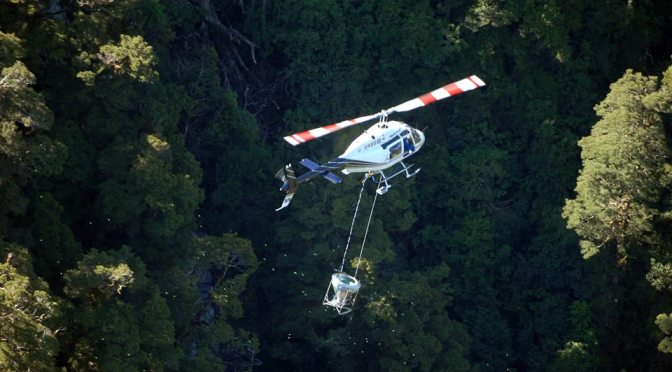
NZ drops into its forests about  4,000 KG of pure 1080 per year, enough to kill 20 million people [Photo: Clyde Graf, from a 1080 drop at Makarora]
There is now a familiar litany of scientifically insupportable claims about what great things aerial 1080, a universal poison, is doing for our forest ecosystems. The people of New Zealand have a right to know the truth about what the scientific evidence shows.

We have audited Department of Conservation scientific research and produced an 88-page monograph reviewing more than 100 scientific papers.

The results are startling and belie most of the department’s claims.

Copy of kepler track.jpg
The oxymoron that DOC’s signage is

First, there is no credible scientific evidence showing that any species of native bird benefits from the dropping of tonnes of 1080 into our forest ecosystems, as claimed by the department and Kevin Hackwell. There is certainly no evidence of net ecosystem benefit.

fwdfwdockills7outof9kea7
1080 is killing large numbers of native species

We have repeatedly challenged DoC and Mr Hackwell, a representative of the Forest and Bird Society, to come forward with the hard scientific evidence for their “dead forest” claims. They have not.

Second, considerable evidence exists that DoC’s aerial 1080 operations are doing serious harm, as one would expect, given that 1080 is toxic to all animals. It kills large numbers of native species of birds, invertebrates and bats.

Moreover, most native species are completely unstudied. In addition considerable evidence shows there are chronic and sublethal effects to vertebrate endocrine and reproductive systems, possibly including those of humans.

clydes mt pukaha dead kiwi vid

kahurangi nat park jim hilton.jpg

Considerable evidence demonstrates that DoC’s aerial 1080 operations are doing serious harm.  Photos: Upper (Tomtit in hand) by Clyde Graf
Lower (multiple dead birds) by Jim Hilton:
Dead birds found over a few acres, after 270,000 hectare aerial 1080 poison drop, Kahurangi National Park, 2014. This was the first year of DoC’s “Battle for our Birds” drops.


Third, DoC claims that one can drop food laced with 1080, a universal poison (World Health Organisation classification “1A extremely hazardous”) indiscriminately into a semi-tropical forest ecosystem and only negatively affect one or two target “pest” species. That is counterintuitive and scientifically improbable.

Fourth, as far as we can determine no other country in the world is doing (or has ever done) anything remotely similar – mass poisoning of a semi-tropical ecosystem on the scale that the department is now doing to ours.

Fifth, and perhaps most disturbing, is that what the department-sponsored research shows has been habitually misrepresented – entirely unjustifiable assertions regarding 1080’s benefits and lack of harm.

Statements like those of Mr Hackwell that the forests will be “dead” without poisoning them with 1080, and from John McLennan (Landcare Research) and Al Morrison (then Director General of DoC) that 1080 is existentially necessary to Kiwis is pure demagoguery and scientific nonsense.

What is at risk by continuation of this extraordinary practice – and it is unique in the world – is the ecological integrity of our forest ecosystems, our reputation as an environmentally sane and responsible country, and our existence as a society in which reason and rationality can triumph over bureaucratic prerogative and budgetary gain.

Since Galileo Galilee first discovered the moons of Jupiter in the 17th century, the way to resolve this kind of disagreement has been to do the experiment and examine the evidence, and that is precisely what we urge everyone to do.

Don’t believe DoC. Don’t believe Mr Hackwell. Don’t believe us – believe the evidence. To that end we will provide a copy of our report and the source scientific research papers to all who would like to read them.

* Quinn and Patricia Whiting-O’Keefe are retired scientists.

Header Photo: Robin, TV-Wild

ARTICLE SOURCE:

http://www.nzherald.co.nz/opinion/news/article.cfm?c_id=466&objectid=10448063

Read the Whiting-O’Keefe report HERE

If you have difficulty with the link to the report go to our Resources page & see it there.


Copy of kea article


keadeaths1080


RELATED:

PUKAHA MT BRUCE, 49 DEAD KIWI SINCE 2013 – ONLY ONE EVER TESTED FOR POISONING – FROM DOC’S OWN RECORDS

OIA REQUEST REVEALS 89 DEAD KIWI IN 1080 TREATED TONGARIRO FOREST – AND NOT ONE WAS TESTED BY DOC FOR 1080 POISONING – PRESS RELEASE FROM GRAF BROTHERS


See the TheGrafBoys YT channel and website for more videos. Educate yourself on 1080 poisoning. See also http://1080science.co.nz/

And our 1080 pages for info & links, &/or search ‘categories’ drop down box for further related articles (at left of any page).

EnviroWatchNZ


Rentokil Initial Takes Over the Aerial Poisoning of New Zealand

From Ursula Edgington PhD @ substack

I was only talking to Ben Rubin the other day about the international successful brand awareness of Initial. We see that logo in every public loo in the world. I’m not sure when Rentokil and Initial become one and the same (?) But perhaps the covid era theatre of extreme-hygiene was made specially for/by this chemical marriage.

Pests and viruses – same thing. Both presented by the media as ugly, hated and needing to be endlessly ‘eradicated’.

Surely everyone needs Rentokil Initial’s innovative ‘virus-killing-automatic-air-sanitiser’ for example. Wow! Profits have soared. So much so, expansion to New Zealand has meant Rentokil’s acquisition of that special ‘boys-club’ that forms the 1080 aerial-poisoning NZ Government sub/contractors. But do Kiwis know about Rentokil’s dark secret in its home country of England, involving a very similar toxin from over sixty years ago?

Screenshot from Rentokil Initial’s recent Annual Report detailing their ‘new investment’ into New Zealand’s Military Industrial Conservation Complex

I’ve written before about what we can now confidently term “The Military Industrial Conservation Complex”. This War on Nature is a complex story of NZ Gov psyops and corruption, which for over 70 years has proven to be too much for many activists to bear. Academics like me who have dared questioned this type of ‘Turtles all the Way Down’ propaganda become victims of the Corporate Playbook, as I have published about on

here. Like the hideous Agent Orange, toxic 1080 (sodium monofluoroacetate) keeps raining down on us, apparently to kill the ‘pests’, in a physical and psychological attack. In a blatant contradiction to the Manufacturers Safety Data Sheet (MSDS) the colourful, glossy propaganda still (unbelievably) insists this lethal, indiscriminate poison, with no antidote, is ‘natural’, ‘biodegrades’ and of course, is totally ‘safe and effective’.

Example from the [now deregistered] Pest Control Education Trust, which distributes the propaganda that claims to be valid ‘public consultation documents’ to residents and landowners of land & water about to be aerially poisoned with 1080

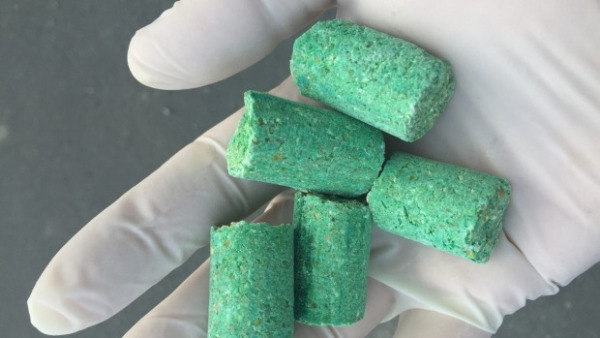
In case anyone is still doubtful about the lies evident in the above example of NZ Dept of Conservation propaganda, let’s look briefly at how synthetic 1080 is manufactured, before it’s added to the green-coloured, sugar-laden, cereal food-baits and then distributed in tonnes by helicopters over our land and water. Ethyl fluoroacetate, sodium hydroxide and ethanol are mixed together. These chemicals are so lethal, with sub-lethal consequences completely untested and unknown and the process so specialized, that up until now, there appears only one company in the world using it – Tull Chemical Co, Oxford, Alabama (conveniently, it recently burned down, but more on that rabbit hole another day). By examining the Manufacturer’s Safety Data Sheet (MSDS) of ethyl fluoroacetate alone, this provides an insight into the known unknowns of the impact of being in contact with this chemical:

Material is extremely destructive to tissue of the mucous membranes and upper respiratory tract, eyes, and skin., Cough, Shortness of breath, Headache, Nausea, To the best of our knowledge, the chemical, physical, and toxicological properties have not been thoroughly investigated.”

[Ref Merck SDS from which those are quoted from]

Here’s an extract from the toxicity section of the MSDS for the 1080 poisoned-food cereal baits, confirming the unknown risks:

There is no antidote. This poison should never be released from the sky and spread indiscriminately. The CDC webpage on 1080 poisoning symptoms seems to have been removed recently, but here is the WayBack Machine’s capture from a few months ago which clearly states the dangers from the ‘unlikely’ inhalation. Apart from it’s not ‘unlikely’ if, against the manufacturer’s instructions, it’s dropped from the sky! As Aly Cook sang a few years back (in another unsuccessful attempt to halt an operation): “Stop the drop of the poison rain; how can mankind be so insane?”:


Toxic historical context


For everyday Kiwi’s stories of the harms caused by aerial 1080 and brodifacoum operations over the 70+ years of Government-sponsored poisoning, please see the Peoples Inquiry 2020 that recorded hundreds of public submissions from personal lived experiences. Details are found in my post here:

Impacts of Toxic Chemicals & Poisons Across New Zealand are Overwhelming and Disturbing

·
11 April 2024
Impacts of Toxic Chemicals & Poisons Across New Zealand are Overwhelming and Disturbing

The volunteer committee of the citizen-led New Zealand People’s Inquiry (of which I’m a member) have this week publicly released the collection of written submissions into the impacts and effects of toxic chemicals and poisons on the people, wildlife and environment of Aotearoa, New Zealand.

Government contractors were understandably labelled ‘cowboys’ by a Chief Medical Officer of Health in a past meeting I attended. That’s because evidence from EPA annual reports and other outcomes shows these companies often have no regard for valid risk assessments, health and safety policies or public consultation processes. For a shocking example of the latter, you can see this evidence from Dr Wendy Pond during the Peoples Inquiry 2020 where a ‘sign off’ approving an aerial poisoning operation was forged, because the tribal elder named, had already passed away. Where is the accountability?

But where was the accountability for Rentokil after the Smarden Affair? Back in 1963, a poison closely related to 1080, fluoroacetamide, was deliberately dumped into a ditch serving a farming community in Kent, UK. This BBC archive summarises the tragic story (2.5 mins). Decades pass. Regardless, the propaganda of BigChem continues. That UK poisoning led to pyres that burned the contaminated herds. Sound familiar?

These memories resurfaced when in 1985 farmers at Smarden discovered the first case of bovine spongiform encephalopathy (BSE) in Kent and a number of further cases followed. Twelve years later, a perceived cluster of cases of new variant Creutzfeldt-Jakob Disease (vCJD) in the Smarden area led to speculation that this human form of BSE was caused by excessive exposure to pesticides. Reports in the press suggested that the residents of Smarden suspected the incident had been some sort of government-controlled experiment and subsequent cover-up which had produced BSE.

Wrote John Clark, Senior Lecturer in History, University of St Andrews back in 2017. [Must be a conspiracy theorist, eh?].

In this latest Annual Report, Rentokil Initial boast about the ‘respectful engagement with communities’ (communities that they are about to poison?) by ‘building strong local knowledge’ and ‘lasting relationships’. (maybe with NDAs?) The report goes on to list the four NZ contractors swallowed-up by BigChem Rentokil:

Extract from Rentokil Initial’s Annual Report

It is EcoFX listed above which repeatedly undertook the aerial poisoning of Pirongia mountain. The drinking-water catchment is located there, serving the local communities, including the schools and the in-bed-with-Government milk-processing plant, Fonterra. Evidence shows that the aerial poisoning with 1080 over Mt Pirongia (like similar operations) includes distributing the poison over the water at the same rate as the land (this saves the ‘cowboys’ money in helicopter fuel and labour hours and therefore maximises profits). Here’s an example of that crime from ten years ago (10 mins):


The latest 1080 poison operation has been announced for nearby Mt Moehau for July this year. The last operation was only three years ago (usually it is every 4-7 years). The frequency and intensity and toxicity of these 1080 aerial poisonings are increasing nationwide. On the residents’ communication for Mt Moehau, no mention of Rentokil Initial, only of EcoFX in the pseudo-consultation invitation:

On EcoFX website, they claim to be ‘part of the Rentokil Initial Group’, as if that is something to be proud of:


It’s interesting to note that EcoFX isn’t a registered NZ Company. The ceased Director is listed as Director/Shareholder of One Degree Ltd and One Foot Investments (unknown entities). Rentokil Initial NZ (strangely, 100% shareholders are Rentokil Spain, not UK) are using the old contractors as ‘trading names’. This could be confusing for anyone trying to engage with the Government or contractor about the consultation process or the inevitable lethal consequences that come with indiscriminate aerial poisoning. And believe me, they are inevitable.

“Safe and effective?” Yeah, nah.

We’ve learnt from the last five years that nothing is quite what it seems. That media mantra ‘Clean, Green, 100% Pure New Zealand’ is another myth. It’s time people woke up to the BigChem capture of our so-called Environmental Protection Authority alongside our healthcare systems. These entities only seek to perpetuate our sickness.

Thanks for reading Informed Heart! This post is public so feel free to share it.

SOURCE

Note: envirowatchnz has a trove of info on 1080 if you check out the main menu & subtabs. Also search 1080 in the categories drop down box. The 1080  industry is huge & rife with corruption and lies. Hopefully folk will believe that now after the ‘safe and effective’ scam fed us by Big Pharma & Co for the past 5 years.

Is there any link between 1080 and mining in NZ?

Joining some dots between certain events in NZ, mining, and the use of 1080 by the Department of Conservation (DoC).

Read at the link:

A Look at New Zealand’s Conservation Science (Dr Jo Pollard)

From CORANZ

by Dr Jo Pollard (BSc (Hons), PhD)

Supporters of NZ’s conservation by aerial poisoning have commonly defended their position with the statement “Look at the science.”

Most of the published science on conservation in NZ is accessed readily, appearing in the NZ Journal of Ecology (NZJE). A browse through the issues from the last couple of years reveals glimmers of hope for ecological management, plus some not so nice things. The following is a quick run through.

Freshest news from Landcare is the observation that ship rats climb up and carefully drink nectar from mountain flax flowers; their furry faces probably transferring pollen between flowers (Donald & Dhami, 2022). 

Landcare is now thinking rats might compete for nectar and pollinate “on a widespread and under-appreciated scale.” 

Also from Landcare is “Do mice matter?” (Watts et al., 2022). It concludes they do.

When other mammals were fenced out of a reserve, mouse numbers rose and apparently reduced numbers of wētā, caterpillars and other invertebrates, potentially having “catastrophic” effects. Then when the researchers got rid of the mice, unexpected things were noted: non-native earthworms seemed to move into the depleted ground faster than native earthworms, and an extremely high number of beetles appeared in one area.

Stoats and Rats

Studies of alpine-dwelling stoats by researchers from several organisations (McAulay et al., 2020; 2021) supported previous findings that rats are stoats’ preferred prey. Fifty-five stoats were caught in traps laid above the tree line in Fiordland, Mt Aspiring and Nelson Lakes national parks. Stomach contents and stoat tissues were analysed to find out what they had been eating. 

At the Fiordland and Mt Aspiring sites the stoats were living on small mammals (e.g. rats), topped up with insects and plant material. There was no bird material in their stomachs, and it was estimated that long-term, small birds made up less than 2% of the diet. In contrast at Nelson Lakes (where there were no rats) stomachs contained small birds (estimated as 15 -26% of the long term diet) and also skinks (19-57%). 

The authors warned that when and where ship rat numbers are low, stoats are more likely to eat threatened species. Also that individual stoats have their own feeding habits, so generalisations cannot be made from narrow observations.

On islands where introduced mammals have been eliminated, things have turned out badly for several bird species. Miskelly et al. (2021) (from Te Papa Museum and the Department of Conservation (DoC)) studied birds on 38 Fiordland islands, where Norway rats or stoats were removed several decades ago. Seven islands left unmanaged provided an experimental control. In the absence of rats or stoats, robins have flourished, seemingly aggressively ousting other species, including grey warbler, silvereye and tomtits. 

“Robins flourished—ousting other species”

The authors warned that killing off predators to achieve “restoration” can cause declines and disappearances of native bird species.  So far then, it seems much is being learnt about ecology that challenges NZ’s Predator Free conservation goal to wipe out mustelids, rats and possums (Predator Free, 2022). 

Many Questions

There are many questions: how to deal with increasing mice, once their predators have been killed off; how do our long-naturalised mammals fit into current ecology; what about the results from the Fiordland islands, where it appears that taking away the introduced predators reduced the diversity of birds? 

Also challenged within these first few papers is DoC’s insistence on aerial poisoning of alpine zones, to “protect” rock wren and kea from stoats. The stoats are likely to not be eating any birds! Plus the poison is toxic to birds and a very broad range of other creatures. It is not reliable in controlling stoats which shift to eating birds if their rat prey is gone. So the alpine animals may suffer a double-whammy: poison, then hungry stoats. DoC’s idea that stoats must be killing off bird species comes from hunted down, marked and monitored nests. But the monitoring itself makes the nests prone to desertion and predation. 

Contributions from DoC to the latest NZJEs include an addition to a large pile of studies on nesting and survival of rare birds wearing radio telemetry gear (Steffens et al., 2022). This gear, ironically, makes birds much less likely to nest, markedly increases energy expenditure and causes fatalities.  

Something seems amiss in the animal ethics screening of DoC experiments. 

Attempts to improve monitoring appeared in the University of Otago’s study on robins, whose nests were observed from a distance to avoid disturbing them (van Heezik et al., 2020), and trials by various researchers on remote monitoring of kiwi, using their calls (Jahn et al., 2022; Ellis & Marsland, 2022). The latter authors had animal welfare and other concerns about the transmitters DoC routinely uses on kiwis’ legs. 

As with DoC, a lack of ethical oversight was apparent in a study from Zero Invasive Predators (ZIP). Nichols et al. (2022) killed 20 rats by feeding them 1080-poisoned food, to make bait for stoats. Since, there has been a change: now they humanely kill their rodents then make them poisonous by injecting them with 1080.

Many articles concerned aerial poisoning using 1080 (sodium monofluoroacetate).

Bomans et al. (2021) from Victoria University monitored bird calls before and after aerial poisoning operations realising however that calls did not reflect bird numbers, because survivors might call frequently, e.g. for mates. Dilks et al. (2021) (from DoC and Lincoln University) used trail cameras, baited with rabbit meat and an egg, to record animals before (spring) and after (summer) an aerial poison operation. With no experimental control they could not conclude much, except that all common small mammals were seen far less afterwards. Morriss et al. (2021) (mainly Landcare people) “gathered observations” on deer mortality rates after aerial poisoning, which were highly variable and it was concluded formal research was needed.

Rats Rebound

Two studies demonstrated the classic rat population response to aerial 1080 poisoning, with numbers rebounding within several months and reaching higher levels than before poisoning began (Bell et al., 2021 (mainly people from DoC); van Heezik et al., 2020 (mainly from Otago University)). To gain better control, Nichols et al. (2021) from ZIP aerially poisoned twice a few months apart, spreading baits at extra high density, and managed to nearly get rid of all rats, stoats and possums. Monitoring of any other creatures’ survival was only “incidental”; a grave omission since the authors propose this super-poisoning might become more common as NZ strives to become Predator Free. 

Rats are especially well equipped, through their lifestyle and physiology, to withstand a 1080 poison war.

An oncoming weapon for beating nature is genetic modification, and there’s no shortage of interested parties lining up.  Inwood et al. (2020) are people from Scion, Landcare, the Environmental Protection Agency and four universities wanting to work on topics such as gene editing to make rats infertile. That idea had been put to bed by a NZ Royal Society review (Dearden et al., 2017) as too dangerous, because modified rats might escape to overseas ecosystems where rats were actually important!

Habitat Importance

Encouragingly, Walker et al. (2021a; 2021b) from Landcare stressed the need to preserve habitat, stating its loss and modification “is a principal, ongoing cause of indigenous biodiversity decline.” Echoing this was Landcare’s study on kereru, for which forest seemed to be a limiting factor (Carpenter et al., 2021). 

Long ago, ecologist Dr Carolyn King pointed out “conservation of species is conservation of habitats”. 

How good things might have been if DoC’s head scientist Graeme Elliott had listened to Dr King and focussed his career on the observation that mohua, needing tall forest trees on valley floors, were suffering from habitat loss. Instead, stoats were blamed for the mohua’s decline, leading to rampant stoat trapping, followed by rats getting out of control and eating the mohua, then the onset of aerial poisoning to quell rats.

Perhaps the Predator Free movement might yet face up to ecology. 

Unfortunately, as restated in the NZJE (McGlone et al., 2020) there is a history of dysfunction whereby conservation management in NZ has departed from science. 

The science indicates a need for careful studies and saving habitat, rather than mindless interference and indiscriminate poisoning.

Footnote: A fully referenced copy of this article is available at this link.

Dr Jo Pollard

Header Photo: pixabay.com
Others: supplied

Predators Are Not Evil But are Mostly Part of Healthy Ecosystems

Opinion by Tony Orman

New Zealand has for many decades waged a war against predators. Currently there are a number of anti-predator campaigns, often using public money in big spend-ups on futile aerial poisoning exercises. In addition, in the end, the blanket operations run counter to the impassioned aim of exterminating predators (e.g. rats) and instead cause major disruption to food chains and serious damage to the ecosystem. For example there is Predator Free 2050, and Zero Invasive Predators, the latter jazzily known by the acronym of ZIP. The zealous programmes have earned international recognition.“Time” magazine which proclaimed “Rats, Possums and Stoats Beware! New Zealand Goes to War Against Invasive Pests.” But the programmes are like the 1837 Hans Christian Andersen fairy tale “The Emperor’s New Clothes”. At one stage in the fable, the wise man serving the Emperor thinks “What!” “Is it possible that I am a fool? I have never thought so myself. No one must know it now if I am so. Can it be, that I am unfit for my job?”Those questions should be asked of those who champion Predator Free 2050 and ZIP – people from Prime Ministers to central and local government politicians, local bodies, naive unquestioning media whoop as investigative journalists, extreme green groups and even unprincipled “scientists” following the money trail of funding all pursuing the dream of exterminating New Zealand’s predators. However the reality is the dreams are running against the way Nature behaves.

Predator Role
Wildlife mangers overseas are increasingly regarding predators as an important part of a healthy ecosystem. In 2014 Al S Glen of New Zealand’s Landcare Research and Christopher Dickman of Sydney University co-authored a book on “Carnivores of Australia” and in a chapter “The Importance of Predators” said “to maintain or restore functioning ecosystems, wildlife managers must consider the ecological importance of predators.” This is hardly a new idea. Charles Elton, an Oxford ecologist, first conceptualised food webs in the 1920s, speculating that wolf removal would result in over-population of deer on which wolves preyed. The notion was taken up by others such as highly respected conservationist and author Aldo Leopold. Predators tend to remove vulnerable prey, such as the old, injured, sick, or very young, leaving more food for the survival and success of healthy prey animals. Also, by controlling the size of prey populations, predators help slow down the spread of disease. Predators will catch healthy prey when they can, but catching sick or injured animals is more likely and helps in the formation of healthier prey populations because only the fittest animals survive and are able to reproduce. In addition, predators help to reduce the negative impacts that their prey may have on the ecosystem if they become too abundant or it they stayed in one area for too long. Biologists have recognised predators like cheetahs prey on grazing animals like antelope, it keeps the prey population moving around (in fear) and prevents overgrazing in any one area. As a result, more trees, shrubs, bushes, and grasses can grow, which then provides habitat for many other species.

Predator Removal Dangers
If carnivores were removed from an ecosystem, what would happen? Herds of grazing animals, such as antelope, would grow and grow and result, in large herds overgrazing their food source, and as the food disappeared, the whole herd would begin to starve. Caroline Fraser writing for the US’s Yale School of the Environment  said experts “beginning with aquatic experiments, have amassed considerable evidence of damage done to food chains by predator removal and have extended such studies to land.” Predators are simply a part of any ecosystem’s food chain. New Zealand’s native falcon prey on other native birds such as tuis and bellbirds. Blue duck (whio) prey almost entirely on aquatic invertebrates, mostly caddisfly larvae. Kiwi prey on worms. When animals of a predatory nature are introduced such as rats and stoats were to New Zealand, they go through a “boom and bust” phase before their populations settle down to a relatively static state.  Unfortunately, native prey species can become drastically reduced or even extinct as a result of the predator “boom”.  The critical aspect of managing this situation is avoiding predator “booms”.  Consequently,the fervour and haste which the Department of Conservation and local councils applies with toxins is reckless and fraught with ecological danger.

Disastrous Outcomes
Large scale poisoning with eco-toxins such as 1080 and brodifacoum may heavily reduce predator numbers initially but with a few short years, the outcome is disastrous. The science is there to show the resurgence in predator numbers and subsequent wrecking of the food chain.  Wendy Ruscoe in a study published in Landcare Research’s publication 2008 showed aerial dropping of 1080 will temporarily knock back a rat population but due to the rodent’s amazing reproductive capacity, the surviving rats recover rapidly and within 18 months, are two to three times greater than before poisoning began. A 2007 study by Landcare scientists Graham Nugent and Peter Sweetapple showed rat numbers recovered within 18 months and at the two year mark, rat abundance could be four times greater than before poisoning.

Stoat Prey
The disruption to the naive ecosystem ripples further.  A major prey for stoats is rats.  When rat numbers are reduced by 80% – 90%, the stoat deprived of its major food source, invariably switches prey to birds. But later as rat numbers surge and boom and pass original numbers, stoats enjoy a virtual banquet of rats, breeding increases and surges and then explodes.The well intentioned but ignorant predator extermination programme usually using 1080, has merely stimulated, within a few short years, major population explosions of rats and stoats. Attempting to poison-away rodent surges in beech-mast years is the ecological equivalent of farting against thunder. All this does (if anything) is delay the inevitable, as the fast-breeding ability of rodents will eventually allow population growth to match the food source. Rather than benefiting the birds and overall ecological health, there is massive ecological disruption by the man-induced mega rat and stoat plagues.

Ecological Damage
That is not counting the birds and insects and other invertebrate organisms killed by 1080 as research demonstrated, by DSIR scientist Mike Meads, in the 1980’s.  1080 was originally patented as an insecticide in 1927. Examples are many of human interference directly or indirectly into Nature’s food chains resulting in profound consequences. In a classic 1966 experiment, biologist Robert Paine removed the purple seastar, Pisaster ochraceus — a voracious mussel-feeder — from an area of coastline in Washington state. Their predator gone, mussels exploded in numbers, crowding out biodiverse kelp communities with monoculture. Less than a decade after Pisaster, marine ecologists James Estes and John Palmisano reached the astonishing and widely reported conclusion that hunting of sea otters had caused the collapse of kelp forests around the Aleutian Islands. With otters reduced to low levels, the prey (sea urchins) stripped the kelp forests. When otters eventually returned, they regulated urchins, allowing “luxuriant” regrowth of biodiverse kelp communities.

Toheroa Decline
In New Zealand, the decline of the toheroa shellfish was attributed unofficially to heavy over-fishing of snapper which preyed on paddle crabs which in turn preyed on toheroa. With the heavy decline in snapper, paddle crabs proliferated and almost obliterated toheroas. New Zealand has a long history of an obsession with attempted extermination of predators. In the 1950s acclimatisation societies managing trout fisheries blamed freshwater eels and shags for perceived declines in trout numbers. Bounties were paid out on eels. It had little effect. Ironically the best trout fishing rivers had healthy populations of both trout and eels. Eels simply removed the sick, the old or the unwary thus making for a quality trout population. The concept of being ”predator free” or “zero predators” has no ecological justification, except in limited circumstances on smaller offshore islands and “mainland islands”. Even in islands where predators may have been eliminated e.g. Secretary Island in Fiordland, the success is short-lived and temporary as animals can and do swim from the mainland to recolonise.

Playing God
It seem incomprehensible that an agency such as the Department of Conservation and the Predator Free 2050 and ZIP concepts should go unquestioned in the light of the understanding internationally of the dangers of playing God with predators..But the ‘fly in the ointment’ is human nature.  For example a scientist in DOC arguably has a vested interest by way of employment and a handsome salary. Similarly with any consulting scientist attached to Predator Free 2050 and ZIP. For others of zealous nature, as some humans are wont to be, it becomes the pursuit of “The Impossible Dream.”  For politicians it’s good P.R. to declare war on the baddies, no matter how pointless and damaging that might be. The sad outcomes are the gross misuse of public funds and more tragically the profound ecological damage that often occurs in the pursuit of that “Impossible Dream.”

DOWNLOAD THIS ARTICLE AS A PDF FILE


Footnote:

Tony Orman has spent a lifetime in the outdoors observing and reading about it and Nature. He has had some two dozen books published, mainly on fishing, deerstalking, conservation and rural life.

Outdoor Groups Urge a “New Look’ DoC

From Tony Orman,
(Spokesman for the Council of Outdoor Recreation Associations)

Some outdoor recreation-conservation groups are calling for a revision of the Department of Conservation priorities and targets following a recent National Radio interview with the department’s newly appointed director-general Penny Nelson.

The new director general of DoC has taken over from Lou Sanson, after holding senior roles both with the Ministry for the Environment and the Ministry for Primary Industries.

DoC is responsible for managing one-third of the country’s landmass and some say it’s time for fundamental reform. 

DoC  head Penny Nelson says there needs to be conversation about what people want conservation to look like.

Laurie Collins of the Sporting Hunters Outdoor Trust welcomed the opportunity.

“That conversation is much needed,” he says. “In my opinion a change is needed. “Bureaucrats often with ideological bents have had too much influence.”

Tony Orman, spokesman for the Council of Outdoor Recreation Associations said the organisation in its successive election charters had called for a revision of DoC’s priorities.

“The charter says reorder priorities of DoC to make its three main priorities conservation, the environment and recreation, instead of its diversion into commercial undertakings,” he says. “Also the name be changed to Department of Conservation and Outdoor Recreation to emphasize its basic function.”

Tony Orman says DoC’s culture needs to change to embrace ecological reality.

“DoC must protect and maintain the public’s conservation estate to embrace the evolved 21st century ecosystem and not try to recreate and preserve a hypothetical 500 AD world.”

Peter Trolove – DoC has failed to back Water Conservation Orders to protect rivers

Dr. Peter Trolove president of the NZ Federation of Freshwater Anglers, an advocacy for trout and salmon and rivers, said it had been disappointing in the light of the deterioration in rivers, to see little or no support from the department for Water Conservation Orders (WCO) designed to give waterways national park type protection.

“WCOs are being undermined due to commercial exploitation for irrigation and power generation. Rivers are a finite resource and habitat not only for trout and salmon but native fish, which should particularly concern DoC.”

Laurie Collins of the Sporting Hunters Outdoor Trust said new DOC director-general Penny Nelson told of audible bird song when living on Kapiti Island. He was critical of the department’s blanketing of public lands with the eco-toxin 1080.

Having worked with the first trials of 1080 and subsequently in department work during his working career, he said 1080 devastated insects and most birds but not all avian species.

“Nectar feeders such as tuis and bell birds – noisy singers –  are the least affected. On the other hand, insectivorous bird species, such as bush robins, tomtits, warblers, rifleman and others and predator or scavengers such as falcons, keas and wekas are devastated by the poison.”

Each carcass or invertebrate such as worms killed by 1080 remained toxic. The decline in kiwi feeding on worms after 1080 could well be significant. 

Laurie Collins said he was concerned to hear Penny Nelson talk of genetic technology to eradicate “destructive invasive species like possums”. Having worked on possums on departmental work and as a possum trapper, he said the “invasive pest” tag was wrong.

“Possums are demonized. They are a herbivore, not a predator and browsing of foliage has been a function of the ecosystem for millions of years.”

Besides possum populations are  low.

“It’s so obvious by noting road kills,” he says. “Nor are they invasive as stated, since possums are slow breeders with one joey a year.”

Laurie Collins said it became a vicious cycle as scare-mongering over possums led to aerial 1080 drops that indiscriminately killed insects and birds.

Possums he said were a resource with the fur fetching over 20 many times the value of crossbred sheep wool.

Laurie Collins says DoC has become trapped in a time warp, with an anti-introduced phobia and an obsession with eco-poisons such as 1080 and brodifacoum.

The new DoC director general has some formidable challenges to get the ship back on a reality course.

“By talking and very importantly listening to and hearing practical people who understand the bush and the natural world, the new captain might steer DoC back on to a sensible course,” he says.

NSW government dropping 1080 poison baits in Sydney water catchment area

EWR comment: The many who have tracked and even opposed the 1080 operations (moving along in NZ for over 50 years) know there is more to this than meets the eye. Particularly in latter years as increasingly the rules have expanded to allowing dispersion into waterways. How can this not affect human health? Look what happened in Auckland. On a grand scale we have also seen the gradual destruction of the very species the narrative has told us were being protected. Slowly but surely the wild food supplies are being severely reduced, and what is left is being rendered too risky to eat. This is not about conservation according to the UN’s supposed biodiversity goals contained in the Agenda 21 documentation. It is all part of the New World Order reset goals, world control of all resources including food. Note Aussie recently proclaimed they are now in the said NWO. So here we have Australia spreading 1080 into their waterways. Catchment waterways for Sydney.
The article is from MSN. (Thanks to Jordan for this link).

msn.com

The New South Wales government is preparing to drop poisoned animal baits into a part of Sydney’s main drinking water catchment considered so important, public access is restricted.

The move has angered a conservation scientist who says mass aerial baiting in the special area contradicts those protections.

However, the NSW government says the baiting is necessary to protect vulnerable native animals affected by the devastating bushfires of 2019/20.

The meat baits, which are laced with the poison known as 1080, are designed to kill foxes and dingoes — also referred to as wild dogs. They will be dropped across parts of the Greater Blue Mountains World Heritage Area, including within the Warragamba Special Area.

Special areas act as buffers of pristine bushland upstream of dams and are designed to protect water quality. In the Warragamba catchment, “schedule 1 areas” are the most heavily protected and public entry is banned.

They are surrounded by “schedule 2 areas”, where entry is restricted and activities such as bike riding and motorboat use are prohibited.

But according to internal government documents, seen by the ABC’s Specialist Reporting Team, poisoned baits were airdropped in schedule 2 areas in June and July 2020, with more baits to be dropped this month.

Originally, the NSW Parks and Wildlife Service (NPWS) also wanted to bait schedule 1 areas, but it abandoned the idea over concerns about how the public would react.

“We anticipate that there is a risk of community concern regarding the perceive (sic) risks of using 1080 in Sydney’s drinking supply,” the NPWS noted in an email.

“For these reasons we are proposing we don’t bait in Schedule 1 lands. If we determine a way to manage that risk down the track, then we can reconsider.”

WaterNSW told the ABC it considered the baiting a “very low” risk to the catchment, thanks to other mitigating factors.

“These factors … include restricting baiting to areas away from waterways, the high rate of decay of ‘1080’ in the environment, and baiting occurring only in catchment zones far removed from the Warragamba supply storage,” a spokesman said.

Scientist argues dingoes should be protected

The Department of Planning Industry and Environment said the program had been carefully mapped out, and baits would not be dropped within 200 metres of waterways.

That does not reassure Kylie Cairns, a molecular biologist and geneticist who specialises in dingo research at the University of New South Wales (UNSW).

She is opposed to any baiting in national parks where dingoes roam, saying they are Australia’s land-based apex predator and should be protected.

“If you have the apex predator being controlled in such a manner, you could be disturbing or impacting negatively on the natural environment in that area,” she said.

Dr Cairns said since baiting was typically done to reduce the loss of livestock in agricultural areas it was “shocking” that baiting was planned up to 10 kilometres inside the world heritage area.

“You have to ask, is that really balancing the need to conserve dingoes in their environment … with the impact that they might be doing to livestock operations on the outside of the park?”

She said a growing body of work suggested habitats could be improved in areas where dingoes were well managed and, that in particular, dingoes helped keep kangaroo numbers down, which allowed plants and smaller herbivores to flourish.

Expert says baiting needed to control dingoes

Greg Mifsud is the national wild dog management coordinator at the Centre for Invasive Species Solutions. He supports the use of aerial baiting to access hard to reach areas. And he said it was more targeted than the name suggested.

“The movement of foxes and dogs in those landscapes after fire could be quite different and therefore targeting areas with aerial baiting just means you might be able to get a better uptake of baits by animals that you’re targeting,” Mr Mifsud said.

He was not involved in the program run in the Warragamba Special Area, but he does oversee the National Wild Dog Action Plan and provides advice to landholders and agricultural groups on predator control strategies.

Mr Mifsud said dingoes still posed a significant threat to wildlife and he argued regular baiting was needed because as soon as it stopped, they came back.

“Dogs aren’t going away,” he said.

“Despite the best efforts, they’ve adapted to the changes and they’re moving into areas, like … on the outskirts of Brisbane and places like that. So it’s really just going to be about ongoing management.”

Concerns over ‘cruelty’ and native animals

Mark Greenhill is the Mayor of the Blue Mountains City Council, which covers a large section of the world heritage area. He’s opposed to the use of 1080 because he thinks animals that ingest it die painful deaths.

“We can be more humane than that,” he said.

“My concern is that, apart from the cruelty of the poison, there’s no guarantee this poison wasn’t taking out native animals.”

This year, his council officially banned the use of 1080 in his government area. That ban does not cover land controlled by the state government, such as national parks, but he wished it did.

“The [Warragamba Special Area], while outside our local government area, is still within the Blue Mountains World Heritage Area. So, forgive me for feeling somewhat proprietorial,” he said.

A spokesperson for NPWS told the ABC it had seen a 90 per cent reduction in fox activity across the Greater Blue Mountains World Heritage Area since it started baiting last year.

NPWS also said strict legal conditions surrounded aerial baiting and ensured human safety.

SOURCE:

https://www.msn.com/en-au/news/australia/nsw-government-dropping-1080-poison-baits-in-sydney-water-catchment-area/ar-AAOchHC?fbclid=IwAR3kZwqJeDcAr4iFMXewnea_h2_pvzMnkSijGr10twCABOmzulVaj2Qzbyw

The Bromley, 1080 whitewash

EWR comment: Remember this story? I’ve neglected 1080 for some time now … it is still on the radar though and they continue to spread 1080 here in NZ. Read the latest whitewash on the Bromley incident, mainstream’s article titled: Company was ‘taking shortcuts’ when worker ended up in coma after poisoning incident
(Further updates to follow)

From Carol Sawyer

UNBELIEVABLE? Well no, not really. Time everyone woke up to the corruption. But as far as this article is concerned, why don’t reporters make themselves familiar with the substances in question? The company was making pure 1080, (sodium fluoroacetate), and had in the warehouse the substances necessary to make it (400L of ethyl fluoroacetate, sodium hydroxide, and ethanol) as well as some unknown quantity of sodium fluoroacetate.

“The company was under pressure to meet its supply obligations and decided to try to manufacture sodium fluoroacetate – the active ingredient in 1080 – locally rather than importing it.”
Sodium fluoroacetate IS pure 1080, and NO-ONE in NZ has the consent to manufacture it, not even the NZ government’s own 1080 bait factory in Whanganui. The pure, deadly ingredient is imported from Tull Chemical Co in Oxford, Alabama, and has been for many, many years. It is the active ingredient in 1080 cereal baits, not “the active ingredient in 1080”.
One of the most deadly substances in the world. 1/143 of a teaspoon can kill a 70kg human being and yet this was being manufactured illegally in a warehouse in a heavily built up area, with an aquatic centre (where children learn to swim) across the driveway and a preschool nearby, without consent, without signage, and unbeknown to the other businesses in the building at 56 Wickham St, Bromley.
Not only that but the warehouse had no ventilation. I am told that in court yesterday when asked about the means of ventilation they said they would lift the roller door onto the carpark/entrance!! I am also told that the judge said that 1080 was not to be referred to in court as 1080, but as sodium fluoroacetate. How many people in NZ know the chemical sodium fluoroacetate is 1080! Why would the judge say that do you think? Rhetorical question.
Oh, words fail me… those who have been following this case will know what I mean. A whitewash, pure and simple.
Here is the true story behind this:

https://www.facebook.com/carol.sawyer.3511/posts/2614111712202472

Read Dr Fiona McQueen’s letter on 1080 poisoning & NZ’s native birds that the Wanaka Sun declines to publish

EWR comment: the 1080 issue is still as present as ever. It has been overshadowed more urgently at this blog by the CV VX rollout. The 1080 poisoning however continues, business as usual with currently the East Cape to be slathered with this deadly poison. Sixty years on and we still have the pests? How long does one keep applying a solution that doesn’t work? Meanwhile the beautiful Kea is in serious decline. If you are new to the 1080 problem here in NZ just watch the GrafBoys’ excellent award winning doco ‘Poisoning Paradise‘ & visit their site tv-wild.com. Also see our 1080 pages (main menu). Article below…
__________________________________________________________________________

IMPORTANT UNPUBLISHED LETTER BY DR. FIONA McQUEEN – THE WANAKA SUN

“…most conservation –minded NZ’ers would be fairly shocked to hear that 1080 actually kills native birds – in any numbers, small or “huge”. This unfortunate fact has been well and truly proven in peer-reviewed studies and is termed “by-kill”. Which species? Tomtits, robins, morepork and kea to name a few… after the 2020 drop in the pristine Matukituki Valley, 50% of DoC’s monitored kea died”
Dr Fiona McQueen

From Carol Sawyer

On April 15, 2021, The Wanaka Sun published an opinion piece by Ross Sinclair, committee member of the pro-1080 poison Central Otago Lakes “Forest and Bird”…. incorrect and biased as one might expect.
Over the ensuing weeks there were a number of ‘Letters to the Editor’ in opposition to this article. (Notably there were none in support of the opinion piece, although Ross Sinclair was given the right of reply not once, but twice!)
One letter was from Dr. Fiona McQueen, consultant rheumatologist at the SDHB, and author of “The Quiet Forest: The Case Against Aerial 1080”.
The Sun’s editor, Pat Deavoll, told Dr. McQueen in an email on 19 April that she would “certainly publish it in the next edition- you have made some very good points”. It has never been published.
I posted it on Facebook a week ago along with the original opinion piece, with Dr. Fiona McQueen’s permission.
Strangely, I shared it to Upper Clutha Community Notices, a local Wanaka Facebook group with more than 7,000 members. It was approved and then quickly deleted and when I pointed this out to one of the admins with whom I have had cordial dealings in the past, it was reinstated. It was deleted again; again I pointed this out and it was reinstated. It appeared there was disagreement among the admins.
Finally, after 24 hours or so, comments were turned off, this particular administrator sent me an extremely rude private message, totally uncalled for, referring to “your precious post”, the post was deleted, and she blocked me.
Dr. McQueen’s letter STILL has not been published by The Wanaka Sun and yet here in this week’s issue is a letter from John Veysey, commenting on the non-existent letter !! (I thought I must have made a mistake but I have been back through the last 6 weeks of The Wanaka Sun and, no, Dr. Fiona McQueen’s letter has never been published).
Here is her letter again, and I have attached John Veysey’s letter to The Wanaka Sun, from this week’s edition, (which must have a few people scratching their heads as no-one reading The Wanaka Sun has ever seen Dr. McQueen’s letter) :

“Dear Sir,
I would like to make some comments in response to your recent article, “Putting 1080 to Bed”. Firstly, I would expect that most conservation –minded NZ’ers would be fairly shocked to hear that 1080 actually kills native birds – in any numbers, small or “huge”. This unfortunate fact has been well and truly proven in peer-reviewed studies and is termed “by-kill”. Which species? Tomtits, robins, morepork and kea to name a few. How many are killed?
Contrary to Dr Sinclair, I find the data on kea to be extremely alarming. It has been estimated (by DoC) that each poisoning operation will kill, on average, 12% of kea. But sometimes that percentage has been much higher. For example after the 2020 drop in the pristine Matukituki Valley, 50% of DoC’s monitored kea died.
“The keas’ deaths will be horrific, with extreme muscular spasms going on for many hours,” said Dr Jo Pollard, PhD, an independent scientist who has crusaded for years against the use of aerial 1080.
Personal confirmation of this came to me quite separately from an individual working on a DOC hut during 2020. In the days following a 1080 drop he commented, “the keas were making a really awful noise, it sounded like they might have been screaming …” It is very disturbing that there are so few of these iconic birds to be found now around the West Coast, in areas where they used to be plentiful. DOC says its the stoats. Really? Stoats were introduced more than a hundred years ago. The kea population only seems to have plummeted in the last twenty or so (since intensive and repetitive 1080 drops have been underway in kea habitat). More likely it is something that most definitely kills them in large numbers – 1080.
Ross Sinclair has alluded to the recently published paper by Bomans et al, (NZ Journal of Ecology 2021) investigating the effect of 1080 drops on birdsong. True, there was very little difference shown between 1080 and control groups over a period of years (leaving aside the subgroup of tomtits exposed to 1080 where birdsong was reduced). But hold on, shouldn’t there have been a difference? Isn’t that what the whole 1080 programme is supposed to do? Bring back the birdsong? Here is conclusive scientific proof that it is a complete waste of time and money, with a lot of dreadful suffering thrown in for many helpless creatures.

Dr Fiona Mcqueen
Consultant rheumatologist
SDHB”

PCR LTD COURT CASE POSTPONED AGAIN TODAY…. COMPANY NOT TO BE CHARGED WITH MANUFACTURE OF PURE 1080

Are we expected to believe that chemicals were being processed in the Bromley warehouse (this was stated in the original news story) but that despite the chemicals in the warehouse being those used for manufacturing pure 1080, the company was NOT manufacturing pure 1080?

By Carol Sawyer

(See the Stuff article)

Unfortunately Stuff has not made clear, or understood, the difference between importing 1080 (sodium fluoroacetate) and storing the chemicals needed to make it! ( See quote).

If you are not manufacturing sodium fluoroacetate, but only importing it, why do you need the chemicals used to make it?! An important question to have asked, surely? As the article points out, manufacturing sodium fluoroacetate is not permitted in NZ. This building contained ethyl fluoroacetate, sodium hydroxide, and ethanol… the products needed to MANUFACTURE pure 1080 (sodium fluoroacetate). It also contained sodium fluoroacetate.

Quote from article: “The factory did not manufacture 1080, but stored the chemicals that could be used to make it.
Manufacturing 1080 is not permitted in New Zealand but some companies, including PCR Ltd, have permission to make cereal bait from imported 1080.”


How do Stuff know the factory was not manufacturing 1080? It appears that PCR Ltd have not been CHARGED with manufacture, which is not the same thing. Assumptions being made here.

Quote from article: “Company spokesman Steve Attwood previously told Stuff the Bromley site was “essentially a storage facility”.
What the company was doing with the chemicals was “a commercially sensitive process of delivering good pest control products”, he said.”
……What on earth does THAT mean?

The accident happened nearly two years ago and yet Unit 1, 56 Wickham St, Bromley, Christchurch has still not been decontaminated and still apparently contains these highly hazardous chemicals, as a Hazchem sign was eventually placed on the building last year and is still there. The three other units under the same roof are all leased by other businesses and an aquatic centre, where children learn to swim, is just metres away and shares the same drive-in entrance. The building is so hazardous that firemen have been forbidden to enter in case of fire! Today the Bromley court case was due to be heard at 10.00 am. After nearly two hours of other cases being heard it was again adjourned. Will it ever come to court? After WorkSafe NZ spent a year investigating this incident, charges were laid in June, 2020.
The case was due to be heard in the Christchurch District Court in mid-July, 2020. It was postponed on the day.
It was due to be heard on the 19th August, 2020. It was again postponed on the day.
It was due to be heard on the 15th September, 2020. It was again postponed on the day.
It was due to be heard on 2 December, 2020. It was postponed again on the day.
It was due to be heard on 9 February, 2021. It was postponed again today.

See original story here : https://www.facebook.com/carol.sawyer.3511/posts/2614111712202472
**************************************************************************

PS After I contacted reporter Joanne Naish this afternoon she brought the question of manufacture to her editor’s attention. The editor has therefore made a tweak. This part now reads:”The company previously said it was not manufacturing 1080 at the Bromley warehouse, but was storing the chemicals that could be used to make it.”

READ THE STUFF ARTICLE AT THE LINK:

https://www.stuff.co.nz/national/crime/124183456/pest-control-company-charged-after-chemical-poisoning-leaves-man-in-coma?fbclid=IwAR3K2T3TtlHZ4O4PPx5p1jzPc-J1fSJ9k6LLATriDdjVSSEZxwRa5_1m4iI

Photo: Google Maps

NZ honey and 1080: is honey giant ‘Comvita’ telling the truth?

By Carol Sawyer

WAS HONEY GIANT “COMVITA” TELLING THE TRUTH ?

As of today, Japan is warning it will stop importing New Zealand honey if it continues to find the weed killer glyphosate during border testing. What will happen if they ever realize they should test for 1080 poison as well?! On September 21, 2018, Benita Martin sent a question to Comvita – “Please advise what tests for 1080 are undertaken on your honey? I’m worried about the bees that were found on the 1080 poisoned cows and your hives are closest to the location.”

*****************************************************************

A Comvita representative responded :

“Comvita uses Analytica Laboratories to undertake Sodium monofluoroacetate (1080) testing. Analytica are an IANZ accredited laboratory who perform a wide variety of bee product testing on behalf of the Apiculture industry. Comvita undertook 1080 testing on a range of honey samples which were taken from honey harvested between September 2017 – March 2018 including honey from 1080 drop zones. No traces of 1080 were detected in any samples which is inline with all scientific literature which suggests the risk of contamination to bees and their products appeared to be negligible. ‘Low risk’ is a category we assign to this residue in our testing schedule, and best reflects where no verified evidence of cross contamination is known to occur. This is consistent with research we have seen elsewhere which indicated 1080 is not attractive to bees and poses no threat.”

******************************************************************

However the Executive Director of Analytica Laboratories said on 20 June, 2018, in an email to beekeeper Roy Arbon :

“… we are not able to test your honey for 1080 unfortunately, because we don’t have a testing method for doing so…”

******************************************************************

What happened between March 2018 and June 2018 ? Did Analytica lose their testing equipment ?!

Is Comvita telling the truth ?

*******************************************************************

FURTHER INFO FROM OIA REQUESTS: Neither Analytica or Hills have tests* for detecting 1080 in honey:

* Documents supplied by Claire & Tim.

Poison Eyewitness NZ 243 subscribers

Roy talks about his experience as an organic beekeeper in New Zealand until 1080 poison!

_________________________________________________________________________

RELATED POSTS:

https://envirowatchrangitikei.wordpress.com/?s=honey%2C+1080

Poison found in sealife samples THREE YEARS after an aerial brodifacoum poison operation (Ecocide Awareness NZ)

From Ecocide Awareness NZ

Staff from New Zealand Dept of Conservation are often employed as ‘consultants’ for overseas ‘pest’ eradication projects. One example of such an eradication attempt comes from Wake Atoll, known as ‘Wake Island’ – which is between Hawaii and Guam in the northern Pacific Ocean. It is made up of Wake, (525 ha), Peale (95 ha), and Wilkes Islands (76 ha).

Wake is an unincorporated U.S. territory that is managed by the Department of Defense, U.S. Air Force. About 70 people reside on Wake (military personnel and contractors). Wake has approximately 19 km of coastline and is an important breeding area for many species of seabirds.Importantly, the coastline is also fished by the local residents for sport and food.

In 2012 an aerial brodifacoum poisoning operation took place over the islands to try to eradicate rats. How long brodifacoum persists in the environment is unclear, but we know it can potentially affect the food chain. These residues may impact on fish that are caught by Wake Island residents for sport and consumption. Three months after the poisoning, 5 out of 48 samples had “detectable levels” of poison – toxicologists therefore recommended a 942 day fishing ban after initial testing was done. But how much longer would the pesticide be in the food chain?

In 2015 – THREE YEARS AFTER this aerial operation of brodifacoum – samples from various marine life were taken. The scientists found that some fish (1 of 8 bluefin trevally, and 4 of 4 blacktail snapper, all from within a lagoon) had low but detectable levels of brodifacoum residues.

The scientists suggest that outcomes from their investigation should provide a comprehensive idea of the risks of contamination in marine life over the longer term from using pesticides aerially. In the article, the authors state “All reasonable efforts should be made to minimize unnecessary environmental and nontarget exposures (e.g., through precise application methods) and all risk assessments must consider the specific context of proposed action [poisoning the environment].”

However, an aerial distribution from helicopter of a lethal poison can NEVER be ‘precise’. The environment and the residents’ health have been put at risk.Reference: Siers, Shane R.; Shiels, Aaron B.; Volker, Steven F.; Rex, Kristen; and Pitt, William C., “Brodifacoum residues in fish three years after an island-wide rat eradication attempt in the tropical Pacific” (2020). USDA National Wildlife Research Center – Staff Publications. 2313.https://digitalcommons.unl.edu/icwdm_usdanwrc/2313

Kathy White says: “Remember the Hauraki Gulf brodifacoum poison drop? The dead dolphins, penguins, dogs and toxic sea-slugs? And the DOC man interviewed on TV, lying about having tested the penguins and them being negative. Fortunately there was an astute journalist who probed and discovered they hadn’t tested them – they had just examined them. Years later, in Penny Fisher’s journal articles, it talked about detecting brodifacoum in the penguins and them thinking the penguins may have died of starvation. They did later studies on anticoagulant rodenticides in penguins and found more than 50% of South Island test subjects had at least one anticoagulant in them.”

Image 1: Wake Island aerial view. Source: Pinterest

Image 2: Brodifacoum baits Source: Wellington Council

#publichealth#pesticide#brodifacoum#ban1080#contamination#healthandsafety#toxicology#ecology#foodsafety#cleanwater

NZ’s DoC & Ospri set for another poisoning spree: cyanide and 1080 near Hokitika & near Kaikoura, more cyanide (Ecocide awareness)

Ecocide Awareness NZ

Happy New Year and it’s with a sad heart that we provide a ‘heads up’ for some of the forthcoming next round of proposed poisoning operations in Aotearoa New Zealand – planned by Dept of Conservation and/or Ospri. Other poison operations may not be made public. Three examples are shown in images below, taken from the current online Pesticide Summary. The South Island’s West Coast is already heavily poisoned, with deadly diphacinone, brodifacoum, 1080, cyanide and other toxins. The cocktail effect of these multiple chemicals in sublethal amounts is a total unknown in terms of the impact on our public health. But, despite this, a further mixture of a cyanide and 1080 (bait stations and hand laying) is planned near Hokitika. Meanwhile, on the East Coast near Kaikoura, more cyanide will be laid in bait bags near areas already previously poisoned with 1080. What are the effects of a mix of cyanide and 1080? The streams feed the drinking water supplies for residents and stock. The streams all eventually meet the sea, of course. Are the Kiwi tourists paying to be whale-watchers, aware of the invisible toxins those wildlife face? And thirdly (but by no means, finally) aerial 1080 poison is proposed to be spread by helicopter over 7412 hectares adjacent to sacred Aoraki Mt Cook.

Will 2021 bring any relief from these poisons to our land and water?

#poison#contamination#pesticides#safewater#publichealth#fraud#water#ecocide#newzealand#corruption

HELIOTAGO’S REPUTATION GETS A BOOST … IT MAY NOT BE THE ONE THEY WANT!

By Carol Sawyer

Well,well, well…..it seems that when people look up HeliOtago Ltd, at least one of the photos they get is this one I took of one of their rescue helicopters, ZK-IME, dropping 1080 poison at Makarora, Mt Aspiring National Park, on February 23, 2017.Google has just congratulated me and told me the photo has had 10,176 views and it appears to be tied to the Google Maps ‘HeliOtago Ltd’ location ID.Google said “10,000Hi Carol,10,000 photo views—that’s something to be proud of!Thanks for adding photos to Google Maps—they are helping others make decisions about the things worth doing and places worth seeing. Keep it up!” Things worth doing ?!!!! Dropping 1080 poison ?! 🤣🤣🤣 Google is nuts!

Warning sounded: multiple poison operations currently on NZ’s west Coast Sth Island, includes 1080 & cyanide

A Facebook post from:

Ecocide Awareness NZ

Environmental Conservation Organization · Community · News & Media Website

“Admin are extremely concerned for public health and safety now that almost the entire West Coast of South Island is currently covered in deadly pesticides – mainly 1080, and also cyanide and others poisons, aerial and distributed by hand. From Kohaihai Bluff, North of Oparara River, all the way down to Wanganui Bluff, near Poerua River, around Hari Hari – there are multiple poison operations in and around the coasts, rivers, estuaries and forests. And astonishingly, even more are planned. This presents a high risk of contamination of drinking water and our food chains. As New Zealanders travel around our country during the Christmas holidays, often for the first time – we URGE people to be aware, to take precautions and to share your knowledge of the pesticide risks with others. Remember: 1080 poison has NO ANTIDOTE. If you have internet coverage where you are – much of the West Coast sadly does not – check Dept of Conservation Pesticide Summary interactive maps, alongside the regional councils and Ospri websites. If you do not have access to the internet, please visit your local council and DoC office (if they are open to the public) and insist that the staff find out whether an area is contaminated. Do NOT rely on signage as this is often missing, unhelpful and/or illegible.”
____________________________________________________________________________

Below is an image of the areas being poisoned. To find the interactive map at DoC’s website go to this link: https://www.doc.govt.nz/nature/pests-and-threats/pesticide-summaries/ (Once you have selected the appropriate area, you will be asked to tick the ‘agree’ box bottom right hand corner before accessing the map).

1080 ACCIDENT AT BROMLEY, CHRISTCHURCH – WILL IT BE A COVER-UP? 18 MONTHS DOWN THE TRACK IT’S NOT LOOKING GOOD!

By Carol Sawyer

Richard Healey says:

“It’s a tale that illustrates an important and irrefutable point, the organisations that New Zealanders believe are there to protect them from the sort of dishonest sociopaths who are behind this sordid mess are actually only there to make them THINK that they are protected.

Where in God’s name should you start?

Where were the “democratically” elected councillors when the West Coast District Council ignored their constituents’ widespread and well publicised opposition to the use of 1080 in order to bankroll this commercially, morally and scientifically flawed enterprise?

Where was the office of the auditor general when $272,549 was slipped out the back door as an “impairment” to avoid scrutiny of what would otherwise be very questionable business decision?

Where were ECAN while all of this was taking place under their noses? The site is still not listed on their register of land use information to this day.

Where were Worksafe when this witches’ brew of toxic chemicals was deposited upwind of a densely populated residential zone without even a rudimentary warning sign in place?

Where was ANYONE when the council, in what I can only view as a barefaced attempt to slink out from underneath its responsibilities for site decontamination, sold off its shareholding at a massive loss?

Where were ECANZ, FENZ and WorkSafe when the job of ensuring that the site was made safe in a timely manner was discussed?

Where were the courts when the task of holding the, frankly despicable, perpetrators of these events promptly to task arose?

The only people who come out of this with any credit are the foot soldiers on the ground who went in to clean up this unholy mess, the ESR team, the FENZ fire-fighters and the ambulance crews and medical staff who saved the life of the worker involved in the original explosion.

Outcomes like this don’t happen through laziness or incompetence. They happen by design.”

***************************************************

Email from WorkSafe NZ forwarded by Asst Area Commander, Steve Kennedy, Fire and Emergency NZ (FENZ), to ?, January, 2020.

Here is the text of that email for clearer reading, though I have attached the screenshot too:

“Completed by Steve Kennedy Just a quick follow-up from the operation we mounted with both FENZ and ESR assistance at the Pest Control Research NZ Limited worksite at Unit 1, 56 Wickham Street, Bromley, Christchurch in June last year (Wednesday, 12 June and Thursday, 13 June 2019). The site remains sealed under WorkSafe direction and has not been entered since Thursday, 13 June 2019 the site remains contaminated and the same hazardous substances remain in situ. We continue to work with Pest Control Research for them to developed and produce an adequately robust decontamination and site recovery plan, while there appears to be some reluctance on their part to move this along. I have been ask to confirm our understand that FENZ continues to flag this site/address in your CAD systems as a contaminated hazardous substance location containing quantities of: Sodium Hydroxide [CAS 1310732 ] (solid) Ethyl Fluoroacetate [CAS 459-72-3] (liquid) Ethanol [CAS 64-17-5) (liquid) Sodium Fluoroac by Steve Kennedy”

Also attached is the email that says fire officers must not enter the building. A photo of this email is attached, but for ease of reading I have copied out the text here. It was also sent by Fire Service Asst Area Commander Steve Kennedy, again in January, 2020, and says:

“This message was sent with High Importance.

In June 2019 FENZ, in conjunction with Worksafe, was involved in an incident at Pest Control Research, 1/56 Wickham. The site remains contaminated following an industrial incident involving the manufacture of Sodium Fluoroacetate.

No entry is to be made to this building. The site report and Dispatch Safety Alert have been updated.”