
“To rub it in, they are common, often silent until they’re not, and they are inside the blood vessels of many of us wandering around clueless right now. How should we feel about this? One of the clot samples analysed was taken from a 12 year old! And the unvaccinated must expect to have the covid spike protein in their bodies by now and may share the risks.”
For 5 years reports from funeral workers, clinicians and affected citizens worldwide have circulated about strange, rubbery, pale-coloured fibrous structures found inside blood vessels during embalming and surgical procedures. These descriptions – of long, elastic, branching casts that seem unlike any known clot – have been ignored or dismissed but do prompt questions about whether they are real or attributed to post-mortem artifact.
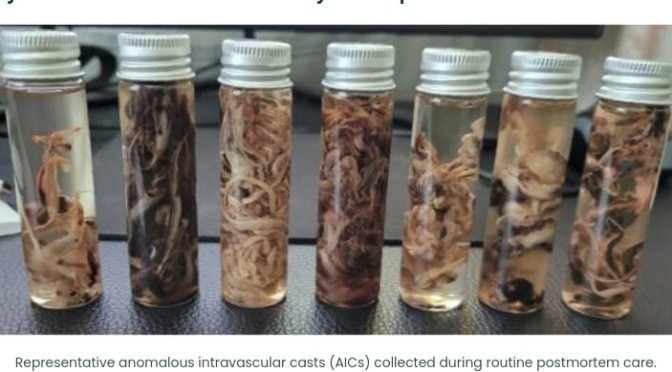
These containers of white rubbery clots shown above are each taken from deceased people during the embalming process, used to preserve the body prior to a burial or cremation. They are hard to rationalise away, being literally “in your face” – rather than an obscure cellular pathway or argument about covid stats. They are a twisted, bizarre manifestation of the corruption of the circulatory system.
To show that the process of scientific discovery is rarely complete, as we look at the photo again we note that the rubbery clots differ subtly between each case, but are consistently uniform in their width, colour and contour within each container, representing what was a unique living person.
At NZDSOS, we have not been passive, but listening, documenting, and raising the alarm. We argue consistently that these anomalous intravascular casts (AICs) represent a novel and worrying biomedical phenomenon requiring urgent scientific investigation and covid jab withdrawal meantime.
We interviewed NZ embalmer Brenton Faithfull about his observations in 2022, profiled initial efforts to understand the clots and wrote to many Australasian medical colleges and New Zealand decision-makers in 2024 – but to the silence we have come to expect. One of the first to raise the alarm, UK embalmer John O’Looney, gives a recent revelatory interview to NZ jourmalist Penny Marie of Let Kids Be Kids.
Patients and clinicians are also reporting these structures, as documented by ex-USAF Major Tom Havilland and Laura Kasner at their Clotastrophe blog. Major Havilland is committed to informing authorities and the public, as here just recently, and has done annual surveys of funeral directors, like the most recent 2025 survey here, still detailing these vascular casts in a significant – though now declining – percentage (19%) of embalmings. Note that most people aren’t embalmed, but we can assume a similar proportion of abnormal blood in those who are cremated or buried without an open casket situation.
As dreadful as the implications are, this new evolving situation – seemingly associated the mRNA jab rollouts – should have added to other alarming harms (such as batch variability, frameshifting, IgG class switching, nuclear integration, sudden deaths, cancer, adverse fertility effects, DNA contamination, product swap after the trials etc) and officials should have halted the genetic injections immediately. There is no statute which permits the state to harm people deliberately, by act or omission.
New Zealand Researchers Counter the Silence With Hard Work and Determination
Now we have answered our own call for some explanations by supporting some scientific analysis, starting 2 years ago. A landmark trilogy of studies, published on a preprint server and significantly funded by NZDSOS, provides the first comprehensive biochemical and structural characterisation of these “white clots”, better defined as anomalous intravascular casts (AIC). The findings are clear, profound, and carry significant implications for public health and clinical medicine.
This work solidifies anecdotes as established scientific fact. It shows that AICs are a previously unrecognised, abnormal form of intravascular clotting during life with a unique, persistent, and damaging architecture. Having said that, our background research reveals that microscopic versions of this type of disturbed amyloid-like clotting have been characterised pre-covid, but never in the visible, disturbing, large and obstructive form that showed up from 2021.
The Three-Part Investigation: A Systematic Unraveling
The researchers took a deliberately systematic approach, recognising that to understand something entirely novel, one must first describe it, then analyse its chemical composition, and finally define its molecular machinery. They obtained samples and organised 5 laboratories on 3 continents to do blinded analysis. In other words, the labs did not know what the samples were; several asked not to know; and a decision was made at the start to suppress the labs’ ID, to avoid external pressure on them and keep the focus on the data. Notwithstanding, the end result has the necessary detail to establish a bedrock foundation so that other work may follow. (The papers are now combined into a single paper being submitted for peer-review).
Paper 1: Establishing a New Structural Phenotype
The first study asked a foundational question: What do these structures look like at the macro and micro level, and how do they compare to what we already know?
The results show that AICs are not ordinary post-mortem clots. Typical post-mortem clots are gelatinous, friable, and either dark red (“currant jelly”) or pale yellow (“chicken fat”). They lack structure, break apart and wash out easily.
In stark contrast, AICs are:
- Elastic and Cohesive: They exhibit rubber-like elasticity and significant tensile strength, often producing a characteristic “squeak” when cut – a sign of a dense, cross-linked microstructure. Originally christened ‘calamari clots’, they sound and handle like vulcanised rubber, or even Haloumi cheese.
- Lumen-Conforming and Branched: They take the shape of the blood vessels, including anatomical branching junctions, proving they formed within and filled the living vascular tree.
- White/Fibrous: Their cream-to-white colour indicates a lack of the red blood cells that dominate normal clots. Platelets were absent too.
- Histologically Distinct: Under the microscope, they show dense, homogeneous networks of fibrin-like fibres but with a striking lack of intact blood cells. Fibrin is the dominant protein in normal blood clots. Crucially, they also show partial “Lines of Zahn”— clot substance alternating with lines of platelets and red cells that are the near certain signature of a clot formed under active, living blood flow, as below.

Conclusion of Paper 1: AICs are a coherent structural entity formed ante-mortem (before death) within flowing blood, yet they are structurally distinct from both typical clots and normal post-mortem changes. A new category is needed.
Paper 2: Revealing a Bizarre Elemental Fingerprint
The second study moved from structure to bulk chemistry. If they’re not standard fibrin clots, what are they made of? Using inductively-coupled plasma mass spectrometry (ICP-MS), several of the labs performed blinded elemental analysis.
The results were startling and ruled out simple explanations:
- Possible Sulphur Depletion: Sulphur is a key elemental marker for protein, abundant in the amino acids of fibrinogen. A pure fibrin clot should contain around 8,100 ppm sulphur. The AICs averaged only 1,190 ppm – an 85% reduction. Okay, so this is not apples-to-apples comparison, but this single finding rules out that these are just “big fibrin clots”.
- Phosphorus Enrichment: Concurrently, phosphorus levels were elevated. Phosphorus is not a major component of protein backbones; its presence signals phosphate-bearing compounds (like phospholipids, polyphosphates, or other phosphate esters). Of note phospholipids comprise a large part of cell membranes, such as those of red blood cells, which appeared to be lysed (destroyed) in proximity to the rubber clots.
- Nitrogen-Carbon Imbalance: Further analysis indicated a dilution of nitrogen-rich fibrin protein material by nitrogen-poor, carbon-rich components in the fibrous stroma between the fibrils.
Conclusion of Paper 2: The elemental signature of AICs may not be a protein-dominant fibrin matrix. Perhaps, they are instead a hybrid organic-inorganic matrix, where a protein scaffold is diluted by significant non-protein, phosphate-rich material. This explained their unusual physical properties but raised the next question: what, exactly, is the protein part?
Paper 3: The Proteomic Smoking Gun
The final study employed high-precision liquid chromatography and tandem mass spectrometry (HPLC-MS/MS) to identify every protein present and its relative abundance. Our results chart here is a composite of specimens from 3 deceased people to save space, and the individual specimens showed excellent concordance with each other. Note that novel or unknown proteins such as the covid spike protein – or various other potential random peptides anticipated by condition 5 of Medsafe’s provisional consent – will not show up with this particular method. Such characterisation would require much more complexity and greater expense.

This molecular deep dive yielded the most critical insights.
- Profound Fibrinogen Chain Imbalance: Yes, AICs contain fibrinogen, the clotting protein. But the three chains (α, β, γ) that normally assemble in a near-perfect 1:1:1 ratio were in a very distorted ratio of 1:7:3. The α-chain, crucial for lateral aggregation and clot elasticity, was severely depleted. This alone would produce an abnormally dense, tightly packed, and stiff fibrin network – structurally aberrant from the start.
- Severe Plasminogen Deficiency: This is perhaps the most significant finding, consistent with the fact of their persistence. In a normal, healthy clot, plasminogen is incorporated throughout the fibrin mesh. Once healing is complete, it is activated to become plasmin – the enzyme that dissolves the clot in a process called fibrinolysis. In AICs, plasminogen was almost absent, detected at a mere 0.13% of total protein signal. Tissue plasminogen activator (tPA), the trigger for this process, was also barely detectable. The implication here is that this deficiency creates a clot that could be without end. It is architecturally designed to persist. The body lacks the intrinsic biochemical machinery to break it down. This provides a direct mechanistic explanation for the long-term persistence of these casts in the body.
- Inflammatory and Immunothrombotic Signature: The protein composition also demonstrates dysregulated inflammation. The presence of Myeloperoxidase (MPO) and Cathepsin G points to white blood cell involvement, driving oxidative stress and protein damage. Immunoglobulin G (IgG) was also found, suggesting an adaptive immune response and the formation of what is termed immunothrombosis – a pathological mish-mash of clotting and inflammation.
- Minor Proteins as “Detritus”: Over 500 other human proteins were detected at smaller levels. Some of these are likely non-specific “biochemical detritus” caught in the aberrant matrix, not functional components, consistent with the sulphur-depleted, protein-scarce elemental data. However, many others give strong clues as to some specific processes involved, which are beyond the scope of this initial data drop.
Conclusion of Paper 3: AICs have a reproducible, pathological protein make-up: abnormal fibrinogen stoichiometry (physical 3-D structure) creating a malformed scaffold, coupled with a near-total absence of the fibrinolytic system, all within a context of inflammatory and immune activation.
Synthesis: What Does This Mean?
Taken together, these three analyses paint a compelling and concerning confirmation of abnormality.
AICs are not “clots” in the physiological sense. They are non-dissolvable and lack blood cell components. They are persistent intravascular biostructures made from a malformed fibrin scaffold that is biochemically “locked in.” Their hybrid elemental composition suggests incorporation of phosphate-rich material (like platelet-derived polyphosphate or phospholipid membranes), which may further stabilise them and alter their physical properties.
The proteomic finding of a disabled ‘breakdown’ system perfectly explains the physical persistence, and the distinctive elemental signature. The persistence allows the malformed, fibrin scaffold (due to α-chain depletion) to act as a trap for phosphorus-rich cellular debris – like platelet polyphosphates and red blood cell membranes – which accumulate over time, enriching the cast in phosphorus and further diluting its protein-based sulphur and nitrogen content.
In sum then, their formation represents a severe corruption of the blood clotting system – one that builds but cannot break down, and that intertwines with inflammatory pathways.
Clinical and Public Health Implications: Why This Matters
Extrapolating from the accounts of individual embalmers and then the later survey responses from large groups of funeral professionals, we can assume these structures are forming far too commonly to ignore. They are hardly “vanishingly rare”. And their progenitor microscopic versions will likely appear even more common if they are looked for. So the existence of such a persistent, obstructive material in blood vessels is hardly a benign curiosity, let alone worthy of willful blindness. It is easy to work out the potential consequences:
- Microvascular Obstruction: While a large clot in a coronary or cerebral artery causes sudden, catastrophic events like heart attack or stroke, persistent occlusion of microscopic vessels is more insidious. It impairs capillary flow, leading to chronic hypoxia (oxygen starvation) in tissues. This can manifest as organ dysfunction (renal, cardiac), neurocognitive issues, profound fatigue, and exercise intolerance – symptom profiles that will be familiar to many.
- Driving Chronic Disease: The persistence of this material sustains inflammation, damages endothelial linings, promotes vascular stiffening, and can act as a focus for further abnormal clotting. It creates a self-reinforcing cycle of vascular injury and ischemia (oxygen lack).
- Therapeutic Resistance: Standard thrombolytic (clot-busting) drugs work by activating the fibrinolytic system. A structure that lacks the very target of these drugs (plasminogen) will be highly resistant to such treatment.
A Critical Call for Further Investigation and a Proposed Mechanism
Outside of this project’s imperative for academic conservatism, NZDSOS has long suggested the injections as the most likely culprit to explain the AICs. Peer-reviewed literature already demonstrates that the SARS-CoV-2 spike protein can bind to fibrinogen, inducing structural changes and increasing resistance to fibrinolysis in vitro (in the lab). Other studies have shown co-localisation of spike protein with fibrin in pathological contexts. Informal publications show the documented ability of spike protein – and the synthetic lipids of the nanoparticles, it must be said – to trigger inflammatory and coagulatory pathways and mark them as prime candidates for investigation as potential drivers of the abnormalities seen in AICs.
The NZDSOS Position: Validation and a Path Forward
This research validates the persistent observations from the front lines of embalming and clinical medicine. Clearly, it moves the discussion from “Are these real?” to “What causes them and how do we address them?”
Our call is three-fold, put in as measured a tone as possible given the potential implications of these clots forming in many of us:
- For the Medical and Scientific Community: Treat these findings with the seriousness they warrant. Replicate the studies. Investigate the causative agents, with the spike protein hypothesis being an immediate priority. Explore potential diagnostic markers and treatments aimed at this unique pathology.
- For Clinicians, and pathologists: Be aware of this novel entity. Consider AICs in the differential diagnosis of patients with unexplained microvascular or large vessel thromboembolic symptoms, especially those with persistent, debilitating conditions.
- For the Public and Health Authorities: Recognise that post-vaccine medicine is encountering numerous harms and novel pathologies. Stop the jabs immediately, and support open, transparent research into these phenomena to understand their prevalence, cause, and impact on population health.
Where This Research Is Leading Us Now
Any novel finding generates new questions. Three cogent ones have emerged, and the answers will help converge on a solution. We are investigating them with urgency, but it does not help that government, the Medical Council and professional colleges are all in denial.
First, do AICs meet the definition of amyloid? Our proteomic data reveal distorted fibrin, but cannot tell us whether it is misfolded into the beta-sheet structure that defines true amyloid (non-functional damaging protein deposits). However, work by other researchers – some peer-reviewed, some informal – using more advanced assays implies microclot precursors and AICs do indeed possess amyloidogenic properties. If replicated, this would move their classification from “aberrant clot” toward “amyloid-like deposit” – with profound implications for persistence and toxicity.
Second, could AICs involve a prion-like mechanism? Prions are misfolded proteins that corrupt normal proteins and propagate the chaos in a domino-effect. Our research was not set up to demonstrate this, but emerging evidence of seeding capacity – the ability to corrupt normal fibrinogen – raises the possibility of a self-propagating pathology. Earlier research demonstrated prion-like sections in the spike protein genetic code. This demands urgent investigation.
Third, what is the trigger? Work prior to covid shows that abnormal proteins can bind fibrinogen, producing aberrant clots resistant to breakdown. So plausibly we can hypothesise that an introduced agent – such as engineered antigens – could similarly corrupt fibrin architecture. The temporal association with the mRNA rollouts makes the injections a highly plausible culprit. Investigating whether spike protein, lipid nanoparticles or even modified RNA co-localises with AICs is now the urgent next step.
The role of platelets is intriguing too – or rather the lack of them. The structure and contents of platelets are central to normal clotting. Perhaps they are consumed elsewhere, or the microtears lining the blood vessels, caused by reaction to exiting spike proteins, may be simply too small to attract them and trigger their regulatory functions.
In Conclusion
The mystery of the white rubbery clots has been solved at the descriptive level, and many feel they are yet another consequence of the jabs. The clots are a real, distinct, and brand new intravascular structure, since 2021.
To rub it in, they are common, often silent until they’re not, and they are inside the blood vessels of many of us wandering around clueless right now. How should we feel about this? One of the clot samples analysed was taken from a 12 year old! And the unvaccinated must expect to have the covid spike protein in their bodies by now and may share the risks.
Meantime, formal peer-review and publication of our analysis will follow. This will cost, and there are still outstanding bills to pay for the work done so far, and more insights to come. Donations to NZDSOS will help this greatly.
In the meantime, perhaps the silence surrounding our corrupted blood is not so mysterious after all. Psychologist Professor Mathias Desmet reminds us:
Speaking the Truth is always dangerous… because Speaking the Truth by definition means: Articulating Words that destroy Illusions.
The Preprint Trilogy:
- Paper 1 (Morphology & Histology):
https://www.preprints.org/manuscript/202601.1846/v1 - Paper 2 (Elemental Analysis):
https://www.preprints.org/manuscript/202601.2149/v1 - Paper 3 (Proteomic Analysis):
https://www.preprints.org/manuscript/202601.2319/v1
RELATED
Funeral Director John O’Looney tells his hospital admission story
Important Observations from a Funeral Director on the ‘Safe & Effective’
A further interview with the NZ Funeral Director speaking out about what he is seeing (Liz Gunn)
Discover more from Environmental Health Watch NZ
Subscribe to get the latest posts sent to your email.

An excellent report which effectively exposes medical industry corruption — what kickbacks do they get? We can safely assume they’re big. Have reposted.
LikeLiked by 1 person
Can you even trust a white coat today? They’re getting rare!
LikeLike