

Datagrid’s proposed datacentre is on track to become one of the largest rent-seeking plays New Zealand has ever seen
- The facility planned near Invercargill will draw a continuous 280 MW initially — about 6% of everything our grid currently produces.
Their own proposal signals they’ll scale that to more than three times the load, meaning this single site could eventually gobble 20% of the country’s total electricity generation.
For context, Tiwai Point aluminium smelter is currently NZ’s biggest power user at roughly 10–12%. This datacentre will blow that out of the water and, within a few years, will need the entire output of the Manapōuri hydro station just to keep the lights on.
The economics are even uglier. Tiwai returns about $105 of GDP per MWh of electricity. Datagrid’s centre will be lucky to manage $24 — and independent assessments put the real figure closer to $12. That’s a problem.
MBIE’s own numbers on industry’s power use to crate $1 of GDP for NZ are stark :
Fishing & forestry: 2 MJ per $1 of GDP
Chemicals & metals: 12 MJ per $1 of GDP
General industry: 11.5 MJ per $1 of GDP
This datacentre??: 147 MJ per $1 of GDP
NZ’s real vulnerability is energy security. The price of power ultimately sets the quality of life. High electricity prices are already crushing industry and driving de-industrialisation here and across other Western economies.
NZ First is pushing (strongly opposed by National and ACT) to break up the gentailer complex — the four big vertically integrated companies that dominate both generation and retail. That structure lets them shift costs internally, favour their own retail arms, and shape wholesale prices in ways that have delivered record profits alongside record power bills. Perverse.
Enter Mercury: they’ve taken a $30 m, 12.7% stake in the foreign-controlled (French/Singaporean) Datagrid venture and have already locked in preferential power rates for the datacentre.
So let’s recap:
i) A power generato
ii) That is also a retailer
iii) That also owns a chunk of what will be NZ’s largest single power consumer — by far the least efficient user of our scarce electricity — and will supply it large volumes at cut-price rates
Is this retarded? Yes
This project wants to hoover up 20% of our generation capacity. They claim they’ll build more generation themselves, but solar panels won’t cut it — do you honestly believe they’re going to construct another Clyde Dam? Basically Kiwis will end up subsiding this foreign owned and low economic output mouse factory, while we watch more and more industry close and our bills climb
The opportunity cost of diverting that much electricity away from higher-value NZ industry into a low-return datacentre is economic suicide. Power usage on this scale means higher electricity prices – we have limited electrons to spare.
Break up the gentailers and take a very hard look at this proposal.
Larry Blair’s excellent NZ Energy Substack is essential reading — here’s his March piece
The 280MW question?
Where is the power coming from for Datagrid’s Southland data centre?
Mar 18, 2026
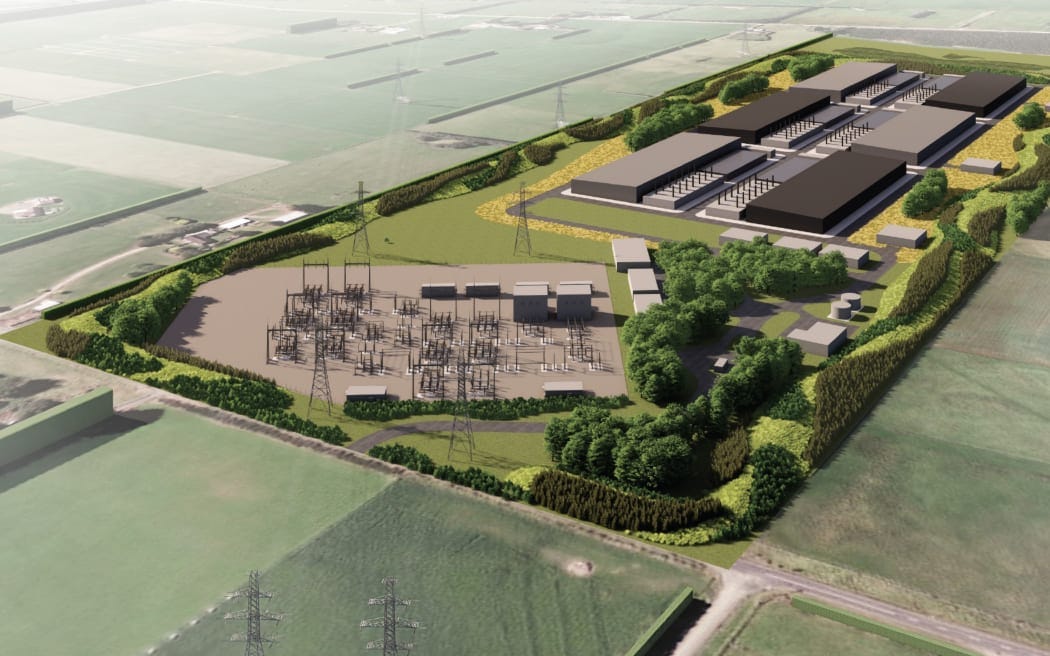
If you had missed it in the news, a company called Datagrid has been granted resource consent to build a $3.5 billion data centre near Invercargill which is being described as the country’s first “artificial intelligence factory”. The 78,000 square-metre data centre will be built in Makarewa, north of Invercargill.
The term “artificial intelligence factory” suggests that this is a data training and inference facility to improve AI models.
There are really only two numbers we need to know about in this story.
280MW and $60 million.
Metabolism.
This data centre is a hungry beast. It has an energy metabolism rivalling that of my three teenage sons.
The consent application paperwork on the Environment Southland website is interesting. It’s a chunky project for sure. Once built the facility will require around 2.45 TWh of electricity based on the nameplate capacity of 280 MW. This will make it New Zealand’s second-largest industrial consumer behind the other Southland industrial, the Tiwai Point Aluminium smelter.
Economic Benefits.
I hope that this is a typo and there is at least one and ideally two zeros missing here.
This number appears to originate from the developer’s own estimates rather than an independent economic assessment. If this figure is correct, it would imply the facility produces roughly $24 of economic output for every MWh of electricity consumed.
This is an incredibly low figure compared with most sectors of the New Zealand economy. From an energy intensity perspective it represents 147 MJ of energy per dollar of GDP generated.
For a sector by sector comparison based on MBIE data the energy per dollar of GDP generated are:
- Chemicals & Metals use 11.53 MJ per dollar.
- Industrial 3.42 MJ per dollar.
- Agriculture, Forestry & Fishing 2.11 MJ per dollar.
- Commercial 0.3 MJ per dollar.
This would infer that the productivity of this data centre is about 13 times lower than the chemicals and metals sector.
As a direct comparison to its neighbour, and NZ’s largest consumer of electricity, the Tiwai Aluminium smelter, which generates around $105 of GDP per MWh of electricity used the data centre will only generate $24 / MWh for NZ Inc.
The key distinction here of course is that this is the value generated for NZ Inc. It will generate far more value for its owners BW Digital in Singapore.
Where is the power coming from?
In November last year, in “Divergence” I noted that electricity consumption in 2024 was 1% lower than it was in 2014 due to “invisible rationing” in the form of excessively high prices and demand management leading to a trend of deindustrialisation. To quote from that piece.
The drop in industrial consumption is not a function of a lack of demand, it is instead a function of a lack of supply.
The demand is still there, but behind the scenes electricity has been rationed.
We don’t call it rationing, instead preferring to use the more palatable term industrial “demand management”, but what it means in the NZ context is that large businesses like the aluminium smelter reduce production to free up electricity supply for the rest of the country.
Similarly smaller industrial users self-ration due to price sensitivities, often stopping production and idling plant if the wholesale electricity prices get too high.
Industrial load is price responsive in a way that residential is not. So, the system naturally rations through price. This is not a conspiracy it’s a function of physics meeting economics.
It is for this reason alone that the Datagrid announcement surprised me the most.
I would not have considered New Zealand as being a very attractive proposition for a data centre of this size. Our electricity system is clearly not delivering the stable abundant and cheap electricity that industrial users need to be able to operate in New Zealand as the forestry products sector and now Wattie’s can attest to.
Data centres operate very differently from many other industrial loads. Unlike factories or irrigation pumps, a hyperscale data centre generally runs 24 hours a day, every day of the year. Their load factor is extremely high.
New Zealand’s electricity system is dominated by hydro generation, so a useful way to understand the scale of the load that this project will add to the grid is to ask the hypothetical question, which hydro station would need to be dedicated entirely to running this data centre?
Here are a couple of examples of hydro schemes around the right size, with sufficient capacity when the real-world capacity factors are considered:
- Clyde Dam 432 MW
- Benmore Dam 540 MW
Another way to look at it is that the proposed data centre would require roughly half of the entire Manapōuri hydro station if it were supplied solely from that plant.
Of course electricity is not physically allocated that way on the grid. But the comparison illustrates the scale of the demand.
When we look at the New Zealand Generation Investment Pipeline we see a bit of 2GW of generation capacity being actively pursued mostly in the form of wind and solar. When we consider capacity factors and firming this figure shrinks significantly.
If we work on the basis if this data centre being powered by a combination of two thirds wind and one third solar it would need about 1GW of installed capacity and that still does not account for those calm nights.
Two key questions.
I leave you all with two key questions.
Firstly a question to the Datagrid folks. Please confirm that $60 million is misquoted and the value to NZ Inc from this project is many multiples more than this?
Secondly a question to the Transpower team. How is this all going to work?
RELATED
Photo credit: NZ Energy
Discover more from Environmental Health Watch NZ
Subscribe to get the latest posts sent to your email.

2 thoughts on “Southland data centre will use 20% of NZ’s generation capacity”