

PLEASE SHARE
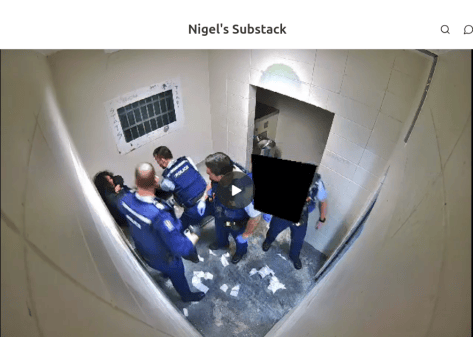
The following video is of this young lady being beaten by NZ Police under no provocation in a police cell. The result?;
(I have had to remove this [full] image as it exposed the face of the victim of police violence)
AND THIS IS WHY:
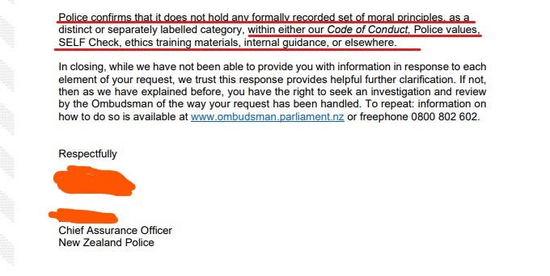

Click on the image below for the video:
RELATED:
Shot at, assaulted, arrested, thrown in jail, drugged, car destroyed, home sledgehammered – something is very wrong with NZ’s justice system – (a must read book review)
Police State NZ?
Official Information Act Request: NZ Police Use‑of‑Force Training – “Compliance Punches” and Cell‑Control Techniques
“Compliance Punches” and Cell‑Control Techniques

To: NZ Police
From: Nigel Gray
Subject: Official Information Act Request – Definitions, Training, and Policy Regarding “Compliance Punches” and Physical Control Techniques in Custody Cells
Nigel’s Substack is a reader-supported publication. To receive new posts and support my work, consider becoming a free or paid subscriber.
Under the Official Information Act 1982, I request the following information relating to NZ Police use‑of‑force training, terminology, and operational guidance:
[ in relation to NZ Herald report: “The sergeant said his punches hadn’t been hard – describing them as “compliance punches” – and his lawyer, David Pawson, suggested Bevins could have been injured by knocking her face against the edge of the stainless steel bed as she was taken to the ground.”]
1. Definitions and terminology
Please provide:
- The official NZ Police definition of a compliance punch, including any internal terminology, training notes, manuals, or doctrine where this term appears.
- Any other terms used by NZ Police relating to punches, strikes, jabs, or blows delivered with a closed fist as part of compliance or restraint techniques.
- Any scale, classification, or severity framework used to distinguish between types of punches or levels of force.
2. Training and instruction
Please provide:
- All training materials, lesson plans, modules, or instructional documents that describe how officers are trained to deliver punches to a person in custody or under arrest.
- Any guidance on target areas, force levels, risk mitigation, and injury‑prevention when delivering punches.
- Any training that covers the use of punches in confined spaces, cells, or when multiple officers are present.
- Any training that covers the use of punches on restrained, seated, or non‑standing individuals.
3. Policy and operational guidance
Please provide:
- All NZ Police policy documents that govern the use of closed‑fist strikes as a compliance technique.
- Any policy or guidance that addresses the use of force on individuals who are already contained within a locked cell.
- Any policy or guidance that addresses the use of force when police property has already been secured and no weapon is present.
4. Cell‑control techniques
Please provide:
- All training materials or policy documents describing approved methods for removing a person from a cell bed.
- Whether NZ Police train officers to pull a person off a cell bed, pull them to the floor, or swing them around the cell as part of standard control techniques.
- Any alternative techniques taught for controlling a non‑compliant person in a cell, including ground‑control, limb‑control, team‑control, or non‑impact compliance methods.
5. Internal reviews and doctrine
Please provide:
- Any internal reviews, audits, or evaluations of the use of punches as a compliance technique.
- Any changes to training or doctrine since 2018 relating to closed‑fist strikes.
- Any IPCA findings or internal Police findings that have resulted in changes to punch‑related training.
6. Use‑of‑Force reporting
Please provide:
- The criteria for when a punch must be recorded in a Use‑of‑Force report.
- Any internal guidance on how officers should describe punches in reporting (e.g., “compliance jab”, “straight punch”, “uppercut”, etc.).
- Any internal definitions of “light”, “moderate”, or “significant” force when describing punches.
7. Custody‑specific force
Please provide:
- Any training or policy that governs the use of force on detainees who are seated, lying down, or partially restrained.
- Any training or policy that governs the use of force when multiple officers are present, including thresholds for escalation and de‑escalation.
Timeframe
I request this information within the statutory timeframe. If any part of this request is refused, please provide the grounds for refusal and identify the relevant sections of the Act.
Yours Sincerely, Nigel Gray
Nigel’s Substack is a reader-supported publication. To receive new posts and support my work, consider becoming a free or paid subscriber.
Note: I can confirm this brutality is not new. I personally knew young Māori who described being picked up off the streets in Napier during the late ’60s, early ’70s. They were walking home, not drunk or doing anything wrong, and taken to the cells and given a hiding. This was also later confirmed for me during my University studies in social work and social policy during the 1980s. A lecturer we had spoke of off duty policemen boasting at their parties about beating up people in the cells. Most Māori will also confirm that they get pulled over by traffic officers for no particular reason. I have first hand knowledge of this also. EWNZ
Photo Credit: pixabay.com
Discover more from Environmental Health Watch NZ
Subscribe to get the latest posts sent to your email.

As fellow Voluntaryist Robert Higgs wrote:
THERE ARE NO GOOD COPS.
“The whole Good Cop / Bad Cop question can be disposed of much more decisively. We need not enumerate what proportion of cops appears to be good or listen to someone’s anecdote about his uncle Charlie, an allegedly good cop.
We need only consider the following: A cop’s job is to enforce the laws, all of them; many of the laws are manifestly unjust, and some are even cruel and wicked; therefore every cop has to agree to act as an enforcer for laws that are manifestly unjust or even cruel and wicked. There are no good cops.” Robert Higgs, Voluntaryist scholar
LikeLike
I do get the point Jack that Robert Higgs makes. Still though, I believe there ARE cops around who do have good hearts and did wish to do good when they signed up … who inevitably ended up leaving given what they are up against. A Kiwi ex-cop communicates that things changed here around 2000. More akin now to the true Agenda 2030 reset lot that are now baring their teeth. I think the so called ‘good cops’ just carefully navigate the unjust, wicked laws and try to create better outcomes for people. Not to bite the hand that feeds. Bit like the good MD bad MD scenarios we’ve recently seen with the death shots.
LikeLike
Like all occupations there are good and bad police and unfortunately there are plenty of the latter — not so many on the Kapiti Coast where we are but definitely in the major cities. The bad ones were highlighted after NZ’s autocrat Comrade Jacinda ordered a rampage against gun-owners in 2019, particularly those ones who could in any way be identified as ‘right wing’ by her and her cabinet’s definition. They were subsequently massively highlighted, of course, outside parliament in February/March 2022 and put brutality, vandalism and theft on full public display. Just as disgusting was the praise their behaviour got by the Leftist Legacy Media (TV 1 News/Stuff/RNZ/Herald and the then Newshub). The fundamental mantra to follow is “never let the police get away with doing anything illegal.” We’re reposting.
LikeLiked by 1 person
Thanks for the reminder WW. Lest anybody has forgotten that awful event in Wellington.
Another example of Police goings on near you is the Horowhenua and the lake there near Levin. Anne Hunt wrote a book about the harrassment of Phil Taueki …
LikeLiked by 1 person