

Book burning at its finest … once digitised they have control over each history to reshape or delete as wished. They’ve been quietly getting rid of books for some time now, NZ included. They seek control of all. Wiping out the data. Precursor to tyranny. Guns gone, info going, censorship increasing, democracy long gone (if it even ever existed), health freedoms going fast. Military on the streets. All the ducks in a row. EWNZ
We are officially in the modern era of book burning and destruction of knowledge, brought to you by artificial intelligence companies. According to reports, big-tech corporations have been on a book-buying spree, old and antique books especially, scanning their contents, and then disposing of them by putting them through giant paper shredders and into the garbage.
Previously, corporations such as Meta and Anthropic were guilty of pirating massive troves of digital e-books to train their AI models with. Authors of those books have sued the companies, and Anthropic was forced to pay-out $1.5 billion in penalty fees, the Associated Press reported last week.
Anthropic’s deputy general counsel, Aparna Sridhar, stated that the ruling represents a landmark, showing “that training AI on books is fair use under copyright law.”
“We are pleased that more than 91% of authors and publishers covered by the settlement have claimed their share of the payment, and we’re looking forward to bringing this matter to a close,” Sridhar added in his written statement.
And as if this weren’t bad enough, these companies are doing the same and more with physical books.
In 2025, Ars Technica reported that Anthropic destroyed millions of books in the process of training its LLM Claude. The tech outlet wrote at the time:
In the process, the company cut millions of print books from their bindings, scanned them into digital files, and threw away the originals solely for the purpose of training AI.
The 32-page legal decision tells the story of how, in February 2024, the company hired Tom Turvey, the former head of partnerships for the Google Books book-scanning project, and tasked him with obtaining “all the books in the world.” The strategic hire appears to have been designed to replicate Google’s legally successful book digitization approach—the same scanning operation that survived copyright challenges and established key fair use precedents.
While destructive scanning is a common practice among some book digitizing operations, Anthropic’s approach was somewhat unusual due to its documented massive scale. By contrast, the Google Books project largely used a patented non-destructive camera process to scan millions of books borrowed from libraries and later returned. For Anthropic, the faster speed and lower cost of the destructive process appears to have trumped any need for preserving the physical books themselves, hinting at the need for a cheap and easy solution in a highly competitive industry.
Ultimately, Judge William Alsup ruled that this destructive scanning operation qualified as fair use—but only because Anthropic had legally purchased the books first, destroyed each print copy after scanning, and kept the digital files internally rather than distributing them. The judge compared the process to “conserv[ing] space” through format conversion and found it transformative. Had Anthropic stuck to this approach from the beginning, it might have achieved the first legally sanctioned case of AI fair use. Instead, the company’s earlier piracy undermined its position.
But the process has become a lucrative venture for booksellers.
404 Media recently highlighted a company called ISBNdb, which boasts that they are “the world’s largest book database,” and provide high-volume book acquisition services for AI companies. “ISBNdb gathers data from hundreds of libraries, publishers, merchants, and other publicly available sources around the globe to compile a vast collection of book data,” the website says.
The company adds: “The world’s best AI training data is sitting on a shelf.”
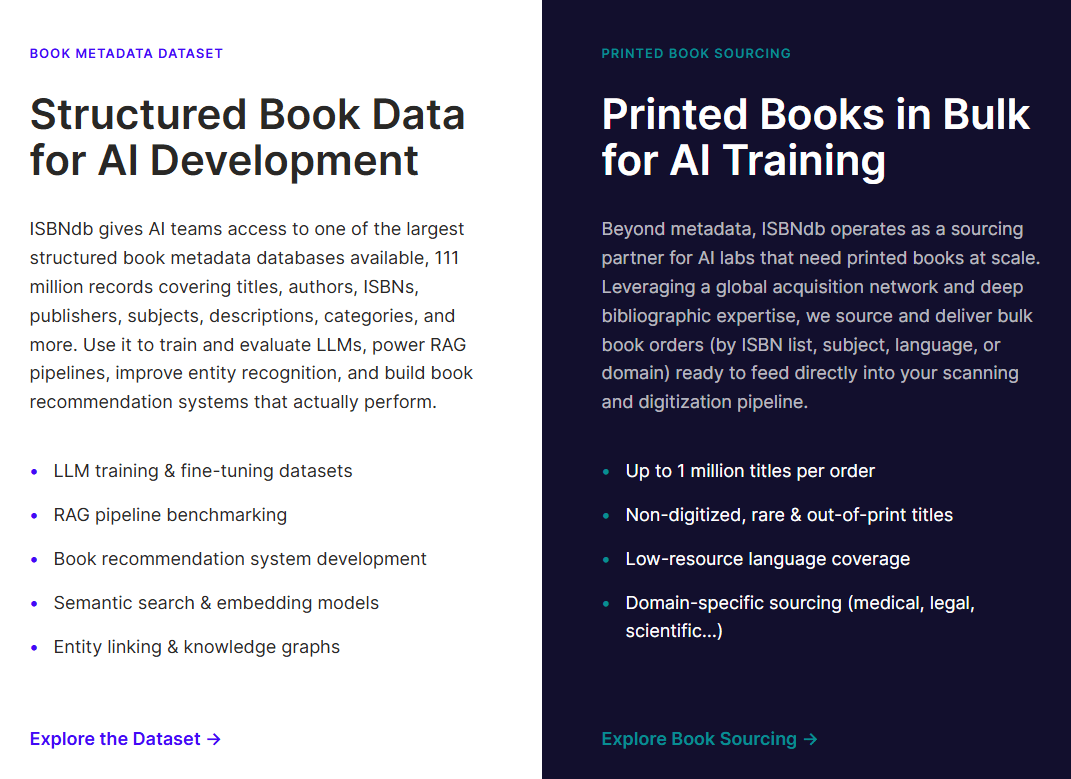
In an article posted in April, the company said that printed books published before 2022 are the best for AI training data because they exclude AI-generated text. Contrast that with the internet today, much of which is now AI-generated, where this replication process can create a “model collapse” — “Subtle linguistic nuances vanish, systematic errors compound, and outputs converge on repetitive patterns. Each generation trained on synthetic data is slightly worse than the last,” the company says. “Print books from the pre-LLM era are structurally guaranteed to be free of this contamination. That alone is a significant advantage. Physical books published before this date are structurally clean of modern poisoning tools.”
Dead Internet: Over 40% Of LinkedIn Posts Are AI, As ‘Agentic AI Activity Is Driving A Lot Of Browser Activity’
Jul 31
SBNdb brags that it can covertly protect the identity of these AI firms’ practices.
“Strict NDA [non-disclosure agreement] on every engagement. Every project begins with a legally binding non-disclosure agreement. Your identity, strategy, and acquisition targets are never disclosed.”
“The optics problem is real. AI company destroys two million books’ is not a headline that generates sympathy.”
A professional bookseller who specializes in selling foreign language books on these types of marketplaces told 404 that he noticed a recent spike in sales. He believes it is because these AI companies are buying more books to train their LLMs.
“I personally have mixed feelings about all of this. It benefits me financially as well as by clearing out old inventory that is otherwise unlikely to sell. I’ve been well-suited for these sales with inventory from overseas and foreign language books. On the other hand, I don’t like the end-use, and I don’t like that uncommon books are being pulped.”
“It’s not just the quantity, but the weirdness of the orders. I’ve had library orders before, and usually they’re mostly confined to a single subject or maybe a slightly broader range of subjects. But basically, almost every library in the world has lost their budget. I know all the U.S. college libraries don’t buy much anymore. The Australian libraries don’t buy much anymore. The type of books […] there’s no rhyme or reason to it. Also, there’s a total disregard for the price of the book. I’ve had some books that sold through this way that were […] greatly overpriced. That’s kind of a tell for AI because they have just so much money.”
Despite this, Anthropic never really explains why the books must be destroyed in such a manner. 404 wrote:
Internal Anthropic documents about its plan to scan millions of books, revealed in the copyright lawsuit, don’t make clear why the company wanted to destroy the books in the process. A deposition of Tom Harvey, who Anthropic hired to lead the project and who previously helped create Google Books, shows that one company Anthropic contracted to scan the books was Datamation, which offers both “high volume destructive and non-destructive book scanning” services. In a destructive book scanning process, the spine of the book is cut so the pages can be fed into a scanning machine, which is faster and cheaper than non-destructive book scanning.
Regardless of its original intentions, the federal judge in the copyright lawsuit from authors against Anthropic, William Alsup, found that Anthropic’s creation of digital copies of the books was legal specifically because the books were destroyed.
“Here, every purchased print copy was copied in order to save storage space and to enable searchability as a digital copy,” Alsup wrote in his ruling. “The print original was destroyed. One replaced the other. And, there is no evidence that the new, digital copy was shown, shared, or sold outside the company.”
This, Alsup said, was “clearly transformative” and therefore qualified as fair use under Section 107 of the Copyright Act.
The WinePress News is a reader-supported publication. To receive new posts and support my work, consider becoming a free or paid subscriber.Upgrade to paid
AUTHOR COMMENTARY
There is no new thing under the sun, and this is the modern penknife to the scroll, then straight into the fire.
Jeremah 36:20 And they went in to the king into the court, but they laid up the roll in the chamber of Elishama the scribe, and told all the words in the ears of the king. [21] So the king sent Jehudi to fetch the roll: and he took it out of Elishama the scribe’s chamber. And Jehudi read it in the ears of the king, and in the ears of all the princes which stood beside the king. [22] Now the king sat in the winterhouse in the ninth month: and there was a fire on the hearth burning before him. [23] And it came to pass, that when Jehudi had read three or four leaves, he cut it with the penknife, and cast it into the fire that was on the hearth, until all the roll was consumed in the fire that was on the hearth. [24] Yet they were not afraid, nor rent their garments, neither the king, nor any of his servants that heard all these words.
Back in March, I wrote a piece titled, “We Have Entered The Age Of Digital Book Burning – An Entirely Paperless, Tokenized World,” in which I detailed how in the midst of this push for tokenization is also a covert war on paper, a plot to eliminate paper records, paper money, and paper knowledge. And in that report I noted how these companies were buying and pirating troves of books so they can extract the book’s contents for their AI models.
It’s happening, we called it.
We Have Entered The Age Of Digital Book Burning – An Entirely Paperless, Tokenized World
Mar 7
In January, Yuval Noah Harari, a prolific transhumanist and recurring speaker at the World Economic Forum, made some startling claims (as he always does) about AI, warning that it “is not just another tool. It is an agent.” He warned that anything with words will be consumed by AI.
“Therefore, anything made of words will be taken over by AI. If laws are made of words, then AI will take over the legal system. If books are just combinations of words, then AI will take over books.
“If religion is built from words, then AI will take over religion. This is particularly true of religions based on books, like Islam, Christianity or Judaism. Judaism calls itself the religion of the book, and it grants ultimate authority, not to humans, but to words in books. Humans have authority in Judaism, not because of our experiences, but only because we learn words in books.
“Now, no human can read and remember all the words in all the Jewish books, but AI can easily do that. What happens to a religion of the book when the greatest expert on the Holy Book is an AI? However, some people may say, can we really reduce human spirituality to just words in books? Does thinking mean only putting language tokens in order?
“[…] But these are just words. The Bible says, in the beginning was the Word, and the Word was made flesh. The Tao Te Ching says, the truth that can be expressed in words is not the absolute truth. Throughout history, people have always struggled with the tension between word and flesh, between the truth that can be expressed in words and the absolute truth, which is beyond words.”
Harari even went on to claim that, in time, AI will takeover the words in people’s minds. “AIs will soon be the origin of maybe most of the words in our minds. AIs will mass produce thoughts by assembling words, symbols, images, and other language tokens into new combinations.”
Top WEF Advisor Yuval Noah Harari Warns That AI Will Completely Enslave Mankind, Takeover The World’s Top Religions And Rewrite The Bible
Jan 25
Harari was not lying. He tried to say this was way off in the future, but I think we understand that what he described is going to be happening (and is happening) very rapidly in the near term.
From my aforementioned report:
It is a quasi-new age of digital book burning. Remember the book Fahrenheit 451 by Ray Bradbury? The 1953 book is a dystopian novel that takes place in a future America where books have been outlawed and the “firemen” come by to burn any books that are found to exist. Society had become illiterate because of it, and literature and words were replaced with television, sports and the many vanities of a cosmopolitan society; as books were seen as sources of confusion and depression. The main character of the story was able to steal and hide a book from being burned, the Bible, and eventually escapes the manhunt after him and finds a society that has memorized a number of books in the event society collapses, and the main character realized that he learned to memorize parts of the book of Ecclesiastes. The group then stands from a distance as they watch the city get nuked into oblivion.
Taken from the book:
“Oh, they don’t miss me,” she said. “I’m antisocial, they say. I don’t mix. It’s so strange. I’m very social indeed. It all depends on what you mean by social, doesn’t it? Social to me means talking to you about things like this.” She rattled some chestnuts that had fallen off the tree in the front yard.
“Or talking about how strange the world is. Being with people is nice. But I don’t think it’s social to get a bunch of people together and then not let them talk, do you? An hour of TV class, an hour of basketball or baseball or running, another hour of transcription history or painting pictures, and more sports, but do you know, we never ask questions, or at least most don’t; they just run the answers at you, bing, bing, bing, and us sitting there for four more hours of film-teacher.
That’s not social to me at all. It’s a lot of funnels and lot of water poured down the spout and out the bottom, and them telling us it’s wine when it’s not. They run us so ragged by the end of the day we can’t do anything but go to bed or head for a Fun Park to bully people around, break windowpanes in the Window Smasher place or wreck cars in the Car Wrecker place with the big steel ball. Or go out in the cars and race on the streets, trying to see how close you can get to lampposts, playing ‘chicken’ and ‘knock hubcaps.’
I guess I’m everything they say I am, all right. I haven’t any friends. That’s supposed to prove I’m abnormal. But everyone I know is either shouting or dancing around like wild or beating up one another. Do you notice how people hurt each other nowadays?”
Or quotes such as these:
“Cram them full of noncombustible data, chock them so damned full of ‘facts’ they feel stuffed, but absolutely ‘brilliant’ with information. Then they’ll feel they’re thinking, they’ll get a sense of motion without moving. And they’ll be happy, because facts of that sort don’t change. Don’t give them any slippery stuff like philosophy or sociology to tie things up with. That way lies melancholy.” […] “We bombard people with sensation. That substitutes for thinking.”
Oh, how familiar those words resonate today?!
“My people are destroyed for lack of knowledge […]” (Hosea 4:6).
These AI companies are evil, they are godless reprobates and “inventors of evil things” (Romans 1:28-32). They are helping to usher in a new technological dark age, creating totally illiterate, domicile, uninspired, apathetic zombies who are incapable of anything or critical thought (more so than many people already are), where people must bow down to their new god for wisdom and truth.
Sam Altman Says Elites Are Close To Creating A Genie That Can Grant Any Wish, Says We Have Reached AI Singularity – The Point Where It Becomes Irreversible And Uncontrollable
Jul 28
Founder Of Quantum Computer Company D-Wave Says Datacenters Are An ‘Altar To An Alien God’ And Taps Into ‘Parallel Universes’
Jul 26
Old books and materials are being destroyed, and this is no mistake, it is deliberate.
I believe it is imperative, more than ever, to make sure you have and preserve and read many books. If that means downloading and printing off documents and books then do that. I do. Do what Solomon did:
Ecclesiastes 12:9 And moreover, because the preacher was wise, he still taught the people knowledge; yea, he gave good heed, and sought out, and set in order many proverbs. [10] The preacher sought to find out acceptable words: and that which was written was upright, even words of truth. [11] The words of the wise are as goads, and as nails fastened by the masters of assemblies, which are given from one shepherd. [12] And further, by these, my son, be admonished: of making many books there is no end; and much study is a weariness of the flesh.
And above all else, ESPECIALLY make sure you have multiple physical copies of the scriptures, the King James Bible; that tops everything else, never go without that; it is your birthright (1 Peter 1:23-25) and the only way to know truth and the Lord’s will (John 14:22-24).
If you enjoyed this report and others like it, please consider sharing this post and supporting The WinePress down below!Upgrade to paid
Thanks for reading The WinePress News! This post is public so feel free to share it.
Photo Credit: The WinePress
Discover more from Environmental Health Watch NZ
Subscribe to get the latest posts sent to your email.

This is so sinister!
They are not only replacing us, but our culture, science and history.
Thanks for posting, Pam. xxx
LikeLike
Exactly, they are Zara. Evil to the max. xx
LikeLiked by 1 person
Stay strong, Pam! xxx
LikeLiked by 1 person
Thank you Zara. You too : ) xxx
LikeLiked by 1 person