
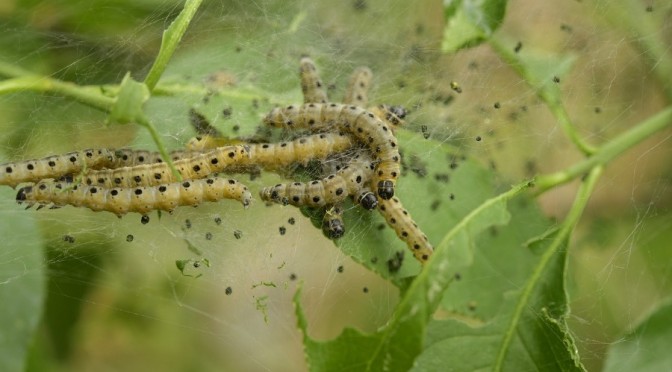
It is a new gardening season and once it warms up the pest populations will quickly grow.
So far the temperatures have been below what would be normal for this time of the year and considering we are only a few weeks away from Labour Weekend it is most strange.
Temperatures have a great bearing on insect pest activity and population growth.
An ideal spring is an early one with 2-3 weeks of nice warm temperatures which attract the pests out of hiding to get on with their lives. Then a sudden cold snap for a week will bowl most of them out of our gardens and then delay the problems they cause till after the new year.
As the weather/temperatures are not great yet it means they are marking time for better days.
If we place controls in now and over the next few weeks we will be able to stop, confuse and eliminate a lot of the pests before their populations start to build.
This can be achieved by quick elimination of the pests that are lurking about on our plants by the use of the quick knock down spray; Wallys Super Pyrethrum.
For General use at 1ml to 2 litres of water (5ml to 10 litres of water) It is very concentrated and very cost effective.
Best used just prior to sunset when bee activity has ceased.
The spray will stay active through the night affecting any pest insects that come into contact with the residue.
Next day it will become inactive within 2 hours of direct sunlight.
You can also use Wallys Super Pyrethrum at 2.5ml per litre for a spray under eaves for spider or indoors for flies etc.
Contains: 28g/litre pyrethrins in the form of an oil in water emulsion
A 1ml pipet is supplied in addition to the measure which is on the side of the Bottle.
Note the container has 100mils which makes up 200 litres of normal garden spray strength.
If not all the made up spray is used, then place the sprayer in a dark cupboard to keep it ready for future use.
The next step in pest control is to hide your plants so the pests dont know that they are there.
Of course you cant lift the plants and hide them some where but seeing many pests find their host plants by the smell of them, then we can disguise the plant’s smell by an over riding stronger smell.
Wallys Neem Tree Granules are perfect for this and even I have been surprised by the many comments from Landscapers and gardeners about how their pest problems have reduced by simply scattering Wallys Neem Tree Granules over the soil near plants, shrubs and even trees.
Ideal in a glasshouse to stop whitefly from smelling your tomato plants.
Placed under your citrus trees and Rhododendrons it will not only disguise the smell of the plants but also clean up any pests in the canopy. Repeat another application 3 months later.
On fruit trees that maybe attacked by either Codlin Moth or Guava Moth I suggest to also make some little bags out of old curtain netting, fill with the Neem Granules and hang in the tree at the four cardinal points about your height, high.
Moths flying around at night will not be able to smell the fruit so easily and so fly on by not knowing there is a ideal place to lay their eggs.
Another excellent control is a lure and trap which can be a from a color or a smell.
Wallys Sticky Yellow White Fly traps are ideal for both inside a glasshouse and outside hanging by plants such as tomatoes.
It always amazes me how many small adult pests are caught on these yellow sticky pads.
That in its self stops hundreds of eggs being laid and the resulting damage to your plants.
Then there is also another way to control moth problem by which you set up a moth lure to attract them and kill them.
Take one litre of hot water add a 100 grams of sugar, one teaspoon of marmite, half a tablespoon of
Cloudy Ammonia and half a tablespoon of Vanilla:
Mix well and divide the mix between two plastic milk or soft drink bottles. (500 mils approx each)
Punch or drill some holes (big enough to allow a moth in) in the side of the bottles just above the level
of the mix. Place on a stand about a couple of metres away from the tree. At about waist height like on a small folding table.
When a number of moths are caught dispose of them and make up a new solution.
Ideal for both codlin and guava moths.
Then we can have control of the psyllid pest which effects and destroys our tomatoes, potatoes and tamarillos and to a lessor extent, capsicums, chilies, peppino and okra.
If you had psyllid problems on your tomatoes last season this is what you do.
When you plant your tomato seedling water it in with a solution of Wallys Silicon and Boron Soil Drench, used at 10ml per litre of water apply about a 150mls of the solution into the soil to water the seedling in. You will repeat this again two weeks later.
This gets the silicon into the plant through the roots and the plant takes it up readily because of the boron.
You then mix Wally Silicon Cell Strengthener Spray used at 5ml per litre of non-chlorinated water and
Mixed with Wallys Silicon Super Spreader used at just 1mil per 5 litres of non chlorinated water.
(Comes a 100ml bottle makes 500 litres of spray, use the 1ml Transfer Pipet supplied to measure)
Mix these two products into a one litre Trigger sprayer which will be 5mils of Wally Silicon Cell
Strengthener Spray with quarter a mil of Silicon Super Spreader which drives the spray into the tomato plant. Spray the young plants each week till about a metre tall.
The spray keeps ok so just place out of direct sunlight to use again next time, after giving the contents a shake.
Once a metre tall spray 2 weekly and then when you reach the stage when there is a good fruit set spray once a month for any new growth.
Done correctly you will wipe out all the psyllids in your back yard or glasshouse and be free of the pests next season until they find their way back from the neighborhood.
Remember that a lot of pests are brought home on plants obtained from elsewhere including places you purchased from.
Root mealy bug is a curse insect as is root nematodes both suck goodness out of the roots of plants they are feeding on. On container plants and out doors they can be treated with Wallys Neem Tree Powder sprinkle a little on to the potting mix then cover with a little more potting mix
On lawns you can do the same but in gardens where the pests are just use Wallys Neem Tree Granules. Often gardeners are surprised at how good the treated plants are after a few weeks of application.
Thats because they dont have the pests sucking out their goodness anymore.
Here is to a reduced pest problem this season.
Phone 0800 466464
Garden Pages and News at www.gardenews.co.nz
Shar Pei pages at www.sharpei.co.nz
Mail Order products at www.0800466464.co.nz
New Zealand Bill of Rights Act 1990. Part II of the Act covers a broad range of Civil and Political Rights. As part of the right to life and the security of the person, the Act guarantees everyone:
1The right not to be deprived of life except in accordance with fundamental justice (Section 8)
2The right not to be subjected to torture or to cruel, degrading, or disproportionately severe treatment or punishment (Section 9)
3The right not to be subjected to medical or scientific experimentation without consent (Section 10)
4The right to refuse to undergo any medical treatment (Section 11)
Furthermore, the New Zealand Bill of Rights Act 1990 guarantees everyone: Freedom of Thought, Conscience, and Religion.
This includes the right to freedom of thought, conscience, religion, and belief,
INCLUDING THE RIGHT TO ADOPT AND HOLD OPINIONS WITHOUT INTERFERENCE (Section 1)


You must be logged in to post a comment.