Tag Archives: plants

Scientists Are Developing mRNA Foods To Replace Injections (in case you plan on declining)

“Not just for food, but for high-value products as well, like pharmaceuticals.”

Note: Don’t fool yourself into thinking they’ll label it …EWNZ

From The WinePress

The following report was first published on September 17th, 2021, on winepressnews.com.

Scientists are actively creating new foods that are similar to the current Covid vaccines in use, as a way to replace traditional inoculation. Both Pfizer and Moderna Covid vaccines use messenger RNA (mRNA) technology that rewrites a person’s genetic code to fight disease. Moderna refers to this technology as an “app,” “software,” “operating system,” and more.

Currently, mRNA tech used in the Covid vaccines must be stored at cold temperatures to work, or they lose their stability.

However, researchers at the University of California-Riverside are testing ways for this mRNA tech to be functional under normal temperatures. In this case, if they are successful, they would then design plant-based mRNA food for public consumption.

For further development and functionality, the researchers received a $500,000 grant courtesy of the National Science Foundation.

The team seeks to accomplish three goals: first, attempt to successfully carry and transport DNA containing the same mRNA vaccine tech into plant cells, where they can replicate.

From there, the team wants to see if these newly cultured plants can replicate enough to generate sufficient mRNA to replace the traditional injection via syringe. Finally, the group of researchers will establish what the proper dosage will be for the masses to consume to effectively replace vaccinations.

Juan Pablo Giraldo, an associate professor in UCR’s Department of Botany and Plant Sciences, said in a university release:

“Ideally, a single plant would produce enough mRNA to vaccinate a single person.

“We are testing this approach with spinach and lettuce and have long-term goals of people growing it in their own gardens. Farmers could also eventually grow entire fields of it.”

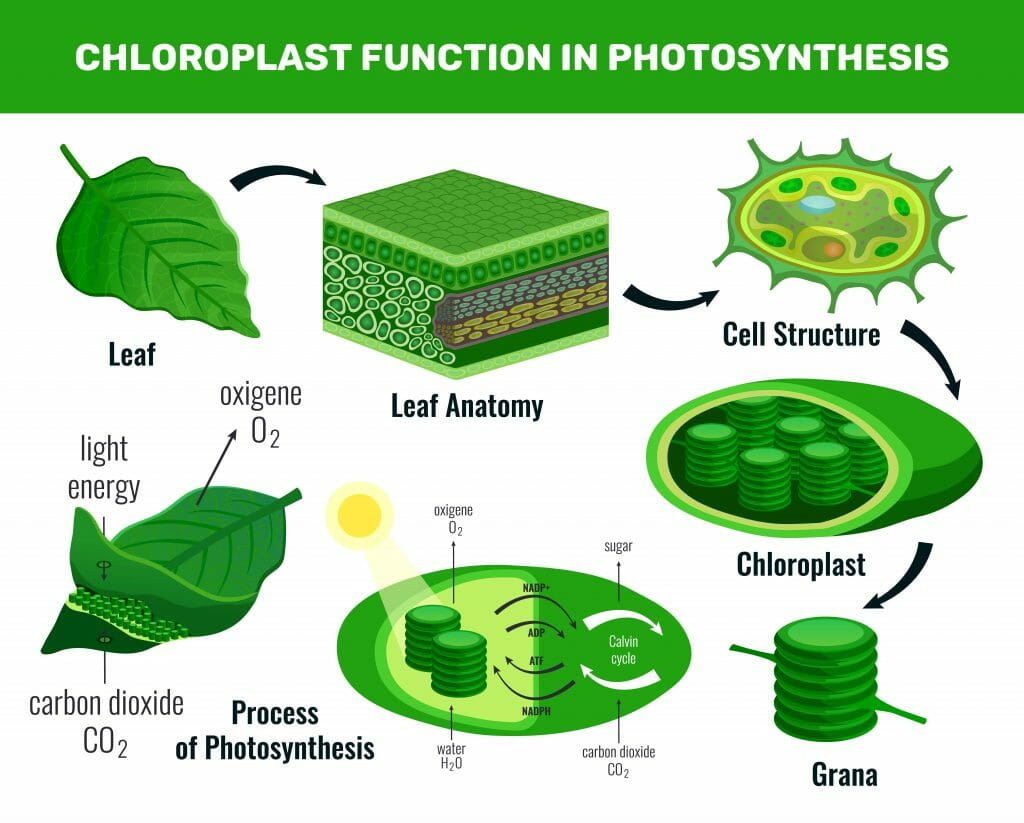
In order for this to work properly, the plant’s chloroplasts are key, says Giraldo and a team of scientists from UC-San Diego and Carnegie Mellon University. Chloroplasts are tiny organs inside plant cells that aid in the conversion of sunlight into usable energy.

“They’re tiny, solar-powered factories that produce sugar and other molecules which allow the plant to grow. They’re also an untapped source for making desirable molecules,” Giraldo added.

Previous studies have been reported to have shown gene expression, which is not a natural part of the plant. This was discovered when Giraldo and his team successfully injected genetic material into the chloroplasts.

Professor Nicole Steinmetz of UC-San Diego worked with Giraldo and the team to utilize nanotechnology to help deliver even more genetic material – identical to how the Covid vaccines work, not just the Moderna or Pfizer ones either.

“Our idea is to repurpose naturally occurring nanoparticles, namely plant viruses, for gene delivery to plants. Some engineering goes into this to make the nanoparticles go to the chloroplasts and also to render them non-infectious toward the plants,” Steinmetz explained.

Giraldo added:

“One of the reasons I started working in nanotechnology was so I could apply it to plants and create new technology solutions. Not just for food, but for high-value products as well, like pharmaceuticals.”

The WinePress News is a reader-supported publication. To receive new posts and support my work, consider becoming a free or paid subscriber.


AUTHOR COMMENTARY

In light of these new ambitions to put mRNA technology into food, it gives a whole new perspective to the saying, “You are what you eat:” If you eat GMOs, you are a GMO.

As far as I am aware of, I have not heard much on this line of development, but that is not to say mRNA foods won’t become more mainstream and commercialized at some point. Whatever the case, don’t consume them, don’t get injected with this technology.

Proverbs 4:14 Enter not into the path of the wicked, and go not in the way of evil men. [15] Avoid it, pass not by it, turn from it, and pass away.

Thanks for reading The WinePress News! This post is public so feel free to share it.

SOURCE

Photo Credit: The WinePress

Dealing with stressed plants in your garden (Wally Richards)

Stress affects plants as well as all life forms as far as I am aware.

We suffer stress in our day to day lives and this time of the year is especially stressful for some people.

As there are different forms of stress which humans can be affected by, there are also different forms of stress that plants can suffer by.

The most obvious of these is moisture either not enough or too much.

Not enough moisture the plant starts to dehydrate and the lower leaves tend to flatten out to shade or cover the surrounding soil helping to prevent moisture loss from the soil.

The upper foliage also droops and without receiving a good amount of water to moisten the earth the plant will wither and die.

Too much water we call wet feet which means there is excessive amounts of water around the roots with little or no oxygen; then the roots will start to rot unless its a bog type plant.

As the roots rot the foliage will droop and leaves will begin to fall off until the plant dies.

Some plants will try to remove the water from around their roots by taking up water to the leaves where it forms as drops of water on the tip of the leaves.

Wet feet is fatal to a number of plants such as citrus trees.

Plants also suffer stress from weather conditions such as rapid temperature changes (going from cold to hot and back to cold) wind damage, heat, cold/freezing, insufficient light or too much sunlight.

Nowadays our plants have to contend with ‘The Dimming of the Sun’ we are told, done to reduce Global warming, but it actually make surface temperatures hotter and the real reason is to reduce plant growth, making poor food crops.

Planted in the wrong situation a plant can stress out because of a range of things such as soil conditions, pH, shade or sun, wet or dry, fertile or barren.

Too much food or not enough, unbalanced nutrients which are locking up, missing elements are all problems that will cause stress.

(Use Wallys Unlocking the Soil and Magic Botanic Liquid for unlocking and supplying all the elements).

When you move container plants, you create a problem as the plant has to readjust to the new situation.

Ficus Benjamina is a pot plant that hates to be moved from one spot to another unless the new spot is identical to the old spot, otherwise it will leaf drop and then produce new foliage as it adjusts.

Plants that are attacked by insects can be likened to you having a multitude of leaches or mosquitoes attacking your body. (That’s stressful).

Leaf diseases such as black spot, mildew etc often appear on plants when conditions favor them or when a plant is in stress for some reason.

If say your fruit tree that is laden with fruit sheds its crop, then the tree is in stress for some reason.

If it sheds part of the crop it is likely self thinning the fruit as it cannot support all the crop, so that the better larger fruit will have sufficient room to mature.

If you think that you are facing several types of stress related issues in your life currently then think again what our plants have to face.

(Does that make you feel better?)

Seedlings in punnets can easily become stressed when their root systems fill the punnet and the mix dries out quickly.

I have seen seedlings in stress in chain stores because the staff don’t water often enough.

It is especially bad this season because of the weather and people not planting out as they would in a better season leaving a lot of old over grown stock.

I went to one hardware chain store recently to pick up a few things and also obtain a few vegetable seedlings; all that was on display were over sized plants which would have already been in stress a few times and a total waste of money buying and planting.

If it’s vegetable seedlings you are going to buy, look for the small plants which have a bit of growing to do before they get too big for the container they are in.

If you buy the big plants what will happen is you plant them out, they grow on for a few weeks then before maturing they go to seed.

When I owned a garden Centre and nursery we would throw vegetable plants out, once they were too big and in danger of going into stress, and replace them with smaller healthy plants.

Now this rule does not apply to plants such as tomatoes, cucumbers etc which you want to flower and fruit.

Likewise flower plant seedlings, the bigger, the better as we want them to flower as soon as.

But brassicas, lettuce, onions, leeks, silverbeet, beetroot, spring onions, spinach etc you want them to mature and not waste your time going to seed.

I have had a few complaints from gardeners recently on this very problem.

While we are on the subject of brassicas, it would be a good idea, if planting out over the next few months, to place Neem Tree Granules in the planting hole and also on the soil surface.

This is to help with the control of aphids and caterpillars.

Then after planting put some hoops over the row and cover with crop cover.

It only costs about $8.50 a metre and it’s 4 metres wide.

Keeps those plants free of pests and makes their preparation for the table an easy job.

The cover can be used time and time again.

Recently I purchased a 5 litre pump-up sprayer to do those in between jobs that my big back pack sprayer is a hassle to use, and my favorite trigger sprayers are too small.

Looking at the range of pump-up sprayers about the 5 litre size, they varied in price from twenty odd dollars upwards.

I have purchased over the years numerous cheaper sprayers which all end up in the rubbish bin, more often sooner than later.

Instead I opted for a more expensive Hills sprayer and after using it I am glad I did.

So easy to use and clean afterwards I am back to being a happy chappie when I need to spray.

So treat yourself or someone to a decent sprayer this Xmas, you will thank me for it.

Well about one more article for the year after this one so look after yourselves and your gardens over the festive season.

Phone 0800 466464
Garden Pages and News at www.gardenews.co.nz
Shar Pei pages at  www.sharpei.co.nz
Mail Order products at www.0800466464.co.nz


New Zealand Bill of Rights Act 1990. Part II of the Act covers a broad range of Civil and Political Rights. As part of the right to life and the security of the person, the Act guarantees everyone:

1The right not to be deprived of life except in accordance with fundamental justice (Section 8)

2The right not to be subjected to torture or to cruel, degrading, or disproportionately severe treatment or punishment (Section 9)

3The right not to be subjected to medical or scientific experimentation without consent (Section 10)

4The right to refuse to undergo any medical treatment (Section 11)

 Furthermore, the New Zealand Bill of Rights Act 1990 guarantees everyone: Freedom of Thought, Conscience, and Religion.
This includes the right to freedom of thought, conscience, religion, and belief,
INCLUDING THE RIGHT TO ADOPT AND HOLD OPINIONS WITHOUT INTERFERENCE (Section 1)


Pollinating your plants (Wally Richards)

I wrote an article on pollination and published in February this year as a number of gardeners were concerned that fruit was not setting and in particular zucchini and pumpkins and now we have a new season in front of us it would be a good time to repeat the subject.

Besides there are a lot more new subscribers to my weekly email due I think to the gardening sessions I do with Rodney Hide on Radio Reality Check through the Internet. https://realitycheck.radio/

So here we go……..

Most plants flower to produce seeds so their line will continue through their off-spring.

When it comes to our gardening efforts we want plants such as tomatoes, zucchini and pumpkins to produce fruit which in every case contain the seeds for the next generation of those plants.

When pollination does not happen then the fruit will only develop a little and then rot.

Pollination is the act of transferring pollen grains from the male anther of a flower to the female stigma.

The goal of every living organism, including plants, is to create offspring for the next generation.

One of the ways that plants can produce offspring is by making seeds.

Every year I receive enquiries about what is wrong with my zucchini/pumpkin/melon/cucumber?

They flower and the fruit appears and then it goes yellow and rots?

The reason is that the female stigma did not receive a few grains of pollen from the male flower anther.

When it comes to the likes of pumpkins, melons and zucchini I always hand pollinate to be sure of a fruit set.

Best done in the morning where you check your plants for female flowers.

That is the flower that has the embryo fruit behind the petals.

When you find one or more then you look for a young male flower (which does not have the embryo fruit) but has anther that is covered with pollen.

I prefer to pick the male flower and remove the petals exposing the anther.

Then I rub the anther against the stigma and thus pollinating it and setting the fruit.

Bees, bumble bees and some other flying insects may do this for you as there is a little nectar that the flowers produce to encourage the flying insects to visit and move pollen from flower to flower.

Now things don’t always work as you would like them to work and sometimes a fruiting plant does not produce any flowers.

This can happen if the plant does not get enough direct sunlight, there is not sufficient energy to produce flowers.

It can also happen if the plant is well feed and well watered instead of flowering it will vegetate producing lots of new foliage minus any flowers.

I call them Fat Cats, well feed and very lazy.

It could also mean that there is a lack of potash so it pays to sprinkle some Wallys Fruit and Flower Power onto the soil at the time flowering should start.

NOTE This… any Curcubitaceae family member which is a large family that includes melons, cucumbers, zucchini and squashes you can take male pollen from say a pumpkin flower and fertilize a female zucchini flower to set the fruit.

Then we have Self-pollinating, self-fertile and self-fruitful all mean the same thing.

You can plant a self-fertile tree and expect it to pollinate itself and set fruit alone (for example, peaches, cherries, apricots).

Self-fertilization, fusion of male and female gametes (sex cells) produced by the same individual.

Self-fertilization occurs in bisexual organisms, including most flowering plants, numerous protozoans, and many invertebrates.

Tomatoes are not pollinated by bees instead it is air movement on a sunny day that will do the job.

In a glasshouse or even outdoors its a good idea in the middle of a sunny day give the plants a gentle shake to set the fruit.

To grow tomatoes in the cooler months or though winter you need types that will produce pollen in the colder times to have fruit set.

Summer growing tomatoes will survive with protection but may not produce fruit.

Winter ones are Russian Red and Sub Arctic Plenty (from Kings Seeds) World’s earliest tomato.

Bred for the U.S. Greenland military bases to endure extremely cold climates.

 Producing concentrated clusters of medium, good flavored, red fruit that ripen almost simultaneously.

A very small plant with compact habit so excellent for anyone interested in growing in pots. Determinate.

Blossom end Rot on tomatoes is the dark patch under the fruit that is the result of lack of moisture to move the calcium at fruit set time.

The fruit sets but the bottom has the dark patch.

After picking the bottom part can be cut off and the rest of the tomato eaten.

If not done the whole tomato will rot on vine or in a container after picking.

Tomatoes grown in containers are prone to this problem as they dry out quickly in hot weather and need watering like two or three times a day.

A large saucer under the container that is full of water will help.

Corn is another one that depends on lots of sun and a bit of a breeze to move the pollen from the male stalks at the top down onto the ‘silks’ of the female cobs.

Planting lots of sweet corn plants in groups but not too close to each other will help.

On a still sunny day you can shake the plants to allow the pollen to drift down onto the silks.

Corn varieties will easily cross pollinate if grown near to each other so keep your pop corn, ornamental corn and maize types well away from your sweet corn.

To sum up with fruiting vegetables and fruit we want them to be pollinated and set fruit for our food chain.

But in our flower garden the reverse applies we don’t want the flowers to be pollinated because once that happens the petals fall off and a seed pod forms.

If like on lilies, you were to carefully cut off the male anthers to prevent pollination then your flowers would last a lot longer.

Once the flowers on a plant have set then if you cut them off the plant (we call it dead heading) then the plant is likely to produce more flowers as it wants to produce seeds.

We do that with roses to encourage a second flush and not only do we cut off the dead flowers and the rose hips (that’s the seed pod) we cut back the stem a little to encourage new growth which can also produce new flowers.

Some gardeners use a small soft brush to collect pollen from male flowers to fertilise the females and that is a nice way of achieving fruit set.

Fruit trees that flower but produce no mature fruit maybe because of a lack of pollinators such as honey bees or bumble bees it pays to use a brush between some of the flowers on a sunny day to set some fruit on the lower branches.

Idea of planting flowering plants to attract honey bees may bring then to your bee loving plants but not to your fruit tree as bees are selective and generally speaking will work one type of flower only at any given time.

Bumble Bees are not so selective and will work several different types of flowers as available.

Figs are very different: The crunchy little things that you notice when eating a fig are the seeds, each corresponding to one flower.

Such a unique flower requires a unique pollinator. All fig trees are pollinated by very small wasps of the family Agaonidae.

The pollinators of fig tree flowers are tiny gall wasps belonging to several genera of the hymenopteran family Agaonidae.

Gravid female gall wasps enter a developing syconium through a minute pore (the ostiole) at the end, opposite the stem.

The wasp is long gone by the time the fig crosses your lips. Figs produce a chemical called “ficin” that breaks down the wasp bodies.

Nature is so resourceful.

Phone 0800 466464
Garden Pages and News at www.gardenews.co.nz
Shar Pei pages at  www.sharpei.co.nz
Mail Order products at www.0800466464.co.nz

New Zealand Bill of Rights Act 1990. Part II of the Act covers a broad range of Civil and Political Rights. As part of the right to life and the security of the person, the Act guarantees everyone:

1The right not to be deprived of life except in accordance with fundamental justice (Section 8)

2The right not to be subjected to torture or to cruel, degrading, or disproportionately severe treatment or punishment (Section 9)

3The right not to be subjected to medical or scientific experimentation without consent (Section 10)

4The right to refuse to undergo any medical treatment (Section 11)

 Furthermore, the New Zealand Bill of Rights Act 1990 guarantees everyone: Freedom of Thought, Conscience, and Religion.
This includes the right to freedom of thought, conscience, religion, and belief,
INCLUDING THE RIGHT TO ADOPT AND HOLD OPINIONS WITHOUT INTERFERENCE (Section 1)
VISITING LIFE UNDER GROUND (Wally Richards)

There is a saying which reads as… As Above So Below and with plants and trees what is above the soil level is replicated to what is below the soil level.

With a tree it is the trunk and branches we see and mirrored under the soil is the tap root and the root system about a similar size as above.

It is the root system and the medium that the roots are in that is the focus of this article.

We often refer to ‘The Soil Life’ which is a teeming mass of microbes, fungi, and soil insects including earth worms that we find in a healthy soil or the growing medium.

Virgin soil with its canopy of plants, living naturally for hundreds of years has a wealth of soil life and to have a soil like that is the goal of every keen gardener as it will, with very little effort, produce great healthy plants.

A vital part of the soil life are the fungi family called Mycorrhizae.

From the internet we see: A mycorrhizal network (also known as a common mycorrhizal network or CMN) is an underground network found in forests and other plant communities, created by the hyphae of mycorrhizalfungi joining with plant roots.

This network connects individual plants together and transfers water, carbon, nitrogen, and other nutrients and minerals between participants.

Several studies have demonstrated that mycorrhizal networks can transport carbon, phosphorus, nitrogen, water, defense compounds, and allelochemicals from plant to plant.

The flux of nutrients and water through hyphal networks has been proposed to be driven by a source-sink model where plants growing under conditions of relatively high resource availability (

such as high-light or high-nitrogen environments) transfer carbon or nutrients to plants located in less favorable conditions. (Helping their mates)

A common example is the transfer of carbon from plants with leaves located in high-light conditions in the forest canopy, to plants located in the shaded understory where light availability limits photosynthesis.

In natural ecosystems, plants may be dependent on fungal symbionts for 90% of their phosphorus requirements and 80% of their nitrogen requirements.

Mycorrhizal relationships are most commonly mutualistic, with both partners benefiting, but can be commensal or parasitic, and a single partnership may change between any of the three types of symbiosis at different times.

These networks have existed for over 400 million years, with up to 90% of all land plants participating.

The formation and nature of these networks, is context-dependent, and can be influenced by factors such as soil fertility, resource availability, host or mycosymbiont genotype, disturbance and seasonal variation.

Some plant species, such as buckhorn plantain, a common lawn and agricultural weed, benefit from mycorrhizal relationships in conditions of low soil fertility, but are harmed in higher soil fertility.

Both plants and fungi associate with multiple symbiotic partners at once, and both plants and fungi are capable of preferentially allocating resources to one partner over another. End.

Back to me: You can see from the above what a incredible resource Mycorrhizal fungi is to the well being of your plants and garden and why you should encourage it and not damage it.

The No-Dig garden that we have often talked about over the years is ideal for building and maintaining these beneficial fungi.(Instead of digging your garden you simply put fresh compost over the soil with other natural manures and plant into this new layer.

This is repeated for every crop)

Mycorrhizal fungi can increase a plant’s roots catchment area by up to 800%.

The bigger the root zone the bigger and better the plants.

We can encourage Mycorrhizal fungi to grow by drenching the soil with Wallys Mycorrcin every so often like once a month around preferred plants and crops.

What we should not do is to use chemicals that will kill the Mycorrhizal fungi and beneficial microbes in the soil. Chemical sprays and man-made chemical fertilisers that leach into the soil and the worst one is your chlorinated tap water you use to water the garden with.

A housing and filter that is 10 micron carbon bonded can be snapped onto your hose tap to remove the chlorine. See http://www.0800466464.co.nz/37-water-filters-remove-fluoride-and-chlorine-

Gardeners that have filtered the chlorine out of their garden watering remark on what a difference it makes to the health of their gardens and plants.

The chlorine is added to water to kill bacteria and it is caustic in nature which is not good for soil life.

We see that Mycorrhizal fungi connects plants underground through their roots and by that means can send messages to each other.

An example of this is a forest stand where the outer trees are attacked by a disease or insect pests and the trees send out a message to the fellow trees about what is happening which then allows the other trees to start building their defense systems against possible attack.

Some plants are very hard to establish and the answer to this I learnt many years ago is that you find a mature specimen of the plant you wish to cultivate and you take some of the soil from the mature specimen root zone and you place that in the planting hole of your specimen.

Plant up and then drench the soil with Wallys Mycorrcin to aid growth and that impossible plant to grow is away laughing.

Introduction of beneficial microbes to the soil is another way of improving your gardens and plants health.

Biologically active soils have the ability to retain moisture and release nutrients ensuring greater production, faster rotation and more rapid recovery from stress.

To build a healthy biological soil we need products that can feed living organisms.

Increasing public awareness of the environmental impact of using chemical-based fertiliser has created a demand for a safe, natural and environmentally friendly fertiliser.

Biological fertilisers increase nutrient availability and feed important soil organisms, such as earthworms and microorganisms (fungi and bacteria) – all essential for plant and soil health.

The product we have called Bio Marinus not only does the above but also introduces new beneficial microbes to your gardens.

Readers may recall the British comedian Kenneth Horne’s radio show “Beyond Our Ken” featured a gardener called Arthur Fallowfield, played by Kenneth Williams.

He often said “The Answer Lays in the Soil”.

THIS WEEKS Special is Mycorrcin is either 250mils, 500 mils or 1litre and till next Sunday we will pay the shipping to your home (No PO Boxes or outer Islands)

No discounts on the product sizes so 250mils is $18.00; 500 mils $30.00 and 1 litre is $50 free shipping on one or more of the same product.

Order on our Mail Order Web site at http://www.0800466464.co.nz/15-plant-nutrition?p=2

In Remarks please state This Weeks Special..

After receiving your order I will phone you to sort out payment either by credit card over the phone or a bank transfer..

Phone 0800 466464
Garden Pages and News at www.gardenews.co.nz
Shar Pei pages at  www.sharpei.co.nz
Mail Order products at www.0800466464.co.nz

New Zealand Bill of Rights Act 1990. Part II of the Act covers a broad range of Civil and Political Rights. As part of the right to life and the security of the person, the Act guarantees everyone:

1The right not to be deprived of life except in accordance with fundamental justice (Section 8)

2The right not to be subjected to torture or to cruel, degrading, or disproportionately severe treatment or punishment (Section 9)

3The right not to be subjected to medical or scientific experimentation without consent (Section 10)

4The right to refuse to undergo any medical treatment (Section 11)

 Furthermore, the New Zealand Bill of Rights Act 1990 guarantees everyone: Freedom of Thought, Conscience, and Religion.
This includes the right to freedom of thought, conscience, religion, and belief,
INCLUDING THE RIGHT TO ADOPT AND HOLD OPINIONS WITHOUT INTERFERENCE (Section 1)

ENCOURAGING CHILDREN TO GARDEN

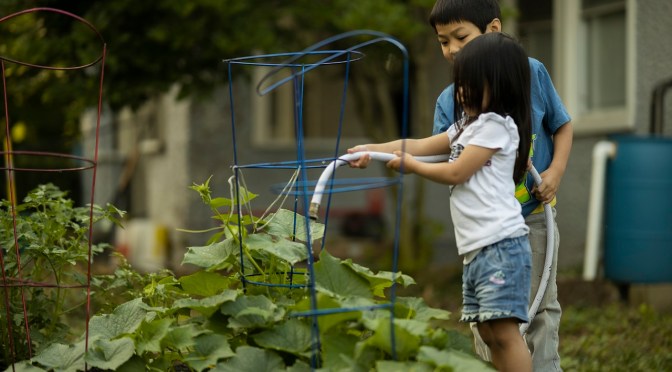
We need to encourage our children and grandchildren to appreciate Nature by including them in some gardening activities.

I believe that young children have a natural infinity with plants and insects when they are allowed to explore our gardens.

Children learn many things by mimicking their parents and are often keen at a young age to assist in various gardening activities.

I remember as a toddler spending many hours in the garden collecting caterpillars off the cabbages and feeding them to our chooks.

I also can still remember how good it felt to be part of Nature back then and the same feeling pertains today when I work or wander around gardens.

Plants that ‘move’ have a fascination for children and a great one for this is Mimosa pudica, the Sensitive Plant, which folds up its leaves when touched.

They are easy to germinate from seed, grown as a pot plant for a windowsill. (Available Kings Seeds)

Nice pink flowers also. As the plant matures it has thorns on the branches which incidentally are another attraction for children.

Cacti with their prickles often appeal to young boys and I had a small collection when I was young and still keep a few.

Two awesome plants for children to grow are Giant sunflowers and Giant pumpkins.

Giant Sunflowers; these extra tall sunflowers will grow up to 5 metres tall.(17 odd feet) Grown in full sun in soil that has excellent drainage and lots of manure.

The giant pumpkins can be monsters which in some cases will weigh over 1000 pounds at maturity. (Half a ton)

If I was going to grow giant pumpkin, here is what I would do:

Obtain the Giant pumpkin seeds from a seed supplier. (Atlantic Giant is the type of seed you need again Kings Seeds)

Pick an all-day-sunny area, then dig a hole about a spade depth and width, chop up the bottom of the hole, so the soil is loose, then fill the hole with chook manure to about two thirds full.

(Other manure could be used if chook manure is not obtainable, but chook is best)

Fill the rest of the hole with a good compost and soil mix, 50/50 making a small mound about 12cm tall above the filled in hole.

Place three seeds in the mound and wet them down with Magic Botanic Liquid (MBL), (20 ml of MBL to 1 litre of water.)

Water the mount to keep moist with plain water and then every 2 weeks with the MBL.

Overseas the biggest record vegetables have been achieved with products very similar or the same as MBL. Spraying the foliage of your Giants every 2 weeks with MBL (10 ml to a litre) will also assist in a bigger healthier plant.

When the seeds germinate select the two smaller ones and carefully remove letting the best one grow on.

After your pumpkin is established and growing well, give them a drink using Wallys Cucumber Booster, once a week.

This is a high nitrogen product that is a combination of sulphate of ammonia and potassium nitrate, which you dissolve in water.

Cucumber Booster is excellent for any plants that enjoys a boost of nitrogen after establishment. It is used for growing cucumbers, pumpkins, zucchini and gourds.

The MBL and Cucumber Booster can be combined for watering into the soil near the base of the plant.

Because of the weather patterns we are experiencing, after you plant your seed, cut off the base of a 2 to3 litre plastic fruit juice bottle and place this over the mound, with the cap removed.

This will give your seed and seedling its own little glasshouse. This is removed once the seedlings germinate prior to culling out the two.

With the Giant Sunflower a tall strong stake should be put in the ground at seed planting time on the edge of a mound as described previously..

This will be needed later to give extra support to the plant.

Another interesting thing to do is once the sunflower gets up about a metre tall, plant 3 or 4 climbing bean seeds at the base of the plant.

These will grow up the sunflower and also provide extra nitrogen for the sunflower.

It is a lot of fun plus a great way to get the children away from the TV and video games, showing them there is more to life than a screen.

Some garden centres run competitions for the tallest sunflower and the biggest pumpkin with various prizes for the winners.

Aphids are likely to be found on your roses at this time and they can easily be controlled with a safe spray of Wallys Super Pyrethrum. Spray very late in the day just before dusk to obtain the best results.

Stone fruit trees that had the curly leaf disease will now be producing new leaves free of the problem. The damaged leaves will fall off over time.

You can if you like, spray the newer leaves a couple of times with potassium permanganate and Raingard just to be sure, but if the disease has finished for the season the sprays will not make much difference.

A spray of Vaporgard without the potassium permanganate would be more effective in allowing the tree’s remaining leaves to gain more energy from the sun, which is needed to produce a good crop.

Codlin Moths will start to be on the wing about now so obtain a pheromone trap from your garden centre so you can monitor the best time to spray.

A number of gardeners have found that a spray of Super Neem Tree Oil and Raingard over the young apples, applied about 5-7 days after an influx of moths into the traps, has resulted in only a very small scar on the mature apple, where the grub took its first and only bite.

(Note Wallys Super Neem Tree Oil has been cleared by EPA to sell again, just waiting on the new approved labels to arrive later this month)

Repeat spray 7 days later and then wait for another influx of moths before repeating.

Add Raingard or MBL to the spray to assist and extend the control period.

Tomatoes should be doing well if in a sunny, sheltered spot. Only remove laterals on a sunny day when it is not humid or moist.

Spray the wound immediately with Liquid Copper to prevent disease entering the wound resulting in the possible loss of the plant.

Ensure that the tomato plants are well supported on stakes during windy times. If you are concerned about blights spray the plants with Perkfection as a preventative, once a month. The same applies for your potatoes.

For general health of any plants, especially roses and food crops, a two weekly spray of MBL and Mycorrcin works wonders. Spray both the soil and the foliage.

Avoiding the use of chemical sprays and fertilisers is a must for healthy gardens and plants.

Phone 0800 466464
Garden Pages and News at www.gardenews.co.nz
Shar Pei pages at  www.sharpei.co.nz
Mail Order products at www.0800466464.co.nz


New Zealand Bill of Rights Act 1990. Part II of the Act covers a broad range of Civil and Political Rights. As part of the right to life and the security of the person, the Act guarantees everyone:

1The right not to be deprived of life except in accordance with fundamental justice (Section 8)

2The right not to be subjected to torture or to cruel, degrading, or disproportionately severe treatment or punishment (Section 9)

3The right not to be subjected to medical or scientific experimentation without consent (Section 10)

4The right to refuse to undergo any medical treatment (Section 11)

 Furthermore, the New Zealand Bill of Rights Act 1990 guarantees everyone: Freedom of Thought, Conscience, and Religion.
This includes the right to freedom of thought, conscience, religion, and belief,
INCLUDING THE RIGHT TO ADOPT AND HOLD OPINIONS WITHOUT INTERFERENCE (Section 1)
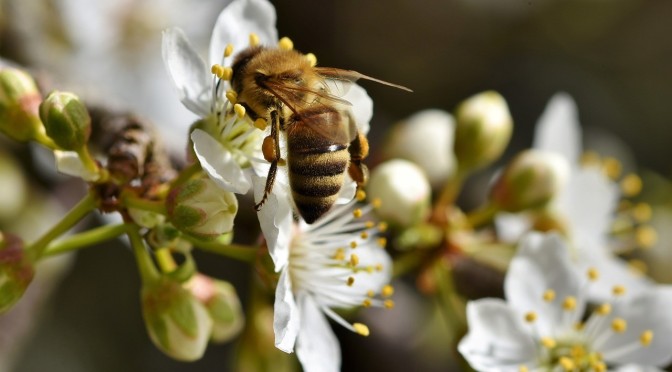
Image by Raksa R85mm from Pixabay

Phosphorous for your garden (Wally Richards)

When we buy plant foods or fertilisers for our gardens we see on them the letters N:P:K followed by numbers which indicate the amounts of each of these elements. The NPK stands for Nitrogen, Phosphorus and Potassium.

Nitrogen provides growing power and helps make plant leaves and stems green.

Nitrogen is used to form basic proteins, chlorophyll, and enzymes for the plant cells. In short, a plant can’t grow without it.

Phosphorus stimulates budding and blooming. Plants need phosphorus to produce fruits, flowers, and seeds.

It also helps make your plants more resistant to disease. Phosphorus doesn’t dissolve like nitrogen. The soil will hang onto phosphorus, not releasing it into water.

Potassium promotes strong vigorous roots and resistance to disease.

Potassium is a nutrient your plants need for good internal chemistry.

Plants use potassium to produce the sugars, starches, proteins and enzymes they need to grow and thrive. Potassium also helps your plants regulate their water usage, and better withstand the cold.

I believe of the three elements its the phosphorus that is least understood by some gardeners.

In the distant past phosphorus was obtain from manures especially bird or bat droppings called guano. Phosphorus was also obtained from Reactive Rock Phosphate which is a hard phosphatic rock.

In most soils it dissolves very slowly.

To make the rock phosphate more readily available to plants it was discovered that a process using sulfuric acid, early in the 1900’s,

would breakdown the reactive rock phosphate so a new agricultural fertiliser was created called Super or Super Phosphate.

It became a boon to agriculture and farming with tons of Super been spread to cause fast growth in fields and crops.

Unfortunately like a number of discoveries such as DDT and Asbestos, there was a hidden price to pay.

Super phosphate kills soil life and with their demise leads to unhealthy plants/grasses.

Not only that, it is now known that Super laden plants and grasses can cause health problems in stock including cancers.

(Chlorine and acidic products also destroy soil life including earth worms. Overt time through continued use soil becomes inert or lifeless)

I read a very interesting book some years ago called ‘Cancer, Cause and Cure’ written by an Australian farmer, Percy Weston.

Percy observed the results of the introduction of Super on his farm and the changes that occurred.

If you are interested the book can be obtained by mail order. The book made me reconsider the use of Super phosphate in garden fertilisers.

Interestingly I have never been an advocate of Super phoshate and to the best of my knowledge have never purchased it as a stand alone fertiliser for my gardens.

Though I have on odd occasions in the past used General Garden Fertilisers.

Fortunately I have always preferred sheep manure pellets, animal manures and natural products as my general plant food.

Now days I avoid using chemical fertilisers or chemical sprays including any herbicides anywhere on my property.

But I have noticed in the past, that even though I have obtained good healthy crops and plants, there is some factor that appears to be missing and the crops are not as lush as I feel they could be.

I have often thought that I am not getting sufficient phosphorus in my composts and mulches.

This caused me to do a bit of research on the Internet and found to my delight a company in New Zealand who make a product called BioPhos.

They take the rock phosphate and break it down naturally with micro organisms making it as readily available to plants as Super phosphate is.

The company sent me a email booklet and it showed trials that proved that not only did BioPhos work as well as Super, but actually better as it did not have a ‘peak’ growth on application and gave a much longer sustained release of phosphorus to plants.

Instead of killing soil life it actually supplies new micro organisms to the soil which carry on breaking the natural phosphorus down, meaning that only one application is needed per year unless you are cropping during the winter as well.

Some rose growers and rose societies recommend using BioPhos for better, healthier roses. BioPhos contains phosphate, potassium, sulphur and calcium at the rates of P10:K8:S7:Ca28.

It is pH neutral and used at the following rates; New beds work in 100 grams per square metre, the same with lawns but water in to settle.

Side dressing plants; seedlings 8 grams (a teaspoon full) around base of the plant or in the planting hole.

Same for potatoes (which do well with phosphorus) Sowing beans peas etc sprinkle down row with seeds.

Roses and similar sized plants 18 grams or a tablespoon full around plant or in planting hole.

Established fruit trees etc, spread at the rate of 100 grams per square metre around drip line or where feeder roots are.

Apply to vegetable gardens in spring and a further application in autumn if growing winter crops. Can be applied to container plants also.

Gardeners that use Biophos for the first time around their gardens often contact me tell how much their gardens have improved within a few weeks of using the product.

Maybe because the gardens are missing phosphate and a sprinkling gives the plants what they have been wanting.

Phone 0800 466464
Garden Pages and News at www.gardenews.co.nz
Shar Pei pages at  www.sharpei.co.nz
Mail Order products at www.0800466464.co.nz


New Zealand Bill of Rights Act 1990. Part II of the Act covers a broad range of Civil and Political Rights. As part of the right to life and the security of the person, the Act guarantees everyone:

1The right not to be deprived of life except in accordance with fundamental justice (Section 8)

2The right not to be subjected to torture or to cruel, degrading, or disproportionately severe treatment or punishment (Section 9)

3The right not to be subjected to medical or scientific experimentation without consent (Section 10)

4The right to refuse to undergo any medical treatment (Section 11)

 Furthermore, the New Zealand Bill of Rights Act 1990 guarantees everyone: Freedom of Thought, Conscience, and Religion.
This includes the right to freedom of thought, conscience, religion, and belief,
INCLUDING THE RIGHT TO ADOPT AND HOLD OPINIONS WITHOUT INTERFERENCE (Section 1)

Photo: Image by Ville Mononen from Pixabay


7 Edible Plants for the Bog: Good Eats That Grow in Wet Soil

Cranberries, taro, day lilies, mint, duck potato and more ….

From onegreenplanet.org

A bog, technically, is a wetland created from freshwater and an abundance of organic matter. Bogs are soft and spongy, characteristically found in cooler climates, with the largest bog being in Siberia. They can be formed in poorly draining basins, from lakes overrun with dense plant growth, or along the flattest floodplains of streams. They can take hundreds of years to form. It’s not these bogs we’ll be growing food in, though they could work.

The bog we are referring to here is that space in a suburban lawn or rural plot where the water tends to stand after rain, the patch that never seems to completely dry out. These spots might seem horrible places for putting in gardens, but with the right plants, it’s possible to make “bogs” productive, beautiful settings. Rather than filling them in, we can take advantage of the moisture and grow some special, and especially delicious, plants.

READ AT THE LINK

ahttps://www.onegreenplanet.org/lifestyle/7-edible-plants-for-the-bog-good-eats-that-grow-in-wet-soil/?utm_medium=social&utm_source=facebook.page&utm_campaign=postfity&utm_content=postfityd34f1

Wireless radiation is affecting plants

Check EHT’s website (link below) for more info on EMFs and their affect on your own health also EWR


The Environmental Health Trust @ Facebook

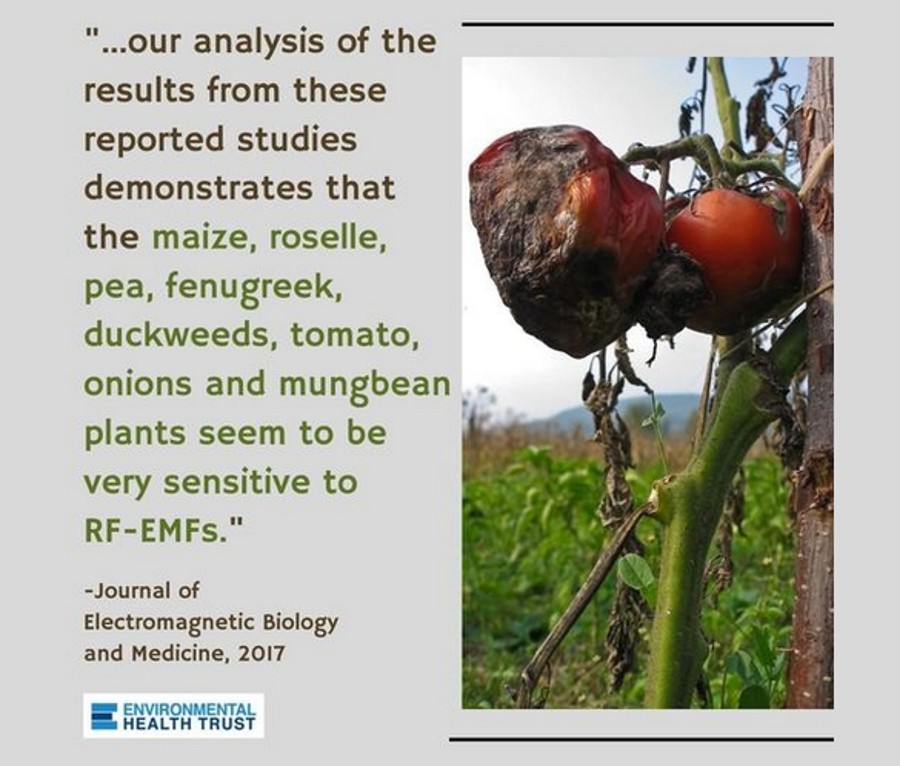
“RF-EMFs stands for radiofrequency electromagnetic fields, more commonly known as wireless radiation (the radiation emitted by cell phones, cell towers, WiFi routers, etc.). Not only does wireless radiation impact human health, but it also impacts #plants like #tomato #corn and #onion and plants.”

Review: Weak radiofrequency radiation exposure from mobile phone radiation on plants

ABSTRACT

Aim: The aim of this article was to explore the hypothesis that non-thermal, weak, radiofrequency electromagnetic fields (RF-EMF) have an effect on living plants. Subject and methods: In this study, we performed an analysis of the data extracted from the 45 peer-reviewed scientific publications (1996–2016) describing 169 experimental observations to detect the physiological and morphological changes in plants due to the non-thermal RF-EMF effects from mobile phone radiation. Twenty-nine different species of plants were considered in this work. Results: Our analysis demonstrates that the data from a substantial amount of the studies on RF-EMFs from mobile phones show physiological and/or morphological effects (89.9%, p < 0.001). Additionally, our analysis of the results from these reported studies demonstrates that the maize, roselle, pea, fenugreek, duckweeds, tomato, onions and mungbean plants seem to be very sensitive to RF-EMFs. Our findings also suggest that plants seem to be more responsive to certain frequencies, especially the frequencies between (i) 800 and 1500 MHz (p < 0.0001), (ii) 1500 and 2400 MHz (p < 0.0001) and (iii) 3500 and 8000 MHz (p = 0.0161). Conclusion: The available literature on the effect of RF-EMFs on plants to date observed the significant trend of radiofrequency radiation influence on plants. Hence, this study provides new evidence supporting our hypothesis. Nonetheless, this endorses the need for more experiments to observe the effects of RF-EMFs, especially for the longer exposure durations, using the whole organisms.

READ MORE AT THE LINK

https://www.tandfonline.com/doi/abs/10.1080/15368378.2016.1220389?journalCode=iebm20

EHR’s website: https://www.facebook.com/EHTrust

Header Photo: pixabay.com

Go here for other posts on topic

The New Zealand Minister of Health has announced he will be introducing legislation later this year to control the availability of natural products (third attempt so far by Labour – Hatchard)

The ‘new world order’ aka globalists, (despite claims of equality for all) cannot abide you acquiring free and natural, health giving remedies … remember this from 2015? Time to save your heirloom seeds. EWR


Given the plethora of wannabe world rulers among the mega corporations, industrial and military powers, political ideologies, media and social media giants, big pharma, intergovernmental and judicial organisations currently competing for global influence, it is worth asking who actually rules the world? Who has the most power?

Undoubtedly the plant kingdom excels. Every individual in the world, in every nation, eats to live each day. Plants have enjoyed a coevolutionary symbiotic relationship with multicellular animal species for at least 500 million years. We have land and aquatic plants to thank for the oxygen we breathe.

Plants derive their timeless world sovereignty directly and continuously from the sun, the earth, and water. Ancient cultures have always revered and employed the life supporting properties of plants.

The ancient Rig Veda refers to them as ‘mothers of mankind’. Maori tradition as children of Tāne, the god of the forest, who separated earth and sky.

Our health and food security is inextricably tied up with that of the plant kingdom. We should make it a priority to protect the integrity of the plant world. We should seek to maintain an alliance with plants, not just in a metaphorical sense but in actuality use our knowledge and influence to sustain their sovereignty and protect their evolutionary genetic structures which underpin our own health.

Is the Sovereignty of Plants a Credible Global Political Agenda?

Respect for the sovereignty of plants dictates actions that can protect our world. Plants transcend national boundaries, their cultivation and use can unify the interests of diverse peoples. Within this concept lies the solution to many of the world’s problems:

Climate — Pollution — Hunger — Peace — Disease

The plants form an army that can defeat all these scourges of modern life.

The Materia Medica of Ayurveda, the ancient health system of India, records 5000 medicinal plants including the methods of their collection, use, and combination. Abbess Hildegard of Bingen enumerated multiple uses of herbs in the 12th century. These are just the tip of the iceberg, there are nearly 400,000 known species of plants.

Aside from food and medicine, throughout history they have been used to make furniture, cutlery and crockery, dwellings, transport, clothing, energy, and much more. All of this can be accomplished without causing pollution.

The Political Agenda of the Sovereign World of Plants:

  • Outlawing experimentation on the genetics of plants and animals
  • Rediscovering and valuing non-polluting skills that utilise plants and trees
  • Reviving the traditional herbal healing methods known by multiple cultures
  • Organic agriculture free of chemicals which exhaust the soil and kill bees
  • Teaching sustainable practices for gardening, horticulture, and agriculture
  • Managing climate change through planting and preservation
  • Improving food supply by increasing the use of plants in diets
  • International sharing and celebration of the wonders of plants
  • Outlawing patents on any genetic sequences derived from plants

Unlike political institutions, the capacity of plants to solve problems cannot be corrupted by power. Yet in our modern life, we have lost the sense of respect, utility, and thanks that plants deserve. We have forgotten the healing properties of plants and many of their other uses. Along with the families of animals, fish, and birds we have began to view them as something to exploit.

Control of the World’s Food Supply is the Ultimate Financial Prize

For the hungry mega corporations, wresting control of our food supply from nature is a mouth watering prospect. It appears to offer an assured source of income and profit stretching into the future. Concern for the consequences of commercial plant production and exploitation is notable by its absence.

Since the patenting of plants is outlawed by international patent law, particularly pharmaceutical and biotech companies have sought to usurp the sovereignty of plants by registering patents over key components of their genetic structures or by slightly altering and thus maiming their structure using genetic manipulation, and then patenting the resulting GM types.

Simultaneously commercial interests are seeking to restrict the use of medicinal herbs by promoting draconian regulation. Andrew Little, the New Zealand Minister of Health, has announced he will be introducing legislation later this year to control the availability of natural products. This will be the third attempt by the Labour Party to do so, two previous attempts were abandoned due to public opposition.

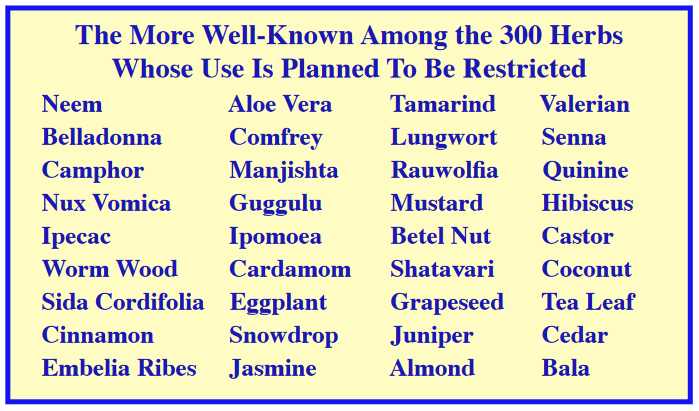
The International Coalition of Medicines Regulatory Authorities (ICMRA), of which Medsafe is a member, has a register of hundreds of traditional herbs and plants whose use it wishes to restrict whilst simultaneously approving over 3,000 synthetic or chemical copies. NZ plans to adopt their register.

9 ways ICMRA Members are Affecting Regulations Around the World

1. Herbs, Natural Health Products, and Traditional Medicines are being assessed as pharmaceuticals with a plan to establish regulations mandating standardised dosages of extracted or synthesised ‘active’ ingredients.

2. Database information is being shared between regulators from different countries which restricts herbs using the ‘Rule of Doubt’—absence of modern scientific information is sufficient to implement a ban despite a long term history of traditional safe use.

3. Herbs, vitamins, and remedies are then classified as medicines only available to be used by registered doctors. This grants medical authorities back door “patents” on indigenous plants that will have a global reach within all member countries without having to invoke patent law. Already hundreds of Ayurvedic, Chinese, and other traditional herbs have been stolen in this way, despite the fact that international law forbids the patenting of plants.

4. A bogus argument has been advanced that plants grown in soil are not standardised like pharmaceutical drugs and may vary slightly in composition. The supposed remedy is the production of synthetic copies of herbs and active ingredients in laboratories. They are approved for food and drink using the discredited principle of ‘Substantial Equivalence’ which allows manufacturers to adulterate traditional remedies and produce cheap ineffective copies without labelling—a process that is accelerating rapidly.

5. Many thousands of additives, preservatives, colourings, fragrances, and processing agents are being approved. In many cases, these substances have been implicated as causal factors in cancer, ADHD, and many other chronic illnesses.

6. Enforcement of Randomised Controlled Trial (RCT) testing and industrial manufacturing standards, sufficiently costly to bankrupt small and medium sized companies, which will gift competitive advantage to global companies.

7. Compulsory proprietary information collection on Natural Health Products and traditional herbs which will inevitably be shared with pharmaceutical companies through revolving doors and cosy relationships allowing the commercial appropriation of traditional knowledge.

8. The new standards being proposed are setting the maximum daily dose of nutritional supplements equal to the minimum proven therapeutic dose. For example studies show that the minimum effective dose of vitamin B12 is 50mcg which is being set as the maximum dose allowed in supplements. This means that retail B12 supplements will be ineffective in treating B12 deficiencies. Only a medical doctor will be permitted to prescribe the larger effective doses. Retail supplements produced by natural health companies with restricted doses will fall into disuse, in favour of synthetics sold by pharmaceutical and nutraceutical giants as prescribed medicines.

9. Regulatory-style laws hand control of natural medicine regulation to ICMRA rather than national governments. This subverts national sovereignty, undermines indigenous knowledge, and takes the right to choose natural medical treatment away from people everywhere.

New Global Regulation Threatens Alternative Approaches to Health Just When Science is Verifying Their Effectiveness

Modern research has shown that development and treatment of disease is affected by a great number of individual factors including: digestion, diet, genetics, lifestyle, environment, climate, psychology, relationships, fatigue, stress, comorbidities, age, and gender.

Traditional medicine offers a range of individualised approaches to healthcare that take account of these wide range of factors. Traditional and functional medicine involve the care of a skilled and knowledgeable physician to prevent ill health and restore good health by strengthening physiological processes, digestion, and re-establishing balance.

In Contrast Modern Medicine is in Crisis

  • Antibiotic and anti-fungal resistance threatens to render routine operations life-threatening by 2050.
  • Healthcare costs and chronic disease incidence are increasing so rapidly, that healthcare is being rationed in many countries.
  • More than 50% of the population now suffer from chronic diseases.
  • Adverse reactions to prescription drugs are now the third leading cause of death.
  • New diseases are emerging and old diseases re-emerging.

The List of Planned Restrictions is Surprisingly Wide

The shopping list of those planning to cut off our access to traditional remedies is very long and largely incomprehensible until you realise that there are commercial companies seeking to control their supply and secure the profits that can be made via monopoly control based on over regulation.

Even common kitchen herbs and spices have not escaped the notice of regulators taking inexplicable decisions to suit commercial interests.

More than 50% of the public have been using their own money to buy natural health products. This supports individual health and reduces the financial burden of public healthcare. This advantage will be lost if the new restrictions are introduced, leaving the public without medical choice and governments in the hands of international pharmaceutical monopolies. New scientific findings are coming to light that plant genetics plays a role in supporting health which cannot be provided by synthetic production. Genetic information in plants is the missing element in our understanding of nutrition. Therefore the proposals to regulate, restrict, and exploit plants in every country pose a threat to the sources of our human genetic stability. We have shared our long journey of evolution with plants. The present time of global crisis is not the time to forget or destroy our long-time supporters who are silently offering us a life line in troubled times, as they have throughout past ages. Please share this information widely with your friends. Contact your MP now to register your opposition to the proposed new regulations.

Click here for Members of Parliament contact details.

For more information my book: Discovering and Defending Your DNA Diet is available as a PDF from Smashwords and a Kindle book from Amazon.

SOURCE

hatchardreport.com

Photo: pixabay.com

IMPORTANT BASIC ELEMENTS: when your plants aren’t growing (Wally Richards)

I receive lots of phone calls and emails from gardeners asking for help with their gardening endeavors.

About 10% of these will be a very familiar problem which is; ‘plants do not grow’.

A few questions often reveals the reasons; such as the over use of man made fertilisers such as general garden fertiliser or even worse, nitrophoska blue.

Often these fertilisers are used to excess (or for too many years) and not only do they damage the soil life but they can also ‘lock up’ in the soil, stunting growth.

The pH of the soil is changed because of the acidic nature of manmade fertilisers.

A little sprinkling of manmade fertilisers, used occasionally to give plants a boost along, is fine as long as the acid aspect is neutralised with a good application of soft garden lime.

Small applications are not going to make fertiliser companies rich compared to handfuls on a regular frequency.

What I am told often by gardeners is; I plant seedlings they slowly grow and seem to sit still for a long time before they either mature or go to seed.

I usually ask the gardener when was the last time you limed (Calcium) the soil.

More often than not it is some time ago or not for a very long time.

A lot of New Zealand soils are a little acidic and become more so over time with our rainfall.

I read one time that calcium is the fuel that feeds the micro life in the soil and without it (soil food web) your plants do not do so well.

Most vegetable plants love a sweet soil which is the term used for an alkaline reading on a pH metre.

The exception to this is potatoes and tomatoes. The vegetables that really love lime are brassicas, peas and beans.

The old gardening way; was to apply garden lime to the garden once a year in the middle of winter.

There are two sources of lime one from lime stone and the other from crushed shells.

Lime stone lime is gritty and slow to breakdown and thus plants may wait some years before they obtain the benefits. Where soft lime breaks down quickly.

Soft lime can be tested by wetting your forefinger and thumb and placing a little of the lime in between.

If it feels soft and makes a slurry then its good value. Lime stone lime is likely to feel course like sand unless it has been powdered down very finely.

After an application of lime the plants start to respond and grow better.

When minerals become locked up because of the over use of fertilisers I also suggest drenches of Magic Botanic Liquid. (MBL)

This excellent product is good for unlocking and along with a dose of calcium, plants respond very quickly and really grow.

Sometimes I have gardeners call me back to say that within a week of doing the above the plants have shown new amazing growth.

There are areas in your garden where you do not want to apply garden lime at all or only a little.

In the annual/perennial flower garden a little occasionally is good.

For acid loving plants use gypsum or dolomite or even better a combination of both.

These contain not only calcium but also Sulphur (gypsum) and magnesium (dolomite)

Which means they can also be used to advantage where you use garden lime on flower beds and vegetable gardens.

Rather than a dose once a year in winter you are far better of to give a sprinkling every 3 months.

The beginning of each season is a good time as it is easier to remember.

So at the beginning of spring and again at the beginning of summer, autumn and winter.

If you have not been in the practice of doing this you will likely notice an improvement in your gardens because you are nurturing the essential soil life.

(Do not use chlorinated water on your gardens either, filter it out with a 5-10 micron carbon bonded filter)

Here is another interesting mineral that can be deficient in gardens and when applied they come to life and take off.

That is phosphate and the product that makes the difference is called Wallys BioPhos which is reactive rock phosphate broken down naturally using microbes rather than acid.

This is how rock phosphate is converted to superphoshate: Acid is applied to reactive rock phosphate.

Superphoshate damages the soil life and causes inert soil through continued use and likely is the reason why many gardeners will not use it.

Conventional agriculture and farming using super and nitrates killing off the soil life in their paddocks.

This means the first essential part of the food chain is destroyed, effecting the healthiness of plants/grass, animals and ourselves.

This is so simply logical, that you wonder why it is allowed to continue?

Mind you it does not make any money for fertiliser, chemical and pharmaceutical companies so we must respect their bottom lines even if we and our environment are not healthy.

Even worse; in the process of converting rock phosphate to superphoshate a pollutant is produced on the ‘scrubbers’ called, fluoride acid (hydrofluorosilicic acid);

a classified hazardous waste, but it is barreled up and sold, unrefined, to communities across America and the world including New Zealand.

Communities to add hydrofluorosilicic acid to their water supplies as the primary fluoride chemical for water fluoridation.

This has to be one of the biggest scams in recent history, a waste product that would cost millions to clean up and disposed of,

is sold at a profit on the pretense it will substantially help fight tooth decay?

BioPhos not only provides plants with the phosphate they require it also introduces beneficial microbes into your soil. BioPhos does the following for plants;

Increases Photosynthesis and storage of sunlight energy

Formulation of simple sugars

Use of sugars and starches for growth

Transfer of energy during plant chemical reactions

Maintenance and transfer of plant’s genetic code

Development of new plant cells

Germination, size, number and viability of seed

That is why some gardeners really notice a big difference when they apply the natural product to their gardens and plants.

Wally Richards

Phone 0800 466464
Garden Pages and News at www.gardenews.co.nz
Shar Pei pages at  www.sharpei.co.nz
Mail Order products at www.0800466464.co.nz

Everything about the plantain herb (7+ ways to use it)

From diyeverywhere.com

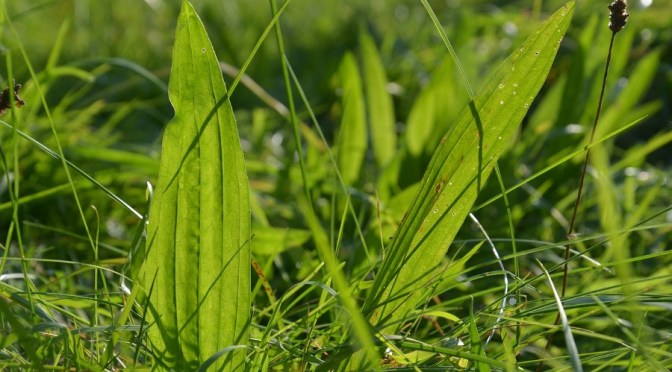
Plantago major, commonly known as plantain, faces an uphill battle in terms of respectability. Some people think it’s a backyard or roadside weed, when in reality, it’s an incredibly useful herb (not to be confused with the banana-like plantain fruit). This perennial plant grows in full- to part-sun locations in a wide range of soils. Oval or lancet-shaped leaves have five to seven prominent parallel veins resembling the veins in celery. In the late spring or summer, plantain plants produce one or more tall, slender flower shoots.

Herbalists believe it to be one of the best, most readily available herbs for a variety of first aid applications and chronic health problems.

READ MORE

https://diyeverywhere.com/2019/06/26/everything-about-plantain-herb-7-items-on-how-to-use-it/

Photo: cornelinux@ pixabay.com

The importance of Phosphorous to the soil in your garden (Wally Richards)

Phosphorus stimulates budding and blooming.

Plants need phosphorus to produce fruits, flowers, and seeds. It also helps make your plants more resistant to disease. Phosphorus doesn’t dissolve like nitrogen.

The soil will hang onto phosphorus, not releasing it into water.

Phosphate is needed by all life forms but if taken in too greater quantities it becomes harmful.

In the distant past phosphorus was obtain from manures especially bird or bat droppings called guano.

Phosphorus was also obtained from Reactive Rock Phosphate which is a hard phosphatic rock. In most soils it dissolves very slowly.

To make the rock phosphate more readily available to plants man discovered a process of using sulfuric acid, early in the 1900’s and a new agricultural fertilizer was created called Super or Super Phosphate.

It became a boon to agriculture and farming with tons of Super been spread to cause fast growth in fields and crops.

Unfortunately like a number of discoveries such as DDT and Asbestos, there was a hidden price to pay.

Super phosphate kills soil life and with their demise leads to unhealthy plants.

Not only that, it was also found that Super laden plants and grasses caused health problems in stock including cancers.

I read a very interesting book a long time ago called ‘Cancer, Cause and Cure’ written by an Australian farmer, Percy Weston.

Percy observed the results of the introduction of Super on his farm and the problems that occurred.

The book made me reconsider the use of Super in garden fertilizers.

Now days I would never use a chemical fertiliser or chemical sprays including any herbicides anywhere on my property.

But I have noticed that even though I obtained good healthy crops and plants, there is some factor that appears to be missing and the crops are not as lush as I feel they could be.

I have often thought that I am not getting sufficient phosphorus in my composts and mulches.

This caused me to do a bit of research on the Internet and found to my delight a company in New Zealand who make a product called BioPhos.

They take the rock phosphate and break it down naturally with micro organisms making it as readily available to plants as Super is.

The company sent me an email booklet and it showed trials that proved that not only did BioPhos work as well as Super, but actually better as it did not have a ‘peak’ growth on application and gave a much longer sustained release of phosphorus to plants.

Instead of killing soil life it actually supplies new micro organisms to the soil which carry on breaking the natural phosphorus down, meaning that only one application is needed per year unless you are cropping during the winter as well.

Some rose growers and rose societies recommend using BioPhos for better, healthier roses.

BioPhos contains phosphate, potassium, sulphur and calcium at the rates of P10:K8:S7:Ca28. BioPhos is Bio Certified for organic growing.

It is pH neutral and used at the following rates; new beds work in 100 grams per square metre, the same with lawns but water in to settle.

Side dressing plants; seedlings 8 grams (a teaspoon full) around base of the plant or in the planting hole. Same for potatoes (which do well with phosphorus)

Sowing beans peas etc sprinkle down row with seeds. Roses and similar sized plants 18 grams or a tablespoon full around plant or in planting hole.

Established fruit trees etc, spread at the rate of 100 grams per square metre around drip line or where feeder roots are.

Apply to vegetable gardens in spring and a further application in autumn if growing winter crops.

Can be applied to container plants also. Apply to tomatoes when planting or side dress existing plants.

When you obtain your BioPhos you will notice it consists of fine powder to granules with pellets of sulphur and odd splinters of wood.

These including the wood are all part of the product not messy packaging.

The lumps of granules actually contain 4,888,000 fungal colonies to aid the breakdown and enhance your garden soils.

If you have concerns about your health, the health of your family and you want to avoid illnesses such as cancer if possible, then grow as much fruit and vegetables as you can without chemicals.

BioPhos is biologically manufactured using an internationally patented thermophillic composting technology.

Natural products: whole filleted fish nutrient, microbes, inoculum, phosphorous rock and limestone are used to create highly available soil and plant food.

• Plant available phosphate

• Biologically activated lime

• Essential minerals and trace elements

BioPhos contains phosphate, potassium, sulphur and calcium at the rates of P10:K8:S7:Ca28.

BioPhos is Bio Certified for organic growing.

It is pH neutral and used at the following rates; new beds work in 100 grams per square metre, the same with lawns but water in to settle.

Side dressing plants; seedlings 8 grams (a teaspoon full) around base of the plant or in the planting hole. Same for potatoes (which do well with phosphorus).

 Sowing beans peas etc sprinkle down row with seeds. Roses and similar sized plants 18 grams or a tablespoon full around plant or in planting hole.

Established fruit trees etc, spread at the rate of 100 grams per square metre around drip line or where feeder roots are.

Apply to vegetable gardens in spring and a further application in autumn if growing winter crops.

Can be applied to container plants also. Apply to tomatoes when planting or side dress existing plants.

Photo: pixabay.com

Gardening & Plant Immunity (Wally Richards)

Wally Richards is a longtime Kiwi gardening guru. I used to post his useful and excellent material earlier in the piece … I’ve neglected the food growing aspect for some time now though aside from the odd article. It seems an appropriate time now to return to it with the much announced coming food shortages. My and my parents’ generations and beyond always grew their own anyway … until supermarkets took over. We knew then what exactly was in our food.

Wally is local to NZ so Kiwis can benefit from his wide knowledge of local conditions. You’ll find further info at his links at the end. You can sign up and receive his regular newsletters. EWR


Gardening Articles for week ending 2nd October 2021

Plants, just like ourselves, have built in protection against diseases though their immunity systems.

We build up our immunity naturally over the years by surviving disease attacks and by having a healthy nutritionally rich diet.

That is not to say that we are immune to disease attacks but under normal situations we can fend off most health problems if we have very good health.

We, like plants, have pathogens and viruses in our bodies all the time but these are kept in check by our immune system and glands.

If we get into stress then our metabolism does not have the same stamina and we catch a cold or worse.

It is said the leading cause of heart disease and cancer is stress.

I think its the stress that is the straw that breaks the camels back, after unhealthy living, insufficient nutrient rich food and a build up over time of toxins in our cells and body fat due to not detoxing..

The same applies to plants, place them into stress and they will more likely catch a disease.

I have written a lot in the past on how to build the health of plants by building the health of the soil; having soil that is rich in humus, minerals, earth worms and soil life.

Even when we have the best soil on earth, plants can still catch a cold when they are placed into stress.

We can however increase the immune systems of plants by monthly sprays of Perkfection Supa for roses and other plants.

The active ingredient of Perkfection is ‘Phosphite ion’ or Phosphonic Acid. (Potassium ions are also present).

Perkfection is very safe to handle and spray and when used on food crops there is no withholding period other than your normal washing of produce before eating.

Perkfection is used extensively by commercial growers of vegetables and fruit as its safe, effective, in prevention and control while not restrictive on exports of produce.

We have suggested Perkfection Supa for Roses and Other Plants as an alternative to more toxic sprays, for the assistance in recovery from/or prevention of, the following problems, Black spot, Downy Mildew, Phytophthora Root rot, botrytis, Canker, heart rot, damping off, crown rot, leaf blight, silver leaf, late blight, collar rot, pink rot, brown rot, Armillaria, and gummy stem rot.

Now that’s a big list of common plant diseases which means that many of your disease related problems can be overcome with applications of this product.

Besides using Perkfection over your roses for the likes of Black spot and Downy mildew you can also use it as a spray over all your fruiting plants and trees including your strawberries.

It can be used also over your potatoes, tomatoes, lettuce, beans, cubits (cucumbers etc) lawns, onions, passion fruit, Cauliflowers, cybidium orchids and ornamental plants and vines.. In fact there is no where you cannot use Perkfection to advantage.

Being ‘Synthetic Organic Phosphates’ what you are doing, is placing this valuable material, onto the foliage of your plants, where it is very readily absorbed and transferred through the whole of the plant.

This fortifies the plant’s cells, increases the plant’s immune system and makes your plants less susceptible to invading pathogens.

There is however a down side, as with any good thing, you can use too much and the recommendation is to use Perkfection at 4 ml per litre of spray once a month for about 6 times in a season.

(Note a season is the normal period of time for that crop or plant. Roses are from Spring till Autumn. Most annuals 5-6 months.)

The reason is that, you can over load your plant with organic phosphates causing a clogging of the cells and halting growth until the system clears.

If a plant has a problem spray the first month with Perkfection at 7 mls per litre.

For plants you wish to fortify use at 4ml per litre for 2 to 3 months.

Prevention is better than cure and by spraying your plants in the spring you give the greatest protection to leaves and fruit, autumn spray will give greatest protection to roots and tubers.

I have suggested that on the 1st of the month to spray your roses and other preferred plants with Perkfection, MBL (Magic Botanic Liquid) and Mycorrcin. Then 14 days later (15th) spray with Mycorrcin and MBL.

What we are doing is boosting the plant’s immune system, supplying a large range of minerals and elements, feeding the beneficial microbes to increase their populations which also work to eliminate diseases.

If insects problems occur then include Wallys Super Neem Tree Oil with Wallys Super Pyrethrum added.. All these sprays are compatible.

Here are a few examples of situations where Perkfection Supa has made a big difference;

Buxus, from early damage to nearly dead plants, sprayed monthly the plants recovered their foliage and are now thriving after 6 months.

Silverleaf on roses and fruit trees caught in the earlier stages, remove damaged branches and spray with Perkfection.

Dry Berry on berry fruit including strawberries (other name is downy mildew) a couple of sprays usually does the trick.

Grapes spray once there is a good show of leaves then repeat monthly for about 3 times to assist in prevention of botrytis.

I have a guava tree which after several years of excellent fruiting it suddenly developed a disease that badly effected the fruit.

A few other gardeners also reported the same problem so I contacted the nursery that propagate the trees and asked the head nurseryman about it. He named the disease (which I forget what it was) and told me that they treat the problem with a chemical spray.

Knowing me fairly well he said that he did not know what I could use as I was against harmful chemicals.

So that season when the guava was starting to produce new growths in the spring I sprayed it with Perkfection and again every month while the fruit were growing.

The result was a tree full of fruit and no sign of the previous problem.

Wet weather diseases on citrus and plants that do not like wet feet can be helped to recover with the use of Perkfection.

It will help stimulate new root development.

It would also be a good idea to clean up the rot in the roots with a soil drench of Terracin followed by a drench of Mycorrcin 3 weeks later.

Terracin is a natural product that suppresses pathogens in the soil allowing the beneficial microbes to increase which means there is a fight for food resources and the now large numbers of beneficial microbes win.

Isn’t life simple when you work with Nature instead of destroying it with man made chemicals.


Phone 0800 466464
Garden Pages and News at www.gardenews.co.nz
Shar Pei pages at  www.sharpei.co.nz
Mail Order products at www.0800466464.co.nz

Image by staszwizg from Pixabay

Poisoning our food is a time worn tactic

Some of my regular readers & correspondents will be aware of my art work being exhibited recently … (having just completed my Bachelor of Maori Visual Arts degree at Putahi a Toi, Massey). For those who are interested I’m posting my work here on the site because it concerns 1080 poison. 

(As good fortune would have it by the way, my two adult children, both artists in their own right,  were also exhibiting at the same time in the Te Manawa Gallery in Palmerston North. The recent feature article from the Manawatu Standard will give you the background to their work also. We were all interviewed as a trio. Unfortunately my daughter’s work is now gone, some of hers is in the newspaper article).

The theme of my work is poison, in particular 1080 & arsenic, which encapsulates the ongoing issues we are facing today … well at least those of us who are concerned about the toxic chemicals that we are involuntarily immersed in daily. These two poisons interweave throughout our history, and are only two of 280-300 active pesticide ingredients registered for use in NZ (read Dr Meriel Watts’ The Poisoning of NZ, p19). The poisoning of our food, our water, our people. The arsenic episode began in the nineteenth century with what was known as the NZ Government’s ‘Sugar & Flour’ policy, where non-selling Māori were targeted with aid in the form of flour mills and other ‘goodies’ to entice them to sell their land. Subsequently the flour became poisoned (as has happened & is documented in other colonized nations) to the extent in the Upper Whanganui River there was a notable decrease in the Māori population.  The poisoning was also discovered & documented by  missionary Rev Richard Taylor in his journals. You can read about it in David Young’s Woven by Water. It is also of course in the oral histories of the River & was spoken about in the Treaty hearings. Tariana Turia (former politician, co-leader of the Māori Party) also wrote about this in the Taranaki Star at the passing of Sir Archie Taiaroa, from the River. Sir Archie had wanted the stories to be made known, saying that Māori were forced to rely on flora and fauna to avoid being poisoned. My great uncle from the Whanganui River died of suspected poisoning. What a damning episode to the record of a so called ‘Christian’ nation. Civilizing so called ‘savages’? It is very clear who were the savages. And so it goes on today with the systematic dropping into our environment, the deadly ecotoxin called 1080.

On this theme I created an assemblage, after the work of indigenous Australian artist Tony Albert, detailing the current poisoning of our waterways and food by the aerial 1080 program operating here in Aotearoa (NZ). In my research on that I have seen testimony of concerned Whanganui people subject to aerial drops who saw incidences of miscarriages & cancer immediately after one. Like the cancer clusters around the cell towers, the authorities of course deny all of this. Dr Peter Scanlon (late) detailed that there have been little if any studies on the effects of 1080 on the unborn. Remember the post about how two midwives advised their pregnant patients to leave town when they heard of an imminent 1080 drop? I would certainly be erring on the side of safety & leaving also were I in their position.

Returning to the assemblage it contains images I’ve used with the permission of the donor* featuring the 2018 hikoi with Emile Leaf & Alan Gurdon. The basic message is … ‘Kāti te paitini haere i ā tātou kai!’ … ‘stop poisoning our food!’ It also features the assimilation drive of the colonists who desired land & and an eventual absorption of Māori into the white race. Well documented if you search … Angela Ballara’s ‘Proud to be White’ is a good start. The newspaper archives she cites speak volumes. Wiping out an ethnic group is technically called genocide however that is well nigh a dirty word in many circles today.

Below is the final gallery version.

Copy of 2018 project 389.JPG
Te Kaupapa Here mō te Parāoa me te Huka | The Flour and Sugar Policy – Artist: Pam Vernon, Te Atihaunui-a-Pāpārangi

Description: Governor Grey’s 1840s policy of aid and education saw the provision of many flour mills in NZ including along the Whanganui River. Matahiwi’s Kawana mill was named after him. David Young records in Woven by Water (p 49-50) the rapid decline in population on the upper river and the alleged systematic poisoning of non-selling hapū there. The government policy therefore became known as the ‘sugar & flour policy’. Land alienation was further fast tracked via The Native Land Court, with depopulation of Māori occurring via land wars, the introduction of muskets and European diseases. Te reo Māori was banned in schools and the assimilation agenda continued into the twentieth century (the Hunn Report,1960).

Copy of 2018 project 376.JPG
Part of the assemblage is this Biblical scripture taken from Matthew , translated it means: “…for there is nothing concealed that will not be disclosed, or hidden that will not be made known” referring to the secret poisoning of Māori who would not sell their lands.

There is another scripture under the visible one (second ‘page’) that quotes Isaiah 26:21, “See, the Lord is coming out of his dwelling to punish the people of the earth for their sins. The earth will disclose the blood shed on it; the earth will conceal its slain no longer.

The image below is also part of the assemblage detailing what a former NZ Premier John Ballance had to say about Māori. He was called a ‘nation builder’.

Copy of 2018 project 380.JPG
John Ballance, dubbed a ‘nation builder’ is renowned for his quote “the only good Māori is a dead one” currently in place of  honour outside the Whanganui District Council buildings

The work below titled ‘Ekoruhe 20:13 | Exodus 20:13’  is an installation featuring three flour bags. I was told years ago by a kuia in our home town that the flour bags marked for poisoning had a red circle on them. I’ve taken artistic license to add red circles to the bag marked ‘paraoa’ (flour), although I am unsure how the red circle originally looked.

Copy of 2018 project 390.JPG

Description: “Kaua e patu” (do not kill), are words from the Bible, the book brought here by the missionaries. Governor Grey’s Flour and Sugar policy was said to be partly an attempt to reduce Māori ‘rebellion’ against land acquisitions, targeting areas where he hoped to acquire land. With the alleged poisoning of Māori, they were forced to use their knowledge of flora and fauna to avoid death. Used globally to this day, the destruction of indigenous food sources on colonial fronts is a time-worn tactic. Currently, another poison is being dropped into our waterways, contaminating both our water & our wild food.

The work below titled ‘E Paitini ana i te Whenua me te Wai | Poisoning the Land & the Water’ speaks for itself.

Copy of Copy of 47572857_308751159849311_7408239486569545728_n.jpg

Description: For over 50 years, 1080 poison, a class 1A ecotoxin with no antidote, banned in most countries, has been dropped regularly onto NZ soil, currently at amounts of 4,000 tonnes per annum, enough to kill 60 million people. The Government recently changed legislation so that it can drop 1080 into the waterways without a resource consent, excluding the operation from Resource Management Act protection. A retired NZ Doctor recently warned that if you die from 1080 poisoning, nobody will know because Doctors are bullied by the MOH into not testing for it.

Below is the work titled E Paitini ana i ngā Manu | Poisoning the Birds. This also speaks for itself.

3. Poisoning the Birds.JPG
E Paitini ana i ngā Manu | Poisoning the Birds, Artist: Pam Vernon
Te Atihaunui-a-Pāpārangi

Description: It’s claimed by DoC that 1080, a class 1A ecotoxin targets pests, however, originally an insecticide, 1080 kills all oxygen breathing animals and organisms (Dr M Watts 2010).  A 2002 Otago 1080 drop killed an estimated 10,000 non-target birds. Over 5 years, of 89 dead tagged kiwi in the Tongariro Forest, none were tested for 1080. In 1984 Brodifacoum exterminated Tawhitinui Island’s entire weka population.

The bird image is from a carved kōkako from Te Keepa Te Rangihiwinui’s house, Huriwhenua, at Ranana on the Whanganui River. It’s speculated it may symbolize the raven sent forth from Noah’s ark (David Young, Woven by Water).

Finally is the work titled St Joseph’s Church & Convent at Hiruhārama. Hiruhārama is on the Whanganui River, home of the pictured Catholic mission presence and Sister Aubert.

5. St Josephs Church and Convent at Hiruharama.JPG
St Joseph’s Church & Convent at Hiruhārama . Artist: Pam Vernon
Te Atihaunui-a-Pāpārangi

Description: Patiarero on the Whanganui River was re named Hiruhārama (Jerusalem) by missionary Reverend Richard Taylor in the 1850s, as were many other Whanganui River settlements. In 1892, Suzanne Aubert (known as Mother Mary Joseph) established the congregation of the Sisters of Compassion, a charitable and religious order, where they cared for abandoned children. Their presence is still there today.

(Thanks to the Sisters of Compassion for permission to use their photograph).
Thanks also to Rere Tihema for the use of his protest images.


The exhibition will remain up until February so if you are in the Palmerston North area over the holiday break you can see it at Te Manawa.

Link to Standard article: https://www.stuff.co.nz/manawatu-standard/lifestyle/109022748/an-artistic-family-shows-their-work-under-the-same-roof?fbclid=IwAR0H6uwgw44-6bqfcvA3thQzKQRv31Zh9_BryTCWMEloo_eYnuLWA8SVJjw


I acknowledge all the kaiako at Putahi a Toi Massey & in particular Kura Te Waru Rewiri from whom I’ve learned so much. My learning is a journey that’s still in progress.


And finally, a correction regarding the Standard article. This is a misunderstanding by the writer who assumed I was from Patiarero going presumably from my painting the Hiruhārama image. I whakapapa to the River through my father’s side (see ‘about the author’ at the main menu) … I am unsure which is our marae however. Still researching that. Apologies. 


New Meta-Analysis Reveals Extensive Phenotypic Differences Between GMO and Non-GMO Cultivated Plants

Written By:

GMWatch Reporter

greenmedinfo.com

Claims of “substantial equivalence” of GM plants again shown to be false

The myth of “substantial equivalence” between GM crops and their closest non-GM relatives (called “isolines”) has taken yet another scientific hit, this time from a new peer-reviewed paper discussed in an article on the website Hygeia Analytics.

The researchers from Mexico City published their meta-analysis of genetic data on rice, canola, maize, sunflower, and pumpkin. They looked at wild, GMO, and non-GMO cultivated varieties of these five crops, analyzing phenotypic change.

The phenotype of a crop is defined by a set of characteristics expressed by the crop’s genetic code (DNA). In theory, genetically engineered plants will show phenotypic changes only linked to the traits that scientists added to the GMO in the hope that they will be expressed. For example, a corn plant engineered to express the Bt toxin should not be different from normal corn in other ways.


READ MORE

http://www.greenmedinfo.com/blog/new-meta-analysis-reveals-extensive-phenotypic-differences-between-gmo-and-non-gm

© [Article Date] GreenMedInfo LLC. This work is reproduced and distributed with the permission of GreenMedInfo LLC. Want to learn more from GreenMedInfo? Sign up for the newsletter here http://www.greenmedinfo.com/greenmed/newsletter.


Next Story No Yard? No Problem: 5 DIY Garden Projects For People Who Don’t Have Space For A Garden

From collective-evolution.com

Gardening can be such a rewarding hobby for you, your family, your neighbours and some friends as well as there is much to benefit from. Aside from being rewarding for your mind and soul, it is also physically rewarding because you actually get to harvest the “fruits of your labor.”

Being able to grow your own food means that you have COMPLETE control over what you are putting into you and your family’s bodies. You get to pick the seeds, the soil and the water that is being used to grow your fruits and veggies. That means completely organic, GMO free, fresh food could be right at your fingertips!

The majority of the produce in your local grocery store has traveled for a long time to get from where it was harvested to your grocery store and then eventually, your kitchen table. Did you know that fresh fruits and vegetables lose many of their nutrients during this traveling process? Not to mention all of the resources that it takes for this food to actually travel to you.

To be able to grow even some of your own fresh fruits and vegetables ensures that you are getting quality, wholesome, nutrient rich food, and you are doing your part for the environment as well.

Now imagine if everyone adopted some of these simple gardening practices, how amazing would that be? This not only brings us one step closer to becoming self-sufficient, but it also will majorly cut down all of the emissions from the big trucks and planes that are transporting this produce. So here are 5 simple gardening projects for people who don’t have a garden!

READ MORE

http://www.collective-evolution.com/2014/04/05/no-yard-no-problem-5-diy-garden-projects-for-people-who-dont-have-space-for-a-garden/