Tag Archives: Pests

DoC says the aerial 1080 drop in the Manawatu Gorge has been deferred to 2019

I emailed DoC, Manawatu recently regarding the proposed aerial drop of 1080 in the Manawatu Gorge. The drop will not now happen until 2019 I’m told (see email below) …

“… aerial application of cereal baits containing 1080 will not take place in 2018 due to a lack of favourable conditions within the consent timeframe.”

I had asked in my email why 1080 is being used when the gorge, as per DoC’s own blog  is trapped manually. I also asked if 1080 will be dropped into the Manawatu River. You can view the drop zone by visiting their site at this link. (Note, you will need to scroll down, read that page & tick the ‘I accept’ box at the bottom to view the map).

As regular readers will be very aware some of the info provided in the email from DoC, differs somewhat to the published independent scientific research, particularly regarding the solubility of 1080 in water. These observations have been made by independent scientists, not armchair theorists. If you are a new reader please go to the 1080 resources/links tab under the 1080 page at the main menu. The websites to the independent science are listed there. You could also use ‘categories’ (left of our news page) &/or the search box (same page) for other articles on topic. You can obviously read this info and make your own decisions about the safety of 1080 in your water … and whether or not to consume it. I should add regarding the Manawatu, that the river is already severely polluted, at one stage earning the reputation of being the most polluted river in the Southern Hemisphere. All of our rivers are so polluted we can only safely swim in 40% of them. Gone are the days of diving in without some prior research online, all depending among other things, if there’s been rainfall washing the pollutants into the water. For some time now I have drunk only distilled water because of this. Any water taken from these sources, including bores, is no longer pure. There are so many pollutants now that our town supplies are treated with chlorine to prevent you contracting diseases. The chlorine however carries its own risks due to its carcinogenic properties.

DoC Manawatu say the pellets won’t be dropped into the river in this instance (the river is not included in the drop zone) admitting though that there could be stray pellets fall into the water. See the GrafBoys’ videos at their Youtube channel on that subject, particularly their  4x international award winning  doco ‘Poisoning Paradise’ that is banned from NZ’s television channels. Clearly the pellets often do fall into the waterways, indeed the rules were changed by the authorities to avoid the obtaining of resource consents to do so.  (See our articles on 1080 & waterways).

Finally, we obviously do not agree with the aerial dropping of 1080, but neither do we support violence in any way in objecting to the drops. I personally do not know of one person who does advocate violence. We are primarily a peaceful resistance, we just do not want our environment or our water & food sources poisoned so will continue to ask the authorities to desist. DDT was once approved, as also was Agent Orange & glyphosate … so also was cigarette smoking considered good for your health … we live in the hope that this poison 1080  will be added to the danger list & preferably banned forever.

Below is the email from DoC:


Wed Dec 5, 2018

Kia ora Pam,

Thanks for your email regarding animal pest control methods in Te Apiti – Manawatu Gorge.

The Department of Conservation intended to deliver an animal pest control operation over approximately 900 ha of the Te Apiti – Manawatu Gorge project area during the spring of 2018. The planned operation targeted possums, rats and stoats across the whole site using a combination of aerial and ground based methods to apply cereal baits containing sodium fluoroacetate (1080).

Standard operating procedures for animal pest control operations include gaining necessary approvals from the Public Health Officer. A condition of the consent for Te Apiti – Manawatu Gorge operation was that it must be completed before 7 December 2018.

1080 operations require a very specific set of weather conditions. 1080 is water soluble, so dry weather is required either side of bait application. Calm weather is vital for safe and accurate aerial bait application and the geography of Te Apiti – Manawatu Gorge makes it especially critical. Unfortunately, it was not possible to deliver the operation to standard before the consent date ended for the 2018 calendar year.

Animal pest control methods to be used in 2019 will be considered in the new year.

In the meantime, animal pest control will revert to ground-based methods already in place to ensure some protection for taonga species in Te Apiti – Manawatu Gorge this summer. Specifically, the use of diphacinone in the existing bait station network on the south side of the reserve only and community trapping initiatives in both sides of the reserve.

In response to your questions:

These young folk are doing a great job trapping, I am wondering why it is the gorge needs to be treated with 1080? Could you explain?

I agree, the Milson Scout Troop are doing a great job trapping to reduce rat and stoat numbers on the northern side of the Manawatu Gorge Scenic Reserve. However, monitoring shows that rat and possum numbers are currently too high for forest health and successful breeding by forest birds. Trapping can only be done in areas that are easily accessible on foot. Large parts of Te Apiti – Manawatu Gorge are steep and unstable so cannot be managed using ground-based control methods. People cannot access these areas safely but possums, rats and stoats can. If control is only carried out in areas that can be accessed on foot, pests will continuously reinvade from unmanaged areas into the remainder of the forest.  Well-managed aerial 1080 operations can reduce possum and rat numbers by more than 95% over large areas of rugged and inaccessible country.

One of the key benefits of community trapping initiatives is the role they play in advocating for biodiversity. Trapping volunteers learn practical skills and become knowledgeable and passionate about our nature through their involvement. Their hard work is valuable and visible, so they help to raise awareness about pest control and the Predator Free movement. We hope the community trappers will continue their good work in Te Apiti – Manawatu Gorge for as long as it is necessary.

Can you also please advise, will the pellets be dropped into the Manawatu River?

The planned treatment area covered forested areas on public conservation land and neighbouring land within the Te Apiti – Manawatū Gorge project area, including the road and rail corridors. The Manawatu River was not included in the treatment area. There is a small chance that some baits could have ended up in the river but this would not impact on water quality. 1080 is highly soluble in water and quickly dilutes to very low and harmless concentrations. It then biodegrades into non-toxic products.

However, as advised above, aerial application of cereal baits containing 1080 will not take place in 2018 due to a lack of favourable conditions within the consent timeframe.

Nga mihi,

Ranger, Community – Kaitiaki, Āo Hāpori

Manawatū District

Department of Conservation – Te Papa Atawhai                         

Conservation leadership for our nature   Tākina te hī, tiakina te hā, o te ao tūroa

www.doc.govt.nz


PHOTO: Wikipedia

Baby Tahr left to die of cold & starvation as Sth Island cull gets under way, right on calving

The cruelty of this killing frenzy knows no end it seems. NZ’s ‘predator free 2050’ scheme aims to rid us of ALL introduced, non-native species except farming stock.

They are already coming for your cats. Of course they failed to fill us in on all of this finer detail. That would involve divulging all they signed us up to decades ago. Do read that article at the first link by Jenese James. It is very enlightening on the culling topic. If you keep your eyes open & read between the lines you may have noticed culling is becoming a common word (not to mention either the extinction of species!). One I saw not too long ago was the culling of Canadian Geese off Palmy’s Lagoon in Centennial Drive. It shocked onlookers & took place in the school holidays where children could have seen it. This scheme has already been condemned by two academics as being unrealistic. You don’t have to even be an academic however to figure it’s unrealistic, or cruel. Not rocket science really.  It’s been said by more than one notable person that a nation can be judged by the way it treats its poor and vulnerable, and its animals.  NZ, once a welfare state, is now found seriously wanting on all counts of that one.

Following is information on the Tahr cull from Carol Sawyer.

TAHR CULL UNDERWAY – BABIES LEFT TO DIE OF COLD AND STARVATION (Please share)

It has come to my notice, from an extremely reliable source, that at least two helicopters were working for the Department of Conservation last weekend – carrying out the Tahr cull (the one that Eugenie Sage said would not now be carried out until next winter) in the designated Tahr cull area that was organised prior to the fatal Wanaka helicopter accident on 20 October, 2018.

One helicopter flew out of Manapouri and a second involved is allegedly Wanaka-based.

The Dept of Conservation is crying out for more money​,​ and yet the helicopter from Manapouri would have had a three hour return trip, I’m told, at a cost of at least $1,500 per hour plus GST​ – ​ just to position it for the Tahr cull. There are several helicopters closer that could have been used instead.

The helicopter from Manapouri was carrying a DoC biodiversity officer to do the shooting.

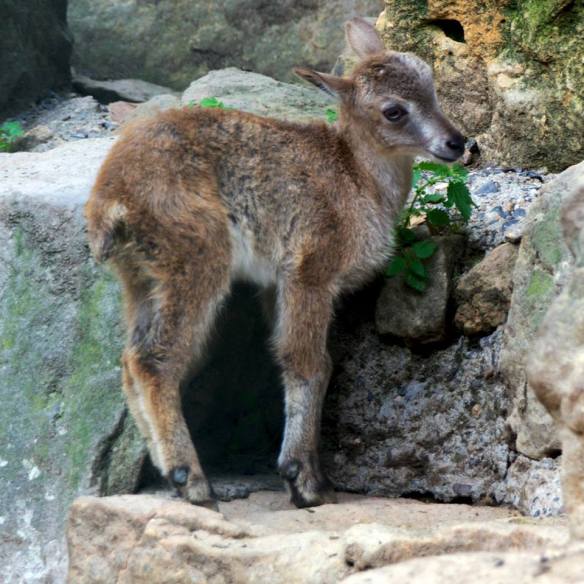
tahr baby
Baby Tahr left to die of cold & starvation without their mothers

The Tahr are calving now. I’m informed the babies would probably not have been seen, as they are “planted” for the first two weeks of life, in a similar manner to deer – with Mum coming back to feed them. They will have been left to die of cold and starvation.

I have also heard via a​ second​ source, a shocked helicopter owner, that DoC are shooting the nanny Tahr in the guts so they go away and die invisibly in the bush, presumably in severe pain. If they were visible their skeletons would be visible for several years. This way they are hidden from public view. I SO hope this is not true!

DoC admits their 1080 rat control operation only lasts 3-6 months … ANNUAL poisoning now for Heaphy Vlly & Coast

From Carol Sawyer
1 Nov 2018

DoC ADMITS RAT CONTROL ONLY WORKS FOR 3 – 6 MONTHS !!
HEAPHY VALLEY AND COAST – TO HAVE ANNUAL AERIAL 1080 POISONING

I have been sent this letter with the comment “Look at this Carol, this is the first time I have seen DOC admit that the poison only holds back numbers of rodents for 3-6 months!”

It is indeed the first time they have admitted that! DoC say in their letter :

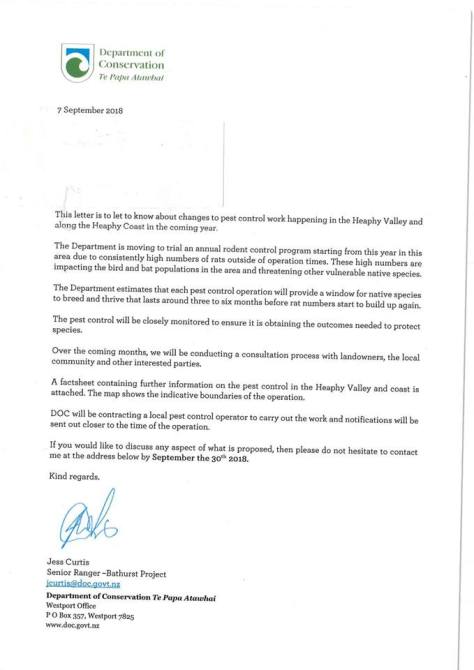
“The Department estimates that each pest control operation will provide a window for native species to breed and thrive that lasts around three to six months before rat numbers start to build up again.”

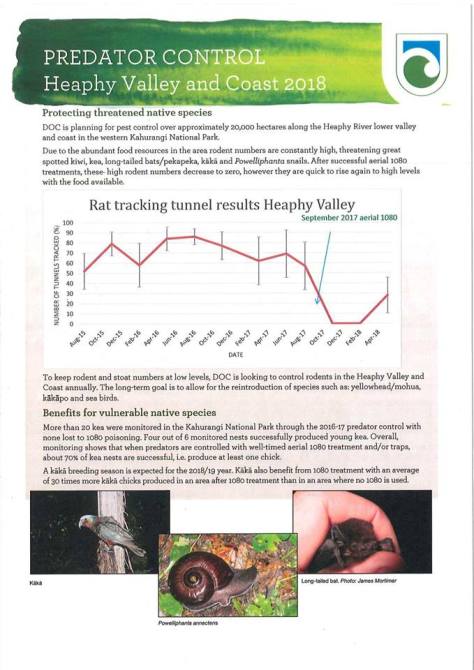
Look at the attached graph… only five months after the 1080 drop, the rat numbers had become HIGHER than they were at the time of the drop and were continuing to climb.

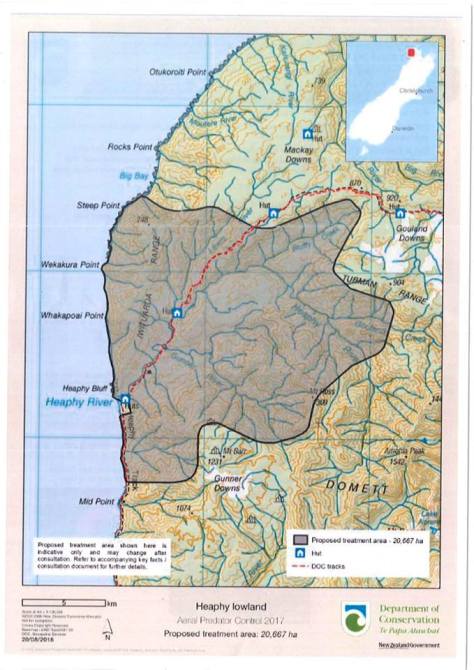
The 20,667 ha area extends over the western end of the Heaphy track, and the drop will take place between October and December, 2018.

**************************************************************

“7 September, 2018

Dear……

This letter is to let you know abut changes to pest control work happening in the Heaphy Valley and along the Heaphy Coast in the coming year.

The Department is moving to trial an annual rodent control program starting from this year in this area due to consistently high numbers of rats outside operation times. These high numbers are impacting the bird and bat populations in the area and threatening other vulnerable native species.

The Department estimates that each pest control operation will provide a window for native species to breed and thrive that lasts around three to six months before rat numbers start to build up again.

The pest control will be closely monitored to ensure it is obtaining the outcomes needed to protect species.

Over the coming months, we will be conducting a consultation process with landowners, the local community and other interested parties.

A fact sheet containing further information on the pest control in the Heaphy Valley and coast is attached.The map shows the indicative boundaries of the operation.

DoC will be contracting a local pest control operator to carry out the work and notifications will be sent out closer to the time of the operation.

If you would like to discuss any aspect of what is proposed then please do not hesitate to contact me at the address below by September 30th, 2018.

Kind regards,

Jess Curtis
Senior Ranger – Bathurst Project
Dept of Conservation”


41990613_2210023522611295_278666141113516032_n

41985800_2210023705944610_994297118141186048_n

42045509_2210023565944624_1542090789104910336_n

42160640_2210023619277952_7005658904696717312_n


A NZ Landcare scientist estimates the likely death toll from an Otago 1080 drop in 2002 to be around 10,000 birds

More evidence on the apparent wanton decimation of NZ’s bird population by the deadly class 1A ecotoxin 1080, banned in most countries, with no antidote, dispensed by helicopters into the bush like a ‘veritable lollie scramble’ as I recently read it described by a person who for a long time worked with both 1080 poison & with DoC. 

The late Bill Benfield* in his book, The Third Wave, Poisoning the Land, describes dead birds that were picked up by searchers in 2002 at the Waianakarua Scenic Reserve in North Otago (a 4043 hectare block). (p 71)

Each bird had been grid referenced on a map and at a pest management strategy meeting in Christchurch (May 2009) a Landcare scientist was able to estimate the likely death toll… an astonishing 10,000 birds. Benfield describes the potential possum population in the reserve as being around 7-8,000 in which case he concludes, the pest management people (DoC & AHB) are poisoning more birds than there are possums.

We know of course that 1080 can’t target just non-native birds. So the photos supplied by people of post-drop death counts invariably include examples of both.

paws for a cause 2.jpg
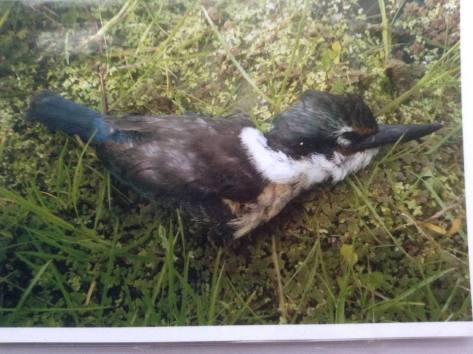
A native Kotare (Kingfisher) found also after a 1080 drop, supplied by Paws for a Cause
kahurangi nat park jim hilton
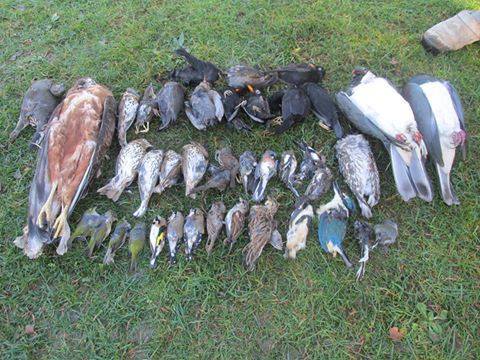
Another image of a birds following a 1080 drop in Kahurangi National Park .. note the native Kereru and Kotare (supplied by Jim Hilton)


NOTE: the header image is not of the birds in question, these are from Paws 4 a Cause’s Facebook page, collected after another 1080 drop. There are many photos of dead birds collected by people directly after the drops. Regarding this article, there is an actual image supplied by Bill Benfield in his book (p71) however I do not at this stage have permission to use it. Please don’t bother asking for proof these ones died of 1080 poisoning. It is not rocket science as to why a collection such as these died when they were collected directly after a 1080 drop.  And besides, the Landcare scientist and the folk at the said pest management strategy meeting in Christchurch, all took it as given that the estimated 10,000 birds died of 1080 POISONING, not other causes. No mention of any other possibilities for death with neither any mention of testing the said birds. Now that these items of information are coming to the fore thanks to investigative writers like Benfield, and to the dedication of the many thousands who recently & historically protested, the said authorities are racing hither and yon suddenly getting the birds tested to ‘prove’ that the folk who simply want clean water & food are getting unnecessarily hysterical.

However, remember the 89 dead kiwi that DoC didn’t bother to test for possible 1080 poisoning? I rest my case. Clearly the authorities can no longer rest on their laurels and assume that the trusting NZ public are asleep like they used to be. 


* About the late William (Bill) Benfield:

William Benfield was an environmentalist author who wrote three books. The first two dealt with the widespread use of 1080 poison in New Zealand. The first is titled At War with Nature-Corporate Conservation & the Industry of Extinction, (find on Amazon) the second, cited in the article above, is “The Third Wave: Poisoning the Land”. His third book is called Water: Quality and Ownership.
Read Amazon’s commentary on At War with Nature: Corporate Conservation and the Extinction Industry:

“This is a book about how the destruction of one of the world’s most unique, ancient and unspoiled wilderness areas has led to the growth of an international industry eradicating animals and plants which have been deemed to be “invasive”. That is because they are where pseudo-scientists say they should not be. What New Zealand began as an industrialised extermination has now become island eradications in many parts of the world. To expand and grow, it must either seek more islands, or widen its scope to cover whole nations; that is what it is now doing.
The parasitic riders who drive this conservation gravy train are:-
•Government conservation agencies who seek to increase their bureaucratic power and influence,
•The agri-chemical industry who supply the chemicals and poisons.
•The powerful and wealthy conservation charities who whip up the concept of “threats to nature” as a way generating donations, bequests and corporate sponsorships.
•The academic and science institutions who see in it a rich seam of grant money for supplying junk science in support of the eradication industry.
Eradications are carried out on a scale reminiscent of the US military aerial deforestation of Vietnam with “agent orange”. Here, for all wildlife, the animals, birds and insects, the poisons used are super-toxins such as brodifacoum and 1080. For vegetation, they have devised new wonder chemical cocktails such as “Armageddon”. It is total ecosystem genocide.
To whip up a public fervour to help justify such mass environmental poisoning, the people are fed the concepts of invasive pests and threats. Thus, harmless creatures are demonised and need be shown no mercy. By deliberate and devious propaganda, the public are kept unaware, that in the blinkered rush of zeal to kill “pests” and “predators”, the eradication industry is killing everything else, even the rare and endangered species such as an entire monitored population of rock wrens from an aerial 1080 poisoning at New Zealand’s Kuhurangi National Park.
It is a war against nature.”
A further article featuring Bill Benfield from Stuff:


In Australia 1080 is killing native dingo & other non target species with no warning of drops (the GrafBoys)

Watch the video at this link.

aus.png

Published on Aug 28, 2018

1080 poison is used to kill native Dingoes in Australia. This short video clip explains some of the impacts of poisoning the native wildlife …
WATCH AT THIS LINK
Learn more about 1080 at the GrafBoys’ NZ website  tv-wild.co.nz

Predator free 2050 – creating a generation who ‘find killing animals weirdly addictive’

The new move by Predator Free 2050 to eradicate cats. A new insidiously inhumane killer poison on a par with 1080 in terms of cruelty is already being trialed in the Hawke’s Bay.

Thanks to The Truth About 1080 Poison Facebook page for the link to this article from Bob Kerridge. Bob has had a long and distinguished professional career in animal welfare, during which time he has been responsible for many creative and innovative initiatives that have enhanced the status and welfare of animals in the New Zealand community. You can read more about him at the end of the article.

As requested by Bob I’m adding an image he supplied.

PHOTO KITTEN & QUOTE.jpg

COMPANION ANIMALS IN AOTEAROA
OPINION – Bob Kerridge, Animal Welfarist.

The average peace-loving New Zealander may not be aware of it but, apparently, we are at war. If you find this difficult to comprehend, and a little frightening, for verification you need go no further than listen to the war-like rhetoric emanating from the people at Predator Free-2050.

This new, but generously funded, movement has a clear mission: To be rid of all predators, (whatever or whoever they may be), by the year 2050, with its website calling us to arms urging us to ‘unite to fight’. The dialogue from command headquarters tells us that the ‘threat of invasion is here’ but that “we have an army of tens of thousands of New Zealanders’ to undertake ‘a military campaign to push the invaders back, just as we did in the last two world wars’.
This disturbing talk exemplifies a dangerous path down which we are being led which could result in an ecological disaster because of this new-found obsession to become predator free. In a recently published paper two eminent ecologists, Professor Wayne Linklater and Dr Jamie Steer, are critical of the methodology being employed: ‘While Predator Free-2050 is well intentioned’, they concluded, ‘New Zealand’s future conservation policies need to be less bombastic, and better informed by the environmental, ecological and social sciences’. In a separate interview Linklater went further when he stated that New Zealanders would regard being ‘cruelty free’ a far greater goal than ‘predator free’, an aspiration with which I totally concur.

Not surprisingly the troops being deployed to free us of all these predators is the Department of Conservation, (DoC), who of course are willing and able to do the job. In my naivety I used to believe that conservation meant preserving our special and unique biodiversity, until I heard the previous Minister, Maggie Barry, proudly proclaiming for all to hear that ‘my guys at Doc are incredibly good at killing things’. Given there are many dedicated individuals employed by DoC who labour long and hard to preserve the lives of many of our endangered species, and more power to them, this was a foolish and heartless statement to make. It is little wonder that a number of previously employed high-ranking scientists are describing the current atmosphere at DoC as ‘toxic’ with a ‘culture of war and a lot of discontent’.

Dr Arian Wallach of the University of Technology, Sydney, and Fellow of the Charles Darwin University, described the essence of conservation succinctly when she stated: ‘The aim of conservation is not to generate an ever increasing (dead) body count, but to guide human behaviours to enable the rest of the earth’s species to flourish’.

The major weapon in DoC’s vast armoury, and akin to the H-bomb, is sodium fluoroacetate, (1080), a cheap and particularly nasty pesticide which is as indiscriminate in whom it targets as it is efficient in killing them. Registered as the most toxic pesticide by the World Health Organisation it was the only chemical weapon reportedly found in Saddam Hussein’s arsenal. 1080 is outlawed in a large number of countries, but to our absolute shame New Zealand has been using it since it was first trialled here in 1954. Despite growing public abhorrence, we are now purchasing 80% of the total supply, making us by far the largest user in the world.

The evils of 1080 are well documented including its permanent effect on our flora and fauna, destroying micro-organisms and insects, (the diet of many birds), the contamination of our waterways, human health risks, the slow and agonising death of untargeted animals, (both large and small), and also, ironically, many of the native birds it’s meant to be protecting. And yet, despite this history I am told that last year 350 million poison baits were dropped on our little country, thus perpetuating what can only be described as a national disgrace.

So just who are these invaders that, as Predator Free-2050 advocates, need this military effort to defeat ‘because it is a very insidious war they have waged’ against us’? The irony is that these so-called invading species have no ability or desire to declare war, or any concept of what is being plotted against them, or why, neither have they the ability to protect themselves or fight back. In fact it’s a bit of a one-sided war, rather more a premeditated annihilation I would suggest.
In reality the selection of predators that need to be killed is at the behest of the greatest predator of them all, humans, either because we just don’t like them, or they are introduced species and not native to our shores, or we have the mistaken belief that if we exterminate them our ecology will be rescued from certain peril. In general the reasons are unscientific and immoral, as are the weapons used against them.

Unbelievably the latest animal to be selected as a targeted predator will astound and horrify most people, but will delight rats, and Gareth Morgan. In an incredulous move the current Minister of Conservation, Eugene Sage, wants to see Kiwi wandering the urban gardens of Wellington, which would not exactly be their choice of where they would wish to reside given the human dangers associated with urban living and their lack of natural bush protection to which they are accustomed. The Minister noted that to achieve this urban dream cats would have to go, parroting the demands of the insidious ‘cats to go’ campaign, requiring ‘having cats inside, and when your cat dies then not replacing it’. So it’s cats or kiwis.

Local and Regional Councils throughout New Zealand, who have never before shown any interest in cats, are now wanting to illegally label them as ‘pest cats’ so they can be destroyed without question, again acceding to Morgan’s dictate that ‘any cat that is free to range should be a dead cat’.

That constitutes another declaration of war, and of course weapons of mass destruction exist, especially for cats. This one comes in the form of the unpronounceable para-aminopropiophenone, or PAPP as it is generally known, currently and unashamedly being trialled by the Hawke’s Bay Regional Council. PAPP is as hideous as 1080 coming in the form of a paste which, once ingested, starts a process of dying which is inhumane and painfully slow, with death averaging an horrendous 3 hours and 51 seconds to occur. During the process signs of toxicosis occur, (head nodding, lethargy, uncontrolled movement and lack of balance), eventually advancing to unresponsiveness and collapse but fully conscious and aware, with final unconsciousness occurring only moments before death.

The persecution of cats, the country’s most popular and adored companion animal, is as unfathomable as it is without foundation. Ecologist Gary J Patonec, (USA), commented: ‘What I find inconsistent in an otherwise scientific debate about biodiversity is how the indictment of cats has been pursued in spite of the evidence’.

I have to question, just what is the motivation that drives people to hate so vehemently that they are quite content in subjecting cats and other sentient beings to such extremes of torture before killing them? But remember we are, apparently, at war and the conservation soldiers are doing it to make the world a better place being totally oblivious to the probable ecological consequences of their extermination practices. The slaughter of one species on the pretext of saving another for the greater good in the name of conservation is reprehensible.
Predator Free-2050 claims to have an ‘army of tens of thousands of New Zealanders’, many of them recruited from children whose schools have received money and complimentary traps if they accede to the terms and conditions of war. Others are equally innocent urban families where the aim is to have ‘a trap in every fifth backyard across New Zealand’ which is creating a generation who, and I am quoting ‘find killing animals weirdly addictive’.

Such a trend is deeply disturbing and I wonder where, in contrast, is the public outrage? Because these trends are often introduced under stealth perhaps people are not aware of where this war is leading us, what weapons of mass destruction are being used, or what the consequences will be. And where are the mechanisms in place that will protect animals from such abuse, or are there none? Are we just going to sit back and watch New Zealanders fall into moral decay?

French ornithologist Jean Dorst conveys some sobering and relevant words of wisdom: ‘Whatever the metaphysical position is adopted and whatever place is given to the human species, man has no right to destroy a species of plant of animal on the pretext that it is useless. We have no right to exterminate what we have not created’.

I have no hesitation in adding my heartfelt support to that sentiment, as my dream for our country has always been that we respect and love all life, and that humans, animals and the environment can coexist in harmony, in addition to a belief that we can, if it is our will, realise that dream. Keep believing.


Bob Kerridge can be contacted on:
Email: bob.kerridge@gmail.com

He resides in Havelock North, Hawke’s Bay
Bob Kerridge has had a long and distinguished professional career in animal welfare, during which time he has been responsible for many creative and innovative initiatives that have enhanced the status and welfare of animals in the New Zealand community.

During his tenure of 32 years with the Society for the Prevention of Cruelty to Animals, (SPCA), Bob Kerridge assumed many roles including Chief Executive, Executive Director and member of the Board. He was a National Councillor with the Royal NZ SPCA, eventually becoming its National President, and was also a Director of the World Society for the Protection of Animals, (WSPA). He was made a Member of the New Zealand Order of Merit in 2004 and promoted to Officer of the Order for services to animal welfare and governance in the Queen’s Birthday honours in 2018.
He has recently established a Fellowship to seek positive and harmonious solutions for animals, humans and the environment.

SOURCE

How the NZ Govt’s 1080 pesticide company re branded itself and why

Orillion is the new name for the Govt/corporation owned factory in Whanganui that manufactures 1080, the poison that is distributed liberally over our land in an endeavour to make us pest free. Per annum they drop 4,000 kg, enough to kill 20 million people. This is 22,000 times more than the rest of the world drops in fact it is banned in most countries. No wonder they wanted to re brand it. People are waking up to its toxicity. They’ve been dropping 1080 for 60 years now so it seems to not be working.

TWO SCIENTISTS WHO REVIEWED MORE THAN 100 OF DOC’S SCIENTIFIC PAPERS SAY: “THERE’S NO CREDIBLE SCIENTIFIC EVIDENCE SHOWING ANY SPECIES OF NATIVE BIRD BENEFITS FROM 1080 DROPS”

The new target is 2050 by which time we will supposedly be pest free. Supposedly. I suspect by 2050 we’ll be free of a lot more than pests.

WITH A LONG HISTORY OF POISONING KEA, DOC IS SET TO FINISH OFF WHAT REMAINS – DR JO POLLARD

WITH THE ANOMALIES NOTED IN KEA DEATHS, A SERIOUS UPGRADE IN MONITORING IS REQUIRED FOR US TO SEE THAT 1080 IS ACTUALLY DOING WHAT DOC SAYS IT DOES

22550029_2002970989983217_9114698567799724082_n.jpg
Local protesters raise awareness at the Govt owned factory ‘Orillion’ situated in Heads Rd Whanganui (PHOTO: Victoria Mitchell)

NZ’S 1080 SUPPLY IS MADE RIGHT HERE IN YOUR OWN BACK YARD – FYI

The old name of this establishment was Animal Control Products. However in 2016 or thereabouts, they enlisted a Massey University owned company in Wellington called Open Lab to re brand it. This does appear to coincide very much with the intensified awareness of the public to the darker side of this poison.

“Animal Control Products NZ develops products to control and eradicate pests. They wanted to reposition their status from being a negatively slanted ‘producer of poisons’ to instead emphasising the great achievements that their products have lead to.

Open Lab was entrusted with re-naming the company and developing a new brand strategy that would be reflected through a revitalised brand story and a modernised design aesthetic.”

You can read about the new slant at the following link:

http://www.openlab.ac.nz/our-work/orillion/

This is in no way a negative slant on Open Lab. They are just working for their dollars. Any design company could have done the task and the point here of course is to highlight the deliberate tactic of prettying up the poisoning program under a plethora of new and colorful rhetoric and images which of course is not new.

“The elected name, Orillion, means ‘the defensive part of a city wall’, and conveys their role as a safeguard of native species, the environment and community. The logo is based on the whauwhaupaku, or fivefinger; a fast-growing plant used to help forests regenerate.”

2openlab.png
Rebranding deadly poison with attractive & appealing brochures: Photo – openlab

It is a time worn tactic employed by governments since forever. The Crown is an expert at it. They re wrote our colonial histories in a similar  fashion to make them more palatable for succeeding generations. It is hoped says the website info, that the new branding will increase export sales.


POSTSCRIPT: From a FB member:

Did you know Company Office records show the Rolleston Partnership with Pest Control Research NZ Ltd was formed in May 2013.

It has only two shareholders- Christchurch man Malcolm Thomas with 51 per cent, and the West Coast Regional Council with 49 per cent.

Did you know ………”In New Zealand, the poison is manufactured into pellets by Animal Control Products Ltd (ACP), a Crown-owned company, which manufactures more than 90 per cent of the pesticides formulations containing 1080 used in New Zealand.”……….


For important details on 1080 that are generally left out of the mainstream dialogue I suggest you visit our 1080 pages at the main menu. There is much evidence there and many links to independent research illustrating that this product kills more than the pests we are told are targeted. If you hike, tramp, hunt or fish, you should also visit the page, Suspected 1080 Poisoning Cases. 

BANNED IN MOST COUNTRIES & CLASSIFIED BY WHO AS ‘HIGHLY HAZARDOUS’… 1080 IS A BROAD-SPECTRUM POISON THAT KILLS ALL OXYGEN-BREATHING ANIMALS AND ORGANISMS – DR MERIEL WATTS

Also, use ‘categories’ at the left of the page & search 1080. There are just too many references to include in this short article. Share the information with your loved ones. You should not for instance, be in or near a drop zone if pregnant.

Midwives warn of 1080 risk

More to come on that topic. Finally, watch out for your pets near any drop zone. Death by 1080 has been likened by a Veterinarian to two days of electrocution. Not a pretty sight and there is no antidote.

For those who are against the use of aerially dropped 1080 on our land (and waterways) there is a peaceful protest-hikoi making its way from the far North & the far South, to meet at Parliament on September 8th. Watch for its passage through your town/area & support their efforts in whatever way you can. Details can be found here.

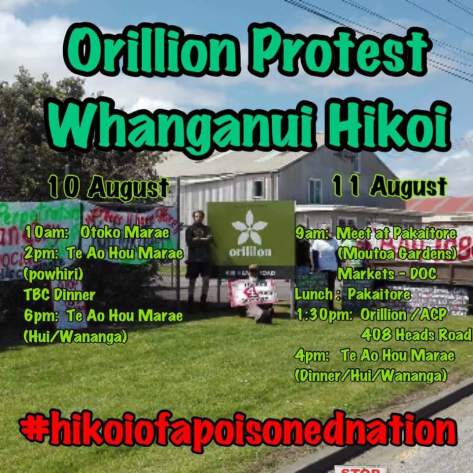
For folk near Whanganui there is to be a peaceful protest there as well. Details below from Hikoi of a Poisoned Nation at Facebook.

38612539_160990171443308_3673515425536147456_n

Header photo: Tim Benseman

EnvirowatchRangitikei

Two academics have hit out at the Government’s Predator Free 2050 goal, calling it “badly designed and unachievable”

From News Hub

They say the plan could lead to a decline in public support for conservation policy, because it’s an “impossible” target destined for “inevitable failure”.

The plan was announced by former Prime Minister John Key in 2016, and Conservation Minister Eugenie Sage has previously said it needed a “reality check”.

Victoria University School of Biological Sciences associate professor Wayne Linklater and ecologist Dr Jamie Steer said their research shows the plan is based on flawed assumptions.

Those assumptions are:

  • Predator extermination is the best way to protect biodiversity
  • The country needs to eradicate every stoat, rat and possum to protect biodiversity
  • A complete eradication of predators is possible

“None of these assumptions are true,” Mr Linklater said.

“Complete eradication of predators is technologically impossible, and biodiversity is affected more in some places by habitat decline and plant eaters than it is by predators.”

He said eliminating select predators from complex communities of plants, animals, and humans was likely to be harmful, causing populations of other introduced animals to erupt.

READ MORE

https://www.newshub.co.nz/home/politics/2018/07/nz-s-impossible-predator-free-2050-goal-blasted-by-academics.html

Eye Witnesses Report on Recent Taupo 1080 Drop – 2 Acre Area Littered with Contorted Dead Deer, ONE Possum and ONE Rat

From a DOC drop of 1080 over 134,000 acres, a group walked two of those acres over one hour to view the results. The forest floor was littered with dead contorted deer – and they found only one possum and her joey, and one rat. This video is from CGNZ (Clean, Green NZ) a voluntary group who were accompanied the day of filming by the Graf Brothers.


deer taupo.png

VIDEO BELOW

By Torvald Nagelhjelm on Youtube

Published on Jul 13, 2016

On the 13th July 2016, together with a few friends, we went to the site of a 50,000 hectare 1080 poison drop in Central North Island, NZ. This is our story. Everything you see is exactly how it was.


coro-5

See the TheGrafBoys YT channel and website for more videos. Educate yourself on 1080 poisoning. See also http://1080science.co.nz/

See also our 1080 pages for info & links, &/or search ‘categories’ drop down box for further related articles (at left of any page). 

Like our FB page &/or follow our blog (right of any page) to help spread the word on all the untruths we have been told – we are about exposing corruption and lies!  Use the share buttons!  Write to your government as the video suggests. Support the Graf Brothers in their fight against 1080 poisoning. 

Thank you!

EnvirowatchRangitikei


A friendly note from admin about commenting.

This site/blog is a truth site. Our purpose is to dig below the surface stories and where present, to expose lies and corruption. We do this also by citing independent research from professional people. This is what mainstream media should be doing however media is also corporately controlled now and as we know corporations are for profits not people or environments. For that reason I reserve this venue for commenting that seeks truth also. If you are strongly pro poison, chemicals, damage to environment, damage to health etc etc your views would be best stated in mainstream media where the status quo is already firmly entrenched. Some of the people of the latter persuasion are in fact paid trolls; so desperate are the powers that be to maintain their control of opinion, they pay people to debunk truth.

So, that established, please feel free to comment without advocating any kind of violence or hatred. We are for truth and peace here.


TROUT MASS-POISONED IN NEW ZEALAND-DOC warned fishermen in 2014 not to eat their catch

A small reality check here: our waters in NZ are no longer pristine … in fact only 40% of them are safe enough to swim in. Our PTB have settled for ‘Ok to wade in’. This warning by DOC was later retracted (see end of article) however in my opinion, from reading the info, the evidence for its safety doesn’t stack up. Do research it for yourself….   EnvirowatchRangitikei


Published on Sep 29, 2014

New Zealand has some of the best trout fishing in the world!

Every year, thousands of international visitors wade pristine rivers in search of the freshwater game fish.

Large brown trout abound some back-country streams, and feisty rainbows reach weights of double figures in many regions. But there’s a problem facing New Zealand fishing, and it’s toxic, very toxic.

The Department of Conservation is using helicopters to aerially spread the deadly pesticide 1080 poison across New Zealand’s forests and streams. The poison is targeted at introduced possums and bush rats, but many other animals, birds and insects are killed, including deer.

The poison contaminates the food chain, and in a rare admission, the Department of Conservation is warning fishermen to avoid eating their catch, despite paying for the privilege …

This video clip shows that the poisoning of New Zealand’s trout goes much further than a few pesky mice…


Here is a media alert at the time from stuff.co.nz:

1080 Prompts Trout Warning

“Anglers are being warned to avoid eating fish caught in back country waters as they could be tainted by 1080 poison.

The Department of Conservation plans to aerially drop 1080 poison across 700,000 hectares of conservation land, mostly in the South Island, to reduce rodent numbers. 

Fishing groups expressed concerns that mice – which were often eaten by trout – could carry sub-lethal amounts of 1080, posing a food safety risk for humans.

DOC commissioned independent research into the risk, finding 1080 levels in trout flesh were significantly higher than recognised food safety guidelines…..

Read More

DOC predictably scaled back their warning  further down the track, however NZ Fish & Game advised erring on the side of caution“Fish & Game advises that if you have concerns, you should not to eat trout flesh from trout caught in 1080-poisoned catchments, until advised otherwise.” The following video by the Graf Boys takes a closer look at the research cited which ‘officially’ deems the risk from 1080 to aquatic life ‘low’. There are holes in it.


I personally consider it essential for you to research 1080 for yourself. There is much spin about many products from corporations whose bottom line is profit. You need to keep an open mind and read the independent research as well. Long gone is the day we can simply trust what a corporation says. Their legal obligation is to their shareholders, not you. Don’t believe me? Watch The Corporation documentary. And eat any wildlife from poisoned areas at your own risk.


Published on Jan 3, 2015

In a letter to the CE of Waikato Regional Council, the CE of the Environmental Protection Authority suggests that 1080 poison does not harm aquatic life, and breaks down into harmless bi-products in water.

However, some of the research referenced – Niwa freshwater ecologist Dr Alistair Suren’s work – highlights a common trend in the poison industry, with regard to the misrepresentation of 1080-poison science by New Zealand authorities, and those that use the poison …


See the TheGrafBoys YT channel and website for more videos. Educate yourself on 1080 poisoning. See also http://1080science.co.nz/

See also our 1080 pages for info & links, &/or search categories for further related articles (at left of any page). 

Consider liking our FB page &/or following our blog (right of any page) to help spread the word on all the untruths we have been told – we are about exposing corruption and lies!  Use the share buttons! 

Thank you!

EnvirowatchRangitikei

More on Bonny Glen’s leachate disposal … they’re ‘chipping away’ at it

The Chronicle is reporting on the leachate. There have been more discussions regarding the ongoing treatment of this toxic runoff:  “Leachate from the Bonny Glen landfill may soon be treated on site rather than, or before, being dumped into the Marton wastewater treatment plant…”

We heard on June 12th that: “…it would still be a few months before a solution would be finalised concerning leachate…”  and that ” Bonny Glen manager Paul Mullinger …   was taking the issue “very seriously”. They are “… considering some sort of on-site treatment and did not view the issue as insurmountable”… and Deputy Mayor Dean McManaway says “It’s important we keep chipping away and not let this rest.”

Note the operative words here: “may … few months … considering … chipping away”.

It is interesting that on one side of the table, the company that managed to secure a nice loose ‘gentleman’s agreement’ to dump the toxic leachate in the first place, and contaminate our local stream to the extent RDC and Horizons seem unwilling to conduct ongoing in-stream biota surveys, concealing just how loose that agreement was … and on the other side that same company managed to effectively exclude all discussion of leachate, truck nuisance and landfill pests from the hearings altogether. And now it’s all go ahead with the consents safely in hand, still we’re required to ‘chip away’ at things. Some of us are not fooled by all this drag-the-chain rhetoric.

In the meantime, as the latest Chronicle article points out, the waste water treatment plant is still non-compliant.

Read the article here:  http://www.nzherald.co.nz/wanganui-chronicle/news/article.cfm?c_id=1503426&objectid=11465277

Wally Richards’ Weekly Article: For your garden plus updates on Glyphosate, the Bees & Smart Meters

Here is Wally’s latest updates from his Weekly Newsletter page. Check out his website for lots of information & advice on local gardening plus recommended products. This week he’s commented on Big Tobacco, Germany, the bees and Bayer, and on the WHO and glyphosate….
WINTER IS COMING

Now that day light savings has finished we realise that winter is coming and in a number of areas light frosts have already occurred.

From my own experience in Palmerston North and talking to gardeners in other areas including Invercargill, the winters now days are very mild to what we experienced when we were young.

Heavy frosty mornings with frost lasting well into midday but nice sunny blue skies except when we had what we called a black frost.

That was when the frost did not disappear because the day would have heavy clouds, which did not allow the sun to warm the ground. Not nice.

These days in Palmerston North at least we do not have too many frosts in winter and usually the ones we have are light and soon disappear. Outside of the city you do not have to go far to find a good frosting when the conditions are right.

What has changed besides ‘climate change’ is the warmth that a city generates from houses, vehicles and street lighting. Pollution in the air also acts the same as cloud cover trapping heat and preventing frosts to settle. We are more likely to see fogs than frosts.

This bodes well for the more tender plants which would be damaged or killed by a good frost.

It does not help with control of pest insects and plant diseases which a good heavy frost will knock them for a six.

For us gardeners we still need to give more tender plants some protection and later in winter use methods to reduce disease and insect pests.

Now is the time to take action to help your plants survive the winter chills.

Apply Fruit & Flower Power to the root zone of plants that could be damaged, your preferred plants and any tender plants. The potash and magnesium in this product hardens up the foliage, strengthens the root system and helps to maintain nice green foliage.

Apply this month and again monthly for the next two months on evergreen plants but only once on deciduous plants and trees.

Wet weather diseases are caused by lots of rain and insufficient drainage.

The root systems need oxygen and if there is too much water then there is insufficient oxygen, the roots can hold their breath (so to speak) for a while but then they will start rotting.

You will see leaves turning yellow, curling and dropping followed by the plant’s death.

You can assist the plants to withstand wet weather diseases by spraying them with Perkfection Supa once a month for the next 3 months on evergreens such as citrus. One spray on your roses and deciduous trees at this time.

If you can; ensure that the drainage around plants that hate wet feet is improved where possible.

One easy way on established plants such as citrus or around the edge of vegetable gardens is to dig a trench one or two spades deep. On citrus and similar just out beyond the drip line.

Excess water will drain into the trench where wind and sun will evaporate it away quicker.

This is only needed where you know that ponding takes place during rainy times, good free draining areas are not so prone to the problems.

For our final protection of tender plants we can use the ‘spray on frost protection’ called Vaporgard.

Mixed at 15mls per litre in warm water and sprayed over the foliage of tender plants it will give them down to minus 3 degrees frost protection for 3 months within 3 days of application.

This works very well on the first frost but if there are several frosts in a row, night after night then additional protection such as frost cloth will be needed.

The reason for this is the damage to the cells does not have a chance to repair before they are frozen again.

Tender plants that are in containers can be moved to places where they are protected such as under the eaves or under evergreen trees. I now can keep impatiens and petunias in containers going year after year by using all the above suggestions and having them in sheltered areas.

Plants such as capsicums and peppers growing in open ground can be sprayed with Vaporgard under and over foliage and a couple of days later carefully lifted and placed into containers.

Then moved to a glasshouse or protected area like a porch where they will continue to produce for you slowly over winter as long as you keep them a little on the dry side.

Now that the soil is cooler and rains have starting to moisten the gardens; means you can plant your spring bulbs in sunny areas. Container grown bulbs are likely planted already.

Let your strawberries run and root in for a fresh lot of plants later in May.


LATEST NEWS:

Monsanto & Bayer

The latest news is very interesting as chemical company giants, Monsanto and Bayer are taking a hammering as reports about the harm some of their main products are doing to our health and the environment.

The World Health Organisation (WHO) recently placed glyphosate on level 4 meaning its a very probable cause of cancer. (Level 5 means it does definitely cause cancer.)

Monsanto’s cause was not helped by the video of pro-GMO Patrick Moore claiming Monsanto’s glyphosate is “safe to drink,” then walking out of an interview when asked to prove it, has been making the cyber-rounds. But perhaps no one has framed it better than Jeffrey Jaxen, a writer for Before It’s News.

Jaxen calls the Moore interview a “Big Tobacco Moment,” comparing it to the publicly televised statement in 1994, by William Campbell, then-CEO of tobacco giant Phillip Morris, who told Congress, “I believe nicotine is not addictive.”

Jaxen wrote: “When paradigms shift, tyrants fall, or corporations lose their market it is often not from some spectacular event, but by a single, humanizing display.”

If you have not seen it go to:  https://www.organicconsumers.org/news/gmos-big-tobacco-moment-shocks-public-awake

Bayer is loosing its battle; saying their toxic neonicotinoids such as Confidor are safe. Study after study show neonicotinoids are a key culprit in bee declines and are harming other organisms, from earthworms to birds.

Bayer filed a lawsuit against Friends of the Earth Germany in an
effort to shut down their campaign to save the bees. Thanks to the work
of concerned people across Europe, Bayer lost and Friends of the Earth
Germany won. This demonstrates the importance and power of organizing and
when the truth is revealed, people can push back against corporate power,
and win.

On the home front it was reported that Lloyds of London are not covering events
of smart meter fires or health risks associated with wireless devices. 

Likely soon most insurance companies will follow suit as they normally do
when Lloyds makes exclusions..

Are Smart Metres causing fires? According to TV3 news yes; within the
last five months there have been 67 call outs in Canterbury to
malfunctions involving power boxes, and 422 throughout the country.

Smart Meters & Power Surges Causing Fires

Your power company installs a smart meter and then when there is a power surge it can blow up appliances and possibly set your home on fire, which has happened in NZ and overseas.

Then you could find your Insurance company has wavered damage cause by Smart Metres.

Not only that but health problems cause by High Intensity Radio Frequencies are not going to be covered either. See:  https://www.youtube.com/watch?v=dF-djNIb5Oc

People and children sensitive to this radiation can have problems of head aches, nose bleeds, emotional problems and sleeplessness. Makes for more interesting times.

Wally Richards