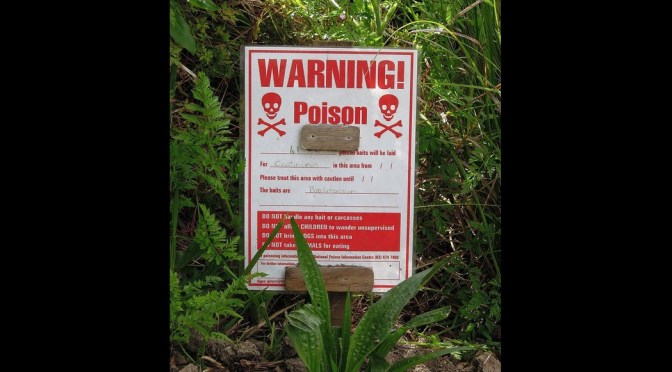
Tag Archives: Pests

More tips on dealing with pests in the garden (Wally Richards)

The tomato/potato psyllid has caused a few headaches for gardeners when the populations of this relatively new pest build up and they affect not only potatoes and tomatoes but also a number of other host plants such as tamarillo, capsicum,, chili and peppino. The nymphs are so small and you need a magnifying glass to see them clearly, so you may have a small population of psyllids in your back yard and not realise the problem.

To find out if you have psyllids then you can do so by planting a potato either into your vegetable garden or into say a 20cm pot or bucket. Take a potato from the kitchen that has started to sprout and plant it as above. It only has to be into a hole about 8cm deep and covered with soil or growing medium. We are going let the plant grow to maturity and then harvest what tubers have formed underneath. If the tubers are small about the size of a marble and likely re-shooting; that will tell you that you have psyllids and they attacked the potato foliage when it was still young and growing. If on the other hand the tubers harvested are of a good size but when cut them in half, there are dark rings inside or what we call Zebra lines,  then yes you have psyllids and they attacked the plant later after the tubers had grown to a reasonable size.

That means next season when you grow potatoes or tomatoes you need to use controls so that you have a harvest of eatable produce.With potatoes the easy way is to plant very early your seed potatoes like back in July so that the crop is harvested before October. That should allow you to get an ok crop. With tomatoes you need to use Wallys Cell Strengthening kit of products to make the tomato plant cells so tough that the psyllid nymphs can not piece the plant to feed and inject in the toxin that causes all the problems.

Club Root is a disease that affects the brassica family causing the roots to become very distorted and so bad that they cant supply moisture and nutrients to the foliage above. So when you plant your cabbages etc and they grow quite happily at the start, then the growth slows down and comes to a stop normally  before the plant has reached maturity unless it is a miniature, fast growing variety. Its a frustrating disease which is soil born and often it has got into your garden when planting purchased (or given) any seedlings that were grown in club infested soil. Once you have it then I am told it takes up to 25 years to eradicate; that is as long as, during that time, there are no host plants grown in the contaminated area. It does not affect other plants such as silverbeet, beans etc only members of the brassica family which includes swedes. It affects brassicas such as Brussels sprouts, cabbages, cauliflowers, kale, turnips, swedes and radishes, their ornamental relatives such as Cheiranthus (wallflowers), Matthiola (stocks), Aubrieta (aubretia), and cabbage-family weeds such as Capsella bursa-pastoris (shepherd’s purse). In the past steam cleaning the soil was the only known control for it. Other methods can be used such as heavily liming the soil and using a soil drench of potassium permanganate. They can help get quick maturing crops to harvest. If you have the dread disease in the soil then here is a suggestion to maybe help eradicate it.

What you do is plant a cabbage seedling into a 20 litre pot, then in the middle of your vegetable garden you sit the pot on top of some bricks so that it is not in contact with the soil. The idea here is that rain and watering will wash down into the soil below the smell of the cabbage and that will activate the dormant club root spores to swim up  to where the roots of the cabbage are. But as the plant is above the soil and not in contact with the soil then the spores have no where to latch onto and colonise.  So they fizz and die. If you have a big area you may need a few cabbages in pots spread through out the area to try and activate all the spores in the soil. The following season you could test plant a few cabbages into the area and see if they grow and if they are free of the disease.  Otherwise try again the same trick of activating the spores.

Moths are a problem in our gardens because of the eggs they lay and the caterpillars that hatch out to feast on fruit and plants. There are codlin moths which affect apples, pears and walnuts and they are every where in NZ. Then there are Guava Moths which are so far in the more northerly parts of the North Island and they affect all fruit including citrus and nuts. Finally another one called the army worm which is so far mainly in Northland but is likely to build up populations and head south to other gardens. It eats the foliage of just about every thing and is causing a lot of headaches to both commercial and home gardeners. If you can eliminate the three moths before they get to lay their eggs then your plants are fairly safe from damage. Moths are attracted by smell to find their host plants or to feed on nectar for energy. Thus a trap can be used to lure them in and kill them. In my recent book ‘Gardening with Wally Richards’ I have a chapter on moth control and part of that is this simple to make trap to catch and kill them.

Take one litre of hot water add a100 grams of sugar, one teaspoon of marmite, half a tablespoon of Cloudy Ammonia and half a tablespoon of Vanilla essence:

Mix well and divide the mix between two plastic milk or soft drink bottles.

Punch some holes in the side of the bottles just above the level of the mix.

Place on a stand about a couple of metres away from the tree.

At about waist height like on a small folding table.

When a number of moths are caught dispose of them and make up a new solution.

Cloudy Ammonia used to be common once upon a time from a grocery store if not so easy to find try hardware stores, there are two chains in NZ and they may have. (Bunnings and Mitre 10).


TWENTY FIVE PERCENT OFF SALE

Till the end of January we are discounting the following products by 25% to help you gain control of Insect pests and improve your soil quality.

Orders must be placed on www.0800466464.co.nz using the Code 25% in the remarks place.

I will phone you after receiving the order and deduct the 25% off the items below and also give you 10% off most other items except for bulk items.

FREIGHT: shipping charged on orders under $100 (After discounts) North Island In other words order of $100 plus after discount and not bulk items free shipping.

South Island $150.00 plus after discounts for free shipping.

Exception is for Rural delivery a charge of $3.15 on each parcel sent no matter if rest is free shipping or not.

Here are the 25% discount items:

Wallys Neem Tree Granules 1kg normal price $15.00 save $3.75 making it $11.25

Wallys Neem Tree Granules 3kg normal price $28.00 save $7.00 making it $21.00

Wallys Neem Tree Granules 10kg normal price $80.00 save $20.00 making it $60.00

Wallys Neem Tree Granules 20kg normal price $160.00 save $40.00 making it $120.00

Wallys Neem Tree Powder 1kg normal price $15.00 save $3.75 making it $11.25

Wallys Neem Tree Powder 3kg normal price $28.00 save $7.00 making it $21.00

Wallys Neem Tree Powder 10kg normal price $80.00 save $20.00 making it $60.00

Wallys Neem Tree Powder 20kg normal price $160.00 save $40.00 making it $120.00


Wallys Super Neem Tree oil 125 ml normal price $18.00 save $4.50 making it $13.50

Wallys Super Neem Tree oil 250 ml normal price $24.00 save $6.00 making it $18.00

Wallys Super Neem Tree oil 1 litre normal price $60.00 save $15.00 making it $45.00


Wallys Super Pyrethrum 100 ml normal price $28.00 save $4.20 making it $23.80


Wallys Super Fish Fertiliser 1Litre normal price $16.00 save $4.00 making it $12.00

Wallys Mycorrcin 250ml normal price $20.00 save $5.00 making it $15.00

Wallys Mycorrcin 500ml normal price $35.00 save $8.75 making it $26.25

Wallys Mycorrcin 1 Litre normal price $55.00 save $13.75 making it $41.25

Orders must be placed on www.0800466464.co.nz using the Code 25% in the remarks place.

Phone 0800 466464
Garden Pages and News at www.gardenews.co.nz
Shar Pei pages at  www.sharpei.co.nz
Mail Order products at www.0800466464.co.nz

New Zealand Bill of Rights Act 1990. Part II of the Act covers a broad range of Civil and Political Rights. As part of the right to life and the security of the person, the Act guarantees everyone:

1The right not to be deprived of life except in accordance with fundamental justice (Section 8)

2The right not to be subjected to torture or to cruel, degrading, or disproportionately severe treatment or punishment (Section 9)

3The right not to be subjected to medical or scientific experimentation without consent (Section 10)

4The right to refuse to undergo any medical treatment (Section 11)

 Furthermore, the New Zealand Bill of Rights Act 1990 guarantees everyone: Freedom of Thought, Conscience, and Religion.
This includes the right to freedom of thought, conscience, religion, and belief,
INCLUDING THE RIGHT TO ADOPT AND HOLD OPINIONS WITHOUT INTERFERENCE (Section 1)

DEALING WITH SUMMER PESTS IN THE GARDEN (Wally Richards)

Gardening should be a pleasant pastime and not just another chore that has to be done. If you find it a chore then maybe there are too many things you are doing and the pleasure of working with plants and the soil is lost.

There are things that we gardeners must do to keep everything growing healthy and looking good. I am always are looking for ways to do tasks quickly and simply so more time can be spent doing the gardening things that give satisfaction and gratification. Enjoyment comes from preparing an area and planting it with seeds or seedlings then watching them develop and grow for harvesting to eat or flower to enhance your home.

Summer time temperatures allow pest insects to multiply quickly and infest your plants. If their populations become too great then it is a real chore to try and get them under control. In fact it is better to start control methods as early as possible making life easier in the long term. By spreading Wallys Neem Tree Granules over the soil under trees, shrubs and established plants will greatly help reduce and prevent insect populations building up. There are soil pests that we don’t see which are feeding on the roots of plants, sapping the plant’s energy causing loss of vigor. Mealy bugs, root nematodes, grass grubs and slaters can be controlled and eliminated by scattering the Neem Granules in the plant’s root zone. Gardeners and Landscapers often comment to me that a few weeks after applying the Neem Granules the plants are looking much better. Simple reason is the pests feeding on the roots have gone and the plants are happy. Wallys Neem Granules can be used around your roses, vegetable plants and flowering annuals.

Wallys Neem Tree Powder which is the same as the granules just a smaller, even particle size are ideal to use in the planting hole of seedlings, along with sowing of seeds and in particular with carrot seeds to prevent carrot fly damage. With carrots you side dress to row when the carrot tops are a few centimeters tall as well as when sowing the seeds. Container plants are often a home for mealy bugs which feed on the roots and later come upstairs as adults to feed on the foliage.  The ones on the foliage are easy to control with Wally Super Pyrethrum but you need to place Neem Powder on top of the growing medium. As the powder breaks down it will develop grey mould which is the natural breakdown happening. It is unsightly so after applying the powder cover with a little growing medium. Out of sight, out of mind. If you want a top quality lawn then it is a good idea to sprinkle Wallys Neem Tree Powder over the lawn at a rate of 50 grams per Square Metre.  If your lawn is infected by grass grubs each year then in Autumn when the autumn rains have moistened the soil you spread the Neem powder over the lawn after it has been recently cut. Then lightly water the area to wash the powder down off the grass onto the soil. If you have a roller then its a good idea to roll the lawn to press the powder into the soil.

When you find there are pest insects on any of your plants outdoors you can make up a spray using Wallys Super Neem Tree Oil with Wallys Super Pyrethrum added. Just on dusk when the bees have stopped working for the day you spray the plants under and over the foliage.  The pyrethrum is a quick knock down and it will kill the flying insects such as white fly and leaf hoppers. The Neem Oil will, as an anti-feedent on the foliage, stop the pests feeding on the plants after which they will starve to death in a few days. Often gardeners find that the sprays work, but it is only a short time before the insect pests are back. The reason being is they are on other plants in the area and re-infesting back onto your treated plants. You need to spray the other plants they are coming from. If those plants happen to be over the fence then that is a problem that can only be solved with winter or you getting the ok from the neighbor (who likely is not a gardener) to spray their plants as well.

Gardeners that live in the country and have possums, rabbits and hares to contend with can do the following: plants that are been eaten spray with Wallys Neem Tree Oil just before dark. Wallys Neem Tree oil being the real thing and not some vegetable oil with the Neem properties added, has a horrible taste which with its smell will deter possums and rabbits. Once you find that the varmints have stopped eating your plants then instead of having to respray to keep control and keep them away, simply scatter Wally Neem Tree Granules around and the smell of them should keep your plants safe. A point when using the spray mix of Wallys Neem Oil and Pyrethrum and you have unused spray then you can pour the left over liquid into a container and store in a dark cupboard. Rinse the sprayer out thoroughly jetting some clean water through the nozzle to be sure all the spray has gone. Next time you use you can take the stored spray and if need be add more of the products and water.

To look after the soil and the beneficial microbes plus fungi that live in the soil which help our plants feed and grow, mix Wallys Super Fish Fertiliser with Wallys Mycorrcin in a watering can and water the area around or over your preferred plants such as vegetables, fruit and roses. This will help to greatly increase the soil life (as long as you are not watering with chlorinated tap water). Here is an interesting possibility: as the combination of the fish fertiliser and Mycorrcin has a distinct smell you could try spraying the mix over fruit trees when the birds are attacking the fruit. A product that used to be available years ago from Canada called Alaska Fish Fertiliser which had quite a smell to it did deter birds from ripening fruit. If you find it successful let me know.

TWENTY FIVE PERCENT OFF SALE

Till the end of January we are discounting the following products by 25% to help you gain control of Insect pests and improve your soil quality.

Orders must be placed on www.0800466464.co.nz using the Code 25% in the remarks place.

I will phone you after receiving the order and deduct the 25% off the items below and also give you 10% off most other items except for bulk items.

FREIGHT: shipping charged on orders under $100 (After discounts) North Island In other words order of $100 plus after discount and not bulk items free shipping.

South Island $150.00 plus after discounts for free shipping.

Exception is for Rural delivery a charge of $3.15 on each parcel sent no matter if rest is free shipping or not.

Here are the 25% discount items:

Wallys Neem Tree Granules 1kg normal price $15.00 save $3.75 making it $11.25

Wallys Neem Tree Granules 3kg normal price $28.00 save $7.00 making it $21.00

Wallys Neem Tree Granules 10kg normal price $80.00 save $20.00 making it $60.00

Wallys Neem Tree Granules 20kg normal price $160.00 save $40.00 making it $120.00

Wallys Neem Tree Powder 1kg normal price $15.00 save $3.75 making it $11.25

Wallys Neem Tree Powder 3kg normal price $28.00 save $7.00 making it $21.00

Wallys Neem Tree Powder 10kg normal price $80.00 save $20.00 making it $60.00

Wallys Neem Tree Powder 20kg normal price $160.00 save $40.00 making it $120.00


Wallys Super Neem Tree oil 125 ml normal price $18.00 save $4.50 making it $13.50

Wallys Super Neem Tree oil 250 ml normal price $24.00 save $6.00 making it $18.00

Wallys Super Neem Tree oil 1 litre normal price $60.00 save $15.00 making it $45.00


Wallys Super Pyrethrum 100 ml normal price $28.00 save $4.20 making it $23.80


Wallys Super Fish Fertiliser 1Litre normal price $16.00 save $4.00 making it $12.00

Wallys Mycorrcin 250ml normal price $20.00 save $5.00 making it $15.00

Wallys Mycorrcin 500ml normal price $35.00 save $8.75 making it $26.25

Wallys Mycorrcin 1 Litre normal price $55.00 save $13.75 making it $41.25

Orders must be placed on www.0800466464.co.nz using the Code 25% in the remarks place.

Phone 0800 466464
Garden Pages and News at www.gardenews.co.nz
Shar Pei pages at  www.sharpei.co.nz
Mail Order products at www.0800466464.co.nz

New Zealand Bill of Rights Act 1990. Part II of the Act covers a broad range of Civil and Political Rights. As part of the right to life and the security of the person, the Act guarantees everyone:

1The right not to be deprived of life except in accordance with fundamental justice (Section 8)

2The right not to be subjected to torture or to cruel, degrading, or disproportionately severe treatment or punishment (Section 9)

3The right not to be subjected to medical or scientific experimentation without consent (Section 10)

4The right to refuse to undergo any medical treatment (Section 11)

 Furthermore, the New Zealand Bill of Rights Act 1990 guarantees everyone: Freedom of Thought, Conscience, and Religion.
This includes the right to freedom of thought, conscience, religion, and belief,
INCLUDING THE RIGHT TO ADOPT AND HOLD OPINIONS WITHOUT INTERFERENCE (Section 1)

For other gardening posts see ‘gardening’ in categories (left side of page)

Check out our sister site truthwatchnz.is for other news

Photo: pixabay.com

Pestie Pests in the garden (Wally Richards)

Insects that eat, or feed off, our garden plants we call them pest insects but they are just part of the Natural World we live in and if there were no pest insects then that would also be the end of the beneficial insects that live by eating the ones we call pests.

Unfortunately there is usually far more pests than beneficial insects so we have to use control methods to keep the pest’s numbers down.

As I have said many times before the pests and diseases that affect our garden plants are actually Nature’s Cleaners, it is their job to take out the weak plants.

By doing so they aid in the demise of the sickly plants and as the remains compost down to feed and make room for the healthy plants.

So if we force plants to grow as they do commercially then those plants will be attacked by pests and diseases which the grower will use any number of chemical sprays to prevent their crop from being damaged and unsalable.

Which in fact only makes matters worse as the plants will now be weak and sickly from all the chemicals they have been exposed to.

Some times we are at fault by providing a massive food source for pests which allows them to rapidly increase their numbers and a bigger problem for us gardeners or growers.

For instance we plant a row of cabbages and to the butterflies that’s food bonanza, heaps of foliage to sustain all the caterpillars that will hatch out of the eggs they lay.

But say one cabbage is growing in a field of lots of different plants them Mrs Butterfly is going to have a problem finding it and if she does it will only support a few caterpillars to maturity.

In New Zealand we have a Native pest called the grass grub which is the larva of the bronze beetle.

Before New Zealand was settled by the colonialists the grass grubs/beetles fed on the  sparse growing native grasses and a few other plants.

Not a lot of food source and so not a lot of grass grubs which were also a welcome morsel for the many Kiwis that foraged at night.

Then settlers cleared the bush and planted grass; hectares of grass and what a win fall for the grass grub beetles and this their populations grew to the millions of them that we have these days, every year.

Temperature is a big factor for many pest insects and when the temperatures are warm they can rapidly bred.

When we have a early spring with a week or two of early nice warm days and nights then the pests that have been waiting for those conditions come out to play and lay.

Then if we are hit with a cold snap for a week or so many of these early risers will be killed along with vulnerable eggs they laid.

When that weather pattern happens then it is not until January/February that we see their populations rise and become troublesome.

Otherwise we have problem populations happening by November/December.

So the key for good control of pests such as whitefly, leaf hoppers, aphids etc is to start control methods at the first sign of any pest.

Too often we also miss controlling pests early because they are on weeds or plants we are not concerned about or they are over the fence; as the neighbor maybe is not a keen gardener and then they have a breeding jungle of plants/weeds.

When they are over the fence those pests will keep coming over to your plants the whole season and unless you ask the neighbor if you can tidy up and clean up their patch you have a yearly problem which will require constant controls till winter.

Sprays of Wallys Super Neem Tree Oil with Wallys Super Pyrethrum applied to your plants just before dark. Spraying under and over the foliage.

Repeated every few days if you have a bad infestation and then weekly to fortnightly to maintain control.

Placing Neem Tree Granules or powder on the soil or growing medium helps a lot as it creates a smell which helps disguise the smell of the plants making it more difficult for pests to find their host plants.

A electric Insect Zapper that attracts night flying moths and beetles to the UV light for them to zapped on the high static electricity grid will also reduce you problems greatly.

Do a Google search and find a unit for about $40.00. One thing to remember they are often 230v plug in so you need to be sheltered from weather where you are playing with electricity.

Wallys Yellow sticky white fly traps are also a g reat way to reduce the adult flying insect pests.

Then we have the pests that are not so noticeable such as Mealy bugs.

These white pests are like a small bit of cotton wool as seen on your plants and in particular container plants.

The adults are what you see sucking on the stems and leaves of plants and are easy to control with a spray of Wallys Super Pyrethrum but low and behold within next to no time they are back on the plant. Why? Cause the young live in the roots of the plant also sucking goodness from the plant’s roots. They come up stairs later on which is when we see them..

So to control them in the root zone a sprinkling of Wallys Neem Tree Powder over the growing medium but not against the trunk.

It is best to give a watering over the powder then cover with some potting mix as it will go moldy as it breaks down and it does not look good.

Covered you wont see the mold.

Also making up a solution of Wallys Super Neem Tree Oil in warm water and watering that over the surface of the mix in the container maybe a better option and repeat that a few times till no more down stairs comes up stairs.

Root Nematodes are another pest we don’t see in the roots of plants but they can be there without your knowledge, even in your lawn grasses roots.

You can test for that in the lawn by applying Wallys Neem Tree Powder to a area of the lawn and watering in.

If after a few weeks that areas grasses look better than the rest of the lawn, then yes you had root nematodes and so it would pay to treat the rest of the lawn.

Wallys Neem Tree Granules sprinkled over the soil in your gardens and in particular under your citrus trees can improve the health and vigor of your plants by the control of the pests.

Phone 0800 466464
Garden Pages and News at www.gardenews.co.nz
Shar Pei pages at  www.sharpei.co.nz
Mail Order products at www.0800466464.co.nz


New Zealand Bill of Rights Act 1990. Part II of the Act covers a broad range of Civil and Political Rights. As part of the right to life and the security of the person, the Act guarantees everyone:

1The right not to be deprived of life except in accordance with fundamental justice (Section 8)

2The right not to be subjected to torture or to cruel, degrading, or disproportionately severe treatment or punishment (Section 9)

3The right not to be subjected to medical or scientific experimentation without consent (Section 10)

4The right to refuse to undergo any medical treatment (Section 11)

 Furthermore, the New Zealand Bill of Rights Act 1990 guarantees everyone: Freedom of Thought, Conscience, and Religion.
This includes the right to freedom of thought, conscience, religion, and belief,
INCLUDING THE RIGHT TO ADOPT AND HOLD OPINIONS WITHOUT INTERFERENCE (Section 1)

Image by Alexa from Pixabay

Gardening: What to plant & when (Wally Richards)

With a great number of first time gardeners growing their own vegetables, a question that I am often asked is; when is the best time to plant various crops?

This is a difficult question to answer as conditions vary greatly in different parts of the country.

To make matters more complicated, you can have a situation where the growing conditions can be different just half a mile away which is a result of what we call micro-climates.

A gardener with a good micro-climate; as a result of the terrain, or by established trees, making a sheltered hot spot which can be planting out a month or more before it is safe for another gardener to do so, a bit further down the road.

When you buy packets of seeds you will find on the packet the average best sowing times for various regions.

This information is general and unless you know your own growing conditions, succession sowings should be made about 2 to 4 weeks apart.

If the early plantings fail through weather conditions, your later ones will be more successful, as the weather settles.

Over a period of years you will become a better judge of when to sow and plant out.

A gardening diary giving weather conditions each week and sowing times will make a great reference for the future plantings.

Keen gardeners like to beat nature and grow plants out of the normal season so they can have early crops and this can be done with a glasshouse, or the use of plastic film over wire hoops to warm the garden soil and protect the germinated seedlings from adverse weather conditions.

Early plantings can also be assisted by placing plastic bottles over the individual plants after cutting the bottom off and removing the cap.

The most important aspect is when not to plant out seedlings of vegetables.

Late plantings of vegetables towards the end of autumn means they have only a small window of growth, which is progressively slowing down day by day.

In mid winter growth can reduce to zero and immature crops will just sit waiting for better times.

As the daylight hours extend and the soil warms, they then get a growth spurt but because of the previous conditions the plants feel their lives have been threatened and will only grow on a bit and then go to seed. (Bolt)

Thus the crop is a failure, a waste of time and money. Crops of winter vegetables are planted in summer to grow to near maturity as winter sets in.

In doing so they will mature ready for use in winter and hold nicely over the cold winter months.

For instance leek seedlings will be planted out in December through to February for succession, winter harvesting.

Brassicas, such as winter cabbage and Brussel sprouts will be planted out later in January through till March, dependent on varieties (maturity times) and succession requirements.

The worst problem with brassicas grown for winter is that the young plants have to face the problem of the white butterfly’s caterpillars when the pests are most active.

By placing Neem Tree Granules in the planting hole and sprinkling some onto the soil, around the plants will greatly assist in control.

Refresh the granules every 6 weeks with a few more onto the soil.

Stress on vegetables that are not grown for their fruit (cabbages etc as apposed to say tomatoes) can make them go to seed prematurely.

Two ways this can happen, one is purchasing seedlings that are in punnets and have become root bound and likely have suffered stress through inadequate waterings.

Always look for the very young fresh seedlings of non fruiting plants to purchase, even if you need to grow them on in their punnets till they are of a nice size to plant out.
The next problem can occur during the spring when weather conditions fluctuate from nice warm sunny days to cold miserable days.

The plant’s growth responds to the sunny warm days and then they sulk in the cold windy days.

This stress of change, makes the plants believe that conditions are not good and their lives are threaten, so all they want to do then is reproduce themselves, so then they go to seed.

Often not straight away as they have to reach a certain level of maturity to be able to flower and thus several gardeners have contacted me recently to ask why their early spring plantings have gone to seed.

Either of the above can be the cause of bolting.

A number of gardeners also like to do late plantings if they live in areas not prone to early frosts.

Late plantings of sweet corn in January can often result in a second harvest of cobs before winter sets in.

Tomatoes sown from seed in December and January should give you more ripe fruit after your earlier plantings have finished.

You do not even have to sow seed, as you can strike the laterals (side shoots) to make a new young plant, once it has rooted up.

To do this; fill a small pot two thirds full of compost and fill the balance to the top with sand or fine pumice.

Remove a lateral which should be about 6cm long and place it into the sand to about the depth of the sand.

Moisten down and keep moist. When the plant stands up and shows some new growth then the early roots have formed.

If you spray the laterals with Vaporgard a day before you remove them off the parent plant, you will have a new young tomato plant quicker.

When removing laterals off tomatoes or old leaves, it is most important that you do not do this during humid or moist times as a disease can enter the wound and you lose a good plant.

Remove laterals on a nice sunny day when the air is dry and as you remove each lateral, spray the wound with Liquid Copper.

It is still not too late to plant seeds of summer crops unless you live in an area prone to early frosts.

Keep the soil moist at all times using non chlorinated water. (Put a filter onto your tap to remove the chlorine) it makes the world of difference and your crops will grow quicker and healthier.

Gardeners that use tank water or are fortunate to live in a town/city that does not dose the water supply with this chemical poison, do not have to worry about a filter.

If you do not have room for a vegetable plot then use containers or planter boxes to grow as many vegetables as possible.

 Fill the containers with a good purchased compost, not potting mix.

Much better for your health and pocket.

Phone 0800 466464
Garden Pages and News at www.gardenews.co.nz
Shar Pei pages at  www.sharpei.co.nz
Mail Order products at www.0800466464.co.nz


New Zealand Bill of Rights Act 1990. Part II of the Act covers a broad range of Civil and Political Rights. As part of the right to life and the security of the person, the Act guarantees everyone:

1The right not to be deprived of life except in accordance with fundamental justice (Section 8)

2The right not to be subjected to torture or to cruel, degrading, or disproportionately severe treatment or punishment (Section 9)

3The right not to be subjected to medical or scientific experimentation without consent (Section 10)

4The right to refuse to undergo any medical treatment (Section 11)

 Furthermore, the New Zealand Bill of Rights Act 1990 guarantees everyone: Freedom of Thought, Conscience, and Religion.
This includes the right to freedom of thought, conscience, religion, and belief,
INCLUDING THE RIGHT TO ADOPT AND HOLD OPINIONS WITHOUT INTERFERENCE (Section 1)

Photo: pixabay.com

DEALING WITH CODLIN, GUAVA MOTHS and ARMY WORM IN YOUR GARDEN (Wally Richards)

It is that time when fruit is setting and soon to be attacked from the grubs of moths; Codlin and Guava.

Guava moth is mostly in the upper north island but there has been a few cases in other areas likely as a result of fruit been brought south from infected areas.

So share with family and friends as there is nothing worse than losing your crop to these two pests.

There are two moths in New Zealand that attack fruit namely, Codlin Moth which have apples, pears and walnuts as their host fruit. Guava Moth which has ALL fruit and nuts as their host.

The Codlin Moth is seasonal active while there is fruit on their host plants but the Guava Moth is all year around going from one host tree to another including citrus.

Both are relatively easy to control so that you can obtain a reasonable amount of your crop as long as you follow my proven advice. Firstly let us understand how these two pests operate.

Being moths they only fly at night and they find their host tree by the smell of the forming and ripening fruit. So if they cannot smell your tree/fruit they will fly on by to a tree they can smell.

This is the first step in reducing the damage to your fruit by disguising the smell of the tree/fruit.

To do this you need an overriding smell that negates the smell of the tree’s fruit.

Wallys Neem Tree Granules scattered on the ground underneath the tree from the trunk to the drip line.

Then by making some little bags out of curtain netting we hang more of Wallys Neem Tree Granules in the tree on the lower branches about head high at the four cardinal points.

So we use the Wallys Neem Tree Granules as described after flowering and when the fruit has formed to a reasonable size. One application then is all that is needed for each crop to disguise the fruit as the granules last over 2 months, slowly breaking down..

The next step in control is to prevent any grubs that hatch out near your fruit from eating their way into the fruit. Once a grub enters the fruit you have lost the battle cause even if you use a poisonous systemic insecticide to kill it?

What is the point as its going to die inside the fruit and be useless.

No you need a non toxic substance on the outside of the fruit that is going to prevent the grub from eating its way in.

Wallys Super Neem Tree oil with Raingard is the perfect answer.

You spray the fruit, not the tree so there is a coating of Wallys Neem Tree Oil on the skin of the fruit protected from washing off in rain with Wallys Raingard (lasts for 14 days before reapplying.)

The Neem Oil is an anti-feedent which means when the young grub takes its first bite it will get some Neem Oil in its gut and will never eat again starving to death fairly quickly been so young.

On your mature fruit you will have a little pin pricked scar that where it took its one and only bite.

So all you do is just spray the maturing fruit every 14 days that are relatively easy to reach and spray.

Fruit that are more difficult to spray will likely be eaten by birds later on anyway and as long as you are getting a nice amount of fruit to harvest that is all that really matters.

Then there is also another way to control moth problem by which you set up a moth lure to attract them and kill them.

Take one litre of hot water add a100 grams of sugar, one teaspoon of marmite, half a tablespoon of Cloudy Ammonia and half a tablespoon of Vanilla:

Mix well and divide the mix between two plastic milk or soft drink bottles.

Punch some holes in the side of the bottles just above the level of the mix.

Place on a stand about a couple of metres away from the tree.

At about waist height like on a small folding table.

When a number of moths are caught dispose of them and make up a new solution.

Cloudy Ammonia used to be common once upon a time from a grocery store if not so easy to find try hardware stores, there are two chains in NZ and they may have it.

If you do all three procedures for control or at least the first two then you should be able to once again enjoy your own fruit.

The Codlin Moth traps are useful as if you monitor them they trap the male codlin moths which tells you it is the time to start using the Wally Super Neem Tree Oil spray on your apples etc.

If after a month you find no new male moths in the trap you can stop spraying as it is all over for the season. (That is unless you have Guava moths in your region).

Guava moth pheromone traps are a waste of time because they are all year round so there is no time to start or stop control sprays as with the Codlin Moth………..

Army worms are the caterpillars of the  Fall Army worm Moth and these hungry little pests can devastate crops of vegetables and lawns.

Some of the methods mentioned above such as disguising the smell of your vegetable by using Wally Neem Tree Granules would likely help.

The liquid trap may also help catch a few of the moths.

My thoughts are to set up a Insect Killer trap safely outside (it is powered by 230 volts) so must be sheltered from rain.

The UV light shining out over your back yard will attract night flying insects and they will be electrocuted on the high voltage static electricity on the grid.

Same thing that used to be in old butcher shops for flies, nowadays there are smaller modern ones.

Also called a Bug Zapper.

Regular sprays of your lawn and plants that the army worm is devouring using Wallys Super Neem Tree Oil with Raingard added should also help control them.

Phone 0800 466464
Garden Pages and News at www.gardenews.co.nz
Shar Pei pages at  www.sharpei.co.nz
Mail Order products at www.0800466464.co.nz


New Zealand Bill of Rights Act 1990. Part II of the Act covers a broad range of Civil and Political Rights. As part of the right to life and the security of the person, the Act guarantees everyone:

1The right not to be deprived of life except in accordance with fundamental justice (Section 8)

2The right not to be subjected to torture or to cruel, degrading, or disproportionately severe treatment or punishment (Section 9)

3The right not to be subjected to medical or scientific experimentation without consent (Section 10)

4The right to refuse to undergo any medical treatment (Section 11)

 Furthermore, the New Zealand Bill of Rights Act 1990 guarantees everyone: Freedom of Thought, Conscience, and Religion.
This includes the right to freedom of thought, conscience, religion, and belief,
INCLUDING THE RIGHT TO ADOPT AND HOLD OPINIONS WITHOUT INTERFERENCE (Section 1)

Image by NoName_13 from Pixabay

There’s an Even Worse Poison than 1080 – It’s Brodifacoum

by Tony Orman

Government use of 1080 poison in New Zealand is controversial and seems to command the headlines ahead of other poisons.

But there is a much worse poison – it is called brodifacoum.

Brodifacoum is widely used by regional councils and government agencies such as the Department of Conservation. Typical of its widespread use is Ulva Island near Stewart Island where the Department of Conservation is currently undertaking rodent eradication.

I have come across brodifacoum poisoning notices in the central North Island when trout fishing, accompanied by my Labrador dog. In one case I asked a farmer why the regional council was using brodifacoum for possums. He didn’t know and added that possum numbers were very light anyhow.

Because of the extreme danger to my dog, I didn’t go fishing. Besides, trout fishing a river into whichever toxic baits will have fallen or on the banks, doesn’t make for an enjoyable day’s fishing! 

Such cavalier attitude of regional councils – and the Department of Conservation – belies the lethal nature of brodifacoum.

Comparison

How does it compare to 1080?

Both poisons have a ”withholding period” which means a time must elapse after the toxin’s use before stock can be safely grazed or game animals such as deer, taken for home consumption.

The Ministry of Primary Industries stipulates 4 months for 1080 poison. For brodifacoum it is 3 years i.e. 36 months after poisoning.

The extensive withholding time for brodifacoum is due to its known long-term persistence in the environment and animal bodies.
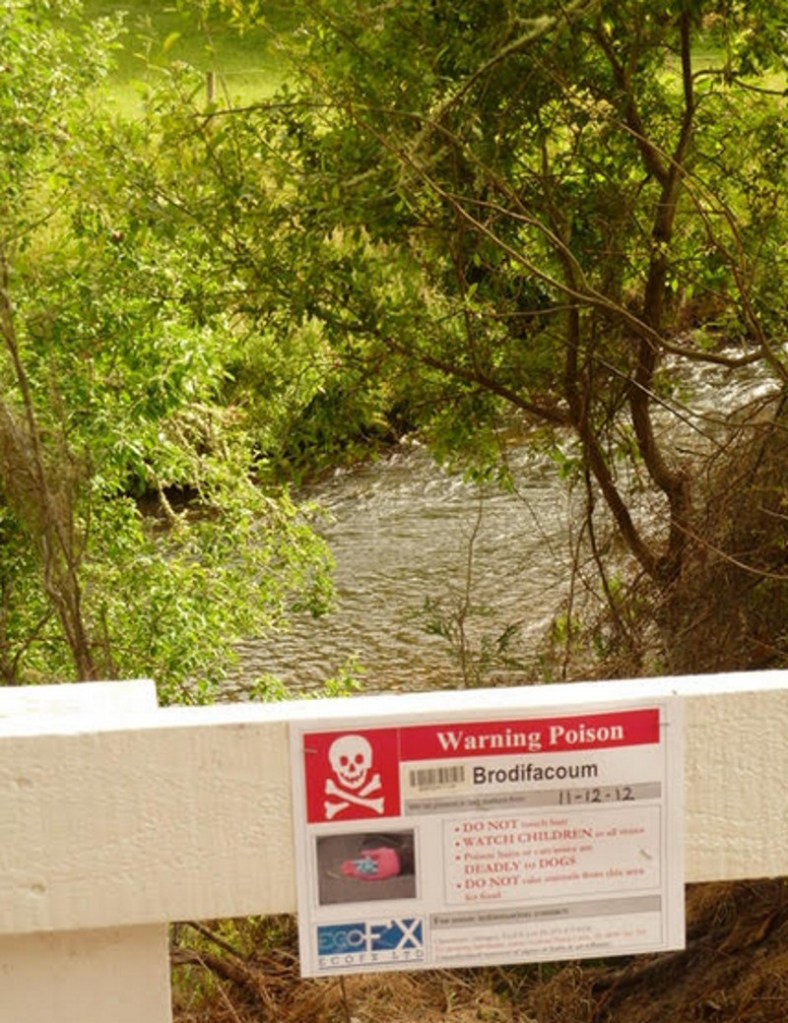
Brodifacoum warning notices by a King Country trout stream – photo Tony Orman

What is brodifacoum?

Brodifacoum is an anticoagulant, which causes the animal to die slowly and painfully from internal bleeding. As cruel as death over two or three days is by 1080, by brodifacoum it is far more prolonged, in the case of rats within 4 to 8 days and larger animals such as possums, up to 21 days.

1080 requires a user to have a licence to use the toxin but no licence is needed for brodifacoum, for example rat poison sold over shop counters, to anyone, young or adult with no controls whatsoever.

Secondary Poisoning

Brodifacoum and 1080 have another similarity, called “secondary poisoning”. In other words a dead poisoned animal remains toxic and any bird or other creature scavenging the dead body, takes in poison and dies.

Scientists C.T. Eason and E.B. Spurr in 1995 in a study “The Toxicity and Sub-lethal Effects of Brodifacoum said insectivorous birds (e.g. bush robins, fantails) are likely to be exposed to brodifacoum by eating invertebrates that have fed on toxic baits; i.e., they are likely to be at risk from secondary poisoning. Predatory birds (especially the Australasian harrier, New Zealand falcon, and morepork) might also be at risk from secondary poisoning by eating birds, small mammals, or invertebrates that have fed on toxic baits.

Predators are greatly at risk. Both poisons are very slow to kill, and especially so with brodifacoum. An animal be mouse, bird or insect, on taking the poison, slowly dies and in its distressed, weakening state, naturally and quickly attracts the attention of predators among them native birds such as bush falcons, hawks, moreporks, pukekos and wekas.
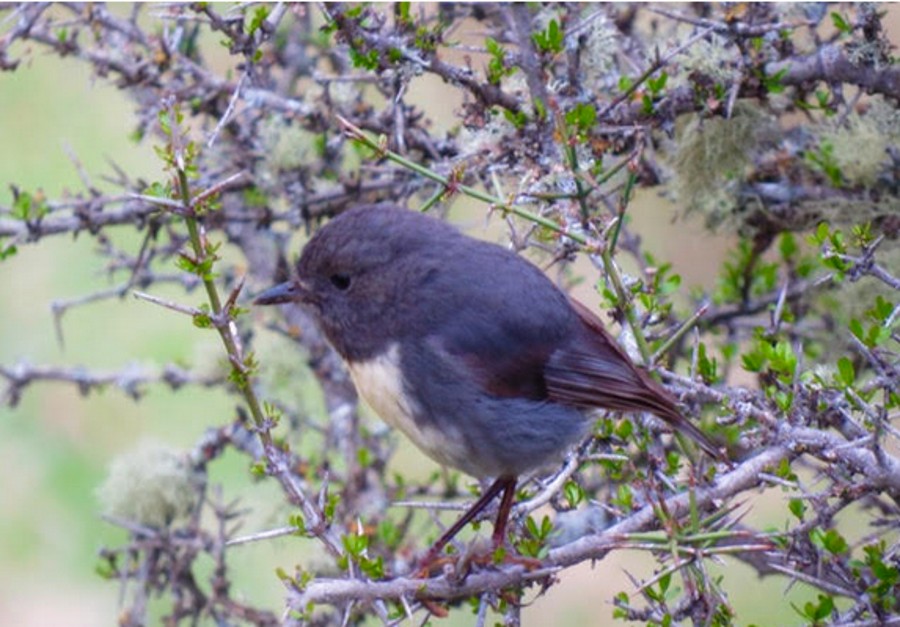
Bush robins are at risk from brodifacoum – photo Tony Orman

Ecological history is littered with instances following poisoning.  For example  scientists Eason and Spurr said the “entire weka population on Tawhitinui Island, Pelorus Sound, Marlborough Sounds was exterminated mainly by direct consumption of rat bait (Talon) intended for ship rat control.”

The two scientists said “indigenous New Zealand vertebrates most at risk from feeding directly on cereal-based baits containing brodifacoum are those species that are naturally inquisitive and have an omnivorous diet (birds such as weka, kaka, kea, and robins). The greatest risk of secondary poisoning is to predatory and scavenging birds (especially the Australasian harrier, New Zealand falcon, southern black-backed gull, morepork, and weka)”

The duo added “the risk from brodifacoum will be at its greatest when saturation baiting techniques, such as aerial sowing, are used in eradication programmes.” Such as Ulva Island where DoC is “aerially sowing” brodifacoum.

Seven years later in 2002, Spurr and Eason along with two other scientists produced a study “Assessment of risks of brodifacoum to non-target birds and mammals in New Zealand”.

The quartet of scientists described brodifacoum as “highly toxic to birds and mammals” and listed victims such as the Australasian harrier (Circus approximans) and morepork (Ninox novaeseelandiae), other native birds such as the pukeko (Porphyrio melanomas), weka (Gallirallus australis), southern black-backed gull (Larus dominicanus), and kiwi (Apteryx spp.) and introduced mammals, including game animals e.g. deer.

Dead Dotterels

Other studies have identified the lethal nature of brodifacoum.

Landcare Research scientist Penny Fisher said “because brodifacoum persists in the environment, other birds may suffer secondary poisoning from eating animals that have ingested poison” and cited “a high mortality of New Zealand dotterels following an aerial brodifacoum operation at Tawharanui Regional Park in North Auckland, in 2004. At least 50% of the dotterels in the area at time of operation disappeared or were found dead. Sand-hoppers-common food item of NZ dotterels —ate baits and accumulated brodifacoum and provided a potential route for transmission of the toxin to dotterels.”

Two dead eels found in a Southland waterway had brodifacoum in the gut contents of one and that “suggests the eel had recently ingested food containing brodifacoum, probably through scavenging the carcass of a poisoned possum.”

Freshwater Residues

Brodifacoum similar to 1080, leaves residues.

In 2005 a paper in the New Zealand Journal of Marine and Freshwater Research, Volume 39, told of freshwater crayfish (koura) with significant 1080 concentrations and 1080 residues in eel tissue that were on average 12 times higher than the PMAV (provisional maximum acceptable level).

The INTERNATIONAL PROGRAMME ON CHEMICAL SAFETY Health and Safety Guide No. 93 said of brodifacoum “as a technical material — is highly toxic for fish”.

Processing poisons for wild animal control/eradication is Orillion a State Owned Enterprise governed through a Board of Directors appointed by the New Zealand Government. Orillion’s safety data sheet for brodifacoum says “may cause long lasting harmful effects to aquatic life.”

Therein lies a threat to not only valued sports fishes such as trout and juvenile salmon migrating downstream to sea, but also native fish such as eels and galaxids.

Sodium fluoroacetate, also known as compound 1080, is the poison around which controversy swirls. Brodifacoum is little known but is surreptitiously used by the Department of Conservation and councils.

1080 is ecologically destructive and damaging to the ecosystem – but brodifacoum is far worse.

Footnote: Environmentalist Tony Orman has spent a lifetime in the outdoors and has had some two dozen books published among them “New Zealand the Beautiful Wilderness”

Header Photo: Wikipedia – By Squidonius – Own work, CC BY-SA 3.0, https://commons.wikimedia.org/w/index.php?curid=17253187

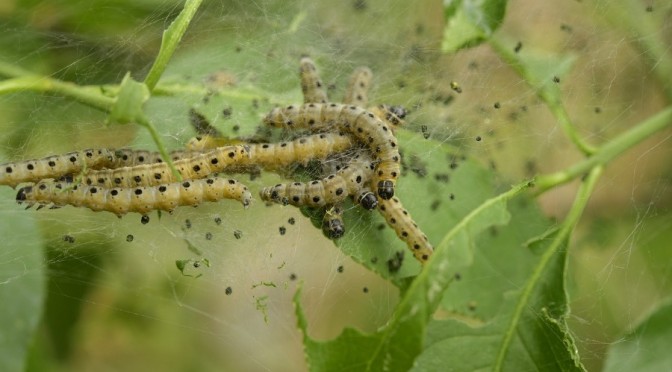
GRASS GRUBS: NOW IS THE TIME (Wally Richards)

I am often asked is it the best time to do certain things in the garden and more often than not when asked it is not the best time. Gardeners sometimes miss the boat and only later when the damage is done or the plants are out of season, that they look for the solution.

When I had a garden centre I would have newby gardeners coming in during the spring looking for daffodil bulbs/plants, cause they saw them flowering in people’s gardens.

This also applied to tulips and other spring flowering bulbs. Now is the time to buy your spring bulbs and plant them.

Lawn problems caused by grass grubs are noticed in the spring when patches of lawn die.

Treatment then is a total waste of time and money because the grubs are in most cases deep below the surface in cocoons waiting for the right conditions to emerge as beetles.

Any treatment applied in the spring may catch a small amount of grubs and not worth the expense.

What has happened is way back in October through to about December (maybe January) the grass grub beetles were on the wing chewing up the foliage of your plants in the evening and laying up to 300 eggs per female back into your lawn or gardens.

As these eggs are laid deep in the soil and when the grubs emerge they start eating the roots of the grasses (or some other plants) this is way down about 200 mm under the soil. The grubs are small and the damage done is not great.

The grubs grow and keep working their way upwards as the roots are eaten out at the lower depths.

If the soil becomes dry during a summer drought, the grubs go into a semi dormant state waiting for the moisture to return.

This normally happens with the autumn rains and the grubs wake up and start feeding again getting closer and closer to the soil surface.

Now if we cut a square in the lawn with a spade about 50mm deep we are likely to find a number of the white grubs in the area we have lifted.

These grubs curl up when disturbed. Any greasy looking caterpillars found are the porina.

If you lift turf in different areas of the lawn you can see where the worst problems are in other words where the most grass grubs are.

These are likely to be found in areas where there has been past problems or in areas near where lights shine at night, because the beetles are attracted to lights in the early evening when they are in flight.

You may find that in some areas in the turf you lift there are either no grubs or only say under 6 per square foot. In other areas you may find lots of grubs in a square foot. Its those areas you should concentrate your efforts as that is where damage will occur and be noticed.

There are currently two non chemical treatments available.

The liquid one is Wallys 3 in 1 for Lawns.

The product consists of Eucalyptus oil and Tea Tree oil along with natural plant foods in the form of manures and seaweed/fish extracts.

Available in 1 litres containers which cover 50 square metres of lawn or gardens.

Follow the instructions for mixing with water and it is best applied to the lawn in a device called a Lawnboy.

After application the lawn is further lightly watered with the hose or a sprinkler to wash the oils off the grass and down into the top 6 to 10cm of the lawn. It is there that it does its job.

Often lawns are the home of garden slugs which emerge out of the soil and thatch to invade our gardens during moist times. The product knocks them out also.

Worms will happily live underneath the oil layer in the top soil without any known adverse effects.

Worms that are near the surface when applied may not fair so well.

This means it is best to apply the product when the soil is moist but not after a good amount of rain which tends to bring worms to the surface.

I have found that these oils will control other soil insects such as eel worm, centipedes, root mealy bugs, porina etc.

Even the likes of earwigs and slaters can be given the old hurry on if they are causing problems.

The manufacturer informed me that the oils act as an irritant to the pests and they succumb as a result.

Imaginative gardeners may find this product an interesting tool in assisting in the control of some pests such as wire worm in the soil by treating the area a few weeks before planting (say) their new seasons potatoes.

The product is only recommended for lawn use and ideally should only be used for the control of pests in the lawn areas.

Used for any other purpose is not recommended but being two natural oils I cannot see any health concerns as you are not likely to spray over any food crops and eat them without first washing as normal.

Being a oil based product, it can of course burn foliage and grass if applied in sunlight.

For lawn applications it is recommended to use early in the morning or late afternoon and washing in with the hose, the oils off the foliage and into the soil.

Safe for your children and pets unlike the previous mention products.

The other natural product is Wallys Neem Tree Powder.

I suggest powder as it is less easy picked up when mowing the lawn.

Once again after you have done your spade tests on where the most grass grubs are then you really only need to treat those areas.

Spread the powder at 50 to 100 grams per square metre onto a recently mowed lawn and when the soil is moist.

Lightly water to settle the powder off the grasses and get it down to the soil surface.

If you have a roller or can hire one then roll the areas treated to press the powder into the soil.

It will breakdown and release the Neem properties which will be taken up by the roots of the grasses.

Thus when Mr Grass Grub takes a bite of the root he gets some Neem into his gut and it turns off his ability to eat any more. Thus he starves to death.

Most effective and safe for children, pets and soil life.

Now is the time to treat Grass Grubs

If your lawn problem just involves porina caterpillars then the most effective and less expensive treatment is applications of Wallys Super Neem Tree Oil applied late in the day on a freshly mowed lawn.

You should use a lawnboy to drench the grasses at the rate of 5 mls of Wallys Super Neem Oil per Litre of water or a boom spray nozzle on your back pack sprayer.

You are looking to get a coating of the Neem Oil to the base of the grasses where the porina is going to feed that night. Once they get some Neem in their gut they will stop eating and starve to death.

Treatment for porina can be done anytime of the year as they are a all year round pest.

FOOT NOTE:

Each week along with the gardening article I am going to make a product on a special price for you, for one week only.

The special will end the following Sunday when I dispatch the new article.

This week it will be  Wallys Neem Tree Powder 1kilo Normally $15.00 this week only $10.00

Also Wallys Neem Tree Powder 3 kilo bag Normally $28.00 This week only $20.00

Order on the Mail Order Web site at www.0800466464.co.nz  (any problems registering then phone me)

In the comment place please put the words NEEM SPECIAL so I know to deduct the special off you order before I phone you to arrange payment and any freight costs.

Remember Freight is free  in North Island for Orders of $100 or more (excluding bulk items) South Island it is orders of $150.00 or more for free shipping. (excluding bulk items)


Phone 0800 466464
Garden Pages and News at www.gardenews.co.nz
Shar Pei pages at  www.sharpei.co.nz
Mail Order products at www.0800466464.co.nz


New Zealand Bill of Rights Act 1990. Part II of the Act covers a broad range of Civil and Political Rights. As part of the right to life and the security of the person, the Act guarantees everyone:

1The right not to be deprived of life except in accordance with fundamental justice (Section 8)

2The right not to be subjected to torture or to cruel, degrading, or disproportionately severe treatment or punishment (Section 9)

3The right not to be subjected to medical or scientific experimentation without consent (Section 10)

4The right to refuse to undergo any medical treatment (Section 11)

 Furthermore, the New Zealand Bill of Rights Act 1990 guarantees everyone: Freedom of Thought, Conscience, and Religion.
This includes the right to freedom of thought, conscience, religion, and belief,
INCLUDING THE RIGHT TO ADOPT AND HOLD OPINIONS WITHOUT INTERFERENCE (Section 1)

HOUSEHOLD ITEMS THAT ARE USEFUL IN THE GARDEN (Wally Richards)

There are a number of items that can be used in your garden to the benefit of plants.

For instance a year ago I wrote the article about using Apple Cider Vinegar on fruit trees to increase their performance and to reduce disease problems.

The formula is 250mil Apple Cider Vinegar (ACV) mixed with 5 litres water in a 5 litre sprayer.

Spray the mix in the evening when the sun has just gone off your trees or plants, so the sun isn’t heating/burning leaves through the liquid spray droplets on them, and there’s time for the spray to dry before nightfall..

Spray the whole tree, vine or plant.. under and over leaves, the trunk, branches, twigs, fruit everything..

This will also feed the tree through the leaves (when they are there for deciduous trees) as a foliage food.

Baking Soda applied at a tablespoon per litre of water with Raingard added is good to prevent some fungus diseases such as black spot. (Don’t use on calcium sensitive plants)

Baking Soda can be sprayed over the foliage of oxalis to dehydrate the leaves. Oxalis to sensitive to calcium.

It does not affect the bulbs below but regular spraying of baking soda will keep the garden free of the oxalis foliage without affecting other plants.

To deal to the bulbs in the soil, mix Wallys Super Compost Accelerator at 200 grams per litre of water and water liberally over the foliage down into the soil to compost the bulb and bulblets.

Then there is table salt which can be sprinkled on weeds to kill them which is ideal on pavers and where you dont have other plants growing.

Cooking oils and vinegar can also be sprayed onto weeds in full sun light to dehydrate the foliage and kill annual weeds.

Condys Crystals, (potassium permanganate) a quarter tea spoon per litre of water with or without Raingard to control leaf diseases such as black spot, rust and curly leaf.

Sunlight Bar Soap (big yellow bar) lathered up in water to spray over aphids and soft body insects to kill them. (The fatty acids breaks down their soft bodies)

Dish washing liquid lathered up in warm water to break surface tension to allow water to penetrate.

Aspirin: in plants, just like in mammals, salicylic acid helps them cope with stress and disease. By adding Aspirin to the water, gardeners are hoping to help their plants cope with problems and grow faster and stronger.

The acid is effective on plants because many plants produce it themselves in tiny amounts. Plants produce this acid when stressed or fighting disease. Feeding them a greater supply of the acid proves beneficial. Giving the plant too much aspirin can have a negative effect as it can burn its leaves.

Dissolve 250mg to 500mg of aspirin in 4.5 liters of non chlorinated water and spray plants two to three times per month.

Similarly soak the leaves of willow trees in water for a week or more and use that as a spray as you would the aspirin. Willow water is ideal also for putting cuttings in to help them form roots quicker.

All great uses and here is the most interesting one of all:

Hydrogen peroxide 3%.

I read about this some years ago and it was again brought to my attention recently.

Hydrogen peroxide, well known as an ingredient in disinfectant products, is now also approved for controlling microbial pests on crops growing indoors and outdoors, and on certain crops after harvest.

This active ingredient prevents and controls bacteria and fungi that cause serious plant diseases.

Adding hydrogen peroxide to water promotes better growth in plants and boosts roots ability to absorb nutrients from the soil.

Diluted 3% peroxide adds needed aeration to the soil of plants and helps control fungus in the soil.

It acts as an insect pest deterrent and kills their eggs.

Ideal on brassica leaves for white butterfly eggs this time of the year.

I used 3% Hydrogen peroxide with Magic Botanic Liquid added on tomato and chili plants in my glasshouse and there was reduced actively within a couple of days.

A spray every 2-3 days is ideal for control or once a week or 2 weekly as a preventive.

I see on the Internet that the 3% should be further reduced with water such as 1:1 so if using 3% strength it would pay to do a test spray on a small area of foliage on each type of plant and see if there was any adverse reactions before using at 3% over whole crop or plant.

Ideal this time of the year to reduce pest number going into the winter.

I see the best use is in glasshouses where the product does not get washed away with rain.

Use out doors over and under foliage and you may need to reapply after rain.

Happy Gardening.

For your information I have the 3% hydrogen peroxide available to order thought our mail order web site at www.0800466464.co.nz

It is in the Pest Control section. (Listing will be on the web site with pictures later on today (Sunday 19th April.)

We have a one litre Trigger Spray Bottle Ready to Use with 3% Hydrogen Peroxide and Magic Botanic Liquid spray for $12.50

A one litre refill for the above for $8.00

and a 5 litre ready to use for $40.00

Of course you being subscribed to these Newsletters have a 10% discount off the above as with most of our gardening products.

If you have not used the Mail Order web site previously please tell me when I phone you to sort out payment method and freight that you have 10% off

Regards
Wally

Phone 0800 466464
Garden Pages and News at www.gardenews.co.nz
Shar Pei pages at  www.sharpei.co.nz
Mail Order products at www.0800466464.co.nz


New Zealand Bill of Rights Act 1990. Part II of the Act covers a broad range of Civil and Political Rights. As part of the right to life and the security of the person, the Act guarantees everyone:

1The right not to be deprived of life except in accordance with fundamental justice (Section 8)

2The right not to be subjected to torture or to cruel, degrading, or disproportionately severe treatment or punishment (Section 9)

3The right not to be subjected to medical or scientific experimentation without consent (Section 10)

4The right to refuse to undergo any medical treatment (Section 11)

 Furthermore, the New Zealand Bill of Rights Act 1990 guarantees everyone: Freedom of Thought, Conscience, and Religion.
This includes the right to freedom of thought, conscience, religion, and belief,
INCLUDING THE RIGHT TO ADOPT AND HOLD OPINIONS WITHOUT INTERFERENCE (Section 1)

Image by Maya A. P from Pixabay

Dealing with pests in your lawn (Wally Richards)

There are three insect pests that are the main problem ones in lawns; grass grubs, porina and black beetle grubs.

The affect they have on your lawns depends on the number of the pests in a given area.

A few, will hardly be noticed, where a good number per square foot will damage the grasses and be easy to see. Damage can be seen by bare spots, brown, dead areas or discolored grasses.

Birds are a very good indicator that there are grubs in the lawn when they spend their time scratching and pecking in certain areas.

I have gardeners ringing me up about this time of the year to say they have grass grubs in their lawns or that they have dead spots.

My first question is, how do you know you have grass grubs?

They usually reply that there is dead areas or that birds are ripping certain areas apart.

Nether of these are a good indication that there are currently grass grubs actively eating roots near the surface.

If there are dead areas which have appeared in the spring or early summer then it is likely that grass grubs did cause the problem by eating the roots of the grasses in the autumn and into the winter.

The grasses would have appeared ok in the winter, even though they had little root system left, because they were not actively growing.

In the spring when they started to grow on the root system left, which was insufficient to support the grass, thus it browns off and dies.

In the meantime the grubs have burrowed deep into the soil to pupate and then emerge about October to December as beetles.

There may well be a few grass grubs in the lawn at this time and by lifting some turf you can soon find out and how many there are per square foot.

If there are a few like 1 to 5 then its hardly worth while bothering with a treatment, a greater number would be worth while to treat.

Most likely the reason the birds are working the lawn is for porina caterpillars which live in the soil. Porina come up in the early part of the evening to feed at the base of the grasses.

These are easy to control by firstly mowing the lawn to allow the spray you are going to use, to reach the base of the grasses where they feed.

Then in late afternoon mix Neem Tree Oil at the rate of 5mils per litre of warm water and apply that to your lawn area. Using a lawn boy will do the best job to get a good coverage.

(Note EPA has just about completed our application under the new requirements for all Neem Oils and we should be back selling later this month.)

That night when the grubs come up to feed they will get a dose of Neem and that turns off their ability to ever eat again.

If the birds eat them they will not be affected and worms in the soil will be ok too.

The time to treat for grass grubs in the lawns is in the autumn when the soil is moist and they are feeding near the surface. The other time is when they are beetles which is about now.

With porina they can be treated all year round whenever they are present.

Treatment for grass grubs and black beetle grubs can either be a strong chemical one or a safe natural one such as Wallys 3 in 1 for lawns which is a mix of Eucalyptus and Tea Tree oils.

This will not harm wild life, pets or worms, where the chemical ones will.

To treat the grass grub beetles you can use the method described in my first book, Wally’s Down to Earth Gardening Guide, extract;

Grass grub adults emerge in October, (as beetles) and are active until about mid-December, depending on weather conditions and exactly where they are in New Zealand.

The cooler the temperature, the later they emerge. The adults will start to emerge in mild conditions, when the soil temperature reaches about 10 degrees, they then mate, fly, eat and lay eggs in the short space of time between dusk and early evening.

As they tend to fly towards light, you are most likely to know they’re there when the flying beetles hit your lighted window panes.

This very attraction for the light has become one of our best weapons in controlling the pest in its adult stage.

You can set up a grass grub beetle trap by placing a trough, such as the one used when wall-papering, directly underneath a window near a grassed area.

Fill the trough with water to about two-thirds of its capacity, then place a film of kerosene on top of the water.

Put a bright light in the window, the beetles fly towards the lit window, hit the glass and fall into the trough. The kerosene acts as a trap, preventing the fallen beetles from climbing out.

You can extend this method to areas away from the house by using a glass tank, such as might be used for an aquarium.

Place the empty tank into a tray containing several inches of water (and the kerosene), and position a light inside the glass tank.

By adding a sheet of ply or something similar over the top of the tank, you will ensure that the light shines only through the sides of the tank above the waiting water and kerosene.

It is better to use a dome-shaped battery-powered light rather than an ordinary torch for this job as the bigger light makes the trap more effective.

If the tray and tank are raised off the ground and placed on something like a table, you will get an even better result.

However you set up your beetle trap, this is a very good method to dispose of the pests.

Simply get rid of all the beetles caught the next morning by flushing down the toilet or feeding to chooks.. Run this system (call it Wally’s Grass Grub Beetle Catcher, if you like) from just before dusk to about 2 or 3 hours after sunset.

We know now how to make the grubs’ preference for light work against them, but light can also work in their favour.

If you have un-curtained windows in rooms which are lit at night, you will find grass grub beetles from yours and neighboring lawns will be attracted to the area during the early hours of the evening.

Street lighting is probably the worst offender, and people with areas of lawn near street lights often find those are the parts worst-affected by grass grubs.

The beetles will eat the foliage of various plants such as roses, beans and citrus while on the wing.

Those plants that are being eaten can be sprayed with Neem Tree Oil.

If the populations of beetles are very high then in the early part of the evening take a torch and check the plants that are being eaten.

If you see lots of the brown beetles then mix up a spray of  Wallys Super Pyrethrum added and go out and spray the pests.

The pyrethrum is a quick knock down and should wipe out good numbers of them.

The more beetles you can kill means less damage to your lawns next year.

Phone 0800 466464
Garden Pages and News at www.gardenews.co.nz
Shar Pei pages at  www.sharpei.co.nz
Mail Order products at www.0800466464.co.nz


New Zealand Bill of Rights Act 1990. Part II of the Act covers a broad range of Civil and Political Rights. As part of the right to life and the security of the person, the Act guarantees everyone:

The right not to be deprived of life except in accordance with fundamental justice (Section 8)

2The right not to be subjected to torture or to cruel, degrading, or disproportionately severe treatment or punishment (Section 9)

3The right not to be subjected to medical or scientific experimentation without consent (Section 10)

4The right to refuse to undergo any medical treatment (Section 11)

 Furthermore, the New Zealand Bill of Rights Act 1990 guarantees everyone: Freedom of Thought, Conscience, and Religion.
This includes the right to freedom of thought, conscience, religion, and belief,
INCLUDING THE RIGHT TO ADOPT AND HOLD OPINIONS WITHOUT INTERFERENCE (Section 1)

Image by JayMantri from Pixabay

Psyllids in your garden and how to deal with them (Wally Richards)

Psyllidae, called the jumping plant lice or psyllids. (Note much of the following is from Internet research)

They are a family of small plant-feeding insects that tend to be very host-specific, each plant-louse species only feeds on one plant species or feeds on a few closely related plants.

Of current concern to tomato, potato, tamarillo, capsicum and chili gardeners is the new psyllid commonly known as the tomato/potato psyllid.

This psyllid comes from Central and North America where it breeds primarily on potatoes, tomatoes and other plants in the potato family, Solanaceace.

It also breeds on kumara, which is in the bindweed family, Convolvulaceae.

It was first found in New Zealand in 2006 and has spread throughout New Zealand.

This psyllid may transmit a bacterium, Candidatus Liberibacter solanacearum that causes a disease in its host plants.

The tomato potato psyllid occurs on its host plants in gardens, and crops in greenhouses and on farms.

The tomato potato psyllid breeds all year, though the time from egg to adult (generation time) is longer in the winter when it is cold, than in the summer or in a heated greenhouse.

Adult tomato potato psyllids are small insects similar in size to aphids. They have wings and look like small cicadas with a distinctive white band on the abdomen. The two pairs of transparent wings are held over their abdomen.

Tomato potato psyllid eggs are yellow and attached to leaves by a thin short stalk. The eggs may be laid on all parts of the leaf and plant stem, but are often found on the leaf edge where they are most easily seen.

Nymphs hatch from the eggs. They are flat and scale like, and have three pairs of legs and sucking mouthparts.

They settle on young leaves, mainly on the underside. Although they can walk, they spend much of their time motionless with their stylets inserted into the plant feeding on the plant sap.

There are five nymphal stages, each is called an instar. buds. Adults emerge from fifth instar nymphs.

The length of time needed for nymphal development depends on the temperature and is shorter when it is hotter.

The tomato potato psyllid inserts its maxillary stylets into the phloem, (the plant vessels for transmitting sap from the leaves to other parts of the plant.)

The sap has a high volume of water and sugars, more than the insect needs.

It excretes the excess water and sugar, which is called honeydew. The tomato potato psyllid coats the droplet of honeydew with white wax before ejecting it.

Leaves can become covered with these white wax coated droplets that are called psyllid sugars.

Like some other Hemiptera (sucking bugs), the tomato potato psyllid can transmit plant pathogens to plants.

Tomato potato psyllid is the primary vector (transmitter) of a bacterium, Candidatus Liberibacter solanacearum, which causes a disease that may weaken plants and reduce yields and quality of crops.

Plants infested with the psyllid may exhibit symptoms of a disease, psyllid yellows.

The disease symptoms initially appear in response to psyllid feeding and is presumably a physiological reaction to feeding and saliva secretions by the tomato potato psyllid.

On tomatoes, the disease symptoms are the yellowing and stunting of the growing tip and a cupping or curling of the leaves.

Many flowers may fall off the trusses of infected plants and fruit that develop may be small and misshapen.

On potatoes, the foliar symptoms are a stunting and yellowing of the growing tip and the edges of the curled leaves often have a pink blush or purple colour.

After a while infected potatoes develop a scorched appearance and plants may collapse prematurely.

Potato plants that are infected at an early stage, develop numerous small tubers. Tuber quality is also affected when the plants are infected at a later stage.

The disease is referred to as zebra chip because when the affected potatoes are fried they exhibit dark stripes where the areas high in sugar burn.

In New Zealand, the bacterial disease is usually less of a problem on outdoor capsicums, chilli and egg-plant.

Tomato potato psyllid breeds all year, especially in the warmer parts of the country and in greenhouses. In these situations, all life stages may be found all year round. In other areas, non-breeding adults may be found on plants.

Adults feed on leaves and can mate more than once. A female can lay up to 500 eggs over a 21-day period, but in the field it is more likely to be around 200 eggs.

The number of eggs laid also depends upon the host plant. The rate of development of nymphs is dependent on temperature.

The psyllid develops between 15°C and 32°C with optimum development at 27°C.

In a greenhouse with an average temperature of 18°C psyllids takes 33 days to complete their life cycle.

In New Zealand there are to 7-8 generations per year in the Auckland region.

In New Zealand’s winter, the numbers of psyllids are low and development is very slow.

Adults and nymphs can survive short periods of sub-zero temperatures. In New Zealand’s spring numbers on infested plants will begin to build up and reach a peak in late summer/early autumn.

Adult psyllids have wings and in North America can spread long distance by air. In New Zealand, dispersal tends to be more limited, 100 m or more in three days. They will invade new areas and plants, especially in summer.

From my experience its a temperature to numbers game, when given the ideal temperatures.

One adult laying 500 eggs can mean in about a month you have a population of 250,000 adults

Initially sprays will help control but as numbers rapidly increase you would need to spray every day and still lose the battle.

That was the point I reached about 3 years ago and watched my tomato plants and tamarillos die in front of my eyes.

The following season I treated my tomatoes and other host plants with silicon drench and sprays and in one season completely wiped out the psyllids from my glasshouse and gardens.

The silicon treatment which I call the ‘Cell Strengthening Kit’ makes the plant’s cells too tough for the psyllid nymphs to piece and feed and they soon starve to death after hatching.

This breaks the life cycle and there are no new adults to replace the old ones when they die.

Information on the kit is available on our mail order web site at www.0800466464.co.nz

More info on the pest at http://www.gardenews.co.nz/product.html#The%20Potato%20and%20Tomato%20Psyllid%20control%20with%20Cell%20Strengthen%20sprays%20and%20drench

With our Silcon products you can once again grow tomatoes, potatoes and other affected plants.

or phone me for more information.

Phone 0800 466464
Garden Pages and News at www.gardenews.co.nz
Shar Pei pages at  www.sharpei.co.nz
Mail Order products at www.0800466464.co.nz


New Zealand Bill of Rights Act 1990. Part II of the Act covers a broad range of Civil and Political Rights. As part of the right to life and the security of the person, the Act guarantees everyone:

1The right not to be deprived of life except in accordance with fundamental justice (Section 8)

2The right not to be subjected to torture or to cruel, degrading, or disproportionately severe treatment or punishment (Section 9)

3The right not to be subjected to medical or scientific experimentation without consent (Section 10)

4The right to refuse to undergo any medical treatment (Section 11)

 Furthermore, the New Zealand Bill of Rights Act 1990 guarantees everyone: Freedom of Thought, Conscience, and Religion.
This includes the right to freedom of thought, conscience, religion, and belief,
INCLUDING THE RIGHT TO ADOPT AND HOLD OPINIONS WITHOUT INTERFERENCE (Section 1)

Photo: pixabay.com


Using Neem in your garden & elsewhere (Wally Richards)

Azadirachta indica, commonly known as Neem, nimtree or Indian lilac, is a tree in the mahogany family Meliaceae.

It is one of two species in the genus Azadirachta, and is native to the Indian subcontinent and most of the countries in Africa. It is typically grown in tropical and semi-tropical regions.

Each year the tree flowers and produces fruit or kernels which are the seeds of the tree.

These are harvested and cold pressed to extract the Neem Oil which is used for many things including as an insecticide and for medical uses.

If the kernels are press only once then the Neem Cake will be dark in colour and have a good Neem smell.

If they are cold pressed more than once to extract more oil then they will be light brown in colour and not have much smell which means they will not any where near effective as the dark Neem Granules/Powder;.

The crushed residue is called Neem Cake in India which my company Garden Enterprises import in container loads into NZ for gardeners to use.

Before it is shipped the Neem cake is dried then screened to obtain to particle sizes which we call Wallys Neem Tree Powder being uniform particles 1-3mm in size.

Then there are the larger particles we call Wallys Neem Tree Granules which vary from 1mm to about 50mm in size.

Both are the same thing it is just the size of the particles that determine what we call them.

Likewise either can be used to do most gardening tasks that Neem Cake can be used for but each has its special tasks for applications.

Firstly lets talk about Neem Tree Powder, lovely to work with, easy to handle and far better to use for some applications than the Neem Tree Granules.

For instance when planting seeds or seedlings a little of the powder can be sprinkled with the seeds or put into a seedling’s planting hole.

It is a must to prevent carrot fly damage; you sprinkle the powder along the furrow with the seeds at sowing time.

Later when the carrots have germinated and have tops of foliage about 3-4cm tall you then side dress the row with the powder.

By doing this most gardeners have found little or no damage to the carrots at harvest time.

The Neem Tree Powder is ideal for treating grass grubs in lawns if used when the grubs are near the soil surface. For most that would be in the autumn after the autumn rains have moistened up the soil.

By cutting out squares of turf and examining the clods will let you see if there are grubs near the surface, if so then treat those areas where there are several grubs per square foot.

Sprinkle the Neem Tree Powder over a freshly mowed lawn and water in to settle the powder onto the soil.

If you have a roller then roll to press the powder into the moist soil.

If not then either lift the height of your rotary mower by a notch or two before you mow again or leave the catcher off so that powder picked up while mowing will be put back onto the lawn. Only applicable for two or three mowings after application of the Neem Powder.

Where you apply the powder on the lawn you may notice after a couple of weeks that those areas are looking better than where it was not used.

This is a good indication that you have root nematodes in the roots of your grasses and they are sucking the vigor out of your lawn. So if this is the case then you know to treat the rest of your lawn.

Neem Tree Powder is also ideal to place a small sprinkling on top of the growing medium of your container plants to eradicate root mealy bugs in the roots. Out side containers it does not matter so much as the powder will get molds when it breaks down which is normal; but indoors it will look unsightly so cover the powder with a little more growing medium.

Wallys Neem Tree Granules being bigger in size means they will last much longer slowly breaking down.

This makes them great to use on the soil of more established plants such as trees, shrubs and roses.

I have had a few gardeners tell me they used them in the root zone of their roses and significantly reduced problems of pests and diseases.

We have found them magic placed on the soil under citrus trees from the trunk to the drip line..

Within a period of about 6-8 weeks all insect pests on or in the tree are gone including whitefly, scale borer and mealy bugs.

At the beginning of the season when you plant up your glasshouse with tomatoes and other plants put some Neem Tree Powder in the planting holes and Neem Tree Granules on top of the growing medium (soil or containers) Many reports have said that in its self has solved most of their problems with whitefly in the glasshouse.

The reason I believe is that the smell of the granules disguises the smell of the plants and hence insects pests flying by don’t know that there are host plants nearby.

Disguising the smell of plants so that insects do not know that they are there is a great easy control.

It is the first line of defense against codlin and guava moth damage. You hide the tree when its fruiting.

The time to use the granules is after the fruit has formed on the tree and is about halfway to maturity.

Sprinkle the Neem Tree Granules under the tree from trunk to drip line.

Next make up some small bags using old curtain netting which you will place some granules in and the hang in the tree about your height. Hang around the tree 4 to 6 bags.

When the moths are flying at night looking for where to lay their eggs from the smell of the fruit they will fly on by as can not smell the fruit because of the Neem Granule’s smell that overrides the fruit smell.

Simple and very effective in greatly reducing the damage to your crop.

In regards to using Neem Tree Granules on the soil under plants you are likely to find they work better on some types if plants than on others.

I found on brassica such as cabbage that powder in the planting hole and granules on the soil meant that caterpillars never got established or caused much damage.

A few months ago a lady gardener from India told me that she soaks Neem Tree Granules in a bucket of water (about a cup full) for a couple of weeks stirring occasionally.

Then she takes the water and sprays or pours over her roses late in the afternoon.

According to her it keeps the pests and diseases under control.

Wallys Neem Tree Powder and Granules are great gardening aids and available in sizes in 1 kilo, 3 kilo and 20 kilo bags.

Problems ring me at 0800 466464
Email wallyjr@gardenews.co.nz
Web site www.gardenews.co.nz

Phone 0800 466464
Garden Pages and News at www.gardenews.co.nz
Shar Pei pages at  www.sharpei.co.nz
Mail Order products at www.0800466464.co.nz

New Zealand Bill of Rights Act 1990. Part II of the Act covers a broad range of Civil and Political Rights. As part of the right to life and the security of the person, the Act guarantees everyone:

1The right not to be deprived of life except in accordance with fundamental justice (Section 8)

2The right not to be subjected to torture or to cruel, degrading, or disproportionately severe treatment or punishment (Section 9)

3The right not to be subjected to medical or scientific experimentation without consent (Section 10)

4The right to refuse to undergo any medical treatment (Section 11)

 Furthermore, the New Zealand Bill of Rights Act 1990 guarantees everyone: Freedom of Thought, Conscience, and Religion.
This includes the right to freedom of thought, conscience, religion, and belief,
INCLUDING THE RIGHT TO ADOPT AND HOLD OPINIONS WITHOUT INTERFERENCE (Section 1)

Image by Alexei from Pixabay

DEALING WITH CURLY LEAF DISEASE IN STONE FRUIT (Wally Richards)

All too often I am asked questions about problems that have already occurred and its to late to prevent them. Its like the old saying, closing the gate after the horse has gone.

Unless you are onto it, you will miss the vital times when your efforts will be worthwhile and make a difference for that season.

We are now into July; the middle of winter and if patterns follow the past few seasons we are likely to see some good weather in August which will mean, (with the extending day light hours) things will start moving.

The following are situations for gardeners that have these problems from the past. Here is what I believe to be the best ways to handle them.

If you read my recent articles about making the soil healthy then apply that also to the following problems because healthy soil will make for healthy plants given time and in most cases.

Plants and trees etc that do not healthy and have a weak constitution, likely through breeding, should after a few seasons of effort be disposed of and replaced with another specimen that can be healthy.

Curly leaf is a disease on stone fruit trees which effects nectarines and peaches.

The spores from the previous season are sitting waiting for the leaves to form and the right conditions to infect. The damage from last spring will lead to even more damage this spring unless you intervene.

If the damage is severe enough, not only will you not have any crop but you can also lose the tree.

I have had a few interesting talks with gardeners that have grown stone fruit directly from stones.

These trees grow on their own root stock, fruit within a couple of years or so and do not have curly leaf disease.

This means that it is the grafted varieties of stone fruit that we have problems with and the very worst ones are those dwarf specimens for curly leaf.

So what to do:

The trees and the ground under them should be sprayed with potassium permanganate at half a teaspoon per litre of water now. Add about a level tablespoon of Ocean Solids to the spray as it increases the effectiveness.

Leave for about two weeks and spray again with potassium permanganate at ¾ a teaspoon into a litre of water with 3 tablespoons of Ocean Solids, dissolved and then added to a further 10 litres of water.

Spray the whole tree and drench the soil underneath from trunk to beyond the drip line.

What we are trying to do here is kill as many spores of the disease as possible that are on the tree and in the soil under the tree.

Some years ago I suggested scattering Ocean Solids under the trees before they start to move in the spring, the information on this came from Sea90 for those familiar with that method.

I have heard some positive feed back from gardeners that have done this and they also said that if any damage starts to appear on the foliage they spread some more Ocean Solids.

Likely the sodium chloride neutralizes the spores as well as increasing the mineral uptake of the tree.

The traditional method of control is to spray the tree, once the leaves start to appear, this is done every 7 to 10 days with Wallys Liquid Copper and Raingard.

The idea here is to keep a film of copper over the leaves as they are growing to kill the spores when they land on the leaves.

‘This spray program is repeated for about 2 months. The Raingard is very important because without it the copper would wash off in rain and that is when the disease spores strike.

I have also suggested the use of Vaporgard to be sprayed over and under the foliage once a good amount of leaves have appeared without damage.

The film is also a barrier to the spores and will assist the tree to produce more energy from sunlight helping to retain a good crop of fruit.

Growing your own fruit and vegetables naturally is the answer to better health.

Codlin moth another annoying pest that spoils apples, walnuts and sometimes pears.

At this time the codlin are in cocoons, pupating waiting for the right time to emerge to mate, lay their eggs and damage your apples.

Where they are hiding is in nooks and crannies on the tree, but mainly in the soil under the tree.

What you could do at this time if you had a few chickens is netting off the area under the tree, rake the soil and put your hens in there to gobble up any cocoons they scratch out.

Next at end of July sprinkle Wally Neem Tree Granules under the tree from trunk to drip line.

What this does is create a smell from the granules breaking down that prevents the moths when they emerge to detect the apple tree above them.

They sit there waiting for the tree to come along and hopefully will be eaten by birds.

The pests are not going to emerge till the apples have set on the tree after flowering and the weather conditions are congenial.

Once the flowering has finished you can put a can with treacle in an onion bag and hang it in the tree.

This will attract the male moths, by monitoring the trap you will know when they are on the wing.

Then you can start spraying with Wallys Neem Tree Oil and Raingard every 10 to 14 days.

You dont need to spray the tree just the apples so they have a coating of oil on them when the grubs take their first bite. Once activity stops in your trap you can stop spraying.

Another alternative I discovered last season was to use crop cover wrapped around the fruiting branches and pegged with clothes pegs.

It can be taped on at the beginning of a branch, one layer only which allows sufficient light to leaves and fruit and I found not only did it keep birds from pecking the fruit it also prevented any codlin moth damage.

Psyllids on potatoes, tomatoes, tamarillos and some other plants.

A real problem pest which ideally with potatoes you plant the seed potatoes as soon as possible, protect them from frost by mounding up over foliage then once this has become impractical then use crop cover over hoops to give frost protection.

Harvest the crop about Labour Weekend or as soon as mature.

In early and out as soon as mature is easy solution. If you want a late planting use the special Quarantine cloth over the crop to prevent the psyllids getting in.

Otherwise use the cell strengthening kit which toughens the foliage so that the nymphs cannot feed.

Tomato plants are ruined by the psyllids much to the dismay of gardeners.

The idea is; to strengthen the plant’s cells so that the weak piercing-sucking mouth parts of the psyllids have difficulties piercing the strong cells of the plant and therefore cant feed and die.

REMINDER  EARLY BIRD SPRING PROMOTION COMING TO AN END

For our Early Bird Promotion till the end of July (July 31st cut off) the following applies. Neem Powder Neem Granules all sizes, 1kg, 3kg 10 kg and 20 kg 20% off the mail order web site price.

All other gardening products 15% off the marked prices but excluding bulk items such as 12.5 kilos Fruit & Flower etc.

Shipping if after discounts and excluding bulk items the order is $150 plus North Island or $200 plus South Island Free shipping for those orders.

Under those order sizes shipping at cost to you.

Often the discounts given means that you can get free shipping as the discount covers the shipping costs.

Orders must be placed on line at www.0800466464.co.nz

You cant pay on the web site and we phone you after receiving the order to give you your discounts.

Please put in the remarks place ‘Early Bird’ so I know to sort out the discounts before I phone you.

We can then take credit card details over the phone safely or email you details to do a bank transfer.

Regards

Wally Richards

Phone 0800 466464

Problems ring me at 0800 466464
Email wallyjr@gardenews.co.nz
Web site www.gardenews.co.nz

Phone 0800 466464
Garden Pages and News at www.gardenews.co.nz
Shar Pei pages at  www.sharpei.co.nz
Mail Order products at www.0800466464.co.nz

Photo: pixabay.com

Growing potatoes (Wally Richards)

Once upon a time when the world was a much better place and people could afford to buy a quarter acre of land and build a house for their family to grow up in and enjoy the benefits of those days 50 to 100 years ago.

(You only have to think back to see how bad things have become in more recent years. )

Well the first thing that a young married man would do with the land would be to plant a crop of potatoes.

This served two purposes it would help break up the earth for future gardens and lawns plus a bounty crop of potatoes to store and use.

Nowadays because of the dread potato psyllid you need to plan and plantings of potatoes and later on tomatoes or use controls to combat the psyllid.

If you had psyllids last season and did not use the Cell Strengthening products you will have worse problems this season.

With potatoes there is a way to get a early crop in and out before the plants are attacked.

Psyllids are temperature controlled and when too hot like over 35 degrees or too cool like under 15 degrees they are slow to reproduce.

When the temperatures are ideal for them they produce in the hundreds and thousands.

When they feed on the foliage they inject a toxin into the potato plants which will prevent the baby tubers from growing bigger than a marble,

or if the tubers have reached a reasonable size then you find in the harvested potatoes dark rings and they taste bad.

Early planting is a way around the problem and the way to do this is:

Dig a trench about one and a half spade depth.

Place your sprouted potato on top of the following at the base of the trench,  about a table spoon of gypsum, quarter a teaspoon of BioPhos a few sheep manure pellets and a sprinkling of Wally Neem Tree Powder.

Sprouts should facing skywards. Use  a little soil to cover the sprouts.

The soil protects against any frosts and possible early emergence of psyllids. 

Now this is most important you need to check frequently the crop and as soon as the new sprouts pop though the cover add a little more soil to re-cover.

You keep doing this till until your trench is filled level with the soil.

Then you start mounding up to keep the sprouts covered.Not only will this be adequate protection from late frosts but will increase the size of your crop.

The new potatoes will form all the way up the haulm of the potatoes you planted as long as you covered the sprouts as they appear.

If you don’t then once the spouts get up a few inches out of the ground you will not obtain any extra potatoes to harvest.

Growing quick maturing potatoes now should have them mature and ready to harvest before the temperatures rise and the psyllids come out to play.

When you stop mounding sprinkle Wallys Neem Tree Powder as a side dressing each side of the row.

When the crop is mature than either lift so the tubers are safe or if you leave them in the ground removed the top foliage and cover the stubble with soil so there is nothing for the psyllids to attack.

Ideally the above could have been done in the middle of winter like in May/June.

The earlier the better.

Any late crop of potatoes planted say about Labour Weekend will likely be doomed to failure once the tops are exposed and before maturity.

To overcome this possibility then you Need to use Wallys Cell Strengthening kit to make the cells of the plants so tough that the nymphs can not piece to feed.

This means about the time of planting the seed potatoes and started covering then a soil drench of Wallys Silicon and Boron soil drench.A send drench can be applied about the time you stop mounding.

Then a weekly spray of the foliage with Wallys Silicon Cell Strengthening Spray with Wallys Super Spreader added which drives the spray into the plants.

Use those products and your should be able to have later crops with no psyllid damage.The same products should be used for your tomatoes, capsicums, chili, garlic and tamarillos. 

I also like to add Magic Botanic Liquid to the cell strengthening spray for greater results.

REMINDER  EARLY BIRD SPRING PROMOTION

For our Early Bird Promotion till the end of July (July 31st cut off) the following applies.Neem Powder Neem Granules all sizes, 1kg, 3kg 10 kg and 20 kg 20% off the mail order web site price.

All other gardening products 15% off the marked prices but excluding bulk items such as 12.5 kilos Fruit & Flower etc.

Shipping if after discounts and excluding bulk items the order is $150 plus North Island or $200 plus South Island Free shipping for those orders.

Under those order sizes shipping at cost to you.

Often the discounts given means that you can get free shipping as the discount covers the shipping costs.

Orders must be placed on line at http://www.0800466464.co.nz

You cant pay on the web site and we phone you after receiving the order to give you your discounts.

Please put in the remarks place ‘Early Bird’ so I know to sort out the discounts before I phone you.

We can then take credit card details over the phone safely or email you details to do a bank transfer.

Regards

Wally Richards
Phone 0800 466464
Garden Pages and News at www.gardenews.co.nz
Shar Pei pages at  www.sharpei.co.nz
Mail Order products at www.0800466464.co.nz

Photo: pixabay.com

Deterring cats from your garden (Wally Richards)

A deterrent is a thing that discourages or is intended to discourage someone or something from doing something.

The word ‘Deterrent’ is not a word that is used much in gardening but it is a means to prevent something that you do not want to happen from actually happening.

For instance; you don’t want cats from digging up seedlings or having their toilets in your gardens.

Many years ago when I was wearing a younger man’s shoes I learnt that cats do not like the smell of naphthalene which was told to me by a older gardener.

Having at the time a garden shop I thought that it would be a good product to sell as many gardeners complained about cats using their gardens as toilets.

Most of the time it was not their cat but cats from around the neighborhood.

I found a company in NZ that imported tons of naphthalene for the tanning industry so it was easy to obtain a 25 kilo bag of the crystals and make it available for gardeners to use.

Back then moth balls were also available and most types of moth balls were naphthalene in a ball shape.

Time past and the tanning industry changed their methods of tanning hides and so my NZ supplier stopped importing naphthalene.

I soon found an Australian company that was importing naphthalene from Belgium.

This meant bringing a pellet every year across the ditch to met the demand.

Over the many years I have found that naphthalene is about 90% effective as a cat deterrent, with only the occasional cat not being affected. (Likely sinus problems)

Then one day a coup[le of years ago there was a news item that some children were putting moth balls (naphthalene) into their mouths thinking any thing round must be a lolly.

This cause quite a commotion and the Govt stepped in and banned the sale of moth balls along with naphthalene.

Not only was it not good to have young children eating mothballs but as the name applies Moth Balls are used as a insecticide against moth damage.

Now any insecticide has to be registered with the Govt and no one had ever done so as it is a very old means of protecting Grannies woollies in storage from moth damage.

So two reasons to ban naphthalene in form of balls or discs.

I was notified by one of my retail outlets that moth balls/ naphthalene were banned.

So I contacted EPA and had a wee chat with them about my product naphthalene flakes sold as Cat Repellent.

Firstly they said they were not aware of my product and as cats are not insects it put a different lighton the situation.

They said they would need to have a think about my Cat Repellent and get back to me.

Fortunately they came back within a few days saying that I could sell naphthalene crystals as Cat Repellent but I had to put it in a child proof container and use the label information that they required.

I told them that I was happy with that and so we found a child proof container that would hold 400 grams of naphthalene tampered down.

So gardeners all over NZ were able to deter cats and not have digested cat food in their gardens.

Next my Australian supplier informed me that because of regulations in Australia and a weak demand for naphthalene they were not importing any more.

I purchased 3 tons of what they had available which was enough to see me through a couple of years or so.

All good things come to an end and as I got down to my last couple 25 kilo bags I went looking for a new supply.

China was the first place as there is a lot of manufactured naphthalene there but being a Dangerous Goods (DG) they were only willing to sell a container load which would be about 10 to 20 tons. Enough to last me many years and a lot of money tied up in stock.

So next place to try was India and my Neem supplier in India found a several manufactures of which I could buy any amount that I required.

I purchased 250 kilos through my Indian contact and had him arrange to send it to NZ in my next container of Neem Granules and Powder.

Seems simple enough but not so as now days shipping lines do not want to come to NZ or Australia.

Why? Apparently it is too expensive now because our ‘without common sense’ Govt makes them sit off shore for weeks before they can come in and disembark their cargoes.

That means they are sitting on their thumbs using up fuel and having to pay the crew while on the beck and call of our authorities.

So no matter how hard we tried, no ship could be found to bring the naphthalene with our Neem Granules in our own container. (any excuse not to come to NZ

We were running out of Neem Granules and powder so we elected to bring the granules and leave the naphthalene behind.

My man in India found a German ship and our container was on the way minus our naphthalene.

Ok how to get 250kilos of a DG to New Zealand.

Aircraft were hungry for money so at a cost of just on $7000 we flew my 250 kilos in.

That made it a expensive product so a few changes had to be made.

Instead of 400 grams we reduced the amount to half, 200 grams and increased the price.

To offset the cost for gardeners I included instructions on how to get the most value and longer use out of the reduced amount.

Naphthalene if applied to a dry area will slowly evaporate over several weeks, months even, but if rained on or watered over its gone straight away.

So I have included instructions on how to take a common 2 litre plastic milk bottle and cut away part of the base to make a nice rain proof place to put a small amount of the naphthalene flakes in to deter cats.

You can simply use one or more of the milk containers to protect gardens, sheds, doors, porches etc from cat urine marking and toilet use.

Another New Normal.

Naphthalene can be used in other ways as a deterrent for other things which I can explain in a future article.

As usual …There are Bits about other things if you email me .

Problems ring me at 0800 466464
Email wallyjr@gardenews.co.nz
Web site www.gardenews.co.nz
Phone 0800 466464
Garden Pages and News at www.gardenews.co.nz
Shar Pei pages at  www.sharpei.co.nz
Mail Order products at www.0800466464.co.nz

USING NEEM TREE GRANULES AND POWDER IN THE GARDEN (Wally Richards)

In India the kernels of the Neem Tree are collected and cold pressed to extract the Neem oil which is used to control insect pests in agriculture and our home gardens.

The Neem Oil is not a poison so unlike chemical insecticides it does not poison the pests, the environment or the user.

Instead it acts as a deterrent and has the ability to prevent insect pests from feeding making it an anti-feedent and when a small amount is consumed by pest insects feeding on the plants sprayed with the oil they stop eating and starve to death..

Recently EPA came across an overseas study that suggested that the active ingredient in Neem Oil could be harmful to aquatic life.

Apparently there are other studies that show it is not but EPA has taken the precaution of having all brands of Neem Oil to be re-registered and while the applications are being scrutinised the Neem Oil brands cannot be marketed in NZ.

That is the reason the Wallys Super Neem Tree oil is currently removed from sale while our application is being approved.

Neem Granules and powder which in India are called Neem Cake does not have that problem and is used as a soil conditioner, fertiliser and pest deterrent.

The only difference between Wallys Neem Tree Granules and Wallys Neem Tree Powder is the particle sizes.

The powder is uniform size particles about 1-3mm where the granules is a mix of powder up to lumps about 30mm in size but mostly about 10-15mm.

The powder is ideal for using in the planting hole for seedlings, on the lawn and on smaller containers.

To deter carrot fly you sprinkle the power with the seeds when sowing and later when the tops are up about 4 to 5 cm you side dress the row with Wallys Neem Tree Powder.

It is fast acting, breaking down and needs to be reapplied about every 2-3 months.

The larger particles of Wallys Neem Tree Granules are slower to break down giving a much longer protection period of about 3 to 5 months.

This makes them ideal for placing in the root zone of larger plants, roses, shrubs and trees.

I have been pleased with the effects that have happened when used on the soil surface in the root zone of citrus trees.

An application sprinkled from the trunk to the drip line cleans the tree of all insect pests within a few weeks of application.

I had a Lime growing in a container that was attacked by scale insects with a lot of ants over the plant collecting the honeydew the scale was peeing out.

A handful of Wallys Neem Tree Granules onto the growing medium and within a month no ants and no scale.

A couple of months ago a lady gardener from India living now in NZ told me how she has beautiful roses free of pests and most diseases and looking very healthy.

The secret she told me was to put about a handful of Neem Granules into a bucket of water.

Stir occasionally and then take the water and pour over your roses.

A natural food and deterrent bit like the article I wrote a few weeks back about mixing Apple Cider Vinegar with water and spraying over fruit trees.

If you are going to try the Neem Granules into a bucket of water I would also suggest you make it even better by adding a little Magic Botanic Liquid (MBL).

It has taken us 6 months to get a container load of Wallys Neem Powder/Granules from India to New Zealand because of all the upsets in the supply chains and lock downs.

Normally it would have only taken 6 to 8 weeks.

I asked my India supplier because the delays are so long now to arrange a second container.

I asked for that 3 months ago and they are still trying to find a shipping line to bring it to NZ.

Why is this the case?

Which apparently applies to both New Zealand and Australia, as our Governments make them stand off shore for long periods of time before they can dock into our ports.

While waiting to dock they use up fuel and have to pay their sailors wages for doing nothing.

A few gardeners have told me that using Neem Powder or Granules in their vegetable gardens has deterred cats from fouling the gardens.

Apparently the cats do not like the smell of the Neem.

This may work for some cats and be a deterrent but I have not had sufficient feed back to say it is greatly successful on most cats.

If you find by using it in gardens that cats stop fouling please let me know.

The product Wallys Cat Repellent which is naphthalene flakes works on about 95% of cats.

We are trying to bring a shipment from India but so far not having any success so out of stock.

None of the shipping lines want to handle it so trying to air freight it here if they can find a plane to bring it to NZ.

My advice to all you readers currently is to plant up food crops into any available ground and stock up on essentials as a world wide famine has started and things are not looking good.

Have an ample stock of vegetable seed varieties that you like to grow and store the packets opened or unopened in a glass jar sealed with a lid in your fridge.

Also seeds for growing sprouts which can be grown all year round for good nutrition as not subjected to day light hours like our vegetable crops for growth.

Have on hand a supply of MBL and Ocean Solids which a small amount of both can be added to the water that you use to do your sprouts to increase their mineral content.

There is an old saying ‘Prepare for the Worst and Hope for the Best.’

If you want a ‘Bit more’ information on current happenings email me.

Phone 0800 466464
Garden Pages and News at www.gardenews.co.nz
Shar Pei pages at  www.sharpei.co.nz
Mail Order products at www.0800466464.co.nz

Photo: pixabay.com

More info on controlling those garden pests (Wally Richards)

I am often asked about how to control populations of slugs and earwigs in gardens without using the usual chemicals.

This is particularly important in food growing gardens as we do not want to have poisons in the food we are eating.

You may not realise it but both earwigs and slugs do provide benefit to your gardens as they prefer decomposing plant material to living plants

so if you are clean and tidy and there are no rotting plants available then they will do damage to your growing plants.

When you are weeding if you leave some weeds on the soil to break down naturally then the two pests will become assets.

Sprinkling lawn mowing clippings onto gardens is another way of using what many consider a waste product to benefit.

One precaution with that is if the lawn grasses are seeding as you would then be putting a lot of new grass weeds into your gardens to germinate later.

If the slugs and earwigs (You can include with them slaters or as some call them wood lice) are a real problem then you could try the following.

I learnt about this method a long time ago and have often suggested to gardeners to use it.

What you need is some strips of 3plywood or similar about 250-300mm long and about 150mm wide.

These are laid down on the soil in areas where you are having problems with the pests.

Now you take a trigger sprayer and mix two parts bleach to one part water.

During the day you fold back the slats of ply onto their far edge and see what is hiding under them.

If you have some of the pests you wish to control simply give them a spray of your bleach and lay the ply back down on top of them.

Repeat the same process regularly until you have the pest population under control.

Slugs and snails cannot tolerate copper as it makes them dehydrate and die.

If either pest comes into contact with copper they will not pass over the barrier it creates.

So this can be used to protect seedlings from being their evening meal.

I suggest placing untreated sawdust around the seedlings you wish to protect then spraying the sawdust and seedlings with Wallys Liquid Copper and Raingard added.

Much safer than using toxic poisons to kill them and better for the safety of your pets and wild life.

There is another slug like pest which is commonly called the Cherry Slug or Pear Slug as it feeds on these trees during the summer period when they are active.

They start about November to December in most areas and can be seen as a small black slimy slug on the foliage which they are eating.

If you do not treat this first generation then in January to February there will be a second large wave of them and damage will correspondingly increase.

The best solution is to spray the foliage with Wallys Liquid Copper with Raingard added as they can not handle copper either.

Another one that can be used for snails and slugs is the mineral iron.

There is a slug and snail bait on the market that uses chelate iron as the killing component which means it fairly save for pets and wild life.

You can make a slug and snail bait yourself by soaking bran in a solution of sulphate of iron and water or if you have available use chelate iron.

Add to this yeast which is what attracts the pests and they will eat the bran which now contains iron and die as a result.

There is one pest that you will never gain complete control of if they are in your area and that is ants.

Many of the ant baits on the market are only effective for a little while as the ants become bait shy to them realising that the bait is what is killing them.

Many years ago I found a very old formula that ants never seem to wake up to the fact it is killing them.

We call it Granny Mins Ant Bait and the container has a combination of Borax and Boric Acid with the recipe on how to make it up.

The product is very inexpensive selling for about $7.00 and you just dissolve the jars contents in hot water and add the required amount of sugar and honey. It makes just about a litre of bait.

Stir well and place the mixture in small jar lids wherever you see ants.

Top up the lids as they empty till there is no more ant activity.

The bait should only be used outdoors and if you have any concern for pets then put a small amount of liquid ant bait into small jars and lay then on their sides on the ground.

The small amount of ant bait used is not likely to be harmful to pets but better safe than sorry.

If ants are inside your home then the easy most effective way is to set up one or more of those insect cans that release pyrethrum spray every few minutes.

As long as that can is operating and even for a few weeks after it has emptied no ants will come into that area.

They detect that there is pyrethrum around and know it is not good for them.

Cockroaches inside your kitchen are a curse for some people and the easy way to control them safely is to sprinkle Borax powder behind the fridge and stove.

Only use in safe places such as these two areas so it is well away from food stuffs and pets.

The cockroaches walk though the borax powder and being very clean insects they clean them elves of the powder which kills them.

Products mention are from Wallys Range of products and can be found in some garden shops or by Mail Order on www.0800466464.co.nz

If there is an interest in some non gardening news email me for the Bits that the media does not like you to know such as 3 waters anti-democracy.

Photo: francok35 @ pixabay.com

How to deal with powdery mildew and other diseases in your garden (Wally Richards)

This is the time of the year that the disease called Powdery Mildew will attack a number of plants in your garden.

Powdery mildew is a common fungus that affects a wide variety of plants. It is easily identified and appears as light grey or white powdery spots usually found on infected leaves, but can also be found underneath, or on stems, flowers, fruit or vegetables.

Powdery mildew, mainly caused by the fungus Podosphaera xanthii, infects all cucurbits, including zucchini, squash, cucumbers, gourds, watermelons and pumpkins.

Powdery mildew infections favor humid conditions with temperatures around 20-27° C so recent rains and warm temperatures have been the cause of what we now see in our gardens.

A little early this season as it more often appears with the autumn rains in March and April. Being early means a problem in obtaining the maturity of some crops such as pumpkins.

Unlike some other diseases, powdery mildew spores do not live in the soil, but rather are transferred from plant to plant by the wind …

If possible, plant cultivars that are resistant to powdery mildew and be sure to rotate crops in your vegetable garden.

I always describe diseases and insect pests as the cleaners of Nature, helping to take out the weak plants and contributing to their demise at the end of the season.

But when a disease such as powdery mildew strikes before the end of the season it means you may not get the best out of infected plants before they fail completely.

Pumpkins and zucchini will stop growing as they cannot gather energy from the sun when their leaves are covered with the powder.

That means their fruit may not mature and thus be wasted.

My easy solution is to spray the affected foliage with Wallys Super Neem Tree Oil; it instantly turns the leaf back to green and allows the plants to carry on for a while longer.

Only spray at the end of the day when the sun is off the plants as oil and sun/UV become a weed killer and you would burn the leaves.

One reader this week from up Auckland way asked about when he could spray his peaches for brown rot as he has been spraying the fruit every week with Wallys Super Neem Oil and Raingard for preventing the guava moth maggots from entering the fruit. An interesting dilemma as the oil will have an adverse reaction with the sprays needed to control brown rot in stone fruit.

My recipe for brown rot is a combination of Wallys Liquid Copper, potassium permanganate, spray-able sulphur with Raingard added.

If you have brown rot problems then that spray program should be started after the fruit have formed and reached about half their full size.

No need to spray the tree just the fruit to protect them as they head to maturity. Spray two-weekly till harvest.

One gardener that reported back to me about 2 years ago said that he was able to obtain about 90% of his crop from using the program.

He also thought that because he missed one 2 weekly spray in the middle because he had to go away, it may otherwise have been 100% successful.

The previous season all his fruit was lost which is a good indication how successful the combined sprays are.

Another disease that could be appearing on the trunks of your tomato plants at this time is a fungus growth, grayish in colour, that is going to kill your plants.

The cause of the disease is the insect pest, tomato/potato psyllid.

The nymphs when feeding on the foliage inject a toxin into the plant which will cause the fruit to be smaller, the leaves to turn yellow and drop and the death of the plants.

There is only one solution that is 100% effective for all plants which are hosts to the psyllid and that is Wallys Cell Strengthening spray/drench program.

Three components ; Wallys Silicon and Boron soil drench which is applied prior to or at planting time and again two weeks later.

By the way some gardeners have told me that they have use the drench on other plants which has resulted in very healthy strong plants.

This is likely due to the boron aspect as well as the silicon and boron deficient soils will prevent some plants from preforming as well as they could. Avocados and cauliflowers are two that come to mind.

There is on our mail order website a natural slow release boron you can use in your gardens every couple of years or so. The Cell Strengthening spray with the Super Spreader that drives the former into the plant should be applied weekly while the plants are growing.

If your tomatoes are failing and you can get some Russian Red seedlings plant them out with the strengthening products as it is not too late to get them going for some late cropping.

Feed them with Wallys Secret Tomato food with Neem granules and add the Magic Botanic Liquid to the Cell Strengthening sprays.

Happy Gardening.

Photo: Sweetaholic @ pixabay.com

Dealing with bugs and pests in the garden

This is the time of the year some of a gardener’s bug enemies get out and cause damage. I have had my first phone call this week in regards to grass grub beetles eating the foliage of plants. The beetles are nocturnal, they will come out at dusk to mate and feed, lay eggs during their short life span. One beetle might consume a few leaves but hundreds and even thousands start to become a biblical plague.

I remember a few years ago about this time a lady phoned me with a sad story. She had purchased a horticultural block of land with hundreds of blueberry plants which she had figured out; that the income from the harvest would cover her mortgage repayments. What she had not calculated on was the block being surrounded by paddocks which were full of grass grubs. The beetles were out in their thousands feeding on the blueberry foliage and shredding the plants.

What to do?

When this happens in towns; plants get eaten at night and there is no sign of any culprits in daylight hours then it is beetles that are doing the damage. Take a torch after dusk and go check the plants that are being eaten for the beetles. When you see them then spray them directly with Wallys Super Pyrethrum at commercial strength. That is 2.5 mils per litre of water. It is a strong knock down affecting the pest’s nervous system and killing them.

You need to go out each night to check and spray till after a few nights there are no more beetles. If you are not able to go out then just before dusk, spray any target plants with Wallys Super Neem Tree Oil with the Super Pyrethrum added. When the beetles arrive later on they will get a dose of Neem when they feed and also have contact with the pyrethrum so a double whammy.

There is another way to control the beetles because they are attracted to light. This is an old method where you set up a strong light inside a window facing out to the area you want to control. Under the window you place a wall paper trough or similar against the bottom of the window pane. The trough is half filled with water and a little kerosene added to float on top of the water. The beetles fly at the light hit their heads on the window pane and they drop down into the trough below. The kerosene prevents them from climbing out and next day you can either feed the beetles to the chickens or flush them down the toilet. Have your light trap working every night until there is no more activity.

A more modern way is what butchers in days gone by used to have to zap flies; but a modern compact version of those zappers. I purchased one recently to use indoors for flies. It is a Sansai Insect Killer SK-120C. Put that into Google and you will find a number of suppliers in NZ around the $50 price. Plug into the power and the UV tubes light up which are the light that attracts flies etc and the grid is electrified static electricity. Any pest coming towards the grid gets executed.

Now this could be used outside in a weather proof situation as you do not want to mix electricity with water/rain. Also ideal to use for mosquitoes and sand flies if outside having a BBQ. It will also incinerate untold moths and any other flying night insects. Likely it will be zapping away most of the night so next day you can unplug and clean up the burnt bodies.

Another pest that will appear about now is the pear-slug or cherry slug. It is a black slimy looking slug that feeds on the foliage of cherry and pear trees and is the larva of the sawfly. The first infestation is often not noticed because the numbers are often few but the second infestation later in January/February period is large and damage to the foliage is certainly seen. Being a slug like pest they are controlled by sprays of Wallys Liquid Copper with Raingard added

So check your trees for them and if seen spray. If you can eradicate the first wave of them then there will be few to cause damage later on.

For other pest insects now is the time to get on top of them before they can breed masses of their offspring. Whitefly, leaf hoppers, scale, thrips, mites, caterpillars, etc. Fill up your sprayer with Wallys Super Neem Tree Oil combined with Wallys Super Pyrethrum to spray any and all target plants just before dusk. You can add to this spray Magic Botanic Liquid if you want to also promote healthier plants.

If you do this say every two weeks before problems start to arise or if already a problem them once a week till you have control. Settled weather means population explosions.

Happy Gardening.

Phone 0800 466464
Garden Pages and News at www.gardenews.co.nz
Shar Pei pages at  www.sharpei.co.nz
Mail Order products at www.0800466464.co.nz

Photo: pixabay.com

Protecting your fruit crops from Codlin & Guava Moth (Wally Richards)

I wrote this article a few months ago but as several gardeners recently have been asking how to protect their fruit crops from both Codlin Moth and Guava Moth

I think it is well worth repeating this information. Guava moth is mostly in the upper north island but there has been a few cases in other areas likely as a result of fruit been brought south from infected areas.

So share with family and friends as there is nothing worse than losing your crop to these two pests.

There are two moths in New Zealand that attack fruit namely, Codlin Moth which have apples, pears and walnuts as their host fruit. Guava Moth which has all fruit and nuts as their host.

The Codlin Moth is seasonal active while there is fruit on their host plants but the Guava Moth is all year around going from one host tree to another.

Both are relatively easy to control so that you can obtain a reasonable amount of your crop as long as you follow my proven advise. Firstly let us understand how these two pests operate.

Being moths they only fly at night and they find their host tree by the smell of the forming and ripening fruit. So if they cannot smell your tree/fruit they will fly on by to a tree they can smell.

This is the first step in reducing the damage to your fruit by disguising the smell of the tree/fruit.

To do this you need an overriding smell that negates the smell of the tree.

Wallys Neem Tree Powder scattered on the ground underneath the tree from the trunk to the drip line.

Then by making some little bags out of curtain netting we hang more of Wallys Neem Tree Powder in the tree on the lower branches about head high at the four cardinal points.

So we use the Wallys Neem Tree Powder as described after flowering and when the fruit has formed to a reasonable size.

One application then is all that is needed for each crop to disguise the fruit as the powder last over 2 months slowly breaking down..

The next step in control is to prevent any grubs that hatch out near your fruit from eating their way into the fruit.

Once a grub enters the fruit you have lost the battle cause even if you use a poisonous systemic insecticide to kill it? Whats the point its going to die inside the fruit and be useless.

No you need a non toxic substance on the outside of the fruit that is going to prevent the grub from eating its way in.

Wallys Super Neem Tree oil with Raingard is the perfect answer.

You spray the fruit, not the tree so there is a coating of Wallys Neem Tree Oil on the skin of the fruit

protected from washing off in rain with Wallys Raingard (lasts for 14 days before reapplying.)

The Neem Oil is an anti-feedent which means when the young grub takes its first bite it will get some Neem Oil in its gut and will never eat again starving to death fairly quickly been so young.

On your mature fruit you will have a little pin pricked scar that where it took its one and only bite.

So all you do is just spray the maturing fruit every 14 days that are relatively easy to reach and spray.

Fruit that are more difficult to spray will likely be eaten by birds later on anyway and as long as you are getting a nice amount of fruit to harvest that is all that really matters.

Then there is also another way to control moth problem by which you set up a moth lure to attract them and kill them.

Take one litre of hot water add a100 grams of sugar, one teaspoon of marmite, half a tablespoon of Cloudy Ammonia and half a tablespoon of Vanilla:

Mix well and divide the mix between two plastic milk or soft drink bottles.

Punch some holes in the side of the bottles just above the level of the mix.

Place on a stand about a couple of metres away from the tree.

At about waist height like on a small folding table.

When a number of moths are caught dispose of them and make up a new solution.

Cloudy Ammonia used to be common once upon a time from a grocery store if not so easy to find try hardware stores, there are two chains in NZ and they may have.

If you do all three procedures for control or at least the first two then you should be able to once again en joy your own fruit.

The Codlin Moth traps are useful as if you monitor them they trap the male codlin moths which tells you it is the time to start using the Wally Super Neem Tree Oil spray on your apples etc.

If after a month you find no new male moths in the trap you can stop spraying as it is all over for the season. (That is unless you have Guava moths in your region).

Guava moth pheromone traps are a waste of time because they are all year round so there is no time to start or stop control sprays as with the Codlin Moth………..

Curly Leaf and Garlic Rust are also two concerns of many readers.

If you have either of these conditions currently my suggestion is to take a tablespoon of molasses dissolve in a litre of hot water and place in a trigger sprayer with 20 mils of Magic Botanic Liquid MBL (per litre) and spray the foliage of either plants. Repeat weekly.

The molasses can help save your crop by supplying energy that the leaves cannot create from sunlight because of the damage they suffer from the two diseases.

Phone 0800 466464
Garden Pages and News at www.gardenews.co.nz
Shar Pei pages at  www.sharpei.co.nz
Mail Order products at www.0800466464.co.nz

Image by S. Hermann & F. Richter from Pixabay

Keeping the Snails and Slugs Away Naturally (Aly’s Self Sufficient)

LISTEN AT THE LINK:

https://www.youtube.com/watch?v=MjoJRQXZgyc

Oct 3, 2021

Aly’s Self Sufficient Using fire ash and pine needles 🙂 If you have other ideas of natural ways to repel slugs and snails let me know.

With the Tararuas set to be 1080’d, ex Mayor Feyen advocates a return to alternatives like trapping

Ex Horowhenua Mayor Michael Feyen speaks about the alternatives proposed by the Advance NZ party that will create job opportunities for the people. (Currently the associated dollars funnel into the 1080 poison state owned gravy train). Michael has always been supportive of alternatives to 1080, during his time as both councilor and mayor with the Horowhenua District Council. Unfortunately it was not a vision shared by enough of his colleagues to have gained any traction. Time for change. EWR

Photo Credit: Wikipedia

The Effects of Imprinting Kids to Kill Animals

Horrific killing contests lead to “dead animals, children and huge smiles.”

Ed Note @ 10/5/25: An interesting recent related link has been added at the end

From psychologytoday.com

“There’s something desperately awful about taking a child out to experience nature by handing them a gun and telling them to kill it. That’s like going to the most beautiful art museum in the world and ripping down canvasses because ‘someone will just make another one.’ It teaches children that killing is a goal, a healthy way to view another life and socially acceptable.“ —Kayla Simon, Hunting perpetuates cruelty, teaches violence

There are more humane ways of dealing with ‘invasive species’ than 1080, world-renowned conservationist Dr. Jane Goodall says.”

“The effects of imprinting kids to kill animals are bad news.” —Email from a concerned mother in New Zealand

Killing animals in sanctioned school events and family outings is business as usual in parts of New Zealand

In New Zealand, youngsters are trained to kill nonhuman animals (animals) in sanctioned school and family events. While many kids really enjoy them, it’s good that not all of them do. However, those who don’t want to partake often don’t know what to do because they’re told they have to participate or are ridiculed by other students. Two years ago, I received an email from a 9-year-old New Zealander asking me (via a parent), “Why is it wrong to not want to kill animals?” In his note, I could feel his concern and pain—how could anyone think it’s wrong to try to save lives, but okay to kill animals because some people don’t like them and think they’re some sort of “pest.”  I agree with Jane Goodall when she says, “I abhor the use of the word pest.”

Concerning youngsters killing other animals and enjoying it, yesterday I received two incredibly disturbing emails informing me about a horrific killing contest that took place in Ōpōtiki, New Zealand. The first was an essay by Lynley Tulloch titled “The McDonaldification Of Hunting: Training Children To Kill In Opotiki” and the second, a video called “Ōpōtiki youngsters get stuck into hunting competition designed just for them.

Most unfortunately, these are not isolated incidents in a country in which many people who take part in their brutal war on wildlife are hell-bent on eliminating all non-native animals by 2050.1,2 For example, possum hunting competitions regularly occur in rural New Zealand schools, and these often involve “dressing up dead possums for competitions, hurling them in throwing competitions and carrying them over obstacle courses” as Dr. Tulloch notes.

Unfortunately, in this reprehensible war on wildlife, a good number of non-target animals also are killed using brutal methods involving the horrific poison 1080 along with trapping, snaring, shooting, and bludgeoning. Numerous references about many different aspects of New Zealand’s assault on wildlife can be found in an essay called “Jane Goodall Says Don’t Use 1080, Jan Wright Says Use More.”

Watching the sickening video “Ōpōtiki youngsters get stuck into hunting competition designed just for them.” isn’t easy, and I want you to know this before you do. It’s said a picture is worth a thousand words, and I’m sure that this film will generate many more. This horrific event was designed by “a group of hunting mums” for youngsters under 16. In the article accompanying the video we read, “Hunting is a big part of life in the eastern Bay of Plenty and the Opotiki Little 3 – that took place over the weekend – encourages kids to get involved by attempting to bag the largest number of possums, magpie and rabbit.” One mother said, “Most of us have full time jobs as well as doing this but we do it for the kids so… it’s worth it to see their smiles!” These are smiles from violently “bagging” sentient beings.

The link between violence toward nonhumans and violence toward humans

It’s well known that there is a link between violence directed toward nonhumans and violence directed toward humans.3 Ms. Tulloch writes “Opotiki, dubbed the homicide capital of New Zealand, is a small town with a huge reputation for domestic violence and murder. It has been reported that Opotiki had 1.25 homicides for every 1000 people between 2004 and 2019–and this is the highest rate in the country.” Clearly, Opotiki has issues with violence, “yet, as a community they have come together to teach their children that violence toward another living creature is socially acceptable. Not only acceptable, but something to be glorified through gamifying it in a competition.”

There are many things that are very wrong with organized and sanctioned killing contests—it’s really bad news that they exist and it’s worse news that kids smile after “bagging” the animals—and it’s good that not all youngsters want to engage in them. There still are many people who don’t know they occur and it’s essential to inform a wide audience that they are a reality of life—business as usual—in various parts of New Zealand.

Gretchen Wyler since famously said, “Cruelty can’t stand the spotlight,” and I hope that more and more people will strongly oppose these slaughter fests. Nothing “good” comes out of them, and it’s well-known that a lot of “bad” can stem from training youngsters to kill other animals for fun and games. As Dr. Tulloch correctly stresses, “Wake up, New Zealand. It is not rocket science to see the link between the many forms of violence. It’s a one-way street. And it has a dead end.”

Stay tuned for further discussion on how New Zealand youngsters continue to be trained in inhumane education of the most egregious kind. I’m encouraged that I receive numerous emails from New Zealanders—kids and adults—who are deeply concerned about what’s happening and want to know how to put an end to “this most despicable form of schooling,” as one parent put it. Just after I posted this essay I received this email from a woman in New Zealand: “Oh my goodness–I am going to have to read this to my daughter who was so bereft after what should have been a great school field trip turned into a nightmare where a ranger showed them all how to trap a possum and essentially to get used to it as that’s what conservation looks like. She’s been beside herself about it ever since…”

New Zealand continues to have major animal welfare issues. We can only hope that as people learn about what’s happening in parts of New Zealand, they will work hard to be sure that this sort of violent inhumane education doesn’t happen in their own communities. Imprinting kids to kill animals is bad news, can have horrific long-term effects, and should be stopped immediately.

References

Notes:

1) Numerous essays about New Zealand’s brutal slaughter of non-native and native wildlife can be seen here and in the essays below. It’s important to note that scientists and non-scientists alike agree that New Zealand’s war on wildlife in not only unethical, but also unscientific.

Dalton, Jane. The link is established between serial killers and animal cruelty. The Independent, July 30, 2019.

2) Links for the essays below are provided here.

New Zealand Continues to Have Major Animal Welfare Issues.

Accusations of “Invasive Species Denialism” Are Flawed.

“Why Is It Wrong to Not Want to Kill Animals?”

What if New Zealand’s War on Wildlife Included Primates?

The “It’s OK to Kill Animals Humanely” Apology Doesn’t Work.

New Zealand Kids Get Into Killing Animals and Love Doing It.

Killing Animals Is “Weirdly Addictive” Says New Zealander.

It’s a Ghastly Time to Be a Bunny in New Zealand.

Teaching New Zealand Kids to Kill Animals Is Very Worrisome.

Youngsters Encouraged to Kill Possum Joeys in New Zealand.

New Zealand Kids Kill Possums for Fun and Games.

Long-Term Effects of Violence Toward Animals by Youngsters.

Violence Toward Animals: “Can You Please Help My Daughter?”

New Zealand’s “Possum Stomp” vs. Compassionate Conservation, Individual Well-Being, and Ethics

Does Everybody Really Hate Possums? The Bandwagon Effect.

Rather Than Kill Animals “Softly,” Don’t Kill Them at All.

Compassionate Conservation Isn’t Seriously or Fatally Flawed. (Contains numerous references about compassionate conservation.)

The Clean Pet Food Revolution Will Change the World. (An interview with the authors of a riveting new book about pet food consumption and its effect on nonhumans and the planet as a whole.)

The Animals’ Agenda: An interview About Animal Well-Being.

Animals Need More Freedom, Not Bigger Cages.

Compassionate Conservation Isn’t Veiled Animal Liberation.

Anthropomorphism Favors Coexistence, Not Deadly Domination. (Contains many references about compassionate conservation.)

Eason, C., A. Miller, S. Ogilvie & A. Fairweather. An updated review of the toxicology and ecotoxicology of sodium fluoroacetate (in New Zealand. Journal of Ecology, 35, No. 1, pp. 1-20, 2011.

Flora and Fauna of Aotearoa. New Zealand Government 1080 Poison Tests Flawed. Scoop, 2019.

McQueen, F. M. F. The Quiet Forest: The Case Against Aerial 1080. Tross Publishing, 2017.

Morris, Michael C. Predator Free New Zealand and the ‘War’ on Pests: Is it a just War? Journal of Agricultural and Environmental Ethics, 2019.

O’Callaghan, Jody. Conservationist Jane Goodall says ‘more humane ways’ than 1080 to deal with invasive species. Stuff, May 28, 2019.

Palmer, Scott. What is 1080, and why do people oppose it? Newshub, 2018.

Robinson,  Reihana. The Killing Nation: New Zealand’s State-Sponsored Addiction to Poison 1080. Off the Common Books, 2017.

TheGrafBoys. Cows & Endangered Birds Poisoned in Taranaki Aerial Drop. (New Zealand)

Wallach, Arian, et al. Summoning compassion to address the challenges of conservation. Conservation Biology, 2018.

Wallingford, Golde. New Zealand, The Poisoned Nation.

3) For more information on the link between violence toward nonhumans and violence toward humans click here.

SOURCE: https://www.psychologytoday.com/us/blog/animal-emotions/202003/the-effects-imprinting-kids-kill-animals


About the Author

Jane Goodall Says Don’t Use 1080, Jan Wright Says Use More

An article here from psychologytoday.com, Mark Bekoff PhD, on the use of 1080 in NZ. Use would be a polite word given NZ has been literally slathered with this deadly poison for over 50 years. It’s killing everything and not just pests. EWR

“New Zealand’s former Commissioner of the Environment—1080 is moderately humane.”

There are more humane ways of dealing with ‘invasive species’ than 1080, world-renowned conservationist Dr. Jane Goodall says.” 

I abhor the use of the word pest.” —Jane Goodall

“It is my view based on careful analysis of the evidence that not only should the use of 1080 continue (including in aerial operations) to protect our forests, but that we should use more of it.” Jan Wright, New Zealand’s Parliamentary Commissioner for the Environment (2007-2017)

New Zealand continues to have major animal welfare issues. A growing number of people are extremely concerned with their war on wildlife, the goal of which is to kill all invasive “pests,” including rats, possums, stoats, and other invasive animals by 2050, using the horrific poison 1080 (sodium fluoroacetate)—which also kills numerous non-target nonhuman animals (animals) including cows and native kea—along with other brutal methods including trapping, snaring, shooting, and possum stomping. Michael Morris rightly notes that in this war “there are issues with the recruitment of children for killing, humiliation of combatants, questionable economic motives for the ‘war,’ deception by government agencies, lack of consultation, a lack of consideration of alternatives, the use of excessive suffering, and unrealistic expectations.”

In addition to adults taking part in this widespread massacre, youngsters also are being trained to harm and to kill non-native animals in school-sanctioned programs. The Jane Goodall Institute New Zealand has called for a ban on school possum hunts. It also should be noted that as of May 2015, New Zealand declared all animals to be sentient beings and continues to rank among countries with the highest levels of domestic violence.

I’ve listed a number of essays in the reference section that deal with what’s happening in a place that many people call “a country of peaceful people.” A native New Zealander told me, “Millions of nonhumans numerous humans would surely disagree with this picture of the country I deeply love. The government is recklessly destroying countless lives and gorgeous landscapes.”

New Zealand’s continuing war on wildlife is one of the most inhumane assaults on nonhuman animals and a wide variety of pristine landscapes, air, and water. It’s clear that public safety has been put at risk by the use of 1080, including reprehensible aerial poisoning operations. I continually receive emails from people who are appalled at the barbaric way in which millions of animals are killed, and beautiful environments are destroyed by environmental poisons, including some messages from people who are all for getting rid of non-native species, but who are deeply concerned and put off by the brutal and inhumane slaughter of these sentient beings.

I recently learned of a report by Dr. Jan Wright written when she was Parliamentary Commissioner for the Environment, called “Evaluating the use of 1080: Predators, poisons and silent forests,” that sets the current stage for the use of 1080 and other brutal environmental poisons. She continues to work to make parts of New Zealand pest and predator-free. I’ve also learned that many New Zealanders don’t know about this one-sided and misleading essay about this highly condemned poison that causes deep and enduring pain before the animals finally die. Dr. Wright’s report is accessible for free online.

On page 52 of this biased and uninformed report, we read,

“A recent report commissioned by the National Animal Welfare Advisory Committee (NAWAC) rated the relative humaneness of 1080 and other pest control techniques used in New Zealand.159 The results of the NAWAC report form the basis of the humaneness assessments in this report. The NAWAC report rated 1080 as moderately humane.” 

In a review of the toxicology and ecotoxicology of 1080, Dr. Charles Eason and his colleagues note that compared to the negative ecological impacts of 1080, “the animal welfare implications have received comparatively less attention.” They also write, “In carnivores, and notably in dogs, central nervous system disturbances are marked, and poisoned dogs run uncontrollably, retch and vomit, and appear distressed and agitated with prolonged involuntary muscle contractions exacerbated by convulsions and seizures prior to death from respiratory failure.” Reading the above once made me ill, so I caution you that what happens to animals who ingest 1080 isn’t “pretty,” as a number of people, including a middle-schooler, told me.

What does “moderately humane” really mean?

Being poisoned with 1080 clearly makes for a horrific way to die. It’s “colorless, odorless, and tasteless and is therefore easily ingested by companion animals as well as native species. Its victims—intended or otherwise—experience a slow, agonizing death.” So, it’s time to stop the meaningless talk about 1080 being “moderately humane” or that it amounts to “killing with kindness.”

Killing with kindness,” a phrase put forth by Nicola Toki, the Threatened Species Ambassador of New Zealand’s Department of Conservation (DoC), is a misleading and troublesome oxymoron that covers up the hate and violence with which possums and other animals are vilified as “the enemy.” It’s a perversion of the word “kindness.”

It’s clear that the phrase “moderately humane” basically means it’s OK to allow other animals to endure human-caused, horrific pain and suffering before they die. In many instances, it’s what the complacent science of animal welfare is all about—we do the best we can to reduce suffering, but in the end, it’s perfectly OK to cause pain, allowing them to suffer and die intentionally. Welfarism patronizes millions upon millions of animals and doesn’t really protect them, and whenever you see the word “welfare” in the literature, you can be pretty sure something unpleasant is being done to animals.

The bottom line for welfarists is that they’re trying to make life marginally better for animals in the arenas in which animals are exploited, leaving unquestioned the human practices that cause tremendous animal suffering. Welfarism is a salve for our conscience.

This is the basic reason why Jessica Pierce and I wrote The Animals’ Agenda: Freedom, Compassion, and Coexistence in the Human Age in which we put forth the science of animal well-being in which the life of every single individual matters. This isn’t an animal rights position. Rather, it’s a matter of decency to treat other animals with respect, dignity, and compassion. And this is precisely what the rapidly growing interdisciplinary field of compassionate conservation is all about.

So, this means that even if there are millions of so-called pests, it’s not OK to kill them, because each of their individual lives matters because they are alive. They’re not unfeeling objects with whom we can do whatever we like. Each and every individual cares about how they’re treated. Nonetheless, Dr. Wright and others clearly think it’s just fine to intentionally do things that they know will cause deep pain and suffering.

Calling 1080 “moderately humane” is humane-washing taken to the extreme.

Would 1080 supporters give 1080 to dogs?

It’s also useful to ask those who favor using 1080 if they would give it to dogs and other companion animals. I know some would, however reprehensible this might be. Dogs and cats can harm other animals—they can be “pests” according to some people—and cause environmental damage, so it’s a fair question.

If some people wouldn’t expose these animals to 1080 and other environmental poisons, then why would they allow other sentient beings to experience 1080-induced pain and death? While there are no systematic accounts of dog poisoning due to 1080, around 254 dogs were reported to have been killed by 1080 between 1960 and 1976. Dogs are extremely susceptible to being poisoned.

Along these lines, Dr. Wright writes, “It must be extremely upsetting to lose a cherished dog to 1080, but only eight dogs have died this way in the last four years. The sad reality is that many many more will die on roads each year, and no one is proposing a moratorium on traffic. It is important to keep risks in perspective.”

This is easy for her to say, but people who lose dogs or other animals to 1080 don’t like it one bit, and they’re deeply affected by their losses. Eight dogs are eight too many. For an update on the number of dogs who are actually harmed or killed by 1080 please see note 3. They aren’t spared from the horrific effects of 1080, but some people like to downplay the real numbers.

It’s high time to stop using 1080 and other environmental poisons once and for all: “Cruelty can’t stand the spotlight,”

“In New Zealand, flawed policies to exterminate entire species from our nation are revealing just how important it is that psychology, sociology, history, and ethics, as a few examples, take a greater role in environmental debate and policy.”

New Zealand stands alone in the world for its widespread and growing use of the super toxin ‘1080’, spread by helicopter over hundreds of thousands of hectares of conservation land, rolling hills, and even into waterways and drinking water catchments.” —Reihana Robinson, The Killing Nation: New Zealand’s State-Sponsored Addiction to Poison 1080

I hope that as more and more people become aware of the wide-ranging effects not only on targeted individuals but also on other animals and their homes, they will work hard to stop its use once and for all. Jane Goodall is right on the mark when she notes, “There are more humane ways of dealing with ‘invasive species’ than 1080.” And, going a step further, there are many who favor using more humane non-lethal alternatives, because, in reality, the violent, lethal methods that are used to get rid of non-natives other than 1080 also are brutally inhumane, and they don’t really work. They’re not close to being expressions of compassion and empathy, the animals surely aren’t being killed “softly,” and they don’t help to develop a culture of coexistence between humans and nonhumans.

It’s also hypocritical to declare nonhumans to be sentient beings and then sanction war on them using violent methods that knowingly cause intense and prolonged suffering and death. And using violence against other animals can become addictive and have long-term effects.

New Zealand can easily become a global model for banning the use of 1080 and other horrific environmental poisons and adopting nonlethal methods for dealing with the problems at hand. And, educators should stop teaching children that it’s OK to harm and to kill other animals because this also doesn’t work and establishes a horrific model for future generations. It’s good that not all youngsters want to partake in killing for fun and games.

I look forward to New Zealand and other countries replacing violent and ineffective wars on other animals with respect and compassion for who these nonhuman beings truly are. It’s the decent thing to do. Clearly, declaring other animals to be sentient beings means absolutely nothing to those people who continue to brutalize millions of animals in what some ironically call “a country of peaceful people.”

References

Notes

1) Jan Wright also writes, “The symptoms poisoned animals display also differ. Possums stop eating within an hour of consuming 1080, become lethargic and die between 5 and 40 hours later, depending on the dose consumed.160 Rats can show pain-related behaviours such as increased grooming and stomach scratching, altered breathing, un-coordination and convulsions…Herbivores usually die of heart failure, whereas carnivores are more likely to suffer convulsions and respiratory failure, for possums it lasts between five and forty hours to die.” Wright also acknowledges that 1080 may kill other animals than introduced predators, such as deer and dogs (who may ‘go through states of fitting and uncoordinated movement to difficulty in breathing, lethargy, and paralysis. Vomiting can also occur.”162 (The numbers refers to references in this report.)

2) In practice, animal welfare isn’t much concerned with the plight of individual animals, and “good animal welfare” isn’t really good enough for the billions of non-human animals who are used in a wide variety of human-controlled venues, ranging from so-called factory farms, to laboratories, zoos and circuses, to pets, to wild animals and conservation efforts both in captivity and in more natural settings.

3) “A lethal dose of 1080 for a dog is extremely small compared to other mammals and birds, as seen from LD50 doses (Table 2), and survival of invertebrates exposed to, or dosed with, 1080 (Eason et al. 1993a, b; Booth & Wickstrom 1999). Dog deaths from 1080 poisoning creates enormous negative publicity around the use of 1080 in New Zealand. A comprehensive record of dog poisoning incidents throughout all of the years that 1080 has been used in New Zealand has not been kept. However, 254 dogs were reported killed by 1080 during the period 1960–1976 (Rammell & Fleming 1978), thus reinforcing the knowledge that dogs are very susceptible to secondary poisoning by 1080 (e.g. Eason et al. 2011; Goh et al. 2005). Working farm dogs and hunting dogs are especially susceptible, often because they are in or near operational areas.”  Link to paper here: https://www.tandfonline.com/doi/full/10.1080/03014223.2012.740488

The ‘official’ figure of 8 dogs is an insult. One small vet survey alone found 64 dogs presented at vets with 1080 poisoning. As above, 256 reported killed during 1960-1976. Vet toxicology reporting puts the figure in the thousands. If you think about how many unreported dogs are killed out in the bush or on farms where the owners never get to the vet on time or can’t afford to pay a vet to investigate the death, the true figure of pet and working dogs killed by 1080 poison in New Zealand alone would be staggering. Many people talk about the dogs that they lost to 1080 on social media and these were never reported. It’s a tragedy in this country that those who think the poison makes more birds will say to these people they should control their dogs better and it is their fault alone. The truth is that 1080 has fins, wings, legs, and it does not stay in designated ‘drop zones’. See the story of Lulu below.

https://www.scoop.co.nz/stories/SC1111/S00030/at-least-65-dogs-in-a-year-poisoned-by-1080-in-new-zealand.htm

Lulu’s story https://www.stuff.co.nz/auckland/72573428/dog-dies-after-swallowing-1080-vet

Dogs

And from a retired veterinarian:

I doubt the historical data on dog deaths from 1080 is very accurate as there is no obligation to report them.

As I may have mentioned previously the New Zealand Veterinary Association conducted a survey on treatment outcomes for 1080 poisoned dogs at the request of MPI. MPI anticipated the survey would show 1080 poisoned dogs can be treated successfully. The limited and (selected?) results revealed a very poor prognosis from a surprisingly low number reported cases over the 10 year period of the survey.

My experience on the Coast was that dogs died before they could be brought into the vet clinic. My only successful cases (2) involved secondary poisoning from possum carcasses washed onto farmland long after the aerial application. Never from primary ingestion of a bait.

These video clips document, and present evidence from aerial 1080 poison operations undertaken around New Zealand

Some essays with numerous references about New Zealand’s war on wildlife.

New Zealand Continues to Have Major Animal Welfare Issues.

Accusations of “Invasive Species Denialism” Are Flawed.

“Why Is It Wrong to Not Want to Kill Animals?”

What if New Zealand’s War on Wildlife Included Primates?

The “It’s OK to Kill Animals Humanely” Apology Doesn’t Work.

New Zealand Kids Get Into Killing Animals and Love Doing It.

Killing Animals Is “Weirdly Addictive” Says New Zealander.

It’s a Ghastly Time to Be a Bunny in New Zealand.

Teaching New Zealand Kids to Kill Animals Is Very Worrisome.

Youngsters Encouraged to Kill Possum Joeys in New Zealand.

New Zealand Kids Kill Possums for Fun and Games.

Long-Term Effects of Violence Toward Animals by Youngsters.

Violence Toward Animals: “Can You Please Help My Daughter?”

New Zealand’s “Possum Stomp” vs. Compassionate Conservation, Individual Well-Being, and Ethics

Does Everybody Really Hate Possums? The Bandwagon Effect.

Rather Than Kill Animals “Softly,” Don’t Kill Them at All.

Compassionate Conservation Isn’t Seriously or Fatally Flawed. (Contains numerous references about compassionate conservation.)

The Clean Pet Food Revolution Will Change the World. (An interview with the authors of a riveting new book about pet food consumption and its effect on nonhumans and the planet as a whole.)

The Animals’ Agenda: An interview About Animal Well-Being.

Animals Need More Freedom, Not Bigger Cages.

Compassionate Conservation Isn’t Veiled Animal Liberation.

Anthropomorphism Favors Coexistence, Not Deadly Domination. (Contains many references about compassionate conservation.)

Eason, C., A. Miller, S. Ogilvie & A. Fairweather. An updated review of the toxicology and ecotoxicology of sodium fluoroacetate (in New ZealandJournal of Ecology, 35, No. 1, pp. 1-20, 2011.

Flora and Fauna of Aotearoa. New Zealand Government 1080 Poison Tests Flawed. Scoop, 2019.

Morris, Michael C. Predator Free New Zealand and the ‘War’ on Pests: Is it a just War? Journal of Agricultural and Environmental Ethics, 2019.

O’Callaghan, Jody. Conservationist Jane Goodall says ‘more humane ways’ than 1080 to deal with invasive species. Stuff, May 28, 2019.

Palmer, Scott. What is 1080, and why do people oppose it? Newshub, 2018.

Robinson,  Reihana. The Killing Nation: New Zealand’s State-Sponsored Addiction to Poison 1080. Off the Common Books, 2017.

TheGrafBoys. Cows & Endangered Birds Poisoned in Taranaki Aerial Drop. (New Zealand)

Wallach, Arian, et al. Summoning compassion to address the challenges of conservationConservation Biology, 2018.

Wallingford, Golde. New Zealand, The Poisoned Nation.

https://www.psychologytoday.com/nz/blog/animal-emotions/202001/jane-goodall-says-dont-use-1080-jan-wright-says-use-more?fbclid=IwAR1avSBQYxWP8G4NP_Xj3iL-E5QcKVk0fDBDTPp5VC_F1lhtPfK4zp0AMWg


SOURCE

https://www.psychologytoday.com/nz/blog/animal-emotions/202001/jane-goodall-says-dont-use-1080-jan-wright-says-use-more?fbclid=IwAR1avSBQYxWP8G4NP_Xj3iL-E5QcKVk0fDBDTPp5VC_F1lhtPfK4zp0AMWg

1080 – how it is used & what it does

From the Clyde Graf … “most people have heard about New Zealand’s use of 1080 poison, but most are unaware of how it is used and what it does. Here’s a short introduction …”


1080 to be used by Aussie govt to kill 2 million feral cats using aerially dropped 1080-laced sausages

Note: as somebody has pointed out already, this poisoning by 1080 is already happening in Australia. However the ‘new’ in the event is the aerial distribution. They’ve taken a note out of NZ’s shameful practice by the looks. How can anybody in their right mind assume that aerially dropping a class 1A Ecotoxin that kills everything that breathes into an environment is only going to kill what the distributor thinks in his/her head only? Like a magic wand? This is fairyland thinking. In NZ one drop alone is estimated to have killed 10,00 birds! Another, close to 600 sheep! Another, over 300 deer!   Another, 77% of native species, Kea! This is not conservation! Please wake up people!
The deadly poison 1080 kills everything.
So, is it sounding familiar?
‘Threatened species’?
Joining dots anybody?
Remember the article we posted by Jenese James? This is a must read to make sense of all this. The plan to eliminate all non native species is global but they aren’t exactly telling us that. They are simply saying they want to eliminate predators & pests. Not all non native species.
And we in NZ know already that 1080 doesn’t and indeed can’t target pests.
And sausages? Kids, pet animals, you name it will be picking these up & tasting them. Pellets are bad enough but tasty looking food?
This clearly has not been researched by the authorities. They even claim that the death will be quick (see links in article) which is absolutely untrue. A vet has deemed death by 1080 as akin to two days of electrocution.
This would all ring a little truer if we could see similar concern by the various authorities for the dwindling species we already have. DoC in NZ have seen the Kea close to extinction. Our insect populations have plummeted but do we see any urgent rush to desist from the widespread use of poisons & pesticides in the environment, known to be killing them? No we don’t & we won’t be any time soon knowing the massive profits they generate.
I am very suspicious at this extermination of feral cats. Cull them, sure, but with aerial drops that are not selective in what they kill? And with the cruel poison 1080.
If you are unsure about 1080 watch Poisoning Paradise & read ‘Why are People So Concerned About 1080?’


The Australian government wants to kill two million feral cats by next year — and it wants to do it by airdropping poisonous sausages. There are currently an estimated 2 to 6 million free-roaming cats across the country, and officials say they are threatening native wildlife populations.According to the Australian government, the goal is to “reduce the impact of feral predators and increase the resilience of our native species,” because cats “damage the productivity of Australia’s farming sector.” The government wants to kill two million wild cats by 2020, which it says are a major contributor to the extinction of at least 27 mammals since their introduction to the country by Europeans, possibly in the 1700s.
Part of the plan to cull the rising cat population is to bait the cats with lethal sausages made of kangaroo meat, chicken fat, herbs, spices and a poison called 1080, which is deadly to animals, according to the New York Times. The sausages are dropped from airplanes into areas with high stray cat populations. The cats allegedly die within 15 minutes of consuming the sausage.”They’ve got to taste good,” Shane Morse told the NYT. “They are the cat’s last meal.” PETA Australia calls the poisonous sausages “horrifically cruel”Along with baiting, the government is also trapping and shooting cats, in some cases. “The scientific evidence is unequivocal that feral cats are one of the greatest threats to Australia’s land-based mammals,” the government said in its “Threatened Species Strategy” plan

Some parts of Australia are taking the issue a step further, offering rewards for slain cats. The state of Queensland is offering $10 AUS ($7 USD) per feral cat scalp. PETA and other organizations condemned the policies when they were announced, but Australian officials have supported them.

The plan initially received intense backlash when it was first announced in 2015. But now, even PETA Australia “in principle recognized that feral cats hunted wildlife to a point at which species can no longer survive,” according to the NYT.

SOURCE:

https://www.cbsnews.com/news/australia-is-trying-to-kill-millions-of-stray-cats-by-airdropping-poisoned-sausages-2019-04-26/?fbclid=IwAR2VYDmV_0FpLCylpK00_sFs5wU5kTzIlmwgjHmindHvCHq-2ICPMKb0FMg


For further articles on 1080 use the ‘categories’ drop down box at the left of the news page. Check out the 1080 pages at the main menu, particularly the sub tab, ‘suspected 1080 poisoning cases’. Educate yourself on the risks & protect yourselves. Don’t ever touch the baits.

Finally, remember what the retired NZ MD Charlie Baycroft said recently …‘if you die from 1080 poisoning, nobody will know  because the Ministry of Health is bullying NZ Doctors into not testing for 1080′.


Silent forest now in Fiordland’s Hollyford Valley – no birds – only cicadas & tourist traffic a local reports

Do not feed the Kea the sign above advises. Ironic isn’t it? They’ve been fed 1080  unfortunately by the very corporation which purports to protect them. We know 1080 kills every breathing organism (according to Dr Meriel Watts) so what else can we expect? Ten thousand birds in one drop a Landcare scientist has calculated for one of DoC’s drops. This is so not rocket science & yet here we have another sad testimony of the increasingly silent forests.  This one is from Carol Sawyer.

HOLLYFORD VALLEY, FIORDLAND NATIONAL PARK, DEVASTATING AERIAL 1080 POISON DROP, OCTOBER 2017 – 18 MONTHS LATER, STILL DISASTROUS RESULTS – NO RECOVERY !

By Carol Sawyer

Yesterday I visited the Hollyford Valley in Fiordland. What a silent place, apart from the cicadas and the tourist traffic. This road is dangerously busy. One rental car passed me on a double yellow line…this is standard.

FANTAIL PIC TE ARA. 1080S DESTROYED ALL FANTAILS AROUND GUNNS CAMP HV FIORDLAND
All of the fantails have gone from around Gunn’s Camp at Hollyford Valley, Fiordland, NZ  Photo: Te Ara

A recent survey found this narrow winding road has, on average, 150 buses and 1200 cars on it every day. Knob’s Flat is about to have a $30 million lodge put in by the Milford Development Co, so the influx is going to be even greater.

The toilets are so disgusting that I was told yesterday that some bus tour drivers stop and let their passengers toilet in the forest so they don’t have to deal with the assault on their senses. ( Attached is a photo Shane Wilson took of the toilets at The Divide, on the Hollyford Road, about a year ago. I was going to take a photo myself yesterday but the stench the minute I opened the door truly had me reeling backwards, so I didn’t. )

The 1080 drop in the Lower and Upper Hollyford Valleys in Fiordland, 5-6 October, 2017 has been an unmitigated disaster ! The area had never been 1080 poisoned before.

Read on….

RATS :

For many years, there has been a volunteer trapping programme in place around Gunn’s Camp on the Hollyford Road. Ninety-eight traps are set along approximately 20 kms of the Hollyford Road, back into the bush a bit, from Marian Corner to Humboldt Creek and for a couple of kilometres beyond the end of the road.

These traps are set approximately 200 metres apart, and they are cleared every three weeks, weather permitting. For years, these traps averaged a total of 6 to 12 rats every three weeks, all up.

After the 1080 drop, the next couple of trap clearances yielded very little. This is what one would expect immediately after an aerial 1080 drop.

Five months later, March 2018, the traps were cleared and contained 32 rats. Interestingly, some of the traps had two rats in them, which is apparently unusual.

The following weekend the tally was 24 rats. That equates to 54 rats in a period of 6 weeks, whereas prior to the drop one could have expected, at the most, 12 to 24 rats to be caught in that time.

Rats had NEVER been caught here in these numbers before !

Things have not improved. The latest trap clearance, February, 2019, yielded 19 rats and 7 stoats !!

( These results come from inside the Dept of Conservation itself, but I doubt that they would have seen the light of day if they were not exposed here ! DoC need to understand that not all their employees agree with their poisoning ways.)

BIRDS :

KAKA PHOTO. BIRDING NZ. SPECIES NRLY WIPED OUT BY 1080 IN HOLL VLY
Kaka almost wiped out in Hollyford Valley, Photo: Birding NZ

Gunn’s camp in the Hollyford was a Kaka haven. Twenty to forty Kaka were regularly seen there, and as many as fifty were counted on one occasion.

Moreporks ( Ruru ) abounded. One Morepork used to sit behind a generator shed there, and when the generator was turned off every night it then became very vocal. It was a loved ‘character’ of this special place.

All Kaka disappeared after the drop. Eighteen months later up to 3 Kaka have been seen and a Morepork was heard in the distance one night a while ago, according to regulars ( The “generator” Morepork was obviously killed by the poison. ) Fantails are gone.

I guess the DoC poisoners will be back again this year, for their biennial onslaught


COMMENT AT FACEBOOK ON THIS ARTICLE:

“Yes try finding birdlife in the Lindus Pass now days, it’s pretty much NON existent”

If you’ve noticed the same anywhere in NZ, please add your comments to our ‘Silent Forests’ page. Just let me know if you want anonymity or if I can add your name. Thank you.


This slideshow requires JavaScript.

Photos at Hollyford Valley, Fiordland, NZ (Carol Sawyer)

  1. DoC’s Hollyford Valley Sign
  2. Hollyford River
  3. Hollyford Valley
  4. Hollyford River
  5. Gunn’s Camp

SOURCE


NOTE: For further articles on 1080 use categories at left of the news page.

If you are new to the 1080 poisoning program, a must watch is Poisoning Paradise, the doco made by the GrafBoys (banned from screening on NZ TV, yet a 4x international award winner). Their website is tv-wild.com. Their doco is a very comprehensive overview with the independent science to illustrate the question marks that remain over the use of this poison. There are links also on our 1080 resources page to most of the groups, pages, sites etc that will provide you with further information to make your own informed decision on this matter.

A news site in India has noticed NZ’s love affair with “poisons, profits and pests”

Word’s getting around isn’t it? Remember this one? One of the great aspects of social media & the internet. All being severely curtailed however as we speak.

From taazakhabarnews.com

inhumane-death-by-1080
Inhumane death by 1080

Almost on the verge of losing its native species New Zealand is beginning to realize the environmental implications of 60 years of indiscriminate aerial application of toxic pesticides and chemicals like 1080 (sodium fluoroacetate) in its forest ecosystem. Secondary poisoning due to rat poison is posing a big threat for the birds of prey and insectivores. Though no one wanted it that way, birds are being poisoned when the insects eat the poisonous rat bait and the birds then eat the insects.

For such a small country, New Zealand packs a poisonous punch. Its Department of Conservation (DoC) has a toolbox full of chemical weapons and is willing and able to use them. Last year alone saw aerial broadcasting of 800+ tonnes of toxic bait across an estimated 700,000 HAs of its native forest ecosystems (including lakes and rivers) in a campaign against rats dubbed the Battle for the Birds. The poison used was 1080 (sodium fluoroacetate), which kills by interrupting cellular respiration and affects all life forms requiring oxygen. The extreme toxicity and agonizing mode of action has sparked much controversy about the inhumanity of using such a poison. There is also no known antidote and in the opinion of many 1080 should have been banned outright years ago. In New Zealand, it has been used for over 60 years to control introduced species such as rabbits, possums and rats.

native-rock-wren-endangered
Native rock wren  – NZ’s only true alpine bird that spends its entire life above the bush line in often difficult climatic conditions

Poisons are a booming business, especially for the “treatment” of rats on islands. In this instance, the poison is brodifacoum a second-generation anticoagulant used for island eradications. The method of aerial application is like “blitzkrieg”, but lack of accuracy and by kill risk means that these operations can impact, as is often witnessed, on sea mammals, fish and birds.

Brodifacoum is also persistent and bioaccumulative.

The New Zealand state-owned enterprise, Animal Control Products imports as much as 90% of the world’s supply of pure manufactured 1080 annually from the United State’s Tull Chemical Company (the sole manufacturer). This is then processed into various baits. But New Zealand’s pest control industry is not all about spreading bait from helicopters or ground-based operations in its own ecosystem, it is also about export opportunities. Animal Control Products has found a niche market for selling New Zealand expertise and products for pest control solutions and island restorations. It is a lucrative sideline for this government. New Zealand provides the skill to kill, marketing its expertise and branding, and proudly presiding over island eradications.

But does the world need such a thing as island eradications and ecosystem restorations? And if we are to believe the world does need such drastic measures, the question needs to asked. Are poisons really working? The respected science journal, Nature, reported in 2012 that “Killing rats is killing birds”. Canada and the United States are planning to restrict the use of blood-thinning rat poisons, such as brodifacoum.

The disastrous eradication of Alaska’s Rat Island used 42 tonnes of brodifacoum. This resulted in the demise of 420 birds including 46 bald eagles that tragically came to dine on rat. One would hope that the island eradication industry would think twice about using poisons that have far reaching environmental implications. Rats will go wherever we go. But still, aerial poisoning of islands is heralded as the “final solution” to the problem of rats. This way of looking at island conservation as a poisoning opportunity was born in New Zealand.

READ MORE

http://taazakhabarnews.com/poisons-profits-and-pests/?fbclid=IwAR1-XQnt4kTdwdAa0KdYAmj9QnI_N-iAFC4I3PgjX4hFXuQp8DktjsthrtA

DEER POISONED WITH 1080 can experience exploded internal organs, they tear open their own stomachs with their antlers, blood oozes from eyes & nose & their eyes pop out

These images were captured in the Taupo Region in 2016, images of contorted deer that have died a slow agonizing death from 1080 poisoning. For over 50 years the New Zealand Government has been systematically dropping massive amounts of food, laced with this cruel and universally toxic poison into its forest ecosystems. Enough poison every year to kill the entire population of NZ four times over. No other country is doing, or ever has done, anything remotely similar on such a scale.

A vet has told us that a typical death from 1080 is like TWO DAYS of slow electrocution. In addition as per this video mothers die with their young or sometimes their surviving young are left to die from starvation. In a bungled Turangi aerial drop, four horses died, one of which had coughed up its own lungs reports Reihana Robinson in her book The Killing Nation! The Animal Welfare Act was tweaked to allow this kind of animal death with 1080 poisoning. See below how long the other animals take to die, some of them non-target of course, although DoC would have you believe, in spite of their own documentation stating otherwise, that non-target animals do not die in 1080 drops:

copy of control the food from fishing and outdoors april 18
(From Fishing & Outdoors, April 2018 edition)

The three shareholders by the way, should you feel inclined to contact them, are Beef & Lamb NZ Ltd, Dairy NZ and Deer Industry NZ.  (OSPRI NZ is Operational Solutions for Primary Industries).

IT IS TIME THE CRUELTY STOPPED!!


Published on Jul 13, 2016

On the 13th July 2016, together with a few friends, we went to the site of a 50,000 hectare 1080 poison drop in Central North Island, NZ. This is our story. Everything you see is exactly how it was.


RELATED POSTS:

DEATH BY 1080 POISON IS LIKE BEING ELECTROCUTED FOR TWO PLUS DAYS, SAYS VET

SEE INFORMATION ON THE POTENTIAL THREAT 1080 POSES FOR HUMAN LIVES:

SUSPECTED 1080 POISONING CASES 

Note, there is no antidote to 1080 & a retired NZ Doctor has spoken out and said if you die of the poison nobody will know because Doctors are bullied by the MOH into NOT testing for 1080.


NOTE: For further articles on 1080 use categories at left of the news page.

If you are new to the 1080 poisoning program, a must watch is Poisoning Paradise, the doco made by the GrafBoys (banned from screening on NZ TV, yet a 4x international award winner). Their website is tv-wild.com. Their doco is a very comprehensive overview with the independent science to illustrate the question marks that remain over the use of this poison. There are links also on our 1080 resources page to most of the groups, pages, sites etc that will provide you with further information to make your own informed decision on this matter.

If you are pro poisoning of the environment, EnvirowatchRangitikei is not the place to espouse your opinions. Mainstream would be the place to air those. This is a venue for sharing the independent science you won’t of course find there.

Finally we don’t endorse violence in any way shape or form.

NOTE: Periodically & randomly the facebook share option will disappear from posts on the news page. If it is not appearing, click on the heading of the article to go to its own page, usually the share button will show up there. (All else failing, on the actual post’s page, copy & past the url to your facebook page)


Cruel poisons will never bring back the birdsong

Mainstream has posted an opinion piece by Fiona McQueen on our diminishing birds.

OPINION: Dave Hansford has launched yet another attack against those opposed to pest control in the Brook Waimarama Sanctuary, near Nelson. This sanctuary has just reopened, surrounded by a 14km pest-proof fence. It will be stocked with kiwi, kākāriki and kākā.

The nasty part is that brodifacoum, a poison graded 8/10 for its ability to cause animal suffering, needed to be introduced first to kill pests inside the fence. It also killed native birds including weka and pukeko.

Do the ends justify the means? A human equivalent would be if a ruling party decided to clear out a country, exterminating all unwanted people and restocking with different people who are representatives of a “chosen race”. Wait a minute, hasn’t that been done before?

Andrea Midgen, chief executive of the SPCA, recently spoke out about the associated animal cruelty saying, “1080 (and other poisons) causes intense, prolonged suffering to animals and therefore we cannot support its use”.

READ MORE

https://www.stuff.co.nz/environment/109905094/cruel-poisons-will-never-bring-back-the-birdsong?fbclid=IwAR3yH5TEU4e8nFP4bqDYU-feu_R-hLPL8QrGFVY1Gaoro3l22tFCbfC6gJ8

The decimation of our native Kea – we are watching one of New Zealand’s greatest environmental tragedies taking place!

A WELL-KNOWN TE ANAU HELICOPTER PILOT SPEAKS OUT ABOUT THE LOSS OF KEA DUE TO AERIAL 1080 POISON

Carol Sawyer

If anyone would know about Kea numbers in Fiordland, Dick Deaker would.

Fiordland helicopter pilot Dick Deaker is one of the central figures in the deer recovery industry through its peak to today. He began as a deer culler, moved from fixed wing to helicopters and then into live recovery and the “Deer Wars”.

He says :

“There has only been one Kea seen in the Earl Mountains, (Fiordland National Park), since the last big 1080 poison drop there. We rarely see any in the Kepler Mountains since the last big drop – one at the Luxmore Hut. Prior to the last drop up to six Kea hung around the hut.

Plenty of Kea on western catchments! The Grebe catchment has never been poisoned, and it is not unusual to see up to 100+ some mornings. Groups of six or more are common.

I spoke to S…. G….. of Tuatapere a couple of weeks ago. When they 1080’ed Rata Burn West last time he never saw a Kea again for two years!! It was the home of Kea!

kea carols post
Dick Deaker (posted by permission)

We are watching one of New Zealand’s greatest environmental tragedies taking place! Worse than the introductions of stoats, ferrets, possums, wilding pines etc. that were all brought in by government agencies of bygone years!”


Header Photo: wikipedia