Category Archives: Gardening

The importance of phosphate in your garden (Wally Richards)

Phosphorus stimulates budding and blooming. Plants need phosphorus to produce fruits, flowers, and seeds. It also helps make your plants more resistant to disease.

Phosphorus helps plants gain more energy from sunlight and with cloudy, hazy skies we are seeing too often; plants need all the advantages possible to gain energy from sunlight.

Phosphorus doesn’t dissolve like nitrogen. The soil will hang onto phosphorus, not releasing it into water.

Phosphate is needed by all life forms but if taken in too greater quantities it becomes harmful.

In the distant past phosphorus was obtain from manures especially bird or bat droppings called guano.

Phosphorus is also obtained from Reactive Rock Phosphate which is a hard phosphatic rock. In most soils it dissolves very slowly.

To make the rock phosphate more readily available to plants man discovered a process of using sulfuric acid early in the 1900’s, and a new agricultural fertiliser was created called Super or Super Phosphate.

It became a boon to agriculture and farming with tons of Super been spread to cause fast growth in fields and crops.

Unfortunately like a number of discoveries such as DDT and Asbestos, there was a hidden price to pay. Super phosphate kills soil life because its acidic and with their demise leads to unhealthy plants.

Not only that, it was also found that Super laden plants and grasses caused health problems in stock including cancers.

I read a very interesting book years ago called ‘Cancer, Cause and Cure’ written by an Australian farmer, Percy Weston.

Percy observed the results of the introduction of Super on his farm and the Malays that occurred.

For many years now I have not used any chemical fertilisers or chemical sprays including any herbicides anywhere on my property.

For a while I noticed, that even though I obtained good healthy crops and plants, there was some factor that appeared to be missing and the crops are not as lush as I felt they could be.

I often thought that I am not getting sufficient phosphorus in my composts and mulches.

This caused me to do a bit of research on the Internet and found to my delight a company in New Zealand called Sieber Technologies Ltd who make a product called BioPhos.

They take the reactive rock phosphate and break it down naturally with micro organisms making it as readily available to plants as Super is.

The company sent me a email booklet and it showed trials that proved that not only did BioPhos work as well as Super, but actually better as it did not have a ‘peak’ growth on application

 and gave a much longer sustained release of phosphorus to plants.

Instead of killing soil life it actually supplies new micro organisms to the soil which carry on breaking the natural phosphorus down, meaning that only one application is needed per year unless you are cropping during the winter as well.

Some rose growers and rose societies recommend using BioPhos for better, healthier roses.

BioPhos contains phosphate, potassium, sulphur and calcium at the rates of P10:K8:S7:Ca28.

BioPhos is Bio Certified for organic growing.

It is pH neutral and used at the following rates; New beds work in 100 grams per square metre, the same with lawns but water in to settle.

Side dressing plants; seedlings 8 grams (a teaspoon ) around base of the plant or in the planting hole. Same for potatoes (which do well with phosphorus) Sowing beans peas etc sprinkle down row with seeds.

Roses and similar sized plants 18 grams or a tablespoon full around plant or in planting hole.

Established fruit trees etc, spread at the rate of 100 grams per square metre around drip line or where feeder roots are. Apply to vegetable gardens in spring and a further application in autumn if growing winter crops.

Can be applied to container plants also.

Apply to tomatoes when planting or side dress existing plants.

A number of gardeners over the years have obtained BioPhos and applied it around their gardens; then a few weeks later many have phoned me to say what a big difference the product has made to their gardens.

I presume one of two things has happened or maybe both of the following:

The gardens and plants were lacking in phosphate and the introduction of it gave a noticeable difference to the plants.

Or the plants were able to obtain more energy from the sun and hence creating a growth spurt.

BioPhos is a must for root and bulb crops such as potatoes, carrots and garlic.

I have now completed a third session of gardening with Rodney Hide which likely aired this coming week then available after that on replay at…..

https://realitycheck.radio/replays/real-talk-show-replays/

THIS WEEKS SPECIAL:  BIOPHOS  two 1.3kilo pouches for $30.00 free shipping (No PO Boxes or outer Islands) Saving you $8.00 shipping costs Normal one 1.3 pouch is $15.00 plus $8.00 shipping total $23.00

or out big 10kilo bag for $38.00 and free shipping saving you $16.00 shipping North Island or $19.00 shipping South Island (No PO Boxes or outer Islands)
That is into a carton for shipping and you could add a few more non bulk items into the same carton.

Order on our Mail Order Web site at http://www.0800466464.co.nz/

In Plant Nutrition area..


In Remarks please state This Weeks Special..
Phone 0800 466464
Garden Pages and News at www.gardenews.co.nz
Shar Pei pages at  www.sharpei.co.nz
Mail Order products at www.0800466464.co.nz


New Zealand Bill of Rights Act 1990. Part II of the Act covers a broad range of Civil and Political Rights. As part of the right to life and the security of the person, the Act guarantees everyone:

1The right not to be deprived of life except in accordance with fundamental justice (Section 8)

2The right not to be subjected to torture or to cruel, degrading, or disproportionately severe treatment or punishment (Section 9)

3The right not to be subjected to medical or scientific experimentation without consent (Section 10)

4The right to refuse to undergo any medical treatment (Section 11)

 Furthermore, the New Zealand Bill of Rights Act 1990 guarantees everyone: Freedom of Thought, Conscience, and Religion.
This includes the right to freedom of thought, conscience, religion, and belief,
INCLUDING THE RIGHT TO ADOPT AND HOLD OPINIONS WITHOUT INTERFERENCE (Section 1)

For more articles & with a health focus go here

Image by Annette Meyer from Pixabay

GROWING HIGH HEALTH VEGETABLES (Wally Richards)

I have always enjoyed growing different plants that are not commonly available.

This is one of the aspects that makes gardening more enjoyable and exciting when you have successes.

Three vegetables that I have grown in the past and am writing about are not rare but not common for many gardeners.

The first of these is called Chayote or more commonly known as Choko.

Originating from Mexico where the vines grow prolifically they have little financial value there likely because they are so prolific.

Specialist fruit and vegetable shops or flea markets are likely to have chokos for sale at this time of the year for about a dollar each.

Most people likely do not know the fruit and by pass them where people from Asia are likely to be the main buyers.

Choko are a member of the gourd family; Cucurbitaceae, along with melons, cucumbers and squash.

In Asia they are commonly diced up and used in stir fries and soups.

The fruit does not need to be peeled to be cooked or fried in slices. Most people regard it as having a very mild flavor by itself.

It is commonly served raw with seasonings (e.g. salt, butter and pepper) or in a dish with other salad vegetables and/or flavorings. It can also be boiled, stuffed, mashed, baked, fried, or pickled in escabeche sauce.

Both fruit and seed are rich in amino acids and vitamin C.

The fresh green fruit are firm and without brown spots or signs of sprouting. Smaller ones are more tender. I actually I like the fruit raw eaten like an apple they are crisp and refreshing.

The tuberous part of the root is starchy and eaten like a yam (can be fried).

The leaves and fruit have diuretic, cardiovascular and anti-inflammatory properties, and a tea made from the leaves has been used in the treatment of arteriosclerosis, hypertension, and to dissolve kidney stones. So a very versatile, interesting plant.

They are easy to grow and the older fruit will start shooting from the base then all you need to do is place the fruit sideways, half buried in compost with the shoot upwards.

Start off in a container where it will root up and then protect in a glasshouse or similar (even a window sill) till spring when it can be planted out.

It must be planted in a free draining situation, sunny and a degree of protection from frosts.

Spray the vine with Vaporgard for frost protection in winter and cover with frost cloth when there is two or more frosts in a row.

The first season from experience I found no fruit but a lot of growth and some winter damage.

The next season I once again thought all it wanted to do was grow but as the day light hours shortened small flowers and fruit started forming. The fruit grow rapidly and within a week or so a baby fruit becomes bigger than your fist.

For the health and mineral benefits we have; Nutritional value per 100 g (3.5 oz)

Energy 80 kJ (19 kcal): Carbohydrates 4.51 g : Sugars 1.66 g : Dietary fiber 1.7 g : Fat 0.13 g : Protein 0.82 g.

Vitamins are Thiamine (B1) (2%) 0.025 mg: Riboflavin (B2) (2%) 0.029 mg: Niacin (B3) (3%) 0.47 mg: Pantothenic acid (B5)(5%) 0.249 mg: Vitamin B6 (6%) 0.076 mg: Folate (B9) (23%) 93 g.

That is an impressive range of B vitamins making 43% of total them there is Vitamin C (9%) 7.7 mg: Vitamin E (1%) 0.12 mg: Vitamin K (4%) 4.1 g

The Trace metals are Calcium (2%) 17 mg: Iron (3%) 0.34 mg: Magnesium (3%) 12 mg: Phosphorus (3%)18 mg: Potassium (3%) 125 mg: Zinc (8%) 0.74 mg

Health wise how good is that? So easy to grow and eat raw to obtain full benefits of the vitamins and minerals.

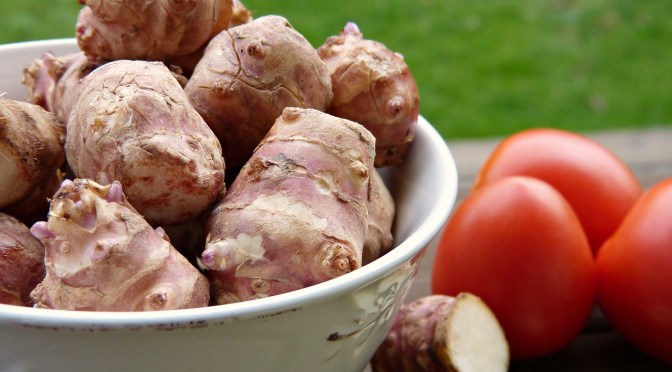
Next we have a less common one called Jerusalem Artichokes which is a root vegetable from the Helianthus tuberosus family, also called sunroot, sunchoke, earth apple or topinambour, it is a species of sunflower native to eastern North America.

Grown from tubers it can be successfully grown any where that has reasonable drainage and sun light.

Grown in a container, waste area, vegetable garden or flower garden it will thrive.

In a container it grows about a metre or so tall in open ground from a couple of metres to 3 or 4 metres tall dependent on soil and growing conditions.

 In autumn it produces smaller sunflower blooms and dies back about this time of the year when you can start harvesting the tubers.

The nobbly tubers contain about 10% protein, no oil, and a surprising lack of starch. However, it is rich in the carbohydrate inulin (76%), which is a polymer of the monosaccharide fructose.

Tubers stored for any length of time will convert their inulin into its component fructose.

Jerusalem artichokes have an underlying sweet taste because of the fructose, which is about one and a half times sweeter than sucrose.

Jerusalem artichokes have also been promoted as a healthy choice for type 2 diabetics, because fructose is better tolerated by people who are type 2 diabetic.

It has also been reported as a folk remedy for diabetes.

Temperature variances have been shown to affect the amount of inulin the Jerusalem artichoke can produce. When not in tropical regions, it has been shown to make less inulin than when it is in a warmer region.

You can find recipes for the tubers on the Internet, steamed or baked and excellent for soups. They have a nutty, earthly taste a bit like Gin seng.

Nutritional value per 100 g (3.5 oz) is Energy 304 kJ (73 kcal): Carbohydrates 17.44 g: Sugars 9.6 g: Dietary fiber 1.6 g : Fat 0.01 g: Protein 2 g.

Vitamins; Thiamine (B1) (17%) 0.2 mg: Riboflavin (B2) (5%) 0.06 mg: Niacin (B3) (9%) 1.3 mg: Pantothenic acid (B5) (8%) 0.397 mg: Vitamin B6 (6%) 0.077 mg: Folate (B9) (3%) 13 g: Vitamin C (5%) 4 mg: Trace metals Calcium (1%)14 mg: Iron (26%) 3.4 mg:

Magnesium (5%)17 mg Phosphorus (11%) 78 mg: Potassium (9%) 429 mg

Last and the most uncommon of all is yacon (Smallanthus sonchifolius, syn.: Polymnia edulis, P. sonchifolia) a species of perennial daisy traditionally grown in the northern and central Andes from Colombia to northern Argentina for its crisp, sweet-tasting, tuberous roots.

The peeled roots are lovely to eat raw, sweet to the taste without the side effects of sugar..

The tubers contain fructooligosaccharide, an indigestible polysaccharide made up of fructose.

Fructooligosaccharides taste sweet, but pass through the human digestive tract unmetabolised, hence have very little caloric value.

Moreover, fructooligosaccharides have a prebiotic effect, meaning they are used by beneficial bacteria that enhance colon health and aid digestion.

Easy to grow, plants grow about 1.5 metres tall large leaves with a texture like Borage harvest, roots in autumn.

If you can obtain a starter tuber of yacon its well worth growing.End….

Here is a link that I received recently that you maybe interested in especially in regards to the current select committee on the Therapeutic Products Bill.

This bill which has in the past been defeated twice before could mean that you are not allowed to grow healthy vegetables by some Govt committee if the bill is passed.

Also concerning article from the same writer:

https://hatchardreport.com/are-we-going-backwards-or-rushing-ahead/

We will carry on last week’s special on BioPhos for another week  as proving very popular.


Phone 0800 466464
Garden Pages and News at www.gardenews.co.nz
Shar Pei pages at  www.sharpei.co.nz
Mail Order products at www.0800466464.co.nz


New Zealand Bill of Rights Act 1990. Part II of the Act covers a broad range of Civil and Political Rights. As part of the right to life and the security of the person, the Act guarantees everyone:

1The right not to be deprived of life except in accordance with fundamental justice (Section 8)

2The right not to be subjected to torture or to cruel, degrading, or disproportionately severe treatment or punishment (Section 9)

3The right not to be subjected to medical or scientific experimentation without consent (Section 10)

4The right to refuse to undergo any medical treatment (Section 11)

 Furthermore, the New Zealand Bill of Rights Act 1990 guarantees everyone: Freedom of Thought, Conscience, and Religion.
This includes the right to freedom of thought, conscience, religion, and belief,
INCLUDING THE RIGHT TO ADOPT AND HOLD OPINIONS WITHOUT INTERFERENCE (Section 1)


Image by Silvia from Pixabay

Wally Richards & Rodney Hide on Reality Check Radio with Gardening Basics – (must hear)

If you’re new to growing your own food (and even if you’re not) this info is gold. Wally shares from 50 odd years of down to earth gardening experience – easy to follow, from ‘go’ to ‘woah’ … basic and practical. You can also phone Wally on his 0800 number for practical advice.

Listen at the link below:

Wally Richards: Grow Your Gardening Game

THE IMPORTANCE OF POTASSIUM AND MAGNESIUM IN YOUR GARDEN (Fruit + Flower Power – Wally Richards)

Potassium often referred to as Potash because the ash from wood burn containers a good amount of potassium and magnesium sulphate is often referred to as Epsom Salts are two important elements in gardening.

A long time ago I realised the importance of these two and so I created a product which combined them, in a prill form, 55% potassium and 45% magnesium and called it Wallys Fruit and Flower Power which is one of the many uses of these two elements.

Plants like us, if they do not get sufficient minerals in their diet, they will be adversely affected and do poorly.

Potassium deficiency will show as soft limp plant growth, poor flowering, taste decline in fruit, and general loss of vigor.

I am often asked what is wrong with plants which, don’t seem as good as they could be, even though they are fed well and watered right.

Often the reason is insufficient Potassium.

Then there is fruit, especially citrus which are lacking in juice and flavor.

Tomatoes and cucumbers that don’t have that home grown flavor that one would hope to have.

Plants that have poor flowering or don’t flower at all. Once again the problem can be insufficient Potassium.

Magnesium is involved in chlorophyll production, which converts sunlight into sugars and is involved in activating enzymes.

Because of its role in chlorophyll, the first symptoms of magnesium deficiency show up as yellowing, usually between the veins of the older leaves. In severe deficiencies, the entire leaf will turn yellow or red and then brown, with symptoms progressing up the plant.

There are numerous plants that show this tendency, citrus, Daphne, rhododendrons, tomatoes, passion fruit and roses to name a few.

Once the yellowing starts to appear then already the plant is having problems and even when magnesium is supplied, it takes several weeks before the lovely dark green colour is restored.

During this time the plant is weakened, as the chlorophyll is not working to its full potential which makes the plant more susceptible to diseases and pests.

The amount of energy created from sun light is affected and plant growth is reduced.

During drought conditions, plants suffer and one important aspect to assist in this is Potassium.

It regulates water absorption and retention, influences the uptake of some nutrients and helps to increase disease resistance.

As the weather cools and winter approaches, plants feel the chill like we do, but plants cant put on a jersey like we can.

The plant’s protection from chills and frosts comes from having adequate Potassium in their diet.

Thus us gardening commentators always suggest to gardeners to supply potash to their plants as winter starts to approach and to avoid using nitrogen fertilisers which only increases sappy growth.

Commercial growers of plants and orchardists use the two elements to ensure their plants have sufficient Potassium and magnesium in their diet.

These two vital elements are blended together in the right balance as required for plants.

For the home gardener we supply Fruit and Flower Power in three pack sizes. 1.25 Kilos, and 2.5 kilos

and a bulk bag which is 12.5 kilos making it the best purchase if you have storage room.

The 1.25 kilos comes nicely packaged in a stand up pouch with a 50 gram (50ml) scoop.

It is used at the rate initial rate of 50 grams (one scoop, just below level full) per square metre around the base of the plant or around the drip line.

Use for any plant that is flowering, fruiting, showing lack of vigor or yellowing in foliage.

Now this next bit might surprise many; but the monthly requirement is 25 grams (half scoop) per square metre.

This should be applied while plants are flowering, fruiting, during dry times and going into winter. Outside of these times a 2-3 monthly dose should be fine.

For fruiting a dose at 50 grams should be applied prior to flowering followed by the 25 grams till harvest. For the likes of tomatoes and cucumbers, apply over fruiting period for best flavor.

I get a lot of complaints that citrus fruit are dry and lack flavor so this will fix the problem.

A number of fertilisers mixes do not contain sufficient potassium, likely because it is a more expensive element which is a pity as it should be at least ample for general gardening use.

Now is a good time to apply Fruit and Flower power around your gardens and repeat each month with a small sprinkling.

It will help to keep your leaves green and the plants will gain more energy from the sun even considering its shorter day lights hours as we head into winter.

It will firm up sappy growth from summer feeding of fertilisers and plant foods.

Also other precautions you should take going into winter include:

Protecting your vulnerable plants from frost by using the Spray on Frost Protection; Vaporgard.

Mulches used to overcome dry conditions in summer should be removed from under plants to allow the soil to breath and dry out quicker during wet periods.

This helps prevent root rots and loss of valuable plants.

A spray of Perkfection over plants that could be affected with wet soil is a good help to prevent root damage through wet feet.

Spray vegetables and preferred plants with Magic Botanic Liquid (MBL) each week. (It helps them grow healthier and faster.

Side dress vegetable plants with a sprinkling of BioPhos.

Brassicas (Cabbage etc) that have caterpillars should be sprayed with Wallys Super Neem Tree Oil with Raingard added to prevent the oil washing off with watering or rain.

Reduce the amount of water you are giving container plants indoors and tender plants in glasshouses.

They do not need so much water now and wet feet intensifies the cold and can be fatal.

Any Questions any time just phone me or email me with your contact phone number.

THIS WEEKS  Special is a 12.5 kilo bag of  FRUIT and FLOWER POWER normal price is $60.00 plus shipping but till next Sunday we will pay the shipping to your home saving $16.00 North Island and $19.00 South Island. (No PO Boxes or outer Islands)

Order on our Mail Order Web site at http://www.0800466464.co.nz/18-bulk-goods?p=3

In Remarks please state This Weeks Special..

The 12.5 Kilo bag will be in a carton which can fit other products from our mail order web site but not other bulk goods.
You will have 10% off any other products you purchase (Not other bulk products)

I will phone you when we receive the order and arrange the free shipping and your preferred method of payment.

Regards

Wally Richards


Phone 0800 466464
Garden Pages and News at www.gardenews.co.nz
Shar Pei pages at  www.sharpei.co.nz
Mail Order products at www.0800466464.co.nz


New Zealand Bill of Rights Act 1990. Part II of the Act covers a broad range of Civil and Political Rights. As part of the right to life and the security of the person, the Act guarantees everyone:

1The right not to be deprived of life except in accordance with fundamental justice (Section 8)

2The right not to be subjected to torture or to cruel, degrading, or disproportionately severe treatment or punishment (Section 9)

3The right not to be subjected to medical or scientific experimentation without consent (Section 10)

4The right to refuse to undergo any medical treatment (Section 11)

 Furthermore, the New Zealand Bill of Rights Act 1990 guarantees everyone: Freedom of Thought, Conscience, and Religion.
This includes the right to freedom of thought, conscience, religion, and belief,
INCLUDING THE RIGHT TO ADOPT AND HOLD OPINIONS WITHOUT INTERFERENCE (Section 1)

About sprayers and spraying in your garden (Wally Richards)

Gardeners and horticulturists can at times take things for granted as we are often doing certain chores and don’t stop to realise that what we do and why we do it, is not common knowledge with everyone who gardens or are attempting to garden.

One of these is spraying plants for whatever reason we spray; whether it be for pest control, disease control, weed control or other reasons.

Lets start off with sprayers of which there are many types and I have four types that I use for different reasons and times.

Firstly I have a Back Pack sprayer which is hand pumped and holds about 16 litres of spray.

This one is only used for weed killing and the compound I use in it is Ammonium sulphamate that I dissolve into water at the rate of 200 grams per litre of water.

I add to this Raingard at the rate of 1mil per litre of water.

The best time to spray weeds is on a nice sunny day in full sun light and ideally when the soil is on the dry side.

If you are using any other non chemical weed killers then a sunny day with dry soil is a must for success.

If you are using chemical herbicides you should add Raingard to the spray as it will increase the effectiveness of the herbicide by 50% and apply it also ideally on a sunny day and drier soil.

The reason is that when soil is dry plants are moisture seeking and will take the spray more readily into their foliage.

The sprayer that you use for weed killers should be clearly written on ‘WEED KILLERS ONLY’

failure to do this will often lead to tragic loses in your gardens.

I have had many instances when someone else has used a sprayer that had been used to kill weeds and used the sprayer on plants for insect problems. (It works you kill the plants and the insects disappear, not so nice for your cherished plants)

This is particularly so with chemical herbicides because rinsing the sprayer out after use will not remove all the chemical as they impregnate into the plastic and if you were to use the same sprayer with say an insecticide in it and spray roses,

tomatoes, beans and various other plants, it will cause herbicide damage to the foliage and in some cases kill the plants.

If you have small weed killing jobs to do then what ever you are going to use, put it into a Trigger Sprayer that you mark ‘WEED KILLERS ONLY’

I actually have several 1 litre Trigger Sprayers that I use for different applications and as I do not use Raingard in the Trigger Sprayers I can store what spray has not been used in a shed out of direct sun light for future use..

If Raingard or VaporGard has been used in a sprayer then any spray not used should be either discarded or put into a container for future use so that you can wash out the sprayer immediately and run some clean water though it to make sure filters and jets are cleared of any residue.

So discard the contents, part fill with clean water and give a good shake.

Tip this water out and again part fill the sprayer with clean water and open the nozzle of the sprayer to make a jet and jet spray some of the water through the nozzle.

This will help ensure that the sprayer will be ready for use next time you want to use it.

Failure to do some often means time wasted as you try to clean residues from the sprayer so it will work.

Many products that have been diluted with water will keep for a time if stored out of sunlight, they may slump which means they fall to the bottom and there is more water above the product. A good shake normally remixes the product with the water.

Sometime I will add a little more of the product to the sprayer and also more water as to label instructions to top up the sprayer and overcome any possibility of the product deterioration while stored.

Besides the Back Pack Sprayer and several trigger spray bottles I also have two other pump up sprayers for spraying.

One is a 2 litre pump up sprayer the other is a 5 litre sit on the ground pump up sprayer.

Those are for the jobs that are bigger than what a Trigger sprayer would be used for and yet not enough to use the pack pack size.

Most spraying of any product except weed killers should be done at the end of the day when the sun is going down towards dusk and direct sunlight off the plant’s foliage.

This is particularly important if using any oil products such as Wallys Neem Tree Oil.

Also if using Super Pyrethrum on its own or with the Neem Oil as pyrethrum has a short life when exposed to UV which is in fact about two hours.

Also pyrethrum can affect honey bees and by dusk most of them should be back home in their hives.

Next morning when the sun comes up the Pyrethrum will be gone within a couple of hours.

Now here is a very important point which many do not realise when spraying chemical herbicides.

NEVER spray on a still calm day. Many people think that is the best time to spray when in fact it is the worst.

I learnt that when I obtained my Chemical Handlers certificate years ago and here is the reason why;

When it is calm tiny spray droplets are lifted up in to the air from conventional air currents (warm air rises) and these deadly droplets rise up and will at sometime drop onto what ever is below, your place? Down the road? Who knows but very damaging to what ever plant they land on.

The ideal time to spray is when there is a nice mild breeze, this will force the spray droplets down onto the target weeds.

Another good idea if your sprayer has a wand you can make a spray shield out of a two litre plastic ice cream container.

In the centre of the container make a hole that is big enough to fit over your wand when the nozzle is removed.

Place the end of the wand through the hole and put the nozzle back on.

You place this over the weeds you want to spray and pull the trigger. All the spray will stay inside the ice cream container.

So even on a windy day or calm day you can spray your weed killers safely.

We have now listed on our mail order web site at www.0800466464.co.nz One Litre Trigger Spray bottles for $6.00 each

(See under Disease Control top of first page)

If you are ordering other gardening items from the web site then add a Trigger or two to your order.

On their own the freight cost does not make them a good buy but when freight (if applicable) is on other products the  trigger sprays can hitch a ride on that freight.

You get 10% off the price so that makes them only $5.40 each a good buy at that price.

Problems ring me at 0800 466464
Phone 0800 466464
Garden Pages and News at www.gardenews.co.nz
Shar Pei pages at  www.sharpei.co.nz
Mail Order products at www.0800466464.co.nz


New Zealand Bill of Rights Act 1990. Part II of the Act covers a broad range of Civil and Political Rights. As part of the right to life and the security of the person, the Act guarantees everyone:

1The right not to be deprived of life except in accordance with fundamental justice (Section 8)

2The right not to be subjected to torture or to cruel, degrading, or disproportionately severe treatment or punishment (Section 9)

3The right not to be subjected to medical or scientific experimentation without consent (Section 10)

4The right to refuse to undergo any medical treatment (Section 11)

 Furthermore, the New Zealand Bill of Rights Act 1990 guarantees everyone: Freedom of Thought, Conscience, and Religion.
This includes the right to freedom of thought, conscience, religion, and belief,
INCLUDING THE RIGHT TO ADOPT AND HOLD OPINIONS WITHOUT INTERFERENCE (Section 1)

Image by Renate Köppel from Pixabay

HOUSEHOLD ITEMS THAT ARE USEFUL IN THE GARDEN (Wally Richards)

There are a number of items that can be used in your garden to the benefit of plants.

For instance a year ago I wrote the article about using Apple Cider Vinegar on fruit trees to increase their performance and to reduce disease problems.

The formula is 250mil Apple Cider Vinegar (ACV) mixed with 5 litres water in a 5 litre sprayer.

Spray the mix in the evening when the sun has just gone off your trees or plants, so the sun isn’t heating/burning leaves through the liquid spray droplets on them, and there’s time for the spray to dry before nightfall..

Spray the whole tree, vine or plant.. under and over leaves, the trunk, branches, twigs, fruit everything..

This will also feed the tree through the leaves (when they are there for deciduous trees) as a foliage food.

Baking Soda applied at a tablespoon per litre of water with Raingard added is good to prevent some fungus diseases such as black spot. (Don’t use on calcium sensitive plants)

Baking Soda can be sprayed over the foliage of oxalis to dehydrate the leaves. Oxalis to sensitive to calcium.

It does not affect the bulbs below but regular spraying of baking soda will keep the garden free of the oxalis foliage without affecting other plants.

To deal to the bulbs in the soil, mix Wallys Super Compost Accelerator at 200 grams per litre of water and water liberally over the foliage down into the soil to compost the bulb and bulblets.

Then there is table salt which can be sprinkled on weeds to kill them which is ideal on pavers and where you dont have other plants growing.

Cooking oils and vinegar can also be sprayed onto weeds in full sun light to dehydrate the foliage and kill annual weeds.

Condys Crystals, (potassium permanganate) a quarter tea spoon per litre of water with or without Raingard to control leaf diseases such as black spot, rust and curly leaf.

Sunlight Bar Soap (big yellow bar) lathered up in water to spray over aphids and soft body insects to kill them. (The fatty acids breaks down their soft bodies)

Dish washing liquid lathered up in warm water to break surface tension to allow water to penetrate.

Aspirin: in plants, just like in mammals, salicylic acid helps them cope with stress and disease. By adding Aspirin to the water, gardeners are hoping to help their plants cope with problems and grow faster and stronger.

The acid is effective on plants because many plants produce it themselves in tiny amounts. Plants produce this acid when stressed or fighting disease. Feeding them a greater supply of the acid proves beneficial. Giving the plant too much aspirin can have a negative effect as it can burn its leaves.

Dissolve 250mg to 500mg of aspirin in 4.5 liters of non chlorinated water and spray plants two to three times per month.

Similarly soak the leaves of willow trees in water for a week or more and use that as a spray as you would the aspirin. Willow water is ideal also for putting cuttings in to help them form roots quicker.

All great uses and here is the most interesting one of all:

Hydrogen peroxide 3%.

I read about this some years ago and it was again brought to my attention recently.

Hydrogen peroxide, well known as an ingredient in disinfectant products, is now also approved for controlling microbial pests on crops growing indoors and outdoors, and on certain crops after harvest.

This active ingredient prevents and controls bacteria and fungi that cause serious plant diseases.

Adding hydrogen peroxide to water promotes better growth in plants and boosts roots ability to absorb nutrients from the soil.

Diluted 3% peroxide adds needed aeration to the soil of plants and helps control fungus in the soil.

It acts as an insect pest deterrent and kills their eggs.

Ideal on brassica leaves for white butterfly eggs this time of the year.

I used 3% Hydrogen peroxide with Magic Botanic Liquid added on tomato and chili plants in my glasshouse and there was reduced actively within a couple of days.

A spray every 2-3 days is ideal for control or once a week or 2 weekly as a preventive.

I see on the Internet that the 3% should be further reduced with water such as 1:1 so if using 3% strength it would pay to do a test spray on a small area of foliage on each type of plant and see if there was any adverse reactions before using at 3% over whole crop or plant.

Ideal this time of the year to reduce pest number going into the winter.

I see the best use is in glasshouses where the product does not get washed away with rain.

Use out doors over and under foliage and you may need to reapply after rain.

Happy Gardening.

For your information I have the 3% hydrogen peroxide available to order thought our mail order web site at www.0800466464.co.nz

It is in the Pest Control section. (Listing will be on the web site with pictures later on today (Sunday 19th April.)

We have a one litre Trigger Spray Bottle Ready to Use with 3% Hydrogen Peroxide and Magic Botanic Liquid spray for $12.50

A one litre refill for the above for $8.00

and a 5 litre ready to use for $40.00

Of course you being subscribed to these Newsletters have a 10% discount off the above as with most of our gardening products.

If you have not used the Mail Order web site previously please tell me when I phone you to sort out payment method and freight that you have 10% off

Regards
Wally

Phone 0800 466464
Garden Pages and News at www.gardenews.co.nz
Shar Pei pages at  www.sharpei.co.nz
Mail Order products at www.0800466464.co.nz


New Zealand Bill of Rights Act 1990. Part II of the Act covers a broad range of Civil and Political Rights. As part of the right to life and the security of the person, the Act guarantees everyone:

1The right not to be deprived of life except in accordance with fundamental justice (Section 8)

2The right not to be subjected to torture or to cruel, degrading, or disproportionately severe treatment or punishment (Section 9)

3The right not to be subjected to medical or scientific experimentation without consent (Section 10)

4The right to refuse to undergo any medical treatment (Section 11)

 Furthermore, the New Zealand Bill of Rights Act 1990 guarantees everyone: Freedom of Thought, Conscience, and Religion.
This includes the right to freedom of thought, conscience, religion, and belief,
INCLUDING THE RIGHT TO ADOPT AND HOLD OPINIONS WITHOUT INTERFERENCE (Section 1)

Image by Maya A. P from Pixabay

WINTER PREPARATIONS IN THE GARDEN (Wally Richards)

This week I noticed a distinct chill in the air, first thing in the morning, which could be described as a very light frost.

Others must have noticed it in their localities as orders started coming in for Vaporgard, the spray on frost protection.

Now if you think back to Marches in the past years, it is very early to start to get chilly and it is more into April and May that one starts to realise that winter is getting into gear.

March is the first month of autumn in New Zealand and we have just started autumn with some leaf colour changes.

In autumn, New Zealand enjoys some of the most settled weather of the whole year.

Soak up long, sunny days and golden leaves with hiking, cycling or kayaking. (used to be)

Looking overseas there are number of late cold events in places such as California where snow is certainly not common even in winter.

I wound not be surprised if we don’t have a really cold winter this year and an early start to it.

So time to get organised for winter chills in your garden and in your home.

Did you know that your bank is offering Green Loans to people for such things as insulation, double glazing, heat pumps and solar power systems?

I am in the process of installing an off the grid solar power system I purchased from China for my warehouse and my bank has happily lent the cost of installation under this new leaning critia..

So what to do to protect your garden against the coming cold and frosts?

First thing is soft sappy growth of plants caused by nitrogen fertilisers will suffer unless you harden the growth up by applying Wallys Fruit and Flower Power which is half potash, to firm up growth and half magnesium to help ensure foliage stays green in winter.

A small sprinkling once a month starting now will toughen and green up your plants for winter.

Deciduous plants such as roses and many fruit trees that will drop their leaves and rest over winter so there is no point of using Wallys Fruit and Flower Power till the spring when they start to move for the new season.

Wet weather in winter takes a toll on plants that don’t like wet feet and can often lead to their deaths.

Mulches that you used in summer around plants should now be removed as they prevent the soil from drying out and will cause root rots.

Great for summer water retention but deadly in winter. Even weed mat can cause a problem in a wet winter.

It is now time to start a monthly treatment of plants that do not like wet feet such as citrus trees by spraying the foliage with Wallys Perkfection, once a month for the next 3 to 6 months.

It fortifies the roots making them less susceptible to rotting in wet soil.

The above has taken care of your preferred ever green plants but what about the ones that are frost tender such as passion fruit, avocados, tamarillos, hibiscus, citrus etc?

Also glasshouse plants such as tomatoes, Capsicum and chili that you are wintering over?

It is time to spay the foliage with Wallys Vaporgard; ‘Spray on Frost Protection’.

It comes in two sizes 100 mils which makes 6.66 litres of spray which is often enough to do all the cold sensitive plants in many gardens once or 250 mils makes up 16.66 litres of spray.

Place the Vaporgard bottle into a jug of hot water so it pours better and then mix with warm water at 15 mils per litre.

You can add some Magic Botanic Liquid to the spray which your plants will appreciate.

Only spray on a sunny day in full sun light over the plants leaves so the film dries faster.

It gives down to minus 3 frost protection within 3 days of application for about 3 months.

So a spray now will be repeated about middle of June to take your plants out of winter.

If you don t use all the spray mixed up remove from sprayer and store in a bottle in a dark cupboard. It can be used again later. Then and most important; immediately rinse out sprayer with fresh water and tip out.

Then another lot of water which you will spray as a jet (adjust nozzle to make jet) to ensure that filters and nozzle don’t block when Vaporgard sets.

If you don’t do this straight away you will have problems cleaning it the next time you go to use. The above is good practise to do with any sprays you use in your sprayer.

In areas where frosts are very heavy then you can add Wallys Liquid Copper to the Vaporgard spray and that places an extra layer of particles over the foliage to give even better frost protection.

How does Vaporgard work? Besides putting a protective film over the leaves it acts as a sunscreen against UV.

VaporGard develops a polymerised skin over each spray-droplet which filters out UVA and UVB. This provides a sunscreen for chlorophyll which is normally under attack by UV light.

This results in a darker green colour of the foliage within a few days of application. This chlorophyll build-up makes the leaf a more efficient food factory producing more carbohydrates, especially glycols.

Glycol is anti-freeze so the plant has its own anti-freeze protection of the cells. The cells still free but are protected with the anti-freeze.

That is fine if you have a frost every few days but if there is several frosts night after night then the cells dont have enough time to heal before they are fozen again.

That being the case you need to use additional protection such as frost cloth for the second and third frosts.

Vaporgard will ensure that you don’t get caught out from that unexpected frost.

Once you have winter proofed your gardens then also change your watering patterns of your indoor plants which will suffer inside during winter if the mix is wet.

A little water as needed is best for winter indoor plants keeping the mix a little on the dry side.

Most important after watering that you remove any water from the saucer below the pot.

If at this time you find when you water the water quickly fills the saucer below then you have a problem called soil tension which prevents the water from wetting all the growing medium.

If the pots are not too big then plunge them into a tank of water and watch them bubble away.

When they stop bubbling lift and let drain before placing back on saucer. They will accept water better next time. If the containers are too big to plunge then mix some dishwashing liquid into warm water, lather up and water that over the growing medium. It will break surface tension.

Two interesting things were reported this week one about server climate events which we have recently seen.

Ian Wishart did some investigating and here is the out come:

Whatever; one thing for sure the climate during my life time has changed and not for the better, but then again it has been changing from the day planet Earth came into being so whats new.

You will likely see this in the news soon….

Silicon Valley Bank Collapsed yesterday; A bid to reassure investors goes awry. The failure of Silicon Valley Bank was caused by a run on the bank.

The company was not, at least until clients started rushing for the exits, insolvent or even close to insolvent. Other banks are in trouble now also.

Phone 0800 466464
Garden Pages and News at www.gardenews.co.nz
Shar Pei pages at  www.sharpei.co.nz
Mail Order products at www.0800466464.co.nz

New Zealand Bill of Rights Act 1990. Part II of the Act covers a broad range of Civil and Political Rights. As part of the right to life and the security of the person, the Act guarantees everyone:

1The right not to be deprived of life except in accordance with fundamental justice (Section 8)

2The right not to be subjected to torture or to cruel, degrading, or disproportionately severe treatment or punishment (Section 9)

3The right not to be subjected to medical or scientific experimentation without consent (Section 10)

4The right to refuse to undergo any medical treatment (Section 11)

 Furthermore, the New Zealand Bill of Rights Act 1990 guarantees everyone: Freedom of Thought, Conscience, and Religion.
This includes the right to freedom of thought, conscience, religion, and belief,
INCLUDING THE RIGHT TO ADOPT AND HOLD OPINIONS WITHOUT INTERFERENCE (Section 1)


Gardening: beating the veggie shortages … (Wally Richards)

It is certainly interesting times we are living in … there are also some gardening problems to overcome. Recently I went looking for some vegetable seedlings and seed packets of vegetables that I wished to add to my gardens at this time.

I was after cauliflower seedlings to grow and harvest in winter and some onion seeds to sow now. I had to visit several gardening places before I found the items I required. This means that a lot of people have woken up to the fact that fresh produce in the supermarkets are several times dearer currently than they would normally be in March. In fact in March there should be a glut of cheap fruit and vegetables available from spring and summer crops. There isn’t. The supermarkets are now starting to import vegetables that are normally available in abundance from NZ growers. There Isn’t. Imported produce is much more expensive than local grown hence if you are paying $5 for a small cabbage now soon you will be paying $10 or more. I was talking recently to a check out operator at local supermarket than was saying there are several customers that are not at all friendly now. I can understand why, people with limited money for buying food can’t afford all the groceries that they are used to buying; their budget just does not stretch that far. Hence they can be grumpy and even a bit nasty to the Supermarket staff. The same people are in a Catch 22 they don’t have the money to grow their own produce and/or don’t have land that can be used for gardening. Readers of my columns are good gardeners, in the main, and even if on a budget they are able to grow a reasonable amount of their own food which is not only a big saving but also much more healthy for us gardeners.

There are problems that are currently happening and one of these is as I found; a shortage of seeds and seedlings in many gardening outlets. Cabbage and cauliflower seedlings I have purchased recently have caterpillar eggs on the leaves and if you don’t rub them off they will be eaten alive not too long after planting. So check leaves for the little lightly yellow eggs and rub them off before you plant. I use Wally Neem Granules when I plant cabbages etc a little in the bottom of the planting hole and more on the soil surface by the seedlings. This has a very good control of the caterpillars and even though I have caterpillar eggs on my plants and holes on the leaves there is not any caterpillars on the foliage. The holes are made by hungry birds not caterpillars. It is even worse on my silverbeet which young seedlings I planted have either disappeared or they have damaged foliage. More mature silverbeet will likely have a lot of leaf damage from birds feeding. The best way to keep birds off silverbeet and brassicas is to use what I call Crop Cover or what shops call, Bug Mesh. Either laid loose over crops or supported over crops with hoops made from ridged plastic irrigation pipe or number 8 wire. The crop cover is good for many seasons and will keep birds and just about all pests off your crops include neighborhood cats. Old curtain netting could be used instead of the more durable crop cover.

When you buy vegetable seedlings look for the smaller, fresher ones not the over grown ones which have likely been stressed and will go to seed prematurely. Even if you take them home to grow on a bit to make handling easier, then do so. First thing I do when I get punnets home is plunge them into a bucket of water than I have thrown some sheep manure pellets into some time ago. I hold them down into the liquid manure and watch them bubble away. This not only gives them a good soaking of the mix but some nature liquid food as well. Let them drain and place in full sun till you are ready to plant them. Water as need be in the meantime and prior to planting plunge them into the bucket again. Seedlings will pull apart better when the mix is wet and they have ample wet mix on the roots when you plant. After planting give them a watering with the hose to bed them in. Then you can put your crop cover over them if you are going to use this method.

I wrote recently a quick way of converting some existing lawn area into a productive vegetable patch. For those that missed it here it is again:

If you want to convert a part of your lawn to vegetable growing then mow the chosen area (a sunny area is best by far) as short as possible (called scalping). Around the lawn edge of this area dig a small trench about half a spade depth. The soil and grass from this trench can be stacked some where for future use. The trench will assist with drainage and as a mowing strip between the vegetable garden and the existing lawn. Place the lawn clippings caught in the catcher over the scalped area. (Extra food for your vegetables crops) Now cover the scalped lawn area that has the lawn clippings with a layer of cardboard or alternatively several layers of news paper. You can find cardboard from recycling places, super markets etc. Sprinkle any animal manure you can get hold of or blood & bone with sheep manure pellets. A sprinkling of Wallys BioPhos and Wally Ocean solids will complete the nutrient requirements. Then over this place a layer of purchased compost which I prefer Daltons as it does not container green waste and thus herbicide problems. This layer need only be about 5cm thick just deep enough to plant seeds or seedlings in.’ end……..

The problem that we all have had this season is the lack of direct sunlight. Called ‘Dimming’ the sun is obscured by hazy skies or too much cloud and not enough ‘Blue Skies’. Plants are slow to grow, flower buds don’t form or don’t open and solar panels don’t make much power as they do in direct sunlight. Can’t help with solar panels other than wash them to make better use of the light available. For plants provide them with Liquid Sunlight by dissolving a tablespoon of molasses into a litre of hot water and when cooled down add some Magic Botanic Liquid and spray foliage of your plants. Repeat every few days. Likely you will notice the leaves will get much bigger and that is good. It may attract ants if they are a problem where you are so then make up some of our Granny Mins Ant Bait and use that to kill the ants. (Old recipe and lots better than most baits and cheaper also).

Off Topic..With the flooding and forest waste problems I wonder why they don’t control burn it? I think they used to in the past as the ashes are great for planting more trees. (Of course they are not allowed/// something about CO2? Workers not allowed to take it for fire wood apparently and logging companies say too expensive to do. (Lot more expensive the damage it does). Also they used to dredge rivers to make them deeper so more water could flow without flooding surrounding areas. (oops not allowed to, upsets river life: PC gone mad). Simple remedies that we used to use. Burn the slash and dredge the rivers!


Phone 0800 466464
Garden Pages and News at www.gardenews.co.nz
Shar Pei pages at  www.sharpei.co.nz
Mail Order products at www.0800466464.co.nz

New Zealand Bill of Rights Act 1990. Part II of the Act covers a broad range of Civil and Political Rights. As part of the right to life and the security of the person, the Act guarantees everyone:

1The right not to be deprived of life except in accordance with fundamental justice (Section 8)
2The right not to be subjected to torture or to cruel, degrading, or disproportionately severe treatment or punishment (Section 9)

3The right not to be subjected to medical or scientific experimentation without consent (Section 10)
4The right to refuse to undergo any medical treatment (Section 11)  
Furthermore, the New Zealand Bill of Rights Act 1990 guarantees everyone: Freedom of Thought, Conscience, and Religion. This includes the right to freedom of thought, conscience, religion, and belief, INCLUDING THE RIGHT TO ADOPT AND HOLD OPINIONS WITHOUT INTERFERENCE (Section 1)

Image by Mark Valencia from Pixabay

WEEDS – A NEW WAY TO DEAL TO THEM (Wally Richards)

This week I received a book from an old friend of mine, Julia Sich which she has written and called ‘Julia’s Guide to Edible weeds and Wild Green Smoothies’.

Many of you will know the ‘Weed Lady’ through her previous book and workshops.

In your gardens you will likely have a number of plants we call ‘weeds’ which are of benefit to your diet and health.

The definition of a ‘weed’ is simply ‘a plant that is growing where we do not want it to grow’.

Many of the plants we grow for food or for their flowers; when allowed to self seed they become weeds.

I recommend that you obtain a copy of Julia’s book and learn to your benefit, many of the plants you pull out, kill and compost which could be better off been cultivated and consumed.

The book is available in two formats as a down load E Book or as a printed publication.

The web site is https://www.juliasedibleweeds.com/

and the book is available for NZ$19.95 for the Ebook OR $34.95 plus postage for the printed version.

The book gives you both the common names and the Botanical names as well as coloured pictures to assist in identification.

Each weed has a written description along with its nutritional values and how to use them for your benefit.

Mind you if the Government had its way it would ban the use of these natural plants and their ancient uses if favour of Big Pharma’s bottom line. (Therapeutic Products Bill)

Pharmaceutical companies hate natural remedies even though many of their concoctions were originally derived from plant’s properties.

If you have the knowledge such as given in Julia’s book then you can look after your own well being as our fore fathers did from all races on the planet. (And at no expense if out of the weeds in your gardens)

We have to read and learn about the advantages of these plants but in Nature animals know what is best for them as far as their well being is concerned.

For instance if you place cattle into a paddock that has a wide range of plants including weeds, the cattle will consume the ones that they need for better health beside eating a lot of grass.

Which is an interesting point in so much as grass is also very good for your health and in particular, wheat grass and barley grass.

That is if you apply all the known minerals and element to the growing medium.

Reason is that grasses will take up all the minerals available where other plants such as tomatoes only require 56 of the known 114 mineral and elements.

That is why some farmers will apply what we sell as Ocean Solids to their paddocks to the great benefit of their stock’s health.

I remember a farmer telling me one time about his practice of spraying diluted sea water over his paddocks which was much to the annoyance of his farming neighbour,

because a certain amount of the sea spray would fall onto the neighbors side of the fence and when the neighbour let his stock into that paddock they would rush over to the  area by the fence line and demolish the mineral rich grasses growing there.

Julia mentions ‘your’s truly’ in her book and in particular in regards to ‘Smoothies’

I presume many of you have or still do on occasions, if not regularly, go out and pick a range of greens and put them into a high speed blender with a banana and wizz up a very beneficial brew.

The banana addition takes away some of the unpleasant taste of some plants and makes your drink very palatable.

Julia tells the story of how smoothies solved health issues that she once had as I found the same many years ago when I first started making smoothies from as many different plants as I could get my hands on.

Some plants are nice to eat raw and have flavors that make them appealing such as salad crops.

The rest including grasses are better taken raw in a smoothie.

Besides being of great benefit to your health another very good reason to find out what weeds you can eat is the unusual weather that has affected New Zealand recently.

Here is a update from a Food Producer in the Hawke’s Bay: ‘Hi everyone, food producer here. Just wanted to write an easily digestible post so people can understand how severe the destruction in H.B is for the whole of N.Z

The media aren’t really discussing it fully and people I speak to can’t seem to wrap their heads around how serious this is for us as a country.

What’s been lost: It’s called the fruit bowl for a reason, not just grapes and apples but also pears, onions, corn, carrots, blueberries, strawberries, honey, dairy, beef, sheep products including wool and also apiaries, nurseries and seed banks.

Wineries and orchards have had heritage trees and vines utterly wiped out. We’re talking 30-40-year-old plants gone. Countless bee hives and fields of crops buried under a metre of silt.

These aren’t just for fresh produce but also wine, vinegar, honey, bread and processed fruit and vegetables for things from muesli bars to ice cream and condiments.

The layer of silt now covering the once fertile land has been completely smothered. There’s so much cleaning up to be done before people can replant and fertilize it will take years to get back even close to normal.

In that time we’ll see massive shortages of all the above, affecting almost all food items you can think of.

A very apt warning and not only in NZ but also in many major food producing areas of the world, either through Floods or Droughts millions of acres of crops have been lost..

Think about that. You might want to start cultivating a few weeds for a ‘Rainy Day’.

Of course as we have seen this spring and summer a lack of blue skies with nice fluffy white clouds which has also greatly affected us home gardens as well as commercial growers.

Direct sun shine is what all plants use to create carbohydrates which is the energy that makes them grow, flower and produce seeds.

Hazy skies and cloud cover that prevents direct sunlight being available for plants and solar panels is a very big concern.

In 2006 this matter was brought up at the United Nations and the speech about it can be heard here

VIDEO LINK

Well worth 18 minuets of your time to be better informed. (Now days they talk about ‘Planet Shading’ which would be a bit like a ‘Nuclear Winter’ no sun plants don’t grow.

Playing with weather or the ability to produce or prevent weather patterns is a fact and now days it is harder to determine what is natural and what is man made.

If severe weather events we have experienced are not natural then a lot of people that have been badly affected would not be very happy for sure.

Phone 0800 466464
Garden Pages and News at www.gardenews.co.nz
Shar Pei pages at  www.sharpei.co.nz
Mail Order products at www.0800466464.co.nz


New Zealand Bill of Rights Act 1990. Part II of the Act covers a broad range of Civil and Political Rights. As part of the right to life and the security of the person, the Act guarantees everyone:

1The right not to be deprived of life except in accordance with fundamental justice (Section 8)

2The right not to be subjected to torture or to cruel, degrading, or disproportionately severe treatment or punishment (Section 9)

3The right not to be subjected to medical or scientific experimentation without consent (Section 10)

4The right to refuse to undergo any medical treatment (Section 11)

 Furthermore, the New Zealand Bill of Rights Act 1990 guarantees everyone: Freedom of Thought, Conscience, and Religion.
This includes the right to freedom of thought, conscience, religion, and belief,
INCLUDING THE RIGHT TO ADOPT AND HOLD OPINIONS WITHOUT INTERFERENCE (Section 1)

Pollination in your garden (Wally Richards)

Most plants flower to produce seeds so their line will continue through their off spring.

When it comes to our gardening efforts we want plants such as tomatoes, zucchini and pumpkins to produce fruit which in every case contain the seeds for the next generation of those plants.

When pollination does not happen then the fruit will only develop a little and then rot.

Pollination is the act of transferring pollen grains from the male anther of a flower to the female stigma.

The goal of every living organism, including plants, is to create offspring for the next generation. One of the ways that plants can produce offspring is by making seeds.

Every year I receive enquiries about what is wrong with my zucchini/pumpkin/melon/cucumber?

They flower and the fruit appears and then it goes yellow and rots?

The reason is that the female stigma did not receive a few grains of pollen from the male flower anther.

When it comes to the likes of pumpkins, melons and zucchini I always hand pollinate to be sure of a fruit set.

Best done in the morning where you check your plants for female flowers.

That is the flower that has the embryo fruit behind the petals.

When you find one or more then you look for a young male flower (which does not have the embryo fruit) but has anther that is covered with pollen.

I prefer to pick the male flower and remove the petals exposing the anther.

Then I rub the anther against the stigma and thus pollinating it and setting the fruit.

Bees, bumble bees and some other flying insects may do this for you as there is a little nectar that the flowers produce to encourage the flying insects to visit and move pollen from flower to flower.

Now things don’t always work as you would like them to work and sometimes a fruiting plant does not produce any flowers.

This can happen if the plant does not get enough direct sunlight, there is not sufficient energy to produce flowers,

It can also happen if the plant is well fed and well watered instead of flowering it will vegetate producing lots of new foliage minus any flowers.

I call them Fat Cats, well fed and very lazy.

If this is the case with any Curcubitaceae family member which is a large family that includes melons, cucumbers, zucchini and squashes you can take male pollen from say a pumpkin flower and fertilize a female zucchini flower to set the fruit.

It could also mean that there is a lack of potash so it pays to sprinkle some Wally’s Fruit and Flower Power onto the soil at the time flowering should start.

Then we have Self-pollinating, self-fertile and self-fruitful all mean the same thing.

You can plant a self-fertile tree and expect it to pollinate itself and set fruit alone (for example, peaches, pie cherries, apricots).

Self-fertilization, fusion of male and female gametes (sex cells) produced by the same individual.

Self-fertilization occurs in bisexual organisms, including most flowering plants, numerous protozoans, and many invertebrates.

Tomatoes are not pollinated by bees instead it is air movement on a sunny day that will do the job.

In a glasshouse or even outdoors its a good idea in the middle of a sunny day give the plants a gentle shake to set the fruit.

To grow tomatoes in the cooler months or though winter you need types that will produce pollen in the colder times to have fruit set. Summer growing tomatoes will survive with protect but may not produce fruit.

Winter ones are Russian Red and Sub Arctic Plenty (from Kings Seeds) World’s earliest tomato. Bred for the U.S. Greenland military bases to endure extremely cold climates.

Producing concentrated clusters of medium, good flavored, red fruit that ripen almost simultaneously. A very small plant with compact habit so excellent for anyone interested in growing in pots. Determinate.

Blossom end Rot on tomatoes is the dark patch under the fruit that is the result of lack of moisture to move the calcium at fruit set time.

The fruit sets but the bottom has the dark patch.

After picking the bottom part can be cut off and the rest of the tomato eaten.

If not done the whole tomato will rot on vine or in a container after picking.

Tomatoes grown in containers are prone to this problem as they dry out quickly in hot weather and need watering like two or three times a day. Alarge saucer under the container that is full of water will help.

Corn is another one that depends on lots of sun and a bit of a breeze to move the pollen from the male stalks at the top down onto the ‘silks’ of the female cobs.

Planting lots of sweet corn plants near but not too close to each other will help.

On a still sunny day you can shale the plants to allow the pollen to drift down onto the silks.

Corn varieties will easy cross pollinate if grown near to each other so keep your pop corn, ornamental corn and maize types well away from your sweet corn.

To sum up with fruiting vegetables and fruit we want them to be pollinated and set fruit for our food chain.

But in our flower garden the reverse applies we don’t want the flowers to be pollinated because once that happens the petals fall off and a seed pod forms.

If like on lilies you were to carefully cut off the male anthers to prevent pollination then your flowers would last a lot longer.

Once the flowers on a plant have set then if you cut them off the plant (we call it dead heading) then the plant is likely to produce more flowers as it wants to produce seeds.

We do that with roses to encourage a second flush and not only do we cut off the dead flower and rose hip (that is the seed pod) we cut back the stem a little to encourage new growth which can also produce new flowers.

Some gardeners use a small soft brush to collect pollen from male flowers to Fertilise the females and that is a nice way of achieving fruit set.

Fruit trees that flower but produce no mature fruit because of a lack of pollinators such as honey bees or bumble bees it pays to use a brush between some of the flowers on a sunny day to set some fruit on the lower branches.

Idea of planting flowering plants to attract honey bees may bring then to your bee loving plants but not to your fruit tree as bees are selective and generally speaking will work one type of flower only at any given time.

Bumble Bees are not so discrmitant and will work several different types of flowers as available.

Figs are very different: The crunchy little things that you notice when eating a fig are the seeds, each corresponding to one flower. Such a unique flower requires a unique pollinator. All fig trees are pollinated by very small wasps of the family Agaonidae.

The pollinators of fig tree flowers are tiny gall wasps belonging to several genera of the hymenopteran family Agaonidae. Gravid female gall wasps enter a developing syconium through a minute pore (the ostiole) at the end opposite the stem)

The wasp is long gone by the time the fig crosses your lips. Figs produce a chemical called “ficin” that breaks down the wasp bodies.

Nature is so resourceful.


Phone 0800 466464
Garden Pages and News at http://www.gardenews.co.nz
Shar Pei pages at http://www.sharpei.co.nz
Mail Order products at http://www.0800466464.co.nz

New Zealand Bill of Rights Act 1990. Part II of the Act covers a broad range of Civil and Political Rights. As part of the right to life and the security of the person, the Act guarantees everyone:

1The right not to be deprived of life except in accordance with fundamental justice (Section 8)

2The right not to be subjected to torture or to cruel, degrading, or disproportionately severe treatment or punishment (Section 9)

3The right not to be subjected to medical or scientific experimentation without consent (Section 10)

4The right to refuse to undergo any medical treatment (Section 11)

Furthermore, the New Zealand Bill of Rights Act 1990 guarantees everyone: Freedom of Thought, Conscience, and Religion.
This includes the right to freedom of thought, conscience, religion, and belief,
INCLUDING THE RIGHT TO ADOPT AND HOLD OPINIONS WITHOUT INTERFERENCE (Section 1)

Photo: pixabay.com

Surprising facts (and cover up) about copper (Wally Richards)

On a brighter note (well kind of) with impending storms and things on the horizon … latest from Wally Richards … EWR


Recently a reader sent me an article which I found very interesting so I will share this with you……..

Iron gardening tools versus copper gardening tools: What we were never taught.

Iron or Copper Equipment in Farming In the 1930s

A Walter Schauberger was invited by King Boris of Bulgaria to examine the reasons for the great decline in that country’s farming production.

During his trip through the countryside he noticed that in the areas populated by the Turks, the harvests were more plentiful than elsewhere. It was here that the old wooden plough was still used.

The rest of the country had replaced these with modern iron ploughs imported from Germany as part of a general modernizing of Bulgarian agriculture.

The first steam ploughs had also been introduced. Schauberger drew the logical conclusion that the reduced cropping was a consequence of the introduction of iron ploughs,

but it was not until later that he developed his theory of the detrimental effect of iron machinery on agriculture. His work with water jets gave him a new perspective on the problem.

It was shown that if a small amount of rust was added to the water in these experiments, no charge developed; the water became ’empty.

He abstracted this finding to the use of iron ploughs and thought their effect on harvest yields must relate to this.

When the iron plough moves through the soil, it becomes warm, and the disturbed soil is covered with a fine dust of iron particles that quickly rust. He had previously noticed that iron-rich ground was dry, and that the turbines in power stations ‘discharged’ water.

The conclusion of all these observations was that iron had a detrimental effect on the water characteristics within the soil; it expelled the water and ‘drained’ it of its power.

When the steam plough, and later the tractor plough, were introduced, the situation worsened as a result of the increased speed with which the blades moved through the soil.

Walter Schauberger has said that water disappears from fields that have been ploughed in this way, for straightforward physical reasons; the iron plough’s rapid passage through the soil cuts through the fields magnetic lines of energy,

causing an electrical current to occur in the same way that a coil in an electric generator rotates in a magnetic field.

This, in turn, leads to an electrolysis in the soil which separates the water into oxygen and hydrogen.

The electrolysis also damages the microscopic life in the soil and this leads to an even higher temperature occurring in addition to the iron blades’ friction with the soil. It is especially with iron that these phenomena occur.

With ploughs of wood, copper and other so-called ‘biologically magnetic’ materials, the soil’s magnetic field is not disturbed
.

The conclusion that Schauberger drew from these observations, was that another material other than iron should be used for farming equipment.

His attention focused on copper. Copper rich soils retained their ground moisture well, and so he began to experiment with copper ploughs as well as other equipment made from copper.

To begin with he merely covered an iron plough’s cutting surface with copper sheeting and made tests with this.

The tests took place under controlled conditions, dividing the field up into segments, some of which were ploughed with the prevailing iron machinery and some with the adapted copper machinery.

The results proved very favorable to the copper, which showed a 17-35 per cent increase in harvest.

  • A large firm, Farmleiten – Gut Heuberg, near Salzburg, showed an increase of 50 per cent.
  • On a hill farm outside Kitzbuhl tests showed an increase in the potato crop of 12.5 times the quantity sown.
  • Throughout there was an increase in quantity, but also a marked increase in quality.
  • The baking potential of corn was increased, and potatoes were not attacked by the Colorado beetle, though neighboring potato fields ploughed in the more usual way were still attacked, and the nitrogen requirements of the soil were reduced.

During 1951-52 controlled tests with the copper plough were made by the Farming Chemical Test Station in Linz. The tests concerned the cultivation of oats, wheat, kohlrabi and onions.

Certain sections were worked only with iron machinery, others with iron machinery and added copper sulphate, and a third area with only copper machinery.

In certain tests the copper sulphate was exchanged with pure copper dust. A significant increase was observed in these tests also.

Rumors of these successes spread to farmers around Salzburg where many of the tests had taken place, and they started to call the copper-wonder ‘the golden plough’.

It was manufactured in large quantities but soon considerable opposition arose from an unexpected quarter.

In 1948 Viktor Schauberger had signed a contract with a company in Salzburg for the production of a large number of ploughs.

Then suddenly one day he was visited by a high official from Salzburg’s treasury office. The latter arrived in an elegant car, and the following ensued: the treasury director:

‘There has been a rumor that the Salzburg town corporation has carried out successful tests with your ploughs, and, naturally, this is of interest.

But now I must ask you face to face – what is is worth to me, if I support you?’ Schauberger said: I don’t understand what you mean.

You are from the treasury, you have nothing to do with support I have paid my fees for the test and everything is complete.’ The Treasury director went on: I must make myself clear.

The fact is, I have an agreement with the nitrogen industry whereby if I can stimulate the farmers to use more nitrogen than usual I receive a royalty for each sack being sold.

If now the farmers were to change to the copper plough the demand would permanently diminish, and thus I need royalties from your ploughs as compensation.

Can’t we come to an understanding as old friends and make a good deal for us both?

‘ Schauberger replied furiously: ‘I have only one thing to say to you – you are a greedy rascal – a thing I should have understood at once – when as a representative of the people you drive around in a luxury car.’

It was after this exchange that there was a surprise termination of the contract from the company that was to have provided the ploughs.

Representatives from the local agricultural society also started to warn farmers against using the copper plough as it could cause over-production which would give lower prices.

Thereby their production and use were totally halted. In 1950, Schauberger, together with engineer Rosenberger, however, obtained a patent on a method of coating the active surfaces of farm machinery with copper. End

Interesting how iron can effect the soil and crop production.

Moral of the story; Corruption is always in the higher places and we see the same today all over the world.

Phone 0800 466464
Garden Pages and News at www.gardenews.co.nz
Shar Pei pages at  www.sharpei.co.nz
Mail Order products at www.0800466464.co.nz


New Zealand Bill of Rights Act 1990. Part II of the Act covers a broad range of Civil and Political Rights. As part of the right to life and the security of the person, the Act guarantees everyone:

1The right not to be deprived of life except in accordance with fundamental justice (Section 8)

2The right not to be subjected to torture or to cruel, degrading, or disproportionately severe treatment or punishment (Section 9)

3The right not to be subjected to medical or scientific experimentation without consent (Section 10)

4The right to refuse to undergo any medical treatment (Section 11)

 Furthermore, the New Zealand Bill of Rights Act 1990 guarantees everyone: Freedom of Thought, Conscience, and Religion.
This includes the right to freedom of thought, conscience, religion, and belief,
INCLUDING THE RIGHT TO ADOPT AND HOLD OPINIONS WITHOUT INTERFERENCE (Section 1)

PLANTS AND YOUR HEALTH (Wally Richards)

Readers that have followed my weekly columns and books will be well aware of how I have combined gardening with health.

I know that naturally grown vegetables and fruit will be very beneficial to your health and well being and when you add all the 114 known minerals to the growing media then the same food plants will be super healthy and taste so good.

The minerals can be obtained from using Wallys Unlocking your soil (minerals from rocks) Wallys Ocean Solids (Minerals from the blue waters of the ocean) and Magic Botanic Liquid (MBL which is minerals from prehistoric times).

The most benefit from your produce is obtained by eating raw or only lightly cooked.

The fast way to obtain maximum goodness is by converting healthy foliage into a drink we call ‘smoothies’

This is achieved with a very high speed blender which smashes the molecules of the plant material used allowing for easy assimilation into your body when you drink the green liquid.

Take the leaves of edible plants such as lettuce, carrot tops, celery, wheat or barley grass, silverbeet etc.

There are also a number of weeds that are edible such as Puha or Rauriki, dandelion and Stinging nettles.

Every plant has some beneficial properties even ones that are not normally eaten.

For instance there are about 3 or 4 different coloured carrots you can grow and each one has their own health benefits.

I always add a banana to my smoothies as it gives a nice palatable flavour.

We know that for thousands of years people in different areas of the planet learnt about plants growing in their area which they could use for their health and medical purposes.

I read one time that there is a plant or plants some where on the planet that will cure any ills of humans; in some cases we just have not found that plant yet or have the knowledge of how to use it.

Much of the pharmaceutical medicines was originally found through the old remedies of various plants people had used for generations.

The original chemists had jars of all sorts of dried plants and minerals which they would use to make up the concoctions that added recovery from sickness.

We hear about Chinese medicines, Indian medicines and even Maori medicines most of which were derived from locally grown plants and herbs.

A problem arises as Big Pharma cannot make money out of natural remedies as they cannot be patient. So if you know your herbs and herbal lore the poor pharmaceutical companies are not able to take your money with their concoctions.

Recently we saw during the holiday break our beloved Govt once again trying to implement a bill to ban the traditional use of herbs and plants for your well being. This is their third attempt at doing so and again removing another of your rights to be able to treat yourself and look after your own heath.

Andrew Little (Little brains I think) introduced the Therapeutic products bill see… https://www.beehive.govt.nz/release/therapeutic-products-bill-introduced

The Therapeutic Products Bill replaces the Medicines Act 1981 and Dietary Supplements Regulations 1985 with a comprehensive regulatory regime that is (said to be) fit for the future.

Labour having failed twice in the past to pass legislation because of public outcry are using a different tact to make it happen..’The Bill establishes a new regulator within Manat Hauora – Ministry of Health, headed by an independent statutory officer,

with a wider remit than the medicines regulator Medsafe.’

This person can deem any plant, herb, fruit and vegetable as beneficial to your health and thus ban the use of it, the growing of it and the import of it.

The only benefit of this has to be for the pharmaceutical companies and removes our freedom of choice to take what is traditionally safe natural remedies to what are often not safe pharmaceutical medicines.

In 2017 Labour opted for a prohibited list of 300 common herbal ingredients.

More well know on these included Aloe Vera, Comfrey, Belladonna, Hibiscus, Jasmine, Snowdrop, Juniper, Mustard, Worm wood, Cinnamon, Almond, Grapeseed, Ipomoea, Neem, Eggplant, senna and Valerian.

Many of these plants, herbs and spices like Cinnamon, Mustard are currently sold in shops. So how on earth did they get onto a prohibited list?

The answer lies in attempts to gain control of our food supply.

Natural products that are beneficial to health cannot be patented, but synthetic copies can be.

To make this work, the products that grow in gardens need to be banned.

Already I see Senna which is a natural aid for constipation is not easily obtainable in NZ.

Labour and the Ministry of Health did not make this list up, the list was supplied by the International Coalition of Medicines Regulatory Authorities (ICMRA) of which Medsafe is a member.

ICMRA is largely funded by the pharmaceutical industry whose interests they serve.

If we wish to be able to continue to freely chose herbal medicines and supplements without government interference, we will need to speak up.

Go to this Link https://www.parliament.nz/en/pb/sc/make-a-submission/document/53SCHE_SCF_BILL_130084/therapeutic-products-bill before February 15th.

Write to your MP and complain that the appointment of a regulator amounts to an open ended blank cheque to control the use of products used by more than 50% of our population without fully specifying the principles he should use.

Many of us do not realise what uses there are for many plants we grow in our gardens and while researching for this article I discovered https://medicinalseedkit.com/kit/

Have a look, I was amazed the wealth of information that is there.

For instance Chicory : This is the wild plant that Native Americans used to look for more than any other.

They’d harvest and use chicory to make a natural painkilling extract for a wide range of physical discomforts, especially stiff and achy joints. And so can you!

The root is rich in chicoric acid (CA), a plant compound with potent anti-inflammatory and analgesic properties but no risk of addiction.

If our pharmacies ever run dry, having even a small patch of chicory growing in your own backyard will provide relief. There are many more such as:

Chamomile – The Natural Antibiotic

Evening Primrose – A Natural Remedy for Skin and Nerves

California Poppy – Better Than Sleeping Pills

Feverfew – Nature’s Aspirin for Fevers and Migraines

Knowledge is power over your destiny and well being and it should never be taken away from you by Government regulations not in our interest.

An over reach of power by the Government.

If you want more information try https://hatchardreport.com/category/natural-health/

Make a submission, write to your local MP.

I have on both counts and if you would like a copy of the email I sent to most of the Labour MP’s just ask and I will send you the copy.

You can alter it to suit and use it in your words to the MP’s.

If enough people complain then you maybe we will be still able to still grow your lemon tree (good for colds).

No more broccoli (Some kids will be happy) as it is a great source of antioxidants and may enhance your health by reducing inflammation, improving blood sugar control, boosting immunity, and promoting heart health.

Why Is Broccoli a Superfood? fiber, vitamin C, vitamin K, iron, and potassium.

The list goes on.


Phone 0800 466464
Garden Pages and News at www.gardenews.co.nz
Shar Pei pages at  www.sharpei.co.nz
Mail Order products at www.0800466464.co.nz

New Zealand Bill of Rights Act 1990. Part II of the Act covers a broad range of Civil and Political Rights. As part of the right to life and the security of the person, the Act guarantees everyone:

1The right not to be deprived of life except in accordance with fundamental justice (Section 8)

2The right not to be subjected to torture or to cruel, degrading, or disproportionately severe treatment or punishment (Section 9)

3The right not to be subjected to medical or scientific experimentation without consent (Section 10)

4The right to refuse to undergo any medical treatment (Section 11)

 Furthermore, the New Zealand Bill of Rights Act 1990 guarantees everyone: Freedom of Thought, Conscience, and Religion.
This includes the right to freedom of thought, conscience, religion, and belief,
INCLUDING THE RIGHT TO ADOPT AND HOLD OPINIONS WITHOUT INTERFERENCE (Section 1)

Image by Gerhard from Pixabay


TIME TO PLANT FOR WINTER (Wally Richards)

December, January, February are the best months for planting vegetables and flowers for winter food and colour.

The reason is you need to catch the longer day light hours to obtain reasonable growth.

The day light hours are progressively diminishing but during these months there is ample time to get plants to a mature state before winter sets in.

Once it chills down vegetables which are mature or near mature, will hold nicely in the garden for you to harvest as you require.

There is a problem from my experience is that seedling nurseries don’t produce winter type vegetable plants and flowers until we are just about into winter. By then by then you have lost the growth of the longer day light hours.

Chances are that they will sit and sulk during winter then bolt in the spring to flower.

Many gardeners prefer to buy seedling in punnets or cell packs to plant which is very expensive even if you are getting a head start in comparison to growing from seed.

That is only an advantage at the start as seed sown vegetables, sown at the same time as transplanted seedlings from seedling packs, will out grow the transplants and give you a superior plant.

The key is not to sow seeds in containers to transplant but to direct sow where they are going to grow and mature.

Nature is by far the best plant grower from seed that I know of; just look at the crops of weeds that Nature has germinated in your gardens.

I am going to show you now the very best way to direct sow and grow seed in open ground or in raised gardens.

Select a sunny area of either of the above and remove all weeds that are currently growing there.

Rake the soil over to obtain a nice level area of friable soil.

Over this you sprinkle blood & bone, sheep manure pellets and Ocean Solids.

Alternative or as well as you can use any animal manures you have available.

Lightly rake the above to mix with soil or growing medium.

Then place about 4 layers of newspaper or one layer of thin cardboard to suppress any weed seeds that are likely to germinate. Wet down the paper or cardboard.

Next spread a layer of good purchased compost and I recommend Daltons Compost as its not just a bag of rubbishy bark with some lime and fertiliser thrown in.

(Some contains green waste that has herbicides in it as well which is no great help in establishing your plants.)

You are now ready to sow seeds of crops suitable for this time of year sowing

You need to do a bit of research on the Internet for mail order seeds from Egmont Seeds or Kings Seeds

Look at all the types available in say cabbages to see which ones are for winter growing/harvesting.

Buy the ones that suit you and the season best.

Open pollinate seeds are preferred ones to buy and g row as they will mature at different times rather than all at once. You can also note the recommended plant spacing distances on the ones you are buying.

Normally there are a lot of seeds in the packet and you are only going to sow a few of them at one time.

The packets with spare seed in them can be placed in a glass jar with a lid and placed in your fridge to keep well for future plantings.

Say the spacing is 30cm apart then you are going to put 2 seeds 15cm apart on top of your purchased compost and then spray them with Magic Botanic Liquid (MBL) before lightly covering them with the compost.

Leave for a day and then lightly water the area. Repeat lightly watering each day or if drying out quickly twice a day.

After a few days or a week or more you should have a strike with lots of the sown seeds sprouting.

Allow them to grow about 5 cm tall and spray them weekly with MBL.

Once they are at about 5 to 8cm tall you are going to cull out the crop.

Where two seeds have both germinated together select the stronger looking one and with a pair of scissors cut the weaker one off at ground level.

Allow all the other seedlings to grow and water to keep soil moist. As we are at say 15cm apart and not the preferred 30 cm we wait till the foliage of all are starting to touch each other

then we harvest the young plants to leave growing plants 30 cm apart (or what ever is the ideal spacing according to the seed packet info.)

The harvested young plants can be eaten/cooked in any suitable way.

If you have ample room and you want to plant for succession then repeat sowing as above in a months time and even a late sowing a month later in March.

That is it till the spring.

I can foresee that purchased vegetables are going to become very expensive over the next year or more for several reasons.

Imported chemical fertilisers that the commercial growers use are in short supply and much dearer than they used to be.

There are already and will be more crop failures from flooding or droughts and growth is slower because of the lack of direct sunlight from overcast and cloudy days.

If you have heard about the proposed ‘Dimming of the Planet’ to offset global warming by creating hazy skies and then if you are aware it; this has nothing to do with global warming but everything to do with slowing food crops growth so you have to eat Bill Gates Lab grown food or starve.

There is a lot of truth in the saying ‘Control the food and money and you control the people’.

I learnt of a recent problem in the Philippines were a kilo of onions is now the equivalent price of $20 NZD. Reason I believe is the flooding in northern parts of Philippines where the weather is a bit more like ours and a lot of food crops are grown there.

One Filipino friend going back for a holiday said she is not taking chocolates as normal but a suitcase of onions.

Taking about Philippines and their food stuffs we have a Philippine/Asian food distribution centre here in Marton which you can order non frozen food stuffs on line and have them sent to your home with your gardening requirements.

Have a browse at http://www.0800466464.co.nz/74-philippine-products

You are likely to be surprised at how better value many items are compared to Supermarket brands of similar products. Spaghetti sauces for instance are very popular with Europeans and about half the price of NZ brands.

Also save money in your gardens by seed sowing vegetables as I have described above.

Those people that took my advice in earlier articles about having a few chickens on their property will now be enjoying the fresh eggs daily and not paying about $10.00 a dozen at the supermarket.

Its just a sign of things to come I think.

ALSO DONT FORGET OUR CURRENT PROMOTION TILL END OF MONTH..

All Neem Products (Neem Oil, Neem Granules and Powder all sizes) 20% off

Wallys Super Pyrethrum 20% off

Wallys White Fly sticky Traps 20% off

Wallys Super Compost Accelerator 600 grams 20% off

Wallys Ammonium Sulphamate 2kilos 20% off

Wallys Cat Repellent 200 grams 20% off

All the rest of our products (except bulk ones and Asian food stuff ) 10% off.

Place orders on our mail order web site at www.0800466464.co.nz and place in comments ‘PEST SALE’  so I know to do the discounts when I will phone you.

I will apply discounts and Shipping (if any) before I phone you with the total.

Then we either do Credit/Debit card over phone or I will email you bank transfer details.

If in North Island and order comes to $100 after discounts then free shipping.

In South Island $150.00 after discounts for free shipping.

The total does not include bulk items such as 12kilo BioPhos, 13kg Ocean solids and 10 kg Unlocking soil (Freight is always charged on bulk products)

The above offer is valid till 31st January…


Phone 0800 466464
Garden Pages and News at www.gardenews.co.nz
Shar Pei pages at  www.sharpei.co.nz
Mail Order products at www.0800466464.co.nz


New Zealand Bill of Rights Act 1990. Part II of the Act covers a broad range of Civil and Political Rights. As part of the right to life and the security of the person, the Act guarantees everyone:

1The right not to be deprived of life except in accordance with fundamental justice (Section 8)

2The right not to be subjected to torture or to cruel, degrading, or disproportionately severe treatment or punishment (Section 9)

3The right not to be subjected to medical or scientific experimentation without consent (Section 10)

4The right to refuse to undergo any medical treatment (Section 11)

 Furthermore, the New Zealand Bill of Rights Act 1990 guarantees everyone: Freedom of Thought, Conscience, and Religion.
This includes the right to freedom of thought, conscience, religion, and belief,
INCLUDING THE RIGHT TO ADOPT AND HOLD OPINIONS WITHOUT INTERFERENCE (Section 1)

Image by Alexey Hulsov from Pixabay


Time to deal to those garden pests (Special offers – Wally Richards)

( See at end of article for New Year Sale Details…)

Wishing you a Happy New Year Gardening.

Now the weather has settled a bit and temperatures are better (But still a bit chilly at times) Insect pests will multiply rapidly unless you instigate early controls.

If you look at when you are successful in eliminating one adult female insect, that will prevent somewhere between 100 to 300 more of the same pests to invest your plants.

For instance using the yellow sticky white fly traps; hang one near your tomato plants and within a few days the number of whitefly and other flying pest insects caught on the trap’s sticky surface will be dozens.

The sticky traps are worth their weight in gold for pest control.

Plants such as tomatoes, cucumbers, pumpkins, egg plants, capsicum and courgettes will likely have under the older leaves a lot of young pests.

Inspect the oldest leaves looking over and under and if there are a good number of pests remove the leaves from the plant and place in a plastic bag and seal.

This will greatly reduce the pest problem.

There will likely be pests on the upper/newer leaves but a spray of Wallys Super Neem Tree Oil with Wallys Super Pyrethrum will take care of these.

These combined sprays should only be applied only just before dusk for two reasons, Neem Oil in sunlight or with UV on a cloudy day can burn foliage.

Pyrethrum is quickly deactivated by UV/Sunlight and when expose to than will be ineffective within a couple of hours.

Pyrethrum sprayed just before dark will be active all night affecting any pests that come in contact with it. Pyrethrum is a quick knock down affecting the insects nervous system and thus killing it.

Neem Oil on the other hand will last for up to 7 days, slowly decreasing the effectiveness due to sunlight.

Its action is anti-feedent and once a pest insect consumes some Neem it stops eating for ever.

Adding Raingard to the above sprays will prolong the effective life of them and prevent the sprays been diluted by rain or watering.

For control of guava moth and codlin moth the most effective way is to spray the fruit with Wallys Super Neem Tree Oil with Raingard added.

This puts a layer of Neem Oil over the fruit so that when one of the moth’s grubs tries to eat their way into the fruit they are stopped at the first bite. Repeat spraying the fruit with Neem oil and Raingard added every 14 days till harvest.

Leaf hoppers, aphids, caterpillars and mealy bugs are simply controlled with the spray above applied late in the day.

One of the problems is re-infestation from other plants nearby or from over the fence.

Unless the other plants nearby are also sprayed you will never win.

Spider Mites are best controlled by sprays of sulphur or as we used to do in days gone by, Sulphur powder dusted over the plants that have mites.

At this time of the year you may have the cherry slug or pear slug eating holes in the leaves of those trees. If so spray the foliage with Wallys Liquid Copper with Raingard added. The pests cant handle copper and drop off and die.

Mealy bugs live in the root system of plants and the adults are found in the canopy. Spraying the canopy will take them out but not affect the ones in the root system.

Apply Wallys Neem Tree Powder to the top of the mix in containers that are affected and Wallys Neem Tree Granules to the soil in the root zone of plants affected.

Pest problems on citrus trees are very easily fixed by sprinkling Wallys Neem Tree Granules from the trunk to the drip line. Lightly water to get them started and normally within 6 to 8 weeks the citrus tree will be free of pests.

The smell of Neem granules/power is also a great deterrent as the Neem smell camouflages the natural smell of the plant and pests looking for their host plant by smell cannot find them and fly on by.

In glasshouses Wallys Neem Granules on the soil or on top of the mix in containers will reduce insects pests from been lured in from the smell of their host plants.

Little pouches made out of curtain netting and loaded with Neem Granules before hanging in fruit trees that are subjected to codlin and guava moth attack. Used in conjunction with the Neem Oil sprays on the fruit should mean you have plenty of unaffected fruit for your use.

Cats can be a pest in gardens as they use them for their toilets and Wallys Cat Repellent is the most effective way to prevent them fouling gardens or other areas.

Crop cover also called Bug Mesh is the best control of keeping white butterflies off your cabbages and brassicas. Hoops made out of rigid alkathene pipe with crop cover over them.

Weeds are another garden pest and a safe to use spray is Wallys Super Compost Accelerator which you can use to compost weeds where they are growing.

A few years ago a chap from UK phoned me and asked about getting ammonium sulphamate in NZ.

I had not heard of it and asked whats it for.

He told me in England you purchased it, dissolved it in water and sprayed it onto weeds to compost them where they are growing. The weeds think its nitrogen and readily take it in where it completely composts the living weeds and then coverts to nitrogen so no harm on soil life or yourself.

The most effective rate is 200 grams per litre of water sprayed on a sunny day when the soil is on the dry side. Given ideal conditions the weeds are composted very quickly in some cases with an hour.

Available as Wallys Super Compost Accelerator in 600 gram jar (makes 3 litres of full strength spray) or in 2kg jar named Ammonium sulphamate making 10 litres full strength spray.

If used at say 100 grams per litre of water the composting takes longer but on most weeds still very effective. A good choice to use instead of possible cancer causing chemicals.

One of the interesting aspects of the composting is if watered over oxalis foliage and into the soil where the bulb is, it will compost the bulb and bulblets in the soil. Repeat when new oxalis foliage appears till the area is free of the pest weed.

When used at rates of say 60 to 80 grams per litre of water it does not affect some strains of grass but can compost some broad leaf weeds in lawns. Experiment as to what rate it composts weeds but not affect you lawn grasses.

Unlike herbicide lawn weed killers that you cant compost the lawn clipping because of the reside in the cut grass that would effect herbicide sensitive plants (roses, Tomatoes, Beans) there is no problem with ammonium sulphamate composting the clippings which will only speed up the composting.

Wishing you a pest free New Year.

To help to make it so we are offering you a special discount of 20% off the following pest control items:

All Neem Products (Neem Oil, Neem Granules and Powder all sizes) 20% off

Wallys Super Pyrethrum 20% off

Wallys White Fly sticky Traps 20% off

Wallys Super Compost Accelerator 600 grams 20% off

Wallys Ammonium Sulphamate 2kilos 20% off

Wallys Cat Repellent 200 grams 20% off

All the rest of our products except bulk ones 10% off

Place orders on our mail order web site at www.0800466464.co.nz and place in comments ‘PEST SALE’  so I know to do the discounts when I will phone you.

I will apply discounts and Shipping (if any) before I phone you with the total.

Then we either do Credit/Debit card over phone or I will email you bank transfer details.

If in North Island and order comes to $100 after discounts then free shipping.

In South Island $150.00 after discounts for free shipping.

The total does not include bulk items such as 12kilo BioPhos, 13kg Ocean solids and 10 kg Unlocking soil (Freight is always charged on bulk products)

The above offer is valid till 31st January…

The first 25 orders into the web site will receive a free autographed copy of Wallys Glasshouse Gardening for New Zealand.
Make your summer free of pests and order soon.

Regards and Happy New Year

Wally Richards

Problems ring me at 0800 466464
Email wallyjr@gardenews.co.nz
Web site www.gardenews.co.nz

Phone 0800 466464
Garden Pages and News at www.gardenews.co.nz
Shar Pei pages at  www.sharpei.co.nz
Mail Order products at www.0800466464.co.nz


New Zealand Bill of Rights Act 1990. Part II of the Act covers a broad range of Civil and Political Rights. As part of the right to life and the security of the person, the Act guarantees everyone:

1The right not to be deprived of life except in accordance with fundamental justice (Section 8)

2The right not to be subjected to torture or to cruel, degrading, or disproportionately severe treatment or punishment (Section 9)

3The right not to be subjected to medical or scientific experimentation without consent (Section 10)

4The right to refuse to undergo any medical treatment (Section 11)

 Furthermore, the New Zealand Bill of Rights Act 1990 guarantees everyone: Freedom of Thought, Conscience, and Religion.
This includes the right to freedom of thought, conscience, religion, and belief,
INCLUDING THE RIGHT TO ADOPT AND HOLD OPINIONS WITHOUT INTERFERENCE (Section 1)

Image by jumyoung youn from Pixabay

How to grow potatoes in buckets for beginners

DIY Garden Ideas

Potatoes contain vitamins, minerals, starch ….. eating potatoes fight cancer, increase glucose loading capacity, reduce plasma cholesterol and triglyceride levels… Porous and dry soil helps potatoes grow well. Using old plastic paint buckets to grow potatoes is a great idea, it’s easy to make and saves money. You use 2 old plastic paint buckets, 1 of which you cut holes around 4 sides to later harvest potatoes, then punch holes for drainage. Next, you stack the old paint bucket that has been cut on the remaining one. It is better to plant the potatoes in the sand so that they germinate and then plant them in an old paint bucket After 3-4 months you can already harvest the first batch of potatoes and have a delicious and nutritious meal from the potatoes. Follow us: Facebook: https://www.facebook.com/5T1TV Twitter: https://twitter.com/namtrinhhau Pinterest: https://www.pinterest.com/ideas2034/ Instagram: https://www.instagram.com/john_ideas_…

A Christmas message from Wally Richards

Here it is Christmas day and I am writing this short weekly article today because I was too busy yesterday mowing lawns and tidying up gardens for Christmas.

So I hope you are having a pleasant day and a chance to hopefully forget the woes of the past year.

As the Chinese say, ‘Have an Interesting Life’ which some take as a curse because an interesting life is not an easy one.

It is full of problems as well as good times which in comparison a life without the ups and downs is very boring.

As us gardeners know, problems are just challenges in the garden, things to resolve and sort out.

Having successes against the odds is wonderful and very satisfying.

I always get a thrill when seeds I have sown burst forth as young seedlings out of the growing media.

Life has been born anew.

As I wrote a week or two ago this summer so far has been dismal with too many cloudy skies and too few blue skies.

I see today in Marton we have some blue in between the clouds so that means some direct sunlight.

That will make the farmers & commercial growers happy as they are looking for growth.

I am happy to say that my first vine ripened tomatoes were picked this week and were delicious.

That’s a lot better than paying between $7.99 and $8.49 a kilo from Supermarkets.

I have been eating and giving away cucumbers both telegraph and green types which I see are selling for $2.00 to $2.90 each.

Lettuce at this time of the year should be about a dollar each but no they are closer to $4.00 each.

So hopefully if you have been following my articles over the last period of time you will also be enjoying your own salad crops. More possibly so if you have a glasshouse.

This now is my third year of growing garlic and no garlic rust thanks to the cell strengthening products.

I scoured seed/cloves from about 3-4 places for planting and the best certainly was the big fat cloves which I can feel in the soil have produced good size bulbs.

A few have started to flower so cut the flower spike off so all the goodness will go into the bulbs.

No hurry to lift them yet so will leave until the tops show signs of dying back.

Sprays weekly with Magic Botanic Liquid (MBL) with Mycorrcin added will help produce better crops on all vegetables.

I smiled the other night about the shortage of strawberries this time of the year that I saw on the News.

I have big beautiful strawberries rich in flavour available as a dessert every couple of nights of the week.

That’s thanks to regular sprays of Mycorrcin and MBL along with an occasional feed of My Secret Strawberry food.

I have to go harvest a few shortly to put on the pavlova.

When we purchased this place in Marton a few years ago I was so surprised that an old 1920 house on a quarter acre section did not have one fruit tree, not even a standard (must have) lemon tree.

Well on last count I have now 36 fruit trees and two brambles.

(Some were in 100 litre drums from Palmerston North) moved here and are still sitting happily in their drums which makes them easy to move around. In the open ground I added more varieties of fruit trees and ones in their third season are now producing nice small crops.

I will have to keep them under control in time to come; so there is not a jungle of fruit trees.

On the back by the rear fence is a giant macrocarpa, must be many years old and along the same fence line on the other side are some ornamental deciduous trees which send up suckers all over the place.

This means that no open ground vegetable gardens as they would be robbed of goodness during first season.

Instead all vegetable gardens are raised and on concrete to prevent robber roots.

My challenge this year is to have as much vegetables growing all year round to ensure food safety as much as possible, plus far better taste and healthier to eat than the chemically grown expensive vegetables from the supermarket.

Also I will once again try to establish a passion fruit vine, this time in a lean to glasshouse I have.

It has been about 50 years since I last had a successful passion fruit vine growing in a place I lived.

Not that I don’t try every so often.

Mind you 50 years ago in Palmerston North it was a different world with hot blue sky summers and frosty cold winters.

I saw on social media this week a picture of young children in the middle of the road somewhere in suburbia on trikes, bikes and on foot playing from back in 1950’s and the caption said : “We had no idea how good we had it and no clue that we were the last ones.”

Never a truer Analogy of then and now.

It is hard to believe how much things have changed and obviously to us that have lived in the best times that the now is like a different planet and people.

Where did this thing called Woke come from?

I remember back when people used to dance such as foxtrots and rock and Roll now the dancing looks like semaphore signaling?

I suppose they might have seen a clip of young people doing what was called ‘Hand Jive’ while sitting around a dance hall. I was thinking back recently to a house in Domain Street where I grew up in, it was a little cottage house on a very small section with only enough room for me to have a small vegetable garden.

But in the house there was a coal range which supplied hot water, heating with cooking top and oven.

All of that for most of the day from a shovel full of clean burning cheap coal.

The best scones ever came out of that oven and a kettle or soup would be kept hot on the steel top.

The house has long gone and along with neighboring homes for a motel complex now.

Enough reminiscing instead keep gardening and hoping that the year ahead will be an improvement on recent past.

“Where there’s life there’s hope” is attributed to J.R.R. Tolkien whose character Samwise Gamgee declared it in The Lord of the Rings. In another of Tolkien’s famous quotes, “A single dream is more powerful than a thousand realities.”

Merry Christmas and I will catch up with you before the New Year.

Phone 0800 466464
Garden Pages and News at www.gardenews.co.nz
Shar Pei pages at  www.sharpei.co.nz
Mail Order products at www.0800466464.co.nz


New Zealand Bill of Rights Act 1990. Part II of the Act covers a broad range of Civil and Political Rights. As part of the right to life and the security of the person, the Act guarantees everyone:

1The right not to be deprived of life except in accordance with fundamental justice (Section 8)

2The right not to be subjected to torture or to cruel, degrading, or disproportionately severe treatment or punishment (Section 9)

3The right not to be subjected to medical or scientific experimentation without consent (Section 10)

4The right to refuse to undergo any medical treatment (Section 11)

 Furthermore, the New Zealand Bill of Rights Act 1990 guarantees everyone: Freedom of Thought, Conscience, and Religion.
This includes the right to freedom of thought, conscience, religion, and belief,
INCLUDING THE RIGHT TO ADOPT AND HOLD OPINIONS WITHOUT INTERFERENCE (Section 1)

Image by Aline Ponce from Pixabay

POLLINATING FLOWERS OF FRUITING PLANTS (Wally Richards)

Pollination can be a problem for gardeners when it does not occur naturally.

Various plants use different modes of pollination from attracting insects such as bees to move the pollen to air movement or vibration.

Often we think of the honey bees as the main pollinators, which for a number of plants and crops they surely are, but then there are bumble bees, native bees, flies, moths, butterflies and other insects which can all assist in the pollination process.

A number of native plants have white flowers to attract the moths at night as New Zealand did not originally have other pollinators other than our native bees.

The wind, or more to the point, breezes are also responsible for moving the pollen in some plants to complete the fertilisation process.

A good example of this in the vegetable garden is sweet corn, the pollen is formed on the male flowering heads at the top of the plant with the female corn tassels below, given a light breeze and the pollen dust falls to the tassels below or to the corn plant next door.

This is the reason we plant corn in clumps, fairly close to each other to ensure that a good set is achieved and the cobs are full.

Each one of those fine tassels that form on the ears of corn are connected individually to a embryo corn seed and each tassel needs to receive pollen to fill the cob completely.

Those cobs that only have a number of mature seeds with misses means that those misses did not receive pollen from the tassel.

When I grow corn I like to do a bit of hand pollination on a sunny day when the tops are laden with pollen. This is simply done by running your hand up the male flowers and dumping the contents on the female tassels below.

It helps ensure fuller cobs at harvest time. Also 2 weekly sprays of Magic Botanic Liquid makes for better, bigger sets on the cobs.

When nature and elements don’t do the pollination for you, then this is where you the gardener, can step in and do the job yourself.

Some plants are what we call ‘self fertile ‘which means that the plant will ensure that it will set seed without the need of another plant of the same species being anywhere near. Many of these are breeze pollinated.

The rest of the plants of various types are likely to need another similar plant nearby to ensure a good fruit or seed set.

These other plants are often referred to as pollinators and without one you will still get some fruit setting, but no where as good as if you had a pollinator also. Many of these will be pollinated by bees or other insects.

Then again in some plants such as with Kiwi Fruit you have a situation where some plants are male and some are female and then you need at least one male in close proximity to about 1 to 5 females.

Where room is limited we have overcome the problem of having to plant two separate kiwi fruit vines by grafting a male and female onto the same root stock.

Even then there is no guarantee that you are going to achieve a good fruit set as it requires bees to visit both the male and female flowers to move the pollen.

Because of the varroa mite, which has destroyed most if not all the feral bee colonies there may not be any honey bees around your gardens any more.

Then it comes down to the bumble bee and native bees along with other insects to do the job.

Chemical Insecticides such as Confidor also has caused all pollinators populations to decline.

Another problem may occur where the possible pollinators are elsewhere in the garden collecting nectar and leaving your tree alone even though its in full flower.

You can help to attract the possible pollinators to your target tree by dissolving raw sugar in hot water and adding more water and then spraying the sweet liquid over your target tree.

Another problem can occur if a plant is in a too shady situation where it does not get sufficient sunlight directly on the plant to initiate flower buds or if the buds form, they buds don’t open into flowers.

We often see this on roses in the shade which don’t flower well and also on flowering house plants that are too far from natural light to flower properly, such as flowering begonias.

Cold conditions can mean a plant such as a tomato will flower but not produce pollen, thus the flowers fall off after a few days. Cold setting types are best for those colder times.

Also if it gets too hot then tomatoes will not set fruit and that can be seen at times in glasshouses.

Tomatoes are not pollinated by honey bees, but the vibration from a bumble bees wings does the trick as they fly near the plant.

A light breeze on a sunny day when the flowers are pollen laden does the job and generally speaking tomato plants outdoors will set fruit well.

In glasshouses and similar sheltered areas the plants may fail to set and this can be overcome on a sunny day by simply tapping the stake or trunk of the plant to cause a vibration.

A very important aspect in the flowering fruiting cycle is to have ample potash available to any flowering/fruiting plant.

A monthly sprinkle of Fruit and Flower Power on the soil in the root zone will greatly assist.

Pumpkins, zucchini and melons have both male and female flowers on the same plant and the pollen needs to be moved from the male to the female.

If you have good populations of bumble bees around then they normally do the job for you otherwise you will not have a crop.

The female flower is easy to determine as they have the embryo fruit behind the flower, the male does not.

To ensure a good fruit set I like to, on a nice sunny day, pluck a male flower off the vine that has ample pollen and after removing the petals rub some of the pollen onto the centre part of the female flowers.

If the fruit is not pollinated it will still grow for a time but then rot off.

Passion fruit can be another one that a bit of hand pollination will help ensure a good crop.

Too much nitrogen in the form of man made fertilisers or animal manures can cause plants to vegetate which means they produce lots of growth but little or no flowers.

If this is happening then apply Fruit and Flower power to kick in the flowering cycle and stem the rapid growth.

Some plants such as bougainvillea need a bit of stress to give a great show of flowers.

If you feed them well and supply ample water they tend to grow all over the place and not flower.

Instead let them dry out for a time to kick in the flowering cycle and don’t feed them much either.

As a gardener you need to remember that most plants only flower to reproduce themselves by seed.

When their lives are threatened then they quickly go into a flowering cycle.

The best example of this is a number of annual weeds that grow lushly in the spring when there is ample rain but as soon as the soil starts to dry they start to flower.

On our vegetables such as cabbages and silverbeet we need to keep the soil moist because if we allow it to dry out too much the plants will bolt or in other words, go to seed prematurely.

One last aspect is potatoes, early types will be mature and ready to harvest when the tops start to flower.

Late types will be ready when they have flowered and the tops start to die back.

Often you may see that fruit not unlike tomatoes form on the potato tops, these are the fruit which are not to be eaten as they are poisonous, these fruit contain potato seed


Phone 0800 466464
Garden Pages and News at www.gardenews.co.nz
Shar Pei pages at  www.sharpei.co.nz
Mail Order products at www.0800466464.co.nz


New Zealand Bill of Rights Act 1990. Part II of the Act covers a broad range of Civil and Political Rights. As part of the right to life and the security of the person, the Act guarantees everyone:

1The right not to be deprived of life except in accordance with fundamental justice (Section 8)

2The right not to be subjected to torture or to cruel, degrading, or disproportionately severe treatment or punishment (Section 9)

3The right not to be subjected to medical or scientific experimentation without consent (Section 10)

4The right to refuse to undergo any medical treatment (Section 11)

 Furthermore, the New Zealand Bill of Rights Act 1990 guarantees everyone: Freedom of Thought, Conscience, and Religion.
This includes the right to freedom of thought, conscience, religion, and belief,
INCLUDING THE RIGHT TO ADOPT AND HOLD OPINIONS WITHOUT INTERFERENCE (Section 1)

Image by Ralph from Pixabay

GROWING WOES IN THE GARDEN (Wally Richards

Comment: Note, those that wield the weather weaponry, that also are paying farmers world wide to plow in their crops … would not want the herd to be successfully growing their own food. Saving the planet? I don’t think so …I received recently a fruit and veg update from one of the local supermarkets (who incidentally are on the pig’s back so to speak with the plandemic and lockdowns – recording ‘excess profits’). Here’s an excerpt:

Kia ora,

A couple of weeks ago, we got in touch to let you know what was happening on our growers’ farms, orchards and paddocks, and what that means for you. As we all gear up for holiday shopping, we thought we’d share another update on how we’re working directly with Kiwi growers to get the very best fresh fruit and veg into our stores.

A rainy December: 

With rainy weather and limited sunshine across the country, particularly in the upper North Island, many of our local growers are facing challenges with crops ripening up, and with getting the right conditions for harvesting. 

We have direct relationships with our growers, and we’re talking to them every day to help find solutions to these challenges. But you might notice supply looking a little lighter in your local Countdown. Thanks in advance for your understanding.  

It goes on with other dismal statements and predictions … watch this space.

EWR


Here is Wally’s article anyway … and do keep gardening with that Kiwi can-do attitude! Same applies to anywhere on the planet of course 🙂

For most of the country it was a dismal spring and now we are into the first month of summer things have not improved much. Weather and conditions do vary across New Zealand depending on your region and even your own property if you have a micro-climate, but overall there is thread of similar.

I spoke this week to an agriculture/farm supplier representative and he said that growers and farmers were complaining about growth of plants and pasture. So lets look at the facts, we are only about 10 days away from the longest day which means we are hitting 16 plus hours of day light which should mean maximum growth of plants with blue skies.

But we are not getting nice blue skies, lots of cloudy or overcast days and a fair bit of rain as well.

Temperatures for this time of the year are not great either and not our more normal warm temperatures day and night.

So lack of direct sun light and fluctuating temperatures do not bode well for plant growth.

Wet feet and lower soil temperatures is another plant growth factor.

Plants need adequate moisture, adequate nutrition, suitable temperatures, long hours of direct sunlight and CO2 to grow.

Currently the planet’s CO2 levels are about 416 ppm.

You may not be aware of this but some commercial growers have in their glasshouses CO2 generators to increase the growth of their crops.

Most experts agree that 1,500 ppm is the maximum CO2 level for maximum plant growth, although any CO2 level between 1,000ppm and 1,500ppm will be very good. So a low amount of 416ppm is only half of what gives good growth.

Here is an interesting fact…The amount of CO2 in the atmosphere was reduced by about 90% during the last 150 million years. If this trend continues CO2 will inevitably fall to levels that threaten the survival of plants, which require a minimum of 150 ppm to survive.

Does that ring any bells?

Half of the world’s oxygen is produced via phytoplankton photosynthesis. The other half is produced via photosynthesis on land by trees, shrubs, grasses, and other plants.

You know the old saying? ‘Breath out and make a plant happy’

I am surprised at the slow growth of vegetable plants in my gardens at this time of the year.

In my glasshouses growth is better as they offer better protection from the environment so tomatoes are doing great, cucumbers and good but chili plants are slow.

Chili love hot temperatures to really grow well.

Seeds sown in raised gardens are slow to germinate or rot out because of lower soil temperatures.

Outside seedlings of lettuce, carrots and pak choy are slow and that is how it is in my part of Marton.

Home gardeners will keep on growing their plants no matter what the conditions are like and do what we can to improve the results.

I would suggest a weekly spray of molasses and Magic Botanic Liquid (MBL) to help improve vegetable growth. About a table spoon of molasses dissolved in a litre of hot water then 10mils of MBL added.

Give a small side dressing of Wallys BioPhos once a month.

If you have access to manure make up a compost tea by placing any animal manures into a plastic rubbish tin and filling two thirds full with non-chlorinated water.

Place about 50mils of Bio Magnus Fish fertiliser into the brew (This has live beneficial microbes which will increase their populations in the brew) You can further increase their population growth by adding Mycorrcin or molasses to the brew.

Stir and airate regularly, get a paddle to stir and a jug to fill and lift up high over the barrel then pour contents back into the brew. This gets oxygen into the brew.

Every so often take out some of the brew and water into the soil by where your plants are growing.

Add more manure and other components with more non-chlorinated water and you have a neat home made fertiliser for your crops.

Here is a interesting thing to do, take a plastic 2 litre cordial bottle, half fill with non chlorinated water, add to this about 10mil of Bio Magnus Fish fertiliser and a teaspoon of molasses, place cap on and give contents a shake.

Place outside some where in sun light and check often.

The populations of microbes will rapidly grow and the bottle will balloon and if left will explode when the plastic fractures.

When the bottle has expanded a bit then release pressure by removing cap.

Pour contents of bottle into your gardens for great benefit to the plants.

You as a home gardener can do things to help increase the growth of your crops which is not available for commercial growers to do.

Their answer is to apply dressings of nitrogen to the soil to force growth which is a problem for them currently as Nitrogen fertilisers are in short supply and what is available is much more expensive than normal.

So if you think $10 a cabbage is bad worry about it more when its $20 or $30.

There is currently a world shortage of food which as the months go by appears to be getting worse.

I have read calls for people overseas that have lawns to dig them up and plant vegetables.

Of course in many places and even here in NZ having a lawn is not a thing when the sections are small and the house takes most of the land you own anyway.

Woe is the loss of the good old quarter acre section which with a few chickens you could supply about 50% plus of your food chain for a small family.

Even though currently the growing conditions are not as good as normal for this time of the year at least they are better than they will be in a few months time.

For those that have room now is the time to start planting winter crops of brassicas, cabbage etc, if you like leeks they should already be in.

About every 2-3 weeks plant another small planting of the crops such as two or three of each so you have succession to harvest in winter.

If you are looking for a gift for Christmas then a copy of my Down to Earth Gardening Guide or my Glasshouse Gardening for New Zealand might be an idea.

I will autograph and place a message with the persons name/names in the book.

A gardener recently during a phone conversation told me of an old Chinese Saying:

To be happy for one day, Get Drunk.

To be happy for one week, Get Married.

To be happy for life, Get a Garden.

Phone 0800 466464
Garden Pages and News at www.gardenews.co.nz
Shar Pei pages at  www.sharpei.co.nz
Mail Order products at www.0800466464.co.nz


New Zealand Bill of Rights Act 1990. Part II of the Act covers a broad range of Civil and Political Rights. As part of the right to life and the security of the person, the Act guarantees everyone:

1The right not to be deprived of life except in accordance with fundamental justice (Section 8)

2The right not to be subjected to torture or to cruel, degrading, or disproportionately severe treatment or punishment (Section 9)

3The right not to be subjected to medical or scientific experimentation without consent (Section 10)

4The right to refuse to undergo any medical treatment (Section 11)

 Furthermore, the New Zealand Bill of Rights Act 1990 guarantees everyone: Freedom of Thought, Conscience, and Religion.
This includes the right to freedom of thought, conscience, religion, and belief,
INCLUDING THE RIGHT TO ADOPT AND HOLD OPINIONS WITHOUT INTERFERENCE (Section 1)

Image by Eszter Miller from Pixabay
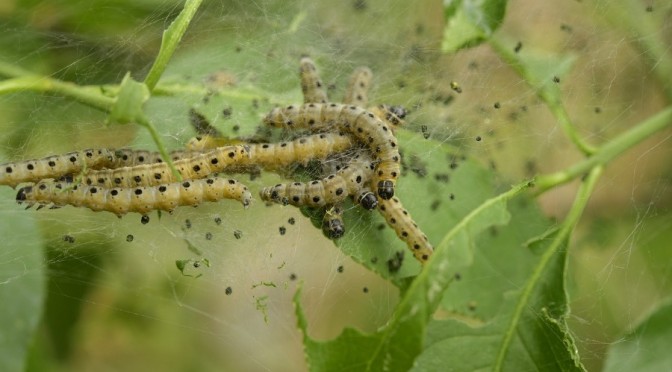
December Gardening (Wally Richards)

This week I received two emails which maybe of interest to some gardeners. The first was from a gardening couple, which read:

Hi Wally, Your advice and weekly email’s worked great. I got first in the Veggie Section and my wife won in the Rose categories. Jerry.

What can I say? If you use natural products that enhance the soil, giving the plants all the possible minerals that they may need to be healthy and stop using chemicals that are harmful to both soil, plants and yourself.

Over the years I have received a few similar stories about how gardeners have turned their gardens into award winners by simply observing and using the above information.

The second email is of concern this time of the year and it read;

Hi Wally, I have a problem with a brown beetle infestation. I was finding the leaves of my newly planted plum trees and almond tree were getting stripped bare almost. I wasn’t sure what it was but think the culprit is this brown beetle.

I have since found hundreds (literally) in one of my raised beds and quite a few wherever I have placed the garden mix I bought a month ago.

Is there something I can do to get rid of these beasties? They are now attacking my raspberry plants and feijoa trees. Because they are in the soil – and potentially quite deep (some of them were 20cm deep) – I’m not sure how to fight them. Please help!

The writer sent me an amazing photograph which shows hundreds of these brown beetles drowning in a container of water, along with photos of her plants badly damaged.

The beetle is the Grass Grub beetle and this is the time of the year that they emerge from pupating deep in the soil to feast on the foliage of a number of plants, mate and lay eggs back in lawns for future generations.

In my first book, Wally’s Down to Earth Gardening Guide, I suggest a trap to aid control of these pests.

Here is an extract from the book:

‘Grass grub adults emerge in October, and are active until about mid-December, depending on weather conditions and exactly where they are in New Zealand. The cooler the temperature, the later they emerge.

The adults will start to emerge in mild conditions, when the soil temperature reaches about 10 degrees they then mate, fly, eat and lay eggs in the short space of time between dusk and early evening.

As they tend to fly towards light, you are most likely to know they’re there when the flying beetles hit your lighted window panes.

This very attraction for the light has become one of our best weapons in controlling the pest in its adult stage. You can set up a grass grub beetle trap by placing a trough, such as the one used when wall-papering, directly underneath a window near a grassed area.

Fill the trough with water to about two-thirds of its capacity, then place a film of kerosene on top of the water. Put a bright light in the window, the beetles fly towards the lit window, hit the glass and fall into the trough.

The kerosene acts as a trap, preventing the fallen beetles from climbing out.

You can extend this method to areas away from the house by using a glass tank, such as might be used for an aquarium.

Place the empty tank into a tray containing several inches of water (and the kerosene), and position a light inside the glass tank.

By adding a sheet of ply or something similar over the top of the tank, you will ensure that the light shines only through the sides of the tank above the waiting water and kerosene.

It is better to use a dome-shaped battery-powered light rather than an ordinary torch for this job as the bigger light makes the trap more effective.

If the tray and tank are raised off the ground and placed on something like a table, you will get an even better result.

However you set up your beetle trap, this is a very good method to dispose of the pests. Simply get rid of all the beetles caught the next morning.

Run this system (call it Wally’s Grass Grub Beetle Catcher, if you like) from just before dusk to about 2 or 3 hours after sunset.’

Spraying the plants that are been attacked with Wallys Super Neem Tree Oil will help to also control the populations.

This should be done late in the day after the sun is off the plants. When a beetle chews on a leaf they get some Neem into their gut and that shuts off their ability to eat.

Problem arises, if there are hundreds of beetles then there needs to be hundreds of bites.

With the likelihood of more beetles emerging every day it is an on going battle over the next month or two.

Another way is to go outside just after dark with a torch and check your plants for beetles.

If you see a good number on any plant then a spray at that time with Wallys Super Neem Tree Oil and Wallys Super Pyrethrum added, sprayed to hit the beetles rather than the plant itself.

Another very good natural spray to use late in the day is a solution of Wallys 3 in 1 for Lawns.

This is a combination of Eucalyptus oil and Tea Tree oil, nice to use and deadly on pests.

If you repeat your nightly spraying and use a light trap also, then you will make a big dent in the grass grub beetle populations and thus suffer less damage to your plants and lawns.

The season is still poor weather wise which helps keep insect populations lower than normal but care should be taken with your potatoes and tomatoes by placing Neem Tree Granules on the soil in the root zone and spraying the plants occasionally with Wallys Super Neem tree Oil.

Visit your local garden center to obtain some good ideas for Xmas Presents.

Phone 0800 466464
Garden Pages and News at www.gardenews.co.nz
Shar Pei pages at  www.sharpei.co.nz
Mail Order products at www.0800466464.co.nz


New Zealand Bill of Rights Act 1990. Part II of the Act covers a broad range of Civil and Political Rights. As part of the right to life and the security of the person, the Act guarantees everyone:

1 The right not to be deprived of life except in accordance with fundamental justice (Section 8)

2 The right not to be subjected to torture or to cruel, degrading, or disproportionately severe treatment or punishment (Section 9)

3 The right not to be subjected to medical or scientific experimentation without consent (Section 10)

4 The right to refuse to undergo any medical treatment (Section 11)

 Furthermore, the New Zealand Bill of Rights Act 1990 guarantees everyone: Freedom of Thought, Conscience, and Religion.
This includes the right to freedom of thought, conscience, religion, and belief,
INCLUDING THE RIGHT TO ADOPT AND HOLD OPINIONS WITHOUT INTERFERENCE (Section 1)

ENCOURAGING CHILDREN TO GARDEN

We need to encourage our children and grandchildren to appreciate Nature by including them in some gardening activities.

I believe that young children have a natural infinity with plants and insects when they are allowed to explore our gardens.

Children learn many things by mimicking their parents and are often keen at a young age to assist in various gardening activities.

I remember as a toddler spending many hours in the garden collecting caterpillars off the cabbages and feeding them to our chooks.

I also can still remember how good it felt to be part of Nature back then and the same feeling pertains today when I work or wander around gardens.

Plants that ‘move’ have a fascination for children and a great one for this is Mimosa pudica, the Sensitive Plant, which folds up its leaves when touched.

They are easy to germinate from seed, grown as a pot plant for a windowsill. (Available Kings Seeds)

Nice pink flowers also. As the plant matures it has thorns on the branches which incidentally are another attraction for children.

Cacti with their prickles often appeal to young boys and I had a small collection when I was young and still keep a few.

Two awesome plants for children to grow are Giant sunflowers and Giant pumpkins.

Giant Sunflowers; these extra tall sunflowers will grow up to 5 metres tall.(17 odd feet) Grown in full sun in soil that has excellent drainage and lots of manure.

The giant pumpkins can be monsters which in some cases will weigh over 1000 pounds at maturity. (Half a ton)

If I was going to grow giant pumpkin, here is what I would do:

Obtain the Giant pumpkin seeds from a seed supplier. (Atlantic Giant is the type of seed you need again Kings Seeds)

Pick an all-day-sunny area, then dig a hole about a spade depth and width, chop up the bottom of the hole, so the soil is loose, then fill the hole with chook manure to about two thirds full.

(Other manure could be used if chook manure is not obtainable, but chook is best)

Fill the rest of the hole with a good compost and soil mix, 50/50 making a small mound about 12cm tall above the filled in hole.

Place three seeds in the mound and wet them down with Magic Botanic Liquid (MBL), (20 ml of MBL to 1 litre of water.)

Water the mount to keep moist with plain water and then every 2 weeks with the MBL.

Overseas the biggest record vegetables have been achieved with products very similar or the same as MBL. Spraying the foliage of your Giants every 2 weeks with MBL (10 ml to a litre) will also assist in a bigger healthier plant.

When the seeds germinate select the two smaller ones and carefully remove letting the best one grow on.

After your pumpkin is established and growing well, give them a drink using Wallys Cucumber Booster, once a week.

This is a high nitrogen product that is a combination of sulphate of ammonia and potassium nitrate, which you dissolve in water.

Cucumber Booster is excellent for any plants that enjoys a boost of nitrogen after establishment. It is used for growing cucumbers, pumpkins, zucchini and gourds.

The MBL and Cucumber Booster can be combined for watering into the soil near the base of the plant.

Because of the weather patterns we are experiencing, after you plant your seed, cut off the base of a 2 to3 litre plastic fruit juice bottle and place this over the mound, with the cap removed.

This will give your seed and seedling its own little glasshouse. This is removed once the seedlings germinate prior to culling out the two.

With the Giant Sunflower a tall strong stake should be put in the ground at seed planting time on the edge of a mound as described previously..

This will be needed later to give extra support to the plant.

Another interesting thing to do is once the sunflower gets up about a metre tall, plant 3 or 4 climbing bean seeds at the base of the plant.

These will grow up the sunflower and also provide extra nitrogen for the sunflower.

It is a lot of fun plus a great way to get the children away from the TV and video games, showing them there is more to life than a screen.

Some garden centres run competitions for the tallest sunflower and the biggest pumpkin with various prizes for the winners.

Aphids are likely to be found on your roses at this time and they can easily be controlled with a safe spray of Wallys Super Pyrethrum. Spray very late in the day just before dusk to obtain the best results.

Stone fruit trees that had the curly leaf disease will now be producing new leaves free of the problem. The damaged leaves will fall off over time.

You can if you like, spray the newer leaves a couple of times with potassium permanganate and Raingard just to be sure, but if the disease has finished for the season the sprays will not make much difference.

A spray of Vaporgard without the potassium permanganate would be more effective in allowing the tree’s remaining leaves to gain more energy from the sun, which is needed to produce a good crop.

Codlin Moths will start to be on the wing about now so obtain a pheromone trap from your garden centre so you can monitor the best time to spray.

A number of gardeners have found that a spray of Super Neem Tree Oil and Raingard over the young apples, applied about 5-7 days after an influx of moths into the traps, has resulted in only a very small scar on the mature apple, where the grub took its first and only bite.

(Note Wallys Super Neem Tree Oil has been cleared by EPA to sell again, just waiting on the new approved labels to arrive later this month)

Repeat spray 7 days later and then wait for another influx of moths before repeating.

Add Raingard or MBL to the spray to assist and extend the control period.

Tomatoes should be doing well if in a sunny, sheltered spot. Only remove laterals on a sunny day when it is not humid or moist.

Spray the wound immediately with Liquid Copper to prevent disease entering the wound resulting in the possible loss of the plant.

Ensure that the tomato plants are well supported on stakes during windy times. If you are concerned about blights spray the plants with Perkfection as a preventative, once a month. The same applies for your potatoes.

For general health of any plants, especially roses and food crops, a two weekly spray of MBL and Mycorrcin works wonders. Spray both the soil and the foliage.

Avoiding the use of chemical sprays and fertilisers is a must for healthy gardens and plants.

Phone 0800 466464
Garden Pages and News at www.gardenews.co.nz
Shar Pei pages at  www.sharpei.co.nz
Mail Order products at www.0800466464.co.nz


New Zealand Bill of Rights Act 1990. Part II of the Act covers a broad range of Civil and Political Rights. As part of the right to life and the security of the person, the Act guarantees everyone:

1The right not to be deprived of life except in accordance with fundamental justice (Section 8)

2The right not to be subjected to torture or to cruel, degrading, or disproportionately severe treatment or punishment (Section 9)

3The right not to be subjected to medical or scientific experimentation without consent (Section 10)

4The right to refuse to undergo any medical treatment (Section 11)

 Furthermore, the New Zealand Bill of Rights Act 1990 guarantees everyone: Freedom of Thought, Conscience, and Religion.
This includes the right to freedom of thought, conscience, religion, and belief,
INCLUDING THE RIGHT TO ADOPT AND HOLD OPINIONS WITHOUT INTERFERENCE (Section 1)

Image by Raksa R85mm from Pixabay

No dig garden using cardboard (Wally Richards)

I’m currently doing this with my garden plot. Brilliant idea. Especially if you’re a bit past digging extensively! EWR


Cardboard boxes are everywhere.

A lot of products are transported in cardboard boxes, most products we ship out are in cardboard boxes.

Supermarkets have heaps of medium to large cardboard boxes which they often put into a cycling bin as a friendly way of disposing of them.

During the week I chanced to have a chat with a gentleman that is doing similar as our company with a range of products to enhance your gardens.

During the conversation he told me of a method that he suggests to people and gardeners for starting or extending their vegetable gardens.

A method using cardboard that I had never thought of.

I have in the past suggested using cardboard as a mulch to suppress weeds which works very well.

This method is using cardboard to convert part of a lawn area into a productive vegetable garden very simply and very quickly.

In the past when I have converted a lawn to a growing area I have lifted the turf taking the top 50mm of turf off in squares, stacking them somewhere, grass side down, to rot down.

Then I would dig over the bare soil before raking off nicely for planting.

A bit of work but it made a new growing area.

Now this new way is that you firstly mow the area that you want to convert as low as the mower will let you.

You then cover the area with cardboard over lapping to ensure a total coverage of the area.

Do this on a calm day as it is difficult to do when it is windy.

Over the cardboard you put a layer of purchased compost about 20mm thick and lightly water to settle into place.

The reason for the purchased compost is that it will be weed free as long as it did not come from a re-cycling source.

I prefer Daltons Compost as it is good quality and herbicide free.

Most of the others I wouldn’t give you tuppence for as many are just fine bark with some nutrients added or bark with recycled garden wastes.

Once you have the cardboard and compost down then it is time to put minerals and nutrients onto the layer of compost.

I suggest Wallys Unlocking your Soil, BioPhos, Wallys Ocean Solids, Wallys Calcium & Health, Blood & Bone, animal manures, chicken manure, sheep manure pellets and Bio Boost. (As many as available)

Then we are going to place over these products a further layer of compost 40 to 50mm thick.

You need to choose a area that is fairly sunny and well away from trees, shrubs and vines as you are creating a great food source for your vegetables and those other bigger plants will try and robe your garden creating lots of fibrous feeder roots in the plot.

The first season will be ok but the fol,lowing season it will be full of roots and nothing will grow.

To help prevent this happening and to ensure your vegetable plot has good drainage make a trench around the plot area about to a spade depth.

This will allow surplus water to drain into the ditch where it will evaporate from sun and wind.

It will also help prevent some robber roots happening.

You could lay fence palings on top of this trench to allow a place for the wheels of your mower to ride on when cutting the rest of your lawn.

Give them a couple of coats of acrylic paint to seal in the tanalised chemicals.

If you only make your plot about a metre wide then you can work the area from one side.

If more than a metre wide you need to have a mowing strip on the far side to work all around the bed.

You should avoid walking on the b ed as it compacts the growing medium.

One time I did several parallel vegetable beds about a metre wide with lawn in between them at the width of my mower. This allowed me to mow between each growing bed and a nice place to work the gardens from.

I love the idea of cutting the lawn low, covering with cardboard to suppress the weeds and then covering that with goodies and compost. Instant vegetable plot.

On existing vegetable gardens that are currently empty except for weeds the same can be done.

Cover the area with cardboard as above, then the other things ready to plant up.

The cardboard will break down over time and the worms and soil life love it.

Then the following year you may want to put new cardboard down over the bed and repeat as above.

If you have a garden with say oxalis this will bury the plants and tubers and make gardening easier for a while.

Go to your local supermarket and ask them for their used cardboard cartons or help yourself out of the dumpster.

If you happen to be near where we are in Marton then I can supply you with some large cardboard boxes to use.

We are getting g close to Christmas and if you are looking to plant up containers to give away as Christmas gifts then you better get started so they have a bit of time to settle in before you given them away.

Phone 0800 466464
Garden Pages and News at www.gardenews.co.nz
Shar Pei pages at  www.sharpei.co.nz
Mail Order products at www.0800466464.co.nz


RELATED:

Here is a video from Charles Dowding’s YT channel demonstrating this method. For those like myself who like a visual demo. There are other related vids at YT that are also helpful if you search. EWR
New Zealand Bill of Rights Act 1990. Part II of the Act covers a broad range of Civil and Political Rights. As part of the right to life and the security of the person, the Act guarantees everyone:


1The right not to be deprived of life except in accordance with fundamental justice (Section 8)

2The right not to be subjected to torture or to cruel, degrading, or disproportionately severe treatment or punishment (Section 9)

3The right not to be subjected to medical or scientific experimentation without consent (Section 10)

4The right to refuse to undergo any medical treatment (Section 11)

 Furthermore, the New Zealand Bill of Rights Act 1990 guarantees everyone: Freedom of Thought, Conscience, and Religion.
This includes the right to freedom of thought, conscience, religion, and belief,
INCLUDING THE RIGHT TO ADOPT AND HOLD OPINIONS WITHOUT INTERFERENCE (Section 1)

Photo: screenshot Charles Dowding YT channel

Dealing with pests in your lawn (Wally Richards)

There are three insect pests that are the main problem ones in lawns; grass grubs, porina and black beetle grubs.

The affect they have on your lawns depends on the number of the pests in a given area.

A few, will hardly be noticed, where a good number per square foot will damage the grasses and be easy to see. Damage can be seen by bare spots, brown, dead areas or discolored grasses.

Birds are a very good indicator that there are grubs in the lawn when they spend their time scratching and pecking in certain areas.

I have gardeners ringing me up about this time of the year to say they have grass grubs in their lawns or that they have dead spots.

My first question is, how do you know you have grass grubs?

They usually reply that there is dead areas or that birds are ripping certain areas apart.

Nether of these are a good indication that there are currently grass grubs actively eating roots near the surface.

If there are dead areas which have appeared in the spring or early summer then it is likely that grass grubs did cause the problem by eating the roots of the grasses in the autumn and into the winter.

The grasses would have appeared ok in the winter, even though they had little root system left, because they were not actively growing.

In the spring when they started to grow on the root system left, which was insufficient to support the grass, thus it browns off and dies.

In the meantime the grubs have burrowed deep into the soil to pupate and then emerge about October to December as beetles.

There may well be a few grass grubs in the lawn at this time and by lifting some turf you can soon find out and how many there are per square foot.

If there are a few like 1 to 5 then its hardly worth while bothering with a treatment, a greater number would be worth while to treat.

Most likely the reason the birds are working the lawn is for porina caterpillars which live in the soil. Porina come up in the early part of the evening to feed at the base of the grasses.

These are easy to control by firstly mowing the lawn to allow the spray you are going to use, to reach the base of the grasses where they feed.

Then in late afternoon mix Neem Tree Oil at the rate of 5mils per litre of warm water and apply that to your lawn area. Using a lawn boy will do the best job to get a good coverage.

(Note EPA has just about completed our application under the new requirements for all Neem Oils and we should be back selling later this month.)

That night when the grubs come up to feed they will get a dose of Neem and that turns off their ability to ever eat again.

If the birds eat them they will not be affected and worms in the soil will be ok too.

The time to treat for grass grubs in the lawns is in the autumn when the soil is moist and they are feeding near the surface. The other time is when they are beetles which is about now.

With porina they can be treated all year round whenever they are present.

Treatment for grass grubs and black beetle grubs can either be a strong chemical one or a safe natural one such as Wallys 3 in 1 for lawns which is a mix of Eucalyptus and Tea Tree oils.

This will not harm wild life, pets or worms, where the chemical ones will.

To treat the grass grub beetles you can use the method described in my first book, Wally’s Down to Earth Gardening Guide, extract;

Grass grub adults emerge in October, (as beetles) and are active until about mid-December, depending on weather conditions and exactly where they are in New Zealand.

The cooler the temperature, the later they emerge. The adults will start to emerge in mild conditions, when the soil temperature reaches about 10 degrees, they then mate, fly, eat and lay eggs in the short space of time between dusk and early evening.

As they tend to fly towards light, you are most likely to know they’re there when the flying beetles hit your lighted window panes.

This very attraction for the light has become one of our best weapons in controlling the pest in its adult stage.

You can set up a grass grub beetle trap by placing a trough, such as the one used when wall-papering, directly underneath a window near a grassed area.

Fill the trough with water to about two-thirds of its capacity, then place a film of kerosene on top of the water.

Put a bright light in the window, the beetles fly towards the lit window, hit the glass and fall into the trough. The kerosene acts as a trap, preventing the fallen beetles from climbing out.

You can extend this method to areas away from the house by using a glass tank, such as might be used for an aquarium.

Place the empty tank into a tray containing several inches of water (and the kerosene), and position a light inside the glass tank.

By adding a sheet of ply or something similar over the top of the tank, you will ensure that the light shines only through the sides of the tank above the waiting water and kerosene.

It is better to use a dome-shaped battery-powered light rather than an ordinary torch for this job as the bigger light makes the trap more effective.

If the tray and tank are raised off the ground and placed on something like a table, you will get an even better result.

However you set up your beetle trap, this is a very good method to dispose of the pests.

Simply get rid of all the beetles caught the next morning by flushing down the toilet or feeding to chooks.. Run this system (call it Wally’s Grass Grub Beetle Catcher, if you like) from just before dusk to about 2 or 3 hours after sunset.

We know now how to make the grubs’ preference for light work against them, but light can also work in their favour.

If you have un-curtained windows in rooms which are lit at night, you will find grass grub beetles from yours and neighboring lawns will be attracted to the area during the early hours of the evening.

Street lighting is probably the worst offender, and people with areas of lawn near street lights often find those are the parts worst-affected by grass grubs.

The beetles will eat the foliage of various plants such as roses, beans and citrus while on the wing.

Those plants that are being eaten can be sprayed with Neem Tree Oil.

If the populations of beetles are very high then in the early part of the evening take a torch and check the plants that are being eaten.

If you see lots of the brown beetles then mix up a spray of  Wallys Super Pyrethrum added and go out and spray the pests.

The pyrethrum is a quick knock down and should wipe out good numbers of them.

The more beetles you can kill means less damage to your lawns next year.

Phone 0800 466464
Garden Pages and News at www.gardenews.co.nz
Shar Pei pages at  www.sharpei.co.nz
Mail Order products at www.0800466464.co.nz


New Zealand Bill of Rights Act 1990. Part II of the Act covers a broad range of Civil and Political Rights. As part of the right to life and the security of the person, the Act guarantees everyone:

The right not to be deprived of life except in accordance with fundamental justice (Section 8)

2The right not to be subjected to torture or to cruel, degrading, or disproportionately severe treatment or punishment (Section 9)

3The right not to be subjected to medical or scientific experimentation without consent (Section 10)

4The right to refuse to undergo any medical treatment (Section 11)

 Furthermore, the New Zealand Bill of Rights Act 1990 guarantees everyone: Freedom of Thought, Conscience, and Religion.
This includes the right to freedom of thought, conscience, religion, and belief,
INCLUDING THE RIGHT TO ADOPT AND HOLD OPINIONS WITHOUT INTERFERENCE (Section 1)

Image by JayMantri from Pixabay

Some useful gardening tips (Wally Richards)

For most of the country it has been a poor spring and slow start of the growing season.

We have the daylight hours, in fact we are now only about 7 weeks away to the longest day of the year.

It is the temperatures that are the problem, we are not getting the constant warm temperatures during the day and night.

That does not matter to hardy plants and vegetables that can be grown outdoors all year around such as cabbages. (On line shopping today New World whole cabbage $9.99 at Countdown $7.69)

Lettuce between $3.00 to $4.00 each?

Wow, I currently have so many lettuces that I give then to my chickens.

Not only that as a result of letting one lettuce (Drunken Woman my favorite) go to seed, it self seed giving hundreds of seedlings.

Some of which I have transplanted and currently have lettuce from small seedlings to mature plants going to seed.

I don’t bother growing much cabbage, broccoli or cauliflower as they take longer to mature and we seldom use them anyway in preference to Bok Choy which is much quicker to mature and takes less room.

Silverbeet is an excellent vegetable to grow as it has high nutritional value and you harvest only the outer leaves for use as it will keep producing till it goes to seed.

Whether you grow in open ground, raised gardens or in containers you can produce hardy vegetables that will not only be inexpensive compared to current cost of purchased vegetables but will also have great flavour be free of chemical poisons.

The stuff you buy from Supermarket is not only bloody expensive but are chemically grown and sprayed with chemicals thus having little goodness and a bland flavour.

If it tastes good without having to use condiments then it is good for your health.

Basically no matter how you grow you apply natural products to the soil/growing medium such as any animal or chicken manures, blood & bone, sheep manure pellets at the base.

Garden Lime such as Wallys Calcium & Health, minerals from Ocean Solids and Wallys Unlocking your soil.

Then over this a layer of Daltons Compost. (Most others I do not trust because they can contain recycled green waste which maybe full of herbicides).

Then into this you plant seeds or seedlings and spray them every week with Magic Botanic Liquid (MBL) they will grow twice as fast and twice as big and be very advantageous for your health and budget.

I expect that vegetables in the supermarket are only going to get dearer because of high cost of imported fertilisers, cost of chemical sprays to keep the plants looking perfect on the shelves and the cost of diesel.

Because of the milder temperatures heat loving plants are not fairing very well.

My tomato plants grown in a plastic house in the Auto-pot system are doing ok but plants that like much more heat such as cucumbers, capsicum and chili are sitting and sulking even with the high quality nutrient they have to grow with.

I hate to think how poorly these plants wound do in open gardens along with pumpkin and other cubits.

They would really sulk until the temperatures became better which is most unusual for weather after Labour Weekend in NZ.

If, as some predict, we are heading into a solar minimum which reduces the global temperatures to the extent of a mini-ice age or worse then that would be far worse for food growing than a global warming.

Most of you will have planted or are planting tomato plants currently, if in a glasshouse you will have better results than out doors. Outdoors you need a very sunny, sheltered spot for best results.

Treat the soil with the products mention but don’t use Calcium & Health instead buy some Dolomite.

Tomatoes and Potatoes like a slightly acidic soil pH.

Now this is important to get the best results out of a tomato plant; you make a deep hole and plant it deep, up to the bottom leaves or even deeper.

The reason is that a tomato plant will produce roots all the way up the trunk and often on a more mature plant you will see knobs near the base of the trunk which are beginnings of roots.

If that is seen then mould up growing medium so the root system is increased.

The bigger the roots to feed, the better the plant.

You can place a little of Wallys Neem Tree Powder in the planting hole and sprinkle some of Wallys Secret Tomato Food with Neem Granules on the soil.

That will assist in deterring whitefly especially in a glasshouse as well as feed the plants.

The Secret tomato food contains a good amount of potash which I have noticed lacking in other brands, likely because potash is expensive.

If your tomato, capsicum, chili do not have ample potash then your fruit will lack flavour.

Wallys Secret Tomato Food with Neem Granules was created on the request of a specialist tomato grower who wanted the very best tomatoes.

He told me many years ago that he had tried all the brands but none of them produced really great flavored fruit.

So along with fertiliser experts we created the product, Wallys Secret Tomato Food which over the last 15 plus years has been well sort after by people that love to grow the best tomatoes possible.

There are two types of tomato plants; Indeterminate and Determinate the first is tall growing and is actually a climber the later is a bush type which is short with a wide spread such as dwarf types.

In the Indeterminate type there are very large fruiting ones such as Boy o Boy which can produce fruit weighing 500 grams. Some you need only one slice to cover sliced bread!

To do that you need to not only remove the laterals but also reduce down the amount fruit per truss to get a monster tomato.

Laterals form between the trunk and the leaf branch and in Indeterminate tomato plants it is best to remove them otherwise you get a plant that requires lots of staking and support.

On a determinate plant the laterals are often left on to make the plant bushier and produce a lot more trusses and thus a lot of smaller fruit.

If you allow a lateral to grow about 8cm long you can strike it as a cutting and get free extra tomato plants.

If last season your tomatoes were affected by the tomato psyllid that we wrote about recently then you need to use Wallys Cell Strengthening Kit to protect your plants and be able to harvest tomatoes like you did in the past.

Phone 0800 466464
Garden Pages and News at http://www.gardenews.co.nz
Shar Pei pages at http://www.sharpei.co.nz
Mail Order products at http://www.0800466464.co.nz


New Zealand Bill of Rights Act 1990. Part II of the Act covers a broad range of Civil and Political Rights. As part of the right to life and the security of the person, the Act guarantees everyone:

1The right not to be deprived of life except in accordance with fundamental justice (Section 8)

2The right not to be subjected to torture or to cruel, degrading, or disproportionately severe treatment or punishment (Section 9)

3The right not to be subjected to medical or scientific experimentation without consent (Section 10)

4The right to refuse to undergo any medical treatment (Section 11)

Furthermore, the New Zealand Bill of Rights Act 1990 guarantees everyone: Freedom of Thought, Conscience, and Religion.
This includes the right to freedom of thought, conscience, religion, and belief,
INCLUDING THE RIGHT TO ADOPT AND HOLD OPINIONS WITHOUT INTERFERENCE (Section 1)

Image by Urszula from Pixabay

Psyllids in your garden and how to deal with them (Wally Richards)

Psyllidae, called the jumping plant lice or psyllids. (Note much of the following is from Internet research)

They are a family of small plant-feeding insects that tend to be very host-specific, each plant-louse species only feeds on one plant species or feeds on a few closely related plants.

Of current concern to tomato, potato, tamarillo, capsicum and chili gardeners is the new psyllid commonly known as the tomato/potato psyllid.

This psyllid comes from Central and North America where it breeds primarily on potatoes, tomatoes and other plants in the potato family, Solanaceace.

It also breeds on kumara, which is in the bindweed family, Convolvulaceae.

It was first found in New Zealand in 2006 and has spread throughout New Zealand.

This psyllid may transmit a bacterium, Candidatus Liberibacter solanacearum that causes a disease in its host plants.

The tomato potato psyllid occurs on its host plants in gardens, and crops in greenhouses and on farms.

The tomato potato psyllid breeds all year, though the time from egg to adult (generation time) is longer in the winter when it is cold, than in the summer or in a heated greenhouse.

Adult tomato potato psyllids are small insects similar in size to aphids. They have wings and look like small cicadas with a distinctive white band on the abdomen. The two pairs of transparent wings are held over their abdomen.

Tomato potato psyllid eggs are yellow and attached to leaves by a thin short stalk. The eggs may be laid on all parts of the leaf and plant stem, but are often found on the leaf edge where they are most easily seen.

Nymphs hatch from the eggs. They are flat and scale like, and have three pairs of legs and sucking mouthparts.

They settle on young leaves, mainly on the underside. Although they can walk, they spend much of their time motionless with their stylets inserted into the plant feeding on the plant sap.

There are five nymphal stages, each is called an instar. buds. Adults emerge from fifth instar nymphs.

The length of time needed for nymphal development depends on the temperature and is shorter when it is hotter.

The tomato potato psyllid inserts its maxillary stylets into the phloem, (the plant vessels for transmitting sap from the leaves to other parts of the plant.)

The sap has a high volume of water and sugars, more than the insect needs.

It excretes the excess water and sugar, which is called honeydew. The tomato potato psyllid coats the droplet of honeydew with white wax before ejecting it.

Leaves can become covered with these white wax coated droplets that are called psyllid sugars.

Like some other Hemiptera (sucking bugs), the tomato potato psyllid can transmit plant pathogens to plants.

Tomato potato psyllid is the primary vector (transmitter) of a bacterium, Candidatus Liberibacter solanacearum, which causes a disease that may weaken plants and reduce yields and quality of crops.

Plants infested with the psyllid may exhibit symptoms of a disease, psyllid yellows.

The disease symptoms initially appear in response to psyllid feeding and is presumably a physiological reaction to feeding and saliva secretions by the tomato potato psyllid.

On tomatoes, the disease symptoms are the yellowing and stunting of the growing tip and a cupping or curling of the leaves.

Many flowers may fall off the trusses of infected plants and fruit that develop may be small and misshapen.

On potatoes, the foliar symptoms are a stunting and yellowing of the growing tip and the edges of the curled leaves often have a pink blush or purple colour.

After a while infected potatoes develop a scorched appearance and plants may collapse prematurely.

Potato plants that are infected at an early stage, develop numerous small tubers. Tuber quality is also affected when the plants are infected at a later stage.

The disease is referred to as zebra chip because when the affected potatoes are fried they exhibit dark stripes where the areas high in sugar burn.

In New Zealand, the bacterial disease is usually less of a problem on outdoor capsicums, chilli and egg-plant.

Tomato potato psyllid breeds all year, especially in the warmer parts of the country and in greenhouses. In these situations, all life stages may be found all year round. In other areas, non-breeding adults may be found on plants.

Adults feed on leaves and can mate more than once. A female can lay up to 500 eggs over a 21-day period, but in the field it is more likely to be around 200 eggs.

The number of eggs laid also depends upon the host plant. The rate of development of nymphs is dependent on temperature.

The psyllid develops between 15°C and 32°C with optimum development at 27°C.

In a greenhouse with an average temperature of 18°C psyllids takes 33 days to complete their life cycle.

In New Zealand there are to 7-8 generations per year in the Auckland region.

In New Zealand’s winter, the numbers of psyllids are low and development is very slow.

Adults and nymphs can survive short periods of sub-zero temperatures. In New Zealand’s spring numbers on infested plants will begin to build up and reach a peak in late summer/early autumn.

Adult psyllids have wings and in North America can spread long distance by air. In New Zealand, dispersal tends to be more limited, 100 m or more in three days. They will invade new areas and plants, especially in summer.

From my experience its a temperature to numbers game, when given the ideal temperatures.

One adult laying 500 eggs can mean in about a month you have a population of 250,000 adults

Initially sprays will help control but as numbers rapidly increase you would need to spray every day and still lose the battle.

That was the point I reached about 3 years ago and watched my tomato plants and tamarillos die in front of my eyes.

The following season I treated my tomatoes and other host plants with silicon drench and sprays and in one season completely wiped out the psyllids from my glasshouse and gardens.

The silicon treatment which I call the ‘Cell Strengthening Kit’ makes the plant’s cells too tough for the psyllid nymphs to piece and feed and they soon starve to death after hatching.

This breaks the life cycle and there are no new adults to replace the old ones when they die.

Information on the kit is available on our mail order web site at www.0800466464.co.nz

More info on the pest at http://www.gardenews.co.nz/product.html#The%20Potato%20and%20Tomato%20Psyllid%20control%20with%20Cell%20Strengthen%20sprays%20and%20drench

With our Silcon products you can once again grow tomatoes, potatoes and other affected plants.

or phone me for more information.

Phone 0800 466464
Garden Pages and News at www.gardenews.co.nz
Shar Pei pages at  www.sharpei.co.nz
Mail Order products at www.0800466464.co.nz


New Zealand Bill of Rights Act 1990. Part II of the Act covers a broad range of Civil and Political Rights. As part of the right to life and the security of the person, the Act guarantees everyone:

1The right not to be deprived of life except in accordance with fundamental justice (Section 8)

2The right not to be subjected to torture or to cruel, degrading, or disproportionately severe treatment or punishment (Section 9)

3The right not to be subjected to medical or scientific experimentation without consent (Section 10)

4The right to refuse to undergo any medical treatment (Section 11)

 Furthermore, the New Zealand Bill of Rights Act 1990 guarantees everyone: Freedom of Thought, Conscience, and Religion.
This includes the right to freedom of thought, conscience, religion, and belief,
INCLUDING THE RIGHT TO ADOPT AND HOLD OPINIONS WITHOUT INTERFERENCE (Section 1)

Photo: pixabay.com


Phosphorous for your garden (Wally Richards)

When we buy plant foods or fertilisers for our gardens we see on them the letters N:P:K followed by numbers which indicate the amounts of each of these elements. The NPK stands for Nitrogen, Phosphorus and Potassium.

Nitrogen provides growing power and helps make plant leaves and stems green.

Nitrogen is used to form basic proteins, chlorophyll, and enzymes for the plant cells. In short, a plant can’t grow without it.

Phosphorus stimulates budding and blooming. Plants need phosphorus to produce fruits, flowers, and seeds.

It also helps make your plants more resistant to disease. Phosphorus doesn’t dissolve like nitrogen. The soil will hang onto phosphorus, not releasing it into water.

Potassium promotes strong vigorous roots and resistance to disease.

Potassium is a nutrient your plants need for good internal chemistry.

Plants use potassium to produce the sugars, starches, proteins and enzymes they need to grow and thrive. Potassium also helps your plants regulate their water usage, and better withstand the cold.

I believe of the three elements its the phosphorus that is least understood by some gardeners.

In the distant past phosphorus was obtain from manures especially bird or bat droppings called guano. Phosphorus was also obtained from Reactive Rock Phosphate which is a hard phosphatic rock.

In most soils it dissolves very slowly.

To make the rock phosphate more readily available to plants it was discovered that a process using sulfuric acid, early in the 1900’s,

would breakdown the reactive rock phosphate so a new agricultural fertiliser was created called Super or Super Phosphate.

It became a boon to agriculture and farming with tons of Super been spread to cause fast growth in fields and crops.

Unfortunately like a number of discoveries such as DDT and Asbestos, there was a hidden price to pay.

Super phosphate kills soil life and with their demise leads to unhealthy plants/grasses.

Not only that, it is now known that Super laden plants and grasses can cause health problems in stock including cancers.

(Chlorine and acidic products also destroy soil life including earth worms. Overt time through continued use soil becomes inert or lifeless)

I read a very interesting book some years ago called ‘Cancer, Cause and Cure’ written by an Australian farmer, Percy Weston.

Percy observed the results of the introduction of Super on his farm and the changes that occurred.

If you are interested the book can be obtained by mail order. The book made me reconsider the use of Super phosphate in garden fertilisers.

Interestingly I have never been an advocate of Super phoshate and to the best of my knowledge have never purchased it as a stand alone fertiliser for my gardens.

Though I have on odd occasions in the past used General Garden Fertilisers.

Fortunately I have always preferred sheep manure pellets, animal manures and natural products as my general plant food.

Now days I avoid using chemical fertilisers or chemical sprays including any herbicides anywhere on my property.

But I have noticed in the past, that even though I have obtained good healthy crops and plants, there is some factor that appears to be missing and the crops are not as lush as I feel they could be.

I have often thought that I am not getting sufficient phosphorus in my composts and mulches.

This caused me to do a bit of research on the Internet and found to my delight a company in New Zealand who make a product called BioPhos.

They take the rock phosphate and break it down naturally with micro organisms making it as readily available to plants as Super phosphate is.

The company sent me a email booklet and it showed trials that proved that not only did BioPhos work as well as Super, but actually better as it did not have a ‘peak’ growth on application and gave a much longer sustained release of phosphorus to plants.

Instead of killing soil life it actually supplies new micro organisms to the soil which carry on breaking the natural phosphorus down, meaning that only one application is needed per year unless you are cropping during the winter as well.

Some rose growers and rose societies recommend using BioPhos for better, healthier roses. BioPhos contains phosphate, potassium, sulphur and calcium at the rates of P10:K8:S7:Ca28.

It is pH neutral and used at the following rates; New beds work in 100 grams per square metre, the same with lawns but water in to settle.

Side dressing plants; seedlings 8 grams (a teaspoon full) around base of the plant or in the planting hole.

Same for potatoes (which do well with phosphorus) Sowing beans peas etc sprinkle down row with seeds.

Roses and similar sized plants 18 grams or a tablespoon full around plant or in planting hole.

Established fruit trees etc, spread at the rate of 100 grams per square metre around drip line or where feeder roots are.

Apply to vegetable gardens in spring and a further application in autumn if growing winter crops. Can be applied to container plants also.

Gardeners that use Biophos for the first time around their gardens often contact me tell how much their gardens have improved within a few weeks of using the product.

Maybe because the gardens are missing phosphate and a sprinkling gives the plants what they have been wanting.

Phone 0800 466464
Garden Pages and News at www.gardenews.co.nz
Shar Pei pages at  www.sharpei.co.nz
Mail Order products at www.0800466464.co.nz


New Zealand Bill of Rights Act 1990. Part II of the Act covers a broad range of Civil and Political Rights. As part of the right to life and the security of the person, the Act guarantees everyone:

1The right not to be deprived of life except in accordance with fundamental justice (Section 8)

2The right not to be subjected to torture or to cruel, degrading, or disproportionately severe treatment or punishment (Section 9)

3The right not to be subjected to medical or scientific experimentation without consent (Section 10)

4The right to refuse to undergo any medical treatment (Section 11)

 Furthermore, the New Zealand Bill of Rights Act 1990 guarantees everyone: Freedom of Thought, Conscience, and Religion.
This includes the right to freedom of thought, conscience, religion, and belief,
INCLUDING THE RIGHT TO ADOPT AND HOLD OPINIONS WITHOUT INTERFERENCE (Section 1)

Photo: Image by Ville Mononen from Pixabay


Spring in the garden: things we might miss or forget (Wally Richards)

It is an very interesting spring and start to the new season.

Most of us are saying where is spring? It is already into October and not much springy in the air.

Mind you before the Polar Blast that had us adding another layer of clothes and lighting the fire we did have some not too bad days.

Hopefully those mild days were sufficient to bring some of the pests out of their winter hiding places to be stuck dead by the cold blast.

If in spring we have an early start with sunny days and warm temperatures, then it turns to custard with a few days of bitter cold then all the pests that came out will shiver to death and our pest problem will be significantly reduced.

It then will be into the new year before their numbers multiply and cause problems.

It is now not long before Labour Weekend arrives and that is the New Zealand Traditional time for planting out the tender plants such a tomatoes and Impatiens.

More tender plants such as cucumbers should not be planted till the weather really settles otherwise they just sit there and sulk.

If you do early plantings of non-hardy plants then only do a couple or so and then two to three weeks later another little planting.

Follow that pattern and you cant go wrong.

It is a timely reminder to check grafted fruit trees, ornamentals and roses.

Grafted means they are growing on a similar family plant’s root stock.

This is done for several reasons such as preventing suckering, giving what is supposed to be a better plant such as High Health in Roses and also to determine the end result size of the tree.

The root stock can and often does start producing foliage and if that is allowed to grow then the energy from the roots is grabbed by the root stock’s development and likely at some time the tree that is grafted onto the root stock will fail and die.

Normally it is fairly easy to see the union where the tree is

connected to the root stock.

So any foliage that appears there on the root stock should be rubbed off or cut off to prevent it growing bigger.

Sometime the foliage may appear from under the soil near the trunk. Once again remove.

I have come to understand that grafted stone fruit trees are very likely to have curly leaf disease as the graft is a weakening aspect of the tree’s health and vigor.

I learnt this week an interesting thing; apparently if a person receives a transplant organ then over time that person may start to develop characteristics and even memories of the donor.

Which make s me wonder if a grafted tree starts to show aspects of the tree it is grafted too?

Dwarf stone fruit are the worst to have curly leaf problems.

If you grow a peach, nectarine or plum from a stone then apparently because it is on its own root system it will be far less likely to have curly leaf disease and maybe also less or none of other problems.

With roses we some times see what is often called a water shoot which is a strong upward shoot from near the base.

I think the recommendation is to cut them off but on one occasion I let it grow and with some cosmetic pruning over a couple of seasons turn a bush rose into a standard.

A reader today asked about her compost bins which are made out of tanalised timber.

She asked ‘Would the tanalised timber be harmful to the compost and would it be ok to use the compost on the vegetable garden’?

Tantalized timber has some nasty chemicals in them (Ask any older builder that has worked with tantalized timber for years about how they are faring)

I also learnt from a building inspector that tantalized fence palings that I screwed to my steel warehouse

(To attach steel cages onto for gas bottles and instant gas hot water unit) would overtime eat into the steel and cause corrosion.

So if the chemical can do that to colour steel what are they going to do to your food crops that will take up the chemicals that leach into the soil/compost?

Not a healthy outlook for sure.

The answer is to give the tantalized wood that has been cut to the right size a couple of coats of acrylic paint before assembling to seal the chemicals in.

This is also applied to raised gardens when using tantalized timber.

Container plants indoors and outdoors over winter required much less water but now as the day light hours increase and temperatures rise they will require more moisture.

A problem arises though in that the growing medium, when it became dry causes tension that does not allow the water to penetrate.

So when you water not all the mix/root system gets any moisture and you have a dry spot.

Water rather than staying in the mix a lot of it will run out into the saucer.

There are two ways to solve this problem.

Container that are not too large should be taken and plunged into a tub of water submerging the whole pot. It will start to bubble away which is the air being forced out of the medium as the water replaces the dry air pockets.

When the pot stops bubbling lift up and let the surplus water drain out before returning to its saucer.

That means next time you water the plant will get all the benefit.

If you have a large container that you cannot plunge into a tank of water then what you do is this.

Fill your watering can with warm water and then give a good squirt of dish washing liquid into it.

Lather up with your hand to make the water nice and soapy.

Water the soapy water into the container mix and this will break the tension and allow water to wet the whole mix till the same happens again.

Hanging baskets are prone to having tension and not getting a proper drink. This is especially so with hanging baskets outdoors.

Plunge into a tub of water and watch them bubble. During the summer outdoor baskets should be plunged once a month.

Another big problem with container plants is root mealy bugs and the easy way to fix is to sprinkle a little of Wallys Neem Tree powder over the mix then cover with a little more potting mix.

The powder with become mouldy as it breaks down and look unsightly.

Under a layer of fresh mix you will not see it.

Something extra which  I received this week that you may find interesting/shocking?

https://www.debtclock.nz/?utm_campaign=20221007_newsletter_jordan&utm_medium=email&utm_source=taxpayers

Someone has to pay for this and its not the ones that have caused this debt.

Phone 0800 466464
Garden Pages and News at www.gardenews.co.nz
Shar Pei pages at  www.sharpei.co.nz
Mail Order products at www.0800466464.co.nz


New Zealand Bill of Rights Act 1990. Part II of the Act covers a broad range of Civil and Political Rights. As part of the right to life and the security of the person, the Act guarantees everyone:

1The right not to be deprived of life except in accordance with fundamental justice (Section 8)

2The right not to be subjected to torture or to cruel, degrading, or disproportionately severe treatment or punishment (Section 9)

3The right not to be subjected to medical or scientific experimentation without consent (Section 10)

4The right to refuse to undergo any medical treatment (Section 11)

 Furthermore, the New Zealand Bill of Rights Act 1990 guarantees everyone: Freedom of Thought, Conscience, and Religion.
This includes the right to freedom of thought, conscience, religion, and belief,
INCLUDING THE RIGHT TO ADOPT AND HOLD OPINIONS WITHOUT INTERFERENCE (Section 1)

Image by Eszter Miller from Pixabay
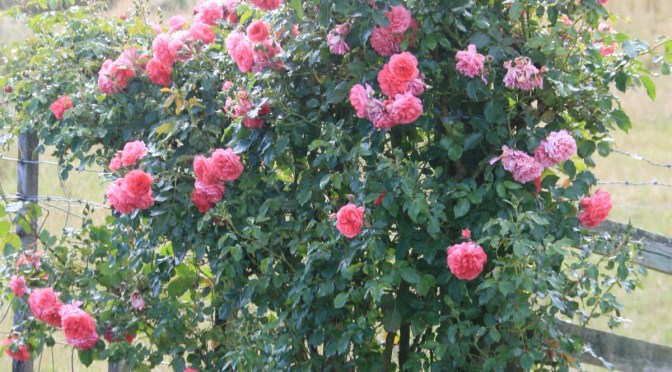
Your Plants’ Natural Immunity (Wally Richards)

Plants, just like ourselves, have built in protection against diseases though their immunity systems.

We build up our immunity naturally over the years by surviving disease attacks and by having a healthy nutritionally rich diet.

That is not to say that we are immune to disease attacks but under normal situations we can fend off most health problems when we have very good health.

If we get into stress then our metabolism does not have the same stamina and we catch a cold or worse.

It is said the leading cause of heart disease and cancer is stress. I think its the stress that is the straw that breaks the camels back, after unhealthy living and insufficient nutrient rich food.

The same applies to plants, place them into stress and they will more likely catch a disease.

I have written a lot in the past on how to build the health of plants by building the health of the soil; having soil that is rich in humus, minerals, earth worms and soil life.

Even when we have the best soil on earth, plants can still catch a cold when they are placed into stress and our current spring weather is very stressful to our plants and to us keen gardeners.

Chilly winds, too wet, too dry, only the occasional nice day does not make for great gardening and our plants don’t do so well either.

We can however increase the immune systems of plants by a few monthly sprays of Perkfection Supa for roses and other plants.

The active ingredient of Perkfection is ‘Phosphite ion’ or Phosphonic Acid. (Potassium ions are also present).

Perkfection is very safe to handle and spray and when used on food crops there is no withholding period other than your normal washing of produce before eating.

Perkfection is used extensively by commercial growers of produce and fruit as its safe, effective, in prevention and control while not restrictive on exports of produce.

We have suggested Perkfection Supa for Roses and Other Plants as an alternative to more toxic sprays, for the assistance in recovery from/or prevention of, the following problems:

 Black spot, Downy Mildew, Phytophthora Root rot, botrytis, Canker, heart rot, damping off, crown rot, leaf blight, silver leaf, late blight, collar rot, pink rot, brown rot, Armillaria, and gummy stem rot.

Now that’s a big list of common plant diseases which means that many of your disease related problems can be overcome with applications of this product.

Besides using Perkfection over your roses for the likes of Black spot and Downy mildew you can also use it as a spray over all your fruiting plants and trees including your strawberries.

It can be used also over your potatoes, tomatoes, lettuce, beans, cubits (cucumbers etc) lawns, onions, passion fruit, Cauliflowers, cybidium orchids and ornamental plants and vines.. In fact there is no where you cannot use Perkfection to advantage.

Being ‘Synthetic Organic Phosphates’ what you are doing, is placing this valuable material, onto the foliage of your plants, where it is very readily absorbed and transferred through the whole of the plant.

This fortifies the plant’s cells, increases the plant’s immune system and makes your plants less susceptible to invading pathogens.

There is however a down side, as with any good thing, you can use too much and the recommendation is to use Perkfection at 4 ml per litre of spray once a month for about 6 times in a season.

(Note a season is the normal period of time for that crop or plant. Roses are from Spring till Autumn. Most annuals 5-6 months.)

The reason is that, you can over load your plant with organic phosphates causing a clogging of the cells and halting growth until the system clears.

If a plant has a problem spray the first month with Perkfection at 7 mls per litre.

For plants you wish to fortify use at 4ml per litre for 2 to 3 months.

Prevention is better than cure and by spraying your plants in the spring you give the greatest protection to leaves and fruit, autumn spray will give greatest protection to roots and tubers.

I have suggested that on the 1st of the month to spray your roses and other preferred plants with Perkfection, MBL (Magic Botanic Liquid) and Mycorrcin. Then 14 days later (15th) spray with Mycorrcin and MBL.

What we are doing is boosting the plant’s immune system, supplying a large range of minerals and elements, feeding the beneficial microbes to increase their populations which also work to eliminate diseases.

If insects problems occur then include Wallys Super Pyrethrum as it is a quick knock down control.

Phone 0800 466464
Garden Pages and News at www.gardenews.co.nz
Shar Pei pages at  www.sharpei.co.nz
Mail Order products at www.0800466464.co.nz

New Zealand Bill of Rights Act 1990. Part II of the Act covers a broad range of Civil and Political Rights. As part of the right to life and the security of the person, the Act guarantees everyone:

1The right not to be deprived of life except in accordance with fundamental justice (Section 8)

2The right not to be subjected to torture or to cruel, degrading, or disproportionately severe treatment or punishment (Section 9)

3The right not to be subjected to medical or scientific experimentation without consent (Section 10)

4The right to refuse to undergo any medical treatment (Section 11)

 Furthermore, the New Zealand Bill of Rights Act 1990 guarantees everyone: Freedom of Thought, Conscience, and Religion.
This includes the right to freedom of thought, conscience, religion, and belief,
INCLUDING THE RIGHT TO ADOPT AND HOLD OPINIONS WITHOUT INTERFERENCE (Section 1)

More tips on beating those pests in your garden (Wally Richards)

It is a new gardening season and once it warms up the pest populations will quickly grow.

So far the temperatures have been below what would be normal for this time of the year and considering we are only a few weeks away from Labour Weekend it is most strange.

Temperatures have a great bearing on insect pest activity and population growth.

An ideal spring is an early one with 2-3 weeks of nice warm temperatures which attract the pests out of hiding to get on with their lives. Then a sudden cold snap for a week will bowl most of them out of our gardens and then delay the problems they cause till after the new year.

As the weather/temperatures are not great yet it means they are marking time for better days.

If we place controls in now and over the next few weeks we will be able to stop, confuse and eliminate a lot of the pests before their populations start to build.

This can be achieved by quick elimination of the pests that are lurking about on our plants by the use of the quick knock down spray; Wallys Super Pyrethrum.

For General use at 1ml to 2 litres of water (5ml to 10 litres of water) It is very concentrated and very cost effective.

Best used just prior to sunset when bee activity has ceased.

The spray will stay active through the night affecting any pest insects that come into contact with the residue.

Next day it will become inactive within 2 hours of direct sunlight.

You can also use Wallys Super Pyrethrum at 2.5ml per litre for a spray under eaves for spider  or indoors for flies etc.

Contains: 28g/litre pyrethrins in the form of an oil in water emulsion

A 1ml pipet is supplied in addition to the measure which is on the side of the Bottle.

Note the container has 100mils which makes up 200 litres of normal garden spray strength.

If not all the made up spray is used, then place the sprayer in a dark cupboard to keep it ready for future use.

The next step in pest control is to hide your plants so the pests dont know that they are there.

Of course you cant lift the plants and hide them some where but seeing many pests find their host plants by the smell of them, then we can disguise the plant’s smell by an over riding stronger smell.

Wallys Neem Tree Granules are perfect for this and even I have been surprised by the many comments from Landscapers and gardeners about how their pest problems have reduced by simply scattering Wallys Neem Tree Granules over the soil near plants, shrubs and even trees.

Ideal in a glasshouse to stop whitefly from smelling your tomato plants.

Placed under your citrus trees and Rhododendrons it will not only disguise the smell of the plants but also clean up any pests in the canopy. Repeat another application 3 months later.

On fruit trees that maybe attacked by either Codlin Moth or Guava Moth I suggest to also make some little bags out of old curtain netting, fill with the Neem Granules and hang in the tree at the four cardinal points about your height, high.

Moths flying around at night will not be able to smell the fruit so easily and so fly on by not knowing there is a ideal place to lay their eggs.

Another excellent control is a lure and trap which can be a from a color or a smell.

Wallys Sticky Yellow White Fly traps are ideal for both inside a glasshouse and outside hanging by plants such as tomatoes.

It always amazes me how many small adult pests are caught on these yellow sticky pads.

That in its self stops hundreds of eggs being laid and the resulting damage to your plants.

Then there is also another way to control moth problem by which you set up a moth lure to attract them and kill them.

Take one litre of hot water add a 100 grams of sugar, one teaspoon of marmite, half a tablespoon of

Cloudy Ammonia and half a tablespoon of Vanilla:

Mix well and divide the mix between two plastic milk or soft drink bottles. (500 mils approx each)

Punch or drill some holes (big enough to allow a moth in) in the side of the bottles just above the level

of the mix. Place on a stand about a couple of metres away from the tree. At about waist height like on a small folding table.

When a number of moths are caught dispose of them and make up a new solution.

Ideal for both codlin and guava moths.

Then we can have control of the psyllid pest which effects and destroys our tomatoes, potatoes and tamarillos and to a lessor extent, capsicums, chilies, peppino and okra.

If you had psyllid problems on your tomatoes last season this is what you do.

When you plant your tomato seedling water it in with a solution of Wallys Silicon and Boron Soil Drench, used at 10ml per litre of water apply about a 150mls of the solution into the soil to water the seedling in. You will repeat this again two weeks later.

This gets the silicon into the plant through the roots and the plant takes it up readily because of the boron.

You then mix Wally Silicon Cell Strengthener Spray used at 5ml per litre of non-chlorinated water and

Mixed with Wallys Silicon Super Spreader used at just 1mil per 5 litres of non chlorinated water.

(Comes a 100ml bottle makes 500 litres of spray, use the 1ml Transfer Pipet supplied to measure)

Mix these two products into a one litre Trigger sprayer which will be 5mils of Wally Silicon Cell

Strengthener Spray with quarter a mil of Silicon Super Spreader which drives the spray into the tomato plant. Spray the young plants each week till about a metre tall.

The spray keeps ok so just place out of direct sunlight to use again next time, after giving the contents a shake.

Once a metre tall spray 2 weekly and then when you reach the stage when there is a good fruit set spray once a month for any new growth.

Done correctly you will wipe out all the psyllids in your back yard or glasshouse and be free of the pests next season until they find their way back from the neighborhood.

Remember that a lot of pests are brought home on plants obtained from elsewhere including places you purchased from.

Root mealy bug is a curse insect as is root nematodes both suck goodness out of the roots of plants they are feeding on. On container plants and out doors they can be treated with Wallys Neem Tree Powder sprinkle a little on to the potting mix then cover with a little more potting mix

On lawns you can do the same but in gardens where the pests are just use Wallys Neem Tree Granules. Often gardeners are surprised at how good the treated plants are after a few weeks of application.

Thats because they dont have the pests sucking out their goodness anymore.

Here is to a reduced pest problem this season.

Phone 0800 466464
Garden Pages and News at www.gardenews.co.nz
Shar Pei pages at  www.sharpei.co.nz
Mail Order products at www.0800466464.co.nz


New Zealand Bill of Rights Act 1990. Part II of the Act covers a broad range of Civil and Political Rights. As part of the right to life and the security of the person, the Act guarantees everyone:

1The right not to be deprived of life except in accordance with fundamental justice (Section 8)

2The right not to be subjected to torture or to cruel, degrading, or disproportionately severe treatment or punishment (Section 9)

3The right not to be subjected to medical or scientific experimentation without consent (Section 10)

4The right to refuse to undergo any medical treatment (Section 11)

 Furthermore, the New Zealand Bill of Rights Act 1990 guarantees everyone: Freedom of Thought, Conscience, and Religion.
This includes the right to freedom of thought, conscience, religion, and belief,
INCLUDING THE RIGHT TO ADOPT AND HOLD OPINIONS WITHOUT INTERFERENCE (Section 1)

COMING UP ROSES (Wally Richards)

A gardener this week phoned me asking about roses and what should he be doing this time of the year?

He suggested that I should write an article about roses so here is a copy of a past article I wrote over 5 years ago and revised now:

There is something special about roses that gardeners like.

It could be the shape and form of the flowers; it maybe the exotic perfumes some varieties have; or it could be something in our genes, because roses must be the oldest cultivated ornamental plant in the history of the world.

In Nature things such as leaf diseases (black spot, rust etc) and insect pest attacks on plants is part of life but when it comes to the rose enthusiast these natural occurrences are like the end of the world.

Woe betide a blemish to the foliage or an aphid feeding on the newly forming flower buds in spring.

It is war and every chemical of mass destruction will be mixed and used to control and eradicate.

The goal is the perfect bloom (with a tear drop of dew on a petal) framed by perfect foliage of a dark rich green. Picture perfect and hopefully with a divine scent to boot.

For those that show their roses at their annual local rose show or in the national rose shows the perfect specimen is the ultimate challenge.

I remember in days gone by when chemicals; that have since been banned because of the damage they did to the environment and to our health, such as Shield for Roses.

These would be used religiously by gardeners on their beloved roses biweekly.

Alternating with Super Shield and applications of Rose Fertiliser and Nitrophoska Blue.

If the rose sprays did not do what was expected there were other lethal chemicals to use, Captan, Bravo, Orthene, Target and Maldison. (All banned now as far as I am aware)

To say that the health of the roses was compromised would be an understatement and every season instead of the perfect rose the plants would be a very sore sight.

Years ago I recognised the problem that the chemicals were doing to the soil life and the immune systems of the roses and wrote articles on the matter.

I remember a Garden Centre owner in the Taranaki region telling me how she read my articles on roses and followed the advise. Within a couple of seasons she had turned the sickly roses in her home garden into lovely roses.

The local rose society members visited the gardens and were amazed at how healthy her roses were and wanted to know what chemicals she was using to have them looking so great.

Her reply was no chemicals which the members had problems believing because they had been indoctrinated into Shield, Nitrophoska etc as the ultimate tools of rose perfection.

The products made the companies that sold them a lot of money but did nothing for the health of the roses or the health of the users.

Here is a little logic I remember as a boy visiting my uncles farm in Taranaki where my auntie had a few rose bushes between a paddock and the gravel driveway.

Besides the dust on the plants in a dry summer and the occasional cow or possum nibbling the foliage they were very healthy.

They had some horse or cow manure thrown at them from time to time and cut back in the winter along with a bit of a tidy up.

Another aspect was that being in the country the plants were not suffering from chemicals in the water such as Chlorine. Just rain water from the sky or the tank.

I remember another rose enthusiast who also told me that his parents were great collectors of roses and had over the years several hundred specimens on their farm property which he was also involved in their care.

He told me how over the years of growing up how wonderful and healthy the plants had been.

As ‘new’ things were introduced to assist with the rose care, the health of the roses deteriorated so more stronger chemicals were used to no avail.

His parents passed and it was then his sole responsibility to care for the sick inheritance.

No matter what he used, how much he sprayed the roses only got worse and one winter after another poor health season he was seriously considering plowing all the roses into the ground as they were hopelessly sick and some had already died.

He told me he read an article I wrote about rose health and a program to follow and decided to give it a go for one last attempt.

What happened was that season there was a marked improvement in the roses, not up to their former glory but certainly heading in the right direction.

Then in the following season most of the roses turned to their full health state and a phone call to thank me was made. He said that my advise was the best gift to his deceased parents ever.

It is just common sense really, work with Nature not against it.

Chemicals are designed to kill and control; they can kill both the good as well as the bad plus adverse side effects as we commonly see with our own human pharmaceutical concoctions.

Chlorine in water is bad news for soil life so if you have this poison in your tap water then see about removing it with a 10 micron carbon bonded housing and filter. Email me for more info if interested.

Next stick to natural things to feed your roses (and other plants) this includes all animal manures including sheep manure pellets, blood & bone, compost that is not made from green waste.

(I know people that have lost their roses to compost containing herbicides from green waste)

The compost is used to cover over the blood & bone etc.

For extra minerals use Wallys Unlocking your Soil twice a year and Ocean Solids once a year.

Apply a little Fruit and Flower Power once a month during flowering season.

Spray your roses 2 weekly with Magic Botanical Liquid (MBL) This will do more for your roses health than anything that I know of.

Once a month spray them with Perkfection starting in Spring when there is a good show of leaves. Perkfection can be added to every second spray of MBL.

Any sign of aphids spray just before sunset with Wallys Super Pyrethrum, it is a quick knock down control.

During season any sign of leaf diseases spray with potassium permanganate at a quarter teaspoon per litre of water.

Here is something that you may find interesting; a Peer reviewed study about climate change that was released recently

see https://www.aei.org/carpe-diem/there-is-no-climate-emergency-say-500-experts-in-letter-to-the-united-nations/

It confirms my thoughts that adverse weather events have been happening every since weather was recorded.

The difference is the Media coverage now compared to say 50 years ago when you only found out about floods and droughts in the news paper.

Pushing the Fear Button for control and to make us poor.

Phone 0800 466464
Garden Pages and News at www.gardenews.co.nz
Shar Pei pages at  www.sharpei.co.nz
Mail Order products at www.0800466464.co.nz

New Zealand Bill of Rights Act 1990. Part II of the Act covers a broad range of Civil and Political Rights. As part of the right to life and the security of the person, the Act guarantees everyone:

1The right not to be deprived of life except in accordance with fundamental justice (Section 8)

2The right not to be subjected to torture or to cruel, degrading, or disproportionately severe treatment or punishment (Section 9)

3The right not to be subjected to medical or scientific experimentation without consent (Section 10)

4The right to refuse to undergo any medical treatment (Section 11)

 Furthermore, the New Zealand Bill of Rights Act 1990 guarantees everyone: Freedom of Thought, Conscience, and Religion.
This includes the right to freedom of thought, conscience, religion, and belief,
INCLUDING THE RIGHT TO ADOPT AND HOLD OPINIONS WITHOUT INTERFERENCE (Section 1)

Photo: envirowatchrangitikei

USDA is tracking community gardens! Red flag

This is from Doug and Stacey. We’ve posted their videos just twice so far on the topic of living off grid.

Here we have a topic rearing its head again … one that is of concern to all of us world wide as the global plans tighten up further, global food supplies manipulated and controlled (see the Ice Age Farmer for more info on that) and the promise from the globalists we’ll ‘own nothing and be happy’. We had hints of future control in NZ back with the Food Bill, threatening we could not share or our produce over the back fence. Nice try! Watch Kiwis!. So here it’s pointed out that the registering of your community garden with government is a red flag and about more than meets the eye … watch and listen to the video.

OFF GRID with DOUG & STACY

Subscribe to OFF GRID with DOUG & STACY: http://bit.ly/2nrYf24