Category Archives: 1080 poisoning

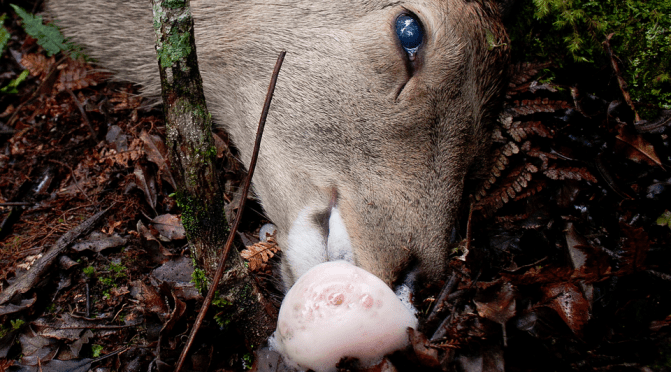
DEER POISONED WITH 1080 can experience exploded internal organs, they tear open their own stomachs with their antlers, blood oozes from eyes & nose & their eyes pop out

A repost from 2019

These images were captured in the Taupo Region in 2016, images of contorted deer that have died a slow agonizing death from 1080 poisoning. For over 50 years the New Zealand Government has been systematically dropping massive amounts of food, laced with this cruel and universally toxic poison into its forest ecosystems. Enough poison every year to kill the entire population of NZ four times over. No other country is doing, or ever has done, anything remotely similar on such a scale.

READ AT THE LINK

If you’re new to the independent information about NZ’s favourite poison for ‘saving’ birds (one aerial 1080 drop in 2002 killed an estimated 10,000 birds … Landcare’s own data) a must see is the GrafBoys’award winning doco, Poisoning Paradise.

Explore our 1080 pages (main menu) or use the drop down box, left hand side of the page. Animals die a very cruel death with 1080. A Veterinarian has explained death by 1080 as slow electrocution. The NZ authorities tweaked the Animal Welfare act to exempt the spreaders of aerially dropped 1080 poison from prosecution for cruelty!

Finally, they want rid of all non-natives. They are not telling us that directly of course. Jenese James describes NZ’s Pest Free agenda in her article, Who is driving PFNZ?:

RELATED POSTS HERE

AND HERE:

Why are people so concerned about 1080?

A farmer who lost 570 ewes following an accidental 1080 drop on his farm said that 6 months later sheep were still dying


Back in 1994 Dr Meriel Watts wrote in her book The Poisoning of New Zealand*, of constant phone calls to the Soil & Health Assn by  folk asking … “Is 1080 safe & do I have to let them drop it on my property?” The Association’s view at the time she said was ‘no’ and ‘no’. Soil & Health’s submission to the Parliamentary Commissioner for the Environment’s Possum Management review stated that “the current practice of distributing by air large amounts of 1080-laced carrot and pollard baits over large areas has lead to unacceptable risks to the environment, human health, dogs, farm stock, birds and other members of the ecosystem.” (p 186, 187).

That submission cited various incidents experienced by farmers.

“In one case a South Island farm lost 570 ewes when 1080 was dropped in his pastures as a result of the helicopter swinging too wide when dropping over bush patches. His sheep were still dying up to six months later; there were also a large number of abortions.” (Dr M Watts, p 187)

“In another case … a central North Island farmer came home to find 1080 spread all over her farm and around her house. There was a nice sign stating this fact, but no prior notification and no prior permission given. Fortunately her dogs were locked up.” (Dr M Watts, p 187)

We seldom of course hear of these incidents as they are not normally featured by mainstream media.  It has been highlighted via the GrafBoys’ information that these stats are actually hidden in the paper work.

Farmers, when claiming compensation, are required to list that compensation as for purposes other than poisoned stock losses.

Please read the comments at this link (previous post) where a farmer shares about the loss of his dogs to likely 1080 poisoning. “MAF and DOC hushed it up pretty quick” he said.

See tv-wild.co.nz also for further info from the GrafBoys. Watch the video on topic at their Youtube channel here.


*The Poisoning of New Zealand by Dr Meriel Watts, Ak Institute of Technology Press, 1994

Image by Roman Solar from Pixabay (note, not the actual farm or farmer in the article).

“No dead body will ever be tested for 1080 in NZ because any pathologist who did so would not have a job for long”… NZ MD speaks out

This is an older post from Carol Sawyer, a New Zealander researcher and writer who spent many years intensively examining the information on 1080 poison. Information that DoC is not interested in. Here Carol interviews retired GP Kevin Shannon on the 2006 story concerning the loss by a NZ laboratory of the heart of a young woman who was a suspected victim of 1080 poisoning while tramping in the South Island Dr Shannon’s statement explains the reticence of any laboratory that does test for 1080 in disclosing their identity. EWNZ.


Police tested for about six poisons, none of them 1080, and then “had the effrontery” to tell him this was not a death by 1080 poison.

hiking-358555_1280.jpg

By Carol Sawyer

Last year I met with retired Dunedin GP, Kevin Shannon, still fit and tall and travelling the world at the age of 87. Kevin (who gave a submission at the ERMA Review 2007, on the case of the death of a female tramper in the link below), is of the opinion that:

…some New Zealanders, no-one knows how many, will have died of heart attacks due to undetected Compound 1080 (sodium monofluoroacetate).

Kevin added that in this instance the Police tested for about six poisons, none of them 1080, and then “had the effrontery” to tell him this was not a death by 1080 poison.

He told me that no dead body will ever be tested for 1080 in NZ because any pathologist who did so would not have a job for long.

See article here :

https://envirowatchrangitikei.wordpress.com/…/could-this-h…/

(see here also)


RELATED:
 THE CATCH 22 OF 1080 POISONING IN NZ – AN MD SAYS THERE IS ‘NO EVIDENCE’ OF IT BECAUSE IT IS NOT ALLOWED TO BE LOOKED FOR

NO ONE IS ALLOWED TO DO AN EPIDEMIOLOGICAL STUDY IN NZ TO SEE HOW 1080 POISON MAY BEHAVE IN OUR POPULATIONS LIVING WITHIN THE POISON AND DUST ZONES

“IF YOU DIE FROM 1080 POISONING NOBODY WILL KNOW” … BULLIED DOCTORS ARE NOT DOING THE TESTS … Dr Charles Baycroft

“In case you have any doubt, the MOH and their clerical employees have a great deal of control over our medical professions and they do not take kindly to anyone expressing an opinion that they disagree with. Working Doctors with current practicing certificates have to tread lightly where the MOH and their agendas are concerned.” Dr Charles Baycroft

NB: Exercise the precautionary principle and take extreme care whilst tramping in NZ’s wild places. The Class 1A Ecotoxin 1080 is spread liberally and aerially around NZ’s environment and we are told it is not very harmful to humans. See our page on suspected 1080 poisoning cases.

SOURCE

Photo Credit: Carol Sawyer

DOC admits to their recent killing of Kea in 1080 drop (note, killing NZ’s native birds with 1080 is not new)

This looks like an uncommon occurrence while still insisting the pay off is worth it to continue its use.

Here is a link to Newshub’s recent news announcement on topic at Youtube:

“The Department of Conservation has confirmed a number of kea were killed in a recent 1080 drop around Arthur’s Pass. The department says it’s awful, not good enough, and they want to do better.”

‘Too big a sacrifice’: DoC confirms kea killed in recent 1080 drop around Arthur’s Pass | Newshub

However, consider the list below of historic carnage concerning 1080 and the unfortunate Kea:

https://envirowatchrangitikei.wordpress.com/?s=kea

And for those new to the topic consider this article I wrote in 2018:

Why are people so concerned about 1080?

Photo: Image by Tim from Pixabay

In spite of denials, according to Fire & Emergency NZ, the company called Pest Control Research in Christchurch was manufacturing 1080

By Carol Sawyer

Excellent work by Stuff reporter, Joanne Naish. At last something is starting to come out in the open.

“The company did not dispute official documents from Fenz, but allegations the company was making 1080 at the site had only come from the “anti-1080 brigade”, he said.

“Oh yeah? Here is the text of an email from Fire Service Assistant Area-Commander, Steve Kennedy, January, 2020:

“This message was sent with High Importance.

In June 2019 FENZ, in conjunction with Worksafe, was involved in an incident at Pest Control Research, 1/56 Wickham. The site remains contaminated following an industrial incident involving the manufacture of Sodium Fluoroacetate.

No entry is to be made to this building. The site report and Dispatch Safety Alert have been updated.”

***********************************************

On site are the following chemicals, according to a Work Safe email sent to FENZ and forwarded by Steve Kennedy to ? on 23 January, 2020. (I have a copy and have posted it up previously):

Ethyl fluoroacetate, ethanol, sodium hydroxide, and sodium fluoroacetate (pure 1080).

See the last method in this document… one way to make pure 1080 is to mix ethyl fluoroacetate, methanol and sodium hyroxide. Ethyl fluoroacetate is highly flammable and very dangerous, as dangerous as sodium fluoroacetate (1080). It isn’t used to make Christmas cake.

https://pubchem.ncbi.nlm.nih.gov/…/Sodium-fluoroacetate…

Ummmm….. why was there no hazardous chemical signage put on this building by Work Safe NZ – until 2020 when a small hazchem sign was put up beside the door?

Why was Unit 2, next door to this one, leased out towards the end of 2019, with the real estate agent who leased it out knowing nothing about what was through the wall, or so he told me? (The accident happened on May 28, 2019).

Read Stuff’s article at the link:

https://www.stuff.co.nz/…/1080-factorys-warehouse-still…

Photo: Stuff.co.nz

Kea likely killed by 1080 – DoC

From the Otago Daily Times

A Massey University post mortem has found six kea in the Matukituki Valley of the Aspiring National Park ”are likely” to have died from 1080 toxin.

The birds were among the 12 kea monitored by the Kea Conservation Trust after the Department of Conservation’s aerial 1080 predator control operation on February 11.

DOC threats director Amber Bill said in a statement today it was ”regretful” to lose any kea to 1080.

”But overall, aerial predator control is proven to benefit kea populations.

”It’s upsetting and disappointing to lose six kea but we are confident with effective control of rats and stoats we will significantly boost nesting success and the number of young birds entering the population.

”We are concerned the tracked kea may have learnt to eat human food around the tramping huts, making them more likely to try 1080 cereal bait.

”DOC’s extensive research of kea through aerial 1080 operations show the risk of 1080 to kea in remote areas is very low but increases markedly with birds that have learnt to scrounge for human food.”

Ms Bill said the Matukituki operation followed DOC’s best practice to mitigate risks to kea from 1080 and ensure they benefited from stoat control after last year’s extreme forest mast or seeding.

”We are constantly working to improve our risk mitigation standards for kea, which are informed by our ongoing research programme.

”In light of this incident, we will be investing more to explore potential additional measures that DOC can take to reduce the risk to kea in future 1080 predator control operations.”

Ms Bill said DOC was considering a campaign to discourage people from feeding kea and prevent kea from learning to scrounge.

“Kea are super smart and present unique conservation challenges.

”We need to continue to learn and assess all options to protect this national taonga from predators and other threats.”

Recent rodent monitoring results from the Matukituki showed rats had been reduced from damaging levels – present in 47% of tracking tunnels – to being undetectable – 0% of tracking tunnels -, following the 1080 operation.

Stoat monitoring was underway.

The Matukituki programme was designed to protect rock wren, kea and whio, as well as kākāriki, kākā, and South Island robin following a beech mast-fueled rat and stoat plague.

Ms Bill said DOC was monitoring whio and rock wren to track how these species were doing.

The dead birds were three adult males, one adult female, one juvenile male and one juvenile female.

SOURCE

https://www.odt.co.nz/regions/wanaka/kea-likely-killed-1080-doc?fbclid=IwAR22SOHfIvTohLfC_Dg_L5AFdd9tiBy2ZS66dgCdO5I5TOH8pnUTjh9odOY

DoC’s own data reveals each poisoning operation kills on average 12% of NZ’s native kea – “a tragedy easily avoided” – Dr Jo Pollard

Dr Jo Pollard, BSc (Hons), PhD

Posted by Carol Sawyer

(Published in the Greymouth Star, 10 March, 2020)

In 1979 scientist Eric Spurr warned that wide scale poisoning of New Zealand with compound 1080, intended to kill introduced mammals, was actually killing kea and many other animals. It took decades before NZ’s Department of Conservation (DoC) finally began to monitor kea deaths from 1080 poisoning.

Now, using DoC’s own data, we can estimate that each poisoning operation will kill an average 12% of kea.

During the most horrific example DoC managed to kill 78% of the tracked kea population (7 of 9 kea monitored at North Okarito). Last month, in the Matukituki Valley, 50% of DoC’s monitored kea died after a 1080 drop.

Disturbingly, two myths have again been rolled out in an attempt to soothe public anger over the destruction of these now rare, iconic birds.

Myth 1. Kea are only likely to eat baits if people have conditioned them through providing food previously. DoC’s own research shows that this is not true. 9% of monitored kea (2/22) died at Kahurangi, a site chosen by DoC precisely because of its remoteness.

The fallacy of this claim is clear to anyone with experience of kea. They are curious to examine and pull anything new apart – as motorists will often attest after even the briefest of encounters with these inquisitive creatures. Scientists consider that this trait is likely an adaptation to living in a harsh environment, where food can be very hard to find, especially in winter (when 50% or more of kea juveniles are likely to die of starvation). Before the advent of DoC, helicopters and a toxin designed to kill everything from microbes to mammals, a willingness to try a new food source undoubtedly played a key role in the birds’ survival.

Myth 2. Kea nests need protection from stoats and 1080 poison provides that protection. Two studies have shown that the presence of stoats does not bother kea (in 1969, then again in 1999). Even if stoats were a problem for kea, 1080 would not fix the situation, quite the reverse. Scientists found that stoats became more likely to eat birds after 1080 drops. Why? Because rats, a primary source of food for the stoats, have been almost wiped out.

Mice do not usually eat 1080 baits so, in the absence of hungry rats, their numbers boom in the aftermath of a 1080 drop – a fact easily established by a review of the literature. Rat numbers, usually low immediately after 1080 operations, rebound strongly within months – often peaking at figures far higher than were present pre-drop. The population booms of mice and rats that are caused by 1080 drops are never highlighted by DoC, although they are easily seen in many studies. Those booms are likely to fuel stoat plagues as a new generation of mustelids arrives to find a larder overflowing with rodents.

Journalist Dave Hansford last year made the dubious claim that because of the “benefit” of 1080 to kea breeding, up to 22% of kea could die before there would be a net loss (Spinoff, August 2019). A 50% death rate would surely be tragic then, even to a journalist with an extreme pro-1080 bias!

Nature lovers should be very concerned because the monitoring of kea throughout 1080 drops is unique. No other native species: microbe, plant, insect or bird has been given even a tiny fraction of the attention or resources that have been used to monitor kea. 1080 is broad spectrum, highly toxic, spreads rapidly, travels up food chains, binds to cellulose and has extreme, unexpected effects. What is happening to everything else that lives in our forests, wetlands, grasslands and mountain tarns?

1080 poison may have a dual function for DoC. Not only does it attract an enormous amount of government funding, its use may help divert concern away from other ways in which vital habitat is being lost through poor management and financial interests. Examples are DoC’s approving high quotas for tourist helicopter flights (80 per day were planned for the remote Darran mountains) and the continued mining of conservation land (despite government promises to curb it).

The public needs to wake up to the fact there is no “science” behind DoC’s aerial poisoning. Mast-driven rodent plagues, often used to justify aerial poisoning, have been around since the time of the kiore. They are part of a general, short term increase in productivity including bird breeding. Effects are not something DoC needs to try to control with aerial poison, it should follow the evidence and stop blindly interfering in a process that it is simply not equipped to control.

Healthy populations of native birds, such as mohua and kakariki, lived in many places around the South Island until DoC started “helping” them by interfering with nests and trapping out the main rat predator (stoats). Rat numbers escalated, bird numbers plummeted, then broad spectrum 1080 poison was applied.

DoC’s science-less management shows a complete lack of respect for NZ’s ecological heritage and the legal mandate it holds to conserve it. Kea, much loved and admired, seem destined for the same fate as other species that have suffered from DoC’s “helping hand”. DoC needs to leave them and everything else alone, now.

For references and more information visit www.1080science.co.nz

Photo: Pixabay.com

Conservationists in NZ sounding the alarm over drop in the numbers of the famously inquisitive kea bird

DoC of course are blaming the feeding of kea, do read the information from Dr Jo Pollardto put that one to rest. EWR

from the Otago Daily Times

There are thought to be between 1,000 and 5,000 of the alpine parrots left in New Zealand, and the Kea Conservation Trust says it’s seen a fall in the population in the South Island’s Hawdon Valley in recent years. “When you go up into the mountains, the numbers are really concerning,” volunteer Mark Brabyn tells Stuff.co.nz. “We don’t want to wait until there is only a couple of hundred left to do something.”

Kea are known for their trusting nature around humans, often approaching passers by and happily gobbling up junk food. But that’s part of the problem. Gorging on ice cream and chips left over by hikers – or sometimes fed directly to the birds – can end up killing them. Stoats are another major threat, destroying all six kea nests in the area last year with no chicks surviving, Mr Brabyn says.

The government has previously admitted that the controversial poison 1080, which is dropped from the air to kill predators, is also responsible for killing some kea. Studies are being carried out to determine whether the poison is an overall help or hindrance to the birds.

The Kea Conservation Trust is now trying to crowdfund a mobile app to track kea with the public’s help. Anyone who encounters a tagged bird would be able to input its tag number to learn more about that individual, log its location, condition and behaviour, and even upload photos. “It would give us such valuable information about numbers and how far they were travelling, and would raise awareness about the bird. People would be connecting and caring,” Mr Brabyn says.

As far as predators go, New Zealand’s government wants to rid the whole country of stoats, rats and possums by 2050, saying these non-native animals kill 25 million native birds each year. But the kea’s inquisitive nature can make even well-meaning pest control efforts difficult.

In February, seven of the birds died after breaking into stoat traps to get at the egg and meat bait inside, prompting the Department of Conservation to modify 700 traps to make them kea-proof. Current research into traps involves stoat anal glands, which presumably won’t attract curious birds.

SOURCE

https://www.odt.co.nz/regions/wanaka/kea-likely-killed-1080-doc?fbclid=IwAR22SOHfIvTohLfC_Dg_L5AFdd9tiBy2ZS66dgCdO5I5TOH8pnUTjh9odOY


Image by cernazu1 from Pixabay

If you suspect you’ve suffered 1080 poisoning in NZ you can’t get tested, despite many DoC signs on poison drop sites saying if poisoning suspected contact the National Poisons Centre

HUMAN BEINGS FALL BETWEEN THE CRACKS WHEN IT COMES TO 1080 POISON

by Carol Sawyer

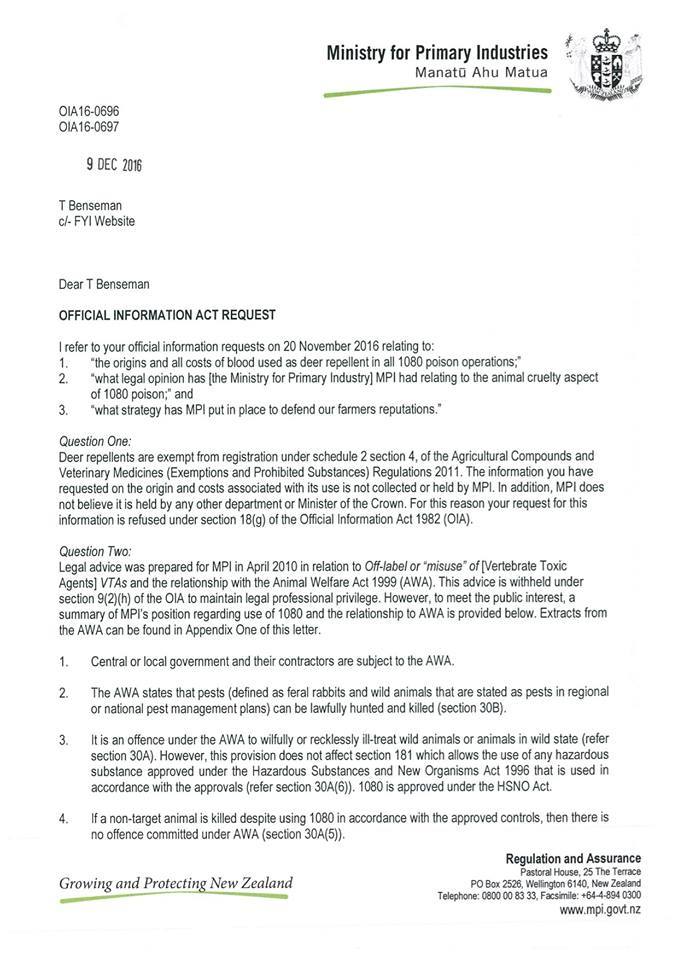
I did a post earlier today about the Ministry of Primary Industries’ Official Information Act response to an OIA request. Their response (see below) quoted the Animal Welfare Act. The AWA said “If a non-target animal is killed despite using 1080 in accordance with the approved controls, then there is no offence committed under the AWA (section 30A (5))”.

With regard to the AWA comment Peter Marshall pointed out, on ‘Upper Clutha Community Notices’ Facebook page, that “… that includes humans then.”

I thought Peter was onto something, (well, wouldn’t you ?) and I wrote a Facebook post about it. However later, when looking at the section regarding “interpretations” in the AWA I found that, for the purposes of the Animal Welfare Act, humans are not classed as animals.

So I deleted my post. Apologies to those who had shared it.

But that is pretty interesting really, isn’t it? The Animal Welfare Act says we are not animals. What are we then?

Also, if as a human being you suspect you have suffered 1080 poisoning you can’t get tested either, despite many ‘Dept of Conservation’ signs at 1080 poison drops saying that if you suspect poisoning you should contact the National Poisons Centre.

See my conversation with the National Poisons Centre here:

https://www.facebook.com/carol.sawyer.3511/posts/2376542842626028

I guess that means we humans are between a 1080 bait and a hard place😔


animal cruelty mpi


Image by Darko Stojanovic from Pixabay

In 1957 a 1080-poisoned horse was fed to local dogs leaving 250 of them dead

MORE THAN 250 DOGS KILLED BY 1080 POISON IN ONE HIT !
( Chatto Creek, Central Otago, NZ – ca. 1957 )

Story by Murray Ellis, via Karen Hore, posted by Carol Sawyer

Murray writes :

“Back in Chatto Creek in about 1957 the local Rabbit Board were dropping carrot slices laced with ‘1080’ poison out of Tiger Moths (aeroplanes) somewhere around Clyde. Stan Lewis was the boss and somehow his daughters gave their pet horse some of these left over carrots. The horse died. Stan, still not knowing what killed the horse, cut it up. He was in control of Rabbiters who had about 300 rabbiting dogs. He dropped some fresh meat off to each Rabbiter over a 50 km radius.
We knew Dan Engstrom and he had about 60 dogs at Chatto Creek. We got back from rabbiting and saw a large slab of fresh meat outside the front door. The dogs had not had fresh meat in a while, so Dan let 60 dogs attack the meat. Some just sniffed and walked away. Over 48 hours most of those dogs went crazy, frothing at the mouth, some strangled themselves on their chains.
We were 10-12 year old kids at the time ,and it left a horrible memory to see those dogs suffer. Only about 8 of those dogs survived . Other Rabbiters lost most of their dogs as well. So a simple accident can kill a horse, and the poison in the horse meat kill over 250 dogs. Even in the 1950’s they didn’t know what they where dealing with, and even now they probably still don’t know what they are playing with.”


Image by Nicooografie from Pixabay

Following a 7 month silence, NZ Worksafe confirms 2019 Christchurch poisoning was 1080, & also appear to confirm a fatality

By Carol Sawyer

If this IS the case there were TWO people poisoned by 1080 on May 28, 2019, at the Kiwicare Ltd warehouse in Bromley, Christchurch, where, according to news reports, chemicals were being processed for delivery to the main 1080-bait factory, Pest Control Research Ltd, in Rolleston.

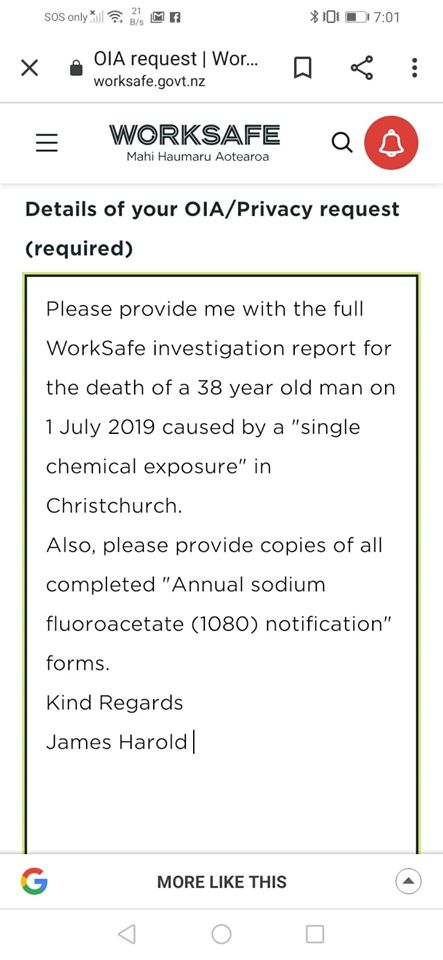
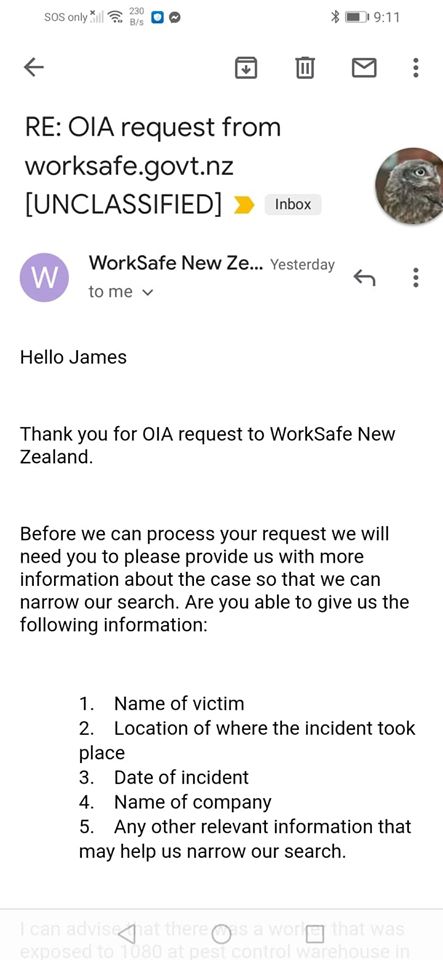
On 9 January, 2020, James Harold sent an OIA request to Worksafe ( see below).

82913229_2559826197631024_3792307001103482880_o

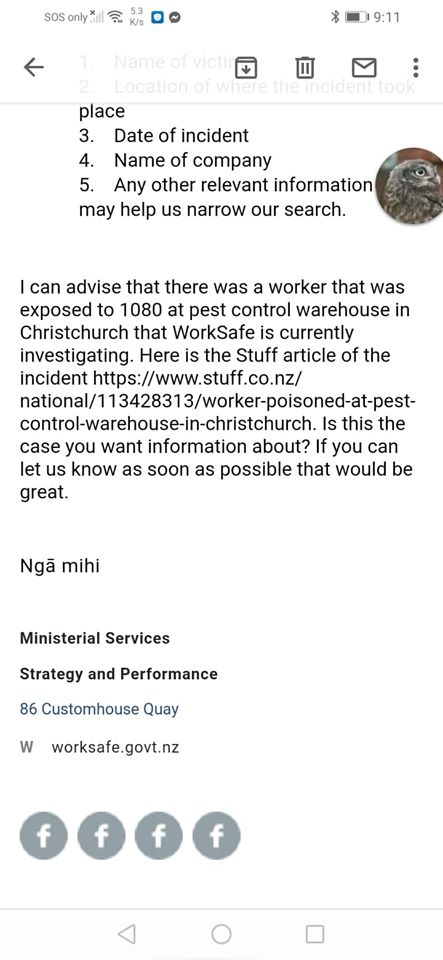
On 14 January, 2020, he rang Worksafe to see if they had received it. They confirmed they had and they sent him the email below, (with his OIA request at the end, which I have not included here as it contains his personal details).

83051189_2559826754297635_7810979390254219264_o

82765094_2559826587630985_7537555931035336704_o


James Harold is adamant that at no time did he mention 1080 poison or the Christchurch (Bromley) poisoning to them.

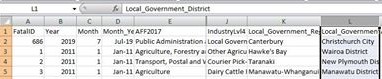
As James’ OIA request asked about a fatality on the Worksafe fatalities register, and the Worksafe response was to ask James if the Bromley incident was the one he meant (which he has since confirmed to them in a reply email), doesn’t a simple deduction mean it would appear the Kiwicare Ltd worker died? ( Not that anything is ever simple with these government departments!)

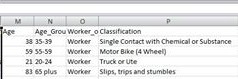
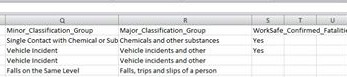
(See record of fatality below, from the Worksafe Fatalities register – a screenshot with the register headings is attached too, for clarity. Enlarged clips supplied at the end of the article for readability)

82032333_2559852174295093_6746616649547251712_o

82307859_2559852184295092_5664439063101308928_o

*********************************************

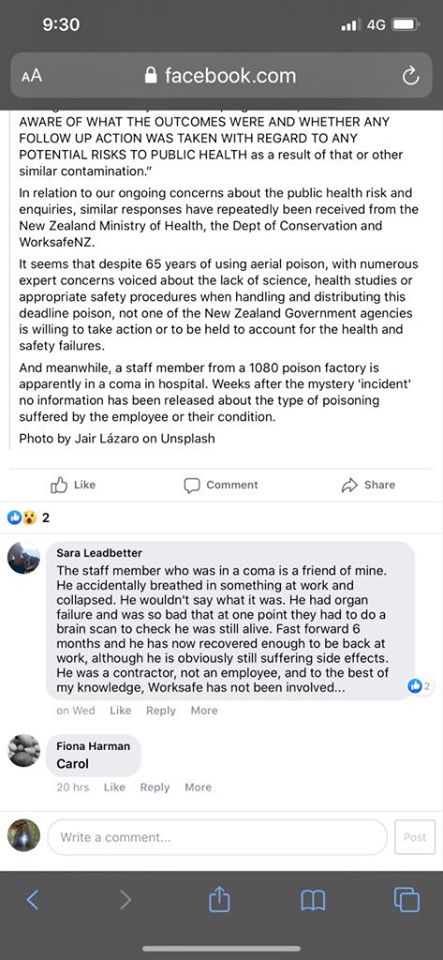
However we also know that a manager was poisoned and survived – see screenshot below of comment made by Sara Leadbetter recently on ‘Ban 1080 – South Island’ Facebook group.

82284932_2559852517628392_4965463737319292928_n

I have since spoken to Sara Leadbetter and she has confirmed her statement. The person still alive is a contractor, not an employee, and is in management at Kiwicare Corporation Ltd (1). I was told he breathed something in and that was the last thing he remembered. He was in a coma, had organ failure, and nearly died. He is now back at work and is still working for Kiwicare in Christchurch.

******************************************

See original news report here :

https://www.stuff.co.nz/…/worker-poisoned-at-pest-control-w…

and see post I wrote on this incident on January 10, 2020, here:

https://www.facebook.com/carol.sawyer.3511/posts/2553849544895356

*****************************************************

(1) Kiwicare Ltd’s owner, Matthew O’Brien, is the 51% shareholder of PCR Ltd, the Rolleston factory that makes 1080 baits.

******************************************************

ENLARGED CLIPS:

  1. clips 1 & 2 are two halves of the first image

no 1
Clip no 1


no 2
Clip no 2

2) Clips 3-5 are thirds of the second image

no 3
Clip no 3

no 4
Clip no 4

no 5
Clip no 5

RELATED:

AN OIA RESPONSE FROM ENVIRONMENT CANTERBURY RC RAISES SERIOUS DOUBTS ABOUT THE SAFETY OF 1080 FACTORY PEST CONTROL RESEARCH LTD

A WORKER IS SAID TO BE IN A HOPEFUL CONDITION IN HOSPITAL, AFTER A WORKPLACE INCIDENT INVOLVING CHEMICALS IN CHRISTCHURCH