GROW YOUR OWN SEEDS (Wally Richards)

Raising plants from seeds is a great sense of achievement for most gardeners and when the seeds are the ones you collected for free it is even better.

All plants that you have growing in your gardens seed at sometime, with some plants that maybe years away but with annual plants it is at maturity each year.

Annual plants that are left to seed and die back will have produced fertile seeds if pollination has occurred successfully.

If these seeds are left to fall naturally to the soil then at some ideal time for them, they will germinate and produce seedlings.

Two things prevent this happening the first being; you removing the dying plants before they can distribute seed or in the case of many vegetables you have harvested before the crop goes to seed and removed flowering vegetables before they set seed.

When you have left something to flower and drop fertile seeds; then later on if you don’t recognize those seedlings as preferred plants, you may kill them thinking they are weeds.

It is a learning curve to know what is a wanted plant and an unwanted plant but with a little close observation you can score a lot of free plants by allowing mature plants to seed.

When plants produce seed pods that are drying out, then more than likely there are fertilised seeds in the pods which you can harvest for sowing sometime.

This applies to a wide range of plants from roses with rose hips, natives, ornamentals, flowers, vegetables and fruit.

How many of us have eaten a ripe plum off their tree and spat out the stone?

Months or maybe even years later up pops a plum seedling which will eventually grow into another plum tree, similar or even different from your named plum tree.

There are a number of fruits that we buy that have seeds, which we can collect at no extra cost.

This includes tomatoes, capsicums, beans, peas, pumpkin, passion fruit, melons, apples, citrus, stone fruit, figs, even strawberries (which are not a fruit as their seeds are on the outside.)

I have at some time grown all in the list from purchase fruit (Fruit, the definition is one that has seeds inside, which includes beans, capsicum etc).

If you come across a special fruit or one that is more difficult to get the seed of from seed packets then you should certainly save the seed and plant them some time.

Whether it is successful or not it really does not matter as its free and a bit of a challenge.

Recently we found two Asian foods one type of snake bean and two types of bitter melon.

I collected a few seeds from them and with the snake bean just sat the whole bean on a late afternoon windowsill to dry out and mature the seeds inside.

They are now all growing happily in one of my glasshouses and later we shall find out if they have come true to form.

Sometime ago I found Dragon Fruit for sale and now have a big specimen which should be approaching flowering time soon and also a number of baby ones.

Collecting some seed from fruit you have grown or purchased is just the matter of removing them from the fruit, laying on a bit of paper towel to allow to dry. Once they are dry you can either plant them or store them.

The best way to store is to write on the paper towel what they are then place inside a sealed glass jar and then into the fridge where they can wait till you are ready to plant.

Several types of seeds can be stored in the same jar. The fridge storage means they will keep very well for a long period of time.

I have tomato seed over 30 years old that will still give me about 20 to 50% strike rate.

The fridge also gives the seeds a false winter so when they come out they will think its spring and germinate better as a result.

Spring is normally the best time to bring out seeds you wish to sprout as the day light hours are extending and many seeds relate to that.

Self sown seeds lay dormant until the conditions are ideal for them to sprout, that means light hours, temperature and moisture levels.

When they germinate they send down (in most cases) a long tap root just as the trunk sprouts upwards.

This long tap root has secondary roots formed off it making the plant sturdy and deep rooting.

This enables the plant to gather food & moisture better than transplants.

So where possible sow your seeds where the plant is going to grow to maturity.

Seeds germinated in cell packs don’t have the advantage of deep rooting but they do have the advantage of less root disturbance when transplanting.

Punnet grown seedlings will suffer the most root damage when you separate the seedlings, but another aspect comes into play, the damaged roots will be quicker to produce side roots and also generate a bigger root system.

Normally this time of the year germinating seeds is not a problem as the soil temperatures are supposed to be over 10 degrees.

In a glasshouse where the air temperature is warm seeds in containers will germinate better as long as adequate moisture is applied to the medium.

Before you cover your seeds spray them with a solution of Magic Botanic Liquid (MBL) at 20 ml per litre of water. This natural product stimulates the germination to kick in.

When germinating in trays or cell packs use a good compost such as Daltons or Oderings as the base then with a sieve you sieve some of the same mix to make a nice layer of friable smaller particles.

It’s onto this you spread your seeds, spray with MBL and cover by sieving more compost.

In the garden sieve the soil for a seed raising bed. Forget the seed raising mixes they are a waste of time as well as being too expensive when compared to the herbicide free two brands I have mentioned.

Keeping seeds of your favorite vegetables is very important because seed strains disappear overnight as seed companies replace varieties.

Also certain companies want to control all the food seeds in the world and they buy up smaller seed companies then provide only the seeds they have sole rights to.

One of these companies has in certain countries persuaded the Governments to pass laws making the collection of one’s own seeds illegal.

This has made life for the native farmers intolerable and to compound matters often the seeds that are then sold to them are not suitable for their growing conditions and result in either poor or no crops.

Can’t happen in NZ you say? Us older gardeners know that plenty excellent named varieties of vegetables have disappeared and the newer varieties are not half as good.

Happy Gardening.

See how the media lies about what happened at NZ’s Parliament last week

Riot cops used gas and fists to clear Parliament grounds of peaceful protesters—and “our free press” MAKES UP scenes of mob violence AGAINST the cops … Mark Crispin Miller

Check out the gap between the media’s propaganda and what really happened … [recently] in Wellington; then ask yourself if there are any US/Western “news” reports that any thinking person can believe.

From America’s “newspaper of record”:

In chaotic and sometimes bloody clashes, protesters wielded fire extinguishers, paint-filled projectiles, homemade plywood shields and pitchforks. Some lobbed cobblestones at officers. Others piled detritus onto gas-fueled fires, including one that caused an explosion at a playground near Parliament.

The same crapola from NBC…

READ AT THE LINK

CHD says Pfizer and FDA dropped data bombshell on covid ‘vaccine’ consumers

Waikanae watchers's avatarWaikanae Watch

Clinical trial data contradicts ‘safe and effective’ government/industry mantra

Washington, DC, March 03, 2022 (GLOBE NEWSWIRE) — In a 55,000-page set of documents released on Tuesday, the U.S. Food and Drug Administration’s (FDA’s) Center for Biologics Evaluation and Research (CBER) is for the first time allowing the public to access data Pfizer submitted to FDA from its clinical trials in support of a COVID-19 vaccine license. This follows U.S. District Judge Mark T. Pittman’sdecisionon January 6 to deny the request from the FDA to suppress the data for the next 75 years which the agency claimed was necessary, in part, because of its “limited resources.”

A 38-page report included in the documents features an Appendix, “LIST OF ADVERSE EVENTS OF SPECIAL INTEREST,” that lists1,291 different adverse eventsfollowing vaccination. The list includes acute kidney injury, acute flaccid myelitis, anti-sperm antibody positive, brain stem embolism, brain…

View original post 176 more words

How Herbal Tea Changed My Life

From greenmedinfo.com

Doug Wolkon, owner of Kauai Farmacy shares his personal healing journey drinking fresh Kauai-grown herbal tea

Ten years ago my wife Genna and I moved into a rental house in Kilauea, Kauai with our three-year old son. He was running circles around me during the day; and at night, I would fall asleep to his bedtime story. As a competitive high school athlete, I never imagined losing my youthful movements by age 35. I’d spent the last 15 years hecticly traversing the country while working nonstop hours on the phone and computer. Nightly I would “unwind” to steak and wine dinners. The compounded effects were beginning to show. My neck and waist were both inflamed and numb. I desperately needed an interceptor.

READ MORE

https://www.greenmedinfo.com/blog/how-herbal-tea-changed-my-life222

Photo: scym @ pixabay.com

About NZ Nat Library cull of 600K books: Are We Becoming Little New Zealanders/Aotearoans?

From pundit.co.nz

Terrified of being unable to cope with the world they look inward. The National Library seems to join them.

The National Librarian has told us the National Library is disposing of 600,000 books from the Overseas Published Collection to make way for a larger Māori and Pacific collection. That is, of course, absurd; there are not 600,000 Māori and Pacific books waiting to get into the library. I doubt that there are even 600; it will take centuries to fill the space. She says ‘the library’s decision to get rid of the books links in with its work on diversity and inclusion of all New Zealanders’.

It is important that a library should have such objectives, but for what sort of New Zealanders? Are they huddling down at the end of the world, ignorant and frightened of everywhere else? Or are they confident New Zealanders engaging with the world. Instructively, there is nary a hint of the latter in the National Librarian’s statement. Indeed, to suggest a library should play a major role in engaging with the world would underline the absurdity of the disposing of the Overseas Published Collection.

This Little New Zealander attitude probably arises from the remit of the Library’s host, the Department of Internal Affairs, which sees it (and National Archives) as a cultural depository with a very narrow definition of ‘culture’.

Underlying the inferiority complex of the Little New Zealanders is the terrifying vision that New Zealanders cannot engage and embrace the world, and achieve eminence at an international level. It is also not true. Most of us engage, and have always engaged, with the rest of the world. Yet there are strong pressures for retreat.

One instance is the ambitions of those promoting Mātauranga Māori (Māori knowledge). I have to be careful because we are told that those who have no specific expertise should not comment on it. The same must apply to those who have no expertise on science (the vast majority of experts on Mātauranga Māori as far as I can judge) so there cannot be much of a dialogue about the relationship between the two.

While respecting Mātauranga Māori, I side with Garth Cooper, one of our most internationally eminent (medical) scientists, with Māori ancestors, who has done much to promote the development of Māori scholarship (as well as our health). He cites Ross Ihaka — a Māori mathematician who co-created the R open-source programming language — with producing ‘the most important thing that’s come out of New Zealand in the last 100 years’. Cooper worried about ‘young Māori scholars that would be the next Ross Ihaka basically missing out because they were told that science was a colonising influence of no interest to them’. I am not sure I agree with his ranking of R – there have been many great innovations that have come out of New Zealand despite the timidity of Little New Zealanders – but I agree with his broad sentiment, that teaching ‘Māori kids about the colonising effects of science [may] lead to loss of opportunity’. It would be a terrible New Zealand if those of Māori descent were discouraged from engaging with the world.

And not just in science. I’ll give you two first names and let you finish the paragraph: Inia, Kiri.

Little New Zealanders don’t realise how much we have to offer the world. I offer a couple of examples where I have a little expertise.

A key work in the development of economic anthropology is Raymond Firth’s Economics of the New Zealand Māori, the first version of which was published in 1929. Firth was not Māori but had been fascinated by them since childhood and drew on their traditions and practices to introduce the notion of the gift exchange economy (first developed by the French sociologist and anthropologist,  Marcel Mauss) to English anthropology.

I used Firth’s work in Not in Narrow Seas to describe the premarket economy but I became increasingly aware that these early exchange relationships persist. You can think of economic development as the transition of a society from where the transactor is more important than what is exchanged – the gift exchange economy of personal transactions – to one where what is exchanged is central and those involved are not – the commercial economy of anonymous transactions. Cognoscenti will recognise this as a development of Karl Polayni’s The Great Transformation. Were I Māori, I would be enormously proud that my ancestors’ economy was so influential on modern thinking.

My second example is Te Tiriti o Waitangi. Close analysis suggests it is a social contract; at least two of the drafters almost certainly knew of the notion. When the notion was debated at the end of the eighteenth century, David Hume pointed out that it might be good in theory but there was no practical example of a country based on a social contract. Now there is – us. Did the Māori signatories see it as the sort of social contract which Hume and Jean-Jacques Rousseau were discussing? Almost certainly not, but the roots of their approach came from Christianity, which Māori had adopted; they talked about the Tiriti as a ‘covenant’, the Christian precursor of the social contract.

One day someone will explore this Māori foundation of the Tiriti, but they won’t be able to via the National Library if it disposes of the Overseas Published Collection which includes work related to Hume, Rousseau and the Christian theologists.

Consider Allen Curnow, who is judged to be one of the internationally outstanding poets of the second half of the twentieth century. His early poetry was strongly ‘nationalist’ but as his confidence grew he shifted to wider international themes, although his last poems show that he was never far from home.

Or go to the Wellington City Gallery, which is currently showing a major exhibition of the works of the Swedish mystic and spiritualist artist Hilma af Klint. Fortunately, the gallery is not under the wing of the Department of Internal Affairs which would, no doubt, deem such a display as an improper matter for its Little New Zealand approach. Perhaps it would applaud an exhibition across the road at the exhibition of Te Papa of paintings by New Zealander Rita Angus. Actually, it was developed by Te Papa and the London Academy of Arts. Unfortunately the overseas exhibition had to be abandoned because of Covid; it would have demonstrated this intensely local artist can hold her head up internationally – like af Klint.

As can Colin McCahon who as been bracketed with Jackson Pollock, Robert Motherwell and Mark Rothko. (I imagine that the intention is to throw out all the books about the three, so we will never know even if the rest of the world does.) Just behind him, Ralph Hotere insisted he was an international artist who was a Māori, never a Māori artist.

Once the National Library has got rid of its Overseas Published Collection, thoughts will turn to purging the foreign holdings of the Alexander Turnbull Library, which includes one of the world’s major collections of the works of John Milton and some wonderful works by William Blake. They have said they won’t; do you trust them? The ATL’s holdings are protected by law; when told he was contemplating breaking the law, a little man pointed down from the ninth floor to Parliament’s debating chamber, saying ‘Heh, heh; We have a little room down there to change it.’

I want to live in a nation where ‘if you can make it here, you can make it anywhere’. I don’t want to live in a pitiable country dominated by introverted Little New Zealanders terrified of the great world outside.

Tags: Little New Zelander, National Library, Department of Internal Affairs, Raymond Firth, Tiriti o Waitangi

Prev / Next

Pasted from https://www.pundit.co.nz/content/are-we-becoming-little-new-zealandersaotearoans?fbclid=IwAR0qOWWH7oa4fL5esV6oB-PKiRUXPZRossvxajyDW-OYIZvNTzp8xKbJOec

Photo: pixabay.com

Royal Navy (UK) microwave weapons expert explains how protesters are targeted

Dr Barrie Trower: “I trained at the Governments Microwave Warfare establishment in 60’s. I worked with the underwater bomb disposal unit, which used microwaves. In the 70’s I helped de-brief spies trained in microwave warfare.” Read more at this link (info supplied with a video on 5g, also well worth a watch). There have been concerns raised recently with such weaponry unleashed on protesters at both Wellington and Canberra. In the following clip Dr Trower explains how they targeted protesters with low level microwaves over a long period of time eventually producing cancer. It’s very real. TWNZ

ALERT: Have already received word from one Wellington profester who has been sent home with radiation poisoning! Many others were apparently also diagnosed with same. Disturbing indeed.


LISTEN AT THE LINK:

https://www.youtube.com/watch?v=DrRjTC4MP_M&t=23s

Photo: screenshot

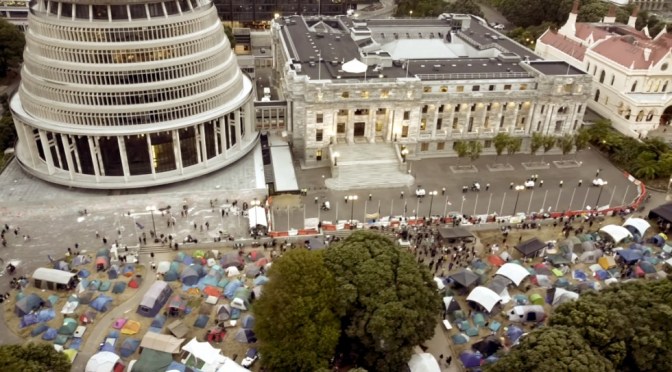
After NZ Police blocked the servicing of Portaloos at Freedom Village, innovative Pro-Fest Kiwis built their own on site

Rather than talk to Pro-Festers at Parliament Grounds Freedom Village, the NZ corporation parading as government, desperate to be rid of them, have had Police block servicing of the portaloos. Not to be outdone, innovative Kiwis (as always) have simply built their own & titled them ‘The Peehive’, plumbers and builders who are part of the village having stepped up. Folk have even planted gardens there. See the link below the Peehive video for a short overview of what they are doing there. Unfortunately it is a mainstream propaganda piece as in they slant it against the profesters, nevertheless you get to hear the heart of those three amazing Voices For Freedom women. This article gives you a good photographic overview of what is happening there. EWR

UPDATE: Profesters also built a small shower block on wheels… the Police have since towed it away.


PEEHIVE VIDEO:

https://www.facebook.com/watch/?v=933223360721310

SAVE Democracy NZ – By Rod Sharp

“Police are being difficult in regard to access of portaloo truck to empty the toilets. Work is now well underway building timber toilet outhouse building’s with flushing toilet suites connected into the localised sewer/manhole. The white tank pictured (off a small sucker truck) will pump out the portaloos when required, again, straight into the sewer main manhole.

Police were spotted filming the latest modifications. I’m sure they realise by now how resourceful we are as people here in the land of the long white cloud”

#YEAHTHETRADIES #ENDALLMANDATES #UNITYOVERDIVISION

MAINSTREAM’S PROPAGANDA DOCO ON FREEDOM VILLAGE:

What a pity Melanie Reid didn’t take a leaf out of Liz Gunn’s book and publish some truth about the now well documented vaccine injuries and deaths. A brief visit to the Health Forum NZ’s tent at Parliament grounds would prove that beyond all doubt. They have all the citizen’s register figures and many testimonials of the trauma people experience, gaslighted because they dare to suggest it is the ‘safe and effective’ and ‘government approved’ vaccine that caused their injuries. Hear Lynda Wharton on that. ACC have received many thousands of claims.

But no, unfortunately mainstream journos prefer to not investigate those uncomfortable truths and lose their careers and salaries for doing so.  Long ago sold out sadly.

WATCH AT THE LINK BELOW … you will also get a view of what the village has achieved in their two short weeks in residence:

https://www.newsroom.co.nz/melanie-reid-a-visit-to-freedom-village?fbclid=IwAR2LXjOMQW0dc_DgUheSw_1W1EM4FGU3hvdtsxScEBGN3vXOaN9-Z4WxHh4

Police are removing profesters from Wellington’s Parliament Grounds (live)

Pro-festers are being evicted right now by NZ Police. MSM is not telling the truth about this. See at the link:

https://www.facebook.com/watch/live/?ref=watch_permalink&v=670613064133264

The scale, diversity and structure of the anti-mandate/pro-freedom occupation at the NZ Parliament

Hornets❜ Nest Surrounded: Liberty Occupation, New Zealand Parliament

Wellington Dispatch No. 002
By Steve ‘Snoopman’ Edwards


The occupation of New Zealand’s Parliament Grounds in the capital city of Wellington and surrounding streets —which began at lunchtime on February 8th 2022 — appears to be growing into a bona-fide grass-roots peaceful uprising.

By Thursday 17 February, it was estimated there 10,000 people either occupying the grounds, or the surrounding streets and supporting the occupation while staying with friends, family or at accomodation in the city.

After sustaining repeated assaults from Police on Day 3 of their occupation, the New Zealand Liberty Movement’s presence swelled, as people came from all over the country, to ensure the numbers tipped the balance of power in favour of the occupation. The objective to pressure the NZ Government to drop the Covid-19 ‘vaccine’ mandates regime is primarily being actuated by their key bargaining chip: bad optics.

READ AT THE LINK:

https://snoopman.net.nz/2022/02/19/hornets%e2%9d%9c-nest-surrounded-liberty-occupation-new-zealand-parliament-wellington-dispatch-no-002/

BREAKING: Vaccine Passports Legal Challenge Initiated

From The Health Forum NZ

If you thought the news on Friday about the lifting of mandates for NZDF and Police was amazing, we now have some more exciting news!

United We Stand, the group of Defence and Police staff that successfully challenged the government on the legality of their vaccine mandates, are now challenging the government on the mandatory use of COVID Vaccination Certificates (CVC or vaccine passports) right across the board for all Kiwis.

Their core arguments include the fundamental argument that CVCs do not prevent or limit the risk of outbreak or spread of COVID-19.

United We Stand are represented by Frontline Law that are asking that the COVID-19 Public Health Response (Protection Framework) Order 2021 is either revoked or amended to remove the CVC requirement by the 4th of March 2022 or they will apply for judicial review of the Order.

As a group of Defence and Police staff, United We Stand have said that they feel it is their duty to fight for New Zealanders and their freedoms. The vaccine passport system is divisive and a huge breach of fundamental rights that isn’t justified by the increasingly questionable benefit in stopping COVID-19 spread. A promise of removing it soon is not good enough. It needs to go now!

Hold the line everyone.

(If you are interested in supporting this case please donate through the United We Stand page https://www.unitedwestand.nz/support)

Photo: EnviroWatchRangitikei