

“Also disturbing are the birth defects documented by a local midwife, and the fact that Ivon Watkins Dow continued to manufacture 2-4-5-T in New Zealand until 1987, making us the last country in the world to manufacture the dangerous substance.”
The Green Party NZ
[Photo Credit: Creative Commons]
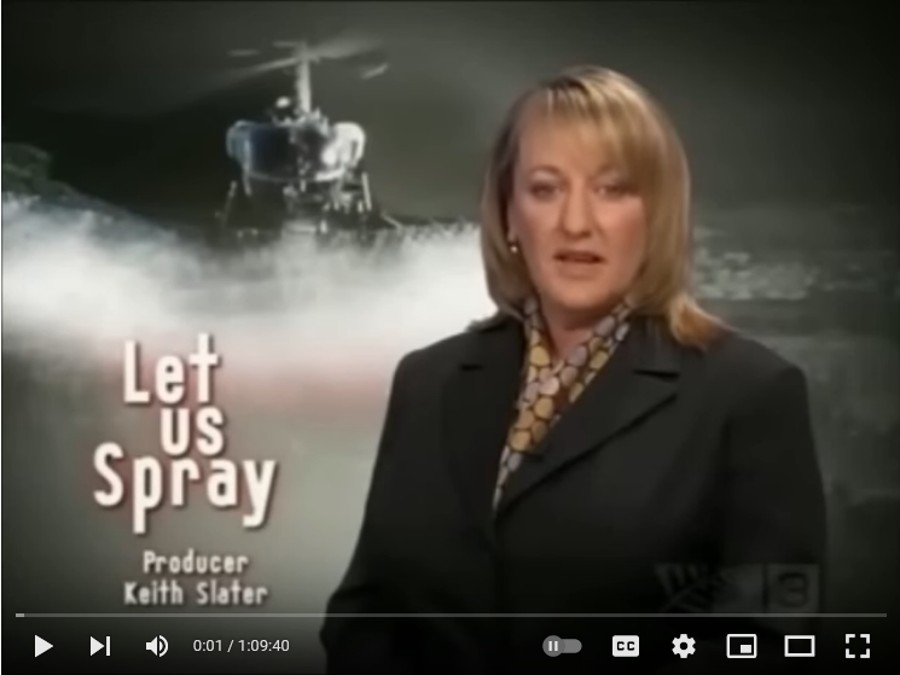
The TV 3 Exposé, initially broadcast then censored from NZ TV. A must see for any member of the public, this doco covers the exposure of the Paritutu and New Zealand community at large to the chemical 2-4-5-T, manufactured at Ivon Watkins Dow in New Plymouth between 1962-1981, and the disastrous effects it had on those exposed.
Further coverage was made by the Investigate magazine:
THE POISONING OF NEW ZEALAND
From Investigate
THE ‘ERIN BROKOVICH’-STYLE SCANDAL IN NEW ZEALAND’S BACKYARD
Outbreaks of rare diseases and tumours are appearing in clusters around New Zealand, close to chemical factories. Why doesn’t the Government want to investigate? Simon Jones discovers what the authorities don’t want you to know:
Walk down any street in New Plymouth and you will probably hear a mixture of coughing and spluttering. Look inside any school and there appears to be more special needs children than is the norm for a city the size of New Plymouth. It’s often been said that everyone knows someone with a serious disease, whether it be cancer or multiple sclerosis.
Bad luck? Possibly, but for the last 15 years a group of residents have turned scientists to uncover what they say is a national health scandal – and one which, despite the government and media’s persistent attempts to ignore, won’t go away.
They may sound like conspiracy theorists in overdrive – and there is little in the way of official evidence and health statistics to back up what they say. But here is the frightening thing: If, in this real-life game of Fact or Fiction?, only 10 percent of what the residents say is true, we have a huge health scandal on our hands – the magnitude and implications of which are unimaginable.
The story centres around one of the city’s major employers, the Ivon Watkins Dow Plant.
Since the early 1960s, and up until 1987, it manufactured the 2,4,5T herbicide – which contains the deadly dioxin also used to form Agent Orange – a weapon of huge destruction in the Vietnam War.
In New Zealand and around the world 2,4,5T is used to kill scrub, gorse and blackberry. In Vietnam, with concentrations of dioxin much higher, it had the same effect – to the extent where it devastated the country’s crops and caused major health problems amongst veterans, including cancer, multiple sclerosis, while creating learning difficulties amongst the vets’ children.
Is it just coincidence that many in New Plymouth – and in areas around New Zealand, where this herbicide was extensively sprayed, complain about the same health problems?
For years governments, both here and overseas, turned a blind eye to the damaging effects of dioxin, refusing to admit that there was any link between Agent Orange and health problems suffered by vets.
Yet recently, in a draft report leaked to the Washington Post, the US government upgraded dioxin to a ‘human carcinogen’ – in other words a substance which is a major cause of cancer, as well as birth defects and infertility.
Only a pending lawsuit by New York restaurant owners, who claim the link to cancer will scare away customers, has blocked publication of the report.
The US Environmental Protection Agency notes that emissions of dioxin have plummeted from peak levels in the 1970s, but still pose a significant threat to some who ingest it – mostly in food, especially food of animal origin.
John Moller, the president of the Vietnam Veterans Association, says it is ironic that some of the 3,800 Kiwi vets who served during the war came home to find that they were still partly exposed to chemicals associated with Agent Orange either by living in New Plymouth or areas where the herbicide was sprayed.
“The New Zealand government says that because of the few figures involved and the time span it is not worth running tests on veterans now.
“That’s rubbish because the government has given $200,000 to the nuclear test veterans association for research and legal fees. Their exposure happened before Vietnam and their figures are much smaller.
“The government has buried its head in the sand for too long,” he says. “For example, when an enquiry was finally instigated, they took samples from native forest but not the Pine forest where 2,4,5-T was heavily used.
“The problem with dioxin exposure is that there is a 30-year envelope. The historical effects are only beginning to come through now.”
The US government invented 2,4,5T in 1941 to be used as a weapon of war against Japan. Later, with concentrations lower, it is intended to control unwanted vegetation, most of which is found in Taranaki, Northland and Gisborne.
The manufacture of 2,4,5-T is said to have started in New Zealand around 1962 and by 1970 the number of birth defects in New Plymouth doubled and the number of cases nationwide started to rise.
Because of international health concerns 2,4,5-T production was halted around the world – with the exception of one factory, the Ivon Watkins Dow Plant in New Plymouth which persevered until 1987. The plant is still in operation today but only produces pesticides.
Levels of dioxin found in 2,4,5-T were reduced through the late 70s and 80s as Ivon Watkins responded to health concerns, yet residents say the effects of intense manufacture in the 1960s are etched on the faces and, more importantly, the glands and
livers of local people now.
Time for some statistics. The average level of dioxin in Agent Orange was around 198 parts per million. In New Plymouth, at the peak of production, the average level in the manufactured product was around 95 parts per million – around half that of Agent Orange. By 1987 the level of dioxin was down to 0.1 or 0.05ppm following heightened awareness about the potential health problems.
Initially residents and workers were happy with health assurances from company bosses, particularly with the way waste was disposed through burning. But only recently have secret dumps been found around the city, dumps which residents say have infected soil and water.
In 1986 the Ministry of Environment held an official inquiry into dioxin contamination after 300kg of vapour accidentally leaked from the plant. Yet, interestingly, company bosses admitted that over 250kg of vapour was normally discharged as a result of the normal process anyway.
The enquiry team concluded that there was no evidence of major contamination in New Plymouth or of any major health risk Yet residents say that part of the information used in that research was based on American studies which have since found to be fraudulent. This is where the issue becomes more complicated. In 1949 an explosion at the Monsanto chemical plant in Nitro, West Virginia, exposed many workers to effects of 2,4,5-T. Thirty years later Monsanto scientists and an independent researcher, Dr Raymond Sunkind, compared death rates amongst workers exposed to 2,4,5-T to those who hadn’t been exposed. When no differences between the two groups were found, Monsanto claimed that dioxin did not cause cancer. Evidence of inaccuracies were only exposed in the late 1980s when a group of Missouri citizens sued Monsanto for alleged injuries suffered during a chemical spill caused by a train derailment in 1979. While reviewing documents obtained from Monsanto, it was held in court that during the early studies, scientists omitted five deaths from the dioxin-exposed and put them in the unexposed group. Given that, and the leaked report to the Washington Post, it’s small wonder that the residents are now calling for a new inquiry.
It’s easy in stories like this to get bogged down with statistics and hearsay. But it’s only when confronted with the truth about health problems in New Plymouth that people start listening.
Take, for example, the case of Ross Lawrence, 43, who lived within a stone’s throw of the plant and worked there as a storeman between 1980 and 1985. He contracted non-hodgkins lymphona and Hepatitis C in 1998 – one year after his wife, Patricia, 41, was diagnosed with breast cancer. To add salt into the wounds, the 17-year-old family dog, Ena, died of cancer last year and both Ross’s children suffer from a mixture of skin complaints and bleeding noses.
It’s only when you hear stories like Lawrence’s that the word “coincidence” becomes a little bit too stretched.
“I came home from Pakistan where I was working on an oil rig in 1997 to look after my wife,” said Ross. “Shortly after I went to the doctor after complaining about flu-type symptoms only to be told that I had cancer and Hepatitis C. Isn’t it strange how three of us could get cancer in one household?”
An extensive course of chemotherapy seems to have thankfully cleared the cancer, and after having her glands removed, his wife managed to keep both breasts. But the trauma also brought its psychological toll. The stress and strain of illness coupled with the loss of his $100,000-a-year job effectively ended their marriage.
“This could have cost my life,” says Lawrence, “and it probably will in the end because Hep. C never goes away. They should be made accountable. How many other people have died of cancer without knowing the cause? How many other people are going to die?”
Ross Lawrence, like other employees, had few concerns at the time of working at the Ivon Watkins Plant. “We knew about the dangers of 2,4,5-T, but it was such a safety orientated company. They held regular safety meetings and did everything by the book.
“We were told that the waste was incinerated at temperatures which were so high that there would be no residue because everything would be dissolved. It was only when dumps containing the waste were found that I really started to worry,” he adds.
“There is still a cover-up going on. If you walk the streets of New Plymouth people wouldn’t know. Most didn’t know what the factory made. The local paper, the Daily News prints little on the subject. And the local MP doesn’t want to know.”
Now Lawrence is actively working on the local rigs but campaigns with others to lift what they say is a veil of secrecy over this health scandal.
Another leading the campaign is Andrew Gibbs, who helped set up the Dioxin Investigation Network. Recently Gibbs sent one sample of blood and a sample of breast milk to America to check for traces of dioxin, the particular type of which is called 2378 TCDD which is the most toxic type known to man. Gibbs claims previous blood tests have been worthless because 2,4,5-T passes through the system so quickly it leaves no trace. The difference here is that they would also be testing for its residual, 2378 TCCD.
When they sent the samples to the US, taken from his partner, Iris, and her sister, Lesley, they went missing for four days. Despite being clearly marked for an Atlanta laboratory, they ended up in Los Angeles. More than 160 days later, they are still waiting for the results.
“In Vietnam they have found levels of 30 to 108 parts per trillion in blood,” he said. “Levels in Maori women around the Bay of Plenty, where the herbicide was extensively sprayed, have already been found to be up around 26.7ppt. As of yet we still don’t know what the blood levels are in New Plymouth.”
Gibbs says even burning the waste didn’t destroy it. Instead waste streams left residue in the soil, on washing hanging out to dry and on barbecues. “We ate it, breathed it and wore it. When the Yanks burnt it off after Vietnam they burnt it off 80-90 miles down wind from Johnson Island.
“We burnt ours downwind on the whole town of New Plymouth. In the 1987 enquiry they said they found no evidence of dioxin in people or soil. But what they had was a 1,500 ppt safe level. The highest recorded in Vietnam was 808 ppt. In New Plymouth we’ve already levels up to 310 ppt.” His views may be ignored by health officials in New Zealand, but they have found credence in America. George Lucier, director of the National Toxicology Programme, and author of the Environmental Protection Agency report, says there is no avoiding dioxin.
“Even penguins in Antarctica have dioxin in them. No-one sets out purposely to make dioxin. It is an unwanted side-product that you get from burning. Anytime you combine heat, chlorine and organic material, there is the possibility of making dioxins.”
Lucier says scientists did not quite understand how dioxin damaged the body, but did know it acted on a universal mechanism controlling cell functions.
Dioxin attaches, or binds tightly, to the AII receptor – a kind of cellular doorway found in virtually all cells in the body. Once there, it changes the function of hundreds of genes. It will either stimulate gene expression of suppress it.
Dioxin exposure has been linked to many different tumours, especially non-Hodgkin’s lymphoma, respiratory cancers, soft tissue sarcoma and prostate cancer. One Italian study of dioxin in children found hormonal changes.
“When they have children, most or all their kids are girls, not boys,” says Lucier. “Dioxin affects pathways that are involved in normal growth and differentiation, so it can cause birth defects,” he adds. “It can effect sperm counts.”
Regional comparisons for cases of multiple sclerosis and non-hodgkins lymphoma are hard to find, if not impossible to get. The Ministry of Health says there are too few cases nationwide to offer a meaningful regional breakdown. The only figures are available are from the Cancer Mortality Atlas published as far back as 1982 which says that lymphosarcoma is ‘particularly severe’ in New Plymouth, while the number of male deaths from Hodgkin’s disease was ‘particularly high’.
Yet, there are regional disparities in other areas too. While New Plymouth is almost three times the national average for Hodgkins Disease, Waipawa is five times. While New Plymouth has three times the national average for lymphosarcoma, Strathallan in South Canterbury has seven times.
There are 14 known cases of multiple sclerosis in New Plymouth suburb of Paritutu, where the plant is based. The figure may sound small, but compare that to Australia where the rate is 40 per 100,000. That should give Paritutu just 2.4 cases.
During the 1986 governmental enquiry, Ministry of Health principal toxicologist Michael Bates defended the higher rates.
“It’s normal to get quite a variation everywhere for all cancers. One area might have a predominantly old group of people for example. But in many cases no-one is exactly sure why.” Yet since 1980 the birth defects rate in Taranaki has been about 50 per cent higher than the average for the rest of the country. While it’s fair to say regional disparities also occur in other areas for different types of diseases and abnormalities, Taranaki usually falls victim to all of them.
50-year-old Roy Drake also lives close to the plant.
In 1988 he was diagnosed with multiple sclero
sis. He now finds it almost impossible to walk
and is close to blind.
Being homebound has meant that Drake has spent a lot of his time studying the effects of Dioxin, looking at international studies from around the world.
“If you look at any major chemical plant anywhere in the world you will find massive rates of the same sorts of diseases. Here in New Plymouth, Down’s Syndrome and Spina Bifida are going through the roof.
“Our local school has 1200 kids and in 1999 they advertised for ten special needs teachers. I’ve found out in one Kindergarten alone there are four kids with cancer.
“People of New Plymouth are very illiterate to it all. That’s because there has been a huge cover up. Imagine the legal implications of this. The damages would run into billions.
“Half of my friends are dead or have brain tumours. Not many people live to a ripe old age round here. They all die five or ten years short of their time. I am very angry and cannot understand why this has been ignored for such a long time.”
Drake says even his caregivers are riddled with disease. “I’ve had one who had sugar diabetes, two with strokes. The girl currently looking after me has cervical cancer.
“For years we have been wearing clothes with dioxin on them. When we put a plate in the cupboard it is there, although you can’t see it. There’s no getting away from it around here.”
Drake thought the new Labour government, with its Green allies, would order a fresh enquiry following new American evidence on the damaging effects of dioxin. Instead, he says, they are happy to sweep the issue under the carpet. In June of this year Health Minister Annette King refused calls for a new enquiry, relying on conclusions found in 1986 – interestingly a report delivered under the previous Labour Government.
“While I appreciate the ongoing concerns about the health of people living around New Plymouth, from the advice I have received from Ministry officials, I am satisfied that the monitoring and investigation carried out around IWD previously were adequate to show that significant exposure of the local population did not occur.”
King went on to say that a study of targeted groups who believe they have been exposed would be too expensive and difficult.
“The residents present prior to that time may have moved and would need to be traced for testing to be meaningful,” she said.
“A detailed analysis of the health data relating to the Taranaki region would be needed before any conclusions relating to the relative rates of cancer, birth defects, or other diseases such as MS, could be meaningfully compared. I understand such a process could be carried out but it is difficult to see what would be gained by doing so now.”
Not surprisingly, Andrew Gibbs disagrees. He says they are looking for recognition and help. He points that areas like Gisborne, where 2,4,5T was sprayed has almost identical ratios of motor neurone disease as Vietnam – isn’t it time we were at least prepared to look at the situation again?
Yet it seems the government is blinded by issues on the grounds of cost. The residents of New Plymouth say they have already paid a high enough price for dioxin contamination, including many lives. Their search for truth and a sympathetic ear goes on – but so far, few people are willing to listen.
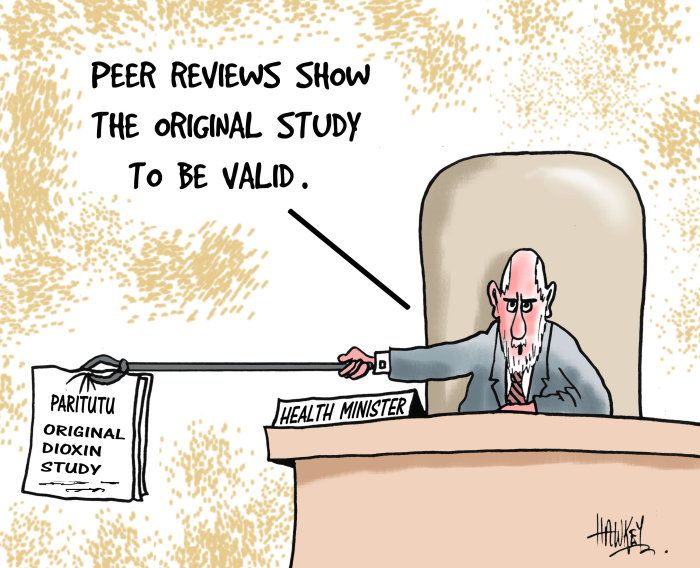
Paritutu Original Dioxin Study. Peer reviews show the original study to be valid. 26 January, 2007 [Image credit at link]
https://natlib.govt.nz/records/23164028?search%5Bpath%5D=items&search%5Btext%5D=70068
MORE ON IVON WATKINS DOW:
MP’s Agent Orange claim triggers inquiry 10/01/05
Officials will investigate a Government minister’s reported claim that Ivon Watkins Dow exported the components of the defoliant Agent Orange for use in the Vietnam War.
MP’s Agent Orange claim triggers inquiry
/cloudfront-ap-southeast-2.images.arcpublishing.com/nzme/FNMG5HFOSRQNF52F77VTYKWEKE.jpg)
John Moller
Officials will investigate a Government minister’s reported claim that Ivor Watkins Dow exported the components of the defoliant Agent Orange for use in the Vietnam War.
Transport Safety Minister and New Plymouth MP Harry Duynhoven has given the long-standing claims that New Zealand made and exported Agent Orange new weight with comments to a Sunday newspaper.
It has also raised questions about whether the Government will face lawsuits at home and overseas.
He told the Sunday News he had information the products used to make Agent Orange – 2,4,5-T and 2,4-D – were shipped from the Taranaki wharves in the 1960s to the American base at Subic Bay in the Philippines for use in the Vietnam War.
This contradicts denials by Ivon Watkins Dow – now Dow AgroSciences – that it supplied Agent Orange or its ingredients to the US military from its Paritutu, New Plymouth, plant.
The newspaper quoted Mr Duynhoven as saying the export of the products under the National Government of Sir Keith Holyoake “should be in the public arena”. The claim has come mainly from environmentalists and the Green Party.
In 1990, during the fourth Labour Government’s final days, a parliamentary committee reported that evidence for the claim was inconclusive.
Mr Duynhoven was overseas yesterday and could not be contacted.
But Government duty minister Rick Barker said officials would look afresh at the claim.
National deputy leader Gerry Brownlee asked if Mr Duynhoven had hidden his information from last year’s health select committee inquiry into the health effects of the agent on veterans and their children.
“Surely Mr Duynhoven wasn’t the only member of Cabinet to have this information?”
He said Prime Minister Helen Clark must tell what she knew, how long she knew and how long she intended sitting on the information.
But Green Party co-leader Rod Donald said Mr Brownlee should “look in the mirror”, as National was in power at the time during the war and for most of the time since.
He said Mr Duynhoven’s reported revelations were breathtaking. They vindicated his party’s view and showed the Government should take IWD to court.
“Being sprayed with New Zealand-made Agent Orange is equivalent to being bombed by New Zealand-made bombs.
“The revelation strengthens our call for the families of Kiwi soldiers in Vietnam to get the full medical treatment they deserve and the monitoring that they’ve been calling for.”
John Moller, former president of the now-defunct Vietnam Veterans Association set up in the 1980s to research the effects of Agent Orange, said he was shocked by Mr Duynhoven’s statement.
The only documents Mr Moller had seen relating to such claims were two books, one of which said ICI New Zealand had supplied Agent Orange.
“But being a member of Parliament I suppose he’s got the knowledge and evidence to back it up.”
Mr Moller said that at the parliamentary probe into the claims, an IWD official was asked if Agent Orange was made at New Plymouth.
“His reply was ‘not at that site’.”
No politicians had bothered to ask whether it was made at another site.
Mr Moller said the irony was not lost on veterans that they could have been poisoned by their own country.
He said veterans and their widows and families should be compensated. About 600 veterans, of more than 3000 who served there, were now dead.
Dow NZ general manager Peter Dryden was overseas and could not be contacted yesterday.
Greenpeace toxics campaigner Mere Takoko said up to 15 per cent of the product made in New Zealand was exported during the Vietnam War period.
She said the Government breached the Geneva Protocol prohibiting the use and supply of chemicals for waging war.
Former Taranaki port watersider Norm Quinlan said it was well-known in the 1960s that Ivor Watkins Dow exported some chemicals to the Philippines.
Now 85, Mr Quinlan said a drum containing liquid from the plant broke while loading one day and another worker got covered in the “juice”.
He was in hospital for months and a few years ago died of cancer.
“There was three in that hold that day and they all later died of cancer.”
Mr Quinlan did not know exactly what substances they were exposed to, but “it was stuff from Ivor Watkins Dow going up to the Philippines … going up that way anyway.
“The only thing I can tell you is that I worked on the ship that sent that stuff away. I’ve got an idea that it was in 66 or 67.”
He said few watersiders from that era were still alive.
Deadly mix
* Agent Orange is a mixture of the herbicides 2,4,5-T and 2,4-D, and was used as a defoliant by the US military in the Vietnam War.
* Ivon Watkins Dow made both herbicides at its Paritutu, New Plymouth, plant but denies producing Agent Orange or selling its components to the US military.
From the Green Party NZ:
Dioxin disaster
TV3’s Melanie Reid has spent the last year investigating dioxin contamination from the herbicide 2-4-5-T, especially in the New Plymouth suburb of Paritutu, where Ivon Watkins Dow manufactured the chemical for more than 20 years. The result, a 90-min documentary called Let us Spray went to air last night. If you missed it, you can watch it online here. (Video displayed above).
The documentary is extremely disturbing. Most notably, a forensic accountant hired by TV3 went through an earlier Ministry of Health report into dioxin contamination in New Plymouth and found that ill-defined parameters, muddled reporting of facts and inconsistencies in drawing conclusions masked the true extent of the dioxin contamination problem. READ MORE
NOTE: DEAD blog.greens LINK NOW
Read more on chemicals and how they poison us on our ‘chemicals’ pages.
Discover more from Environmental Health Watch NZ
Subscribe to get the latest posts sent to your email.

Dear Pam!
This is your official welcome to the Organic Gardener Podcast Facebook Community ! Yup…you are now amongst other great earth friendly gardeners just like yourself! 🙂
And it just so happens we have a Private Facebook Group just for you!
It’s the Organic Gardener Podcast Facebook Community !
Here, you will be able to connect with your fellow gardeners! Share resources, ideas, challenges and successes!
Click HERE to request access the Organic Gardener Podcast Facebook Group !
I’ll see you there! ~ Jackie Marie
Attention!!! Once you click UNSUBSCRIBE below, you will stop receiving our highly targeted communications that have been designed for your benefit! (You’ll miss out on a lot!)
Jackie:~)
Mike and Jackie Beyer The Organic Gardener Podcast PO Box 310 Fortine, MT 59918 1-877-209-6899 organicgardenerpodcast@gmail.com http://www.organicgardenerpodcast.com
>
LikeLike
When we made the documentary film ‘Rubber Gloves Or Green Fingers’ for TVNZ the management were pressured by various producer boards not to broadcast it. As a result muppets like Andrew Shaw did everything they could to prevent it ever being shown. They were just another corporate cog helping to suppress information about the dangers of pesticides.
LikeLike
Hi Tim. Thanks for that information. Is that doco available? I haven’t seen it. Definitely not surprising given the use of them here is very accepted by those in charge who decline to examine the independent research into pesticides. Laughable isn’t it they call us clean & green?
LikeLike
1939 Germans invaded Poland at that time a young Polish Chemistry graduate was pressed into going back to Germany and working for the Germans and on developing 245T. It was referred to as “Weedkiller” by the Germans and was used as part of the “final solution” to kill Jews. In fact it was replaced by the Chemical “Zyklon B” not because Zyklon B was better killing jews but it was faster. 245T was considered better but took longer. Near the end of the war the scientists went on the run, no one wanted to be picked up by the Russians so they looked for the Americans. After being taken to the States and debriefed the one who told me this was sent to NZ to continue developing 245T. And did he what… tons and tons of the shit… too much and by-product. In fact…Vietnam was an opportunity to get rid of the massive surplus of this deadly chemical so it was rebranded as “defoliant” and “agent orange” and dumped on Vietnam. There is high level cover up, I believe the Americans are War criminals and IWD and NZ are complicit. But no one can do a thing about it until the whole story is known.. evidence has been destroyed trails covered. If we had not heard this ourselves from the mouth of the head Chemist then we would not believe it ourselves. This is not a conspiracy theory this is a case where the truth is stranger that fiction. Our farmers were effected from gorse spraying and farm use/ experiments down Manaia way right around our Maunga and across the country, it was even sold in small bottles for domestic use.. our soldiers effected from Vietnam dumping.. it is dorment in our soil til tilled.. it is in our food chain…it billowed over New Plymouth.. It poisoned Vietnam.. It was used as a biological weapon..dig deeper NZ you definitly won’t like what you find. I am a local I have no reason to make this shit up.. its just so unreal that this happened here.
LikeLiked by 1 person
I think people are waking up David thanks to social media. ANd the soldiers, yes I’ve met them one in particular whose child had serious issues he belived because of his service in Vietnam. Shameful. What you say is reinforced by the way they dragged their feet about even admitting it. 2006 I believe it was here. Folks can search ‘Operation Paperclip’ for data on the post war experiments you cite. Thanks for the info David. THe whole thing’s shocking.
LikeLike
Vietnam is right now trying to sue Monsanto for the millions of deformities, health problems, land and environmental problems related to Agent Orange since Monsanto lost another big case last week in California. As NZ produced Agent Orange, a high level executive of IWD spoke out – it leaves NZ open to lawsuits too – 40 years later….and now we drop 1080 a deadly toxin out of helicopters into waterways and on our land. Crimes against humanity.
LikeLiked by 2 people
Well said. That’s a sobering truth isn’t it? Open to lawsuits.
LikeLike
hi Tim i used to live right next to that plant on Marama Cresent at night time when it was raining they use to burn off chemicals so no one could smell it but you could still smell it
LikeLiked by 2 people
I lived on Rangitaki Drive in the early 80s, mowed the lawns at Steel and Tube with no catcher for 2 years as an after school job and to this day can still remember the taste of the chemicals in the air in the area. My cousin Jeff Oneil worked in the lab and died in the last 5 years from a brain tumour. I also remember the leaking drums in the chemical dump on the cliffs above back beach , around the area that they built the tank farm. Those chemicals leaked into the creek that ran along the gully at the back of our house and leached through the soil on the eroding cliff edge down on to the beach. It was common knowledge that the dump was there and that it was leaking. I remember it vividly. There were always mutterings amongst the locals but nobody would listen. Nothing has changed.
LikeLiked by 2 people
The place must have been so toxic Nix. It’s astounding hearing these stories. Do you ever recall being talked to about safety issues? protection even? Would be so good to have a census/survey of sorts of all the folks who’ve lived there over the years. One young woman has shared elsewhere that she scars from the effects of the chemicals during her mother’s pregnancy.
LikeLike
And exactly the same thing we are seeing in this country with 1080.
LikeLiked by 2 people
Yes for sure we are, all covered up.
LikeLike
I know a natural health practitioner who was a young mum all those years ago and worked in the office of Ivan Watkin Dow in Taranaki. She would picnic on the beach with her kids as a tractor from the IWD factory would go down onto the beach and dig a hole and bury the drum of what would have been toxic waste in the sand……When her neighbour sprays with Roundup she is affected immediately and is driven to bed in
an effort to recover i,e, she is super sensitive to the poison. Secondly I know a Vietnam Vet who is surviving with health issues but keeping them at bay by using New Image supplements which includes a colostrum product and shares this knowledge and product with his fellow Vietnam Vets. Those who are suffering and don’t listen to him succumb. It is a national shame that this issue in not dealt with and compensation of some description given to the victims and families -IWD need to be made accountable. I also understand that IWD or a subsidiary are responsible for the abandoned gold mine up the Tui Road, Mt Te Aroha. The poisonous tailings were left and Waikato Regional Council ratepayers paid for the road built up to the site and concrete trucks mixed the contaminated ground into a slurry to set in a big blob in the ground. Things we do…….!
LikeLiked by 2 people
Thank you for that info Mischele. Very interesting indeed. Clearly they took full advantage of people’s ignorance back then. That area must still be very contaminated I would imagine. It would be interesting to know. I didn’t know about the gold mine. Totally typical of a corporation, how they leave the clean up costs to others & are never required to pay themselves. So wrong.
LikeLike
According to this most recent study, it’s still contaminated in Vietnam 50 years later.
https://www.eurekalert.org/pub_releases/2019-02/uoic-tbo022719.php
Why it should be different 30 years later for an ardent spayer and maker of the same component New Zealand…
LikeLiked by 1 person
oh yes what a crime!! Those poor people. Still also being born deformed. Disgusting.
LikeLiked by 1 person
Hi Pam, Is there any way we can get Terry Brownbills Film about 1080 for Social Media?
LikeLiked by 1 person
What is the title David?
LikeLike
Property manager sent a guy she said to “trim” ivy along the fence to please the unhappy neighbour. He ripped it all out then sprayed with herbicide, afterwards rinsing the container on the lawn. He also left dead ivy remnants and leaves all over the fence presumably for someone else to clean up.
Took me a month of constant asking to find out what the herbicide was. “Lion”, which on googling turned out to be glyphosate – Monsanto’s (maker of Aged Orange along with Dow) invention, also known as Roundup, though made by Nufarm.
I read the usage label online, which the guy clearly didn’t bother to read, as he was dressed in shorts like he was watering plants not killing them, without any safety gear:
“When handling wear eye protection, waterproof gloves, boots and overalls.”
Sweet as, she’ll be alright. The label also had this amazing disclaimer that needs to be read to be belived – the maker cannot be held responsible for anything, including its own negligence:
“When you use this product, you agree that neither Nufarm Limited nor any manufacturer of any component of the product will be liable for any damage, injury or loss including consequential loss which arises in anyway from the storage, handling, or use of the product. This exclusion of liability includes loss caused by negligent acts or omissions of Nufarm Limited or any supplier or manufacturer of the product or any of their employees and agents.”
Click to access Lion_Herbicide_20L_Label.pdf
Like, I presume, if their own research happens to uncover some unknown harmful effects, they are not abliged to tell you.
Also funnily, the product’s main page https://www2.nufarm.com/nz/product/lion-herbicide/ advertises it as suitable for “aquatic areas” in spite of the label stating:
“Toxic to aquatic organisms with long-lasting effects. Avoid contamination of any water supply with product or empty container.”
No kidding. I recall ads in local paper by DOC advising of them using Roundup specifically around local streams. This summer, while swimming, I saw quite a few dead small fish in the lake, which I was told by Waikato Regional Council was natural deaths after spawning, which some fish in fact do, but now I am not so sure, as I don’t remember seeing that dead fish before (neither I remember ever seeing live fish, though that may be because I don’t fish for the introduced trout).
In summary, buy more, spray liberally, we will worry about it later. I am still trying in vain to get the property manager to have someone come and clean up all the dead stuff hanging on and around the fence, and I miss the live green and truly harmless (compared to what I’ve got now) ivy. During the current dry spell I try to keep windows and doors shut on the fence side, just in case, to minimise “safe” Monsanto/Dow/Nufarm etc poisoned remnants blown in.
LikeLiked by 1 person
Beggars belief doesn’t it? I’ve asked these sprayers why they don’t wear protective gear & one reply was ‘so’s not to alarm the public’!! Good luck with your ivy remnants Dmitry. Bit of a head banging exercise isn’t it?
LikeLiked by 1 person