
From the same nation that puts down (as in euthanises) its mentally ill, lonely, children, elderly and disabled. (In 2023 Canada assisted 15,000 people to their graves via ‘assisted suicide’. Ninety thousand since 2016. They’re also helping vax injured down the same route, and ‘doing their bit’ by harvesting organs. I believe that used to be called murder? Learn about Canada’s LT plan here.
Continue reading Land Grabs Happening in Canada (the nation that also euthanises its most vulnerable)Tag Archives: land_grab
A Land Grab You Probably Didn’t Hear About
While Kiwis celebrate on November 5th a personage few even really know about now (Guy Fawkes) others remember the long concealed invasion of peaceful Parihaka in the Taranaki. GF has been replaced it would appear, by Halloween going by more recent hype. Here is a post on topic by historian, Vincent O’Malley focusing on the South Island’s involvement in this particular government land grabbing operation ..
SEE ALSO … Art Exhibition ‘The Art of Passive Resistance’ (Wgtn 2001). Click on the various links to see the individual art works and read the commentaries. It was this exhibition that awoke me to the govt land grabbing of the 19th Century. It’s happening now you may have noticed?.. EWNZ
Parihaka & Waipounamu: Remembering the Anniversary of the Invasion of Peaceful Parihaka
The invasion of the pacifist settlement at Parihaka on this day in 1881 is a pivotal moment in Taranaki history. What’s less well known are the southern connections to the conflict, as historian Vincent O’Malley explains.
It’s often assumed that the 19th-century New Zealand Wars fought between the Crown and various groups of Māori were exclusively a Te Ika-a-Māui (North Island) story. But, in addition to the violent clash that took place at Wairau, Marlborough, in June 1843, there is a much deeper, if largely unknown, history of southern engagement with these conflicts.
Military settlers were recruited from Te Waipounamu (South Island) goldfields to fight in the Waikato and elsewhere during the 1860s in return for a share of the confiscated lands. And Ōtautahi (Christchurch) politicians such as Henry Sewell and James Edward FitzGerald were members of colonial governments that were responsible for directing the later military campaigns and land takings, even while they expressed doubts about the justice of what was unfolding.
There is another aspect to this story with a particular focus on Taranaki. Beginning at Waitara in March 1860, Taranaki Māori were subjected to a relentless series of invasions and attacks that continued to play out more than two decades later.
As successive governments sought to implement a policy of “creeping confiscation”, it was, at different points, considered useful to remove Māori from the area. The Chatham Islands had previously been used to imprison Māori from the Tairāwhiti (East Coast) region. When it came to Taranaki Māori, Te Waipounamu was selected instead.
In November 1869, a group of 74 men from the Pakakohi tribe in Taranaki, convicted of treason for resisting the confiscation of their lands under the leadership of the prophet Riwha Tītokowaru, were sent to Ōtepoti (Dunedin).
They were sentenced to hard labour and put to work constructing roads, school playing fields, and even improvements to the Octagon. But in the harsh and unfamiliar climate, many of the group became ill; 18 men had died during their captivity in the south before the government finally agreed to commute the sentences of the survivors in 1872.
Returning north again aboard the government steamer Luna in March of that year, the party of survivors made a stopover at Ōhinehau (Lyttelton). More than 50 of their number travelled by train to Christchurch, where their appearance was said to have startled several shopkeepers and “caused considerable speculation amongst the citizens”, despite their “modern civilian attire”.
Seven years later, another group of Māori political prisoners from Taranaki was sent south.
In 1879, the government pushed through with a survey of lands that had been nominally subject to confiscation 14 years earlier, but were in practice occupied and used by Māori. That May, the people of Parihaka began ploughing up surveyed lands in the area, in an act of non-violent resistance led by prophets Te Whiti-o-Rongomai and Tohu Kākahi.
They had founded the settlement of Parihaka in the 1860s as a place of refuge for all those affected by war and confiscation and soon attracted supporters from Taranaki and beyond. But the actions of the Parihaka ploughmen drew an angry response from settlers in the area, and, by June, the government began arresting them. Denied trials, the prisoners were instead sent to Dunedin.
The people of Parihaka remained undeterred. By June 1880, the ploughmen had been replaced by fencers. They, too, were promptly arrested and imprisoned in the South Island without trial. This time, there were too many to send to Dunedin alone. While some were taken south to Otago, around 40 were imprisoned at Hokitika.

And, in September 1880, approximately 160 of the prisoners were taken to Whakaraupō (Lyttelton Harbour) and imprisoned on the small island of Ripapa. In December, it was reported that many of the prisoners had been punished for being “unruly and defiant” by having their daily rations reduced to bread and water.
Meanwhile, within weeks of their arrival, at least one local firm was advertising special excursion trips down the harbour designed to “afford persons an excellent opportunity of viewing the Maori prisoners at Ripa Island”. Māori misery had become a Pākehā spectator sport. The price was 1 shilling and 6 pence per passenger.
It’s not known exactly how many Taranaki prisoners died during their captivity on Ripapa Island. Buried on Ōtamahua (Quail Island), where there were hospital facilities, they were later reinterred at Rāpaki by members of local Ngāi Tahu hapū Ngāti Wheke.
For them, Ripapa Island (which had been used by the government as a quarantine station since 1873) was a wāhi tapu because of the many people killed there during the Musket Wars of the 1830s. In January 1881, the remaining 149 prisoners were moved from Ripapa to Lyttelton Gaol in order to “subject them to more rigid restriction”.
Small groups of prisoners were released in batches over the following months, and by June, the last of them had been freed.

Back home at Parihaka, prophets Te Whiti and Tohu were no more willing to end their campaign of non-violent resistance to the confiscation of 1.2 million acres of Taranaki lands.
The Crown’s response came on November 5, 1881, when, led by Native Minister John Bryce riding a white charger, nearly 1,600 members of the armed constabulary and volunteers (including some from Christchurch) invaded the settlement.
One journalist who witnessed proceedings reported that: “The whole spectacle was saddening in the extreme; it was an industrious, law-abiding, moral and hospitable community calmly awaiting the approach of the men sent to rob them of everything dear to them.”
Te Whiti, Tohu and several others were seized without resistance and the remainder of the population forcibly dispersed. Many women were raped, and the settlement was pillaged and destroyed.
After an inconclusive trial in Ngāmotu (New Plymouth), where Te Whiti and Tohu were accused of “wickedly, maliciously, and seditiously contriving and intending to disturb the peace”, it was decided to send the prophets south to Christchurch.
They arrived at Lyttelton on April 26, 1882, to a large crowd of spectators, and were immediately transferred to Addington Gaol, where they were held in the women’s section. Plans to put the prophets on trial again in Christchurch were soon jettisoned. Instead, the pair were held under what one historian describes as “a form of honourable restraint” and another as “a gentlemanly kind of house arrest”.
An Australian-born Irishman named John P Ward, who’d served in some of the most brutal campaigns in Taranaki and picked up some ability in te reo Māori during his time in the north, was appointed as interpreter and personal jailer to Te Whiti and Tohu (though he never told them of his military service). Ward subsequently wrote Wanderings with the Maori Prophets, a colourful, if unreliable, narrative of the 11 months he spent accompanying the two men before they were finally permitted to return home to Taranaki in March 1883.
Accompanied by Ward, Te Whiti and Tohu were taken to multiple sites across Christchurch and Canterbury, each designed to impress upon them the wonders of western civilisation. One of the first places visited was Canterbury Museum, where the prophets were met by curator Julius von Haast. From there, they travelled across to Christ Church Cathedral, ascending the tower as far as the bells to take in a panoramic view of the settlement below them.
Both men were said to have gazed longingly towards the sea, visible at a distance. Visits to the Kaiapoi woollen factory, to the theatre, Addington railway workshops, Hagley Park, and elsewhere, followed. Later asked to name a favourite place visited, Te Whiti opted for somewhere simpler, calling the Ōtākaro (Avon River) the highlight of his stay.
Te Whiti and Tohu happened to be in Christchurch during the International Exhibition, a three-month-long showcase of science, technology, commerce, art and civilisation that attracted an estimated 226,000 visitors.
There, and elsewhere in their travels, the pair attracted a large and often admiring crowd of their own, many following the men as they inspected the art gallery, waxworks, “Ladies Court”, “Maori Court” and other exhibits. At least one report noted that some of those who had turned out to see the rangatira were Māori. The warm reception they were receiving prompted the New Zealand Herald to complain that “Christchurch people are having the gratification of lionising Te Whiti and Tohu, all at the Government expense”.
The two Māori prophets travelled much further afield during their stay in the South Island — including journeys to Hakatere (Ashburton), Temuka, Timaru, Oamaru, Dunedin, Tāhuna (Queenstown), Waihōpai (Invercargill), and around to Te Tai o Poutini (the West Coast) on steamer, followed by six months housed in Whakatū (Nelson). But it seems doubtful that Te Whiti and Tohu came away from their extended stay in Te Waipounamu with any sense of the supposed superiority of Pākehā culture.
On their return to Parihaka, the two men immediately threw themselves into rebuilding the settlement into the vibrant and thriving place it had once been, before te rā o te pāhua (“the day of the plunder”) in November 1881.
Te Whiti and Tohu had never rejected western technology or ideas — Parihaka went on to become one of the first settlements in New Zealand with electricity and street lighting — and in this respect their detention in Christchurch and elsewhere in the South Island had not fundamentally altered their outlooks. But it was a compelling chapter in the story of the New Zealand Wars in Te Waipounamu.

This is a lightly edited version of a piece which was first published in Bulletin by Te Puna o Waiwhetū Christchurch Art Gallery. The original, fully-referenced version can be read here.
Vincent O’Malley is a Te Whanganui-a-Tara Wellington writer and historian, born and raised in Ōtautahi Christchurch.
Thank you for reading E-Tangata. If you like our focus on Māori and Pasifika stories, interviews, and commentary, we need your help. Our content takes skill, long hours and hard work. But we’re a small team and not-for-profit, so we need the support of our readers to keep going.
If you support our kaupapa and want to see us continue, please consider making a one-off donation or contributing $5 or $10 a month.
RELATED
In 2024, The National Library site featured a blog post on topic titled ‘Remembering Parihaka’, by Dylan Owen.
“For Taranaki Māori, 5 November 1881 is known as ‘Te Rā o te Pāhua’ or the ‘Day of Plunder’. The invasion of Parihaka — te pāhuatanga — involved 1500 armed constabulary and volunteers led by the Native Affairs Minister, John Bryce.”
Read at the link
https://natlib.govt.nz/blog/posts/remembering-parihaka
To educate yourself, I would also recommend reading ‘Ask that Mountain’ by Dick Scott, and ‘Days of Darkness’ by Hazel Riseborough.
Photo: By James Cowan – The New Zealand Wars, Public Domain, https://commons.wikimedia.org/w/index.php?curid=8050240
Is there a story behind hurricane Melissa … another land grab?
“Smart city” land clearing operations going on?
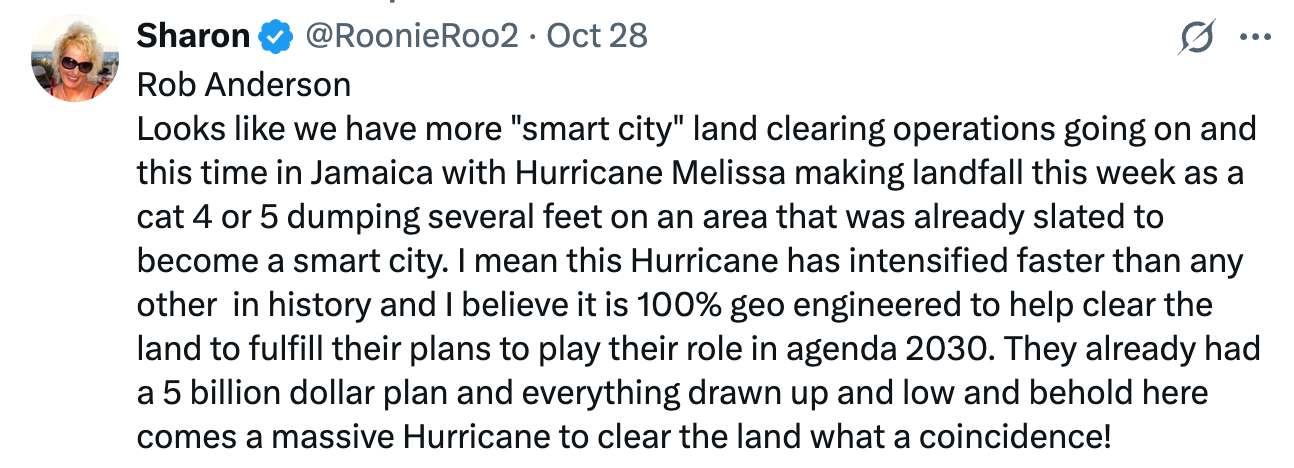
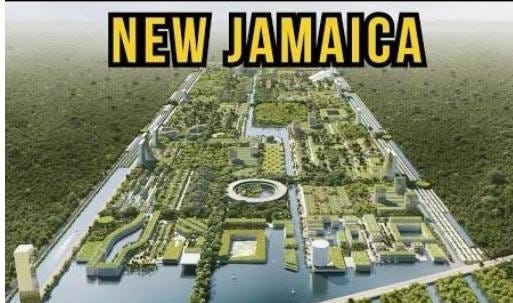

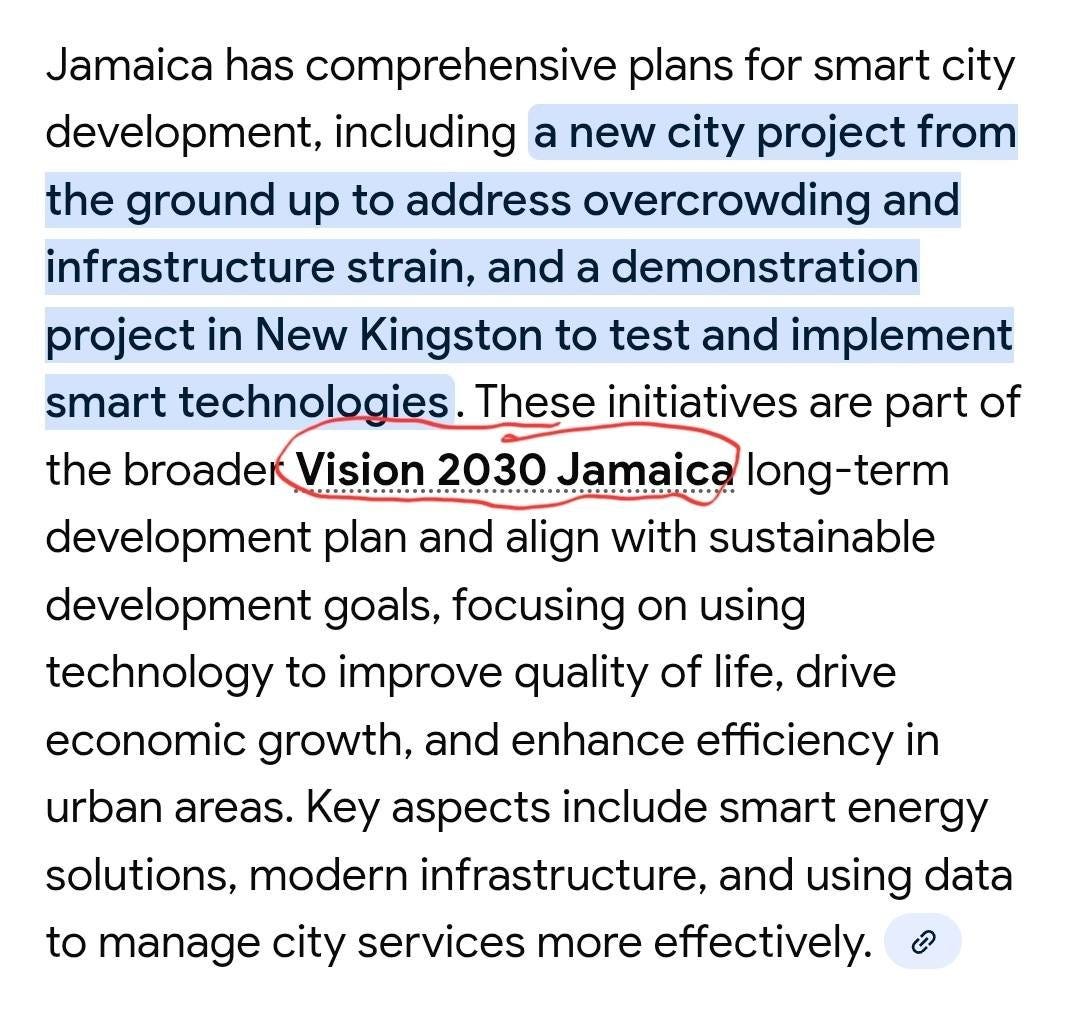
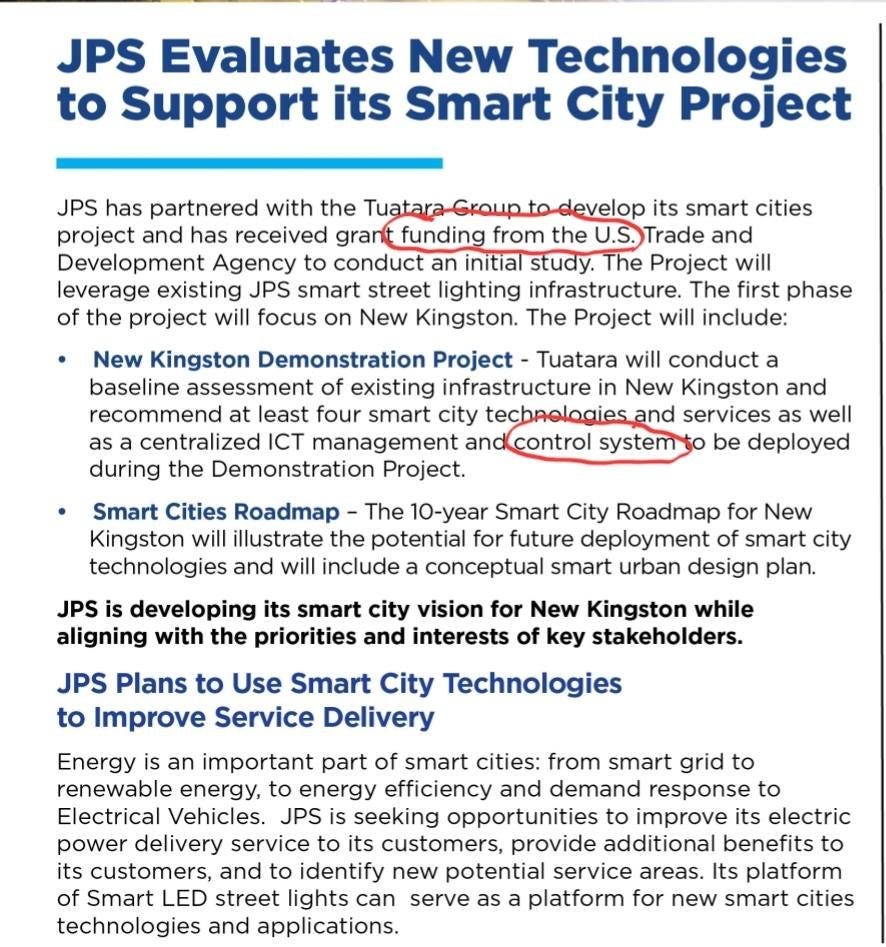
Jamaica is moving toward becoming a UN-backed smart city under its Vision 2030 development plan, a long-term blueprint running from 2009 to 2030 that aims to make the island “the place of choice to live, work, raise families, and do business.”
Aligned with the United Nations Sustainable Development Goals, the initiative integrates Artificial Intelligence, Central Bank Digital Currency, and carbon pricing policies.
You will own nothing and be happy.
GEO-TERRORISM ALERT! DARPA-Geoengineered Weather Weapon Packing 175 MPH Winds Unleashed On Jamaica—WHY NOW?
The Weirdest Storm Path of any Hurricane in Recorded History
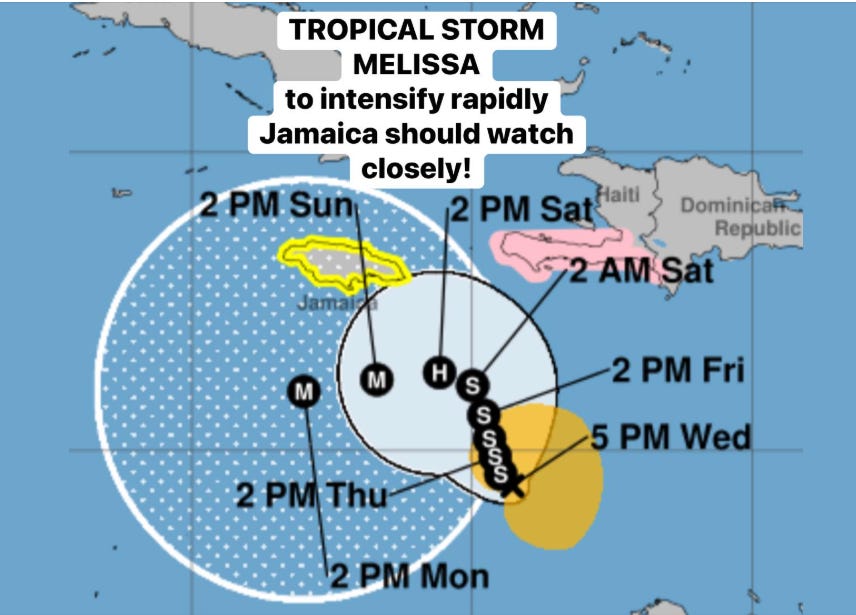
This Alt Media platform has been closely watching Hurricane Melissa since its very inception. From the beginning, even before it was classified as a tropical depression, Melissa possessed all the signatures of a highly geoengineered frankenstorm.
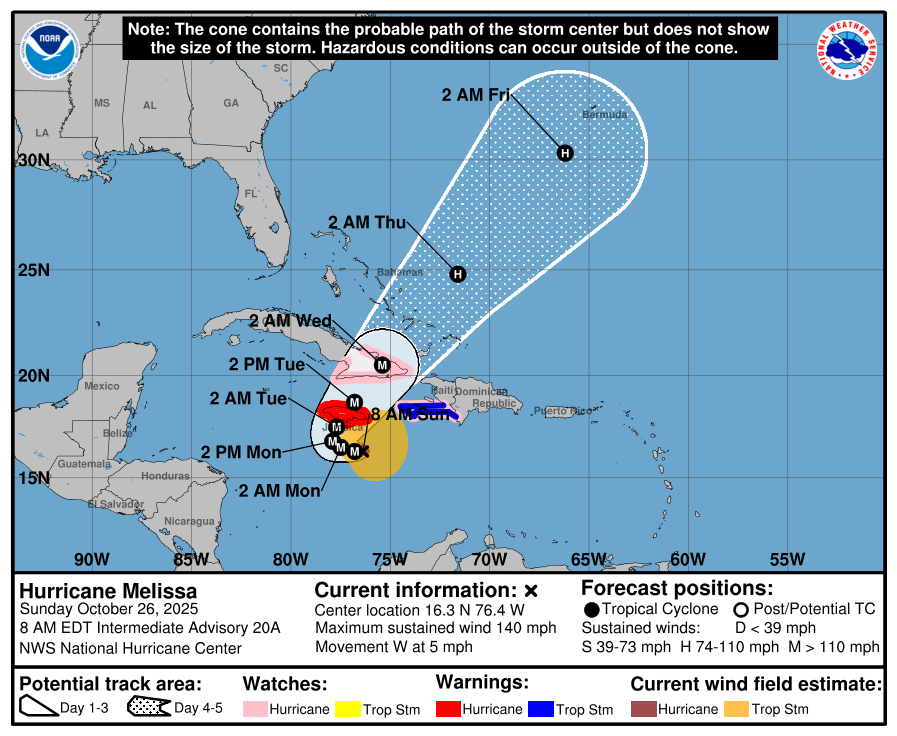
Quite predictably, NOAA has removed the entire trajectory of this transparently manufactured superstorm from the National Hurricane Center website. Because of Melissa’s absurdly manipulated path from the very start, they really had no choice as geoterrorism investigators and weather warfare researchers would have easily exposed the plot by its very odd behavior.
As it stands at 6:30 AM this morning, Tuesday, Oct. 28, this deliberately slow-moving weather weapon has been stationed right over the island to Jamaica to inflict maximum damage (see the following screenshot). And so it is.
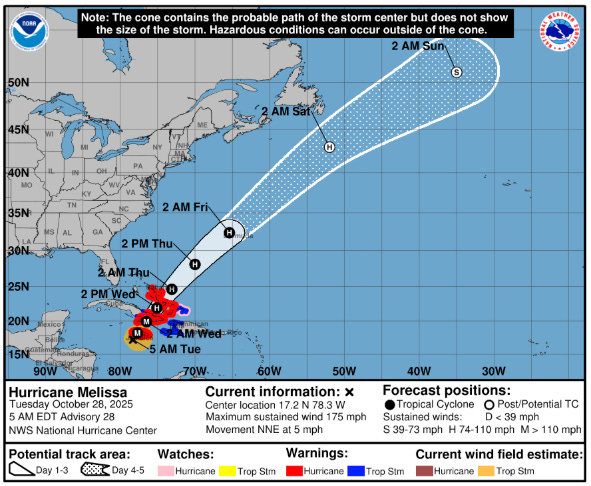
Here’s how Melissa was tracking on Sunday, October 28th before the murderous geoengineers executed a 90 degree angle to slam her right into the center of the southern Jamaican coastline.
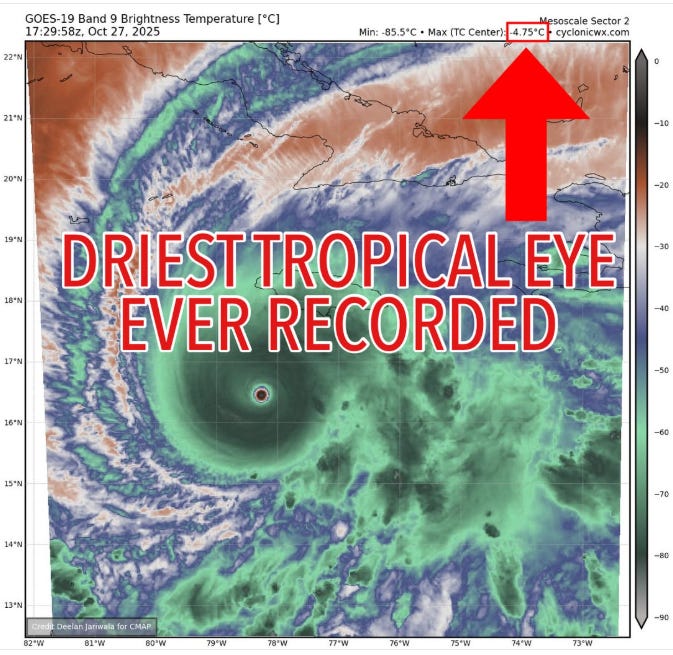
Now we see that Melissa has mysteriously produced the “driest tropical eye ever recorded”.
“NOAA Hurricane Hunter aircraft measured the driest eye ever recorded at –4.75 °C (23 °F), which is a sign of a perfectly ventilated eyewall. This is one of the most efficient Hurricanes we’ve ever sampled with modern technology!”
That data point alone proves that this act of catastrophic geoterrorism is the product of the most advanced DARPA-directed weather warfare technology on the planet today.
Furthermore, let’s not ignore these incriminating data points pointing to a full-blown weather attack and geoterrorist operation being perpetrated against the people of Jamaica and Cuba (as usual).
BREAKING:
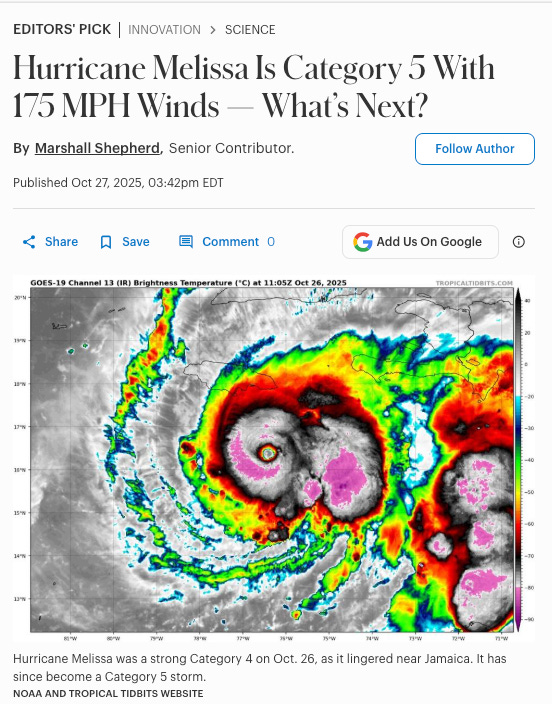
CAT 5 Hurricane Melissa is now packing 175mph sustained winds,
with gusts over 200mph!
Conclusion
As for “WHY NOW?”, it ought to be obvious to everyone at this late date that whenever these NWO geoterrorists fabricate such a captivating weather drama like Melissa, there is a great need for the globalist cabal to distract US from something very BIG that’s going on under the radar. Incidentally, the following UPDATE #1 is not that “something”.
To be continued —
UPDATE #1
“There is a lot of speculation within the global intel community that the main purpose of this calamitous geoterrorist attack is to completely monopolize Mission Barrio Adentro, which is the name of the program involving Cuba’s medical professionals assisting Venezuela. In this way, those doctors and nurses and med techs will not be available to help Maduro’s military in the event of an unprovoked attack of naked aggression by the U.S. Armed Forces at the direction of the warmongering President Trump.”
— A Veteran Intelligence Analyst & Former U.S. Military Officer
State of the Nation
October 28, 2025
N.B. What follows are the usual MSM reports that are hyping the 175 mph winds just prior to landfall. If this wind speed is accurate, then Mega Hurricane Melissa is practically a hurricane-tornado just like weather weapon Hurricane Michael when it devastated a large swath of north Florida in October of 2018.
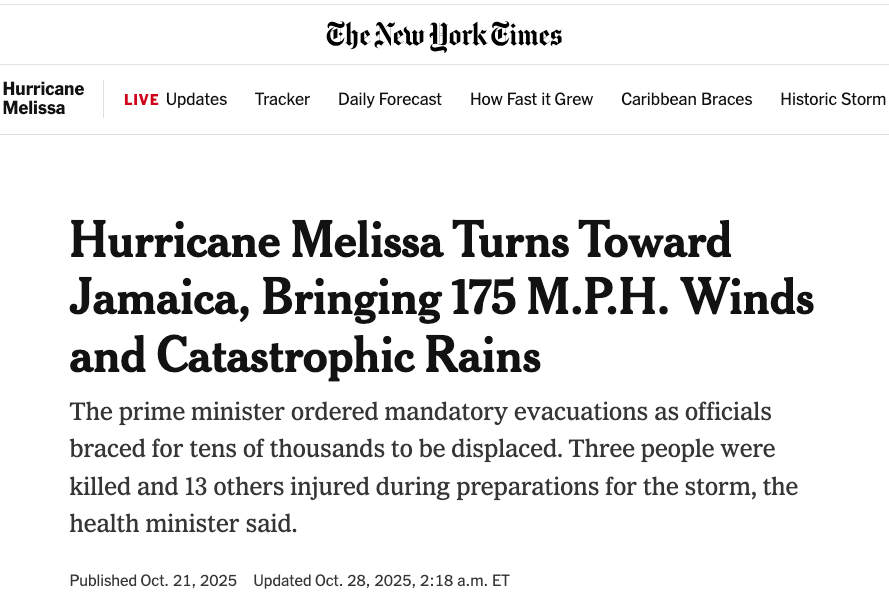
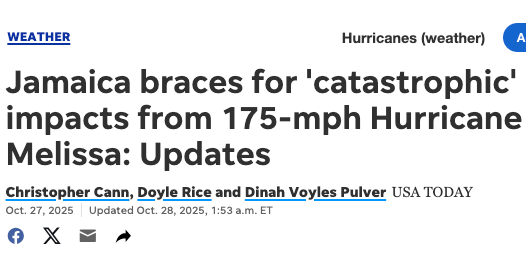
Prime Minister Andrew Holness of Jamaica issued dire safety warnings and ordered mandatory evacuations as Hurricane Melissa, a Category 5 storm channeling 175 m.p.h. winds and enough moisture to drop nearly three feet of rain, made a turn toward his country’s southern coast and its 2.8 million people on Monday.
Speaking on CNN, Mr. Holness offered a grim outlook, saying that he did not believe there was “any infrastructure within this region that could withstand” a storm that powerful.
____
https://www.nytimes.com/live/2025/10/27/weather/hurricane-melissa-jamaica
Subscribe to Seemorerocks
By Robin Westenra · Launched 2 years ago
This is where I post articles by me that might otherwise get buried.
A NZ couple’s battle with incompetence, cover-ups, outright lies and legal bullying
A battle funded by unsuspecting tax payers… another land grab?
From the Daily Telegraph
The Americans say “You can’t fight City Hall”. When you take on your council, Big Bureaucracy always wins because it is not a fair game.
Not only do they set the rules, they are the referee as well.
In central governments, the average worker is a nobody. Managers might have influence in their own departments, but not in others. In local government, people are more interconnected. This makes the problem worse. You could appeal to your elected representatives, but they are more likely to know the key people, work with them regularly, and need them in the future. You will be sacrificed for the ongoing relationship.
It is a world-wide issue. Here is a typical example from New Zealand, that has all the hallmarks of a classic battle with incompetence, cover-ups, outright lies and legal bullying funded by the deep pockets of unsuspecting taxpayers. “David” is Murray and Margaret Shaw, while “Goliath” is the Hamilton City Council.
The Shaws are retired, and have devoted a couple of decades to creating a beautiful nature sanctuary on the outskirts of the city. There are ponds, trees and an abundance of native birds, safe from the city where pet cats often kill chicks, and street lights dazzle the owls at night.
The council has spent the same couple of decades planning suburban growth to devour the surrounding land. Thousands of pages of reports and studies gathered dust on shelves as the wheels of bureaucracy turned slowly. But a sudden offer in 2017 of $280m in government funding changed that. The politicians needed target dates for each stage (unsurprisingly connected to election timetables), so City Hall was under time pressure to deliver.
READ AT THE LINK
50 Years On: Anniversary of the Historic Māori Land March
Note: Lamestream has been curiously silent on this topic this year. At the 40th anniversary in 2016 there was a special doco made in commemoration that had disappeared from sight when I searched a year or so ago …. I finally located & purchased it after a long trail of emails. I was invited a year ago by one online magazine to write for this commemoration, only to find there was nary a mention of it come the time. Zero. Anywhere. Again I find this curious. A quick search turned up a couple of art exhibitions on topic but nothing. Fifty years on? Such a memorable event? Who controls lamestream? Anyway I happened, quite by chance, to take part in the first leg of this March in 1975, and did write of the experience as invited. I have posted it below FYI … If the event interests you at all that is. Such interest among my peers is pretty minimal I would have to say. Indeed it produces either deafening silence, or indignant reactions. The truth of our histories must be told in order to move forwards. Perhaps in this era with the endless lying we have witnessed, it may provoke more interest? The lying goes way back. It is quite frankly, what woke me up. EWNZ
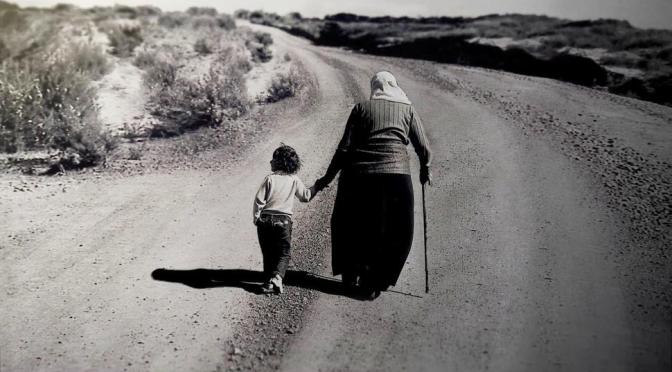
The Land March of ‘75… I recall clearly that memorable moment, setting off from Te Hāpua in the Far North. Those first steps on the metal road, the crunching of shoes on the stones, eager feet not yet blistered and sore, the excited kōrero going on around us, and that now iconic image of Dame Whina Cooper and her little moko at the front, walking up the hill! And that tag line … ‘not one more acre!’
What an historic moment it was!
I am 74 now. I was only 24 back then. On reflection, it was a year to remember, for reasons I could never have foreseen, and marking the beginning of big changes in my life. I was about to embark on a five decade long learning curve, that like the March, would have many twists and turns. It was a journey that would teach me that no, as the popular belief was back then, NZ did not have the ‘best race relations in the world’. More importantly, I would learn why.
And yet you could say it was only by chance really that I happened to be caught up in the March at all. Perhaps it was providence?
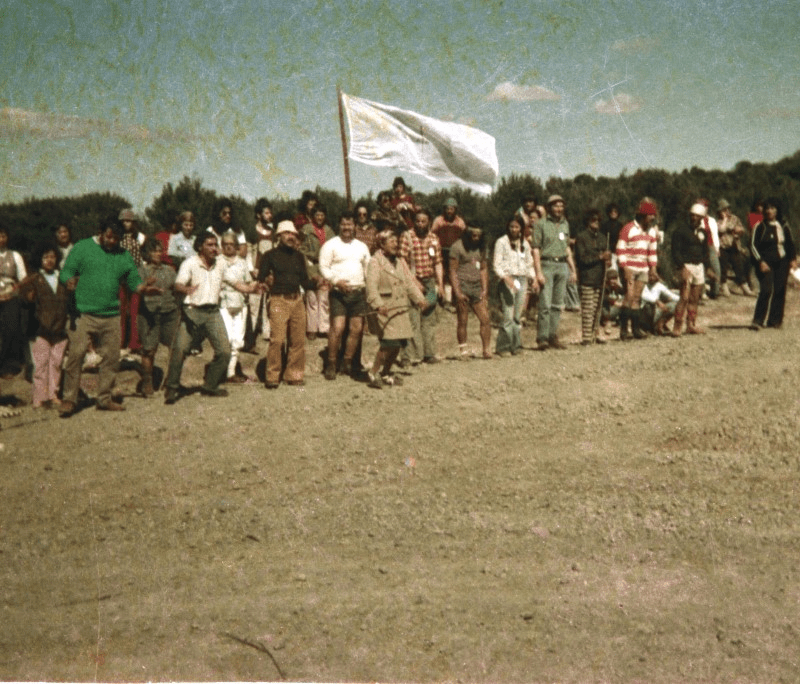
Either way, for various reasons, I’d already dismissed the prospect of going. Being a single parent with my three year old daughter Kahuiarangi in tow, the trip would have posed too many challenges. I was not long out of a violent marriage, so going up there alone was out of the question. I was also very shy. I had already learned a little about the intended March as I’d been following and supporting various protest groups at the time. One of those was CARE, the Citizens Association for Racial Equality. Racism and human rights were a big focus back then. HART, Halt All Racist Tours, was another. That was about South Africa’s official policy of ‘no Blacks allowed’ on their Springbok teams. Consequently, there were fierce protests NZ wide whenever the Springboks toured. There were many folk then who had a real determination to stamp out racism. There were of course the other folk who, like today, believed the aforementioned propaganda on race relations. It was a case of ‘good luck’ to anyone daring to challenge that one.
Those perceptions were challenged however, with the ‘75 March, and then again with the 1981 Springbok tour which saw over 200 demonstrations in 28 centers throughout New Zealand. There were 1500 people charged with offenses related to those events. People were not having a bar of racism, artists and poets included.
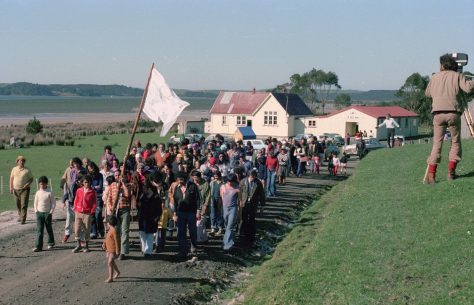
So as chance (or providence) would have it then, on 13 September 1975, I received a phone call from my old friend Barnie Pikari. He and his mate Tama Poata had broken down near Marton, not too far from Hunterville where I was living. I’d not seen Barnie for several years. It turned out he and Tama had left Wellington, heading for Te Hāpua in Tama’s Bedford truck, intending to spend time with Tama’s friend Saana Murray in the Far North before the March began. Tama had helped Saana with her book Te Karanga a te Kotuku. I’d been reading it so had learned a bit about Saana’s struggles in retaining her ancestral lands in the north. The truck fix required parts that would take some time to arrive, so he and Barnie had been forced to find other means of traveling north. As it happened, I’d just purchased my very first car, a little 1961 Ford Prefect, so without hesitation I offered to drive them. I’d never driven that far before so fortunately, had given little thought to the logistics of such a long trip. I say fortunately, because had I done so I likely would never have offered! The trip would take more than twelve hours and the roads in 1975 were very different to 2025.
After packing a few essentials we piled into the Prefect and set off almost straight away, taking turns driving. Obviously, we eventually got there, but not without difficulty. Being a first car I’d not thought about things like spare tyres so at Hamilton, when we got a flattie in the middle of the night, with my spare at home in the laundry, we were forced to get very creative and figure out alternatives! Kiwi ingenuity prevailed and Tama and Barnie came up with the brilliant idea of cutting grass from the side of the road and stuffing the tyre. Gradually we limped, regularly re-stuffing it, until we arrived in Auckland and were able to buy a new one. We sped on north then to arrive at Te Hāpua just as breakfast was finishing. We had a short meet up and photos with Rowley Habib and Saana, watched the haka and listened to the departure kōrero, then set off.
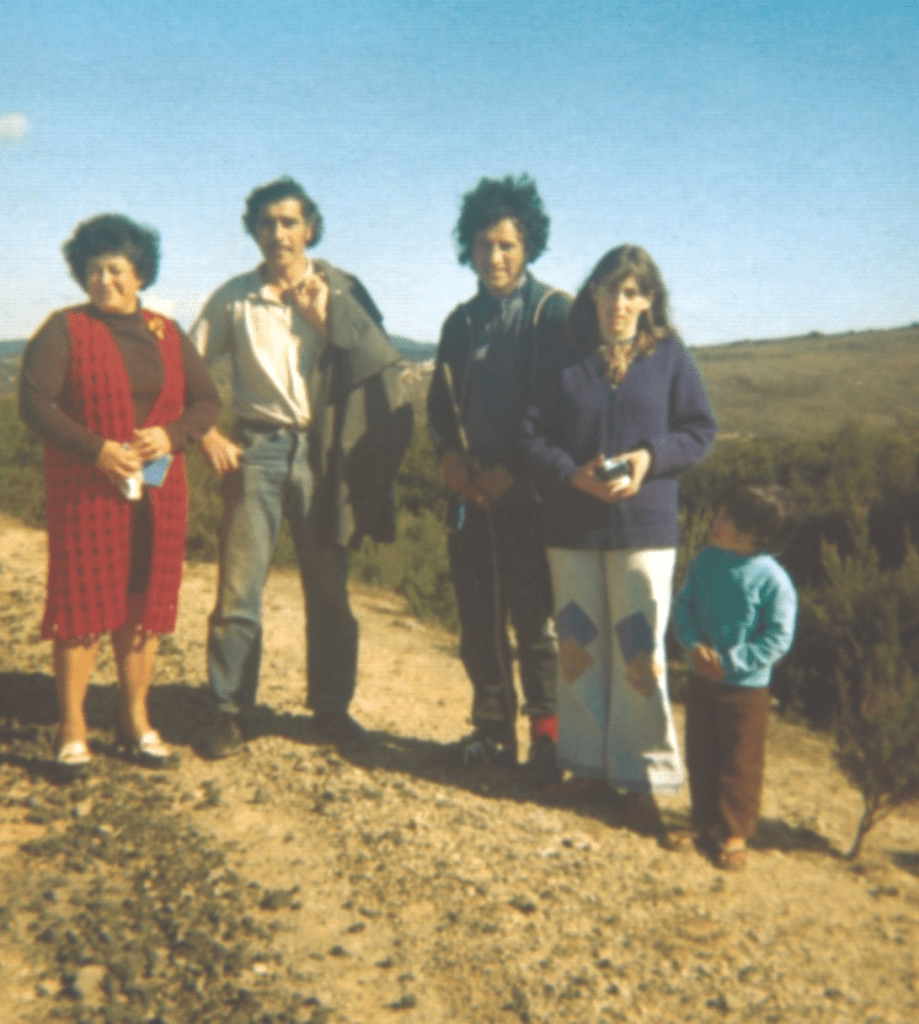
I’d decided by then, having traveled that far and having company now, I would stay on and join the March for a while at least, which turned out to be the Te Hāpua to Auckland leg. My daughter, an easy going child, seemed to have coped okay with the trip, and there were other children now for her to play with.
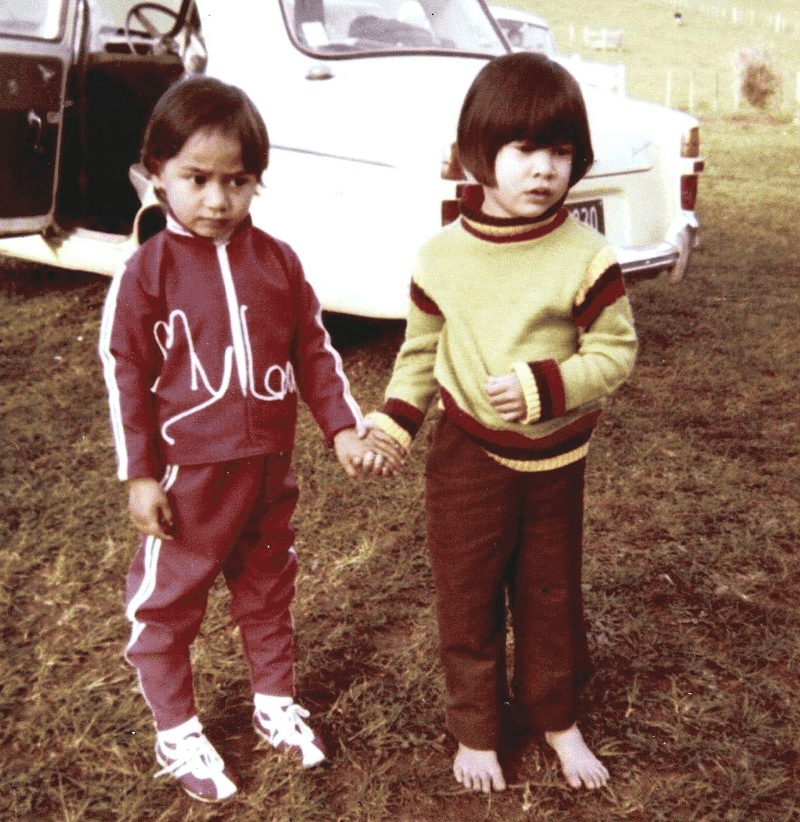
Dame Whina’s little moko was the same age as her so she occasionally came with us in the car. Barnie occasionally drove so I could join the hikoi, sometimes pushing my daughter in her pushchair. Tama had become more involved at an organizational level so aside from the occasional catch up we didn’t see too much of him after that. Along the way we would all stop as a group for refreshments and for tending to sore and blistered feet.
I wish I could say I remember all the content of Dame Whina’s kōrero along the way. In our rush for departure I hadn’t thought of pen and paper, or that I’d even need them, and of course there was no such thing as mobile phones with video and photographic capability. Plus, I had a three year old to care for. Every evening Dame Whina would address those present and explain the purpose of the March, educating us on the historic detail including her own experiences. The concept of government theft of land was pretty new to me, and for most New Zealanders I believe, still is. It blew me away. What particularly struck home from those often fiery nightly kōrero at the respective marae, was our education on the various government Acts, particularly the Public Works Act. Via these Acts, lands were ‘temporarily’ confiscated for other purposes during wartime for instance, then neither returned as promised, nor fully compensated for. Like the lands of the Tainui Awhiro people that had been taken during World War II for an aerodrome, then retained after the war and not returned as promised. Part of those lands had then been turned into the Raglan golf course. It took years of protest and resistance before they were finally returned in 1987. So this taking of lands wasn’t just back in the 1800s as many believe. Folk of my era will know that this kind of information was not imparted to us in our history lessons at school. Rather we learned about the English wars abroad, wars of no great relevance to us. We little knew that we had our own histories of war fought right here … wars of land conquest by the colonial government. Wars over lands that some Māori did not want to sell but which the settler government was determined to have. The richer and more strategically situated lands of the Bay of Plenty, Waikato, Hawke’s Bay, Taranaki and elsewhere, where in all, six million acres were confiscated. In order to justify this, non-sellers were cleverly classed ‘rebels’. Another method of land acquisition has been the perpetual lease system. Māori lands leased for pennies on the dollar so to speak, stripping the owners of their right to manage their own whenua. To get those lands back requires repayment of unmanageable sums to the lessees for improvements made. Mihingarangi Forbes reports on this situation in Tokomaru Bay and the Taranaki and how it has become now an even more unjust situation that no government wants to address. Also mentioned in her documentary, there is the taking of lands from Māori soldiers who went to fight in the world wars. Many returned from war to find they were landless. All with the stroke of a pen. To achieve this land grabbing, there were wars using weaponry, and wars using pen and paper. As the saying goes, the pen is mightier than the sword … in this case yes, those Land Acts did a great job of conquest. Such was Te Kooti Tango Whenua: the Land Taking Court, literally. This was the Native Land Court. For more light on that, one should read Professor David Williams‘ book of that name. He gets very specific about the machinations of that Court, recorded by him as being by far the greater tool for land acquisition than any other. Williams cites IH Kawharu as calling it a ‘veritable engine of destruction’ (ibid p 17). Dr Danny Keenan describes it as ‘predatory’ and ‘ruinous’.
So my learning curve had just begun, not just about land loss, but another important aspect: that of my own whakapapa and identity. I began to research this more after the March was over. My tupuna hail from the Whanganui River. Ko Te Āti Haunui-a-Pāpārangi te iwi.
Ko au te awa, ko te awa ko au
I am the river and the river is me.
So my dad was Māori but knew nothing of our history or our connections to pass on to us, his generation being well into the assimilation process. Dad’s grandmother was Kiri Te Huatahi. She was raised on the river and her daughter Ani, Dad’s mother, was raised at Pipiriki. Dad’s great grandfather Toi Te Huatahi was from Tāngarākau. Dad’s grandmother Kiri had married a Scotsman, William Ross, and his own mum had married a French Canadian, Albert Vernon. So he and his six siblings were raised in Pākehā ways.
We’d been up the Whanganui River road in search of clues to our history not too long before the March as it happened. I recall him peering across the river from Pipiriki to where he’d been told his Aunt Harriett had been buried when she was just 11 years old. She’d drowned in the river. Her older brother later died as a teen from poisoning by green grapes it was said, according to the Doctor who saw him at the time. We do know now that flour intended for non-sellers on the river was poisoned i with arsenic. I do wonder about my great uncle and whether he somehow fell victim to it.
For my dad, his six siblings and his mum, those were survival years. The way forward for many was seen as learning and adopting Pākehā ways in order to live in a Pākehā world. Language banned in schools, lands largely gone and an assimilation agenda well under way, my dad and his siblings faced as little kids, a very racist world. Folk, they said, would cross the road rather than speak to them in 1920s Whanganui. They were half castes! My Pākehā mum’s widowed mother slapped her face when she learned Mum was going to marry Dad.
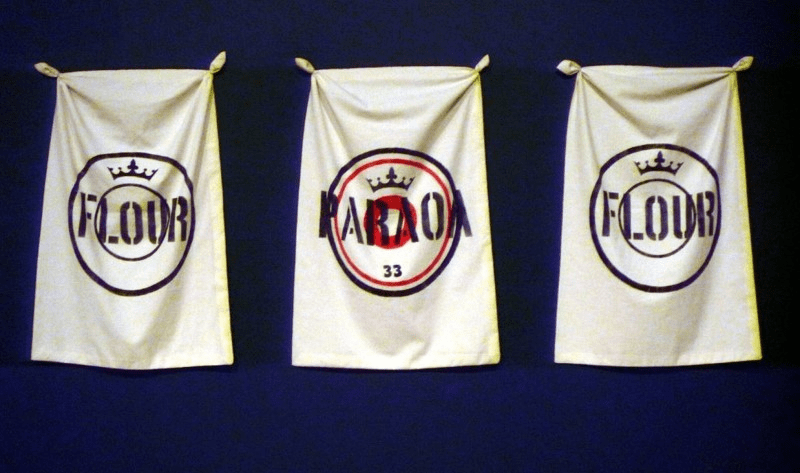
Unfortunately the ‘half castes’ end up feeling they don’t belong in either world. Artist Natalie Robertson aptly describes this as standing astride two tectonic plates that shift and moveii.
The racism has not gone away. It’s simply gone underground.
Ironically, and by way of illustration, while on the March we encountered a racist incident in Auckland. It had been raining that night in Auckland and all three of us were very tired. We decided to spend a night in a motel to dry off our wet clothing and rest as I intended returning home with my daughter the next day. The first motel we approached had a sign out indicating vacancies. Barnie suggested I go in and arrange the booking while he stay in the car with my daughter. That was all good. Then when I signaled to him that we had a booking he drove up to the parking area outside. As we organized our gear to go in however, we were told a mistake had been made and there weren’t any vacancies. Being highly suspicious, we promptly drove around the corner and phoned the motel from a phone booth asking were there vacancies. Yes was the reply. They had vacancies, proving our suspicion was correct, that they’d denied us on grounds of race. Being new to such scenarios, I was angered and determined to approach the Race Relations people to make a complaint, however Barnie promptly waved that off as a waste of time.

I’ve concluded from what I’ve witnessed over ensuing years that he was probably right. For most Māori, the scenario described is not an uncommon one.
Returning home, Tama came with me to get his truck, now repaired, to then return and rejoin the hikoi. All updates on the March were from there on by phone and via the nightly news where it was making headlines daily. Tama’s and my kōrero while traveling was further education for me. His long term involvement with human rights, particularly for Māori, made him a deep well of information. The following is information that particularly stood out for me and you will see why.
At the time of the March, I had been a Christian for three years. I’d been converted on a Gisborne marae, at my father in law Hikiera Mihaere’s tangi. My brother in law Truby had explained to me the tenets of the Gospels and my decision there to follow Christ had brought great peace and reassurance to my life. It was very real. Truby was in training in Auckland at the time to be a Baptist minister. With my still new found Christian faith, I was naively confident that God could easily fix racism and restore lost Māori lands, and I told Tama so. His unexpected yet kindly response (recognizing my ignorance) was nevertheless to the point.
It was the Christian Church he said, that had made the largest acquisitions of Māori lands.
This info took the wind right out of my sails. What could I possibly say to that? Three decades on, I would read in The Rich A New Zealand History by Stevan Eldred-Grigg (p 25) that the children and grandchildren of the first Williams generation (missionary Reverend Henry Williams’ family) had become wealthy land owners by the end of that century. Graeme Hunt reports in The Rich List (2000, p22) that at the time of writing some 800 of Henry’s direct descendants owned more land than any other family in NZ. Although later reinstated, Williams had been dismissed from the Church Missionary Society for these extensive land acquisitions. There were some denominations however that forbade them, period. Clearly Reverend Williams did much good in his time of service both to God and to people. I don’t doubt that. Such large purchases of land however, clearly did little good for God’s reputation. And the prices back then were unarguably fire sale. They are purchases that dog the Reverend’s reputation to this day.
And so, remember that the victors wrote our histories. However, my consolation is that nothing is hidden that won’t eventually be revealed as the Reverend’s good book tells us in Matthew 10:26.
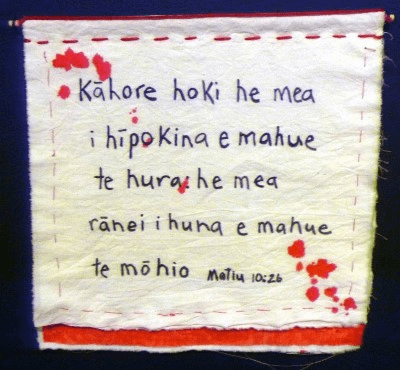
POST SCRIPT
Both Barnie and Tama have passed on now. After the March Barnie joined with Ngā Tamatoa and was part of the occupation of Parliament grounds. He went on to protest vigorously against injustice and racism, both here and in Australia, he wrote articles for the Porirua Community newspaper Te Awa Iti, and co-authored a book, He Whakaaro Ke. He also trained as a Social Worker, and worked for both the Children & Young Persons Service and Māori Mental Health Services. Tama continued his long time involvement in activism against injustice including South African apartheid and the Vietnam War. He wrote a memoir called Seeing Beyond the Horizon that tells his life story, including his impressive achievements in film. He was also involved with initiating the Wai 262 claim, was involved with film, acting in Ngati, a landmark Māori film, plus he acted in and directed many other films. He also promoted indigenous film making in NZ and overseas. At Tama’s passing the late Tariana Turia stated “Tom was one of our quiet revolutionaries who changed our world for the better, in so many different areas” iii. You can find Tama’s book at Steele Roberts’ publishing site. Although now out of print, you will find Barnie’s book from time to time on the second hand book sites.
My dear Dad who weaves intricately into our story, had gone off to World War II at barely 17 years old and had returned amazingly with all of his four brothers. He then met and married our Mum in Whanganui, trained as a builder, then worked hard for the rest of his life, along with my Mum, supporting our family and growing our kai. In his last two years of life, living in the Bay of Plenty with our Mum, he joined the Presbyterian Māori Mission and began learning te reo.
During my child raising years I trained part time as a social worker. After working for six years with Child Youth and Family, I resigned in 1999 and enrolled in a Ucol art class. While studying I attended an art exhibition titled: Parihaka: The Art of Passive Resistance, highlighting a government invasion that didn’t make it into our history books (the victors write our histories). You can read the Parihaka story at their website. I then applied to study Māori Visual Arts at Toioho ki Apiti in Palmerston North. There I would learn more about the Treaty of Waitangi and our true histories, including my own. My art is, among other things, about colonization, the resultant destruction of our environment and about our true histories. I also write. (links below to my websites).
Note: The land grabs continue. The SNAs are another ruse to grab lands.
See here also: Hīkoi of hundreds against Far North SNAs to follow Dame Whina Cooper’s footsteps
Townsville Next Up for Land Grabs?
Catherine Austin Fitts On Helene: “It’s Not A Natural Event” Says It Is A Giant Land Grab
NZ & FURTHER PROPOSED SNA LAND GRABS: 1500 West Coast property owners recently received letters in the mail, out of the blue, stating that their properties have been zoned for takeover by state control …
More on the Aboriginal land grab genocide: 27 elders die within 4 hours of the jab!
i Young, D., Woven by Water, pp 49-50
ii https://www.academia.edu/10943197/A_Journey_of_Belonging_Natalie_Robertson_New_Media_spaces_of_Belonging_in_the_context_of_Maori_art?auto=download
iii Poata, T. Seeing Beyond the Horizon, p 283
Links to my other sites:
Earth’s Blood Stains
Truth Watch NZ
Environmental Health Watch NZ
Just Art NZ

The untouched blue volkswagon .. Michelle Melendez, author of The Great Maui Land Grab explains why blue objects don’t burn
The 2025 Los Angeles fires. Two video links below plus info on Michelle Melendez’s revealing book on the Maui fires:
UN Blue Volkswagen Is Untouched (info on the blue under channel’s info)
With these fires, historically, it’s noted that blue objects don’t incinerate, however glass & metal do. Houses with blue roofs also escape the blaze. Below an image from a video by Jeff Berwick. As with the blue objects, neither are the trees burning.
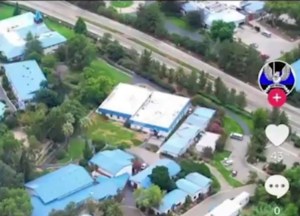
Maui Fire Insider Reveals PROOF That LA Fires were NOT Natural!
(Hear interview with Michelle about the Maui fires and what happened: eye witness)

The book at Amazon:
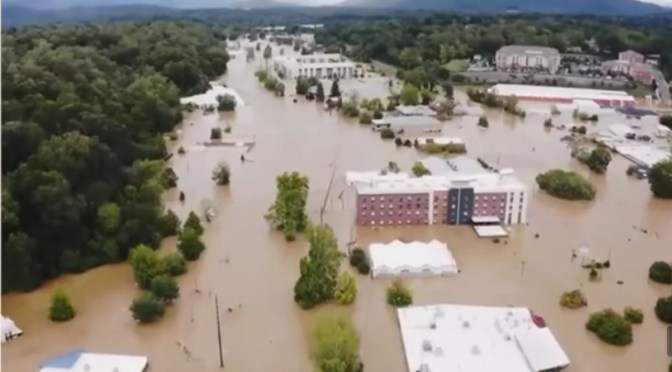
Catherine Austin Fitts On Helene: “It’s Not A Natural Event” Says It Is A Giant Land Grab
From Celia Farber @ substack
From a Tweet by @SenseReceptor on X.
“The goal of this operation and [Hurricane Helene] is an operation, it’s not a natural event…[it] got steered in my opinion,” Fitts says. “The goal of this operation is to take assets and…it’s basically a giant taking…to grab land.”
“The investment banker says:
“We’re having lots of reports of land grab tactics being applied” and adds that the operation “relates to the [U.S. presidential] election.”
“I suspect we’re seeing the White House basically—and, again, this is conjecture—negotiate terms. You know, you’ll get disaster recovery if, you know, you do this, this, and this for the election,” Fitts says.
“The president is saying he’s gonna call back Congress, that there’s not enough money at FEMA to go through the hurricane season, and so they’re strong-arming Congress to come back and basically give the administration what they want on the continuing appropriations process.”
“Furthermore, Fitts says this is also an instance of central bankers attempting to wrangle more control for themselves. “This is all part of installing the digital ID and financial transaction infrastructure you need to assert absolute control,” Fitts says. “And if you look at the patterns, whether it’s the taking or the land grab or other other reports we’re getting out of that area, it looks to me like a lot of assertion of top-down control of counties.”
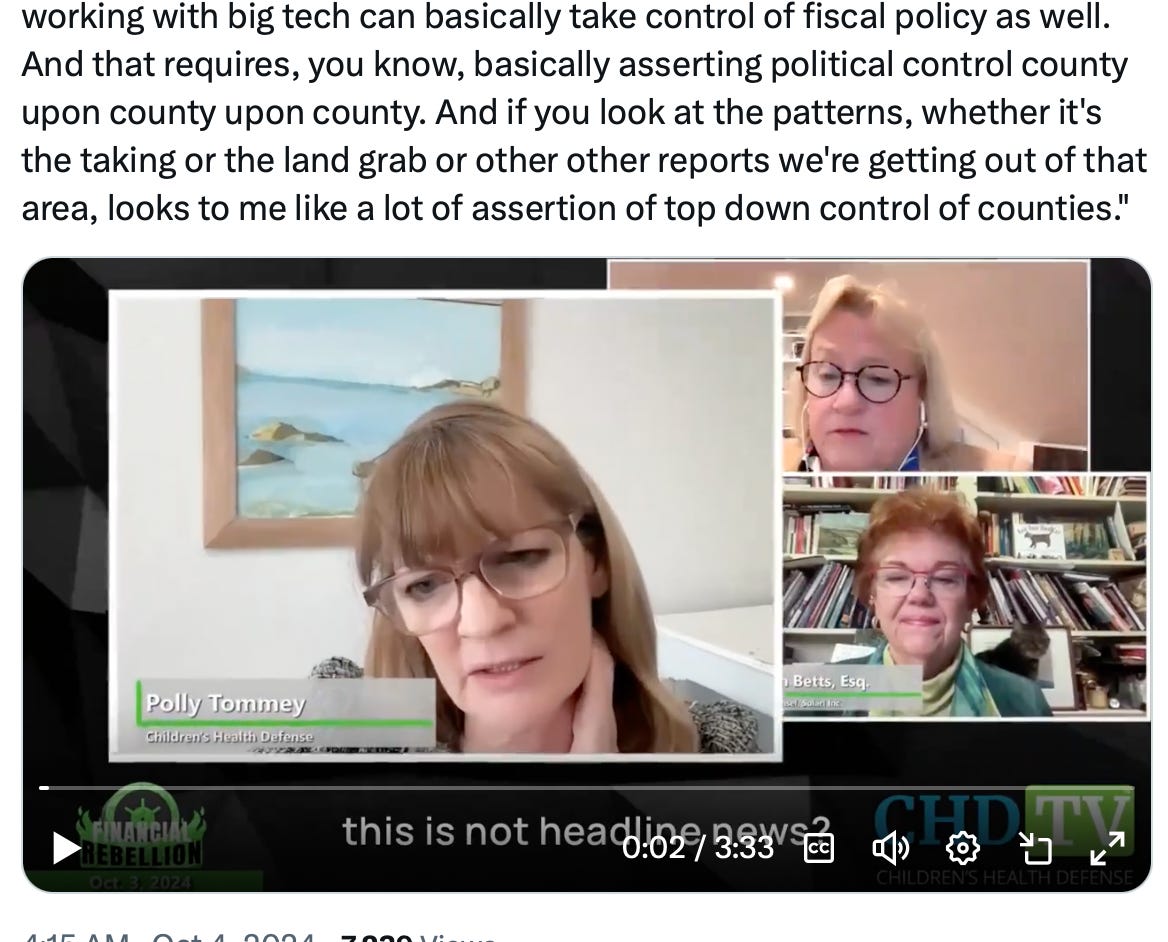
(Clip linked here.)
I just want to reflect on this a little bit. My thoughts may seem obvious and incomplete but I still want to try to put this down:
The recurring pattern we see, from Pearl Harbor, to JFK’s assassination, to Vietnam, to AIDS, 9/11, Katrina, “War in Iraq,” “Covid” and many more induced events I have not listed, is that the magic trick demands we view all aspects of the US “government” as an incarnated spectral being that can vanish and re-appear at will. The main thing to observe is that it is never protective. The guardians of the gates of culture, the ruling classes, guard and protect the trance state that insists Government could not possibly have known/anticipated/done better etc. They do this in many entrenched ways, including by donning windbreakers, going to the scene, and intoning the “tragedy,” but never who let it happen and how.
It (Government) is all-mighty and good and yet it can’t anticipate, nor prevent any catastrophic events its numerous spectral “enemies” (these days including MAGA, imaginary viruses, climate change and “misinformation” on social media.)
Nixon’s War On Cancer And The Growth Of The HHS-NIH-NIC-CDC Beast
Just one example among millions once could point to:
Kate Middleton, Princess of Wales, getting an annihilating cancer, means (apart from mRNA induced turbo cancer reality) that the entirety of the “cancer research” establishment and apparatus since at least Nixon is bankrupt. It can neither predict, prevent, nor cure most cancers.
But nobody says: “Doesn’t that mean none of your models for causes of cancer were correct?”
Instead, the focus is always in the proper funereal emotions, with special emphasis on how brave everybody is.
Linked here (halfway down the post) is my 2006 article on Peter Duesberg’s decades long battle with the Anaconda, and Fauci, in American “cancer science.” It’s a story about a vindictive mafia.
There you see the pattern: Destroy the best scientists. Then land grab their work and attribute it to your own, controllable scientists. Read more about the Duesberg/Rasnick Chromosomal Imbalance Theory Of Cancer at Dr. David Rasnick’s amazing website here, and you can access Peter Duesberg’s essential works here. These vintage papers cling like Waterford crystal when you read them, compared to the swill of the Covid era’s “scientific literature.”
PEARL HARBOR: Roosevelt’s 9/11
James Perloff on Pearl Harbor is a must read. I also passionately recommend his jaw-dropping “13 Pieces Of The Jigsaw: Solving Political, Cultural and Spiritual Riddles Past and Present.This book contains the blueprint for the endlessly repeated Magic Tricks of the Global Anaconda. The media’s role is usually underestimated, but not by Perloff, not in this book. What he documents about William Randolph Hearst is astonishing.
Hearst only needed to commission and publish crude drawings of foreign enemies, and their supposed dark deeds, raping women and what have you: This sufficed to turn the nation to become hellbent on bloodthirsty revenge in various induced “wars.” Only the technologies have changed, not the essence of the Trick. Manipulate the mass response by creating the calamity, then point away, then start a new war. Repress human liberty. Seize property. Enslave. Give people nourishing moral myths.
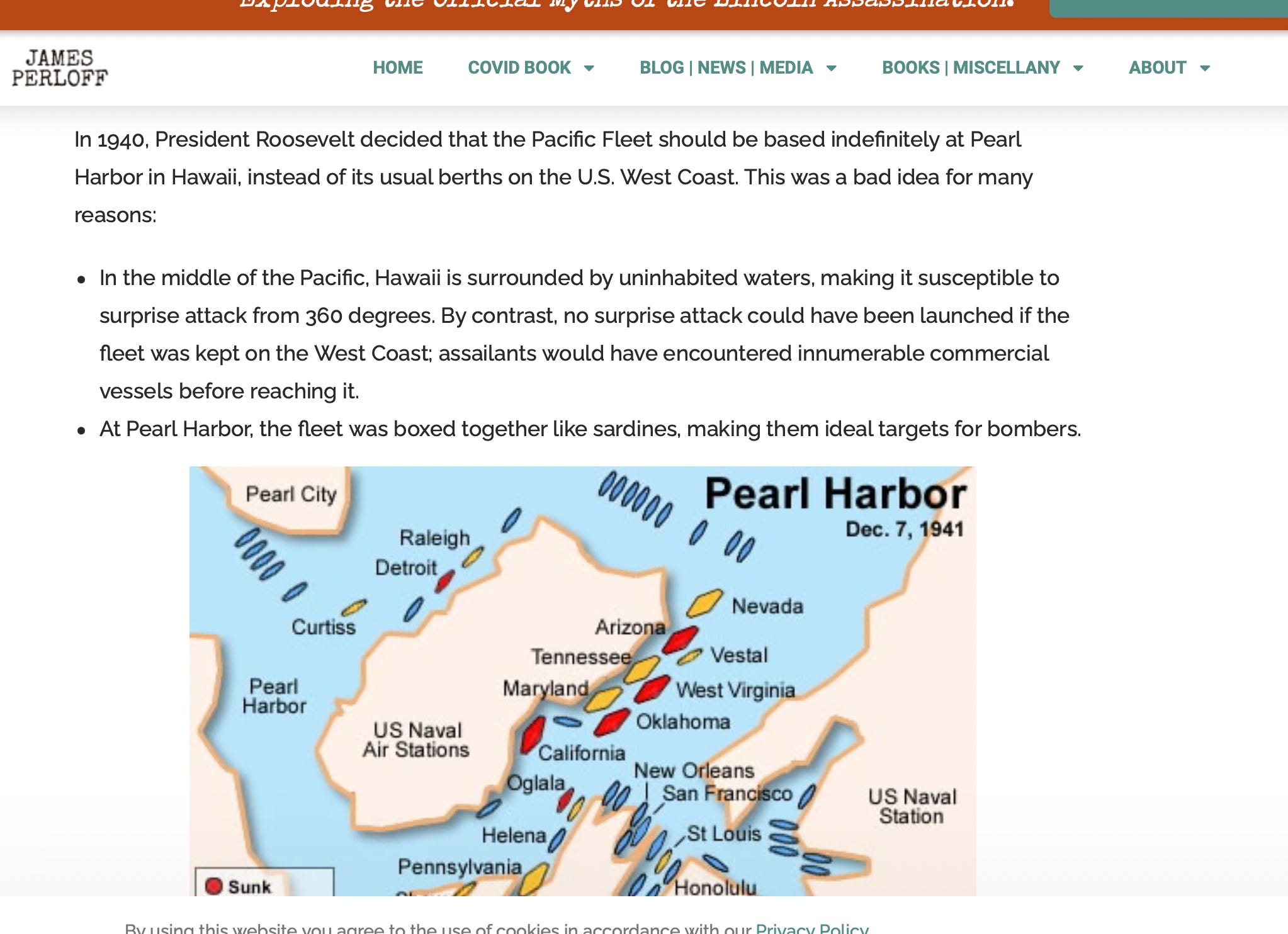
1. They plan it and make it happen. Then stand back and start churning allowable mass emotions for the public, via the media. Then only crazy people would oppose what must happen next.
- They never explain why or how they let the shocking catastrophe happen.
- Congress releases colossal funds and green lights new wars. The “anything they need” part of the Trick.
- Recent epoch: Areas destroyed by HAARP fires, hurricanes, and other weather weapons are overtaken by the government, in the name of safety.
- Media propaganda keeps all language and brainwaves focused on “Mother Nature,” or “pandemics” or plagues of racism and conservatism. Requires abandonment of all knowledge of the natural sciences, from climate to human biology.
- Tech billionaires beckon with a Better Way.
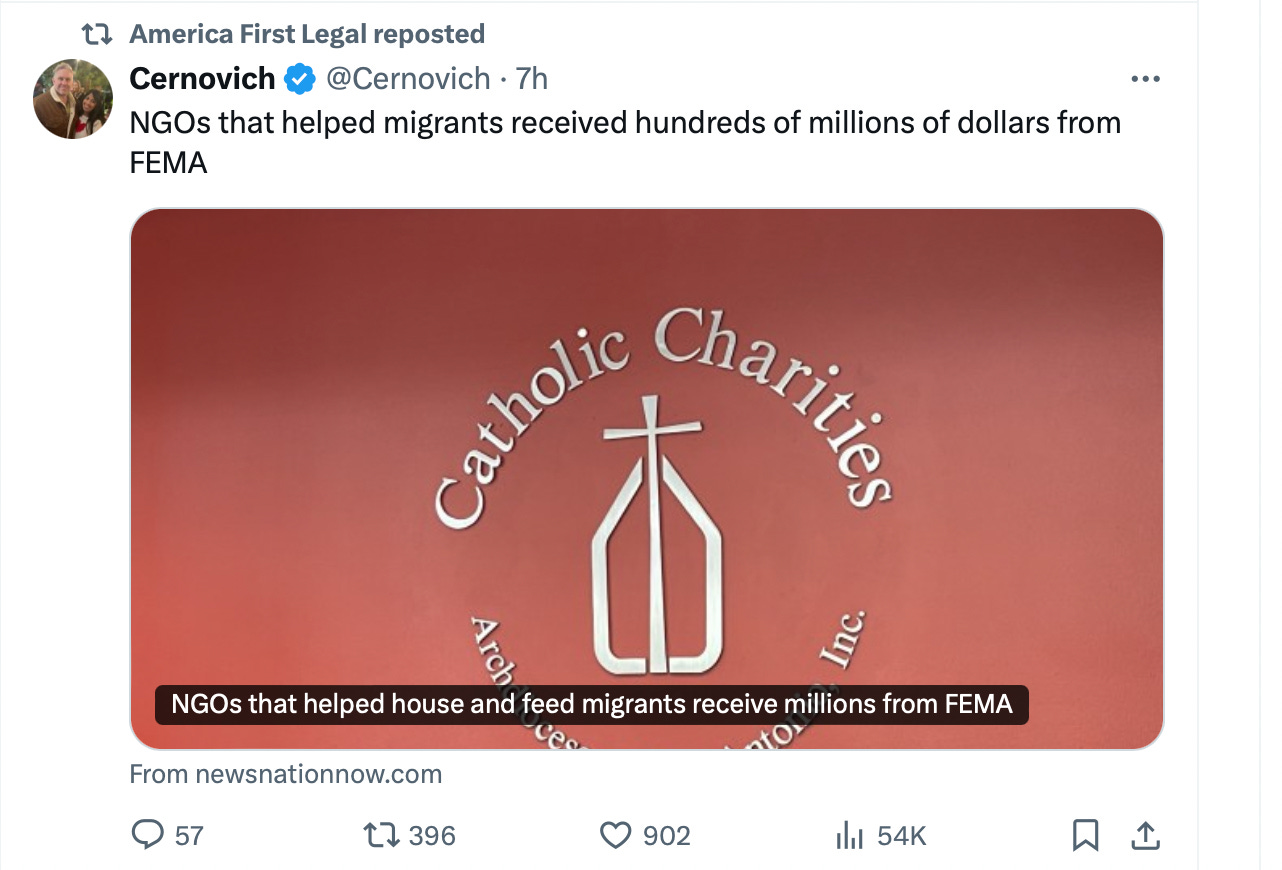
- NGOs, including many with religious cover, locked in with colossal government “funding.”
Here’s a clip about the utopian Technocracy movement, one of whose early leaders was Elon Musk’s grandfather. One of the main principles is “Trust The Experts.”


To reduce the sauce even more:
IF WE KEEP NORMAL-THINK HATS ON; These Are NOT Real Questions:
- Why did the entirety past and present of all US military budgets, surveillance etc, fail to detect or prevent 9/11? All cameras broken, even at the Pentagon, and so on and so on. Norad. (Bill Binney can answer this in full and everybody who has not seen “A Good American” really should watch it.) (In the beginning, I believed the government narrative. My brain was hijacked.)
- Why did Anthony Fauci get paid so much money since 1982, and get to crush so many allegedly wrong scientists, for decades, yet failed entirely to protect Americans from what he claimed was a “virus” called SARS Cov- 2, in 2020? (Again, I mean with Normal Hats on.) Why would people worship him in the middle of a “pandemic” it was his job to “prevent?” I would argue for Stockholm Syndrome, and collective PTSD.
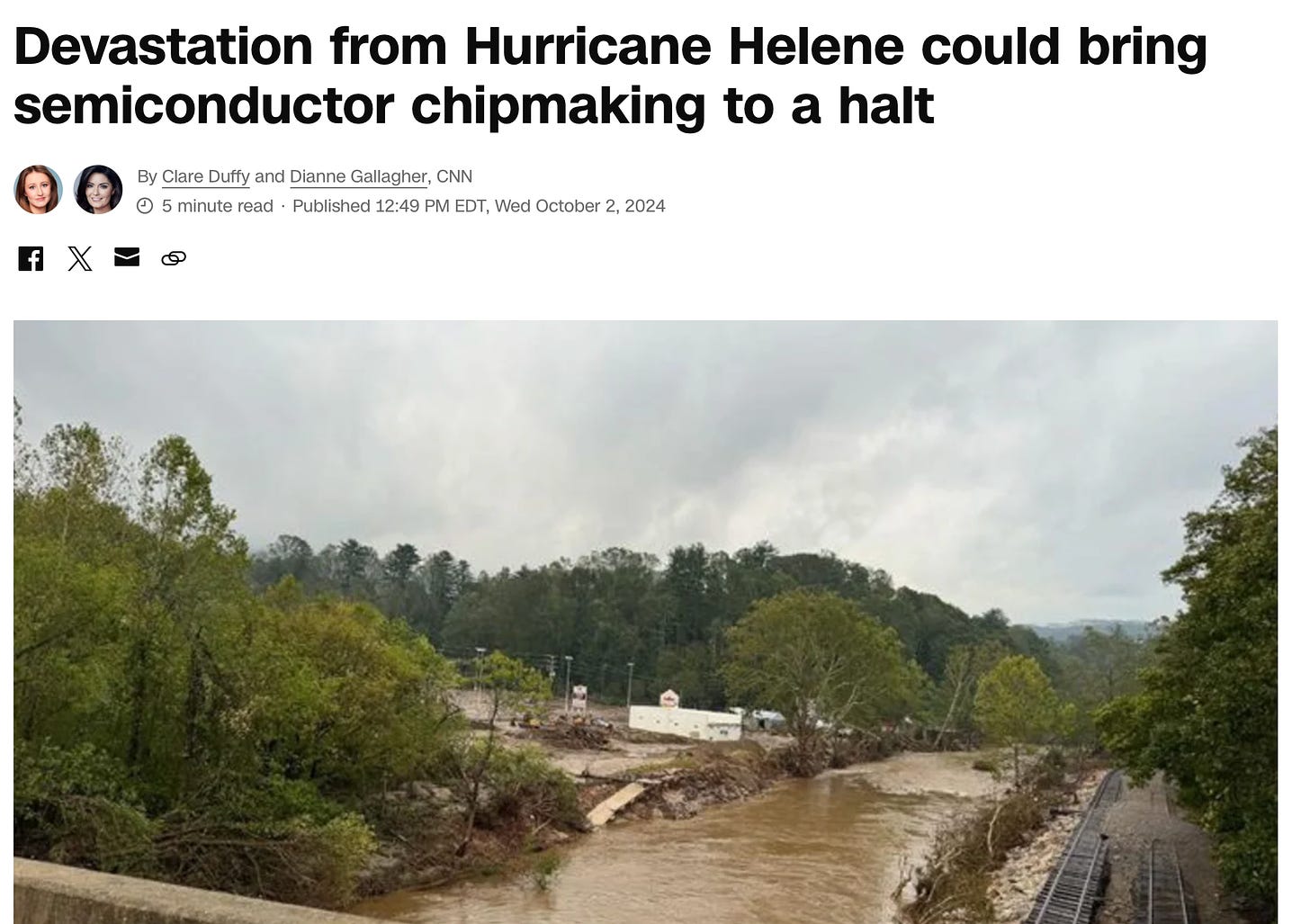
- How, in 2024, does the entirely of meteorological prediction fail such that the citizens of Western North Carolina, were not warned of such a devastating “weather” event their entire town might obliterate and explode into mud, loaded with their dead, including children and babies?
- How did the Secret Service in 1963 fail to protect JFK from being shot in the head in Dallas?
- How did one of America’s great cities, New Orleans, wind up almost entirely under water, in 2005? You can read some basic facts here. The evacuation of 1.2 millions residents, before Katrina hit by then Mayor Ray Nagin seems like a mirage from a bygone era. It was, of course, too little, too late, and Nagin’s role, allegiances, and actions, could be debated for decades.
Prepare for lengthy Wikipedia outtake, from Ray Nagin’s page:Hurricane Katrina

U.S. President George W. Bush and Mayor Ray Nagin meet on September 2, 2005
Main article: Effects of Hurricane Katrina in New Orleans
In August 2005, Hurricane Katrina entered the Gulf of Mexico. Early on Friday, August 26, Mayor Nagin advised New Orleanians to keep a close eye on the storm and prepare for evacuation. He then made several public statements encouraging people to leave but promising that if they did not evacuate, “[w]e will take care of you”.[25] By 10:00 a.m. Saturday, a mandatory evacuation was called for low-lying areas in the surrounding parishes—St. Charles, St. Tammany, Plaquemines, and Jefferson—and a voluntary evacuation for St. Bernard Parish. Nagin had, however, ignored federal and state offers of help and a recommendation to evacuate the entire city. [No citation here. Is this true? CF]
In addition to the parishes’ announcements, President George W. Bush declared a federal state of emergency for Louisiana.
In accordance with the regional evacuation plan, New Orleans, along with the surrounding areas of Jefferson and St. Charles parishes, were given formal voluntary evacuation orders around 50 hours from Katrina’s landfall. This phased approach along with “contraflow“, wherein all incoming interstate highway lanes are reversed outward, ensured that additional vehicles moving onto already congested roads would not create massive gridlock. The local newspaper reported that Nagin stopped short of ordering a mandatory evacuation because of concerns about the city’s liability for closing hotels and other businesses.[26] (That was somehow magically no longer a concern for any US politician in the winter of 2020 when “Covid hit.” They build out the Anaconda black project by black project. CF)
Back to Wikipedia on Nagin:
After receiving a late night Saturday call from Max Mayfield, head of the National Hurricane Center, Nagin was advised that Katrina was headed to New Orleans. He ordered the city attorney to prepare legal documents for a mandatory evacuation of the city, the first in New Orleans’ almost 300-year history. On Sunday, August 28 at 9:30 a.m., the mandatory evacuation order was signed and communicated to the public. The Superdome was opened as a shelter of last resort, and police went throughout the city with loudspeakers alerting all remaining citizens to head to key pickup points for free bus rides. By Sunday evening 80% of New Orleanians and visitors were evacuated or relocated.[27]
After the hurricane hit, the federally built and maintained levees collapsed throughout the city. 80% of the city flooded, some areas as high as 20 feet, over rooftops. Food and water became scarce, and looting was common. After hearing reports of this, Nagin criticized the federal and state response on WWL radio, and his passionate outburst went viral.[citation needed]
(Note, I think it is significant that it says “citation needed” here. I want to hear it. CF)
In response to a question at a town hall meeting in October 2005, Nagin said: “I can see in your eyes, you want to know, ‘[h]ow do I take advantage of this incredible opportunity? How do I make sure New Orleans is not overrun with Mexican workers?'”[28]Some Hispanic groups, including the United States Hispanic Chamber of Commerce, criticized Nagin’s statement,[29] although those attending the town hall meeting reportedly applauded—many believing jobs should first go to locals displaced by the hurricane. Despite this comment, Nagin went on to say this was the city’s biggest economic opportunity and urged New Orleanians to get more comfortable working beside someone who did not look like them, as everyone’s help was needed. During a subsequent interview on Telemundo with Jose Diaz-Balart, Nagin praised the great work Hispanic workers did in New Orleans and said the city would not have recovered without them.[30]
(Do you see it? The creators of the catastrophe install the “good news” and “good things” that must be in place for the OPS of the future, in this case: Imported migrant populations taking jobs from struggling Americans. They are to be thanked. End of bad emotion, implantation of spell/trance. CF)
“Chocolate City” speech
[edit]
Main article: Chocolate City speech
Shortly after Katrina devastated New Orleans, there were calls for moratoriums on rebuilding certain neighborhoods.[31] Two weeks after Katrina struck, Nagin took a weekend trip to Dallas to reunite with his family. While there, he was asked to meet with leading New Orleans businessmen to discuss the city’s future. Nagin says he made it clear at the meeting that everyone had a right to return home, a claim contradicted by some businessmen in attendance.
[Highlights mine.]
Katrina Must Be Revisited: It Is The Blueprint For Helene, As AIDS Was The Blueprint For Covid
My sister Bibi is the only person I know who traveled, alone, to New Orleans, after Katrina, to volunteer. She stayed with our father’s friend Humberto Fontova, who exposed Ernesto “Che” Guevara as one of history’s most “bloodthirsty icons.”
Bibi wrote a harrowing, incredible article about her experience and I have asked her to see if she can find it because I would like to publish it.
Ken McCarthy of Brasscheck TV, and “What The Nurses Saw,” made a Katrina expose film but I am unable to find it. I’ll keep trying.
The Anaconda laid the groundwork in New Orleans, for this horrifying model of “land grabs,” and massacre of undesirable populations. Of course, the Anaconda “laid the groundwork” centuries earlier, one could argue, but I mean in the “modern age.”
GeoEngineeringWatch.Org
Caller to InfoWars says there is video proof of the creation of Hurricane Helene, here.
Said proof is here, at Dane Wigington’s GeoEngineeringWatch.org:
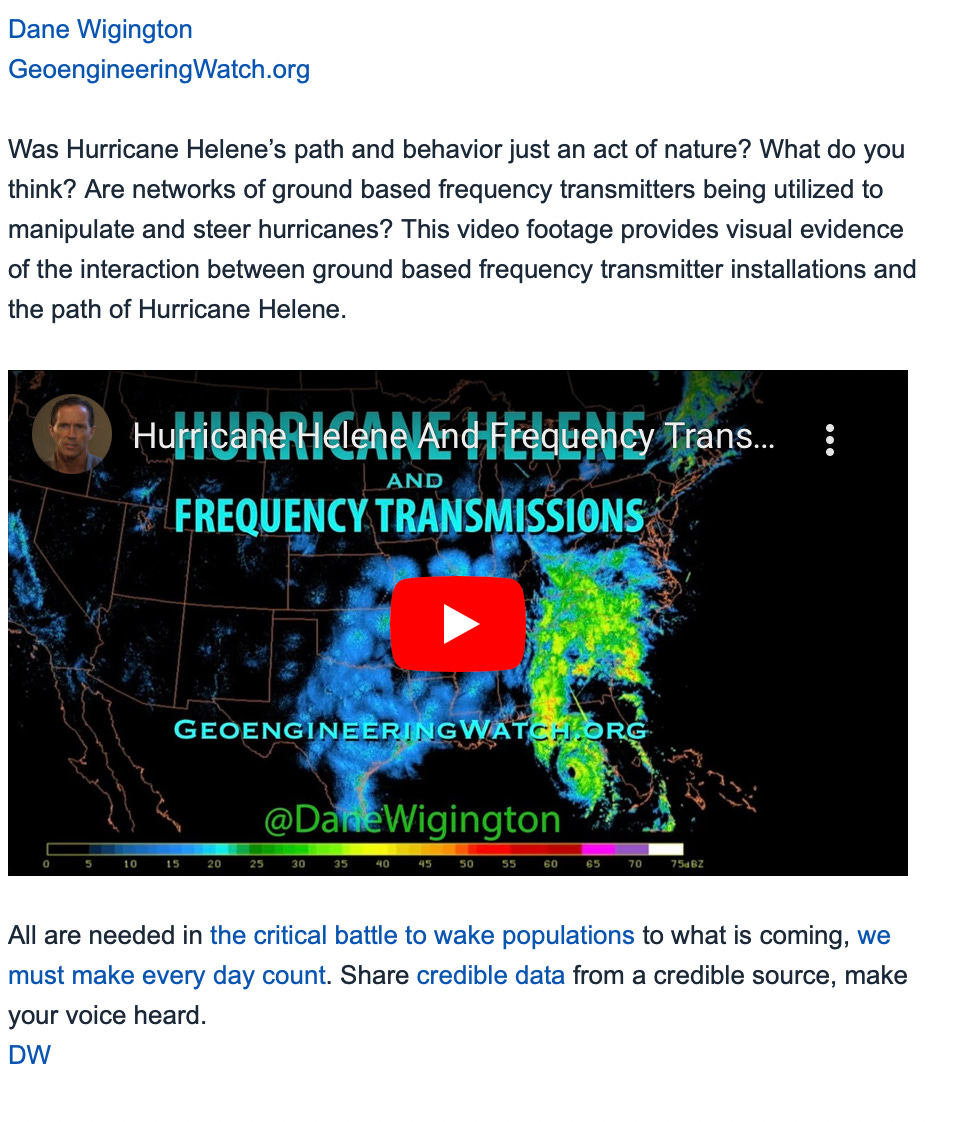
At the very least, any mention of a “tropical storm,” “hurricane” or “tornado,” should henceforth be interpreted by all Americans as an incoming HAARP attack, and believe nothing of what media says about it. Assume they are perfectly content to kill you.
“Helene,” got way worse after landfall, in addition to the altered direction. I thought hurricanes were weakened by landfall. No?
Characteristic of The Anaconda is:
New.
Shocking.
Never Before Seen.
Impossible To Anticipate.
Malevolent.
No sign of “nature” as we know her, or ever knew her.
No explanations.
RELATED:
Alexa Calmly Tells Stunned Americans Hurricane Helene Was Artificially Created, By Cloud Seeding
“It Was Also The First Manmade Hurricane In History.” —ALEXA
Avoid the FEMA camps, rescue centers, ships & planes: Hurricane Harvey rescuer reveals shocking info (New updates from recent hurricanes)
HURRICANE HELENE MYSTERY: Weather Modification, Climate Intervention and the Planned Destruction of a Region for the U.S. Government’s Pilfering of Natural Resources: In the wake of Hurricane Helene’s destructive path through North Carolina, a storm shrouded in mystery and suspicion, the true extent of the devastation and its underlying causes have come to light
Death Totals From Helene Do Not Reflect All Recovered Bodies in NC Who’s DMORT
There’s something nefarious going on in the mountains of Western North Carolina and Eastern Tennessee, where hurricane victims are being left to die; stories emerge of bodies washing up in rural areas
Where is the $24.5 million raised for NC hurricane survivors?
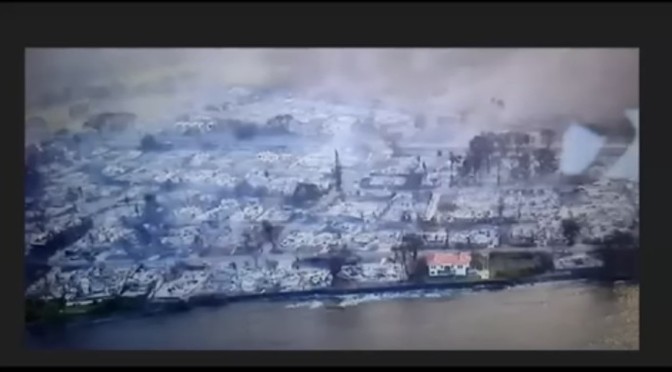
Must see Maui land grab update
BOMBSHELL MAUI FIRE UPDATES: January 2024
FOREIGN POLICE HAVE ARRIVED TO SECURE THE PERIMETER, Insurance CHAOS and more. This terrifying reality is coming to a city near you very soon…
1. The government is completely blocking insurance from paying out.
On top of that, the insurance companies are now saying the homes were not insured for enough to get rebuilt because of the recent inflation. People are struggling to survive and are debating leaving. Other citizens are begging them to stay strong.
Additionally, survivors whose homes didn’t burn to the ground, are having their property seized under “eminent domain” laws. Peggy Hall from The Healthy American wrote a great article explaining Eminent Domain. With that being said, there are some accounts of social media claiming they have received insurance payouts and everything is fine. I find it exceptionally hard to believe and I expect they are PSYOP accounts.
- But it’s much worse than all of this. Foreign police cars and more National Guard have arrived to patrol the perimeter, and keep people out. You are not even allowed to stop on the side of the road. What the actual f*ck is going on here? (video below #3)
- All media is still being blocked. Drones are still not allowed. NO OVERSIGHT IS ALLOWED. What in Gods name are they trying to block people from seeing?
READ / WATCH AT THE LINK
Four Documentaries by John Pilger (Transcripts included)
Celebrating the life of one of investigative journalism’s greats who recently died … watch four of his many documentaries. Search YT for the rest, and/or go to his website here. EWNZ
Classic John Pilger documentary about the decades long occupation of Palestine and subjugation of the Palestinian people. In a series of extraordinary interviews with both Palestinians and Israelis, John Pilger weaves together the issue of Palestine. He speaks to the families of suicide bombers and their victims; he sees the humiliation of Palestinians imposed on them at myriad checkpoints and with a permit system not dissimilar to apartheid South Africa’s infamous pass laws. He goes into the refugee camps and meets children who, he says, “no longer dream like other children, or if they do, it is about death.” – IMDB
See also :
John Pilger Documentary – The Coming War on China (English Subtitles)
Stealing a Nation – John Pilger (2004)
John Pilger’s Historic Expose On The Persecution Faced By Aborigines | Our History
Check out our sister site truthwatchnz.is for other news

Netherlands’ Land Grab: A new documentary records the Dutch farmers’ struggle against a regime that is attempting to seize their land
Comment: of course it is not about the fake climate change narrative … anybody who still thinks it is is greatly duped. EWNZ
A couple of weeks ago, Big Picture released the documentary ‘NITROGEN 2000: The Dutch Farmers’ Struggle’ to watch for free.
NITROGEN 2000 is a 45-minute documentary on the Dutch Farmer struggle of 2019-23. 70% of Holland is owned by small cattle farmers and since 2019, the Dutch government has been advocating a 50% forced buyout of their land. This amounts to a nationalisation of a third of the territory of Holland.
Is this really about lowering nitrogen levels to help orchids over nettles? What other darker designs lie behind the nitrogen policy of Holland? Surely if it were truly about nitrogen other solutions could be found than disenfranchising the most efficient farmers on the planet. In NITROGEN 2000 Big Picture gets to the bottom of the story.
Big Picture’s James Patrick initially went to the Netherlands to shoot two interviews for another film which was under production. While he was there, he got in touch with some leaders of the Dutch farmers’ groups fighting the government’s policy to forcibly buy out their farms.
When he arrived in the Netherlands, Patrick realised that a third of the farms had signs displaying “HELP!.” Upside-down flags were hanging everywhere. It quickly became evident to him that this was a much bigger event than most understood. “I jumped onto the story and aggressively shot an entire film in 6 days,” he said.
What is happening in Holland is a warning to the world of what is to come if we don’t put a stop to this expropriation of the Dutch farmer’s land.
This is a big story. The government of Holland – with European Union blessings – is seeking to forcefully purchase one-third of their territory, disenfranchising half of their cattle farmers.
As everyone knows, corporate media constantly demonises cows: they make methane; their burps are evil; they cause nitrogen to run off into waterways. But the insane argument the Dutch government is using is that the nitrogen in cow dung is settling on protected areas, called Natura 2000 and causing plants less than 1 ft tall to suffer because other plants that grow higher block the sun for the smaller ones. That the government would declare war on half of their farmers in the name of short plants. “It’s a joke, and they have no credibility,” Patrick said.
This appears to be a story of seizing land under questionable “environmental” pretences and removing the bulk of the Dutch farmers from the market, effectively taking them offline. In terms of production per hectare, Dutch farmers are the most efficient farmers in the world. If a large restructuring of the food system is being engineered, sandbagging Dutch farmers is a crucial step towards achieving that goal.
The documentary ‘NITROGEN 2000’ gets to the bottom of the story. Partick interviewed the top players in the story to help people understand this complex phenomenon in a world in transition. To fight for our rights and well-being, we must understand what is happening to us. “This is the mission of my work: to help people see the Big Picture,” he said.
The documentary is free to view, in several languages, but if you would like to make a donation to support the Big Picture’s work, you can do so HERE.
SOURCE:
Photo: pixabay.com
Lahaina, a perfect storm or a perfect crime? (a new book by a local eye witness to the Lahaina fires – Corbett Report)

Burn Back Better with Shelby Hosana
SHOW NOTES AND MP3: https://www.corbettreport.com/burnbackbetter/Shelby Hosana, co-founder of Unjected.com, joins us to discuss her new book, Burn Back Better, detailing her experience on Maui during the recent Lahaina fire and what the investigation so far has uncovered about the dark agenda behind the tragic events of August 8, 2023.
Thanks to Shane for the link.
CLICK ON THE IMAGE FOR VIDEO or WATCH AT THE LINK
Lahaina Reopens And New Questions Arise
Greg Reese: https://ReeseReport.com
8,000+ Posts Have Been Published In 2023: https://EarthNewspaper.com
EarthNewspaper Newsletter: https://EarthNewspaper.com/Subscribe
Support Honest Independent News: https://EarthNewspaper.com/Donate
READ MORE AT THE LINK

You must be logged in to post a comment.