Here is Palmerston North’s gardening guru Wally Richards’ weekly garden news & commentary. Wally gives us his thoughts on the latest findings from WHO … “Glyphosate probably causes cancer”. This latest revelation from WHO along with Canterbury University’s findings were presented to the RDC last Thursday, however they remain unconvinced and the status quo remains regarding the liberal use of Roundup (active ingredient is Glyphosate) in Rangitikei’s public spaces. (Remember, this is also sprayed on pastures so glyphosate has to be in our meat and milk!). Read Wally’s articles and further research on the topic. You can sign up for his weekly article, and phone him on the toll free number provided if you have any gardening queries. You can also email him with queries (details at the end of the article). His website is a mine of useful information.
Gardening Articles for week ending 4th APRIL 2015
Written by Wally Richards.
GARDENING CHEMICALS RAISING HEALTH CONCERNS
The news this week coming from the World Health Organisation (WHO) stated that glyphosate the active ingredient in Roundup (and found in other weed killers), ‘probably’ causes cancer.
There has been mounting evidence of this from various science reports and findings over the last few years.
All of which Monsanto denies as they did in the past with Agent Orange as being safe.
The health problems came to light in Vietnam when Agent Orange (and similar) herbicides were used to defoliate jungles causing servicemen and local populations major health issues..
On the 21st March 2015 (The Guardian article said) – Roundup, the world’s most widely used weedkiller, “probably” causes cancer, the World Health Organisation (WHO) has said.
The International Agency for Research on Cancer (IARC) – WHO’s cancer agency – said that glyphosate, the active ingredient in the herbicide made by agriculture company Monsanto, was “classified as probably carcinogenic to humans”.
It also said there was “limited evidence” that glyphosate was carcinogenic in humans for non-Hodgkin’s lymphoma.
Monsanto, the world’s largest seed company, said scientific data did not support the conclusions and called on WHO to hold an urgent meeting to explain the findings. “We don’t know how IARC could reach a conclusion that is such a dramatic departure from the conclusion reached by all regulatory agencies around the globe,” said Philip Miller, Monsanto’s vice-president of global regulatory affairs.
Concerns about glyphosate on food have been widely debated in the US recently, and contributed to the passage in Vermont last year of the country’s first mandatory labeling law for genetically modified food.
The US government considers the herbicide to be safe. In 2013, (Based on information supplied by Monsanto’s scientists) Monsanto requested and received approval from the US Environmental Protection Agency for increased tolerance levels for glyphosate.
Monsanto will fight this tooth and nail because of the many millions of dollars the company makes every year from selling this herbicide.
In March, 2015, 17 experts from 11 countries met at the International Agency for Research on Cancer (IARC; Lyon, France) to assess the carcinogenicity of the organophosphate pesticides tetrachlorvinphos, parathion, malathion, diazinon, and glyphosate (table). These assessments will be published as volume 112 of the IARC Monographs.1
In NZ already we see that some of the above chemicals have already been removed or restricted by EPA and ERMA. Which is very good but there appears to be no controls or restrictions on glyphosate.
We do not even test for the chemical in our food chain and I am sure that if we did the results would be alarming.
Glyphosate does not disappear when it hits the soil (Which was another lie Monsanto told when Roundup was first introduced) Instead it has a soil life of months or years dependent apon what research
you read or on what soil type.
One thing would appear certain is that if land is cleared using glyphosate at the recommended rates and a food crop is planted then that produce will have glyphosate traces in the foliage and even larger concentrations in root crops.
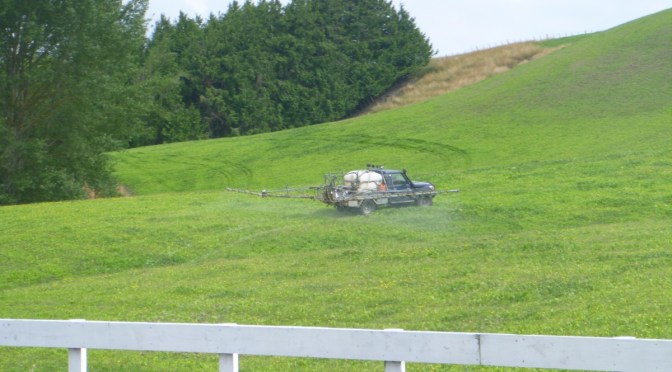
Farming practices that Monsanto recommends make matters even worse; this includes killing pasture grass with glyphosate and immediately putting stock into graze. (Likely spraying while stock is there)
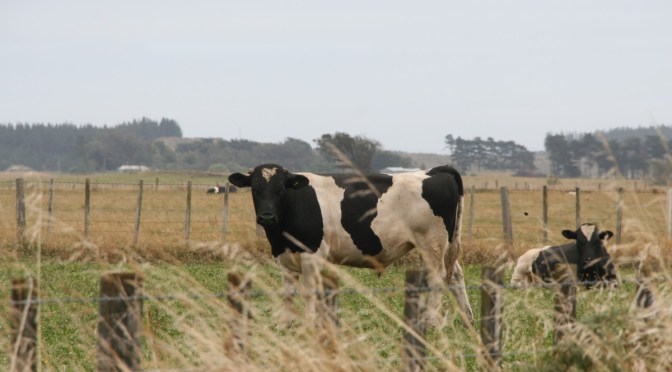
In dairy this means that glyphosate would be in milk, cheese and all by products.
Does Fontera test for glyphosate? I dont think so but it is an interesting question. It could likely mean that traces of glyphosate would be in baby formula?
Then its also in your meat from farm produced stock. The health of the stock is very likely affected also.
As I wrote back in February, Monsanto also encourage farmers to use Roundup as a desiccant, to dry out all of their crops so they could harvest them faster. So Roundup is now routinely sprayed directly on a host of non-GMO crops, including wheat, barley, oats, canola, flax, peas, lentils, soybeans, dry beans, carrots, parsnips, onions, potatoes and sugar cane.
To sum up there is very likely a lot of glyphosate in your food chain coming in small amounts from all those foods we normally eat and no one tests for the chemical!
A few parts per million in your potatoes, onions, meat, breakfast cereals, milk, cooking oils, bread, carrots, sugar etc. Add it up for one day’s meals and maybe thats a lot of parts per million? We do not know because glyphosate is assumed safe according to our Govt departments who presumably only relate to what Monsanto says to the FDA. The fox is guarding the chickens.
Here are some facts:
Glyphosate is a broad-spectrum herbicide, currently with the highest production volumes of all herbicides. It is used in more than 750 different products for agriculture, forestry, urban, and home applications. Its use has increased sharply with the development of genetically modified glyphosate-resistant
crop varieties. Glyphosate has been detected in air during spraying, in water, and in food. There was limited evidence in humans for the carcinogenicity of glyphosate.
Case-control studies of occupational exposure in the USA, 14 Canada,6 and Sweden 7 reported increased risks for non-Hodgkin lymphoma that persisted after adjustment for other pesticides.
The AHS cohort did not show a significantly increased risk of non-Hodgkin lymphoma.
In male CD-1 mice, glyphosate induced a positive trend in the incidence of a rare tumor, renal tubule carcinoma. A second study reported a positive trend for haemangiosarcoma in male mice.
Glyphosate increased pancreatic islet-cell adenoma in male rats in two studies. A glyphosate formulation promoted skin tumors in an initiation-promotion study in mice.
Glyphosate has been detected in the blood and urine of agricultural workers, indicating absorption.
Soil microbes degrade glyphosate to aminomethylphosphoric acid (AMPA).
Blood AMPA detection after poisonings suggests intestinal microbial metabolism in humans. Glyphosate and glyphosate formulations induced DNA and chromosomal damage in mammals, and in human and animal cells in vitro.
One study reported increases in blood markers of chromosomal damage (micronuclei) in residents of several communities after spraying of glyphosate formulations.
Bacterial mutagenesis tests were negative. Glyphosate, glyphosate formulations, and AMPA induced oxidative stress in rodents and in vitro. The Working Group classified glyphosate as “probably carcinogenic to humans”
One of my pet thoughts is the great number of people that have allergies these days compared to say 50 years ago before glyphosate. The chemical in the food chain could well be the cause of a number of these health conditions.
Here is an interesting thought, where trade agreements that allow companies to sue countries if legislation used to protect the populations reduces the profits the company had being making!
Why not have the reverse where a company that supplies a product/chemical that is found to be harmful later on, then that company is totally liable for all the costs involved to that country.
That might have a few chemical companies and pharmaceutical companies change their ways.
Latest news; glyphosate also causes antibiotic resistance in harmful bacteria like Escherichia coli and Salmonella enterica serovar Typhimurium.
My personal opinion, its the worst gardening chemical currently for gardeners health.
Problems ring me at 0800 466464 (Palmerston North 3570606)
Email wallyjr@gardenews.co.nz
Web site www.gardenews.co.nz





You must be logged in to post a comment.