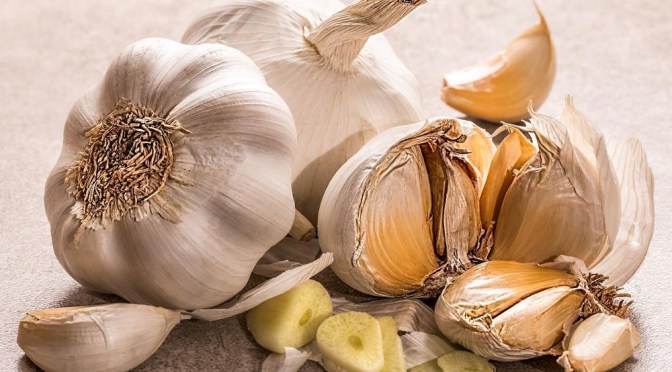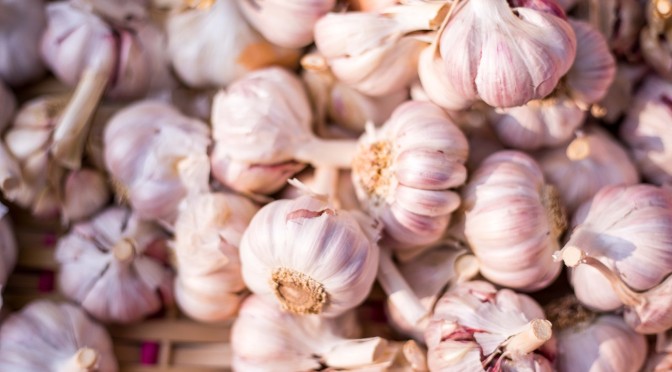
The traditional time of the year in NZ to plant garlic is on the shortest day and then harvest will be about on the longest day. (Can pay to leave till later in January as it may increase size of the bulbs.)
The reason for this is that after the shortest day of sun light hours, then each day there after, will have a little more sunlight every day until the 21st of December.
Or maybe its because it is something to do in the middle of winter along with planting of roses and deciduous fruit trees.
Shallots are also planted at this time.
Garlic has a number of health benefits along with it being a great condiment with food such as steak (garlic butter) and of course my favorite Garlic Bread.
I remember some years ago reading about soaking peeled garlic cloves in raw liquid honey.
What you did was place a small amount of runny honey into a small jar and then pack peeled cloves into the jar before topping up with honey as you filled.
Storing the jar in a warm place like a hot water cupboard (so the honey would stay liquid and not crystallize.
I think after been in store about 3 months you would eat one clove first thing in the morning for health and weight control.
Mr Google confirms this with : While we all use it as a food ingredient, it is also an effective medicine that helps in burning belly fat and detoxification. Research suggests that garlic can be effective in weight loss and is an inevitable part of a balanced diet.
Also the following:
Eating 4-5 garlic cloves in the morning can help to boost your immunity, which is essential now when we have entered the winter season.
It contains compounds that help the immune system fight free radicals and disease-causing foreign pathogens.
How long do you need to take garlic extract to start experiencing its benefits? Since some of the beneficial compounds in garlic extract are fat-soluble, it may take 1-2 weeks for this substance to deliver noticeable effects.
Garlic has been shown to reduce fat accumulation and fat weight in the liver, restore antioxidant activity in the liver, and reduce MDA levels in the liver.
Garlic has a good sulphur content so hence the reason for it helping to detox your body similar to taking MSM organic sulphur crystals on a twice daily bases.
There are eight forms of garlic which are as follows: purple stripe, glazed purple stripe, marbled purple stripe, porcelain, Rocambole, Asiatic, and Creole (although recently it’s been determined that Creole garlic may be in a class by itself).
Creole garlic is considered to be the most expensive and rarest of the all the garlic varieties. Although they were formerly thought to be a sub-group of silverskin garlic, modern DNA studies show them in a separate class by themselves.
Turban is the earliest maturing garlic and popular for this reason. It is a good choice for those who want to spread out their harvest and enjoy some fresh garlic before the rest of the varieties are ready.
It is a weakly bolting garlic. Its name comes from the shape of the umbel (the flower/seed pod on the scape).
Artichoke: The most commonly grown commercial garlic. It has a couple of concentric rows of cloves and tends to be very difficult to peel. But it produces and stores well and this is what you probably buy at the grocers.
You may have seen preperations of what is named Black Garlic which is quite expensive.
Mr Google tells me that it is; Black garlic is essentially regular garlic that’s been aged in a warm environment. Yep, that’s it. It’s not some rare garlic species that’s impossible to find.
Beware: Garlic might be good for people, but dogs metabolize certain foods differently than we do.
According to the Merck Veterinary Manual, garlic and other members of the allium family, including onions, contain thiosulfate, which is toxic to dogs but not to humans.
Growing garlic tips: Best performance comes from improved soil – blend through some well-composted manure or quality compost before planting.
It will not tolerate heavy, clay soil or wet soil. Garlic will grow very well in pots. Use a premium-quality organic potting mix, or one that’s blended for edibles.
Chicken manure is a good option as a fertilizer for garlic as it is a great source of nitrogen and also contains phosphorus, potassium, plus other nutrients needed for strong and healthy plants.
Springle BioPhos over the bed and lightly work into the soil for phosphorus if you do not have chicken manure.
Soak the cloves in Magic Botanic Liquid (MBL) at 20mils per litre of water for at least eight hours or as long as 24 – but 12 to 16 hours is ideal.
Your bulbs will start to produce roots as they soak, and longer soaks increase the risk that you’ll break the roots when you plant them. That inhibits growth and reduces yields.
Garlic grows well in a warm, sunny spot in the garden or in large pots. Begin with breaking up the bulbs into small cloves with your hands.
Place the cloves into the soil with the pointed end facing upwards. Note the biggest cloves will produce the best results plant only them and use the smaller cloves in cooking etc.
Break the garlic bulbs into individual cloves and plant them in rows spaced about 8cm apart.
Planting depth is 20-25mm. You can plant them any time from mid June to mid July.
The problem in recent years is garlic rust which attacks the foliage in later spring or summer and prevents the bulbs from growing much because of the lack of energy from the sunlight, caused by the rust on the leaves.
I have not found any normal sprays such as sulphur, copper, potassium permanganate to be of much use to prevent or control the disease.
So on advise I used the cell strengthening products which we recommend for psyllid control on tomatoes, potatoes and tamarillos.
That meant a soil drench with the Silicon and Boron soil drench after the cloves have sprouted and again 2 weeks later.
Also when the foliage was up a weekly spray with the Silicon cell Strengthening spray with the Silicon Super Spreader and MBL added. For two season now I have had no rust on my garlic where the previous season I had bad rust and poor bulbs.
If you had garlic rust problems in previous seasons you may like to try those products and help to have a good crop. If you are growing garlic and not had a rust problem yet then suggest you do a weekly spray with MBL which also has a nice amount of silicon in it.
If you dont want to use the drench and just the spray then we have a 500mil concentrate of the cell strengthening liquid with the spreader added. You would also add MBL to this spray.
This would be sprayed weekly till harvest, made up in a trigger spray bottle it keeps and keep using till all gone.
Later in season if you are unfortunate to get the dreaded rust you can regularly spray the foliage with Liquid Sun shine (Table spoon of molasses to litre of hot water dissolved and sprayed when cool)
Happy Garlic Growing; I am now off to plant mine…..
Phone 0800 466464
Garden Pages and News at www.gardenews.co.nz
Shar Pei pages at www.sharpei.co.nz
Mail Order products at www.0800466464.co.nz
New Zealand Bill of Rights Act 1990. Part II of the Act covers a broad range of Civil and Political Rights. As part of the right to life and the security of the person, the Act guarantees everyone:
1The right not to be deprived of life except in accordance with fundamental justice (Section 8)
2The right not to be subjected to torture or to cruel, degrading, or disproportionately severe treatment or punishment (Section 9)
3The right not to be subjected to medical or scientific experimentation without consent (Section 10)
4The right to refuse to undergo any medical treatment (Section 11)
Furthermore, the New Zealand Bill of Rights Act 1990 guarantees everyone: Freedom of Thought, Conscience, and Religion.
This includes the right to freedom of thought, conscience, religion, and belief,
INCLUDING THE RIGHT TO ADOPT AND HOLD OPINIONS WITHOUT INTERFERENCE (Section 1)
Photo by team voyas on Unsplash