

Birth defects documented by a local midwife… NZ was the last country in the world to manufacture this dangerous substance 245T…
Continue reading Censored from NZ Television – Ivon Watkins Dow’s release of deadly 245T from 1962-81 in New PlymouthTag Archives: export

The TB data used to justify $80m Yearly 1080 Drops just doesn’t add up

Published on Sep 2, 2016
Censored from NZ Television – Ivon Watkins Dow’s release of deadly 245T from 1962-81 in New Plymouth
“Also disturbing are the birth defects documented by a local midwife, and the fact that Ivon Watkins Dow continued to manufacture 2-4-5-T in New Zealand until 1987, making us the last country in the world to manufacture the dangerous substance.”
The Green Party NZ
[Photo Credit: Creative Commons]

LINK TO VIDEO HERE
Archived here also: https://archive.org/details/let-us-spray_201901
Published on Apr 8, 2013
The TV 3 Exposé, initially broadcast then censored from NZ TV. A must see for any member of the public, this doco covers the exposure of the Paritutu and New Zealand community at large to the chemical 2-4-5-T, manufactured at Ivon Watkins Dow in New Plymouth between 1962-1981, and the disastrous effects it had on those exposed.
Further coverage was made by the Investigate magazine:
THE POISONING OF NEW ZEALAND
From Investigate
THE ‘ERIN BROKOVICH’-STYLE SCANDAL IN NEW ZEALAND’S BACKYARD
Outbreaks of rare diseases and tumours are appearing in clusters around New Zealand, close to chemical factories. Why doesn’t the Government want to investigate? Simon Jones discovers what the authorities don’t want you to know:
Walk down any street in New Plymouth and you will probably hear a mixture of coughing and spluttering. Look inside any school and there appears to be more special needs children than is the norm for a city the size of New Plymouth. It’s often been said that everyone knows someone with a serious disease, whether it be cancer or multiple sclerosis.
Bad luck? Possibly, but for the last 15 years a group of residents have turned scientists to uncover what they say is a national health scandal – and one which, despite the government and media’s persistent attempts to ignore, won’t go away.
They may sound like conspiracy theorists in overdrive – and there is little in the way of official evidence and health statistics to back up what they say. But here is the frightening thing: If, in this real-life game of Fact or Fiction?, only 10 percent of what the residents say is true, we have a huge health scandal on our hands – the magnitude and implications of which are unimaginable.
The story centres around one of the city’s major employers, the Ivon Watkins Dow Plant.
Since the early 1960s, and up until 1987, it manufactured the 2,4,5T herbicide – which contains the deadly dioxin also used to form Agent Orange – a weapon of huge destruction in the Vietnam War.
In New Zealand and around the world 2,4,5T is used to kill scrub, gorse and blackberry. In Vietnam, with concentrations of dioxin much higher, it had the same effect – to the extent where it devastated the country’s crops and caused major health problems amongst veterans, including cancer, multiple sclerosis, while creating learning difficulties amongst the vets’ children.
Is it just coincidence that many in New Plymouth – and in areas around New Zealand, where this herbicide was extensively sprayed, complain about the same health problems?
For years governments, both here and overseas, turned a blind eye to the damaging effects of dioxin, refusing to admit that there was any link between Agent Orange and health problems suffered by vets.
Yet recently, in a draft report leaked to the Washington Post, the US government upgraded dioxin to a ‘human carcinogen’ – in other words a substance which is a major cause of cancer, as well as birth defects and infertility.
Only a pending lawsuit by New York restaurant owners, who claim the link to cancer will scare away customers, has blocked publication of the report.
The US Environmental Protection Agency notes that emissions of dioxin have plummeted from peak levels in the 1970s, but still pose a significant threat to some who ingest it – mostly in food, especially food of animal origin.
John Moller, the president of the Vietnam Veterans Association, says it is ironic that some of the 3,800 Kiwi vets who served during the war came home to find that they were still partly exposed to chemicals associated with Agent Orange either by living in New Plymouth or areas where the herbicide was sprayed.
“The New Zealand government says that because of the few figures involved and the time span it is not worth running tests on veterans now.
“That’s rubbish because the government has given $200,000 to the nuclear test veterans association for research and legal fees. Their exposure happened before Vietnam and their figures are much smaller.
“The government has buried its head in the sand for too long,” he says. “For example, when an enquiry was finally instigated, they took samples from native forest but not the Pine forest where 2,4,5-T was heavily used.
“The problem with dioxin exposure is that there is a 30-year envelope. The historical effects are only beginning to come through now.”
The US government invented 2,4,5T in 1941 to be used as a weapon of war against Japan. Later, with concentrations lower, it is intended to control unwanted vegetation, most of which is found in Taranaki, Northland and Gisborne.
The manufacture of 2,4,5-T is said to have started in New Zealand around 1962 and by 1970 the number of birth defects in New Plymouth doubled and the number of cases nationwide started to rise.
Because of international health concerns 2,4,5-T production was halted around the world – with the exception of one factory, the Ivon Watkins Dow Plant in New Plymouth which persevered until 1987. The plant is still in operation today but only produces pesticides.
Levels of dioxin found in 2,4,5-T were reduced through the late 70s and 80s as Ivon Watkins responded to health concerns, yet residents say the effects of intense manufacture in the 1960s are etched on the faces and, more importantly, the glands and
livers of local people now.
Time for some statistics. The average level of dioxin in Agent Orange was around 198 parts per million. In New Plymouth, at the peak of production, the average level in the manufactured product was around 95 parts per million – around half that of Agent Orange. By 1987 the level of dioxin was down to 0.1 or 0.05ppm following heightened awareness about the potential health problems.
Initially residents and workers were happy with health assurances from company bosses, particularly with the way waste was disposed through burning. But only recently have secret dumps been found around the city, dumps which residents say have infected soil and water.
In 1986 the Ministry of Environment held an official inquiry into dioxin contamination after 300kg of vapour accidentally leaked from the plant. Yet, interestingly, company bosses admitted that over 250kg of vapour was normally discharged as a result of the normal process anyway.
The enquiry team concluded that there was no evidence of major contamination in New Plymouth or of any major health risk Yet residents say that part of the information used in that research was based on American studies which have since found to be fraudulent. This is where the issue becomes more complicated. In 1949 an explosion at the Monsanto chemical plant in Nitro, West Virginia, exposed many workers to effects of 2,4,5-T. Thirty years later Monsanto scientists and an independent researcher, Dr Raymond Sunkind, compared death rates amongst workers exposed to 2,4,5-T to those who hadn’t been exposed. When no differences between the two groups were found, Monsanto claimed that dioxin did not cause cancer. Evidence of inaccuracies were only exposed in the late 1980s when a group of Missouri citizens sued Monsanto for alleged injuries suffered during a chemical spill caused by a train derailment in 1979. While reviewing documents obtained from Monsanto, it was held in court that during the early studies, scientists omitted five deaths from the dioxin-exposed and put them in the unexposed group. Given that, and the leaked report to the Washington Post, it’s small wonder that the residents are now calling for a new inquiry.
It’s easy in stories like this to get bogged down with statistics and hearsay. But it’s only when confronted with the truth about health problems in New Plymouth that people start listening.
Take, for example, the case of Ross Lawrence, 43, who lived within a stone’s throw of the plant and worked there as a storeman between 1980 and 1985. He contracted non-hodgkins lymphona and Hepatitis C in 1998 – one year after his wife, Patricia, 41, was diagnosed with breast cancer. To add salt into the wounds, the 17-year-old family dog, Ena, died of cancer last year and both Ross’s children suffer from a mixture of skin complaints and bleeding noses.
It’s only when you hear stories like Lawrence’s that the word “coincidence” becomes a little bit too stretched.
“I came home from Pakistan where I was working on an oil rig in 1997 to look after my wife,” said Ross. “Shortly after I went to the doctor after complaining about flu-type symptoms only to be told that I had cancer and Hepatitis C. Isn’t it strange how three of us could get cancer in one household?”
An extensive course of chemotherapy seems to have thankfully cleared the cancer, and after having her glands removed, his wife managed to keep both breasts. But the trauma also brought its psychological toll. The stress and strain of illness coupled with the loss of his $100,000-a-year job effectively ended their marriage.
“This could have cost my life,” says Lawrence, “and it probably will in the end because Hep. C never goes away. They should be made accountable. How many other people have died of cancer without knowing the cause? How many other people are going to die?”
Ross Lawrence, like other employees, had few concerns at the time of working at the Ivon Watkins Plant. “We knew about the dangers of 2,4,5-T, but it was such a safety orientated company. They held regular safety meetings and did everything by the book.
“We were told that the waste was incinerated at temperatures which were so high that there would be no residue because everything would be dissolved. It was only when dumps containing the waste were found that I really started to worry,” he adds.
“There is still a cover-up going on. If you walk the streets of New Plymouth people wouldn’t know. Most didn’t know what the factory made. The local paper, the Daily News prints little on the subject. And the local MP doesn’t want to know.”
Now Lawrence is actively working on the local rigs but campaigns with others to lift what they say is a veil of secrecy over this health scandal.
Another leading the campaign is Andrew Gibbs, who helped set up the Dioxin Investigation Network. Recently Gibbs sent one sample of blood and a sample of breast milk to America to check for traces of dioxin, the particular type of which is called 2378 TCDD which is the most toxic type known to man. Gibbs claims previous blood tests have been worthless because 2,4,5-T passes through the system so quickly it leaves no trace. The difference here is that they would also be testing for its residual, 2378 TCCD.
When they sent the samples to the US, taken from his partner, Iris, and her sister, Lesley, they went missing for four days. Despite being clearly marked for an Atlanta laboratory, they ended up in Los Angeles. More than 160 days later, they are still waiting for the results.
“In Vietnam they have found levels of 30 to 108 parts per trillion in blood,” he said. “Levels in Maori women around the Bay of Plenty, where the herbicide was extensively sprayed, have already been found to be up around 26.7ppt. As of yet we still don’t know what the blood levels are in New Plymouth.”
Gibbs says even burning the waste didn’t destroy it. Instead waste streams left residue in the soil, on washing hanging out to dry and on barbecues. “We ate it, breathed it and wore it. When the Yanks burnt it off after Vietnam they burnt it off 80-90 miles down wind from Johnson Island.
“We burnt ours downwind on the whole town of New Plymouth. In the 1987 enquiry they said they found no evidence of dioxin in people or soil. But what they had was a 1,500 ppt safe level. The highest recorded in Vietnam was 808 ppt. In New Plymouth we’ve already levels up to 310 ppt.” His views may be ignored by health officials in New Zealand, but they have found credence in America. George Lucier, director of the National Toxicology Programme, and author of the Environmental Protection Agency report, says there is no avoiding dioxin.
“Even penguins in Antarctica have dioxin in them. No-one sets out purposely to make dioxin. It is an unwanted side-product that you get from burning. Anytime you combine heat, chlorine and organic material, there is the possibility of making dioxins.”
Lucier says scientists did not quite understand how dioxin damaged the body, but did know it acted on a universal mechanism controlling cell functions.
Dioxin attaches, or binds tightly, to the AII receptor – a kind of cellular doorway found in virtually all cells in the body. Once there, it changes the function of hundreds of genes. It will either stimulate gene expression of suppress it.
Dioxin exposure has been linked to many different tumours, especially non-Hodgkin’s lymphoma, respiratory cancers, soft tissue sarcoma and prostate cancer. One Italian study of dioxin in children found hormonal changes.
“When they have children, most or all their kids are girls, not boys,” says Lucier. “Dioxin affects pathways that are involved in normal growth and differentiation, so it can cause birth defects,” he adds. “It can effect sperm counts.”
Regional comparisons for cases of multiple sclerosis and non-hodgkins lymphoma are hard to find, if not impossible to get. The Ministry of Health says there are too few cases nationwide to offer a meaningful regional breakdown. The only figures are available are from the Cancer Mortality Atlas published as far back as 1982 which says that lymphosarcoma is ‘particularly severe’ in New Plymouth, while the number of male deaths from Hodgkin’s disease was ‘particularly high’.
Yet, there are regional disparities in other areas too. While New Plymouth is almost three times the national average for Hodgkins Disease, Waipawa is five times. While New Plymouth has three times the national average for lymphosarcoma, Strathallan in South Canterbury has seven times.
There are 14 known cases of multiple sclerosis in New Plymouth suburb of Paritutu, where the plant is based. The figure may sound small, but compare that to Australia where the rate is 40 per 100,000. That should give Paritutu just 2.4 cases.
During the 1986 governmental enquiry, Ministry of Health principal toxicologist Michael Bates defended the higher rates.
“It’s normal to get quite a variation everywhere for all cancers. One area might have a predominantly old group of people for example. But in many cases no-one is exactly sure why.” Yet since 1980 the birth defects rate in Taranaki has been about 50 per cent higher than the average for the rest of the country. While it’s fair to say regional disparities also occur in other areas for different types of diseases and abnormalities, Taranaki usually falls victim to all of them.
50-year-old Roy Drake also lives close to the plant.
In 1988 he was diagnosed with multiple sclero
sis. He now finds it almost impossible to walk
and is close to blind.
Being homebound has meant that Drake has spent a lot of his time studying the effects of Dioxin, looking at international studies from around the world.
“If you look at any major chemical plant anywhere in the world you will find massive rates of the same sorts of diseases. Here in New Plymouth, Down’s Syndrome and Spina Bifida are going through the roof.
“Our local school has 1200 kids and in 1999 they advertised for ten special needs teachers. I’ve found out in one Kindergarten alone there are four kids with cancer.
“People of New Plymouth are very illiterate to it all. That’s because there has been a huge cover up. Imagine the legal implications of this. The damages would run into billions.
“Half of my friends are dead or have brain tumours. Not many people live to a ripe old age round here. They all die five or ten years short of their time. I am very angry and cannot understand why this has been ignored for such a long time.”
Drake says even his caregivers are riddled with disease. “I’ve had one who had sugar diabetes, two with strokes. The girl currently looking after me has cervical cancer.
“For years we have been wearing clothes with dioxin on them. When we put a plate in the cupboard it is there, although you can’t see it. There’s no getting away from it around here.”
Drake thought the new Labour government, with its Green allies, would order a fresh enquiry following new American evidence on the damaging effects of dioxin. Instead, he says, they are happy to sweep the issue under the carpet. In June of this year Health Minister Annette King refused calls for a new enquiry, relying on conclusions found in 1986 – interestingly a report delivered under the previous Labour Government.
“While I appreciate the ongoing concerns about the health of people living around New Plymouth, from the advice I have received from Ministry officials, I am satisfied that the monitoring and investigation carried out around IWD previously were adequate to show that significant exposure of the local population did not occur.”
King went on to say that a study of targeted groups who believe they have been exposed would be too expensive and difficult.
“The residents present prior to that time may have moved and would need to be traced for testing to be meaningful,” she said.
“A detailed analysis of the health data relating to the Taranaki region would be needed before any conclusions relating to the relative rates of cancer, birth defects, or other diseases such as MS, could be meaningfully compared. I understand such a process could be carried out but it is difficult to see what would be gained by doing so now.”
Not surprisingly, Andrew Gibbs disagrees. He says they are looking for recognition and help. He points that areas like Gisborne, where 2,4,5T was sprayed has almost identical ratios of motor neurone disease as Vietnam – isn’t it time we were at least prepared to look at the situation again?
Yet it seems the government is blinded by issues on the grounds of cost. The residents of New Plymouth say they have already paid a high enough price for dioxin contamination, including many lives. Their search for truth and a sympathetic ear goes on – but so far, few people are willing to listen.
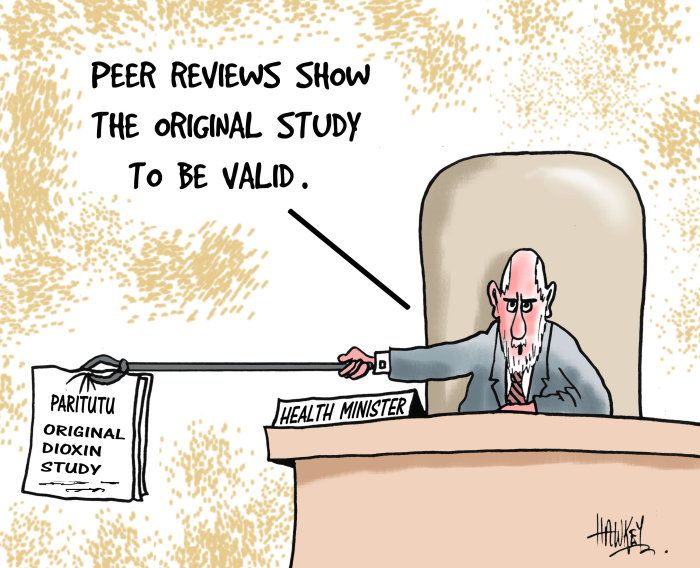
Paritutu Original Dioxin Study. Peer reviews show the original study to be valid. 26 January, 2007 [Image credit at link]
https://natlib.govt.nz/records/23164028?search%5Bpath%5D=items&search%5Btext%5D=70068
MORE ON IVON WATKINS DOW:
MP’s Agent Orange claim triggers inquiry 10/01/05
Officials will investigate a Government minister’s reported claim that Ivon Watkins Dow exported the components of the defoliant Agent Orange for use in the Vietnam War.
MP’s Agent Orange claim triggers inquiry
/cloudfront-ap-southeast-2.images.arcpublishing.com/nzme/FNMG5HFOSRQNF52F77VTYKWEKE.jpg)
John Moller
Officials will investigate a Government minister’s reported claim that Ivor Watkins Dow exported the components of the defoliant Agent Orange for use in the Vietnam War.
Transport Safety Minister and New Plymouth MP Harry Duynhoven has given the long-standing claims that New Zealand made and exported Agent Orange new weight with comments to a Sunday newspaper.
It has also raised questions about whether the Government will face lawsuits at home and overseas.
He told the Sunday News he had information the products used to make Agent Orange – 2,4,5-T and 2,4-D – were shipped from the Taranaki wharves in the 1960s to the American base at Subic Bay in the Philippines for use in the Vietnam War.
This contradicts denials by Ivon Watkins Dow – now Dow AgroSciences – that it supplied Agent Orange or its ingredients to the US military from its Paritutu, New Plymouth, plant.
The newspaper quoted Mr Duynhoven as saying the export of the products under the National Government of Sir Keith Holyoake “should be in the public arena”. The claim has come mainly from environmentalists and the Green Party.
In 1990, during the fourth Labour Government’s final days, a parliamentary committee reported that evidence for the claim was inconclusive.
Mr Duynhoven was overseas yesterday and could not be contacted.
But Government duty minister Rick Barker said officials would look afresh at the claim.
National deputy leader Gerry Brownlee asked if Mr Duynhoven had hidden his information from last year’s health select committee inquiry into the health effects of the agent on veterans and their children.
“Surely Mr Duynhoven wasn’t the only member of Cabinet to have this information?”
He said Prime Minister Helen Clark must tell what she knew, how long she knew and how long she intended sitting on the information.
But Green Party co-leader Rod Donald said Mr Brownlee should “look in the mirror”, as National was in power at the time during the war and for most of the time since.
He said Mr Duynhoven’s reported revelations were breathtaking. They vindicated his party’s view and showed the Government should take IWD to court.
“Being sprayed with New Zealand-made Agent Orange is equivalent to being bombed by New Zealand-made bombs.
“The revelation strengthens our call for the families of Kiwi soldiers in Vietnam to get the full medical treatment they deserve and the monitoring that they’ve been calling for.”
John Moller, former president of the now-defunct Vietnam Veterans Association set up in the 1980s to research the effects of Agent Orange, said he was shocked by Mr Duynhoven’s statement.
The only documents Mr Moller had seen relating to such claims were two books, one of which said ICI New Zealand had supplied Agent Orange.
“But being a member of Parliament I suppose he’s got the knowledge and evidence to back it up.”
Mr Moller said that at the parliamentary probe into the claims, an IWD official was asked if Agent Orange was made at New Plymouth.
“His reply was ‘not at that site’.”
No politicians had bothered to ask whether it was made at another site.
Mr Moller said the irony was not lost on veterans that they could have been poisoned by their own country.
He said veterans and their widows and families should be compensated. About 600 veterans, of more than 3000 who served there, were now dead.
Dow NZ general manager Peter Dryden was overseas and could not be contacted yesterday.
Greenpeace toxics campaigner Mere Takoko said up to 15 per cent of the product made in New Zealand was exported during the Vietnam War period.
She said the Government breached the Geneva Protocol prohibiting the use and supply of chemicals for waging war.
Former Taranaki port watersider Norm Quinlan said it was well-known in the 1960s that Ivor Watkins Dow exported some chemicals to the Philippines.
Now 85, Mr Quinlan said a drum containing liquid from the plant broke while loading one day and another worker got covered in the “juice”.
He was in hospital for months and a few years ago died of cancer.
“There was three in that hold that day and they all later died of cancer.”
Mr Quinlan did not know exactly what substances they were exposed to, but “it was stuff from Ivor Watkins Dow going up to the Philippines … going up that way anyway.
“The only thing I can tell you is that I worked on the ship that sent that stuff away. I’ve got an idea that it was in 66 or 67.”
He said few watersiders from that era were still alive.
Deadly mix
* Agent Orange is a mixture of the herbicides 2,4,5-T and 2,4-D, and was used as a defoliant by the US military in the Vietnam War.
* Ivon Watkins Dow made both herbicides at its Paritutu, New Plymouth, plant but denies producing Agent Orange or selling its components to the US military.
From the Green Party NZ:
Dioxin disaster
TV3’s Melanie Reid has spent the last year investigating dioxin contamination from the herbicide 2-4-5-T, especially in the New Plymouth suburb of Paritutu, where Ivon Watkins Dow manufactured the chemical for more than 20 years. The result, a 90-min documentary called Let us Spray went to air last night. If you missed it, you can watch it online here. (Video displayed above).
The documentary is extremely disturbing. Most notably, a forensic accountant hired by TV3 went through an earlier Ministry of Health report into dioxin contamination in New Plymouth and found that ill-defined parameters, muddled reporting of facts and inconsistencies in drawing conclusions masked the true extent of the dioxin contamination problem. READ MORE
NOTE: DEAD blog.greens LINK NOW
Read more on chemicals and how they poison us on our ‘chemicals’ pages.
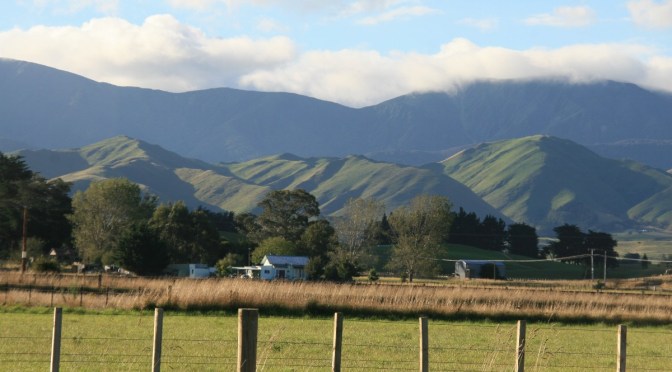
Warning: New Zealand Government And Big Banks In Collusion For Farm Land Grab: The Same Scam As Run In The United States And Australia
March 11 2016 | From: WakeUpKiwi / Various
We are about to see the mass sell off of NZ farms. And 95% of them will go to foreigners under the TPPA- timed to perfection of course. You are now watching the United Nations Agenda 21 / Agenda 2030 bei…. Wake up. Share this information.
We are about to see the mass sell off of NZ farms. And 95% of them will go to foreigners under the TPPA- timed to perfection of course. You are now watching the United Nations Agenda 21 / Agenda 2030 bei…. Wake up. Share this information.

What you have seen happen in Auckland in the past 15-20 years was just the start- a test bed. The evidence here is irrefutable.
Related: Fonterra Drops Forecast Milk Payout
Possibly the most painful part of this will be watching all of the big bank / corporate sponsored ‘experts’ in the filthy corrupt media & Government try and explain it all away in terms of “interest rates” and “market forces”. Farmers are enticed into taking out loans at low interest rates which are then intentionally later raised, in a blatantly criminal plan to seize land. It worked in the US. Copy and paste in Australia. And now copy and paste in New Zealand.

New Zealand company Fonterra is the worlds largest dairy exporter, exporting products to over 100 countries
The truth is, it is an agenda planned even before the inception of Fonterra, specifically for this end goal – the ‘Globalization’ of our land and all of our natural resources – using rigged (Libor) interest rates, market manipulations, fake printed debt and various other financial frauds.

You must be logged in to post a comment.