
I have always enjoyed growing different plants that are not commonly available.
This is one of the aspects that makes gardening more enjoyable and exciting when you have successes.
Three vegetables that I have grown in the past and am writing about are not rare but not common for many gardeners.
The first of these is called Chayote or more commonly known as Choko.
Originating from Mexico where the vines grow prolifically they have little financial value there likely because they are so prolific.
Specialist fruit and vegetable shops or flea markets are likely to have chokos for sale at this time of the year for about a dollar each.
Most people likely do not know the fruit and by pass them where people from Asia are likely to be the main buyers.
Choko are a member of the gourd family; Cucurbitaceae, along with melons, cucumbers and squash.
In Asia they are commonly diced up and used in stir fries and soups.
The fruit does not need to be peeled to be cooked or fried in slices. Most people regard it as having a very mild flavor by itself.
It is commonly served raw with seasonings (e.g. salt, butter and pepper) or in a dish with other salad vegetables and/or flavorings. It can also be boiled, stuffed, mashed, baked, fried, or pickled in escabeche sauce.
Both fruit and seed are rich in amino acids and vitamin C.
The fresh green fruit are firm and without brown spots or signs of sprouting. Smaller ones are more tender. I actually I like the fruit raw eaten like an apple they are crisp and refreshing.
The tuberous part of the root is starchy and eaten like a yam (can be fried).
The leaves and fruit have diuretic, cardiovascular and anti-inflammatory properties, and a tea made from the leaves has been used in the treatment of arteriosclerosis, hypertension, and to dissolve kidney stones. So a very versatile, interesting plant.
They are easy to grow and the older fruit will start shooting from the base then all you need to do is place the fruit sideways, half buried in compost with the shoot upwards.
Start off in a container where it will root up and then protect in a glasshouse or similar (even a window sill) till spring when it can be planted out.
It must be planted in a free draining situation, sunny and a degree of protection from frosts.
Spray the vine with Vaporgard for frost protection in winter and cover with frost cloth when there is two or more frosts in a row.
The first season from experience I found no fruit but a lot of growth and some winter damage.
The next season I once again thought all it wanted to do was grow but as the day light hours shortened small flowers and fruit started forming. The fruit grow rapidly and within a week or so a baby fruit becomes bigger than your fist.
For the health and mineral benefits we have; Nutritional value per 100 g (3.5 oz)
Energy 80 kJ (19 kcal): Carbohydrates 4.51 g : Sugars 1.66 g : Dietary fiber 1.7 g : Fat 0.13 g : Protein 0.82 g.
Vitamins are Thiamine (B1) (2%) 0.025 mg: Riboflavin (B2) (2%) 0.029 mg: Niacin (B3) (3%) 0.47 mg: Pantothenic acid (B5)(5%) 0.249 mg: Vitamin B6 (6%) 0.076 mg: Folate (B9) (23%) 93 g.
That is an impressive range of B vitamins making 43% of total them there is Vitamin C (9%) 7.7 mg: Vitamin E (1%) 0.12 mg: Vitamin K (4%) 4.1 g
The Trace metals are Calcium (2%) 17 mg: Iron (3%) 0.34 mg: Magnesium (3%) 12 mg: Phosphorus (3%)18 mg: Potassium (3%) 125 mg: Zinc (8%) 0.74 mg
Health wise how good is that? So easy to grow and eat raw to obtain full benefits of the vitamins and minerals.
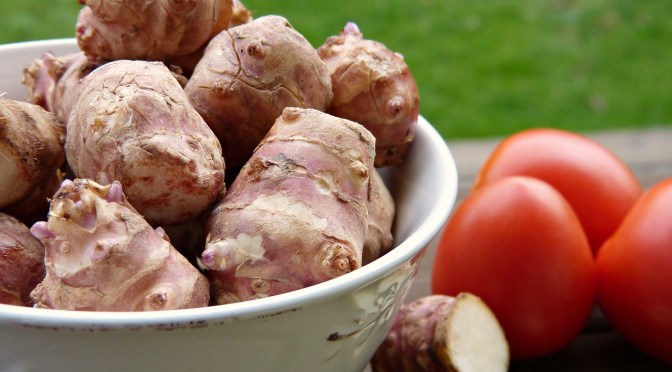
Next we have a less common one called Jerusalem Artichokes which is a root vegetable from the Helianthus tuberosus family, also called sunroot, sunchoke, earth apple or topinambour, it is a species of sunflower native to eastern North America.
Grown from tubers it can be successfully grown any where that has reasonable drainage and sun light.
Grown in a container, waste area, vegetable garden or flower garden it will thrive.
In a container it grows about a metre or so tall in open ground from a couple of metres to 3 or 4 metres tall dependent on soil and growing conditions.
In autumn it produces smaller sunflower blooms and dies back about this time of the year when you can start harvesting the tubers.
The nobbly tubers contain about 10% protein, no oil, and a surprising lack of starch. However, it is rich in the carbohydrate inulin (76%), which is a polymer of the monosaccharide fructose.
Tubers stored for any length of time will convert their inulin into its component fructose.
Jerusalem artichokes have an underlying sweet taste because of the fructose, which is about one and a half times sweeter than sucrose.
Jerusalem artichokes have also been promoted as a healthy choice for type 2 diabetics, because fructose is better tolerated by people who are type 2 diabetic.
It has also been reported as a folk remedy for diabetes.
Temperature variances have been shown to affect the amount of inulin the Jerusalem artichoke can produce. When not in tropical regions, it has been shown to make less inulin than when it is in a warmer region.
You can find recipes for the tubers on the Internet, steamed or baked and excellent for soups. They have a nutty, earthly taste a bit like Gin seng.
Nutritional value per 100 g (3.5 oz) is Energy 304 kJ (73 kcal): Carbohydrates 17.44 g: Sugars 9.6 g: Dietary fiber 1.6 g : Fat 0.01 g: Protein 2 g.
Vitamins; Thiamine (B1) (17%) 0.2 mg: Riboflavin (B2) (5%) 0.06 mg: Niacin (B3) (9%) 1.3 mg: Pantothenic acid (B5) (8%) 0.397 mg: Vitamin B6 (6%) 0.077 mg: Folate (B9) (3%) 13 g: Vitamin C (5%) 4 mg: Trace metals Calcium (1%)14 mg: Iron (26%) 3.4 mg:
Magnesium (5%)17 mg Phosphorus (11%) 78 mg: Potassium (9%) 429 mg
Last and the most uncommon of all is yacon (Smallanthus sonchifolius, syn.: Polymnia edulis, P. sonchifolia) a species of perennial daisy traditionally grown in the northern and central Andes from Colombia to northern Argentina for its crisp, sweet-tasting, tuberous roots.
The peeled roots are lovely to eat raw, sweet to the taste without the side effects of sugar..
The tubers contain fructooligosaccharide, an indigestible polysaccharide made up of fructose.
Fructooligosaccharides taste sweet, but pass through the human digestive tract unmetabolised, hence have very little caloric value.
Moreover, fructooligosaccharides have a prebiotic effect, meaning they are used by beneficial bacteria that enhance colon health and aid digestion.
Easy to grow, plants grow about 1.5 metres tall large leaves with a texture like Borage harvest, roots in autumn.
If you can obtain a starter tuber of yacon its well worth growing.End….
Here is a link that I received recently that you maybe interested in especially in regards to the current select committee on the Therapeutic Products Bill.
This bill which has in the past been defeated twice before could mean that you are not allowed to grow healthy vegetables by some Govt committee if the bill is passed.
Also concerning article from the same writer:
https://hatchardreport.com/are-we-going-backwards-or-rushing-ahead/
We will carry on last week’s special on BioPhos for another week as proving very popular.
Phone 0800 466464
Garden Pages and News at www.gardenews.co.nz
Shar Pei pages at www.sharpei.co.nz
Mail Order products at www.0800466464.co.nz
New Zealand Bill of Rights Act 1990. Part II of the Act covers a broad range of Civil and Political Rights. As part of the right to life and the security of the person, the Act guarantees everyone:
1The right not to be deprived of life except in accordance with fundamental justice (Section 8)
2The right not to be subjected to torture or to cruel, degrading, or disproportionately severe treatment or punishment (Section 9)
3The right not to be subjected to medical or scientific experimentation without consent (Section 10)
4The right to refuse to undergo any medical treatment (Section 11)
Furthermore, the New Zealand Bill of Rights Act 1990 guarantees everyone: Freedom of Thought, Conscience, and Religion.
This includes the right to freedom of thought, conscience, religion, and belief,
INCLUDING THE RIGHT TO ADOPT AND HOLD OPINIONS WITHOUT INTERFERENCE (Section 1)
Image by Silvia from Pixabay
