
They are after your children people. Remember this?
WHO now deems your child’s presence in school as informed consent to vaccinate them (it’s called ‘implied consent’). And where’s the outcry on this one? A nurse already blew the whistle on injecting folk while they’re under anaesthetic. Everything you’d once be outraged at is becoming normalized. EWNZ
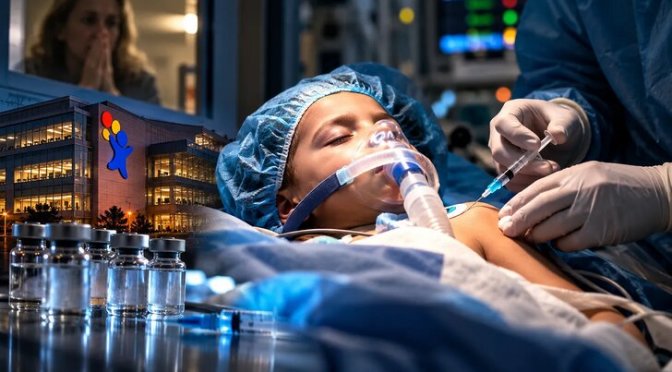
More than 18,000 children have reportedly received vaccinations while unconscious under deep sedation or general anesthesia at Children’s Hospital Colorado, according to an October 23 report by journalist Jon Fleetwood.
The practice, described in a March 2026 publication by the American Academy of Pediatrics, involves administering vaccines to children already undergoing surgery or other medical procedures, including children with neurological or developmental conditions who have difficulty tolerating injections while awake.
The revelation has sparked questions about informed parental consent, vaccine safety, and the potential complications of administering additional medical treatments during anesthesia.
The report follows a separate disclosure from Children’s Hospital of Philadelphia, where a program called “Close Your Eyes, We’ll Immunize” administered 2,054 influenza vaccine doses during the 2025–2026 flu season.
According to the Philadelphia hospital, approximately one-third of participating families said their children otherwise would not have received the influenza vaccine.

Concerns about medical mistakes involving childhood vaccinations are not merely hypothetical. In October 2021, an Indiana family reported that a Walgreens pharmacy in Evansville accidentally administered full adult doses of Pfizer’s COVID-19 vaccine to their two children, ages 4 and 5, instead of the influenza shots the parents had requested. Alexandra and Joshua Price said they only discovered the mistake after leaving the pharmacy, when an employee called to inform them that the wrong vaccine had been administered. At the time, Pfizer’s COVID-19 vaccine was not authorized for children that young.
The family subsequently took both children to a pediatric cardiologist after reporting concerning symptoms. According to local news station 14 News, the parents said their 4-year-old son developed tachycardia, an abnormally rapid heartbeat, while their 5-year-old daughter experienced elevated blood pressure. Both children also reportedly developed fevers. Walgreens declined to comment on the specific incident, citing patient privacy, but acknowledged that vaccination errors were taken seriously. The incident highlights the consequences of medical mistakes involving children and raises questions about safeguards, parental consent, and accountability when vaccines are administered in clinical settings.
Medical literature has identified another concern: distinguishing vaccine reactions from complications of surgery.
A 2007 review published in Pediatric Anesthesia warned that vaccine-related fever and inflammatory reactions could complicate postoperative assessments. Its authors recommended separating vaccination and elective surgery by certain intervals to reduce diagnostic confusion.
A 2017 review in Current Opinion in Anaesthesiology similarly discussed potential interactions between vaccination, anesthesia, and postoperative recovery, noting uncertainty about the best timing.
These concerns become particularly important when children cannot immediately communicate symptoms because they remain sedated or are recovering from anesthesia.
The issue also intersects with ongoing questions about COVID-19 vaccine safety in children.
A 2024 study published in JAMA Network Open, involving more than 4.1 million vaccinated children, identified safety signals involving myocarditis or pericarditis among adolescents aged 12–17, along with seizure signals in certain younger age groups.
The researchers cautioned that these signals required careful interpretation and did not automatically establish that vaccination caused every reported event.
Another study, published in Nature Communications in 2024, examined 5.1 million children in England. Researchers estimated approximately five additional myocarditis cases per million adolescents following a second Pfizer vaccine dose.
The same study found that SARS-CoV-2 infection was associated with increased risks of several serious medical outcomes, including myocarditis.
These findings demonstrate why vaccine safety assessments must distinguish specific adverse reactions from overall risk, particularly across different childhood age groups.
Meanwhile, Children’s Hospital of Philadelphia has disclosed that it is exploring whether to expand its vaccination-under-anesthesia program to include COVID-19, RSV, and additional routine immunizations.
The hospital acknowledged that vaccine-related symptoms could be confused with symptoms arising from a child’s underlying illness or recovery.
As hospitals increasingly incorporate vaccination into surgical appointments, questions about consent, adverse-event monitoring, and medical necessity deserve transparent answers.
Parents should know exactly which procedures their children will undergo, understand the potential risks, and have a meaningful opportunity to accept or decline additional treatments.
For children undergoing surgery, particularly those with complex medical needs, informed consent and careful postoperative monitoring should remain central to every medical decision.
RELATED
Photo Credit: Died Suddenly
Discover more from Environmental Health Watch NZ
Subscribe to get the latest posts sent to your email.
