

Curiously it appears Bunnings were capturing unwitting customers’ facial images, AND their sensitive data in Aussie away back in 2018 … what else has been done with neither your knowledge or your consent?
But don’t worry folks, it was only for your safety. All you conspiracy theorists can rest easy Bunnings is not using this for tracking or other nefarious purposes. And… if you’re found NOT to be a criminal (as in no match), your image will be deleted in 10 seconds flat. (Wink wink) ….. This is a great pity, I used to enjoy browsing in Bunnings…. EWNZ
How we are using Facial Recognition Technology (FRT) to help keep our team and customers safe
Last updated: Tuesday, 7 July 2026
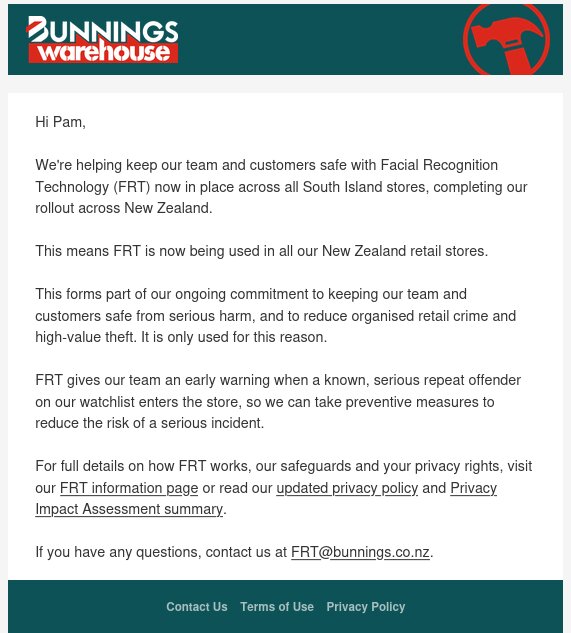
Bunnings New Zealand uses facial recognition technology (FRT) in all of its retail stores to help keep customers and team members safe and reduce serious harm and high-value theft.
It is used only to identify a known offender who has previously committed Serious Harm in our stores, so steps can be taken before harm occurs. It is not used for marketing, customer behaviour tracking or monitoring team members. If there is no match, the image is permanently deleted within 10 seconds.
Quick answers
Is Bunnings using facial recognition technology in New Zealand?
Yes. Facial Recognition Technology (FRT) is in use across all Bunnings New Zealand retail stores. View the list of NZ stores here.
What does Bunnings use FRT for?
FRT is used only to identify known offenders who have previously committed Serious Harm, so our team can act early to help prevent harm.
What is serious harm?
Serious Harm means violent, threatening, aggressive or intimidating behaviour; incidents involving weapons; physical or verbal assault; racial or sexual harassment; high-value theft; and organised retail crime.
What is a watchlist?
A watchlist is a secure, limited list of offenders who have previously caused serious harm in our stores, such as violence, serious threats, or high-value theft. It enables FRT to issue an alert if that offender re-enters a store. Enrolment only happens after a strict review process, is reviewed quarterly for accuracy, and people are automatically removed once the relevant retention period ends.
What happens to my image?
If there is no match to the watchlist of enrolled offenders, the image is permanently deleted within 10 seconds.
Is FRT used for marketing or tracking customers?
No. FRT is not used for marketing, customer behaviour tracking, or monitoring team members.
Who decides what happens after a match?
Trained team members, not the technology, make every decision.
Where is my data stored?
All biometric data is stored in New Zealand.
How did Bunnings decide to introduce FRT responsibly?
The decision was guided by a Privacy Impact Assessment, independent research with 1,000 New Zealanders, and ongoing engagement with a Māori digital sovereignty expert. The system complies with the Privacy Act 2020 and the Biometric Processing Privacy Code 2025.
How Bunnings decided to introduce FRT responsibly
The decision followed a Privacy Impact Assessment, independent community research, and ongoing engagement with a Māori digital sovereignty expert.
All biometric data is stored in New Zealand. The system complies with the Privacy Act 2020 and the Biometric Processing Privacy Code 2025. The system is operated by Bunnings and supplied by Vix Vizion (product: Imagus), an Australian company.
We commissioned independent research and conducted interviews with team members, as well as a nationally representative survey of 1,000 New Zealanders. This helped us understand what New Zealanders think about FRT. More than nine in ten people (93%) supported FRT if it improved safety by more than 10%. Fewer than one in ten (7%) opposed it in principle. A summary of that research is available here.
Our initial rollout in our Hamilton stores, Te Rapa and Hamilton South, launched in April 2026, followed by the rest of the North Island in May 2026 and South Island stores in July 2026.
We will continue our community and customer engagement and closely monitor incidents of serious harm and high-value theft in our stores.
- Read the summary of our independent research findings
- Read the Privacy Impact Assessment
- View the Bunnings New Zealand Privacy Policy
Why does Bunnings use FRT?
Retail crime and threatening behaviour toward retail workers is increasing across New Zealand. In the past year, Bunnings recorded 697 threatening events in New Zealand, up 9.5% on the previous year, including 32 physical assaults and 8 harm or death threats. Across Australia and New Zealand, threatening events at Bunnings have increased 130% since 2022.
Across New Zealand, retailers reported 140,000 retail crime incidents in the past year, costing the sector $2.6 billion. Retail crime has increased 85% between 2019 and 2023.
Most of the harm is caused by a small number of repeat offenders. Last year, 34% of threatening events at Bunnings in New Zealand involved repeat offenders. FRT is aimed at this group. It gives our team early warning when a known offender enters a store, so they can act before someone gets hurt.
RELATED
Bunnings’ use of facial recognition breaches Australian Privacy Act
photo credit: applianceretailer.com.au
Discover more from Environmental Health Watch NZ
Subscribe to get the latest posts sent to your email.

We never go to Bunnings, a few years ago our plumber told us they have a policy of selling cheap inferior merchandise, so we use Mitre 10 Mega instead, and it’s NZ owned.
LikeLiked by 1 person
Ah interesting. I enjoyed their plant department. But yes I switched to M10 some time ago as their really great service is worth the slightly higher prices. Still I daresay they’ll eventually follow suit if they haven’t already!
LikeLike