
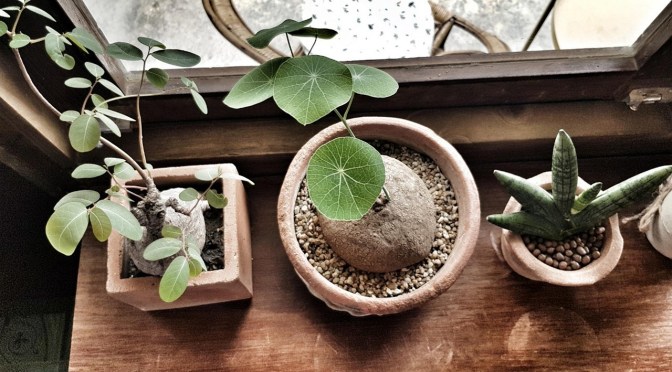
HOUSE PLANTS CARE IN WINTER
Winter can be a tough time for indoor plants if people don’t recognise the problems that the plants face.
The factors that affect indoor plants are, light, temperature and moisture levels.
These three factors are interlinked and if they are not all correct in relationship to each other, then plants will be in a stress situation.
Lets consider each of these starting with light; Indoors light is what I call sidewise light, it is not overhead light but its natural light that comes sidewise though windows or glass doors.
All plants need a certain amount of light and they will always grow towards the light source.
Outside plants grow straight up, indoor plants tend to grow sideways.
The best light in a home is within a metre of a unshaded window facing in a northerly direction.
During summer with long hours of natural light daily, plants will do well and much of their foliage will be facing the window to trap all the light possible.
Once we move the same plant a couple of metres from the window, but still in line with the window,
the light level the plant receives drops a fair amount and the plant stretches towards the window making it lopsided.
Move the plant to the far side of the room and it is likely to be getting only about 10% of the light it was getting in the one metre zone.
A low light plant will be happy in that spot with all its leaves facing the window once it adjusts to its situation.
If we had a room that was pure white with all furniture white, the room would be quite dazzling to our eyes because of the amount of reflected light.(Plants would love it)
On the other end of the spectrum if we had a room that was totally black the room would appear dark to us except for the area immediately around a sunny window.
Indoor plants rely on a lot of reflected light and the lighter the colors in a room the better the plant will be for its light requirements.
When we look at the situation in midwinter our day light hours are down to 8 hours, about half the hours as we have in mid summer.
So naturally from this, plants are getting far less natural light in winter.
This is why some plants do well in the summer months but fail in the winter with foliage browning or yellowing off, leaf drop and many tend to hibernate also.
Temperature in summer is higher and more constant in the plus 15 degrees area.
In winter the temperatures being lower (without artificial heat) is the factor that sends plants into a more dormant state.
We have situations then, with people that are not home during the day and the room is cool to cold.
On returning home to a cold room artificial heat is turned on raising the temperature to a nice level.
On retiring for the night the heating is often switched off and temperatures quickly drop to zero or a few degrees.
In the morning the room maybe warmed again for a short time and then allowed to return to the normal indoor temperature of the day.
This up and down temperatures does have an effect on the well being of the plants.
Next is moisture level and its an aspect that we have the control over completely.
Plants need moisture in the air to keep nice clean foliage.
When the air becomes too dry the plant keeps pushing moisture to the foliage to replace the moisture lost into the drying air.
Tips of leaves or the edges tend to yellow and brown when the plant cant replace sufficient moisture to the leaves. Especially noticeable in palms and ferns.
If we water the plants well, we have the problem that when the temperature drops they have cold wet roots which are prone to rotting.
Lack of good light, wide temperature swings and too much water in the mix is the death of many plants in winter.
You can control to a degree two of these factors, ensure that plants that require good light are very close to (in front of) good light windows without net curtains.
I have had people tell me that their plant is getting good light because it is right near the window.
On further questioning it turns out the plant is either beside the window or below the window which is actually worse than being over the other side of the room.
It must be direct light on the foliage, through the window.
Low light plants such as philodendrons will be happier in less light spots, but a maidenhair fern would die down.
Keeping a steady temperature in winter can be expensive and a cost when you are not at home to have benefit of the heat.
Heating does dry the air and to overcome this, and take advantage of the fact, place a clothes horse in the lounge to dry that days washing.
The drying of the clothes puts ample moisture into the air and helps to keep the plants happy.
If you run a dehumidifier your plants will suffer unless you compensate by say placing wet sphagnum moss on top of the potting mix and wetting it every day without actually watering the mix.
Bowls of water near plants is another way to ensure moisture in the air near the plant’s foliage.
The biggest control in the three aspects that you have, is the moisture level of the potting mix. In winter it should never be wet, just evenly moist to nearly dry.
If you have wide variations of temperature in a room keep the mix fairly dry with only little amounts of water applied when the plant is showing signs of lack of water.
In rooms that heat comes on when you come home would be the time for a little drink which might be every few days to once a week or less.
The odd plant may need say 50 mils of water every night to prevent water loss and leaf drooping.
Another plant in the same room might only require a weekly drink of 250 mls. You have to watch the plants and judge.
If there is ample moisture in the air because you made it so, then your plants will require far less drinks. To sum up, ensure plenty of light (artificial light does help),
go easy on the watering, endeavor to keep a reasonable amount of humidity in the air and if possible avoid rapid changes in temperature.
( Plants can handle this aspect if they are fairly dry in the mix) Except for flowering plants in winter don’t bother feeding. Good luck with your house plants this winter.
ooooo
Phone 0800 466464
Garden Pages and News at www.gardenews.co.nz
Shar Pei pages at www.sharpei.co.nz
Mail Order products at www.0800466464.co.nz
New Zealand Bill of Rights Act 1990. Part II of the Act covers a broad range of Civil and Political Rights. As part of the right to life and the security of the person, the Act guarantees everyone:
1The right not to be deprived of life except in accordance with fundamental justice (Section 8)
2The right not to be subjected to torture or to cruel, degrading, or disproportionately severe treatment or punishment (Section 9)
3The right not to be subjected to medical or scientific experimentation without consent (Section 10)
4The right to refuse to undergo any medical treatment (Section 11)
Furthermore, the New Zealand Bill of Rights Act 1990 guarantees everyone: Freedom of Thought, Conscience, and Religion.
This includes the right to freedom of thought, conscience, religion, and belief,
INCLUDING THE RIGHT TO ADOPT AND HOLD OPINIONS WITHOUT INTERFERENCE (Section 1)
Seize the moments of happiness, love and be loved! That is the only reality in the world, all else is folly.
Image by patharawon monapatpiboon from Pixabay
Discover more from Environmental Health Watch NZ
Subscribe to get the latest posts sent to your email.
