
From THE WINE PRESS @ substack
Note how they are now adding their nano tech poison to just about everything…in order no doubt to capture those who have diligently declined the said safe & effective…. EWNZ
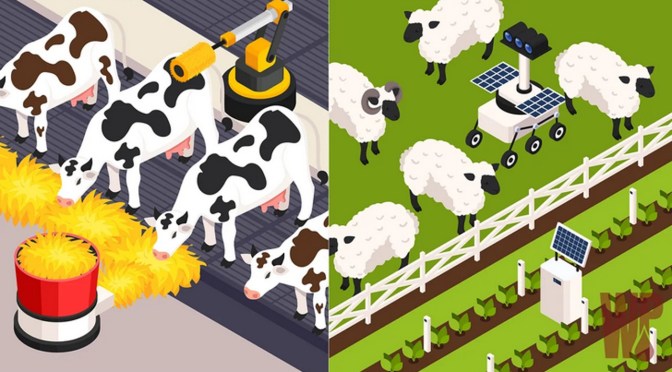
The blueprints include necessities such as mandatory vaccination for all livestock, quarantining, and AI to track the animal’s health.
The following report was first published on July 8th, 2021, on winepressnews.com. The follow report is by Carel du Marchie Sarvaas, executive director at HealthforAnimals, a nonprofit NGO representing the global animal health industry based in Brussels, Belgium – via AgFunder News:
The Covid-19 pandemic has highlighted the clear dangers and difficulties in controlling a worldwide outbreak of an emerging disease.
But a new World Health Organisation (WHO) panel aiming to address the emergence and spread of other zoonotic diseases doesn’t have to look too far to find the best practices and models that can — and in many cases already do — prevent the next pandemic.
If governments and health authorities want to secure a healthy future and protection from the threat of zoonotic diseases, they need only look to the modern farms in countries like Canada, Australia, the US, and throughout Europe, where such outbreaks are increasingly rare.
The day-to-day practices, safeguards, and technologies that are now common on modern farms not only ensure food safety in these countries is the strongest in the world, but also that outbreaks of zoonoses from the food chain are prevented – or, at worst, quickly contained. It is one of the core reasons why the vast majority of zoonoses originate in wildlife, not from domesticated animals.
So much so, that in markets like North America, the EU, and the UK, the threat of zoonotic diseases spreading to people has all but disappeared in the last decade. We have improved animal health management to thank for promoting better livestock health, which has, by extension, protected the health and wellbeing of people as well.
It is down to these innovations that now exist on almost all modern farms in developed countries that there has been no major zoonotic outbreak in Europe since Q fever in the Netherlands in 2007.
As a result, the WHO’s new One Health High-Level Expert Panel already has a broad set of ready-made and tested solutions that can help the world — not just the most developed economies — minimize the threat of zoonotic disease outbreaks and ensure a healthy future for animals and humans alike.
Scaling up animal health interventions in developing countries should be an urgent priority, just like increasing access to Covid-19 vaccines – especially as the burden of neglected tropical zoonotic diseases is significantly higher.
This can be done by providing access to key technologies, practices, and policies, along with expert support.
Firstly, vaccination is the most powerful tool in our pandemic prevention toolbox and is instrumental in bringing down the risk of an outbreak.
Vaccines are essential in preventing animal diseases from spreading among animal populations and jumping to humans, with mandatory Q fever vaccination in the Netherlands helping significantly to bring the last outbreak under control.
Vaccination drives also helped to bring an end to the threat of salmonella from poultry on European farms in the 1990s, which was previously the most high-profile form of household food poisoning just some 20 years ago.
Researchers are now in the process of developing a vaccine for another zoonotic disease — Rift Valley fever — which can be given to both people and livestock.
Secondly, rigorous biosecurity measures — ranging from simple handwashing and personal protective equipment for farm workers, to more advanced air filtration systems — have played an important role in helping to reduce the risk of bacterial transmission from livestock to people, and are now commonplace on many modern farms.
The quarantine, isolation, and compartmentalization of animals has also long been standard practice for livestock farms to continue trade while controlling infection levels, well before the Covid-19 era.
Finally, modern diagnostic technologies — including cutting-edge analysis tools driven by artificial intelligence and machine learning — have helped prevent cases of illness from becoming an outbreak, an epidemic, or a pandemic, by effectively identifying and treating illnesses and diseases early, before they become uncontrollable.
Innovations in animal health, whether new technologies, policies, or practices, have all but eliminated the threat of zoonotic disease outbreaks in livestock throughout developed markets, and in the process, have become a day-to-day part of modern farming.
Farms in developed countries already possess the solutions that are proven to be effective in helping prevent the threat of zoonotic diseases jumping to human populations, ensuring strong animal-human health and food safety.
Our goal should now be to make sure this blueprint of successful technologies and practices is readily available everywhere, not just in developed countries.
Improving access to veterinarians and veterinary resources in developing countries will be crucial if we are to properly leverage these technologies and their public health benefits on a truly global scale.
The global health community cannot afford to waste any time if we want to ensure a healthier and more resilient world and prevent the next pandemic.
AUTHOR COMMENTARY
In late May, I reported how some doctors were sounding the alarm on yet another potential pandemic: a Russian flu virus that originates from farm ducks.
From that report, [Doctors] suggest that vigilant surveillance of farms, live markets and wild birds, along with the implementation of standard infection control measures, could slow the spread of the virus, giving pharmaceutical companies time to develop a vaccine for it.
And so, just by sheer “coincidence,” now the WHO is looking to better prevent another “pandemic” by basically getting control of all farms, and install precision mitigation and tracking of these animals.
Moreover, as mentioned in my report about this ‘duck virus,’ that seemed like a good excuse to help cause a kneejerk reaction to get the masses to stop eating meat. All these evil technocrats have to do is starting vaccinating livestock, watch them fall over dead, and then the media can propagandize everyone in a similar fashion like this Covid shamdemic. Mark it down: “they” will have to cause a new crisis to get the masses off of meat, and then command people not to eat it. Will it be because of what I said? Or for some other reason? We’ll have to wait and see.
All of this plays into and fits together like a puzzle, as we have been reporting on.
Photo Credit: THE WINEPRESS
Discover more from Environmental Health Watch NZ
Subscribe to get the latest posts sent to your email.

ikk!
https://x.com/ElijahSchaffer/status/1895957217456619727
LikeLiked by 1 person
Thanks FC. Big topic now isn’t it!
LikeLike
US news –
Children in households with water treated with fluoride appear to be at a much higher risk of autism, according to a shock study.
Researchers discovered a staggering six-fold increase in autism spectrum disorder (ASD) diagnoses among children who grew up fully exposed to fluoride versus those who did not consume the treated water.
https://www.dailymail.co.uk/sciencetech/article-14589845/Chemical-hated-RFK-Jr-linked-500-increase-autism-shock-new-research.html
LikeLiked by 1 person
Wouldn’t you know it FC? Here in Enzed they’re mandating councils to add it to our water.
LikeLiked by 1 person
JAMA, One of the Most Corrupt Globalist Establishment “Medical Journals” Claims There are 15,000 “Predatory Medical Journals, and Fails to Name Even One Of Them
https://nukepro.net/8755/
LikeLiked by 1 person