
by Tony Orman
Government use of 1080 poison in New Zealand is controversial and seems to command the headlines ahead of other poisons.
But there is a much worse poison – it is called brodifacoum.
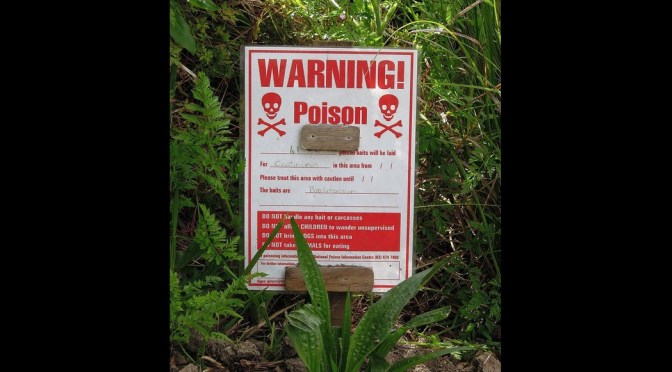
Brodifacoum is widely used by regional councils and government agencies such as the Department of Conservation. Typical of its widespread use is Ulva Island near Stewart Island where the Department of Conservation is currently undertaking rodent eradication.
I have come across brodifacoum poisoning notices in the central North Island when trout fishing, accompanied by my Labrador dog. In one case I asked a farmer why the regional council was using brodifacoum for possums. He didn’t know and added that possum numbers were very light anyhow.
Because of the extreme danger to my dog, I didn’t go fishing. Besides, trout fishing a river into whichever toxic baits will have fallen or on the banks, doesn’t make for an enjoyable day’s fishing!
Such cavalier attitude of regional councils – and the Department of Conservation – belies the lethal nature of brodifacoum.
Comparison
How does it compare to 1080?
Both poisons have a ”withholding period” which means a time must elapse after the toxin’s use before stock can be safely grazed or game animals such as deer, taken for home consumption.
The Ministry of Primary Industries stipulates 4 months for 1080 poison. For brodifacoum it is 3 years i.e. 36 months after poisoning.
The extensive withholding time for brodifacoum is due to its known long-term persistence in the environment and animal bodies.
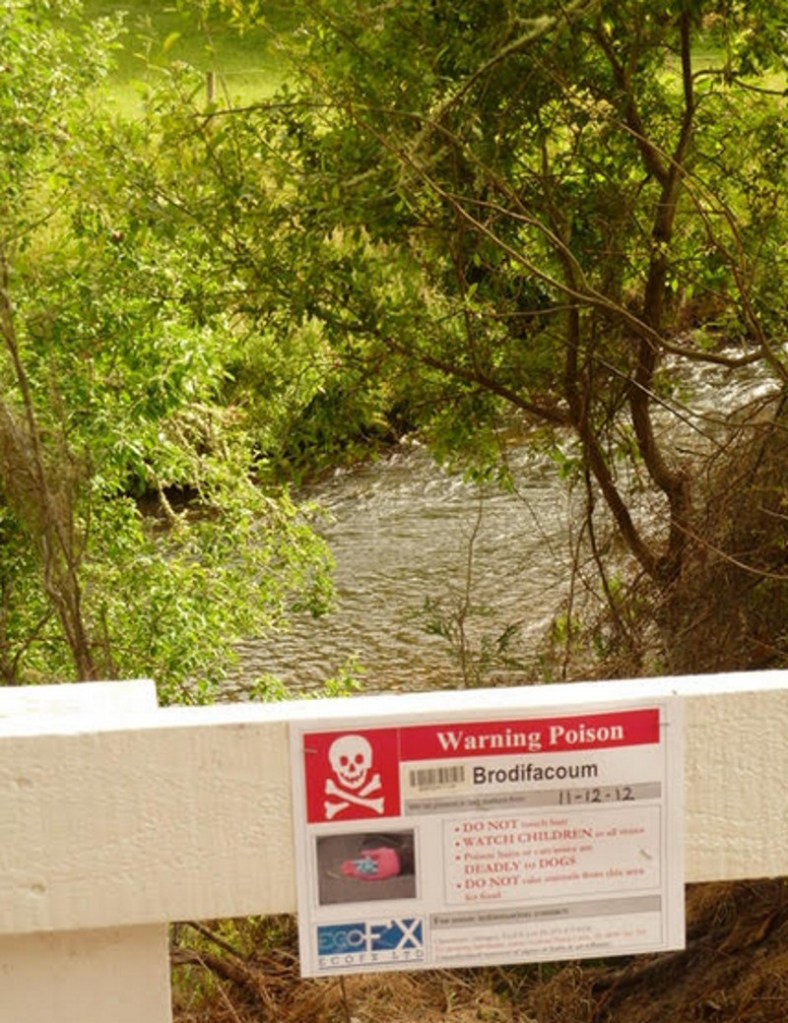
What is brodifacoum?
Brodifacoum is an anticoagulant, which causes the animal to die slowly and painfully from internal bleeding. As cruel as death over two or three days is by 1080, by brodifacoum it is far more prolonged, in the case of rats within 4 to 8 days and larger animals such as possums, up to 21 days.
1080 requires a user to have a licence to use the toxin but no licence is needed for brodifacoum, for example rat poison sold over shop counters, to anyone, young or adult with no controls whatsoever.
Secondary Poisoning
Brodifacoum and 1080 have another similarity, called “secondary poisoning”. In other words a dead poisoned animal remains toxic and any bird or other creature scavenging the dead body, takes in poison and dies.
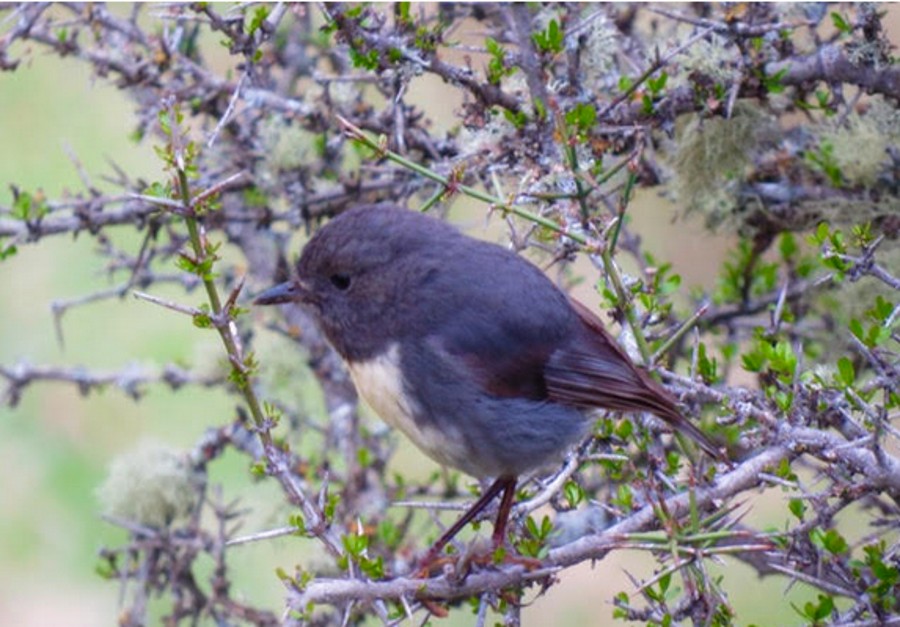
Scientists C.T. Eason and E.B. Spurr in 1995 in a study “The Toxicity and Sub-lethal Effects of Brodifacoum said insectivorous birds (e.g. bush robins, fantails) are likely to be exposed to brodifacoum by eating invertebrates that have fed on toxic baits; i.e., they are likely to be at risk from secondary poisoning. Predatory birds (especially the Australasian harrier, New Zealand falcon, and morepork) might also be at risk from secondary poisoning by eating birds, small mammals, or invertebrates that have fed on toxic baits.
Predators are greatly at risk. Both poisons are very slow to kill, and especially so with brodifacoum. An animal be mouse, bird or insect, on taking the poison, slowly dies and in its distressed, weakening state, naturally and quickly attracts the attention of predators among them native birds such as bush falcons, hawks, moreporks, pukekos and wekas.
Ecological history is littered with instances following poisoning. For example scientists Eason and Spurr said the “entire weka population on Tawhitinui Island, Pelorus Sound, Marlborough Sounds was exterminated mainly by direct consumption of rat bait (Talon) intended for ship rat control.”
The two scientists said “indigenous New Zealand vertebrates most at risk from feeding directly on cereal-based baits containing brodifacoum are those species that are naturally inquisitive and have an omnivorous diet (birds such as weka, kaka, kea, and robins). The greatest risk of secondary poisoning is to predatory and scavenging birds (especially the Australasian harrier, New Zealand falcon, southern black-backed gull, morepork, and weka)”
The duo added “the risk from brodifacoum will be at its greatest when saturation baiting techniques, such as aerial sowing, are used in eradication programmes.” Such as Ulva Island where DoC is “aerially sowing” brodifacoum.
Seven years later in 2002, Spurr and Eason along with two other scientists produced a study “Assessment of risks of brodifacoum to non-target birds and mammals in New Zealand”.
The quartet of scientists described brodifacoum as “highly toxic to birds and mammals” and listed victims such as the Australasian harrier (Circus approximans) and morepork (Ninox novaeseelandiae), other native birds such as the pukeko (Porphyrio melanomas), weka (Gallirallus australis), southern black-backed gull (Larus dominicanus), and kiwi (Apteryx spp.) and introduced mammals, including game animals e.g. deer.
Dead Dotterels
Other studies have identified the lethal nature of brodifacoum.
Landcare Research scientist Penny Fisher said “because brodifacoum persists in the environment, other birds may suffer secondary poisoning from eating animals that have ingested poison” and cited “a high mortality of New Zealand dotterels following an aerial brodifacoum operation at Tawharanui Regional Park in North Auckland, in 2004. At least 50% of the dotterels in the area at time of operation disappeared or were found dead. Sand-hoppers-common food item of NZ dotterels —ate baits and accumulated brodifacoum and provided a potential route for transmission of the toxin to dotterels.”
Two dead eels found in a Southland waterway had brodifacoum in the gut contents of one and that “suggests the eel had recently ingested food containing brodifacoum, probably through scavenging the carcass of a poisoned possum.”
Freshwater Residues
Brodifacoum similar to 1080, leaves residues.
In 2005 a paper in the New Zealand Journal of Marine and Freshwater Research, Volume 39, told of freshwater crayfish (koura) with significant 1080 concentrations and 1080 residues in eel tissue that were on average 12 times higher than the PMAV (provisional maximum acceptable level).
The INTERNATIONAL PROGRAMME ON CHEMICAL SAFETY Health and Safety Guide No. 93 said of brodifacoum “as a technical material — is highly toxic for fish”.
Processing poisons for wild animal control/eradication is Orillion a State Owned Enterprise governed through a Board of Directors appointed by the New Zealand Government. Orillion’s safety data sheet for brodifacoum says “may cause long lasting harmful effects to aquatic life.”
Therein lies a threat to not only valued sports fishes such as trout and juvenile salmon migrating downstream to sea, but also native fish such as eels and galaxids.
Sodium fluoroacetate, also known as compound 1080, is the poison around which controversy swirls. Brodifacoum is little known but is surreptitiously used by the Department of Conservation and councils.
1080 is ecologically destructive and damaging to the ecosystem – but brodifacoum is far worse.
Footnote: Environmentalist Tony Orman has spent a lifetime in the outdoors and has had some two dozen books published among them “New Zealand the Beautiful Wilderness”
Header Photo: Wikipedia – By Squidonius – Own work, CC BY-SA 3.0, https://commons.wikimedia.org/w/index.php?curid=17253187
Discover more from Environmental Health Watch NZ
Subscribe to get the latest posts sent to your email.


How can one be “non abusive” when you are talking about a government that is poisoning and destroying an ecosystem and a once beautiful country? Maybe that is the problem. Kiwis are by nature nice and polite. I suggest that should change….it is now or never…..apathy is the enemy of freedom.
LikeLiked by 1 person
Sadly yes that is the case. Vigilance required.
LikeLike
PS many many folk have stood up to this poison hawidaho, I assure you. They marched from both ends of the two islands recently to Parliament to protest (ignored). They’ve turned up regularly at the drops. One gentleman a long time protester was assaulted by their security guards for showing up while they were illegally unloading a shipment of 1080. He was charged with assault & left with a huge debt in court fees. He has passed now (RIP). No…. folk have been far from ‘polite’. They’ve spoken up as far back as 60 years … all ignored. I can assure you we are not apathetic.
LikeLike
I understand Pam…I have contributed to all of them, the Hikoi, Graeme …I have written the NZ government, in protest of the 1080 drops. I am not even a Kiwi. But I care about NZ as I had been going there since the 80’s. I have watched the demise of a once beautiful country, which I now consider the new province of China. I watched the beautiful clear spring fed streams, once teaming with world class brown trout become full of sediment and weeds from the nitrates of fertilizer and too much cow affluent….. I wrote articles to inform the world what was going on in NZ. “NZ” THE POISONED NATION(https://www.flydreamers.com/en/articles/new-zealand-the-poisoned-nation-a1745?backUrl=L2VuL2NvbW11bml0eQ%3D%3D#ref=wall/item) BUT THIS IS GOING ON ALL OVER THE WORLD NOW. It is going on in Australia, in Canada, in the USA, the whole world. Protests are NOT the way. Becoming involved in the government is the way…be it is on a city council, board of something, getting the people who are on “our side” to run things…..it is a process. They have brainwashed the children…they said that 1080 was just like eating salt and vinegar chips!….I know. I’ve watched, just like Tony Orman….we old timers know what we have lost. The young have been fed propaganda….it is the government who have been indoctrinating the people for years. One has to start using their energies where it will matter, if they want to see change. It is a commitment to truth and the survival of the planet, not just NZ
LikeLiked by 1 person
Thanks for the further insight of where you are coming from hawidaho… and for your efforts at countering the insanity. We are basically at the end stages of Agenda 2030 (a global focus, as you point out). Whilst I agree, participating at those decision making levels is important (rather than protest), I’ve also observed how Agenda 2030 has all but neutered the effectiveness of that approach. Back a few decades yes but now the systems are well infiltrated as Herr Schwab proudly boasts. I watched that play out first hand in the last district I lived in. The CEs of councils are unelected, earn highly bloated salaries & basically run the show. It is part of the plan & gives the illusion only of a democratic system. It’s everything but. Then we have the young global leaders heading the (pretend democratic) govts…) Still, rolling over isn’t an option going forwards. There are reasons for the 1080 steam roller (yes they spy on this site also, & no doubt anybody else who opposes the official narrative) … it’s certainly not, as you also point out, about saving birds.
LikeLike
this is the only time I have ever disagreed. with you – please talk to Dr Jo Pollard – and have U ever seen animals and birds that have been POISONED from 1080? Neither should be used – I have seen both and still would not say that 1080 is not as bad…
LikeLiked by 1 person
Thanks for commenting Annette. Personally I am new to Brodifacoum … this article is from Tony Orman at NZFFA. I will leave it for him to comment in that respect. As to TWNZ & 1080, if you look at 1080 in ‘categories’ (top left of page) there is a large collection of 1080 articles. I am very aware of 1080 & it’s prolific use in NZ… and its horrific effects on those it poisons including humans. And the huge cover up in this respect. Definitely neither should be used imo, preferably no poisons at all. We are awash with them in NZ. On second read, I don’t believe the author is defending 1080 use, rather just pointing out yet another poison the agencies use that folk are perhaps not aware of. Certainly it is interesting the difference in withholding periods.
LikeLike
correction…Tony Orman..not Ormand
LikeLiked by 1 person
Here is Tony Orman’s response Annette:
“Hi Annette, the point I was trying to make is 1080 is terrible and inhumane but brodifacoum judging by withholding periods, time to kill etc, is even worse. There’s no place for either. Of poisons, cyanide is an instant killer. But above all, there’s an ingrained hatred – even phobic- of wild animals by many people, some in universities and scientists to extreme rabid “greenies”. Don’t get me wrong, I regard myself as an environmentalist but rational I hope. -Tony Orman”
LikeLike