Tag Archives: Toxic

World Health Organization Only Requires 90 Days ‘Safety Testing’ on GMOS – Not Long Enough for Tumours to Show

It is well documented what GMOs do to the human body (see videos in this article) let alone the animals. (Liver disease is one effect). However, here we see how Monsanto (and WHO) manage to hoodwink the public by ensuring the testing period required is not long enough for any health effects to emerge … yet. As Prof Seralini discovered in his two year long research with lab rats.  As to the animals, here in NZ our stock (who knows how much) is being fed GE feed. Two producers I’ve contacted here in NZ who are particularly more humane in their animal treatment couldn’t rule out some of the cheaper feed they acquire (making their businesses economically viable) ‘may’ contain GMOs given they are soy products. So … if they admit they possibly are feeding their stock GE food, then what of the larger factory farmed livestock where cost cutting is a primary objective? You can bet your bottom dollar they will be munching on GE feed. The Green Party has drawn this to the public’s attention numerous times.

An excerpt from the Natural Society’s article:

By Christina Sarich

“The WHO could have picked any arbitrary number of months to ensure that GMOs were safe, and make sure that the public wasn’t dining on food that would cause serious damage to their intestines, their livers, their reproductive organs, and their brains. But I suppose just THREE months will do just fine when experimenting with the global food supply and global population.”

Read more about the GMO/Glyphosate connection at our website:https://envirowatchrangitikei.wordpress.com/glyphosate/
Sign our Petition to Restrict the Use of Glyphosate in Rangitikei’s Urban Public Spaces: https://envirowatchrangitikei.wordpress.com/petition-2/

Bees and Glyphosate

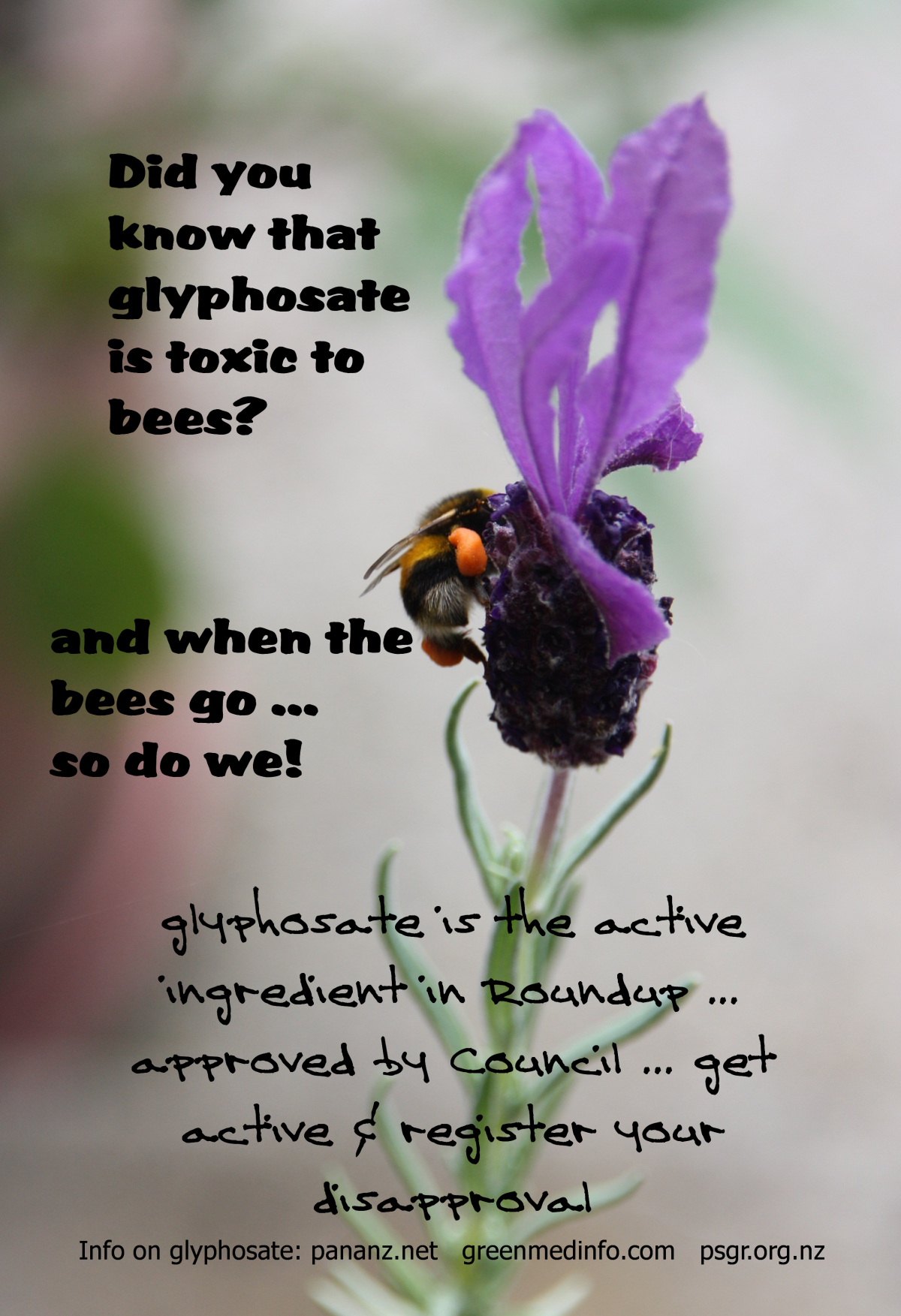
Bee Poster

Currently in the Rangitikei, as in many other places, Roundup is the herbicide of choice for cleaning up weeds. Recently however, the World Health Organization (WHO) has taken recognition of the decades of independent research that warns of its health risk. WHO is warning people of the fact that it probably causes cancer. Check out the Glyphosate page on this site for further information on that.

pesticides_roundup_herbicide_735_250
Roundup, the herbicide of choice that contains glyphosate and is toxic to our bees

Personally I approached the Rangitikei District Council (RDC) twelve months ago to warn them of these dangers and make known to them the vast amount of research that exists linking it with not only cancer but many other illnesses including birth defects. Now, add to this another damning factor … its toxicity to bees. Bees are essential for pollinating our plants. As the poster above conveys,experts confirm that if the bees die off, we humans could well follow. Our toxic environments are destroying the very organisms that ensure the continuation of life on planet earth.

That said, the RDC is not convinced by either the extensive research or any announcements by WHO. Currently in fact, going by the last time I heard them discuss this (March 2015) they are of the opinion that I am the only person in the Rangitikei who is concerned about this. We now have a petition that indicates there are in fact another 97 who are. Good news. If you are connected with the Rangitikei, spend any time visiting, live here or intend to, please consider signing the petition.

Watch for further updates and information on the role of bees in our food chain.

~ Envirowatchrangitikei ~

The Real Reason Wheat is Toxic (it’s not the gluten)

Here is an article that traces many allergic issues back to glyphosate that is sprayed on wheat crops before harvest. A regular practice apparently that kills the plant and allows an earlier harvest. Great idea if you don’t mind ingesting a herbicide that’s been linked with many diseases including birth defects and cancer.

According to the US Department of Agriculture, as of 2012, 99% of durum wheat, 97% of spring wheat, and 61% of winter wheat has been treated with herbicides. This is an increase from 88% for durum wheat, 91% for spring wheat and 47% for winter wheat since 1998.

Read the full article  from the healthyhomeeconomist website HERE