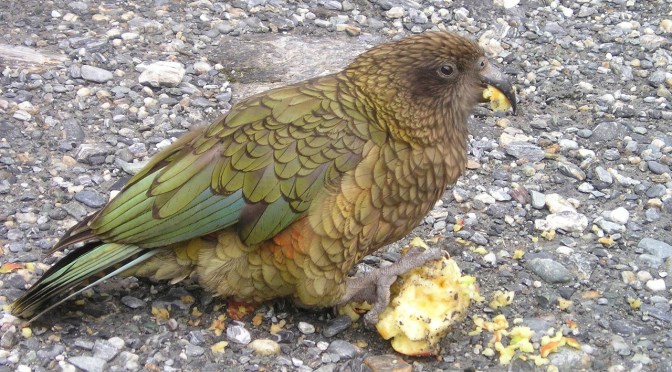
NZ’s Dept of Conservation would have us believe 1080 targets pests only. One aerial drop in Otago in the South Island in 2002 revealed an officially estimated 10,000 native bird deaths! Search Kea in the search box (right of page) for further info on Kea deaths due to aerial 1080 poisoning … EWNZ
Dr Jo Pollard, BSc (Hons), PhD
Posted by Carol Sawyer
(Published in the Greymouth Star, 10 March, 2020)
In 1979 scientist Eric Spurr warned that wide scale poisoning of New Zealand with compound 1080, intended to kill introduced mammals, was actually killing kea and many other animals. It took decades before NZ’s Department of Conservation (DoC) finally began to monitor kea deaths from 1080 poisoning.
Now, using DoC’s own data, we can estimate that each poisoning operation will kill an average 12% of kea.
During the most horrific example DoC managed to kill 78% of the tracked kea population (7 of 9 kea monitored at North Okarito). Last month, in the Matukituki Valley, 50% of DoC’s monitored kea died after a 1080 drop.
Disturbingly, two myths have again been rolled out in an attempt to soothe public anger over the destruction of these now rare, iconic birds.
Myth 1. Kea are only likely to eat baits if people have conditioned them through providing food previously. DoC’s own research shows that this is not true. 9% of monitored kea (2/22) died at Kahurangi, a site chosen by DoC precisely because of its remoteness.
The fallacy of this claim is clear to anyone with experience of kea. They are curious to examine and pull anything new apart – as motorists will often attest after even the briefest of encounters with these inquisitive creatures. Scientists consider that this trait is likely an adaptation to living in a harsh environment, where food can be very hard to find, especially in winter (when 50% or more of kea juveniles are likely to die of starvation). Before the advent of DoC, helicopters and a toxin designed to kill everything from microbes to mammals, a willingness to try a new food source undoubtedly played a key role in the birds’ survival.
Myth 2. Kea nests need protection from stoats and 1080 poison provides that protection. Two studies have shown that the presence of stoats does not bother kea (in 1969, then again in 1999). Even if stoats were a problem for kea, 1080 would not fix the situation, quite the reverse. Scientists found that stoats became more likely to eat birds after 1080 drops. Why? Because rats, a primary source of food for the stoats, have been almost wiped out.
Mice do not usually eat 1080 baits so, in the absence of hungry rats, their numbers boom in the aftermath of a 1080 drop – a fact easily established by a review of the literature. Rat numbers, usually low immediately after 1080 operations, rebound strongly within months – often peaking at figures far higher than were present pre-drop. The population booms of mice and rats that are caused by 1080 drops are never highlighted by DoC, although they are easily seen in many studies. Those booms are likely to fuel stoat plagues as a new generation of mustelids arrives to find a larder overflowing with rodents.
Journalist Dave Hansford last year made the dubious claim that because of the “benefit” of 1080 to kea breeding, up to 22% of kea could die before there would be a net loss (Spinoff, August 2019). A 50% death rate would surely be tragic then, even to a journalist with an extreme pro-1080 bias!
Nature lovers should be very concerned because the monitoring of kea throughout 1080 drops is unique. No other native species: microbe, plant, insect or bird has been given even a tiny fraction of the attention or resources that have been used to monitor kea. 1080 is broad spectrum, highly toxic, spreads rapidly, travels up food chains, binds to cellulose and has extreme, unexpected effects. What is happening to everything else that lives in our forests, wetlands, grasslands and mountain tarns?
1080 poison may have a dual function for DoC. Not only does it attract an enormous amount of government funding, its use may help divert concern away from other ways in which vital habitat is being lost through poor management and financial interests. Examples are DoC’s approving high quotas for tourist helicopter flights (80 per day were planned for the remote Darran mountains) and the continued mining of conservation land (despite government promises to curb it).
The public needs to wake up to the fact there is no “science” behind DoC’s aerial poisoning. Mast-driven rodent plagues, often used to justify aerial poisoning, have been around since the time of the kiore. They are part of a general, short term increase in productivity including bird breeding. Effects are not something DoC needs to try to control with aerial poison, it should follow the evidence and stop blindly interfering in a process that it is simply not equipped to control.
Healthy populations of native birds, such as mohua and kakariki, lived in many places around the South Island until DoC started “helping” them by interfering with nests and trapping out the main rat predator (stoats). Rat numbers escalated, bird numbers plummeted, then broad spectrum 1080 poison was applied.
DoC’s science-less management shows a complete lack of respect for NZ’s ecological heritage and the legal mandate it holds to conserve it. Kea, much loved and admired, seem destined for the same fate as other species that have suffered from DoC’s “helping hand”. DoC needs to leave them and everything else alone, now.
Ex Horowhenua Mayor Michael Feyen speaks about the alternatives proposed by the Advance NZ party that will create job opportunities for the people. (Currently the associated dollars funnel into the 1080 poison state owned gravy train). Michael has always been supportive of alternatives to 1080, during his time as both councilor and mayor with the Horowhenua District Council. Unfortunately it was not a vision shared by enough of his colleagues to have gained any traction. Time for change. EWR
WET JACKET PENINSULAS, FIORDLAND, AERIAL 1080 POISON DROP STARTS – WEEP FOR THE KEA!
By Carol Sawyer
“So, here they are again and this time DoC have done a wee conjuring trick and say it is for stoats (there being no rats). Stoats don’t eat 1080 baits.”
“We have an estimated 1,000 Kea left in the wild in New Zealand….. in the whole world in fact, as they are endemic – i.e.they exist only here! The latest 1080 poison drop in the Matukituki Valley, Mt Aspiring National Park, February 2020, killed 50% of the Kea. More than that will die in the Wet Jacket Peninsulas drop because it is midwinter and the Kea are very hungry.”
Do you know what happens to 1080-poisoned Kea? They stagger around taking hours and hours to die. They bury their heads in the snow to try and get relief from the pain. Dr.Jo Pollard says “The keas’ deaths will be horrific, with extreme muscular spasms going on for many hours.” David Attenborough called them the most intelligent bird in the world. They are the world’s only alpine parrot.
Three BK-117 helicopters – ZK-IME (a.k.a Big Red the Rescue Helicopter), ZK-HJK,(white), and ZK-HEM, (red and white), and a Longranger, all belonging to HeliOtago Ltd, left Dunedin at 6.30 pm this evening heading west to be in place for starting their evil work tomorrow morning. Seven choppers arrived at Monowai tonight… yet to find out if they are all HeliOtago Ltd or if three are from another company. I have been told HeliOtago Ltd flew the prefeed baits from a private farm property at Monowai, last weekend.
This area has never before been poisoned. The drop was planned for last October but there were NO rats so it was postponed and, I am told, the poison that had been brought south for the drop was instead used in the Kepler Mountains drop last March, which was squeezed in just before lockdown…. I’m informed they added on the Princess Mountains to use all the extra poison up. No monitoring done there apparently.
So, here they are again and this time DoC have done a wee conjuring trick and say it is for stoats (there being no rats). Stoats don’t eat 1080 baits.
I can tell you what it WILL kill in large numbers… Kea. As the area has never before been poisoned there are many Kea reported to be in the area. (A while back a pilot sent me a photo of seven Kea that landed beside him when he touched down there.)
We have an estimated 1,000 Kea left in the wild in New Zealand….. in the whole world in fact, as they are endemic – i.e.they exist only here! The latest 1080 poison drop in the Matukituki Valley, Mt Aspiring National Park, February 2020, killed 50% of the Kea. More than that will die in the Wet Jacket Peninsulas drop because it is midwinter and the Kea are very hungry.
The Empire of the Dept of Conservation, greedy helicopter companies, and all their parasitic acolytes WILL fall… but it will be too late for the Kea.
Any of you gutless DoC employees reading this who put your personal livelihoods before your knowledge of this travesty and the horror it entails, and keep your mouths shut pleading “I can’t afford to lose my job”… hang your heads in shame why don’t you! You know who you are!
Ditto the local media who know about this drop and are too scared to touch it and tell the truth. You know who you are too.
A Massey University post mortem has found six kea in the Matukituki Valley of the Aspiring National Park ”are likely” to have died from 1080 toxin.
The birds were among the 12 kea monitored by the Kea Conservation Trust after the Department of Conservation’s aerial 1080 predator control operation on February 11.
DOC threats director Amber Bill said in a statement today it was ”regretful” to lose any kea to 1080.
”But overall, aerial predator control is proven to benefit kea populations.
”It’s upsetting and disappointing to lose six kea but we are confident with effective control of rats and stoats we will significantly boost nesting success and the number of young birds entering the population.
”We are concerned the tracked kea may have learnt to eat human food around the tramping huts, making them more likely to try 1080 cereal bait.
”DOC’s extensive research of kea through aerial 1080 operations show the risk of 1080 to kea in remote areas is very low but increases markedly with birds that have learnt to scrounge for human food.”
Ms Bill said the Matukituki operation followed DOC’s best practice to mitigate risks to kea from 1080 and ensure they benefited from stoat control after last year’s extreme forest mast or seeding.
”We are constantly working to improve our risk mitigation standards for kea, which are informed by our ongoing research programme.
”In light of this incident, we will be investing more to explore potential additional measures that DOC can take to reduce the risk to kea in future 1080 predator control operations.”
Ms Bill said DOC was considering a campaign to discourage people from feeding kea and prevent kea from learning to scrounge.
“Kea are super smart and present unique conservation challenges.
”We need to continue to learn and assess all options to protect this national taonga from predators and other threats.”
Recent rodent monitoring results from the Matukituki showed rats had been reduced from damaging levels – present in 47% of tracking tunnels – to being undetectable – 0% of tracking tunnels -, following the 1080 operation.
Stoat monitoring was underway.
The Matukituki programme was designed to protect rock wren, kea and whio, as well as kākāriki, kākā, and South Island robin following a beech mast-fueled rat and stoat plague.
Ms Bill said DOC was monitoring whio and rock wren to track how these species were doing.
The dead birds were three adult males, one adult female, one juvenile male and one juvenile female.
This is what I have to say about the mega-mast year, and the need to drop more 1080, as profiled in the media recently…
“The Department of Conservation (DOC) is planning its largest predator control programme in response to a ‘mega mast’ event – exceptionally heavy seeding – in New Zealand forests. The $38 million programme will cover about 1 million hectares of conservation land across the country…” (Stuff)
All the following quotes have come from DoC or Landcare Research scientists. If there’s a problem with rats, DoC, OSPRI, regional councils and pest control contractors have no one to blame but themselves for using a pest control method that creates imbalance in the ecosystem and which gives an advantage to the meso-predator that breeds fastest.
The nasty part is that brodifacoum, a poison graded 8/10 for its ability to cause animal suffering, needed to be introduced first to kill pests inside the fence. It also killed native birds including weka and pukeko.
Do the ends justify the means? A human equivalent would be if a ruling party decided to clear out a country, exterminating all unwanted people and restocking with different people who are representatives of a “chosen race”. Wait a minute, hasn’t that been done before?
Andrea Midgen, chief executive of the SPCA, recently spoke out about the associated animal cruelty saying, “1080 (and other poisons) causes intense, prolonged suffering to animals and therefore we cannot support its use”.
The Department of Conservation says it needs to use 1080 poison to kill rats and stop rat plagues. Rats have been present in New Zealand forests for over 700 years. This clip looks at various areas where 1080 poison has never been used, and one example of where it has. This is an observation only, but does raise some questions about areas where 1080 is used …
The new move by Predator Free 2050 to eradicate cats. A new insidiously inhumane killer poison on a par with 1080 in terms of cruelty is already being trialed in the Hawke’s Bay.
Thanks to The Truth About 1080 Poison Facebook page for the link to this article from Bob Kerridge. Bob has had a long and distinguished professional career in animal welfare, during which time he has been responsible for many creative and innovative initiatives that have enhanced the status and welfare of animals in the New Zealand community. You can read more about him at the end of the article.
As requested by Bob I’m adding an image he supplied.
COMPANION ANIMALS IN AOTEAROA OPINION – Bob Kerridge, Animal Welfarist.
The average peace-loving New Zealander may not be aware of it but, apparently, we are at war. If you find this difficult to comprehend, and a little frightening, for verification you need go no further than listen to the war-like rhetoric emanating from the people at Predator Free-2050.
This new, but generously funded, movement has a clear mission: To be rid of all predators, (whatever or whoever they may be), by the year 2050, with its website calling us to arms urging us to ‘unite to fight’. The dialogue from command headquarters tells us that the ‘threat of invasion is here’ but that “we have an army of tens of thousands of New Zealanders’ to undertake ‘a military campaign to push the invaders back, just as we did in the last two world wars’.
This disturbing talk exemplifies a dangerous path down which we are being led which could result in an ecological disaster because of this new-found obsession to become predator free. In a recently published paper two eminent ecologists, Professor Wayne Linklater and Dr Jamie Steer, are critical of the methodology being employed: ‘While Predator Free-2050 is well intentioned’, they concluded, ‘New Zealand’s future conservation policies need to be less bombastic, and better informed by the environmental, ecological and social sciences’. In a separate interview Linklater went further when he stated that New Zealanders would regard being ‘cruelty free’ a far greater goal than ‘predator free’, an aspiration with which I totally concur.
Not surprisingly the troops being deployed to free us of all these predators is the Department of Conservation, (DoC), who of course are willing and able to do the job. In my naivety I used to believe that conservation meant preserving our special and unique biodiversity, until I heard the previous Minister, Maggie Barry, proudly proclaiming for all to hear that ‘my guys at Doc are incredibly good at killing things’. Given there are many dedicated individuals employed by DoC who labour long and hard to preserve the lives of many of our endangered species, and more power to them, this was a foolish and heartless statement to make. It is little wonder that a number of previously employed high-ranking scientists are describing the current atmosphere at DoC as ‘toxic’ with a ‘culture of war and a lot of discontent’.
Dr Arian Wallach of the University of Technology, Sydney, and Fellow of the Charles Darwin University, described the essence of conservation succinctly when she stated: ‘The aim of conservation is not to generate an ever increasing (dead) body count, but to guide human behaviours to enable the rest of the earth’s species to flourish’.
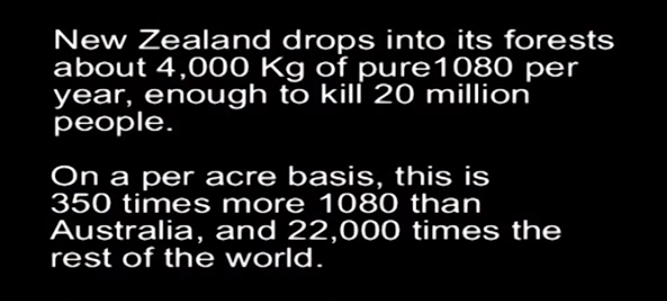
The major weapon in DoC’s vast armoury, and akin to the H-bomb, is sodium fluoroacetate, (1080), a cheap and particularly nasty pesticide which is as indiscriminate in whom it targets as it is efficient in killing them. Registered as the most toxic pesticide by the World Health Organisation it was the only chemical weapon reportedly found in Saddam Hussein’s arsenal. 1080 is outlawed in a large number of countries, but to our absolute shame New Zealand has been using it since it was first trialled here in 1954. Despite growing public abhorrence, we are now purchasing 80% of the total supply, making us by far the largest user in the world.
The evils of 1080 are well documented including its permanent effect on our flora and fauna, destroying micro-organisms and insects, (the diet of many birds), the contamination of our waterways, human health risks, the slow and agonising death of untargeted animals, (both large and small), and also, ironically, many of the native birds it’s meant to be protecting. And yet, despite this history I am told that last year 350 million poison baits were dropped on our little country, thus perpetuating what can only be described as a national disgrace.
So just who are these invaders that, as Predator Free-2050 advocates, need this military effort to defeat ‘because it is a very insidious war they have waged’ against us’? The irony is that these so-called invading species have no ability or desire to declare war, or any concept of what is being plotted against them, or why, neither have they the ability to protect themselves or fight back. In fact it’s a bit of a one-sided war, rather more a premeditated annihilation I would suggest.
In reality the selection of predators that need to be killed is at the behest of the greatest predator of them all, humans, either because we just don’t like them, or they are introduced species and not native to our shores, or we have the mistaken belief that if we exterminate them our ecology will be rescued from certain peril. In general the reasons are unscientific and immoral, as are the weapons used against them.
Unbelievably the latest animal to be selected as a targeted predator will astound and horrify most people, but will delight rats, and Gareth Morgan. In an incredulous move the current Minister of Conservation, Eugene Sage, wants to see Kiwi wandering the urban gardens of Wellington, which would not exactly be their choice of where they would wish to reside given the human dangers associated with urban living and their lack of natural bush protection to which they are accustomed. The Minister noted that to achieve this urban dream cats would have to go, parroting the demands of the insidious ‘cats to go’ campaign, requiring ‘having cats inside, and when your cat dies then not replacing it’. So it’s cats or kiwis.
Local and Regional Councils throughout New Zealand, who have never before shown any interest in cats, are now wanting to illegally label them as ‘pest cats’ so they can be destroyed without question, again acceding to Morgan’s dictate that ‘any cat that is free to range should be a dead cat’.
That constitutes another declaration of war, and of course weapons of mass destruction exist, especially for cats. This one comes in the form of the unpronounceable para-aminopropiophenone, or PAPP as it is generally known, currently and unashamedly being trialled by the Hawke’s Bay Regional Council. PAPP is as hideous as 1080 coming in the form of a paste which, once ingested, starts a process of dying which is inhumane and painfully slow, with death averaging an horrendous 3 hours and 51 seconds to occur. During the process signs of toxicosis occur, (head nodding, lethargy, uncontrolled movement and lack of balance), eventually advancing to unresponsiveness and collapse but fully conscious and aware, with final unconsciousness occurring only moments before death.
The persecution of cats, the country’s most popular and adored companion animal, is as unfathomable as it is without foundation. Ecologist Gary J Patonec, (USA), commented: ‘What I find inconsistent in an otherwise scientific debate about biodiversity is how the indictment of cats has been pursued in spite of the evidence’.
I have to question, just what is the motivation that drives people to hate so vehemently that they are quite content in subjecting cats and other sentient beings to such extremes of torture before killing them? But remember we are, apparently, at war and the conservation soldiers are doing it to make the world a better place being totally oblivious to the probable ecological consequences of their extermination practices. The slaughter of one species on the pretext of saving another for the greater good in the name of conservation is reprehensible.
Predator Free-2050 claims to have an ‘army of tens of thousands of New Zealanders’, many of them recruited from children whose schools have received money and complimentary traps if they accede to the terms and conditions of war. Others are equally innocent urban families where the aim is to have ‘a trap in every fifth backyard across New Zealand’ which is creating a generation who, and I am quoting ‘find killing animals weirdly addictive’.
Such a trend is deeply disturbing and I wonder where, in contrast, is the public outrage? Because these trends are often introduced under stealth perhaps people are not aware of where this war is leading us, what weapons of mass destruction are being used, or what the consequences will be. And where are the mechanisms in place that will protect animals from such abuse, or are there none? Are we just going to sit back and watch New Zealanders fall into moral decay?
French ornithologist Jean Dorst conveys some sobering and relevant words of wisdom: ‘Whatever the metaphysical position is adopted and whatever place is given to the human species, man has no right to destroy a species of plant of animal on the pretext that it is useless. We have no right to exterminate what we have not created’.
I have no hesitation in adding my heartfelt support to that sentiment, as my dream for our country has always been that we respect and love all life, and that humans, animals and the environment can coexist in harmony, in addition to a belief that we can, if it is our will, realise that dream. Keep believing.
Bob Kerridge can be contacted on:
Email: bob.kerridge@gmail.com
He resides in Havelock North, Hawke’s Bay
Bob Kerridge has had a long and distinguished professional career in animal welfare, during which time he has been responsible for many creative and innovative initiatives that have enhanced the status and welfare of animals in the New Zealand community.
During his tenure of 32 years with the Society for the Prevention of Cruelty to Animals, (SPCA), Bob Kerridge assumed many roles including Chief Executive, Executive Director and member of the Board. He was a National Councillor with the Royal NZ SPCA, eventually becoming its National President, and was also a Director of the World Society for the Protection of Animals, (WSPA). He was made a Member of the New Zealand Order of Merit in 2004 and promoted to Officer of the Order for services to animal welfare and governance in the Queen’s Birthday honours in 2018.
He has recently established a Fellowship to seek positive and harmonious solutions for animals, humans and the environment.
“Aerial application of 1080 poison is banned in the U.S. due to the extreme hazard to human health and to the environment.”
U.S. Environmental Protection Agency.
From safe.org.nz
“There’s controversy In Paradise. New Zealand is proud of its clean, green and pure image. However the use of 1080 poisoning as the main weapon in the war against animals regarded as ‘pests’ is controversial.
A cruel and indiscriminate poison, 1080 is used to kill unwanted animals which include possums, feral cats, rabbits, rats and stoats. Its use in New Zealand has been a contentious issue since it was first employed as a pesticide in 1954. Research has shown that the use of this poison is extremely cruel, and dangerous to non-target animals.”
Find out more about the extensive use of 1080 in New Zealand, including:
Following the recent shocking news about 1080 drops into the streams that flow into Lake Taupo, this info from an OIA request is very interesting. Now would you not, with that many precious and rare native birds, be testing as to HOW they died? You surely would not just presume, pests? And would you not actually TEST for poison, any poison?
Not long ago we posted an article on DOC’s failure to show one endangered species in recovery, in spite of $3.5 BILLION being spent! That’s a large sum of money to just shrug your shoulders at. There needs to be some accountability. People are asking questions and rightly so.
These Kiwis were only the tagged ones too, so the numbers may well be just the tip of the iceberg!
An important note to the few who think this article is emotive and inflammatory … PLEASE READ THE ENTIRE ARTICLE AT THE LINK PROVIDED at the end. There are further details about the OIA request, analyses of the results and responses by DOC.
Clearly folk have not read it in its entirety. And the point of my introductory remarks is that the dead birds were not tested by DOC for cause of death. Surely a logical thing to do, not just expect the public to assume/believe it wasn’t 1080?
EWR
“Surprisingly, given so much poison has been dropped across the forest, not a single kiwi from the 89 deaths has been tested for 1080 poison residues.”
This is an offical press release from the Graf Bothers
“It has been revealed through an OIA request that tagged kiwi have been dying in large numbers in one of our most heavily 1080 treated forests.
Aerial 1080 drops first began in the Tongariro Forest in 1976 and have been followed with subsequent drops in parts of the forest in 1988, 1989, 1991, and over much of the forest in 1995, 1996, 1997, 2001, and 2006. Another drop was carried out last week covering around 15,000 hectares.
It would be reasonable to assume, after so much 1080 poison has been spread across the forest, there could be no sign of a ferret or stoat for miles – surely?
Not so. In the last 5 years, revealed through the DoC OIA request, 89 tagged kiwi, of all ages, have died in the Tongariro forest. Keeping in mind that the tagged kiwi only represent a fraction of the wild population, the actual numbers, from a population perspective, may be enormous.
More concerning is what’s killing the birds. The assumed cause of death, in most cases … is predation by ferret. We are told by DoC kiwi can defend themselves from mustelid attacks, once they reach 1.5kg in weight. Yet, many of these birds are adults.
When discussing the use of 1080, the DoC use sentences like “overwhelmingly successful”, “very effective”, “rapid knockdown” to justify their poisoning campaigns.
“It’s the best tool we have for managing pests, and keeping predators at bay.” At least that’s what we’re lead to believe by The Department of Conservation, the PCE, and Forest and Bird.
But what’s really killing the birds? Surely not predators, going by what we’re told about the effectiveness of 1080 at eliminating them. If it is predators, it would also be reasonable to say that the use of 1080 poison clearly isn’t working. Surprisingly, given so much poison has been dropped across the forest, not a single kiwi from the 89 deaths has been tested for 1080 poison residues.
DoC say that the time-frames for the poison drops don’t line up with the likelihood that 1080 could be a cause of death. Given the amount of poison dropped in the forest over the last 35 years, all endemic species found dead within the poisoned boundaries should be tested for poison residues, simply to eliminate toxins as a cause of death. Surely?
More concerning is the fact that in the last 15 years, with tens of millions of hectares of habitat being poisoned, only 5 kiwi across all of New Zealand have been tested for 1080 poison residues. It should be noted that kiwi are known to eat 1080 cereal bait, and 1080 residues have been detected in kiwi droppings.
On top of the 7 poisoned kea three weeks ago, the 3 poisoned kaka earlier in the year, the loss of 11 kiwi at Mt Bruce, 21 ruru in the Waitutu, the poisoned fernbirds, robins, tomtits and others, it is becoming more clear that the experiments with 1080 poison across our forests, aren’t working.
After 35 years of poisoning campaigns, and desperately trying, there still isn’t a single, credible scientific research paper that demonstrates a net population benefit to any native species through the use of aerially applied 1080 poison. Not one! And yet the drops continue.
Responsible, ground control methods do work. 50,000 hectares of the northern Te Urewera National Park is managed by DoC, trappers and volunteers. No aerial 1080 poison is used. We need to encourage, and replicate these methods, and eliminate the future use of aerially applied poisons.
The Election is less than two months away. If you’d like to see an end to 1080 poison, and more responsible, sensible methods of pest control implemented, please consider giving your party vote to UnitedFuture – the only party in government to make the banning of 1080, policy.
on the 5th October DoC replied with a rebuttal to the claims of clyde graf
1080 kiwi claims extremely misleading
Wednesday, 5 October 2011, 12:46 pm
Press Release: Department of Conservation
1080 kiwi claims extremely misleading
The Department of Conservation is concerned factual information about kiwi deaths in the Tongariro Forest has been inaccurately portrayed by anti-1080 campaigners.
A media statement released yesterday by anti-1080 campaigner Clyde Graf linked biodegradable 1080 with the death of 89 kiwi in the Tongariro Forest Kiwi Sanctuary over the past five years.
The release, titled “89 Dead Kiwi – 1080 clearly not working” selectively quoted information provided by DOC and claimed that 1080 drops in the forest had failed to protect kiwi.
It also suggested the biodegradable toxin itself could be responsible for the kiwi deaths.
However DOC says the release fails to point out that 1080 – which breaks down naturally in soil within weeks – was last used in the forest sanctuary almost four months before the first recorded kiwi death.
“We know that kiwi are at very low risk from 1080. DOC has monitored more than 280 kiwi both through and after aerial 1080 operations – some for well over a year – and we have never lost a single bird to 1080.” said Dr. Avi Holzapfel, DOC’s Kiwi Recovery Group leader.
“Claiming that the data shows that 1080 does not control predators is equally misleading. Only about half the deaths could be linked to predation, and the majority of these were chicks killed by stoats in years when 1080 was not used”
“Mr Graf fails to point out that chick survival in this forest more than doubled in each of the two years after the last 1080 operation in 2006 when stoat numbers were very low, compared to years without 1080.”
“Rather than claiming that ongoing predation shows that our pest control is not working, Mr Graf should have put more focus on the fact that predator control at Tongariro has resulted in many more kiwi surviving than would have otherwise. Claiming that 1080 has failed because some kiwi are still being killed by predators is like saying that an emergency department in a hospital is failing because it can not save everyone.
Dr. Holzapfel acknowledges the impact ferrets have on adult birds, with more than 10 adult kiwi having been killed by these predators. “We are learning that ferrets in particular are a significant threat to adult kiwi, and we are adjusting our management to protect birds against this emerging threat. It demonstrates the many pressures kiwi are facing in the wild. But it is extremely misleading to suggest 1080 has somehow played a role in these deaths, ”
Mr Holzapfel said full details of all the information provided to Mr Graf on deaths in the kiwi sanctuary is available on DOC’s website: http://www.doc.govt.nz/1080kiwi
Further information about biodegradable 1080 and its use can also be found on DOC’s website or by visiting www.1080thefacts.co.nz
followed by more facts ……that show DoC really dont know and are misleading the public by continuing the she’ll be right approach
DoC 1080 Kiwi Analysis Misleading
Thursday, 6 October 2011, 2:01 pm
Press Release: The Graf Boys
Clyde Graf – The Graf Boys
Candidate for Coromandel – for UnitedFuture
DoC 1080 Kiwi Analysis Misleading
RE – In response to DoC’s “1080 kiwi claims extremely misleading”.
Firstly, I’d like to thank The Department of Conservation for the opportunity to raise further issues relating to the poor life expectancy for kiwi in the heavily 1080 poisoned Tongariro Forest.
DoC claim in their response…”we have never lost a single bird (kiwi) to 1080″. That’s an astounding statement! If DoC had have tested every kiwi that died within the poisoned area, they could make that claim. The fact is, from the information supplied, they haven’t tested a single bird for 1080 poison residues from within the Tongariro Forest. Therefore, the claim is redundant.
Given the absence of randomisation, replication, and controls in much of DoC research, it is difficult to come to any sound conclusion when referring to what the likely outcome would be if 1080 were not used. But taking into account the persistence of the department in defending it’s use of 1080, the data would likely be biased – hence the need for blinding.
In their response, DoC also claim … “Mr Graf fails to point out that chick survival in this forest more than doubled in each of the two years after the last 1080 operation in 2006 when stoat numbers were very low, compared with years without 1080”.
Once again, an astounding statement. Chick survival in the Tongariro Forest doesn’t look good, going by the information supplied by the DoC.
The following Information is contained in the DoC OIA …
Between September 2007 and March 2011 (about 4.5 years) 88 kiwi chicks were fitted with radio transmitters. Of these, only 5 are known to be alive – and of these, 3 were tagged within the last year.
So, only 2 kiwi chicks, from 85 (88, less the 3 fitted in the last 11 months) fitted with radio tags for a period of between 1 year and 4.5 years, are known to be still alive. That’s just over 2%.
If the 3 chicks that have been fitted in the last year are included, the percentage of known survivors from the original 88 is just over 5%. But this doesn’t mean these 5 birds are going to make it to adulthood. Chances are, they won’t.
Many birds are killed in the sub-adult age group. Of the 38 birds tagged between April 2006 and May 2010, 8 are known to be alive.
From July 2010, to July 2011, 25 sub-adult birds have been tagged. There has been a 1080 free period in the forest, since 2006 (up until a couple of weeks ago). Of these more recent 25 tagged birds, 22 were still alive as of the 31st of July 2011.
Of the 67 adult birds radio tagged, 24 are stated as being alive, as of July 2011.
19 are assumed to have been predated on, and 7 classed as “unknown” and “misadventure”. (Why were these birds not tested, to eliminate poison as a cause of death?). The remainder dropped their tracking equipment.
Kiwi can live for over 60 years. If so few kiwi chicks make it to adulthood in the Tongariro, and the tiny percentage that do are likely to be predated on, kiwi look like being extinct in the Tongariro forest within a generation.
It would seem the data is being selectively analysed by the DoC, and the public are being mis-informed. DoC are focusing on claiming they get a certain percentage of fledgling survival from many species of native birds, including kiwi. Fledgling success has nothing to do with population success. What good is it if a chick lives for a few months and dies, or is killed before reproducing?
If the data was analysed correctly, and looked at life-span, and not “fledgling success”, it would be determined that the use of 1080 for pest control, isn’t working. Not only is 1080 poisoning the entire ecosystem, it’s endangering the welfare of our native wildlife.
The information being fed to the public is that 1080 is helping kiwi survive, when in fact, there’s absolutely no evidence of that. New methodology is needed urgently – not more poison.
Conversely, we are informed that 5% of kiwi in untreated areas make it to adulthood. With targeted pest control, using trapping and non-persistent poisons, (not 1080) that figure could be raised substantially – if the use of 1080 was abandoned. Victor McClean, a kiwi recovery contractor on the Coromandel Peninsula, claims to get over 50% chick survival – without 1080 poison.
As a representative for UnitedFuture, I can say that I will be working hard to ensure that the UnitedFuture policy of banning 1080, is realised – and more responsible, sustainable pest control methods are employed.
Some facts on 1080 poison –
1080 is not only a primary (kills victim after ingesting the bait) killer, but also causes secondary poisoning. For example, if a kea eats a poisonous bait, as was the case 3 weeks ago, it will die. If a kea, the only carrion (dead flesh) eating parrot in the world, were to eat a 1080 poisoned possum carcass, it may also die from secondary poisoning.
Poisoned carcasses can kill for months, even years after primary poisoning occurs.
1080 is persistent, especially in winter. Baits can last for months in dry and cold areas – and in regard to how 1080 breaks down in soil – research is still being undertaken.
1080 is a broad spectrum insecticide, and many of our native birds are killed by eating poisoned insects. Kiwi are omnivores – meaning they eat insects, and other types of foods. The Tongariro food supply of many native species has been repeatedly poisoned over the last 35 years. It’s hardly any wonder kiwi aren’t doing well. We could safely assume many other native species are in the same boat.
We are yet to see the full impact that the poisoning of New Zealand forests is going to have.





You must be logged in to post a comment.