

EWNZ comment: I noticed quite a few years back that some Doctors don’t like you questioning their wisdom. Departing from their narrative can make them blunt and very unhelpful. They are the experts and you are not. I have also noticed they are inclined to give orders rather than discuss. We saw that with the arm dart in recent years and many prefer now to not trust them at all …. to see how the less compliant Doctors fared for the past 5-6 years check out the nzdsos.com doctors. Some were struck off for failing to follow the narrative.
A few days ago, I posted a short tweet that unexpectedly exploded online on multiple platforms.
It wasn’t complicated. It wasn’t a long thread.
Just a simple observation I’ve made over many years of practicing medicine and working closely with thousands of people striving for better health.
Here’s what I wrote:
“The healthiest people I know are very skeptical of what doctors tell them.
There’s a lesson in that somewhere.”
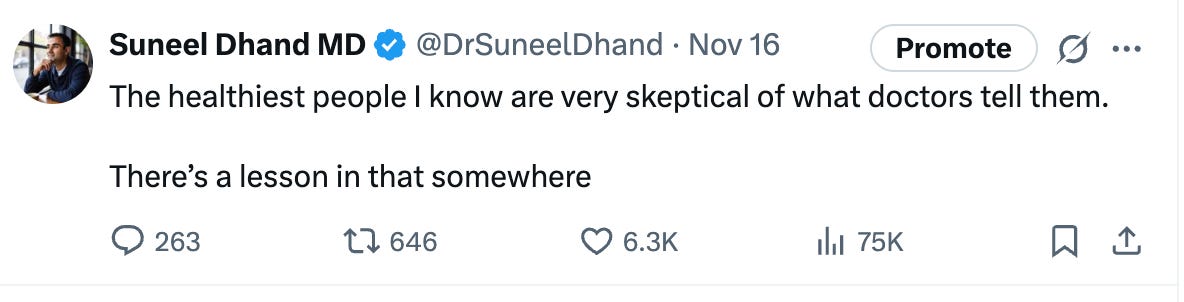
The reaction to it was enormous— and not just on twitter.
But this newsletter isn’t about social media.
It’s about why such a simple thought struck a chord with so many.
Today I want to unpack this idea, dive deeper into the psychology behind it, and explore what it means for your own health moving forward.
Dr. Suneel Dhand Newsletter is a reader-supported publication. To receive new posts and support my work, consider becoming a free or paid subscriber.Subscribe
This message isn’t just anti-doctor. It’s not rebellious for the sake of rebellion.
It’s something much more important:
It’s about taking ownership of your health in a world where far too many people have handed that responsibility away.
Why This Short Thought Resonated So Strongly
The tweet took off because people instinctively knew it to be true.
Over and over, I hear similar comments patients, random people, and online messages:
“I wish I had questioned things earlier.”
“I finally learned to advocate for myself.”
“I got healthier when I stopped relying on pills alone.”
At some point, people realize:
- The healthcare system is overwhelmed.
- Most medical visits are rushed.
- Doctors are too often just mindlessly follow guidelines, time limits, and insurance.
- And medications, while sometimes necessary, are too often the default answer.
What truly resonated was this silent truth:
You can absolutely respect your doctor and still rigorously question the system.
And you should.
The healthiest people already do.
Healthy Skepticism Is a Strength, Not a Rebellion
When I say “skeptical,” I don’t mean dismissive or argumentative for the sake of it.
I mean curious.
Proactive.
Awake to the ways of the world.
The healthiest individuals tend to:
- Ask thoughtful questions
- Research conditions themselves instead of accepting labels
- Seek second opinions
- Learn about nutrition and lifestyle
- Understand their lab results
- Notice patterns in their own bodies
- Push back when something doesn’t make sense
This attitude leads to better outcomes because it prevents passivity.
Healthy people are active participants in their health— not passive recipients of advice.
They don’t outsource responsibility.
They partner with their physicians, but they remain in the driver’s seat.
This mindset creates a completely different life trajectory.
A Broken System Has Taught People to Think Differently
People have watched “standard medical advice” change countless times.
Decades of shifting guidance on:
- cholesterol
- saturated fat
- salt
- medication-first approaches
- low-fat diets
- food pyramids
- vaccine safety and side effects
- exercise recommendations
- blood pressure
…have made people realize that science “evolves”, systems change, guidelines get updated— and often those guidelines were influenced by things that had nothing to do with health.
It’s not that all doctors don’t care.
It’s that the system doesn’t encourage deeper exploration, root-cause thinking, or preventative action.
And so the people who thrive are the ones who say:
“Let me look into this myself.”
They don’t settle for:
“This is just how it is when you get older.”
or
“You’ll be on this medication for life.”
They want to know why.
They want to know if there’s another way.
And more often than not…there is.
The Common Traits of People Who Stay Vibrant and Strong
Over years of working with all types of individuals, I’ve noticed clear patterns among those who maintain their health and vitality.
They ask questions.
They don’t fear sounding “difficult.” They fear being uninformed.
They focus on fundamentals, not fads.
Real food. Movement. Sleep. Stress reduction. Strength training.
They don’t wait until something is wrong.
They proactively monitor their health — labs, weight, waist circumference, blood sugar, inflammation markers.
They’re willing to change.
They don’t cling to old habits simply because they’re familiar.
They stay curious.
Curiosity keeps the brain engaged and the body improving.
They know medication is sometimes needed— but rarely the full answer.
They want to solve problems, not mask symptoms.
This all stems from one key trait:
A mindset of personal leadership.
Doctors Are Guides— But YOU Are the Decision-Maker
This is where the conversation gets interesting.
The healthiest people don’t view doctors as infallible authorities.
They view them as advisors and coaches.
A good doctor doesn’t want blind compliance.
A good doctor wants a patient who is informed, motivated, and involved.
When someone partners with their doctor— instead of deferring everything — the outcomes are dramatically better.
Think of it like this:
A doctor can recommend.
A doctor can interpret.
A doctor can support.
But only you live in your body 24 hours a day.
Only you feel the daily consequences of your choices.
Only you have the long-term incentive to make the right decisions.
This isn’t disrespect.
It’s maturity.
So What’s the Real Lesson?
The viral response wasn’t only about people challenging medicine.
It was about people awakening to something they should have been taught from childhood:
Your health is your responsibility.
Your body is your project.
Your life is your outcome.
And the healthcare system is broken.
Doctors can help— and many do incredible work.
But the direction, the mindset, the leadership?
That must come from you.
Healthy skepticism doesn’t divide you from your doctor—
it strengthens the partnership with the good doctor.
It turns you into a powerful, informed, unstoppable advocate for your own well-being.
And in today’s world, that mindset is not optional.
It’s essential.
Best Wishes,
Dr. Suneel Dhand
Personal website: www.drsuneeldhand.com
Ojais Wellness USA: www.ojaiswellness.com
Ojais Wellness UK/Europe: www.ojaiswellness.co
