
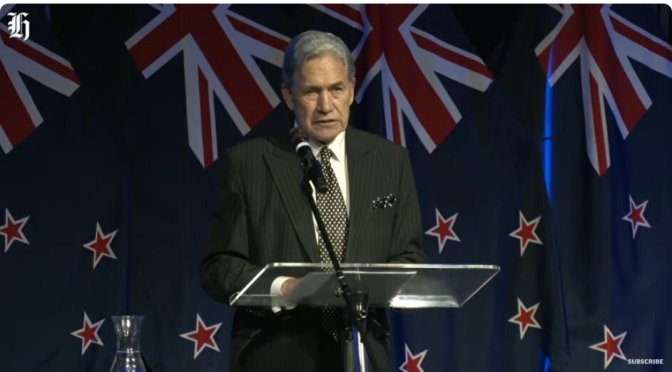
Winston Peters’ State of the Nation Speech in Tauranga. Focusing on issues that are crucial right now, (albeit late I’m reminded) he recalls (as many of us still do) how NZ used to be, pre-Rogernomics when we all had jobs and homelessness was all but unheard of.
Continue reading Winston Peters calls out Globalism & the Covid Inquiry in his State of the Nation SpeechTag Archives: Privatisation
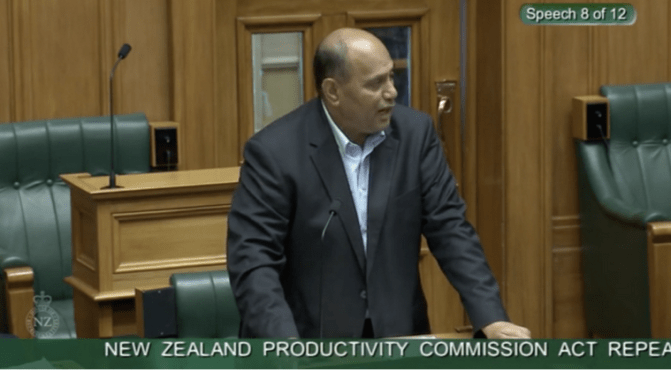
First mention of the Atlas Network in NZ Parliament (think Seymour)
From The Daily Blog
Remember Seymour in an interview denied any connection to Atlas which is not true. He called it conspiracy … EWNZ
The Article 2/2/25:
By Martyn Bradbury
Last night [1 Feb] during the reading of ACTs Bill to dump the Productivity Commission, Labour mentioned the Atlas Network for the first time in Parliament…
Whose interests are ACT actually serving here by silencing the Productivity Commission?
The Atlas Network is an international far right think tank whose extreme policy platform seeks to attack public servants, push for radical privatization, dismantle regulation protecting workers and the environment and champions Landlords over renters.
That sounds remarkably similar to this Government. Who is behind the ACT Party and their policy? The Atlas Network sounds exactly like the policy platform of this new Government and the ACT Party, the Taxpayers’ Union and The NZ Initiative all have links to the Atlas Network so I ask , who is really pulling the strings here?
…the Atlas Network are an international far right think tank and George Monbiot has done an expose on how the Atlas Network influences UK politics and TDB has highlighted the links between them and NZ politics.
Look at the Atlas International play book and ask yourself if it sounds familiar…
A crash programme of massive cuts; demolishing public services; privatising public assets; centralising political power; sacking civil servants; sweeping away constraints on corporations and oligarchs; destroying regulations that protect workers, vulnerable people and the living world; supporting landlords against tenants; criminalising peaceful protest; restricting the right to strike.
…watch how each of these extremist free market agendas are being slowly and quietly implemented. The new draconian gang powers
Atlas Network also gets mentioned by the Public Health Communication Centre who note the connections between Tobacco Lobbyists and the Atlas Network…
| Tobacco Company | Political connections | Evidence of industry links |
| British American Tobacco | Casey Costello (NZ First Party) formerly Chair and member of Tax Payers’ Union Board. Now Minister with responsibility for the Smokefree Environments and Regulated Products Act 1990; vaping; smokeless tobacco; oral nicotine.1 | Guardian investigation reported TPU received funding from British American Tobacco
TPU has links with the Atlas Network, which has received tobacco industry funding.
|
…it also notes that Nicola Willis is a former Nazgul at the NZ Initiative…
| British American Tobacco
Imperial Brands Australasia |
Nicola Willis, Deputy leader National Party, formerly Board Director New Zealand Initiative | NZI list tobacco companies British American Tobacco and Imperial Brands Australasia as members. |
…at some point the mainstream media are going to have two investigate the influence of the Atlas Network over the Political Right in NZ.
It’s good that Labour has started that questioning.
Where are the Greens and the Māori Party?

Photo credits: The Daily Blog

Seymour’s principles of privatisation
This totally makes sense. Drawing attention here to the Atlas Network & the Mont Pelerin Society. Perchance you are wondering who they are, I’ve included videos below the article, interviews on topic from Central News UTS and discussions with Dr Jeremy Walker (Australia) who has written extensively on topic. He is also interviewed by DOC Studios @ Youtube, with a particular focus on NZ. Shining a light on Seymour’s connection to the network. EWNZ
“…why those opposing the bill should be taking every opportunity to hammer home to the public the corporate ties held by Seymour and his backers and their intention to extract Aotearoa’s resources and siphon the profits to the wealthy here in New Zealand and to international corporations. It’s not about equality, it’s about opening up New Zealand to corporate exploitation.”
David Seymour’s Treaty principles bill is now in select committee phase, and open for submissions.
National and New Zealand First claim they won’t support it going further, but public opposition will need to be clear and overwhelming to ensure it doesn’t proceed.
If the bill went to referendum, current polling suggests it would have a good chance of passing, with 36 percent of the public supporting redefining the Treaty principles, and 30 percent undecided.
For those opposed, there are a few important things to consider, writes Ryan Ward.
We can expect an all-out propaganda campaign in favour of the bill.
This will be led by right-wing lobbying groups like Hobson’s Pledge, the Taxpayer’s Union, Groundswell, and others. Hobson’s Pledge has already indicated they have tens of thousands of submissions in favour of the bill ready to go and will be soliciting many more. They and other lobbying groups will also blitz the media with ads and messaging in favour of the bill.
David Seymour has been laying the groundwork for this campaign all along. His consistent and careful messaging surrounding the bill has framed its goal as providing equal rights to all New Zealanders, rather than giving special rights to different groups depending on their ancestry.
He has repeated this message over and over. According to Seymour, it’s about democracy and fairness.
This political messaging will be extremely difficult to counter using the predominant oppositional messaging which focuses on the bill’s racism or ignorant interpretation of the translation or meaning of the Treaty.
It will not be enough to loudly proclaim that the bill is racist toward Māori (it is very much so) or that Seymour is ignorant of the true meaning of the Treaty (he is not).
As evidenced by his dismissal of expert opinion and the haka and protest in parliament, and his minimisation of the hīkoi last week (possibly the largest protest in New Zealand’s history), Seymour is unmoved by factual argument or large shows of public disapproval. (A petition against his bill currently has just over 290,000 signatures, more than the 246,000 people who supported Act in the last election.)
By framing his bill in terms of “equality for all”, David Seymour has shrewdly tapped into the existing racial biases that have successfully torpedoed recent attempts to provide more representation and equity for Māori.
Much of the campaign messaging in the last election by Act, National, and New Zealand First railed against ideas of “co-governance” and unequal treatment of Māori at the expense of the rest of New Zealand. Seymour and his backers will continue to use this divisive rhetoric to turn the public against Māori and in favour of the bill. The recent Voice referendum in Australia and our own recent election results indicate that the public is very vulnerable to this type of dishonest and divisive political messaging.
Getting sucked into the race-war rhetoric that Seymour and his backers are trafficking in has been a losing strategy so far. It puts the opposition on the defensive: the disingenuous arguments about equality for all New Zealanders seem to place Seymour and his bill on an obvious moral high ground and are very difficult to counter effectively.
As Seymour said at the bill’s first reading: “The challenge for people who oppose this bill is to explain why they are so opposed to those basic principles.” We already know how difficult it is to win against such disingenuous framing.
Those opposing the bill need to find another political message that will resonate with the public. A simple message that can’t be co-opted by leveraging entrenched racial biases and relying on the public to understand complex legal and translational arguments.
A recent editorial in the Spinoff by Rupert O’Brien pulls the curtain back on Seymour’s dissembling language of equality and provides an offensive rather than a defensive oppositional rhetorical strategy.
O’Brien notes that while most of the discussion and analysis of the bill has been related to whether it accurately interprets the meaning of Te Tiriti, the real motive behind the bill is related to Act and its backers’ long-term strategy of deregulating business and opening up New Zealand to corporate investment, extraction, and exploitation.
As O’Brien writes, Act and their benefactors “know that it [Te Tiriti] stands as a major obstacle in their goal of deregulation and promoting laissez-faire economics.”
“They aim to achieve deregulation by, in part, turning government departments into state-owned enterprises (corporatising) and subsequently selling these as going concerns on the private market (privatising) . . .
“The Treaty principles have proved a significant roadblock to both corporatisation and privatisation in the past and present a clear threat to any plans of future development of public assets to the private sector.”
This is likely the real, though unspoken, reason that Seymour and his backers are pushing so hard to redefine the Treaty principles. By framing the bill as a means for equality for all New Zealanders, and then inflaming the race-war rhetoric that results from the justified outrage from Māori, Seymour can avoid discussing the real reasons behind the bill and his ties to domestic and international corporate interests that will profit handsomely from opening up Aotearoa to unregulated corporate development. Industries such as gas and mining have been long stymied by the legal interpretation and enforcement of the Treaty.
Focusing on the race war stops the public from “following the money”, as the saying goes.
But the money has been followed. And it leads to domestic and international right-wing lobbying and funding groups whose main goal is to enact policy that results in upwards wealth transfer and corporate exploitation. Many of Act’s largest donors are individuals such as Graeme Hart and the Gibbs family, who profited handsomely from the privatisation of New Zealand’s public sector in the 1990s under National.
There is a reason why Seymour desperately wants to keep the real motivations for his Treaty principles bill secret. The public generally don’t look favourably on politicians and political agendas that are blatantly in favour of corporate interests at the expense of the rest of us. If the real reason for the bill were made clear and widely known, the current framing would crumble, and the equality-race-war rhetoric would no longer likely be an effective strategy to win public support for the bill.
This is why an oppositional strategy focused only on the race-war rhetoric will fail, and why those opposing the bill should be taking every opportunity to hammer home to the public the corporate ties held by Seymour and his backers and their intention to extract Aotearoa’s resources and siphon the profits to the wealthy here in New Zealand and to international corporations.
It’s not about equality, it’s about opening up New Zealand to corporate exploitation.
By making this crystal clear to the public, and focusing relentlessly on a simple oppositional message, we can unite Aotearoa and turn the tide against Seymour and his reinterpretation of the Treaty principles.
Ryan Ward is a Senior Lecturer in the Department of Psychology at the University of Otago.
VIDEO & OTHER LINKS BELOW: (content warning, the DOC Studios videos do contain a few expletives)
The Atlas Network: Big oil, climate disinformation and constitutional democracy (includes Dr Jeremy Walker) From Central News UTS
David Seymour and Debbie Ngawera Packer on Q&A | Jeremy Walker on if Atlas is involved (Dr Walker begins at 1hr 11 mins)
Further info from Dr Jeremy Walker who has written extensively on topic drawing the public attention to the Atlas Group (posted @ Central News UTS) :
Further resources and tips on Atlas from Dr Jeremy Walker. Please disseminate where useful. Some tips on research methods for researching the Atlas Network’s global reach and organisation in specific countries and regions. A key insight was provided to me by Mirowski and Plewhe’s (2009) Road from Mont Pelerin, which defines a “neoliberal” as one of the membership of the global Mont Pelerin Society and/or of the thinktanks of the Atlas Network (p. 4). That book focuses mainly on the ‘economic ideas’ of Hayek, Friedman et al. in Western countries, but as my book More Heat than Life (2020) shows, these ‘ideas’ were paid for by oil money from the beginning, and promoted by oil money via the ever-growing network of thinktanks modelled on the original, the IEA (London) which almost from the beginning was supported by Big Oil, uranium, banking etc, as its seems most of the later clone ‘thinktanks’ are or were where we have any data. The senior exec directors of Atlas orgs are often MPS members. DeSmog has a list of MPS members including the date they were admitted as at 2013. You will find Alan Gibbs under the UK section. https://www.desmog.com/wp-content/uploads/files/Mont%20Pelerin%20Society%202013-membership-listing_Redacted.pdf
Very interesting names on it, including Charles Koch who has ploughed untold millions into the Network, also for example Aust PM John Howard. Wayback machine is vital, Atlas posted their global directory on their website until c. 2021. https://web.archive.org/web/20210824142756/https://www.atlasnetwork.org/partners/global-directory
There is plenty to learn from searching the Atlas site itself. You should also use Wayback to explore deleted material from individual websites. On the basis of that list a team of researchers based at DeMontford has compiled this very important database which: “contains the name and roles of board members, supervisory board members, academic advisory boards, and CEO’s of all think tank organisations that are part of the Atlas Network/Atlas Economic Research Foundation between January 2021 and December 2022. The dataset covers each continent under separate sections for individual continent analysis. https://figshare.dmu.ac.uk/articles/dataset/Atlas_Think_Tank_Main_Employers/22217050?file=39486961
Search for academic literature on neoliberalism, Mont Pelerin Society, and the names in the MPS directory, but Atlas Network as such as very limited exposure. As far as I know no one has published on the basis of this archive, like the MPS records, at the Hoover Institution. https://oac.cdlib.org/findaid/ark:/13030/c80k2f0h/
DeSmog has the best resources on various thinktanks and the hacks that work for them, but yet to fully incorporate the Atlas dimension as they have only recently grasped this. Eg. ‘the Koch network’ is more or less on overlap of the US Atlas orgs, as oil billionaire Charles Koch has been on the Atlas board to my knowledge since 1987, and is a key funder of George Mason University where the head office is based. Also useful is SourceWatch, LittleSis https://www.desmog.com/databases/
Robert Brulle’s paper’s on the funding of climate denial orgs in the US is very useful, although likewise confined to the US and not cognisant until recently that nearly all the orgs named are in fact Atlas affiliates, spinoff orgs, and/or staffed and funded by the same set of ‘philanthropies’, including Donor’s Trust (set up by Atlas HQ to disguise donors identities) and the various Scaife and Koch foundations, as well as others named in Jane Mayer’s Dark Money (Olin, Bradley). https://scholar.google.com/citations?hl=en&user=PlB0bM4AAAAJ&view_op=list_works&sortby=pubdate
Esp these two: https://assets-eu.researchsquare.com/files/rs-178750/v1/77e68e86-364d-45b5-b426-b0355e605d70.pdf?c=1631873834https://www.activist360.co/wp-content/uploads/2019/12/Institutionalizing-Delay-Climatic-Change.pdf
Below are links to an online version of my book, and two subsequent pieces showing the method above used in the Australian context and some of the sources in the bibliography may be useful. Walker, J (2023) Silencing the Voice: the fossil-fuelled Atlas Network’s campaign against constitutional recognition of Indigenous Australia, Cosmopolitan Civil Societies,15(2). (Open Access) https://epress.lib.uts.edu.au/journals/index.php/mcs/article/view/8813
Walker, J (2022) Freedom to burn: mining propaganda, fossil capital and the Australian neoliberals. https://www.researchgate.net/publication/359443471_Freedom_to_Burn_Mining_Propaganda_Fossil_Capital_and_the_Australian_Neoliberals
In Slobodian, Q & Plehwe, D (eds) Market Civilisations: Neoliberals East and South, Princeton University Press. https://press.princeton.edu/books/hardcover/9781942130673/market-civilizations
Walker, J (2020). More Heat than Life: the Tangled Roots of Ecology, Energy and Economics, Palgrave. https://archive.org/details/walker-more-heat-then-life.-the-tangled-roots-of-ecology-energy-and-economics-2020/page/259/mode/2up?q=atlas
Image Credit: By Glenn Davies – Own work, CC BY 4.0, https://commons.wikimedia.org/w/index.php?curid=136317457

Labour is fixing the Nat-created housing crisis with Agenda 21/30 emergency units that look not unlike prison cells

As we know the Nats created a great hole in the State owned housing stock by selling off & land banking properties situated on prime real estate. Now Labour’s set to fix it with ‘affordable’ tiny housing. This is the global trend of course under the UN’s plan for sustainable development. (Sustainably developing developers’ bank accounts, nothing much else is being sustained … note worst pollution of waterways ever, councils are lip service only). With large swathes of the South Island just sold (rather gifted) off shore, governments/corporations have been full on privatising all our state assets with Public Private Partnerships that you all should examine a little more closely. More smoke and mirrors. For a full exposé you need to read Dr Naomi Jacobs’ ebook, a link there to the pdf is on the Agenda 21/30 in NZ page.
Further food for thought is the current new law in Australia that stops you declining vaccination for you or your child (or face 10 years imprisonment) and the stopping of private citizens and asking for papers/ID in the US. This is the beginnings of a totalitarian Police State agenda. That is the fairly plain writing I am seeing on the wall.
Here are the NZ tiny houses from stuff.co.nz … where are the windows?!

Housing crisis solution described as ‘design and planning monstrosity’
A building expert has slammed the Government’s latest emergency housing solution as a “design and planning monstrosity”.
Engineering consultant Jonathan Smith said the design of the small West Auckland units was unacceptable.
“The units are an eyesore and a design fail.”
The one-bedroom properties have already been criticised for looking like “prison cells”.
Single people would live in the prefabricated dwellings, for an average of three months, under the Government’s transitional housing programme.
Smith said the units were a “design and planning monstrosity”.
READ MORE
Agenda 21/30’s stack and pack / tiny housing is world wide
The Chinese Version of Agenda 21 and Why The U.S. Should Care
As most aware people already know, England often provides us with a forward-looking view of where our police state surveillance grid will be in three or four years.
The US has a canary in the mine from which to predict its future and it has to do with how China are implementing Agenda 21. China has long led the world in repressive and inhuman enforcement of its one child policies, mandatory sterilization and forced abortions…. read more
And this is not just China. A search online will see the tiny house trend everywhere. We’ve posted here recently on the trend and the steering away from large sections, formerly a Kiwi tradition.
Use categories to find other articles here on the roll out of UN Agenda 21/ 30.
RELATED:
‘Prison cell’ emergency housing units will house people for three months

Social housing candidate has links to Manus detention centre & human rights breaches (NZ)
Be sure and read the related links down the right hand side of the page in the following article (at the link). They’re denying it’s privatisation. Yeah right! See our recent links on Tamaki, then Horowhenua. They sugar coat the sale with ‘community housing provider’ then sell to private developers. Of course it’s privatisation! It’s also called lying as they did in the Horowhenua. They are taking away our sovereignty by selling off our national assets that our parents and grandparents worked for. No sovereignty, high debt, we’re then beholden to the banks and off shore corporations. See Agenda 21/30 pages for more on that. The UN plan for global governance that is really about world domination people. That is the end game & they want you to swallow it hook, line and sinker. EnvirowatchRangitikei
This is from RadioNZ
One of the consortiums shortlisted to buy Housing New Zealand homes in Christchurch has links to a company accused of human rights breaches on Manus Island.
The government is seeking proposals from three preferred groups before deciding which one will be chosen to purchase 2500 houses in the city.
They are all made up of existing housing providers and investment firms and would be required to continue operating them as social housing and not sell them to the private sector.
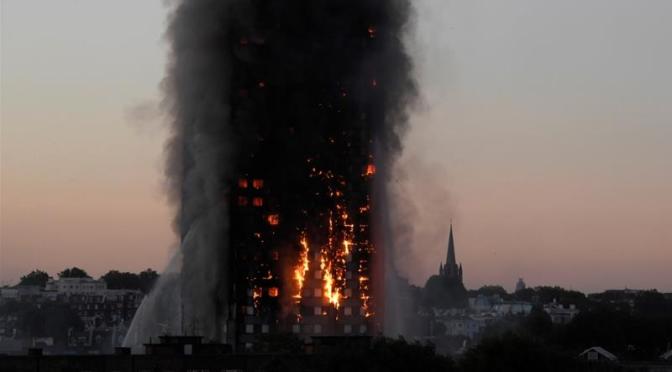
Grenfell Tower: This Is What Austerity Looks Like by William Bowles
by William Bowles
Writer, Dandelion Salad
Investigating Imperialism
London, England
June 17, 2017
‘The Prime Minister, Theresa May, had to [flee] the site of Grenfell Tower yesterday under police guard, BBC News, 17 June 2017
The Abandonment of a Community
Initially, I wasn’t going to write anything on this tragedy, I figured there would be plenty of analysis as to the whys and the wherefores of a building turned into a funeral pyre but I’ve yet to see the word Austerity used once, just once, in connection with this tragedy, which as usual in this world always impacts the most on working class communities, especially the poor, wherever it occurs.
Instead, we got endless hours, days of BBC hand-wringing, focusing almost exclusively on the (heroic) efforts of a devastated community, ignored and forgotten by their council and the government, with those damn cameras peering into peoples’ grief and ultimately, anger, made all the worse by the state’s total indifference to this calamity.
It took three days for the Prime Minister, Theresa May to visit the site and she had to do it under police guard! It’s only today, now four days later, that the government has finally set up some kind of command centre to deal with distraught relatives and friends of the dead, injured and missing (estimates now put the number of dead as at least 70).
If there’s anything that illustrates the murderous endgame of neoliberalism and what it does to people, this is it! But this is also Baghdad and it’s Damascus and a dozen other places around the globe getting a dose of democracy. Here it’s simple neglect powered by greed but it’s committed by the same governments, the same people who have abandoned wholesale, millions of people in their own backyards and slaughtered millions around the planet.
Source: Grenfell Tower: This Is What Austerity Looks Like by William Bowles

Kiwis lose $871 million from power company privatisations, power is up 3.8% & the elderly freeze
Whilst many elderly are stopping in bed all day to keep warm because they are paying outrageous prices for power (courtesy of Smart Meters) the CEOs of the powercos are on salaries of 1-2 million dollars. This is the insanity of corporate greed at its finest.
Today’s business corporation is an artificial creation, shielding owners and managers while preserving corporate privilege and existence. Artificial or not, corporations have won more rights under law than people have – rights which government has protected with armed forceRichard L Grossman and Frank T Adams
Recent articles in Nelson have illustrated what can happen following the installation of Smart Meters with accounts coming in at double the normal price and beyond. (Post to come on that one). The Greens in this article have highlighted the nonsensical world of privatisation … a thinly veiled scheme that clearly benefits the corporate world while claiming to benefit all. Remember, we were told the asset sales would get us out of debt (clearly wrong as our debt continues to climb). We were also told that more powercos meant more competition (free enterprise, the market and all that) which would mean lower prices … wrong again.
“…free enterprise, [is] a term that refers, in practice, to a system of public subsidy and private profit, with massive government intervention in the economy to maintain a welfare state for the rich.” Noam Chomsky
Gareth Hughes MP on Friday, August 28, 2015
“New analysis of the financial statements of Genesis, Mighty River Power, and Meridian released by the Green Party today shows that National’s partial privatisation of power companies has cost New Zealand taxpayers $871 million, the Green Party said.
“The latest data shows that National’s sale of 49 percent of shares in the power companies was a massive transfer of wealth from the people of New Zealand to a few select investors, many who live overseas,” Green Party energy spokesperson Gareth Hughes said.
“If the Crown still owned 100 percent of these companies, taxpayers could collectively have earned another $381 million this year alone and a whopping $775 million since the selloff.
“Add to that the $96 million of costs associated with the sale process, including bonus shares to sweeten the deal for private investors, and the New Zealand taxpayer is $871 million worse off because of National’s failed privatisation plan.
“Consumers are hurting because power prices are up 3.8 percent – meanwhile power companies are paying out massive salaries to their CEOs and directors.
“The CEOs of the three partially privatised power companies now all earn over a million dollars each, and Meridian’s CEO gets close to $2 million when extra perks are included.
“Rising salaries for power company CEOs are cold comfort for Kiwi households facing higher power bills,” said Mr Hughes.
Mighty River Power’s announcement today of a special shareholder dividend means it will pay out almost $300 million for the year, and caps off a string of recent profit announcements from the partially privatised power companies. Contact and Meridian are also paying special dividends, while Genesis’ profit doubled from the previous year.
The Green Party has released new analysis, undertaken by the Parliamentary Library, of the financial statements of the recently partially privatised power companies Genesis, Mighty River Power, and Meridian.
SOURCE: https://www.greens.org.nz/news/press-releases/kiwis-lose-871-million-power-company-privatisations

You must be logged in to post a comment.