
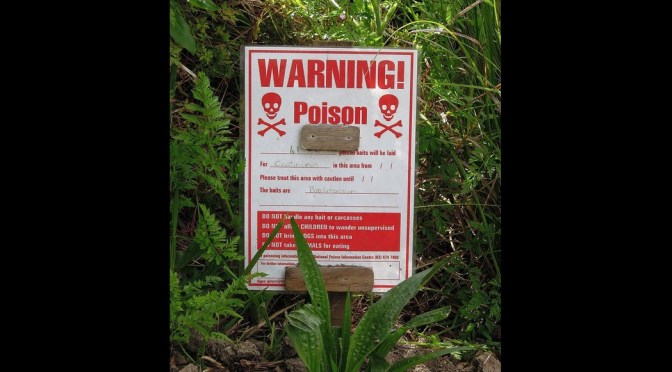
This article was originally published here in 2023 … EWNZ
“The Ministry of Primary Industries stipulates a withholding period of 4 months for 1080 poison. For brodifacoum it is 3 years i.e. 36 months after poisoning.“
by Tony Orman
Government use of 1080 poison in New Zealand is controversial and seems to command the headlines ahead of other poisons.
But there is a much worse poison – it is called brodifacoum.
Brodifacoum is widely used by regional councils and government agencies such as the Department of Conservation. Typical of its widespread use is Ulva Island near Stewart Island where the Department of Conservation is currently undertaking rodent eradication.
I have come across brodifacoum poisoning notices in the central North Island when trout fishing, accompanied by my Labrador dog. In one case I asked a farmer why the regional council was using brodifacoum for possums. He didn’t know and added that possum numbers were very light anyhow.
Because of the extreme danger to my dog, I didn’t go fishing. Besides, trout fishing a river into whichever toxic baits will have fallen or on the banks, doesn’t make for an enjoyable day’s fishing!
Such cavalier attitude of regional councils – and the Department of Conservation – belies the lethal nature of brodifacoum.
Comparison
How does it compare to 1080?
Both poisons have a ”withholding period” which means a time must elapse after the toxin’s use before stock can be safely grazed or game animals such as deer, taken for home consumption.
The Ministry of Primary Industries stipulates 4 months for 1080 poison. For brodifacoum it is 3 years i.e. 36 months after poisoning.
The extensive withholding time for brodifacoum is due to its known long-term persistence in the environment and animal bodies.
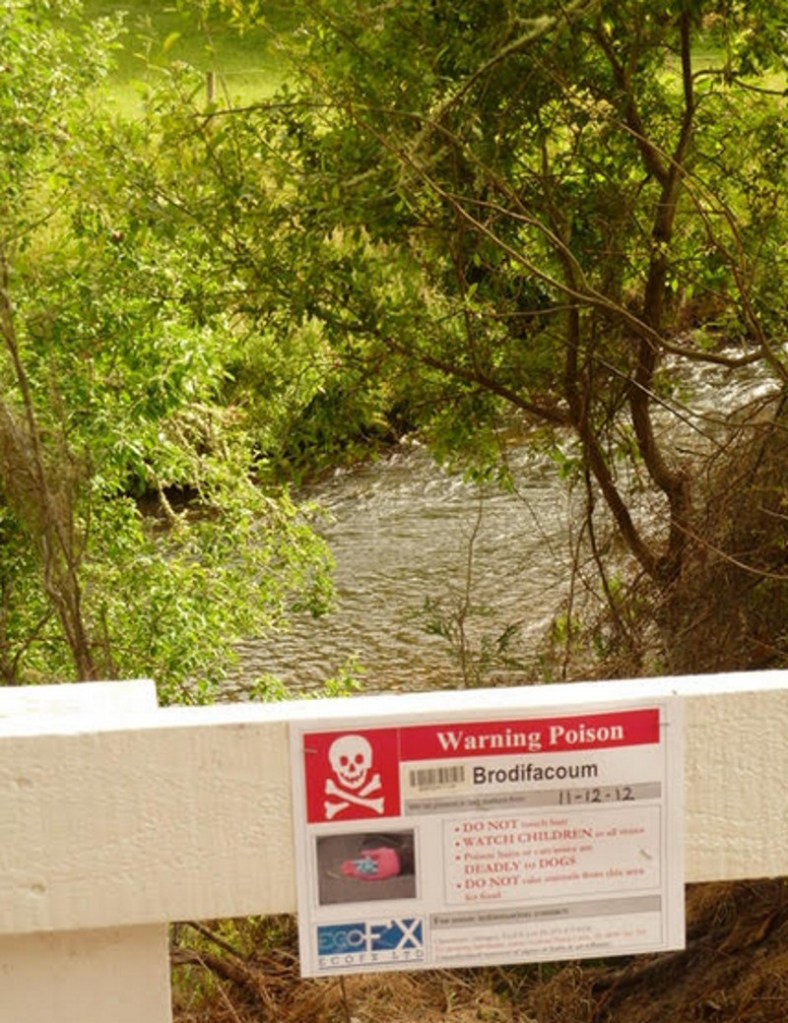
What is brodifacoum?
Brodifacoum is an anticoagulant, which causes the animal to die slowly and painfully from internal bleeding. As cruel as death over two or three days is by 1080, by brodifacoum it is far more prolonged, in the case of rats within 4 to 8 days and larger animals such as possums, up to 21 days.
1080 requires a user to have a licence to use the toxin but no licence is needed for brodifacoum, for example rat poison sold over shop counters, to anyone, young or adult with no controls whatsoever.
Secondary Poisoning
Brodifacoum and 1080 have another similarity, called “secondary poisoning”. In other words a dead poisoned animal remains toxic and any bird or other creature scavenging the dead body, takes in poison and dies.
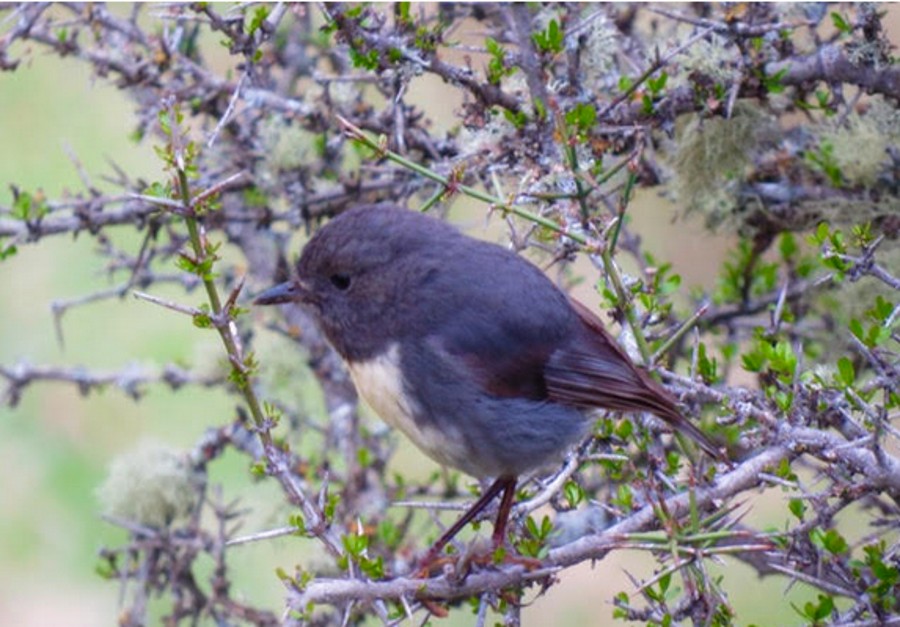
Scientists C.T. Eason and E.B. Spurr in 1995 in a study “The Toxicity and Sub-lethal Effects of Brodifacoum said insectivorous birds (e.g. bush robins, fantails) are likely to be exposed to brodifacoum by eating invertebrates that have fed on toxic baits; i.e., they are likely to be at risk from secondary poisoning. Predatory birds (especially the Australasian harrier, New Zealand falcon, and morepork) might also be at risk from secondary poisoning by eating birds, small mammals, or invertebrates that have fed on toxic baits.
Predators are greatly at risk. Both poisons are very slow to kill, and especially so with brodifacoum. An animal be mouse, bird or insect, on taking the poison, slowly dies and in its distressed, weakening state, naturally and quickly attracts the attention of predators among them native birds such as bush falcons, hawks, moreporks, pukekos and wekas.
Ecological history is littered with instances following poisoning. For example scientists Eason and Spurr said the “entire weka population on Tawhitinui Island, Pelorus Sound, Marlborough Sounds was exterminated mainly by direct consumption of rat bait (Talon) intended for ship rat control.”
The two scientists said “indigenous New Zealand vertebrates most at risk from feeding directly on cereal-based baits containing brodifacoum are those species that are naturally inquisitive and have an omnivorous diet (birds such as weka, kaka, kea, and robins). The greatest risk of secondary poisoning is to predatory and scavenging birds (especially the Australasian harrier, New Zealand falcon, southern black-backed gull, morepork, and weka)”
The duo added “the risk from brodifacoum will be at its greatest when saturation baiting techniques, such as aerial sowing, are used in eradication programmes.” Such as Ulva Island where DoC is “aerially sowing” brodifacoum.
Seven years later in 2002, Spurr and Eason along with two other scientists produced a study “Assessment of risks of brodifacoum to non-target birds and mammals in New Zealand”.
The quartet of scientists described brodifacoum as “highly toxic to birds and mammals” and listed victims such as the Australasian harrier (Circus approximans) and morepork (Ninox novaeseelandiae), other native birds such as the pukeko (Porphyrio melanomas), weka (Gallirallus australis), southern black-backed gull (Larus dominicanus), and kiwi (Apteryx spp.) and introduced mammals, including game animals e.g. deer.
Dead Dotterels
Other studies have identified the lethal nature of brodifacoum.
Landcare Research scientist Penny Fisher said “because brodifacoum persists in the environment, other birds may suffer secondary poisoning from eating animals that have ingested poison” and cited “a high mortality of New Zealand dotterels following an aerial brodifacoum operation at Tawharanui Regional Park in North Auckland, in 2004. At least 50% of the dotterels in the area at time of operation disappeared or were found dead. Sand-hoppers-common food item of NZ dotterels —ate baits and accumulated brodifacoum and provided a potential route for transmission of the toxin to dotterels.”
Two dead eels found in a Southland waterway had brodifacoum in the gut contents of one and that “suggests the eel had recently ingested food containing brodifacoum, probably through scavenging the carcass of a poisoned possum.”
Freshwater Residues
Brodifacoum similar to 1080, leaves residues.
In 2005 a paper in the New Zealand Journal of Marine and Freshwater Research, Volume 39, told of freshwater crayfish (koura) with significant 1080 concentrations and 1080 residues in eel tissue that were on average 12 times higher than the PMAV (provisional maximum acceptable level).
The INTERNATIONAL PROGRAMME ON CHEMICAL SAFETY Health and Safety Guide No. 93 said of brodifacoum “as a technical material — is highly toxic for fish”.
Processing poisons for wild animal control/eradication is Orillion a State Owned Enterprise governed through a Board of Directors appointed by the New Zealand Government. Orillion’s safety data sheet for brodifacoum says “may cause long lasting harmful effects to aquatic life.”
Therein lies a threat to not only valued sports fishes such as trout and juvenile salmon migrating downstream to sea, but also native fish such as eels and galaxids.
Sodium fluoroacetate, also known as compound 1080, is the poison around which controversy swirls. Brodifacoum is little known but is surreptitiously used by the Department of Conservation and councils.
1080 is ecologically destructive and damaging to the ecosystem – but brodifacoum is far worse.
Footnote: Environmentalist Tony Orman has spent a lifetime in the outdoors and has had some two dozen books published among them “New Zealand the Beautiful Wilderness”
RELATED
Brodifacoum Worse Poison than 1080
Header Photo: Wikipedia – By Squidonius – Own work, CC BY-SA 3.0, https://commons.wikimedia.org/w/index.php?curid=17253187


You must be logged in to post a comment.