Tag Archives: killing animals

The Effects of Imprinting Kids to Kill Animals

Horrific killing contests lead to “dead animals, children and huge smiles.”

Ed Note @ 10/5/25: An interesting recent related link has been added at the end

From psychologytoday.com

“There’s something desperately awful about taking a child out to experience nature by handing them a gun and telling them to kill it. That’s like going to the most beautiful art museum in the world and ripping down canvasses because ‘someone will just make another one.’ It teaches children that killing is a goal, a healthy way to view another life and socially acceptable.“ —Kayla Simon, Hunting perpetuates cruelty, teaches violence

There are more humane ways of dealing with ‘invasive species’ than 1080, world-renowned conservationist Dr. Jane Goodall says.”

“The effects of imprinting kids to kill animals are bad news.” —Email from a concerned mother in New Zealand

Killing animals in sanctioned school events and family outings is business as usual in parts of New Zealand

In New Zealand, youngsters are trained to kill nonhuman animals (animals) in sanctioned school and family events. While many kids really enjoy them, it’s good that not all of them do. However, those who don’t want to partake often don’t know what to do because they’re told they have to participate or are ridiculed by other students. Two years ago, I received an email from a 9-year-old New Zealander asking me (via a parent), “Why is it wrong to not want to kill animals?” In his note, I could feel his concern and pain—how could anyone think it’s wrong to try to save lives, but okay to kill animals because some people don’t like them and think they’re some sort of “pest.”  I agree with Jane Goodall when she says, “I abhor the use of the word pest.”

Concerning youngsters killing other animals and enjoying it, yesterday I received two incredibly disturbing emails informing me about a horrific killing contest that took place in Ōpōtiki, New Zealand. The first was an essay by Lynley Tulloch titled “The McDonaldification Of Hunting: Training Children To Kill In Opotiki” and the second, a video called “Ōpōtiki youngsters get stuck into hunting competition designed just for them.

Most unfortunately, these are not isolated incidents in a country in which many people who take part in their brutal war on wildlife are hell-bent on eliminating all non-native animals by 2050.1,2 For example, possum hunting competitions regularly occur in rural New Zealand schools, and these often involve “dressing up dead possums for competitions, hurling them in throwing competitions and carrying them over obstacle courses” as Dr. Tulloch notes.

Unfortunately, in this reprehensible war on wildlife, a good number of non-target animals also are killed using brutal methods involving the horrific poison 1080 along with trapping, snaring, shooting, and bludgeoning. Numerous references about many different aspects of New Zealand’s assault on wildlife can be found in an essay called “Jane Goodall Says Don’t Use 1080, Jan Wright Says Use More.”

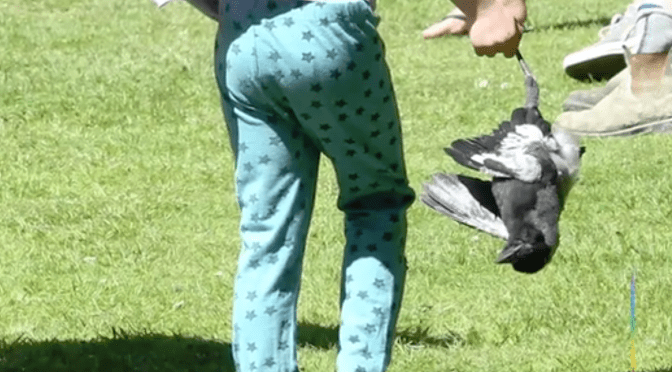
Watching the sickening video “Ōpōtiki youngsters get stuck into hunting competition designed just for them.” isn’t easy, and I want you to know this before you do. It’s said a picture is worth a thousand words, and I’m sure that this film will generate many more. This horrific event was designed by “a group of hunting mums” for youngsters under 16. In the article accompanying the video we read, “Hunting is a big part of life in the eastern Bay of Plenty and the Opotiki Little 3 – that took place over the weekend – encourages kids to get involved by attempting to bag the largest number of possums, magpie and rabbit.” One mother said, “Most of us have full time jobs as well as doing this but we do it for the kids so… it’s worth it to see their smiles!” These are smiles from violently “bagging” sentient beings.

The link between violence toward nonhumans and violence toward humans

It’s well known that there is a link between violence directed toward nonhumans and violence directed toward humans.3 Ms. Tulloch writes “Opotiki, dubbed the homicide capital of New Zealand, is a small town with a huge reputation for domestic violence and murder. It has been reported that Opotiki had 1.25 homicides for every 1000 people between 2004 and 2019–and this is the highest rate in the country.” Clearly, Opotiki has issues with violence, “yet, as a community they have come together to teach their children that violence toward another living creature is socially acceptable. Not only acceptable, but something to be glorified through gamifying it in a competition.”

There are many things that are very wrong with organized and sanctioned killing contests—it’s really bad news that they exist and it’s worse news that kids smile after “bagging” the animals—and it’s good that not all youngsters want to engage in them. There still are many people who don’t know they occur and it’s essential to inform a wide audience that they are a reality of life—business as usual—in various parts of New Zealand.

Gretchen Wyler since famously said, “Cruelty can’t stand the spotlight,” and I hope that more and more people will strongly oppose these slaughter fests. Nothing “good” comes out of them, and it’s well-known that a lot of “bad” can stem from training youngsters to kill other animals for fun and games. As Dr. Tulloch correctly stresses, “Wake up, New Zealand. It is not rocket science to see the link between the many forms of violence. It’s a one-way street. And it has a dead end.”

Stay tuned for further discussion on how New Zealand youngsters continue to be trained in inhumane education of the most egregious kind. I’m encouraged that I receive numerous emails from New Zealanders—kids and adults—who are deeply concerned about what’s happening and want to know how to put an end to “this most despicable form of schooling,” as one parent put it. Just after I posted this essay I received this email from a woman in New Zealand: “Oh my goodness–I am going to have to read this to my daughter who was so bereft after what should have been a great school field trip turned into a nightmare where a ranger showed them all how to trap a possum and essentially to get used to it as that’s what conservation looks like. She’s been beside herself about it ever since…”

New Zealand continues to have major animal welfare issues. We can only hope that as people learn about what’s happening in parts of New Zealand, they will work hard to be sure that this sort of violent inhumane education doesn’t happen in their own communities. Imprinting kids to kill animals is bad news, can have horrific long-term effects, and should be stopped immediately.

References

Notes:

1) Numerous essays about New Zealand’s brutal slaughter of non-native and native wildlife can be seen here and in the essays below. It’s important to note that scientists and non-scientists alike agree that New Zealand’s war on wildlife in not only unethical, but also unscientific.

Dalton, Jane. The link is established between serial killers and animal cruelty. The Independent, July 30, 2019.

2) Links for the essays below are provided here.

New Zealand Continues to Have Major Animal Welfare Issues.

Accusations of “Invasive Species Denialism” Are Flawed.

“Why Is It Wrong to Not Want to Kill Animals?”

What if New Zealand’s War on Wildlife Included Primates?

The “It’s OK to Kill Animals Humanely” Apology Doesn’t Work.

New Zealand Kids Get Into Killing Animals and Love Doing It.

Killing Animals Is “Weirdly Addictive” Says New Zealander.

It’s a Ghastly Time to Be a Bunny in New Zealand.

Teaching New Zealand Kids to Kill Animals Is Very Worrisome.

Youngsters Encouraged to Kill Possum Joeys in New Zealand.

New Zealand Kids Kill Possums for Fun and Games.

Long-Term Effects of Violence Toward Animals by Youngsters.

Violence Toward Animals: “Can You Please Help My Daughter?”

New Zealand’s “Possum Stomp” vs. Compassionate Conservation, Individual Well-Being, and Ethics

Does Everybody Really Hate Possums? The Bandwagon Effect.

Rather Than Kill Animals “Softly,” Don’t Kill Them at All.

Compassionate Conservation Isn’t Seriously or Fatally Flawed. (Contains numerous references about compassionate conservation.)

The Clean Pet Food Revolution Will Change the World. (An interview with the authors of a riveting new book about pet food consumption and its effect on nonhumans and the planet as a whole.)

The Animals’ Agenda: An interview About Animal Well-Being.

Animals Need More Freedom, Not Bigger Cages.

Compassionate Conservation Isn’t Veiled Animal Liberation.

Anthropomorphism Favors Coexistence, Not Deadly Domination. (Contains many references about compassionate conservation.)

Eason, C., A. Miller, S. Ogilvie & A. Fairweather. An updated review of the toxicology and ecotoxicology of sodium fluoroacetate (in New Zealand. Journal of Ecology, 35, No. 1, pp. 1-20, 2011.

Flora and Fauna of Aotearoa. New Zealand Government 1080 Poison Tests Flawed. Scoop, 2019.

McQueen, F. M. F. The Quiet Forest: The Case Against Aerial 1080. Tross Publishing, 2017.

Morris, Michael C. Predator Free New Zealand and the ‘War’ on Pests: Is it a just War? Journal of Agricultural and Environmental Ethics, 2019.

O’Callaghan, Jody. Conservationist Jane Goodall says ‘more humane ways’ than 1080 to deal with invasive species. Stuff, May 28, 2019.

Palmer, Scott. What is 1080, and why do people oppose it? Newshub, 2018.

Robinson,  Reihana. The Killing Nation: New Zealand’s State-Sponsored Addiction to Poison 1080. Off the Common Books, 2017.

TheGrafBoys. Cows & Endangered Birds Poisoned in Taranaki Aerial Drop. (New Zealand)

Wallach, Arian, et al. Summoning compassion to address the challenges of conservation. Conservation Biology, 2018.

Wallingford, Golde. New Zealand, The Poisoned Nation.

3) For more information on the link between violence toward nonhumans and violence toward humans click here.

SOURCE: https://www.psychologytoday.com/us/blog/animal-emotions/202003/the-effects-imprinting-kids-kill-animals


About the Author

Our poisoning obsession is garnering attention at a US psychology blog …”New Zealand’s war on wildlife uses youngsters to reach their shameful goal”

The biennial Whangamomona Kids’ Critter Hunt…

Ed Note @ 10/5/25: a recent and interesting related article has been added at the end.

“Ceri said her grandchildren …  take a little while to get used to killing animals, but once they get into it, they love it.”

“Around 60 children weighed in 165 dead animals … An array of goats heads, possums, turkeys, hares, rabbits, pigs and magpies lay dead in the sun … Ceri Hutchinson, who was on the weigh-in desk, was surprised they hadn’t seen a cat come through “like someone did last year”.”

Headlined “New Zealand Kids Get Into Killing Animals and Love Doing It”, PhD Marc Bekoff comments “New Zealand’s war on wildlife uses youngsters to reach their shameful goal”. Two Kiwi parents have written to the blog expressing their concerns at what their children are being taught. We posted recently here also (cited in  psychologytoday’s article) about the normalizing of poison use in our environment and how it is being conveyed to our kids via school textbooks.  Also downplaying the toxicity of 1080 poison.

Here is the psychologytoday article:

Every child that walked into the Whangamomona Domain on Saturday either had a dead animal slung over their shoulders or a pair of gumboots on.”

“Unfortunately, it is already clear that the policy [New Zealand’s Predator Free 2050 program] has not been well informed by scientific knowledge or conservation best practice. It also misdirects attention from more fundamental and direct threats to biodiversity protection and recovery.” (Wayne Linklater and Jamie Steer 2018)

This morning I received two very different email messages from New Zealand residents concerning their country’s on-going horrific and regrettable war on wildlife using inarguably uncompassionate and sickening poisons such as 1080 and other brutal methods of killing. They motivated me to revisit what is happening in this country’s massive and violent assault on nonhuman animals (animals) and to reflect on how few people, including some New Zealanders, know about what’a currently happening and what’s planned for the future.

All in all, New Zealand’s wide ranging and egregious assault on non-native animals can’t be justified on ecological or ethical grounds. In an essay titled “Predator Free 2050: A flawed conservation policy displaces higher priorities and better, evidence‐based alternatives” by New Zealand conservation and biodiversity researchers Wayne Linklater and Jamie Steer we read, “New Zealand’s policy to exterminate five introduced predators by 2050 is well‐meant but warrants critique and comparison against alternatives. The goal is unachievable with current or near‐future technologies and resources. Its effects on ecosystems and 26 other mammalian predators and herbivores will be complex. Some negative outcomes are likely. Predators are not always and everywhere the largest impact on biodiversity…the policy is flawed and risks diverting effort and resources from higher environmental priorities and better alternatives.” The ethical problems centering on the intentional killing of millions other animals are abundantly clear. For example, Linklater and Steer write, “The improbability of success and the perception by some that current tools are cruel are substantial barriers to ethically robust outcomes. More compassionate approaches to managing predators (Wallach, Bekoff, Batavia, Nelson, & Ramp, 2018) are not being considered.

The first note I received read: “I just read an article saying you have received hate mail for criticising NZ’s policy, especially in some schools, on possums as pests. I am sorry to hear that. I would just like to say I totally agree with you – it is horrific to teach children to kill and even more horrific that anyone would drown animals. I was born here and had a baby possum when I was a child, whose mother was hit by a car and he was the sweetest thing, absolutely adorable. I think people should let nature work things out. After all it was because of humans that we have possums in NZ and they are just living their lives where they were born, the same as us. Best regards for your inspiring work.” While I have received a few very nasty and vulgar notes about my opposition to, and strong criticisms of, New Zealand’s shameful war on wildlife, the vast majority has been very supportive.

“Most children came in with an animal carcass slumped over their shoulder”

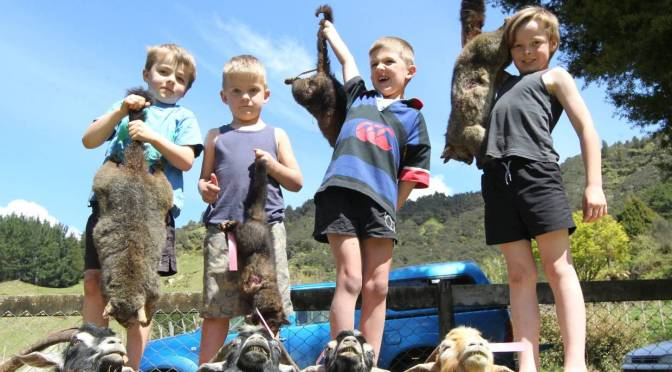
The other email I received with the subject line reading, “It seems to get worse and worse” alerted me to an essay that is available online called “Forgotten World Highway fun: animal carcasses, sausages and fox terrier races.” This piece is about the biennial Whangamomona Kids’ Critter Hunt, “a competition that asks children from near and far to bring biggest and best kills from the past few days in to be weighed and displayed” (please also see “Animal carcasses, psychopathy and school possum hunts“). It contains a number of very disturbing images of kids proudly displaying the animals who they’ve killed, and I urge caution because they are extremely off-putting. Some of the captions for the images read, “Sam Faull, 6, Noah Cameron, 5, Hunter Cameron, 7, and Gus Hutchinson, 8, with their possums at the great Whangamomona Kids’ Critter Hunt,” “Most children came in with an animal carcass slumped over their shoulder,” and “Rueben Pease, 15, with the 170 pound boar he shot in an entry for critter day.” (Note: In a third email in response to this essay of mine I posted earlier, I also received notice about a video called “THE NZ GOVT IS TEACHING YOUR CHILD THAT CLASS 1A ECOTOXIN 1080, BANNED BY MOST COUNTRIES, IS ‘NOT VERY DANGEROUS TO HUMANS’” which normalizes the use of poisons and in which there is discussion of a book titled Poisoning Our Future: Children and Pesticides.)

In “Forgotten World Highway fun: animal carcasses, sausages and fox terrier races” we read, “In the period of two hours around 60 children weighed in 165 dead animals – attaching their names to the carcasses and laying them alongside each other on the ground.” A grandmother also notes, “her grandchildren, who live in Hāwera, take a little while to get used to killing animals, but once they get into it, they love it.” Daniel ‘Pork’ Hutchinson who is president of the Whangamomona Pig Hunt Club claims, “They have a ball.” Even an adult has found killing animals to be addictive (for more discussion please see “Killing Animals Is ‘Weirdly Addictive’ Says New Zealander“).

Kids and animals: Some New Zealand schools are promoting a horrific model

It’s essential to share what’s happening in New Zealand with a wide audience because while a good deal of press has focused on the on-going slaughter and support for it, there are many people who are strongly against it. Some are especially concerned with the training and of youngsters to harm and to kill so-called pests (please also see “Horror at children drowning baby possums at Drury school event” and “Possums and pig hunting fundraiser for country school“), the link between violence toward animals and violence toward humans, and the country’s extremely high rates of domestic violence. In “Possums and pig hunting fundraiser for country school” there are some incredibly disturbing images of kids abusing animals. I received a good number of emails about this essay, in which we learn, “Hundreds attended the family fun day that included all the usual events—the possum carrying obstacle course, the heaviest magpie or rabbit competition, best dressed possum, heaviest goat head and, of course, the gumboot throw” and “The pig hunting opened on Thursday, giving hunters the opportunity to find the heaviest boar. They had more than 100 entries, with hunters registering from as far as Awakino and Whangamomona.”

Pixabay free download
A girl and a bunny

Source: Pixabay free download

I wrote some about these topics in a number of essays (“Imprinting Kids for Violence Toward Animals,” “Long-Term Effects of Violence Toward Animals by Youngsters,” “Youngsters Encouraged to Kill Possum Joeys in New Zealand,” “It’s a Ghastly Time to Be a Bunny in New Zealand,” and links therein), and also noted that not all youngsters want to kill the animals who they’re told to kill by teachers, school administrators, and other adults. For example, in essay titled “Violence Toward Animals: “Can You Please Help My Daughter?” I wrote about a mother who sent me the following note: “I have seen your recent essays on what is happening in schools throughout my country and I am appalled. Thank you for spreading the word. Can you please help my daughter tell her teachers that she does not want to participate in these types of events and contests?” She also mentioned that other parents agreed with her and were at wit’s end because people in power were telling the kids it was perfectly okay to harm and to kill the animals and to parade around with corpses of the animals they slaughtered. I wrote back that her daughter should simply refuse to partake and be nice about it. She should just say “no,” not make a ruckus, and serve as a model for others who might also not want to kill the so-called pests.

It’s also ironic that New Zealand legally recognizes nonhumans as sentient beings, yet wants to kill hundreds of millions of creatures with rich and deep emotional lives. One of the men interviewed in a film about how kids are taught to kill animals admits he and others are out to kill amazing and intelligent animals.

Just say no to sanctioned violence toward other animals

Suffice it to say, schools and groups working on behalf of other animals across New Zealand should lodge formal and vocal campaigns on how to humanely educate youngsters in ways that do not involve killing any animals for fun and money. Those who embrace compassionate conservation also can play a major role in stopping the necessary killing (for more discussion please see “Compassionate Conservation Matures and Comes of Age,” “Compassion as a Practical and Evolved Ethic for Conservation,” “Summoning compassion to address the challenges of conservation,” Ignoring Nature No More: The Case for Compassionate Conservationand “Predator Free 2050: A flawed conservation policy displaces higher priorities and better, evidence‐based alternatives“).

Claims that these animals are being “killed with kindness” are inane. Nicola Toki, the Threatened Species Ambassador of New Zealand’s Department of Conservation (DoC), offered this up in her defense of the slaughter. There’s no reason at all to glorify killing and disrespect for other beings. And, there will be massive amounts of harm and suffering among the millions of sentient beings who are to be slaughtered. So-called “killing with kindness” is neither the panacea nor is it an acceptable excuse for killing other animals. Ms. Toki writes, “The key to getting it right is to hold onto empathy for other living things along the way.” So, killing other animals is just fine as long as the killers feel for the animals they’re slaughtering. I can imagine some people saying or thinking something like, “I know I’m causing you pain as I kill you, but please understand I’m doing it with kindness because it has to be done.” Of course, the animals who are killed couldn’t care less about how their one and only life is taken.

I hope that everyone in New Zealand who opposes killing contests that include youngsters and adults will speak out against such unnecessary violence. There’s no reason to glorify killing other beings. Speaking out against violence toward other animals is one way to call attention to what is happening and to locate others who agree with this point of view. Future long term effects of harmful poisons and teaching kids to kill animals must be spoken about openly and the more people who do it, the more likely things will change for the better. As the late Gretchen Wyler once said, “Cruelty can’t stand the spotlight.” As like-minded people discover one another, things can change and other animals and other humans will benefit from the kindness, compassion, and respect that are shared. Therein lies hope for the future. It’s time to close down the killing fields once and for all.

About the Author

SOURCE:

https://www.psychologytoday.com/us/blog/animal-emotions/201810/new-zealand-kids-get-killing-animals-and-love-doing-it?amp&__twitter_impression=true

PHOTOS: screen shots from Stuff

RELATED: THE STABBING & DEATH OF A LITTLE PET PONY THIS WEEK HAS RAISED THE ISSUE OF THE GROWING ACCEPTABILITY IN NZ OF CRUELTY TO ANIMALS

Making Murderers: Secret Vivisection in Public Schools (Untold History)


This slideshow requires JavaScript.