

From nzdsos.com
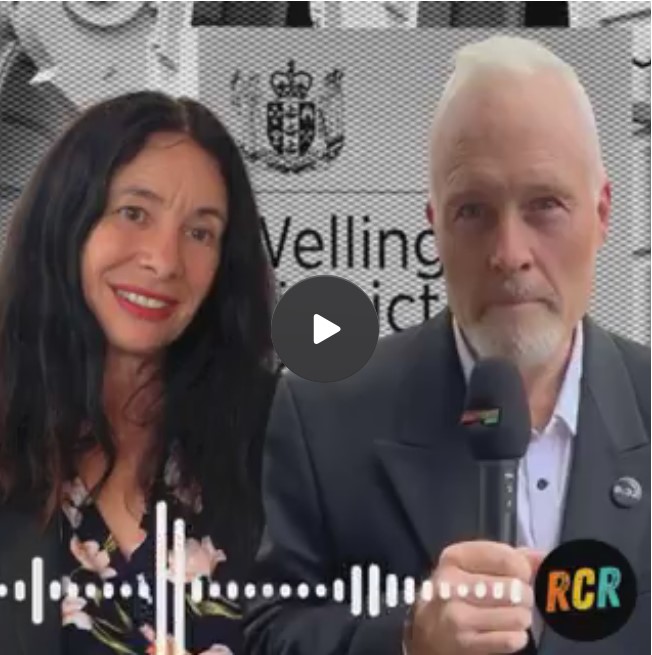
As the authorities can likely tell you, members of New Zealand Doctors Speaking Out With Science (NZDSOS), along with other freedom banner groups and involved citizens, were at the District Court in Wellington on the 11th and 12th of December 2025 to witness conscientious database analyst Barry Young’s application to have charges against him dropped as he claims whistleblower status. Using what little we know of what went on – the Judge suppressed public access and all the evidence presented – we have tried (and mostly succeeded) to be sober and reflective as we consider one aspect of our rapidly deteriorating country which is floundering on the reef. But, against a backdrop of suddenly dead young and old, and a very obvious surge in cancer and immune system failure, staying pleasant is very, very hard.
How dissenting science was ‘othered’ in New Zealand’s corner of the unprecedented global assault
In June 2024, the United States Supreme Court overturned the Chevron deference — a doctrine that long told courts to defer to government agencies’ interpretations of ambiguous law. This striking-down reaffirmed a core democratic idea: courts are the ultimate interpreters of law, not mere rubber-stamps of executive authority. In NZ the situation is somewhat opposite – parliament has supreme authority and it is not the courts’ job to invalidate legislation.
But there is another kind of deference that has shaped public-health governance during the COVID-19 era — one not rooted in thoughtful statute but in the imperative to mass-vaccinate come Hell or high water, ploughing on even after clear evidence of harm appeared. The ‘successful’ rollout required a pervasive strategy to treat corporate evidence and political directives as the default, unchallengeable bedrock of covid policy and judicial reasoning. NZDSOS calls this pattern the Pfizer deference, where its anointed procurement contract rules every roost of relevance in New Zealand, but especially the Crown, the judiciary and regulatory bodies.
This is not a formal legal doctrine like Chevron, but in practice it has had similar consequences: it elevates certain sources of evidence so completely that alternative expert views, even when detailed and sworn as evidence on pain of perjury, are routinely sidelined. This dynamic has been visible not just in policy but in multiple New Zealand court challenges to injection mandates, where appellants — doctors, teachers, Defence Force personnel, police, midwives, port and border workers, flight crew, parents — presented extensive expert affidavits disputing aspects of the science, data integrity and safety profiles.
A notable island of sanity – and we say confirmation of the above – has been the employment courts, where it is company bosses, being found to have behaved badly in breaching their workers’ rights, who judges are only to pleased to find against. Here, they can avoid “safe and effective” like the plague, and leave the Pfizer deference glaring from the wings, but still larger than life.
In most of the civil court cases however, the Crown itself faced challenge and its response was simply official policy assertions, rather than robust counter-evidence. The result was not scientific discovery for interested judges, but one-eyed judicial gymnastics to bolster an official narrative that treated Pfizer-aligned evidence as the uncontested baseline.
That default fails to capture anywhere near the full extent of the serious reports of serious injury and death following vaccination — not merely slam-dunk-for-causation anecdotal accounts, but many entries in safety reporting systems. New Zealand’s regulator Medsafe periodically published data on adverse events following the jabs but ceased suddenly in December 2022, we presume since the reporting got simply too heavy. Tens of thousands of serious adverse reaction reports were logged to CARM, the national pharmacovigilance assessor, and for many people — particularly scientists and doctors who have scrutinised this data, and helped victims and grieving families— the absence of transparent engagement by authorities looks like engineered indifference, and smells way worse.
These are not fringe concerns; they are recorded data points, representing real human beings – we say in obscene, astonishing numbers – whose momento morte records deserve rigorous scrutiny and open inquiry.
The Barry Young Case: A Test of Whistleblower Law and Institutional Authority
Into this environment enters Barry Young, with perhaps the most significant legal contestation of whistleblower protections and institutional deference in New Zealand history.
Barry, a former Health NZ employee, is up for accessing and disseminating internal COVID-19 vaccine rollout data. He has pleaded not guilty in the Wellington District Court, as his motives were rooted in concerns about deaths, especially obvious to him as clusters, following modified RNA injections. His public disclosure saw almost immediate violent police response, impossibly quick for them to have done the required examination of any mitigation and his possible defences (as required by the Crimes Act to prevent vexatious prosecution); a basic human rights analysis; nor assessment of his whistleblower protections. It is claimed, too, that no-one in officialdom has examined his data, but why would they if they are to have a go at Barry Young? This is laughably unlikely anyway. Given all the data points we know they have seen, but ignored to the subsequent death and injury of more people, it is a long stretch that a few buttons haven’t been pressed inside Health NZ, if only out of curiosity.
The Protected Disclosures (Protection of Whistleblowers) Act 2022 (PDA) is legislation intended to shield public-sector workers who disclose serious wrongdoing in the public interest. Represented by lawyer Sue Grey, Barry’s hearing – originally scheduled for a single day in the week just gone – was extended into a second day, and is now carried over into 2026, reflecting apparent complexity and the clear significance to the judge of the issues at stake. And let’s be honest here, many countries (and global bodies) similarly persecuting their own dissenting voices will be intensely interested to avoid the precedent that our law should allow for. In the view of many, the PDA should have seen Barry Young discharged last Thursday to walk off to a hard-earned summer reprieve. But as many of us, similarly burdened by our consciences, have found: the process is the punishment, as well as a stick shaken at any others feeling wobbly.
At its heart, this case asks: When internal voices see danger which contradicts official narratives, are they whistleblowers deserving of protection, or offenders to be prosecuted? The answer, whilst obvious to many on the side of truth and accountability, will define concretely how New Zealand reconciles its supposed commitment to transparency and human rights with the reality of institutional fear of the evidence – whether merely inconvenient or starkly prosecutable.
Pretending, if we may, that courts and legislature are somehow separate and still directed to defending the public, we ask: Who gets to define what counts as authoritative interpretation? In the U.S., Chevron directed that courts should defer to agencies; in New Zealand, Pfizer deference requires that courts and public institutions default to official dogma and ignore credible alternative analyses or safety signals. Where does this leave Barry Young? And how has this worked out for the bereaved and disabled? Curiously, official agencies are ignoring them, or trying to, but many dedicated groups and individuals – Barry and NZDSOS members amongst them – have ensured those responsible never can say they didn’t know, when the time comes.
Safety Reporting and the Public’s Perception of Harm
Medsafe’s regular safety reports categorised adverse events and outlined reported deaths following vaccination, with cautious language emphasising that such reports do not necessarily establish causation. This is consistent with international regulatory practice: reporting systems are curated carefully to flag possible signals, not to determine causality in isolation. But in virtually every case we have examined, the criteria for causation are satisfied. And the sheer volume of reported events — including serious conditions and deaths — and the derelictions in follow-up or transparent explanation leave many people righteously angry.
Worse still, suspiciously provocative phrases were used in lockstep around the world, such as “We’re not seeing anything we didn’t expect to see” and “We are continuing to monitor closely” even as charts leapt off the scale. The ubiquity of this plausible deniability is both undeniable and implausible as a certain shelter from future prosecution.
For those of us who know our first principles and have engaged with safety data at a detailed level, the absence of thorough, publicly accessible explanation and dialogue has cemented our distrust – and disgust – and shown danger signs are being swept under the rug of bureaucratic deference. Further though, it has encouraged us to dig more deeply into the highly precise words and phrases which were used by some officials, and disturbing but unsurprising clues to ‘deception by legalese’ may be starting to emerge.
Courts, Evidence and Default Deference in Litigation
The Barry Young case also highlights another critical dimension: how courts respond to evidence when institutional narratives are widely accepted by default. In many vaccine mandate challenges, appellants brought expert affidavits supporting detailed critiques of risk, safety or methodological assumptions. Yet in many cases, the Crown’s case consisted of policy assertions grounded in official position papers and regulatory statements rather than substantive scientific rebuttals using evidence of its own.
In some instances — such as the High Court’s decision quashing unlawful vaccine mandates for police and Defence Force personnel — judges did engage with the material and concluded that the Crown had failed to demonstrate that mandates were necessary or proportionate. But these decisions were exceptions rather than the rule. In other judicial reviews, the Crown’s position rooted in policy and default official interpretation went largely unexamined in court, not because alternative evidence was frivolous, but because judicial review is not structured to substitute courts’ judgment for that of regulators in technical scientific matters. The effect, however, can be similar to Chevron deference — not in law, but in practice: courts often uphold official evidence frameworks because there is no rival evidentiary structure presented by the Crown to counter the official narrative. In truth, this is generally disallowed anyway, as judicial review proceedings rarely permit cross-examination.
This dynamic reveals a kind of evidentiary asymmetry in litigation: appellants can marshal extensive expert analysis but still find courts defaulting to the official narrative because the state commands institutional acceptance rather than protecting the search for the truth.
Whistleblower Protection or Institutional Silence?
If courts are not tasked with second-guessing scientific expertise, which generally they dislike, there must be other safeguards for transparency and accountability — especially when institutional narratives are challenged by those inside the system seeing harm. That is where whistleblower protections are supposed to come into play.
The Protected Disclosures Act 2022 was amended to protect better those who disclose serious wrongdoing or risk to public interest. It received wide cross-party support and institutional accolades. Yet, in practice, the first major test of that statute involves a man facing criminal charges for actions he believes were in the public interest. NZDSOS members can appreciate his situation. Some within our ranks know all too well the chill of criminal conviction for acting in the public interest.
That mismatch — between what the law promises and how it is operated — strikes at the heart of many things, not least democratic accountability. It sends a chilling and intended message: raising concerns can lead to prosecution rather than protection.
This is not purely hypothetical. In Barry Young’s case, the question is not only whether he committed an offence, but whether the law designed to protect individuals raising concerns means anything. If individuals who shout “Fire in the health response!” find themselves on the wrong side of criminal charges, it confirms that institutional deference trumps statutory protections for dissent.
A Call for Scrutiny and Repair, Not Corporate Deference
The overturning of Chevron deference in the United States should remind us of a broader principle: no authority — whether legal, bureaucratic, or corporate — should go unexamined. Nearly six years into covid and it is beyond clear that driving a position simply because it is official or corporate-aligned closed off vital avenues of inquiry and marginalised legitimate scientific debate. Data is denied; people died – and will continue to do so.
This is not only a legal concern but a democratic one. Public trust in health policy used to depend not on uncritical acceptance, but on transparent evaluation of evidence, open engagement with dissenting expert views, and robust mechanisms for accountability. But our take on the torrent of anti-human legislation and the propagation of delusional ideas on gender, race and climate et cetera tells us that democracy and public trust are far in the rear-view mirror for some of our politicians and chief executives.
The treatment of Barry Young is the most vivid example of how this pattern plays out. A person who moved to save lives now finds himself defending against criminal charges, rather than being protected under the whistleblower statute that was supposed to shield exactly this kind of disclosure. If the Crown imagines it can keep the implications of Barry’s insights suppressed, that ship has sailed. Various much larger data sets show conclusively (and without refutation) that the covid jab, encompassing a whole-of-government enablement, is the most dangerous medical product ever.
To this extent, all of the foregoing discussion is couched far more politely than this emergent War on the World requires. Whilst some still resist that modern New Zealand has been invaded, this is extremely clear to more and more people, many of whom have contributed evidence showing profound wrong-doing to the Royal Commissioners. This very hot potato is now in their court – getting in a mixed metaphor before someone bans them for changing the weather – and, whilst it is addictive to worry how their report will land in February, we must all get on board the patriot train now and resist the over-reach like our lives depend on it.
To ensure that, this time, never again, we have much difficult and likely dangerous work to prioritise, but at some point succeeding will mean that courts can scrutinise evidence frameworks rather than defer to them, strengthen whistleblower protections in practice as well as law, and foster a culture in the heart of our public life in which evidence is interrogated openly rather than sanctioned.
The Pfizer deference tells us the how; to uncover the why and the who is the life path of many people of integrity. Men and women like Barry Young and Sue Grey give heart that the off-course supertanker that is New Zealand can be righted with enough sustained pressure in the critical places.







You must be logged in to post a comment.