Tag Archives: GPs

Your Car Tracks a LOT More Than You Think

By g.calder 
via expose-news.com

Everybody is aware of how invasive smartphone data collection is, and many know how to limit it. But very few people realise that their car is doing the same thing – sometimes even more aggressively – and with fewer legal safeguards than mobile devices. 

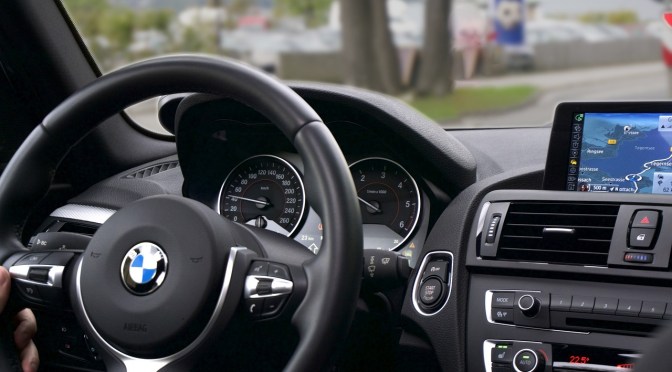
Inside, your car is a sensor farm. GPS saves your every move, cameras record facial expressions, microphones can listen in to phone calls, accelerometers record behavioural metrics, and the infotainment system stores everything from your phone. It’s a goldmine for third parties. The features that make the driving experience safer and slicker also pipe personal data to manufacturers, insurance companies, marketers and data brokers. The Mozilla Foundation even called cars the worst product category for privacy reporting that all 25 of 25 major car brands failed basic privacy tests – and some even admitted sharing data with marketing partners without additional consent. 

Here’s what’s happening, and what you can do about it. 

What Your Car Quietly Collects

Some of the data harvested by your vehicle makes sense, such as GPS data for navigation or tyre pressure monitoring for safety. Other tools keep you in lane, call emergency services, and prevent collisions, but also generate rich datasets about where you go, how you drive, and even who’s in the cabin. Precise location history, in-car microphone recordings, and driving behaviour are stored and transmitted to manufacturers, and third-party brokers. Most of this is buried in default settings and app permissions, masked as convenient connectivity to users. 

All of this was approved through the Biden Infrastructure Bill in 2021, along with the infamous vehicle “Kill Switch” that can shut down the vehicle remotely. That, too, is still in play. 

You can check exactly what data is collected by your vehicle using websites such as Privacy4Cars or VehiclePrivacyReport. 

You Can Restrict It – But There’s a Catch

Car makers can share or sell driving data and in-car collections for analytics, insurance pricing, advertising, and product development. While it’s possible to toggle certain sharing in vehicle menus, disabling some analytics also restrict features that drivers actually want such as live traffic or emergency calling options. Regaining privacy often means giving up conveniences you already paid for.  

Infotainment platforms and connected services may also have their own pipelines and policies too. The end result is a confusing patchwork where opt-outs in one place don’t necessarily carry over, and ultimate privacy can be hard to achieve. 

Why Is It Legal?

The Supreme Court in the US did rule that GPS tracking of a vehicle constitutes a search under the Fourth Amendment, which means that law enforcement must get a warrant before tracking your car. But, amazingly, that ruling only applies to government surveillance. Corporate data collection by private companies, including car makers and insurance companies, aren’t bound by the same constitutional limits. 

So, while the police need a warrant, entities profiting from your data do not. Accepting the terms and conditions at the dealership or when first using the car’s infotainment system means you’ve probably already consented to it, too. 

How Cars are More Invasive Than Phones

Smartphones collect location, Bluetooth beacons, and in-app events that can be linked to advertising ID or user accounts. App permissions, OS prompts and platform rules give tyou some visibility and control, and you can set location settings to Only While Using, revoke background access, and reset advertising IDs. But car data settings are more opaque and much trickier to navigate, with controls scattered between the dealer, the manufacturer, companion apps and more. 

Many people expect their phones to track them and have learned to simply manage those settings, which often come with clearer guidelines on when something is and is not actively monitoring their activity. Generally, people do not expect their cars to create a profile that is just as valuable – and in some cases even more actionable – for third parties. 

They Say You Can Opt Out, But It’s Not Always True

Turning off location services or clicking to opt out does not necessarily mean you’re in the clear. Independent research and investigative journalists have found that some connected vehicles continue to transmit telemetry for diagnostics, safety updates, or “system performance” even when privacy settings are disabled. 

And because the manufacturers control the software, there’s no public way to check what’s really being sent in the background. For many drivers, the only option is to trust the manufacturer’s promise – something that Mozilla’s 2023 report tells us is unwise given that every tested car brand failed basic privacy checks. 

In short, some brands’ default settings mean that the only true fix is choosing a different car. 

Final Thought

Analytics can save lives when the vehicle spots a crash, routes drivers around storms, or highlights a mechanical failure in the car. But it crosses into profitable surveillance when the same hardware also feeds businesses that create driver profiles, tailor prices, and targets individuals without clear consent. Privacy needs to be treated like a core safety feature too. Take time to audit your settings, restrict app access, wipe your data before service or sale, and make sure you know what will be recorded and sold before you buy your next car. 

Join the Conversation

Did you know how invasive car data collection can be? Have you checked settings in your own car? What else is tracking us without our knowledge? Most of us are so focused on phone tracking that we forget what else is profiling us. Add your thoughts at the link/source.

SOURCE

Photo credit: pixabay.com

The NZ government’s new rules are that NO stream or waterway needs to be avoided by helicopters dropping 1080 poison

BUFFER ZONES ROUND LAKES, RIVERS AND STREAMS NO LONGER A REQUIREMENT AT 1080 POISON DROPS

By Carol Sawyer

Someone has just asked me if having GPS in a helicopter means 1080 poison baits do not need to be dropped into waterways – i.e.that streams and waterways could be avoided.

Well, yes, but ag pilots tell me,  and Murray Dench also explains this quite well in the post below) that, even with GPS, bait-dropping can only be accurate with some certainty to within a minimum of 200 metres, and even then, so-called ” overflies” happen (i.e. baits land outside the drop zone).

A good example of an “overfly” was the Kepler Mountains drop at Lake Manapouri in Spring 2016 when a 200 ha area outside the drop zone was covered in 1080 baits by HeliOtago.

(Even though protestors were initially blamed for this, HeliOtago later admitted the cause was that their pilots were under pressure to finish the job).

However the new government rules are that NO stream or waterway needs to be avoided by helicopters dropping 1080 poison, so the question of GPS accuracy and bait-dropping is somewhat academic!

Even when buffer zones are set around waterways, they tend to be woefully inadequate. In Febuary 2017, at the 1080 poison drop at Makarora, a 20 metre buffer zone was applied to the Makarora and Wilkin Rivers, yet baits were found in these rivers after the poison drop.

Below is Murray Dench’s report:

DROPPING 1080 POISON FROM THE SKY IS NOT AN ACCURATE PROCESS

In 2007, following the ERMA Review, Murray Dench wrote to Andrea Eng, General Manager Hazardous Substances, ERMA on Differential Global Positioning Systems with regard to dropping 1080 baits. What he wrote is very interesting. Here it is :

“The distribution of the baits from a helicopter is far from certain. While DGPS has allowed more accurate placement of the aircraft there are other factors involved :-

1. The groundspeed of the machine during the delivery run.

Over level terrain this is quite easily controlled but over steep terrain (where the helicopter is most ‘useful’) every act of climbing and descending to match the contour changes the ground speed.
This is difficult to control because the pilot (if he’s smart) will be concentrating on terrain avoidance and personal welfare to the detriment of accurate groundspeed monitoring.
Another negative factor is wind speed and its degree of crosswind (or even tail wind) component. Again, in level terrain the crosswind component is relatively constant and can be allowed for but in broken country wind changes are legendary including lift, lee turbulence, rotor action, and a raft of others which sensible pilots do their best to avoid.
The changing wind speeds and directions rapidly change the aircrafts airspeed indication for which the pilot must compensate to maintain the target groundspeed. It also rapidly changes the aircraft direction of travel and rate of climb which has to be constantly corrected. When you combine terrain avoidance with constant altitude changes and violently changing wind speed and direction it is not hard to see that accurate distribution of baits is not likely.

2. The height of the machine above the ground during the delivery run.

It is assumed that the hopper delivery system is designed to produce a certain pattern on the ground when delivered from a certain height. If the delivery is from a lesser height then the pattern will not have reached its full dimension and a narrow strip of high bait concentration will be laid. If the delivery is from a greater height than the target then the delivery pattern may be wider with reduced bait density. If delivery from the ideal height results in the baits falling vertically downwards then distribution from a greater height is okay except that the baits are longer in the air and are therefore more susceptible to wind currents moving them out of the intended delivery zone. Trying to maintain an accurate height above ground in steep and broken country while trying to maintain groundspeed and avoid terrain creates a scenario ripe for failure.

3. Accurate delivery relies on the baits exiting the hopper and dropping onto the spinning distribution disc at a constant rate.

This is highly unlikely. The greater the head (weight) of baits in the hopper the greater is the pressure available to push the bottom baits out. As the hopper level reduces the pressure reduces and so the flow of baits also reduces. It is possible that there is some compensation for this negative affect provided by the reducing friction losses against the hopper walls as the hopper level falls but given slippery carrots and free flowing cereal baits it is hard to imagine this mitigation being enough. It is a pretty safe bet that the distribution density of baits at the start of a run is greater than at the end.

4. Overlap.

If a circle of material is continuously dropped while in motion then the path along the centre line of the circle will receive twice as much material as the edges. This is because the material which is thrown forward is added to by the material which is thrown backwards over exactly the same path whereas the material thrown to the extreme edges cannot be duplicated. This provides a distribution pattern with the highest concentration along the centreline of the direction of travel gradually reducing to the minimum distribution density along both edges. It is not possible to produce an even distribution density from a moving 360° rotating disc. It is assumed the applicators mitigate against this effect by overlapping each delivery run so the low distribution density strips along the edges are ‘double dosed’ to achieve the target density.
Again it is assumed this need to overlap is programmed into the tracks to be flown under GPS guidance but is another error inherent in the entire delivery system.

Unintended by-kill is closely correlated with bait distribution.

Having a DGPS in the cockpit of the delivery aircraft is certainly a help but many other factors need assessment and controls added to improve the chance of accurate delivery.
ERMA failed to investigate and understand the variables associated with bait delivery and how poor distribution might easily result and instead nominated DGPS as a ‘cure all’ which it cannot be.”

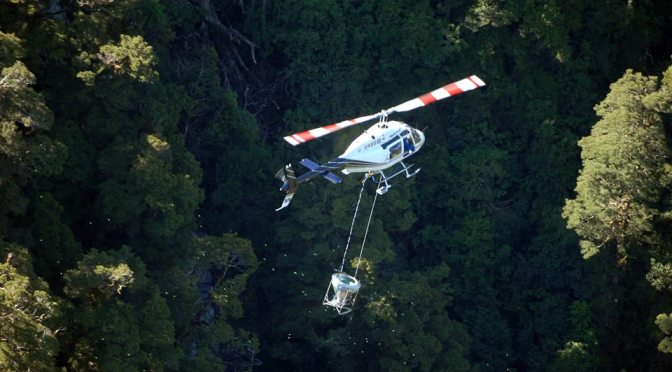
Look closely at the photo above in the header image and you will see baits flying in all directions. This helicopter is low to the bush. Imagine that same helicopter at height and you can start to realize the inaccuracy of a bait drop.

Must See Documentary: Pharmaceutical & Medical Industry Kill More than All Wars


All information reported on TRUTH TALK NEWS and HowardNema.com is sourced and verifiable.
It is critical that you take the initiative to confirm the information contained in this presentation.

For a library of additional links, books, articles and related information please visithttp://www.HowardNema.com

Find your own truth.
There is only one truth.
Seek and you will find it.

http://www.youtube.com/TruthTalkNews
http://www.TruthTalkNews.blogspot.com
http://www.youtube.com/TruthTalkNewsLIVE

READ MORE: http://www.truthtalknews.blogspot.co.nz


RELATED: 

Death by Medicine a film by Gary Null

See our Cancer pages particularly ‘How Modern Medicine Became a Monopoly’.

EnvirowatchRangitikei