

Buying local or growing your own has long been the mantra of those who foresaw this manufactured event in one form or another … “who controls the food supply controls the people; who controls the energy can control whole continents; who controls money can control the world” Henry Kissinger
Continue reading Buy local, grow your own as decisions taken overseas challenge our Kiwi way of lifeTag Archives: famine

Now McCain is sticking it to New Zealanders
I wonder, is the new Hawke’s Bay crop going to be pine trees? RNZ reports that “since 2020, IKEA has converted six Central Hawke’s Bay farms into pine forestry, which they believe makes them the largest forestry owner in the district.”
Continue reading Now McCain is sticking it to New Zealanders
The Truth About the ‘Great Irish Famine’ of 1845-1850
An exposé of the Irish famine (book review) … further illustration of how genocide is not new, and how the victors write our histories … a must read. I encourage you to sub to Unbecoming’s excellent substack. EWNZ
From From Unbekoming @ substack
By Chris Fogarty – 30 Q&As – Unbekoming Book Summary
For over 170 years, the world has been told that Ireland suffered a natural famine between 1845 and 1850 – a tragic tale of potato blight and a foolish population’s over-dependence on a single crop. This story, taught in universities, memorialized in museums, and repeated in countless history books, has one fundamental problem: it’s a deliberate lie. Christopher Fogarty’s “Ireland 1845-1850: The Perfect Holocaust and Who Kept it ‘Perfect’” demolishes this narrative with military deployment records, shipping manifests, and Ordnance Survey maps that reveal what actually happened. While only the potato crop failed, Ireland continued producing massive quantities of grain, cattle, dairy, and other foods – all of which were removed at gunpoint by 67 British Army regiments, approximately half of Britain’s entire military force, and shipped to England while the producers starved. The death toll wasn’t the officially claimed 21,770 but approximately five million people, half of Ireland’s population.
The evidence Fogarty presents reads like a prosecutor’s case file. He names every British regiment involved, tracking their movements through Ireland’s 32 counties via National Archives records. He identifies General Sir Edward Blakeney as the Commander-in-Chief who orchestrated this operation from before 1845 through after 1851 – a man Queen Victoria honored with the Order of the Bath in 1849 as he neared completion of his genocidal mission….
READ AT THE LINK
The book title:
“Ireland 1845-1850: the Perfect Holocaust, and Who Kept it “”Perfect.”
Image by Fathromi Ramdlon from Pixabay

The food control plan from 1974 that you probably didn’t know about
UPDATE: Kissinger has now passed. Related post from expose-news.com:
War Criminal and Depopulationist Henry Kissinger dies
This article appeared as part of a feature in the December 8, 1995 issue of Executive Intelligence Review.See Feature Introduction and Table of Contents.
Kissinger’s 1974 Plan for
Food Control Genocide
by Joseph Brewda
On Dec. 10, 1974, the U.S. National Security Council under Henry Kissinger completed a classified 200-page study, “National Security Study Memorandum 200: Implications of Worldwide Population Growth for U.S. Security and Overseas Interests.” The study falsely claimed that population growth in the so-called Lesser Developed Countries (LDCs) was a grave threat to U.S. national security. Adopted as official policy in November 1975 by President Gerald Ford, NSSM 200 outlined a covert plan to reduce population growth in those countries through birth control, and also, implicitly, war and famine. Brent Scowcroft, who had by then replaced Kissinger as national security adviser (the same post Scowcroft was to hold in the Bush administration), was put in charge of implementing the plan. CIA Director George Bush was ordered to assist Scowcroft, as were the secretaries of state, treasury, defense, and agriculture.
The bogus arguments that Kissinger advanced were not original. One of his major sources was the Royal Commission on Population, which King George VI had created in 1944 “to consider what measures should be taken in the national interest to influence the future trend of population.” The commission found that Britain was gravely threatened by population growth in its colonies, since “a populous country has decided advantages over a sparsely-populated one for industrial production.” The combined effects of increasing population and industrialization in its colonies, it warned, “might be decisive in its effects on the prestige and influence of the West,” especially effecting “military strength and security.”
NSSM 200 similarly concluded that the United States was threatened by population growth in the former colonial sector. It paid special attention to 13 “key countries” in which the United States had a “special political and strategic interest”: India, Bangladesh, Pakistan, Indonesia, Thailand, the Philippines, Turkey, Nigeria, Egypt, Ethiopia, Mexico, Brazil, and Colombia. It claimed that population growth in those states was especially worrisome, since it would quickly increase their relative political, economic, and military strength.
For example, Nigeria: “Already the most populous country on the continent, with an estimated 55 million people in 1970, Nigeria’s population by the end of this century is projected to number 135 million. This suggests a growing political and strategic role for Nigeria, at least in Africa.” Or Brazil: “Brazil clearly dominated the continent demographically.” The study warned of a “growing power status for Brazil in Latin America and on the world scene over the next 25 years.”
Food as a weapon
There were several measures that Kissinger advocated to deal with this alleged threat, most prominently, birth control and related population-reduction programs. He also warned that “population growth rates are likely to increase appreciably before they begin to decline,” even if such measures were adopted.
A second measure was curtailing food supplies to targetted states, in part to force compliance with birth control policies: “There is also some established precedent for taking account of family planning performance in appraisal of assistance requirements by AID [U.S. Agency for International Development] and consultative groups. Since population growth is a major determinant of increases in food demand, allocation of scarce PL 480 resources should take account of what steps a country is taking in population control as well as food production. In these sensitive relations, however, it is important in style as well as substance to avoid the appearance of coercion.”
“Mandatory programs may be needed and we should be considering these possibilities now,” the document continued, adding, “Would food be considered an instrument of national power? … Is the U.S. prepared to accept food rationing to help people who can’t/won’t control their population growth?”
Kissinger also predicted a return of famines that could make exclusive reliance on birth control programs unnecessary. “Rapid population growth and lagging food production in developing countries, together with the sharp deterioration in the global food situation in 1972 and 1973, have raised serious concerns about the ability of the world to feed itself adequately over the next quarter of century and beyond,” he reported.
The cause of that coming food deficit was not natural, however, but was a result of western financial policy: “Capital investments for irrigation and infrastucture and the organization requirements for continuous improvements in agricultural yields may be beyond the financial and administrative capacity of many LDCs. For some of the areas under heaviest population pressure, there is little or no prospect for foreign exchange earnings to cover constantly increasingly imports of food.”
“It is questionable,” Kissinger gloated, “whether aid donor countries will be prepared to provide the sort of massive food aid called for by the import projections on a long-term continuing basis.” Consequently, “large-scale famine of a kind not experienced for several decades—a kind the world thought had been permanently banished,” was foreseeable—famine, which has indeed come to pass.
SOURCE: https://larouchepub.com/other/1995/2249_kissinger_food.html
Famines are not a natural phenomenon: control the food, control the people
From mypatriotsupply.com
Henry Kissinger famously said, “Who controls the food supply controls the people; who controls the energy can control whole continents; who controls money can control the world.”
History shows us this is true – especially when it comes to controlling food.
Many people would like to believe that famines are a natural phenomenon. Unfortunately, this is seldom the case.
Time and time again, famines are man-made and the result of political agendas.
Alex de Waal, author of Mass Starvation: The History and Future of Famine, says, “Famine is a very specific political product of the way in which societies are run, wars are fought, governments are managed. The single overwhelming element in causation —in three-quarters of the famines and three-quarters of the famine deaths—is political agency. Yet we still tend to be gripped by this idea that famine is a natural calamity.”
It is a difficult pill to swallow – that one’s own country would allow their people to starve, and in some cases, purposely. And yet, history doesn’t lie.
Let’s take a look back at some of the worst man-made famines in history to better prepare ourselves for this sad possibility.
READ AT THE LINK
https://www.mypatriotsupply.com/blogs/scout/control-the-food-control-the-people
RELATED: Food Supply Shutdown: Deer, fish, pigs euthanized; crops not planted
Photo: pixabay.com
It’s beginning to look a lot like famine But don’t tell “our free press,” whose job is to deny it, while doing everything they can to bring it on
READ AT THE LINK
RELATED:
BlackRock and Vanguard are taking over centralized food production technologies and will have near-total control over the future food supply in America
Photo: AbsolutVision @ pixabay.com
Vandana Shiva: When Bill Gates pours money into Africa to feed the poor & prevent famine, he’s continuing the work of Monsanto, pushing chemicals, GMOs & the failed Green Revolution

Subscribe to France 24 now: http://f24.my/youtubeEN FRANCE 24 live news stream: all the latest news 24/7 http://f24.my/YTliveEN
Our guest is Vandana Shiva, a world-famous environmental activist from India. Her latest book is entitled “One Earth, One Humanity vs. the 1%”. She tell us about more her opposition to big multinationals such as Monsanto for their nefarious influence on agriculture. But Shiva also singles out billionaires like Bill Gates and Mark Zuckerberg for criticism. “When Bill Gates pours money into Africa for feeding the poor in Africa and preventing famine, he’s pushing the failed Green Revolution, he’s pushing chemicals, pushing GMOs, pushing patterns”, she tells FRANCE 24’s Marc Perelman. Visit our website: http://www.france24.com
Joining any dots yet?

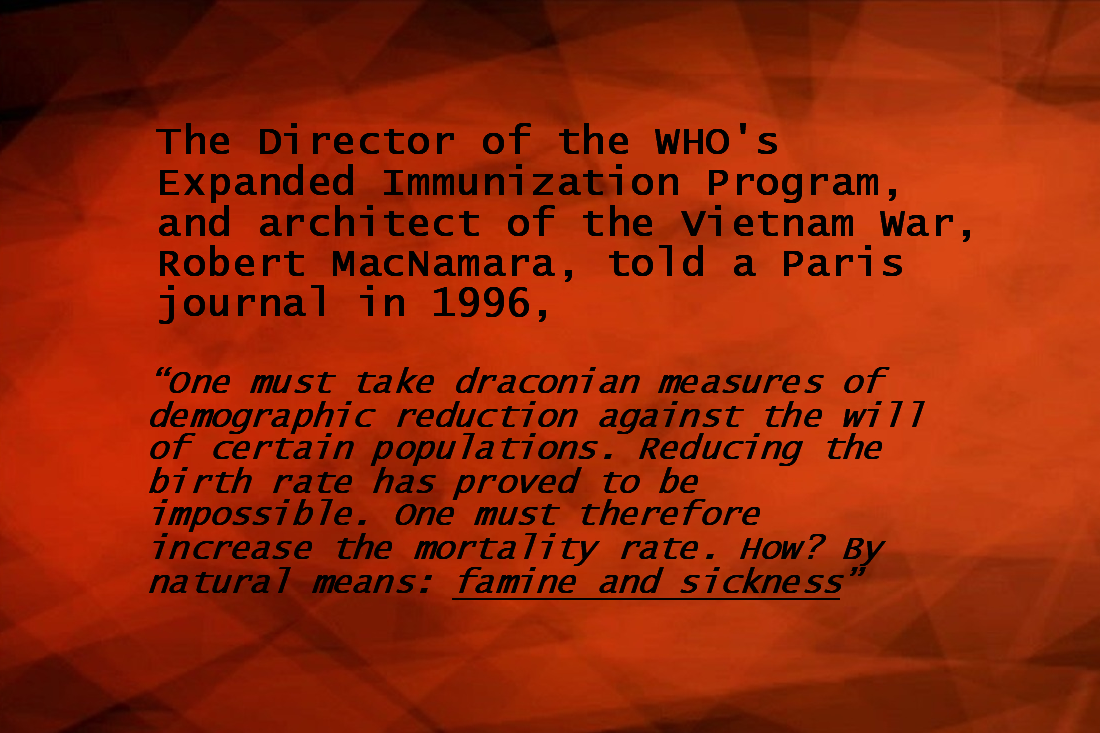
Population control (or should that be population reduction?) is the agenda of the so called elitists. Robert McNamara was a zealous advocate. The following article is on topic:
McNamara’s Folly: Bankrolling Family Planning
RELATED: (article posted today)
Doctors issue infertility warning over Gates’ CV vaccine as it’s rolled out in Britain & the UK govt says it DOESN’T KNOW what the effect of the vaccine will be on fertility
The Technocratic, Transhumanist Total Takeover of Food
The Ice Age Farmer

100K subscribers
To understand the meat shortages and push for fake meat, we must appreciate the technocrats’ agenda for a totalitarian, transhumanist future — and use of FOOD as a weapon to achieve it. Christian looks more deeply into the genesis of this agenda, the history of Rockefeller takeover of agriculture and seeds, the more recent marriage of Big Ag and Big Tech (“AgTech”), and the new AI systems being deployed to achieve “perfect information awareness” — and total control. Subscribe via DLive for more livestreams! http://dlive.tv/iceagefarmer FULL SHOW NOTES: SUBSCRIBE on bitchute: http://bitchute.com/iceagefarmer SUPPORT THE SHOW: http://patreon.com/iceagefarmer http://paypal.me/iceagefarmer JOIN THE CONVERSATION: http://iceagefarmer.com/discord IAF RESOURCES: ⇒ GDD: Growing Degree Days tool: how much colder has 2019 been for you? http://iceagefarmer.com/gdd ⇒ IAF Wiki – read history, understand cycles, know what’s coming: http://wiki.iceagefarmer.com/wiki/His… ⇒ Maps from previous cycles: http://wiki.iceagefarmer.com/wiki/Str… ⇒ Crop Loss Map http://map.iceagefarmer.com ⇒ Join the email list – stay connected: http://iceagefarmer.com/mail *** SUPPORTERS – I recommend (because I use personally) *** STORED FOOD (+ more) @ MyPatriotSupply: http://iceagefarmer.com/prep BUY SEEDS @ TRUE LEAF MARKET: http://iceagefarmer.com/trueleaf EMP-proof Solar: mention IAF save $250 http://Sol-ark.com BEST CBD: http://bignuggetfarm.com 10% code: IAF2018 ⇒ More books: http://amazon.com/shop/iceagefarmer ⇒ Stored food: http://iceagefarmer.com/prep ___

A pertinent clue as to why most of the world is sick & starving
EWR

You must be logged in to post a comment.