I was forwarded an email recently appealing for help for these farmers. Those who buy real milk aka by the newbies as ‘raw’ (ie non-treated to the extent all the goodness has gone) will be aware of the tough time these farmers have had in recent years as the system imposes more and more costs to stay afloat. Not difficult to see the agenda in light of the push toward fake food world wide. I’m copying their letter below (or see info at the link). If you are able to help I know that will be gratefully appreciated. EWR
The New Zealand Ministry for Primary Industry (MPI) has brought criminal charges against as many as 16 farmers for violations of that country’s Raw Milk for Sale to Consumers Regulations 2015 (the “2015 regulations”). As far as is known, none of the cases have actually gone to trial. At least five farmers have settled their cases by pleading guilty to a reduced number of charges and agreed to pay fines of as much as $50,000; in two other court actions where the farmers had plead guilty to violations of the raw milk laws, judges discharged the cases without convictions. Most of these farmers, whether or not they had to pay fines, owe tens of thousands of dollars in attorney fees. Of these seven farmers, only one remains in the business of selling raw milk for human consumption. An attorney representing one of the farmers has been unable to find evidence that any of the charged farmers made anyone ill with the milk they produced.
ACTION TO TAKE
A GiveSendGo fund has been set up to help pay legal expenses for five of the prosecuted farmers (listed on the fund page). None of these farmers became rich selling raw milk—they were dedicated to producing healthy food for their customers and community. Please be there for them and help the farmers recover some of the losses they have suffered due to the unjust government enforcement actions.
The 2015 regulations were the catalyst for the prosecution against the dairies. The farmers are being prosecuted for a violation of laws designed to put them out of business. In addition to having to register with MPI, dairy farmers under the new regulations are required to:
The 2015 regulations had little to do with science and protecting the public health. Many farmers, believing that they would not be able to afford the cost of compliance with the new rules, distributed milk through contractual arrangements such as limited partnerships and herdshare agreements—arrangements they thought would exempt them from the new rules. When MPI saw that not many farms were registering, it launched a sting operation, “Operation Caravan”, against the unregistered raw milk farmers, leading to the ongoing criminal prosecutions.
The 2015 regulations have been a big success for MPI in driving raw milk farmers out of business. Shortly before the ministry issued the new regulations, there were upwards of 200 dairies selling raw milk; today there are around 25.
Please help the Weston A. Price Foundation restore nutrient-dense foods to the human diet through education, research and activism. westonaprice.org
In one of the more draconian enforcement actions ever taken against raw milk producers, the New Zealand Ministry for Primary Industry (MPI) brought criminal charges against the farmers of nine different raw milk dairies for violations of that country’s Raw Milk for Sale to Consumers Regulations 2015 (the “2015 regulations”). Some of the defendants have also been charged with violations of the Animal Products Act (APA). The raw milk charges assert that by engaging in the supply of raw cow milk “a direct or indirect risk to human or animal health would be created.”
The Weston A. Price Foundation (WAPF) is aware of specific charges against three of the farms (two of the three are operated by pensioners). Cedric Backhouse and his wife (WAPF chapter leader Susan Gales) of Alt Energy Farm are each being charged with 26 violations of the 2015 regulations and the APA related to the distribution of raw milk and meat through a herdshare agreement; the potential penalties for each defendant are up to 19 years in jail and $1.8 million (over $1.25 million in U.S. dollars) in fines.
Phillippa (Pip) Martin and John Martin of Manna Milk are each facing seven charges with penalties of up to 12 years in jail and $545,000 in fines (over $380,000 US) for alleged violations of the 2015 regulations and the APA related to the distribution of raw milk through a limited partnership agreement.
Paul and Christine Ashton of Lindsay Farms are each facing five charges with penalties up to eight years in jail and $320,000 in fines (over $225,000 US) for alleged violations of the 2015 regulations related to the distribution of raw milk through a limited partnership agreement.
A majority of the farmers charged were operating under a herdshare or a limited partnership business model as a matter of survival after MPI issued the 2015 regulations affecting raw milk production and sales (the regulations went into effect in March 2016). The ministry promulgated the regulations as a result of a 2014 foodborne illness outbreak associated (or blamed on) raw milk consumption where seven people became ill.
The number of dairies selling or distributing raw milk is a fraction of what it was before MPI imposed the new regulations. It is considerably more difficult for the remaining dairies to make a living than it was five years ago. MPI’s enforcement action against the farmers–in addition to putting the charged farms out of business–is designed to create a chilling effect on the remaining farms and on farmers thinking of starting up a raw milk business.
ACTION TO TAKE
WAPF, a 501(c)(3) nonprofit, is accepting donations to help pay legal expenses for the charged farmers. Donations are tax deductible to the fullest extent of the law. To donate, please use the link here (westonaprice.org/donate) and indicate the fund for ‘New Zealand raw milk’. (For those wanting to send a check, please specify that it is for “New Zealand raw milk”.)
MORE BACKGROUND
Before the 2015 regulations went into effect, it was estimated that as many as 200 farms were selling or distributing raw milk in New Zealand; today there could be less than 20% of that number still left.
A. Compliance Barriers
The cost to raw milk farms to comply with the 2015 regulations was in the range of $10,000-$20,000 per year for each farm regardless of what the farm’s production volume was—an expenditure that many farms could not afford. Beyond that, there were several ways that the new requirements significantly hurt the farmers’ ability to make a living.
1. Depot Permits and Burdens
Before 2016, farmers were able to deliver raw milk to a central distribution point (also known as a “depot”), a necessity given the distance between most farms and their customers plus the substantial amount of extra time it takes to deliver door-to-door. The new regulations required a permit for each depot the farmers were delivering to; otherwise, sales were limited to on-farm and to customer premises. Given the estimated cost of permitting each depot, out of the 26 raw milk farms that have registered with MPI (registration was also a requirement in the 2015 regulations), only one has obtained depot permits. Any customer wanting to pick up milk at the depot had to be registered with MPI as a transport operator. There are numerous recordkeeping requirements for a transport operator even when that individual is picking up milk for his or her own family.
2. Sell-by and Use-by Constraints
The most damaging provisions for farmers in the new regulations were sell-by and used-by requirements for raw milk. The regulation for a sell-by time states the following:
“The sell-by time for a lot of milk is the time that is the 30 hours after the commencement of milking for the oldest milk in that lot. (For example, if milking commenced at 7am on Monday 4 June, the sell-by time is 1pm on Tuesday 5 June, even if milk from a subsequent milking is added to that lot.).”
One of the registered farms estimated that this mandate cost them 30% of their business since the farm was unable to meet the time constraints in getting the milk to its more distant customers.
The requirement for the use-by date for raw milk “is 4 days after the commencement of milking for the oldest milk in the lot.”
3. Testing
Another onerous mandate for the farmers is on testing. Dairies are required to test for five different pathogens, coliforms, plate count, somatic cell counts, and “inhibitory substances” every 10 days. Estimates for the cost of testing are around $750 per month.
4. Records
Lastly, the regulations require that farmers not only keep customer names on file for MPI inspection but also every transaction with each customer as well.
B. Alternate Business Models
Many dairies, knowing they couldn’t afford the cost of compliance with the new regulations, went out of business before the new law took effect. Others–believing their only way to stay afloat was to not have to comply with the 2015 regulations–set up business models such as herdshare programs and limited partnership agreements, proceeding in good faith that giving their customers an ownership interest in their dairy livestock would exempt them from the new requirements.
C. MPI Raids
When fewer raw milk producers registered than MPI had anticipated, in 2019 the ministry launched “Operation Caravan”, an investigation of dairies that MPI suspected were not complying with the new regulations. The investigation included the extensive use of MPI undercover operatives. In December 2019 MPI obtained search warrants and raided eight raw milk farms and farmers’ homes around the country, seizing everything from customer lists to computer hard drives. Some of the raided farms shut down; others kept on going. After a year-long investigation, MPI filed criminal charges in December 2020. The Ashtons had registered Lindsay Farm with MPI months earlier, having been told by the ministry that any potential charges would go away if the farm was registered.
Backhouse and Galea are each charged with 17 counts of selling or offering to sell illegally home-killed meat; each count lists the amount allegedly sold as under $100 and one was for only $15.40. The potential fine for each of the 17 charges is up to $75,000. MPI has never accused Backhouse and Galea of making anyone sick with the milk or meat they produced.
An attorney representing one of the charged farmers has been unable to find evidence that any of the charged farmers made anyone ill with the milk they produced. Under the law, MPI can only prosecute those whose products pose a public health risk.
Arraignment for defendants is scheduled to take place in March.The accused farmers and the 250,000 New Zealand residents who consume raw milk need your support.
Please contribute to this effort to protect freedom of choice, strong local food systems, and the right of small farmers to make a living producing nutrient-dense food.
To donate, please use the link here (westonaprice.org/donate) and indicate the fund for ‘New Zealand raw milk’. (For those wanting to send a check, please specify that it is for “New Zealand raw milk”.)
Thanks for your generosity and your help in spreading the word.
It can take some effort to find a ‘healthy’ commercially-prepared substitute for cow’s milk. One will go through a number of different milk products before even finding which is best; but know this, there is an alternative to conventional cow’s milk that stands out above the rest.
“Eight months ago, Shaylin Downs struggled to make it to school. Her chronic eczema saw her spend days in a wheelchair, travelling to Taranaki Base Hospital three times a week for treatment, unable to enjoy many of the opportunities her school friends did…”
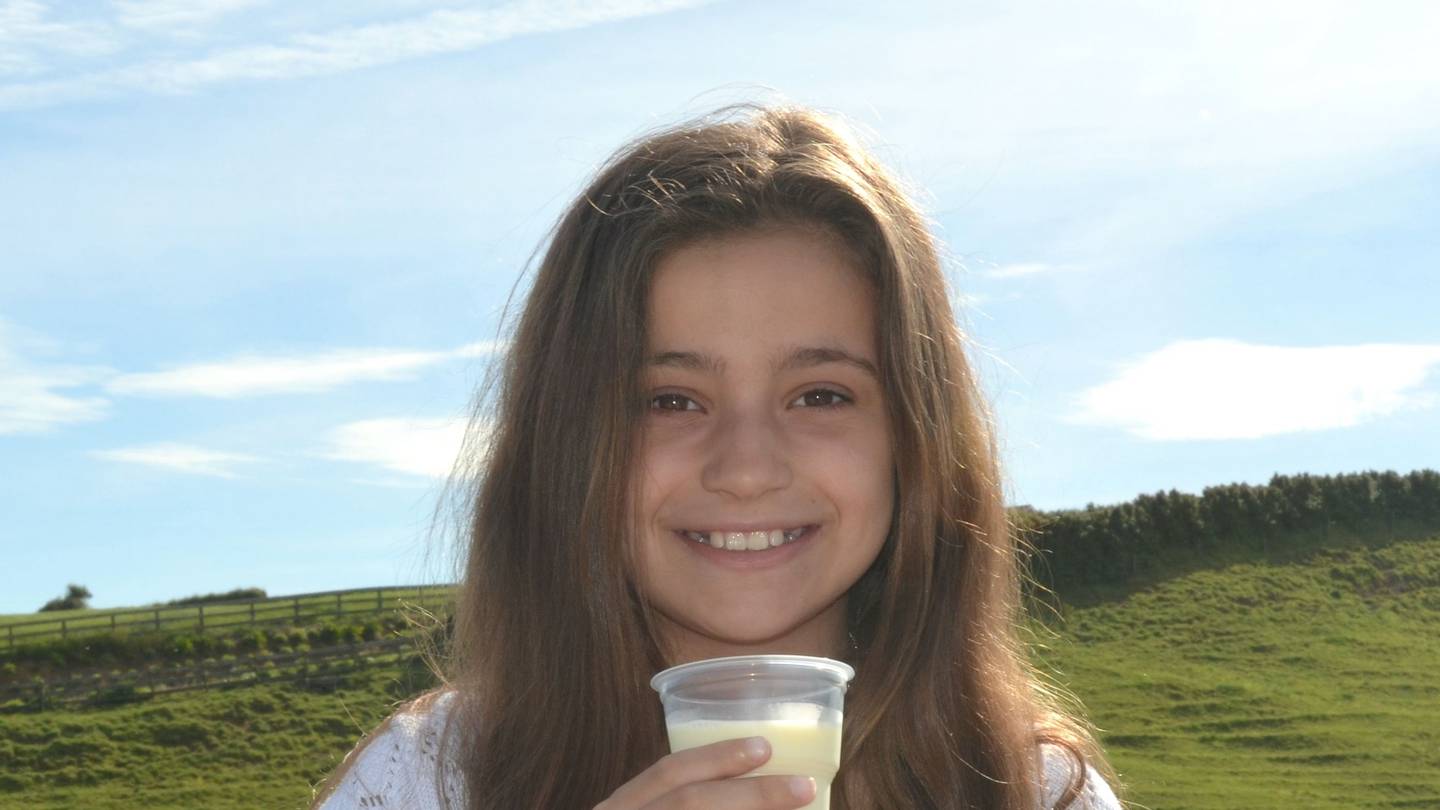
This little girl spent some days wheelchair bound & up to three days a week getting hospital treatment for her eczema. Any parent knows the agony such a child goes through … the itching … unable to scratch and sleepless nights. Yet after a recommendation to try drinking raw milk she is now able to enjoy a normal life. What a wonderful story.
And there are other stories out there like this one. I know personally of kids who suffer eczema if drinking treated milk, but don’t with raw.
Raw milk can still be obtained in NZ, although in some countries it is banned because of health scares. The need to be super sterilized went to the other end of the spectrum and much of the goodness contained in raw is destroyed. Modern equipment and the production of organic raw however means the product’s quality is stringently controlled. Like any food item, you treat it with respect and heed all the requirements regarding cleanliness and refrigeration. I personally buy organic raw, have done for nearly ten years and I seldom ever drink the treated product now.
Read the Taranaki article from the Stratford Press below:
Hello Dolly, Farewell Eczema
Stratford Press
By Ilona Hanne
Eight months ago, Shaylin Downs struggled to make it to school. Her chronic eczema saw her spend days in a wheelchair, travelling to Taranaki Base Hospital three times a week for treatment, unable to enjoy many of the opportunities her school friends did.
With her sheets and pyjamas needing soaking off her in the morning, Shaylin’s life was dominated by her illness.
This summer however, Shaylin is looking forward to being able to join in with her friends, and even going to the beach, something that used to be impossible for her with the salt and sand aggravating her skin.
The difference, says Shaylin’s mum Nikki Hall, is down to a change in diet. “Since Shaylin has been drinking Dolly’s Milk every day we have seen such an amazing difference in her skin and it has impacted her whole life.”
Dolly’s Milk is a raw milk business run by Peter and Margaret Dalziel in Stratford, and they say they aren’t surprised by Shaylin’s story.
“We have heard from lots of people that raw milk can make a real difference in conditions such as asthma and eczema, as well as a range of other ailments which is why we suggested Shaylin try introducing it to her diet.”
With the dramatic improvements in Shaylin’s health, she and her family were able to enjoy a family holiday to Auckland for Shaylin’s 11th birthday. The trip was funded by members of the community who worked hard to raise $2085.17 through various events and auctions.
“I just can’t thank people enough, Shaylin’s life has been completely changed over the past year, and it has been really amazing having the community be so supportive of her.” Nikki adds that her church have also been “amazing, they have supported me emotionally throughout this, as it has been so draining, trying to manage Shaylin’s eczema and keep going every day”.
Nikki says that while Shaylin’s eczema still needs careful management, “and we certainly don’t go anywhere without making sure we have plenty of Dolly’s Milk with us”, their entire family life has changed. “I can now look for more regular work. Before I was limited because I was often at home with Shaylin when she was too unwell to go to school.”
Moana Hancock, one of the fundraising co-ordinators, says that they are “so very grateful” to all the businesses who helped by donating goods and services. These include: Nix Dungeon, Romayse Tutus, Eternal Essence, Dolly’s Milk, Verdigris, Studio 88, Institches, Lara Fay Hairdressing, Egmont Beauty, Ink Pot Cafe, Dane Carr Personal Trainer, Bite Me Cakes, Suede Hair by Design, Ann Coles Photography, Ashleigh Tippet Make Up Artistry, TET Stadium Restaurant and Bar, Robertson Eczema Relief and the Stratford Press.
Shaylin herself thanks everyone in the community who have helped her, adding a special thank you to all her friends, “who have stuck by me even when I was in a wheelchair”.
Do your own research and make an informed decision. If you opt for raw, you can buy it from the farm gate in many districts throughout NZ. You will need to ask around your area locally. There is now a world wide trend to shut such sources down in favour of processed milk which again, contains little nutrients compared to the raw counterpart. Even organic supermarket milk is heated according to standards so again, the nutrients are diminished. Very sad all around. Our forbears drank milk straight from the cow as did I as a child before it suddenly became a health risk. Interestingly nobody I knew of back then ever got sick or died from drinking raw milk. It was delivered daily, free, to children at school to drink during break, and we purchased it raw from the dairy, baled by the dairy owner into our own billy (or small milk can). That was in the era before we needed recycling. The bottles were washed & refilled. Who had the healthier, more cost effective and (that Agenda 21 word) sustainable system?
Doctors even prescribed it for health. Gone are the days. EWR
RELATED:
Dr Sam Bailey has posted an article and subsequent video on topic:



You must be logged in to post a comment.