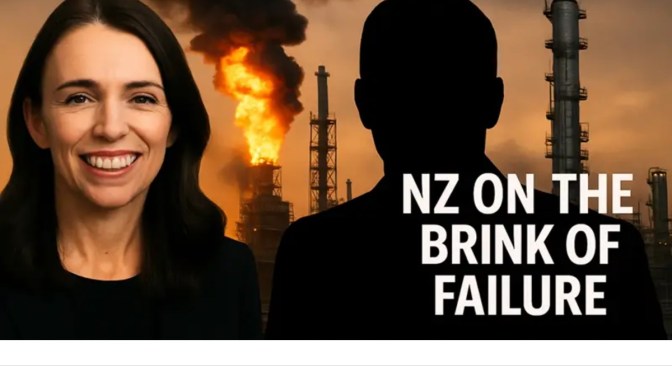
From Mykeljon Winckel @ elocal
via Robin Westenra @ seemorerocks substack
New Zealand today stands in the jaws of a recession deeper and more structural than anything we have seen in decades. Businesses are folding. Workers are fleeing. Families are giving up hope. And yet, somehow, among all the noise, one catastrophic act of economic vandalism continues to escape the national reckoning it deserves:
The deliberate destruction of New Zealand’s only oil refinery at Marsden Point.
Not downgraded. Not mothballed. Destroyed — with no replacement, no transition plan, and no economic modelling worthy of the name.
This was not incompetence. This was government-induced economic terrorism against the long-term interests of the New Zealand people.
And it began under Prime Minister Jacinda Ardern.
The Refinery That Anchored a Nation
Marsden Point wasn’t just an industrial site — it was the beating heart of New Zealand’s energy security. Built in 1964, expanded repeatedly, and modernised as recently as 2018 with a $365 million Te Mahi Hou project, the refinery produced:
- NZ’s petrol
- NZ’s diesel
- NZ’s jet fuel
- NZ’s bitumen
- NZ’s chemical feedstocks
- NZ’s industrial gases
- NZ’s fertiliser inputs
It reduced emissions. It added resilience. It protected our sovereignty.
And then, with ideological zeal dressed up as climate virtue, Ardern’s government backed its closure. Not because it was failing — but because Wellington wanted “alignment with global decarbonisation trends,” a phrase now exposed as vacuous marketing gibberish.
The government knew — yes, knew — that New Zealand would become 100% dependent on imported refined fuels. They knew that we would lose:
- 60 days of crude storage, replaced by just 8 days of refined fuel reserves
- All domestic bitumen production
- All domestic jet fuel resilience
- All domestic ability to refine crude in an emergency
They knew a natural disaster could sever our lifeline. They knew a geopolitical conflict could choke our supply. They knew global refiners could charge whatever they wanted.
And they did it anyway.
“We now only have 8 days of fuel reserves compared to 60 days when Marsden Point was operational… New Zealand is totally reliant on imported fuels… We are without fuel security for the first time in 60 years.”
Ardern’s Legacy: Dependency and Decline
New Zealand is now one shipping delay away from grounded aircraft, immobilised logistics, and a nationwide economic choke-hold. This is not hypothetical — basic supply-chain maths confirms it.
And four years later, the current government under Prime Minister Christopher Luxon has done nothing to reverse or even question this national insanity.
Political cowardice has replaced political leadership. Corporate appeasement has replaced national resilience. And ordinary New Zealanders — the workers, the truckers, the small businesses — are paying the price.
The Economic Reality: Cheap Energy Builds Nations
Every wealthy nation has one thing in common:
Abundant, cheap, reliable domestic energy.
Not imported fragility. Not ideological wish-casting. Not the childish delusion that a country can “transition” by destroying what sustains it.
The closure of Marsden Point was not a transition. It was a surrender — a forced de-industrialisation. A deliberate kneecapping of national capability.
New Zealand now imports bitumen, jet fuel, and diesel from overseas refineries operating under far poorer environmental and labour standards — including, in some cases, the use of child labour in raw material supply chains.
This is what the so-called “clean energy transition” looks like: pollution exported, sovereignty surrendered, illusion maintained.
A nation without energy security is not a nation. It is a client state.
Karl Barkley: One Citizen Doing More Than the Entire Government
While Parliament sleeps, one man — Karl Barkley, engineer and farmer — is fighting to restore what politicians destroyed.
His letter speaks for millions:
“We now only have 8 days of fuel reserves compared to 60 days when Marsden Point was operational… New Zealand is totally reliant on imported fuels… We are without fuel security for the first time in 60 years.”
He has launched KIWI REFINING COMPANY LTD with a vision to bring the refinery back to life, under public ownership, for the public good.
A single citizen, doing the work Cabinet refuses to touch.
Because he understands what the political class either cannot — or will not — accept:
A nation without energy security is not a nation. It is a client state.
The Truth: We Are on the Brink of National Failure
New Zealand is:
- Losing skilled workers at record rates
- Watching businesses collapse weekly
- Facing rising energy bills and grid instability
- Running a government addicted to debt and slogans
- Led by politicians who refuse to confront the damage already done
Cheap domestic energy is the foundation of economic recovery. We had it. We destroyed it. And we were told this was progress.
It was not progress. It was sabotage.
The Question for Every New Zealander
Who authorised this? Who benefits from a dependent, weakened New Zealand? Who gains when we cannot refine our own fuel, build our own roads, or power our own industries?
And why — four years later — has no government lifted a finger to fix it?
Final Word
This is not politics. This is survival.
Marsden Point must be rebuilt. Energy security must be restored. And the politicians who orchestrated or tolerated this national vandalism must be held accountable.
New Zealand cannot chart a prosperous future while running on imported fumes.
And we cannot stay silent while our leaders dismantle the economic foundations our children and grandchildren will rely on.
Enough is enough.
SOURCE