Tag Archives: human_rights

Dr Carwyn Jones: It’s critical to submit on the principles bill – due tomorrow Tues 7 Jan. 2025

From Dr Carwyn Jones

The proposed Treaty principles bill fundamentally changes the meaning of Te Tiriti, and should be opposed through submissions as well as protest, writes Dr Carwyn Jones.

The Principles of the Treaty of Waitangi Bill is now before the justice select committee, and open for submissions.

The proposed law aims to redefine “the principles of the Treaty of Waitangi”, a concept that’s been used in New Zealand law and government since 1975.

Here’s Carwyn Jones explaining what’s in the bill, what happens now it’s had a first reading, and how to make a submission.

The first reading of a bill is one stage in the law-making process. It’s the first opportunity that MPs have to debate the proposed law and to vote on whether it progresses to the next stage.

The three parties in the coalition government (National, New Zealand First, and Act) agreed to introduce this bill and vote to support it at this first reading stage.

The bill therefore passed this stage with all the MPs of the coalition parties supporting it (68 votes) and all the MPs from the opposition parties voting against it (54 votes).

What are the coalition government’s proposed principles of the Treaty that are set out in the bill?

The bill proposes three new principles to replace the principles that are now in use. The established principles include partnership, active protection, redress, mutual benefit, and equity. The three new principles proposed by the coalition government are set out in clause 6 of the bill:

  • Proposed principle 1: The Government of New Zealand has full power to govern, and Parliament has full power to make laws. They do so in the best interests of everyone, and in accordance with the rule of law and the maintenance of a free and democratic society.
  • Proposed principle 2: The Crown recognises the rights that hapū and iwi had when they signed the Treaty/te Tiriti. The Crown will respect and protect those rights. Those rights differ from the rights everyone has a reasonable expectation to enjoy only when they are specified in Treaty settlements.
  • Proposed principle 3: Everyone is equal before the law and is entitled to the equal protection and equal benefit of the law without discrimination. Everyone is entitled to the equal enjoyment of the same fundamental human rights without discrimination.

What is the problem with the proposed principles?

The main problem with the proposed principles is that they do not reflect the agreement made in Te Tiriti o Waitangi. The bill presents a false picture of Te Tiriti.

Under Te Tiriti, Māori leaders granted the British Crown the authority of kāwanatanga (governmental authority in relation to British subjects in New Zealand). This authority is limited by the ongoing exercise of Māori authority, guaranteed in Te Tiriti as tino rangatiratanga.

The new “Principle 1” proposed in the bill ignores the guarantee of tino rangatiratanga.

The effect of the proposed “Principle 2” also ignores the guarantee of tino rangatiratanga. This newly created principle means that Te Tiriti o Waitangi offers no recognition or protection of Māori rights. Under that principle, Māori rights would depend on settlement legislation or recognition by some other instrument that applies to everyone.

Not only does this make tino rangatiratanga subordinate or subject to kāwanatanga, but it also erases the recognition of Māori rights altogether. This is contrary not only to Te Tiriti, but to international standards set out in the United Nations Declaration on the Rights of Indigenous Peoples.

The proposed “Principle 3” also seeks to erase Māori from Te Tiriti. Article 3 of Te Tiriti is a promise made specifically to Māori that Māori would enjoy the rights and privileges of British subjects. Te Tiriti does not make such a promise to anyone else.

There are, however, plenty of mechanisms within the New Zealand legal system that are aimed at protecting all citizens from discrimination and ensuring equality before the law. The new “Principle 3” does not add anything to those protections.

All it would do is remove a mechanism that helps Māori enjoy the equal rights and equal protection of the law.

The proposed principles are also completely different from established principles that have been used for decades as the main way in which the government tries to give effect to its obligations under Te Tiriti.

But the bill won’t change Te Tiriti itself, will it?

The bill cannot, of course, change the words that were written in 1840 and agreed to as Te Tiriti o Waitangi. However, the bill is seeking to fundamentally change the legal meaning and effect of Te Tiriti.

Has the government engaged with Māori about this bill?

No. Through this bill, the government has proposed to fundamentally change the meaning of Te Tiriti without any engagement with its treaty partner.

Is the bill likely to become law?

The coalition agreements state that the government will support the bill to pass the first reading stage. Now that stage is complete, there is no further commitment to support the bill to become law. National and New Zealand First have indicated that they will vote against the bill becoming law. If they maintain that stance, then it seems unlikely that this bill will become law.

However, despite their stated opposition to the bill, those two parties both agreed to include this bill in the coalition agreements, and they supported the introduction of the bill and voted in support of it at the first reading. There are no guarantees that they will oppose the bill at later stages of the process, particularly if they perceive some political advantage to supporting it.

In any case, the Act leader, David Seymour, has been clear that, even if this bill doesn’t become law, it will have laid the foundation to propose similar laws and/or referendums in the future.

What will happen if the bill does become law?

If the bill becomes law, a referendum will be held that would ask voters whether they support the law coming into force. If a majority of voters agree, then the law will come into force six months later.

That would mean that the newly created principles in the bill would replace the established principles that the courts and government have been working with for decades.

The new interpretation of the principles would apply whenever the concept of “the principles of the Treaty of Waitangi” arises in the context of other legislation. This would create considerable uncertainty in the law. It’s likely that prolonged and costly litigation would result, as the meaning and application of these new principles are worked out.

As noted above, the new principles would also effectively erase the recognition of tino rangatiratanga and remove the primary mechanism by which government provides for Indigenous rights here in Aotearoa.

What has the Waitangi Tribunal said about the bill?

The Waitangi Tribunal has issued a two-part report which addresses both this bill and the government policy to review references to “the principles of the Treaty of Waitangi” in 28 pieces of legislation. Part 1 of the Tribunal’s Ngā Mātāpono report can be found here. Part 2 can be found here.

The Waitangi Tribunal was highly critical of both the process and content of the bill.

In terms of process, the Tribunal noted, among other things, the lack of engagement with Māori:

This complete disempowerment of Māori in a process to rewrite the principles is unprecedented. It goes against the tenets of good government that Māori are entitled to expect as citizens, let alone as the Crown’s Treaty/te Tiriti partner. This exclusion from any say in a process to abrogate fundamental rights is extremely prejudicial, and the impacts will not fade for a long time even if the Bill does not proceed beyond the select committee.

In relation to the proposed “Principle 1”, the Tribunal stated:

In our view, Principle 1 is not consistent with the words, meaning, or intent of article 1 of the Treaty/te Tiriti. Rather, it is a statement of a new principle that bears no relation to article 1, overstates the kāwanatanga of the Crown, and ignores the two spheres of Crown and Māori authority that the Treaty/te Tiriti established, where overlaps must be resolved by good faith cooperation between the partners.

In relation to the proposed “Principle 2”, the Tribunal stated:

We find that principle 2 is the complete antithesis of article 2, and Cabinet’s approval of it for the Bill breaches the Treaty/te Tiriti. If enacted, Principle 2 would formally revoke in a statute the promises and guarantees the Queen made to Māori in 1840. It tramples underfoot the mana of the Treaty/te Tiriti and the mana of all Māori. It would have devastating prejudicial impacts . . .

The Tribunal also found that Principle 3 bears no resemblance at all to the texts and meaning of Article 3 for several reasons, including the following:

The Crown’s solemn promises in article 3 were made to Māori, not ‘everyone’, in recognition of their agreement to the Crown’s kāwanatanga and pre-emption powers.

. . .

Māori face barriers to equality that others do not, and many of those barriers were of the Crown’s making, which means that Māori do not always have a level playing field with other New Zealanders, and equitable treatment is required to ensure outcomes that are more equal. Equality without equitable treatment does not capture the promises made in Article 3 or the meaning of the Treaty/te Tiriti as a whole.

People in a modern liberal democracy can and do have different rights. Both officials and the Associate Minister interpreted the right to equality to mean that whenever the Treaty/te Tiriti is relevant to interpreting the law, it “cannot be done in a way that means people do not enjoy the same rights”. In our view, that is not equality, that is a negation of legitimate rights with assimilative intent.

Overall, the Tribunal concluded:

If this Bill were to be enacted, it would be the worst, most comprehensive breach of the Treaty/te Tiriti in modern times. The Crown would be turning the clock back to 1877 and the decision in Wi Parata that the Treaty/te Tiriti is a ‘simple nullity’. If the Bill remained on the statute book for a considerable time or was never repealed, it could mean the end of the Treaty/te Tiriti.

What have Ministry of Justice officials said about the policy underlying the bill?

The Ministry of Justice prepared a Regulatory Impact Statement on this policy. This is a standard process designed to assist the cabinet in considering new laws or other proposed regulations. They provide a high-level summary of the problem being addressed, the options and their associated costs and benefits, the consultation undertaken, and the proposed arrangements for implementation and review. The Regulatory Impact Statement on the Treaty principles policy can be found here.

In relation to the policy underlying the Principles of the Treaty of Waitangi Bill, the Ministry of Justice advised:

The final content of the principles in the proposed Bill is yet to be determined and it might be possible to develop principles that align with established law and the spirit and intent of the Treaty/te Tiriti.

However, their description in the policy proposal is inconsistent with the Treaty/te Tiriti. It does not accurately reflect Article 2, which affirms the continuing exercise of tino rangatiratanga. Restricting the rights of hapū and iwi to those specified in legislation, or agreement with the Crown, implies that tino rangatiratanga is derived from kāwanatanga. It reduces indigenous rights to a set of ordinary rights that could be exercised by any group of citizens.

An interpretation of Article 2 that does not recognise the collective rights held by iwi and hapū, or the distinct status of Māori as the indigenous people of Aotearoa New Zealand, calls into question the very purpose of the Treaty and its status in our constitutional arrangements.

The status quo also provides a higher degree of certainty about what the Treaty principles are and how they operate in New Zealand law. The existing principles have been developed over years of jurisprudence and by the actions of successive Governments. Defining the principles of the Treaty/te Tiriti in legislation might provide a level of clarity about the intent of Parliament when it refers to the principles, but it could also introduce more uncertainty into our constitutional arrangements because it would unsettle the established jurisprudence about the effect of the principles.

What happens next?

The bill has been referred to the justice select committee. This is a committee made up of 11 MPs that includes representation from all the parties in parliament. The committee will gather information and prepare a report on the bill for the House of Representatives. That report may include recommendations for changes to the bill.

The justice select committee is due to report back to the House by May 14, 2025. MPs will consider the committee’s report and then will vote to determine whether the bill continues to the next stage of the law-making process.

How can I have my say on the bill?

The select committee will call for public submissions on the bill to inform their report. Anyone can make a submission on the bill. There is no required form of submission, and they do not need to be long or detailed.

If you wish to make a submission, one approach might be to set out whether you support or oppose the bill, then provide the reasons for your position, and then suggest specific recommendations of changes to the bill, if you have any.

Submitters can also ask to speak to the committee. This could be in person or online. The committee will decide who it will hear from and how that will be managed. If you do wish to speak, individuals will usually only be allocated five minutes to speak to the committee and organisations may be allocated 10 minutes.

There is guidance on making a submission here. Following the online submission process on parliament’s website and using the online submission form is a relatively easy way of making a submission.

The justice select committee page is a good place to view the bill, see when submissions open, watch the proceedings of the committee, and find other information about the bill. The justice select committee page can be found here.

Why should I bother making a submission when the government has already said the bill won’t become law?

It is important that there is strong and visible opposition to the bill so that it is clear to politicians that there is no political advantage in progressing it. Groups who are opposed to recognising Te Tiriti and Māori rights are campaigning to try to persuade the National Party, in particular, to continue its support for the bill. Just as we did with hīkoi, we need to continue to demonstrate the overwhelming opposition to this bill.

Dr Carwyn Jones (Ngāti Kahungunu) is Pūkenga Matua (Lead Academic) of Ahunga Tikanga (Māori Laws and Philosophy) at Te Wānanga o Raukawa, and Honorary Adjunct Professor, Te Kawa a Māui (School of Māori Studies) at Te Herenga Waka Victoria University of Wellington.

E-Tangata, 2024

SOURCE

RELATED
Seymour’s principles of privatisation

Photo credit: supplied to E-TANGATA

Three years on: workplace discrimination continues against thousands of New Zealanders

By Ursula Edgington, PhD

More than two years after all covid19 policies were dropped… qualified, experienced Kiwis remain excluded from jobs they love

I’ve written before – extensively – about the totalitarian policies of the Ardern Government that imposed coercive ‘vaccine’ mandates on most public sector workers, and commercial entities too. For instance, here, here, here and here. But what is happening today, three years on. And what the hell can we do about it?

Many people are sceptical of the forthcoming NZ Gov Covid Inquiry, including the conflicts of interest of the Commissioners involved and the recent expansion of its Terms of Reference, to include the ‘vaccination’. Those of us who sat through some of the harrowing but censored scenes from witnesses to the Scottish Covid Inquiry, may also be wondering how on earth the essential evidence from these hearings, gets ‘out there’. And with our continued effort and support, it will. Eventually.

Meanwhile, here in NZ, there remains numerous examples of the >3 years old policies rigidly still in place. This is despite the High Court judgment against the NZ Defence Force confirming jab mandates an unreasonable imposition on our Human Rights.

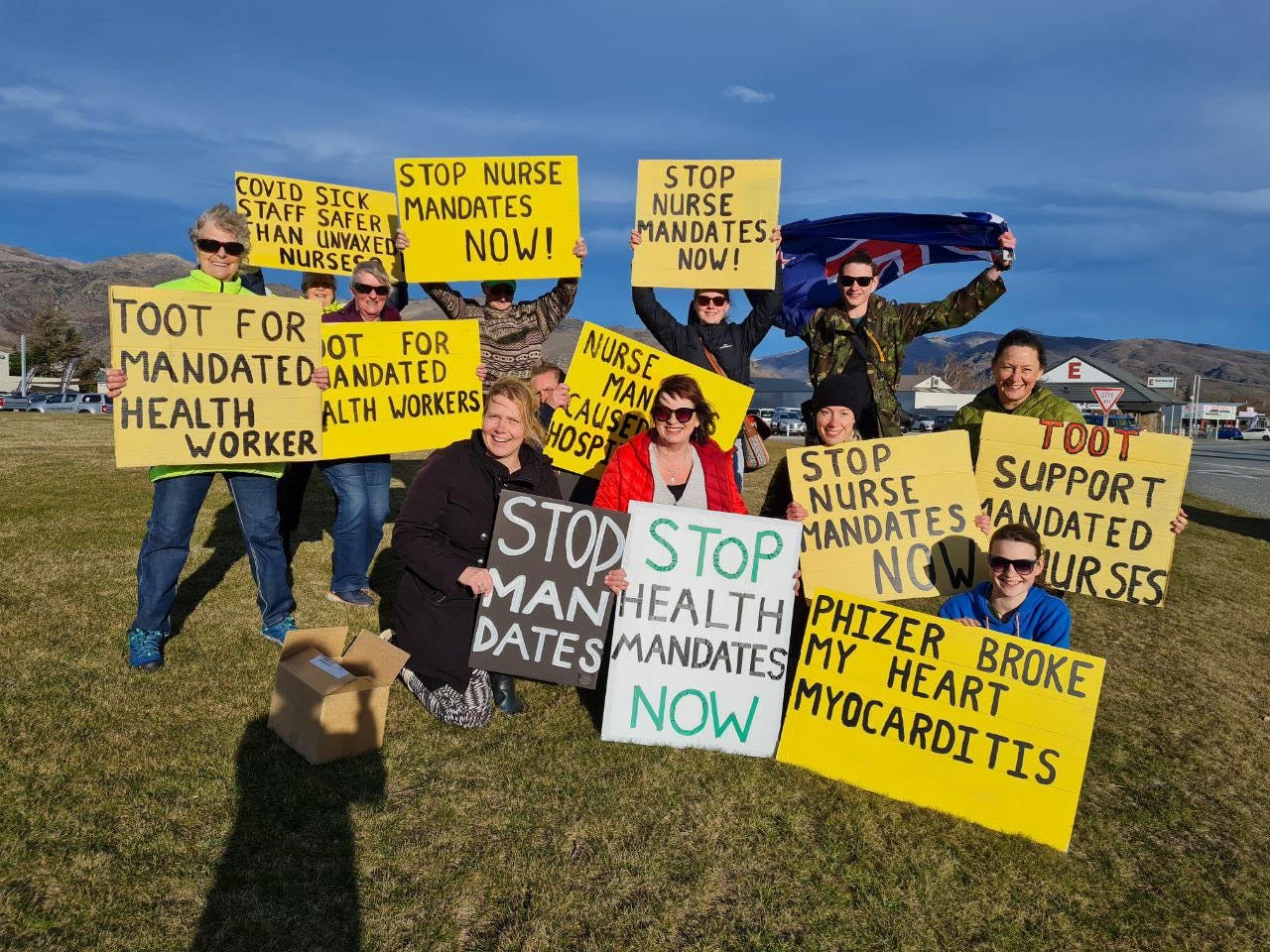
Protests about the jab mandates (image from 2022)

Why we can’t ‘move on’.

To highlight the extent of the problem, I’m providing a ‘snapshot’ – eight job vacancies – advertised with covid ‘vaccination’ requirements (screenshots included):

  1. Support Worker for ‘Nurse Maude’

This job involves caring for people with disabilities in the community. That means intimate care and overseeing meals and medications, including weekend work. This company claims:

“Our reputation for delivering consistently high-quality home support and nursing care is due in no small measure to the experience, professionalism, commitment, and sheer drive of our people. We are seeking experienced support workers to join our Homecare team across Christchurch.”

They are paying the minimal wage (or just above) for these ‘experienced, professional’ carers. That’s NZ$23.38 p/h. Oh, and only those who have had ‘ at least’ two doses of a ‘vaccine’ for a ‘flu’ that is now five years old. The mind boggles…

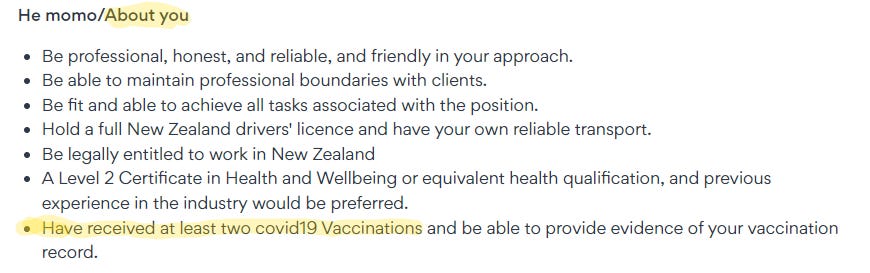
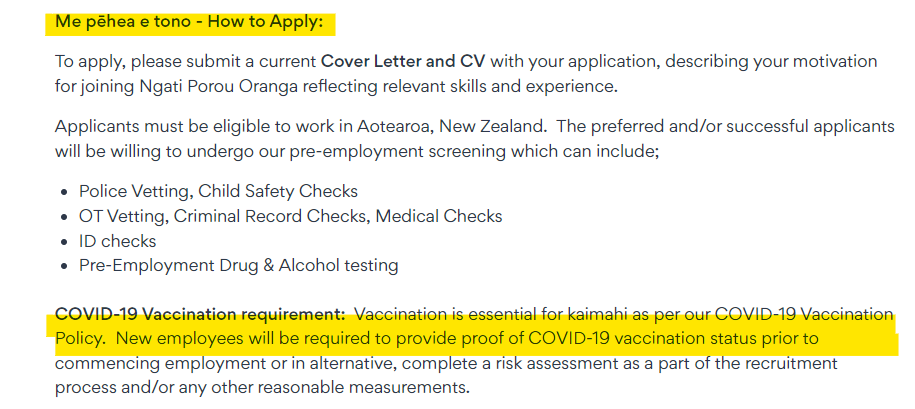
  1. Facilitator’ working for Maori ‘charity’ and Public Private Partnership (PPP) Ngāti Porou Oranga,

This entity is a ‘charitable trust’ and subsidiary of Te Rūnanganui o Ngāti Porou. They claim to be “an integrated Hauora, Housing and Whānau Oranga (support services) provider…” and this role involves working with offenders and their families. It is full-time, and looks extremely demanding. This is from the job description:

To be successful in this role, you will have:

  • Great people skills and ability to build rapport/ Previous experience working in a community work type role
  • TPO accreditation, social work registration, and/or restorative justice accreditation an advantage
  • A positive attitude and a passion for working with people 
  • Excellent time management and organisational skills/ Excellent planning, report writing, and documentation skills
  • Ability to work calm under pressure/ Maintain confidentiality at all times

Operating Competencies:

  • Full, clean NZ Driver License/Excellent oral and written communication skills.
  • A proven leader with self-motivation and initiative.
  • High level of organisational skills/Able to establish a good rapport with people.
  • Proficient computing skills/ Trustworthy and confidential. But don’t forget, if you want to apply:

Readers familiar with the story by now won’t be surprised to read Ngāti Porou Oranga’s Annual Report in Charities Services confirms last year, their income was nearly $30million, with most of that funding sourced from, you guessed it, the NZ Ministry of Health for ‘services rendered’.

Next? While paradoxical images of Trump flipping burgers whilst promoting MAHA are fresh on our minds, and we’re on the subject of wealthy tax-exempt commercial giants, let’s look at a job at McDonalds:

  1. Housekeeper: shift-worker at a Ronald McDonald’s House for families with sick kids.

Screenshot from this article.

The role includes cleaning, stock management and liaising sensitively with guests. And states explicitly:

“COVID-19 Vaccination: In order to maintain a safe and healthy work and accommodation environment and minimise the risk of Covid-19 transmission, RMHC New Zealand recommends that all employees and volunteers are fully vaccinated against Covid-19.”

Are we stuck in a timewarp here?

  1. Community Nurse (Awhi Services) for Tui Medical

Again, this is a demanding, full-time job, requiring high level expertise and qualifications in nursing. The pay is only $70,000 – $89,999 per year. Requirements:

  • Be eligible to work in New Zealand
  • Be registered with the Nursing Council of New Zealand
  • Have a current practicing certificate with the Nursing Council of New Zealand
  • Be fully vaccinated against COVID-19 (!!!)
  • Have previous experience in Primary Healthcare setting or Community Health 
  • Be interested in nursing in a Primary Health team who have a focus on working with and improving the health outcomes for Maori and Pasifika clients 
  • Have an understanding of the importance of Te Tiriti o Waitangi, Te Ao Maori and other cultural competencies
  • Desirable attributes are Independent Vaccinator, Smear taker, with experience in B4S’s, phlebotomy and managing chronic conditions. (my emphasis)

In addition: “The successful candidate will demonstrate the ability to work in a variable workflow environment, build strong report with team members, have good communication and interpersonal skills, and a positive “can do” attitude.” Sound like you? The advert asks. (are they taking the piss?)

The problem for many (mandated-out) healthcare professionals looking at this job, is not only are they not ‘vaccinated’ but they no longer hold an Annual Practising Certificate (APC). Nurses have been unfairly blacklisted and discriminated against for over three years; without an APC they are at risk of a Health Practitioners Disciplinary Tribunal and cancellation of Nursing Council registration. Again, Tui Medical is a PPP – taking large sums from taxpayers’ funds to pay for interventions like covid jabs and ‘worried well’ tests that no-one wants. I’ve written about that topic previously, eg here and here.

Photo from a meeting of mandated healthcare workers. Credit: NFFNZ

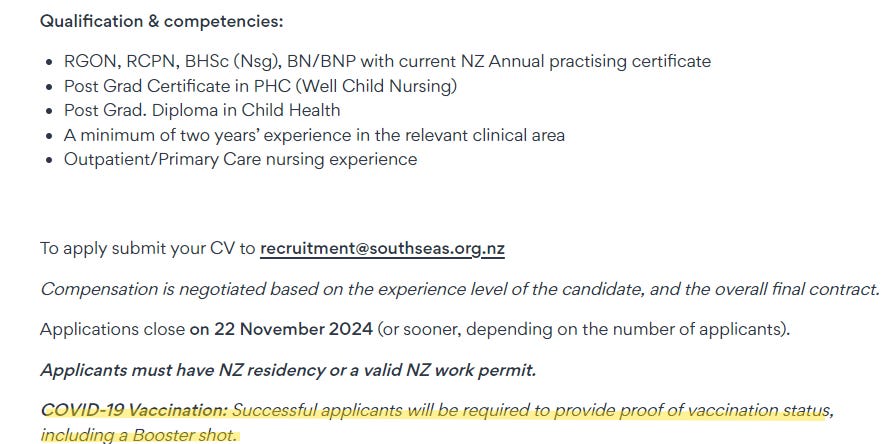
  1. Well Child’ Nurse for Southseas Healthcare Trust, Auckland.

The purpose of the position is to offer a screening, surveillance, education and support service to all New Zealand children/ Pacific and their family from birth to five years old. The position provides a child-centered comprehensive service that focuses on improving child health, social and educational outcomes.

This is a nursing role focused on Islander [Pasifika] families: “Purpose: To contribute to the overall management of Child Development by providing expert nursing care, as necessary. To provide expert nursing care ensuring excellent health and improved child growth and development.” The role demands high level quals and experience, oh and at least THREE doses:

  1. Healthcare Worker for Seibbor Healthcare Limited

This role is caring for a woman in her 40’s who has suffered a stroke. The part-time hours are just above minimal level. The employer states:

“Evidence of Covid-19 vaccination would be an advantage.”

I wonder why?

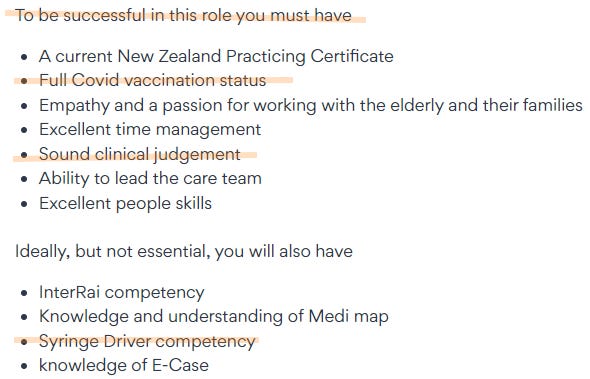
  1. A Registered Nurse is required at an aged-care facility in Hastings.

Apparently for this shiftwork job “We have a competitive remuneration package, as well as a wonderful culture.” Other attributes include:

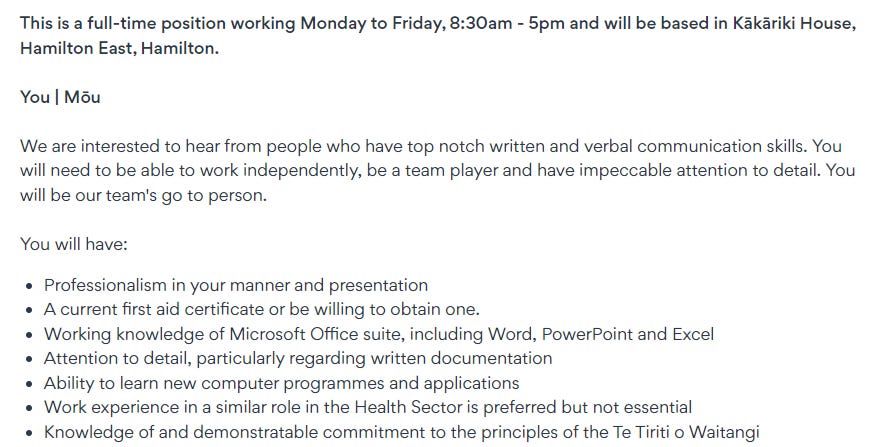
  1. Administrator Role, Kirikiriroa for Pathways.

For those unfamiliar with the word Kirikiriroa it’s the Maori name for Hamilton (apparently). Incidentally, in an attack of wokeness by Council similar to that seen overseas, Hamilton’s statue was removed from the centre of the city ‘for safety reasons’. Anyway, that’s another Kiwi rabbit hole! Pathways is a nationwide provider of mental health support organisations providing a wide-range of services:

The requirement for this office-based role states at least three doses of the experimental jab are required for all employees:

Other discriminating organisations

Meanwhile Student Nurses are still subject to jab mandates at Waikato University. Student Midwives are still subject to covid injection mandates at Auckland University of Technology (AUT). Defence Force recruits are also subject to ‘vaccination’ mandates. The madness seems endless.

And this isn’t limited to healthcare vacancies, a factory job in a commercial bakery also insists on jabbed applicants only:


The purpose of this post about NZ job advert snapshots is to point out that:

a) staff shortages continue in healthcare and other sectors

b) these shortages could be lessened, if discriminatory (and quite frankly, ludicrous) ‘vaccine’ mandate requirements were removed.

c) Our New Zealand Bill of Rights Act (BORA), Anti-Discriminatory laws, the Privacy Act and most Employment legislation aimed at fair equality have all apparently been abolished, without a single word from the Human Rights Commission, professional bodies or the judiciary (to name a few).

Solutions!

Back in July 2022 the shortage of healthcare staff was causing tension when mandates were still in place. In response to the current, ongoing and unacceptable situation, Nurses For Freedom NZ (NFFNZ) Founder Deborah Cunliffe, explains how:

“The MOH and Health NZ implicated unvaccinated nurses as being unprofessional and unfit to work putting our communities at risk due to vaccine refusal. The MOH and Health NZ now need to bring healing to our nursing community by righting the wrongs and correcting the information. Strong leadership is needed. The messages that were given need to be rescinded otherwise we will continue to see mandates by proxy.” (my emphasis)

Helpfully, NFFNZ suggest two ‘Actionable Solutions’ :

1. A Governmental apology clearing all nurses, carers, midwives (students) of any wrongdoing in refusing the ‘vaccine’ – hence limiting the ongoing prejudice against us not only by employers but also by our professional communities and colleagues i.e. nursing council & nursing unions.

2. A clear consistent message from Government and Health New Zealand that any action by employers or professional associations discriminating against unvaccinated workers will be looked on unfavourably and subject to BORA/ law. This information needs to be disseminated to training institutions (ie AUT, Waikato University), contractors, those who are paid by Te Whatu Ora to provide services (ie private hospitals, GP Clinics) etc and include lower management in Health NZ ie Charge Nurses who still think unvaccinated nurses cannot be employed despite policy.

I remain an optimistic informed heart. But my patience is paper thin: when will our coalition Government acknowledge the elephant in the room and stop this illegal discrimination? How can our healthcare systems and patients recover from this?

Informed Heart is a reader-supported publication. To receive new posts and support my work, consider becoming a free or paid subscriber.

Mining industry representatives have embedded themselves & the vast resources of their companies into Cook Island communities

From E-TANGATA
By Teuila Fuatai

Playing the Long Game

The Cook Islands prime minister, Mark Brown, was recently in Aotearoa for a week-long tour of community halls and churches.

His mission? To convince the large Cook Island population living here of the benefits of deep sea mining.

Teuila Fuatai was at the first meeting in Māngere.

With his bright blue shirt and neck ‘ei or flower garlands, Prime Minister Mark Brown looked right at home in Māngere’s Enuamanu Hall.

Brown sat centre-stage, flanked by Bishop Tutai Pere (chair of the government’s Seabed Minerals Authority advisory committee), Tou Travel Ariki (the kaumaiti nui or president of the House of Ariki, the body of high chiefs that advises the Cook Islands parliament), and Alex Herman (the government’s now outgoing Seabed Minerals commissioner), among others.

As one person observed, it was “an intimidating line-up” of the country’s political, religious and cultural leaders.

There to listen was a largely elderly crowd of over a hundred Cook Islanders who’ve made New Zealand their home.

Brown was undoubtedly the main attraction for this audience. He spoke convincingly of the anticipated benefits of deep-sea mining, about university scholarships for young Cook Islanders, and infrastructure basics like good roads and better air access to the pā enua or outer islands, where the cost and availability of flights remain a major issue.

The message from more than two hours of speeches and presentations was clear: A future with mining in the Cook Islands will give us and our people options that we don’t have right now.

“There were a lot of examples around how this industry was leading to ‘firsts’ for our country,” said one attendee, Charlotte Samuela. “Like it’s the first time we’re getting to look at the deep sea, or the first time we’re leading our own research mission as Cook Islanders.”

Charlotte grew up in Rarotonga and now works as a theatre nurse in Auckland. Like many others there, she wanted to know more about how the government planned to manage environmental concerns.

“There was less emphasis on the potential impacts, or really what the research simply can’t tell us yet, which is what I would’ve liked.”

But deep-sea mining is an emerging industry, with very little available long-term research on its impacts, something the government representatives themselves acknowledged.

Still, the Cook Islands government has granted three mining companies exploratory research licenses in the Cook Islands’ exclusive economic zone (EEZ). These companies are hoping to identify, and eventually access, vast deposits of rare earth minerals. It’s a plan that is dividing Cook Islanders at home and overseas.

Read more at the LINK


 (Photo: Cook Islands Seabed Minerals Authority)
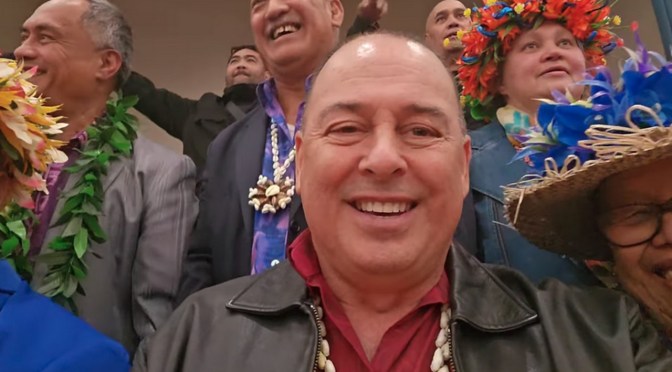
 Cook Islands prime minister Mark Brown spent a week in Aotearoa in November talking to NZ-based Cook Islanders about deep sea mining in their home country. He’s pictured here in Dunedin.