
This is Agenda 21, now Agenda 2030. Plain and simple. ‘They’ plan to own all property. To get that in a simple clip watch this one.
To enlarge on that obtain Rosa Koire’s book Behind the Green Mask. Rosa has many videos on YT (https://www.youtube.com/channel/UCPUJcxSKTOKaz5tVGfqDmKQ/videos) also explaining the agenda. She spotted it (as have many) in the course of her work which happened to be dealing with land.
When you know this agenda of ‘them’ owning all property and we owning none (they’ve come right out and said it publicly now … we will own nothing & will lease everything, AND they add, we will be happy) I know who will be happy. Another like Rosa who detected the agenda because of her work and association with the UN during the 1990s, and who particularly highlighted the ‘public private partnerships’ MO, is Joan Veon… see her also on the Agenda 21/30 pages, main menu. There are many more.
These poor unfortunate people of Matatā have been incrementally driven off their lands. To indigenous peoples this will sound very familiar. We have round two now in process. Note also how the globalists rebrand/rename their activities: ‘eviction’ becomes ‘managed retreat’. It simply means they were given offers they couldn’t refuse. Meanwhile whilst they angst over the said offers their health declines from the stress as did a woman in the Matatā scenario.
Trickery and chicanery all the way. In Scotland back in the day, they simply torched their houses which made way for sheep. In NZ & elsewhere, guns did the trick, along with Act tweaking & jail. Here, like the Enclosure Acts of long-ago England, just tweak the Resource Management Act. Done.
ON TOPIC: https://snoopman.net.nz/2019/08/02/deep-history-of-ihumatao-the-colonial-bnz-connection/
EWNZ
Note in the article below there are videos at the link ….
_____________________________________________________________________________
The Last Man Standing Against Matatā’s Managed Retreat
From Stuff
Nikki MacdonaldDecember 21, 2020
And then there was one.
Take State Highway 2 from Tauranga to Whakatāne. At the beachfront settlement of Matatā, pass the almost-abandoned Clem Elliot Drive, and the field of boulders that came down in the debris flow, and you’ll see Greg Fahey’s place on the left.
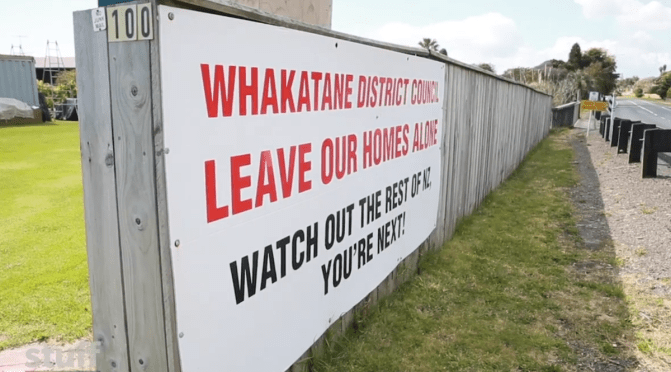
The sign on the fence is a giveaway – “Leave our homes alone,” it reads.
Fahey lives in a shipping container on a section 200m from the golden sand beach.
It might not look like much, but it’s his and he’s damned if he’s going to let local councils tell him he can’t live there.
Fahey is the last resident in the Bay of Plenty red zone fighting against managed retreat.
While one local previously promised war if authorities tried to kick him out, the only war here has been one of attrition. One by one, the owners in the potential path of any debris funnelling down Awatarariki Stream have signed up to Whakatāne District Council’s buyout offer.
While the council still calls it voluntary managed retreat, residents say it’s been anything but.
But one man is still refusing to budge.

The kumara are warm in their beds of sand dredged from the tiny creek beside Fahey’s section, which was this community’s undoing.
The chillies and tomatoes are a constellation of red and the grapes are going wild.
But across the main road, a grassy absence has replaced three homes. Around the corner, on Clem Elliot Drive, the Pearces’ house remains abandoned behind a wire fence, two months after they moved out.
Next door, staunch managed retreat critics the Whalleys proudly display the twin to Fahey’s sign. But – faced with the choice between the buyout offer and the threat of compulsory acquisition – they have also now taken the council’s deal.
Of the 34 properties at high risk from the debris flow, 31 have signed up. The remaining two sections are unoccupied and owned by a Māori trust.

Fahey isn’t worried the community is emptying around him.
“If nobody is going to stand up for this country, well, they’re just going to keep doing this sort of stuff and everybody in New Zealand won’t have a leg to stand on. It doesn’t matter where you live … They can come and take your section out from underneath you … when you have a title to it and you have a building consent and you have a mortgage on that property.
“Well, that’s not saying much for the laws in this country, is it?”
This is the last chapter in a sorry 15-year saga for the residents of the Awatarariki fanhead. For those reluctantly leaving, their one hope is that lessons will be learned, so other communities do not face the same stress born of years of uncertainty.
Matatā residents fight for homes
How did we get here, and what happens now?
It started in 2005, when heavy rain swelled the puny Awatarariki Stream to a torrent, scouring out the debris in its path and dumping 120 Olympic swimming pools worth of silt, logs and car-sized boulders on to the area.
Whakatāne District Council promised an engineering solution to hold back any future debris flows, and allowed residents to rebuild. But in 2012, they abandoned that idea as unworkable.
The risk to life was deemed intolerable, so the council began a process to clear residents out. That process ended last week, with all but one of the at-risk residents taking the buyout deal.
The contentious part of that process was that the alternative to accepting a buyout offer was being made a squatter on your own land.

On March 31, 2021, a nationally unprecedented rule change under the Resource Management Act (RMA) will snuff out Fahey’s existing land use rights, effectively evicting him from his section.
Nobody seems to know what happens then. As one contributor told Waikato University managed retreat researcher Christina Hanna, “nobody’s got any appetite to be sending in bulldozers with protestors lying on the road … ‘How do you expect me to get these people out?’ ”
Because it’s a Bay of Plenty Regional Council plan change that extinguishes homeowners’ rights, it will be up to them to enforce. The council refused to release its one document discussing what would happen to any remaining residents, “to maintain legal privilege”.
Policy and planning manager Julie Bevan says the council will work with the district council and Fahey “to find the best way forward”.
“Once the rules take effect on 31 March 2021 consideration will be given to next steps.”
The district council says while acquiring Fahey’s property under the Public Works Act is a “potential option”, it would prefer to “find an alternative solution that meets the owner’s needs”.

Fahey is clear about what won’t be happening, though. He won’t bow to what he sees as “manipulation and intimidation”. And he won’t be leaving, unless they offer 15 years’ worth of compensation for the stress he’s endured.
He’s already lost the right to build the two-storey, three-bedroom house that was consented before the 2005 event.
He’s had to manage his wife Pauline’s developing dementia in a shipping container that made her claustrophobic, with a portaloo and only a BBQ to cook on. Pauline is now in a care home an hour’s drive away in Rotorua and Fahey visits three times a week.
He’s focused on enjoying Christmas with her, and is adamant it won’t be his last in Matatā.
“I’m not going on their terms. If they kick me off the property – they can’t call the police because I’m not disturbing the peace … I told the mayor and CEOs that I might only own a section, but I will go all the way with you lot. All I’ve got to find is a just judge.”

We couldn’t save your house, Mum
Councils and academics nationwide have been looking to Matatā for clues to how they might deal with communities in the path of natural hazards and climate change-related risks such as storm surge and sea level rise.
Awatarariki Residents Incorporated, spearheaded by Rick and Rachel Whalley and Rick’s mum Pam, had been planning for months for an Environment Court case to test whether it was legal to use the RMA to snuff out a property owner’s existing land use rights.
But they got cold feet when Whakatāne District Council refused to extend the buyout offer beyond the December hearing date. That meant if they lost in court, they would also face massive financial loss, as their house could be compulsorily acquired under the Public Works Act at a rate well below the managed retreat offer.
So they withdrew the case.
“The whole thing was under duress,” Rachel says. “We are devastated that we are losing our home … That was a difficult time, the time I said ‘We couldn’t save your house, Mum.’ I couldn’t keep that promise.”
The district council says the buyout programme was extended several times and was always intended to end before court proceedings to reduce costs and “to enable landowners to move forward and reduce further stress in having to argue appeals in the Environment Court”.

But whether the council can legally take properties under the Public Works Act (PWA) to create a reserve, as it has suggested, remains unclear, as Hanna’s research points out.
“Whakatāne District Council received legal advice that the PWA could not be used for managed retreat and subsequent reserve conversion, but, to confuse things further, the Resource Legislation Amendment Act 2017 suggests otherwise.”
The district council says the PWA can be used to acquire land for a reserve, but not for managed retreat.
The Whalleys won a year’s reprieve through the Envrironment Court, so can stay until March 2022. That’s two good summers and Pam’s 80th birthday to enjoy. But Rachel is adamant something good must come from their misery.
“You don’t create a resilient community by putting it under the pressure that we’ve been under. It really is a flawed experiment. I’m really concerned that other communities are afforded better treatment than we had.”

That’s echoed by 60-year-old Lyall Magee. His grandfather subdivided the beachfront land in the 1970s and he and his two sisters Marilyn and Lesley owned four properties.
Magee’s insurer told him they would no longer insure him beyond March 31, 2021, after talking to the council. The council’s strategic project manager, Jeff Farrell, said the insurer had approached him, and he gave them publicly available information about the high-risk zone.
“We were between a rock and a hard place and we had nowhere to go,” Magee says. “I will never forgive the council for the stress they put Marilyn through.”
Magee’s independent valuation for his two rental properties was $200,000 more than the council was offering. They went up about $50,000, but he’s still had to sell at 2019 prices while he’ll have to buy in a crazy 2020 market.
“They’ve pretty much blown away my whole retirement plan. I think it’s stealing. If you have title to the land, you think you own it, but you don’t. A local authority can come and take it off you, for whatever reason they wish now. They can just make that up. I find that bizarre.”

Greig Thorby previously said any attempt to evict him from his container home would be a licence to war. But in the end, he gave in to what he sees as blackmail – take the offer or we’ll evict you.
“It’s like putting a gun to your head and say ‘Sign here’ … Signing that property over is like selling my soul to the devil. And at the end of the day, I still haven’t got anywhere to go.”
He’s been scouring Northland for a section he can buy with his $210,000 payout. He’ll move his three containers, and hope to use the skills he’s learnt to help others build affordable housing.
“I’ve got two options – fight or flight. I’m taking the safest option … I’m sick of being angry. If I keep staying angry, I’ll end up in jail.”

The uncertainty contagion – the lessons from Matatā
The Matatā managed retreat was triggered by an immediate risk to life, rather than a gradually increasing risk due to sea level rise. That meant there was no scope for a staged adaptation process over time.
However, Hanna says the experience still holds lessons for other communities potentially under threat, such as Mōkau, Marokopa, Kaiaua, Franz Josef, South Dunedin, Port Waikato, Hector, Ngakawau and Granity.
Whether the Government’s contribution of one-third of Matatā’s $15m buyout budget signals future funding help is uncertain. Cabinet papers show Treasury opposed the deal on the basis it would create a precedent for future managed retreat due to climate change. Treasury was also unconvinced that local councils could not afford to pay.
Minister Nanaia Mahuta told Cabinet she did not believe the funding would create a binding precedent. Documents suggest the $15m budget will be overrun by up to $1m, because of higher than expected revaluation and site clearance costs. Cabinet papers say the district council will have to fund the difference.

While the legality of removing property owners’ land use rights remains untested in court, that might not be a problem for any future attempts at managed retreat.
That’s because the Randerson review of the RMA recommended a new law specifying a clear process for managed retreat, which would include the ability to extinguish existing use rights.
In her research paper The Uncertainty Contagion, Hanna argues the Matatā situation was complicated by layers of uncertainty – from the level of the hazard risk, to whether it could be managed, to lack of clarity over who should run any managed retreat, how and at whose cost. While councils have been told to manage hazards, they haven’t been given the tools, she says.
“Extended uncertainty contributed to a continued state of stress and trauma for many, and for those who rebuilt and re-invested, an even greater intensification of economic stress.
“After being in this situation for many years, resistance to council efforts built up, a ‘digging in of the toes’, triggered by erosion of trust and feelings of disempowerment.”
Matatā managed retreat
The Matatā home of Victoria Humphries-Irwin and Wayne Irwin is now a grassy field
That trust was further eroded by the decision to push through the legal process to extinguish existing use rights at the same time as making “voluntary” buyout offers.
Hanna says the Matatā experience shows the need to find a better process for affected communities.
Whakatāne District Council says it “acknowledges the difficulties of the journey for all parties, in particular the residents”.
As Rachel Whalley puts it: “The bigger issue is the way councils engage and work with their communities. Because this process has been wrong from beginning to end.”
“In attempting managed retreat, trust is essential,” Hanna says.
Discover more from Environmental Health Watch NZ
Subscribe to get the latest posts sent to your email.
